 Скачать презентацию Why study Diffractive W Boson Data Samples
6b1bb9259b3a8881d65c34ed1f9ab1ad.ppt
- Количество слайдов: 34



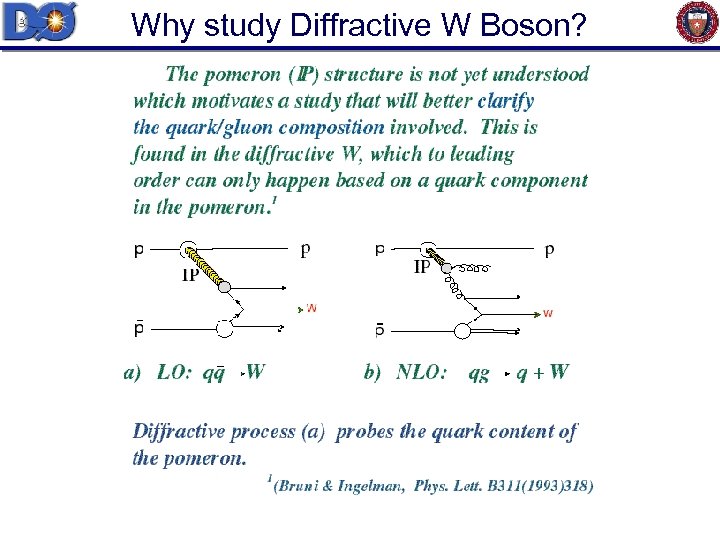
Why study Diffractive W Boson?
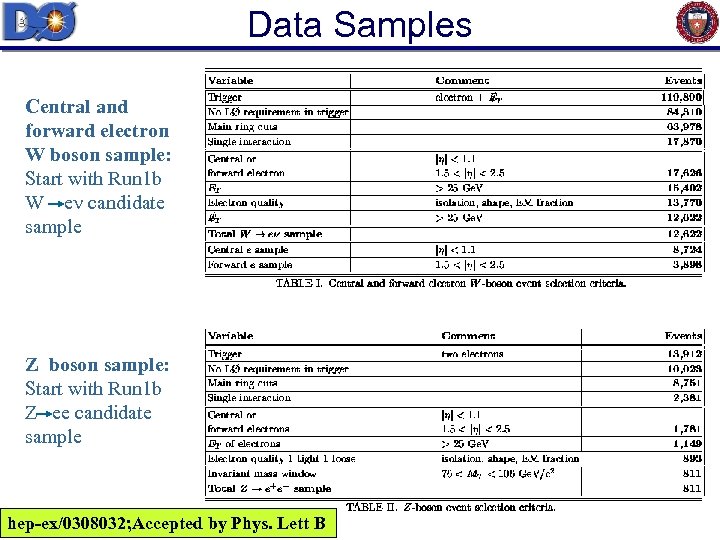
Data Samples Central and forward electron W boson sample: Start with Run 1 b W en candidate sample Z boson sample: Start with Run 1 b Z ee candidate sample hep-ex/0308032; Accepted by Phys. Lett B
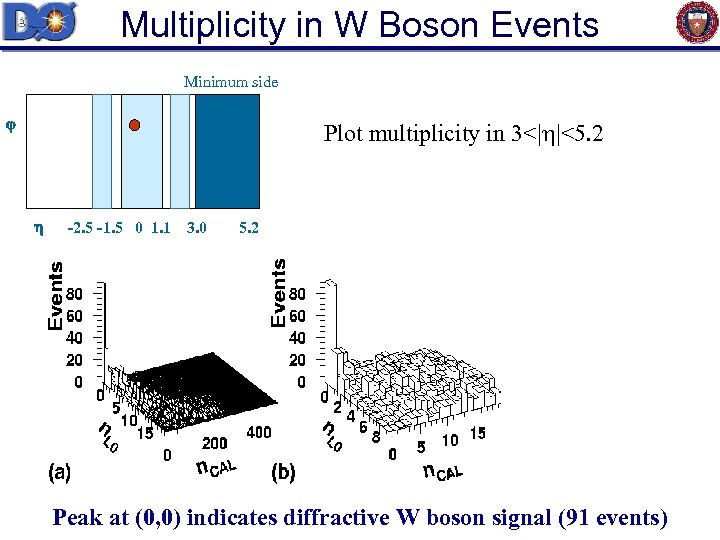
Multiplicity in W Boson Events Minimum side Plot multiplicity in 3<| |<5. 2 -2. 5 -1. 5 0 1. 1 3. 0 5. 2 Peak at (0, 0) indicates diffractive W boson signal (91 events)
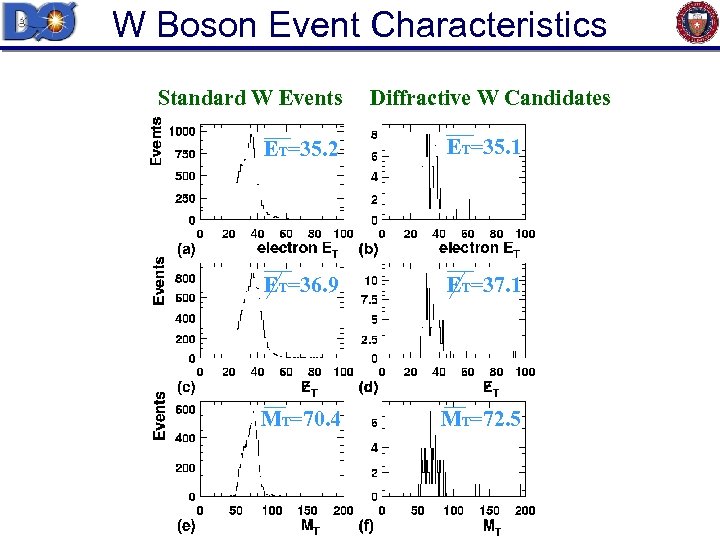
W Boson Event Characteristics Standard W Events Diffractive W Candidates ET=35. 2 ET=35. 1 ET=36. 9 ET=37. 1 MT=70. 4 MT=72. 5
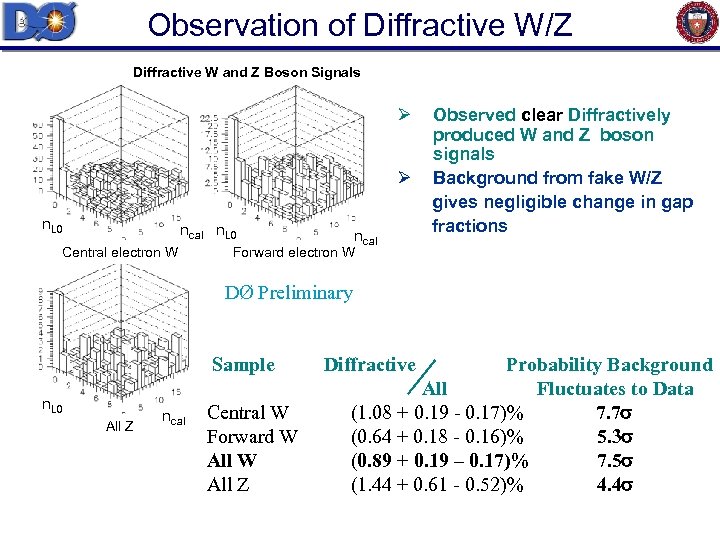
Observation of Diffractive W/Z Diffractive W and Z Boson Signals Ø Ø n. L 0 ncal n. L 0 Central electron W ncal Observed clear Diffractively produced W and Z boson signals Background from fake W/Z gives negligible change in gap fractions Forward electron W DØ Preliminary Sample n. L 0 All Z ncal Central W Forward W All Z Diffractive Probability Background All Fluctuates to Data (1. 08 + 0. 19 - 0. 17)% 7. 7 s (0. 64 + 0. 18 - 0. 16)% 5. 3 s (0. 89 + 0. 19 – 0. 17)% 7. 5 s (1. 44 + 0. 61 - 0. 52)% 4. 4 s
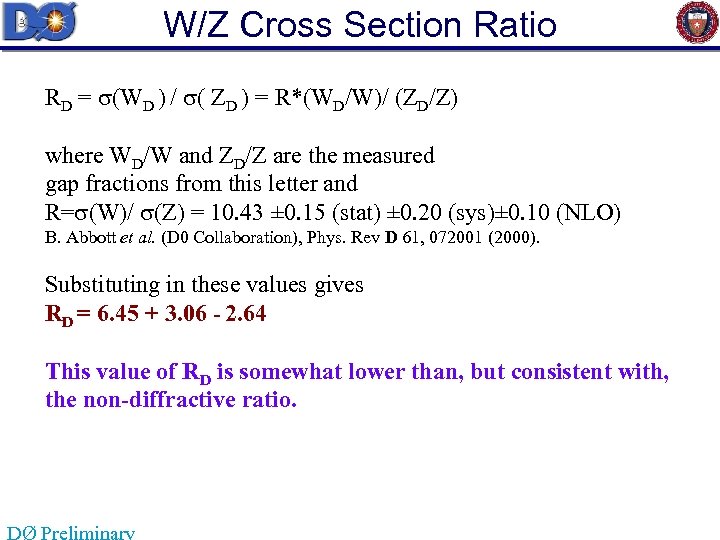
W/Z Cross Section Ratio RD = (WD ) / ( ZD ) = R*(WD/W)/ (ZD/Z) where WD/W and ZD/Z are the measured gap fractions from this letter and R= (W)/ (Z) = 10. 43 ± 0. 15 (stat) ± 0. 20 (sys)± 0. 10 (NLO) B. Abbott et al. (D 0 Collaboration), Phys. Rev D 61, 072001 (2000). Substituting in these values gives RD = 6. 45 + 3. 06 - 2. 64 This value of RD is somewhat lower than, but consistent with, the non-diffractive ratio. DØ Preliminary
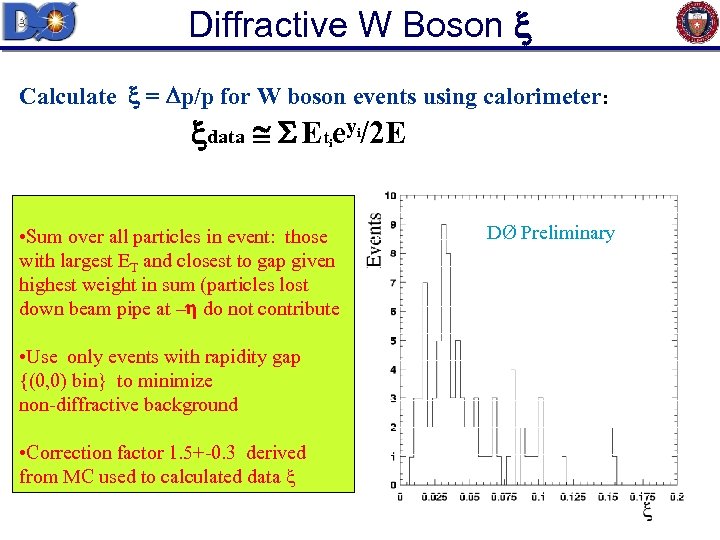
Diffractive W Boson Calculate = p/p for W boson events using calorimeter: data @ S Et eyi/2 E i • Sum over all particles in event: those with largest ET and closest to gap given highest weight in sum (particles lost down beam pipe at – do not contribute • Use only events with rapidity gap {(0, 0) bin} to minimize non-diffractive background • Correction factor 1. 5+-0. 3 derived from MC used to calculated data DØ Preliminary
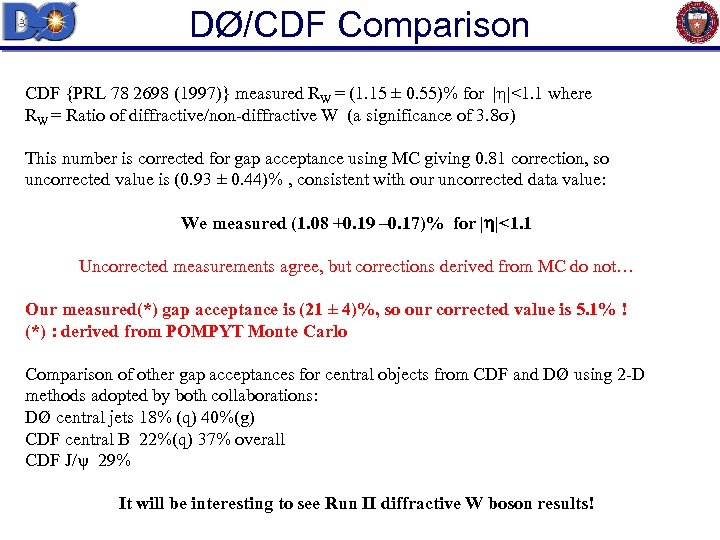
DØ/CDF Comparison CDF {PRL 78 2698 (1997)} measured RW = (1. 15 ± 0. 55)% for | |<1. 1 where RW = Ratio of diffractive/non-diffractive W (a significance of 3. 8 ) This number is corrected for gap acceptance using MC giving 0. 81 correction, so uncorrected value is (0. 93 ± 0. 44)% , consistent with our uncorrected data value: We measured (1. 08 +0. 19 – 0. 17)% for | |<1. 1 Uncorrected measurements agree, but corrections derived from MC do not… Our measured(*) gap acceptance is (21 ± 4)%, so our corrected value is 5. 1% ! (*) : derived from POMPYT Monte Carlo Comparison of other gap acceptances for central objects from CDF and DØ using 2 -D methods adopted by both collaborations: DØ central jets 18% (q) 40%(g) CDF central B 22%(q) 37% overall CDF J/ 29% It will be interesting to see Run II diffractive W boson results!

Run I Gaps • Pioneered central gaps between jets, 3 papers, 3 Ph. D’s • Observed and measured forward gaps in jet events at s = 630 and 1800 Ge. V. Rates much smaller than expected from naïve Ingelman-Schlein model. Require a different normalization and significant soft component to describe data. Large fraction of proton momentum frequently involved in collision. • Observed jet events with forward/backward gaps at s = 630 and 1800 Ge. V • Observed W and Z boson events with gaps
Run II Improvements • Integrated FPD allows accumulation of large hard diffractive data samples • Measure , t over large kinematic range • Higher ET jets allow smaller systematic errors • Comparing measurements of HSD with track tag vs. gap tag yields new insight into process • Can calibrate calorimeter measurement without MC
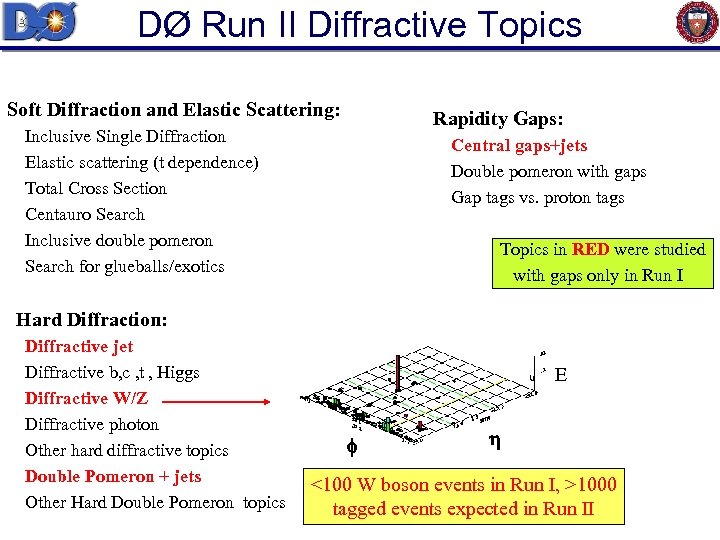
DØ Run II Diffractive Topics Soft Diffraction and Elastic Scattering: Rapidity Gaps: Inclusive Single Diffraction Elastic scattering (t dependence) Total Cross Section Centauro Search Inclusive double pomeron Search for glueballs/exotics Central gaps+jets Double pomeron with gaps Gap tags vs. proton tags Topics in RED were studied with gaps only in Run I Hard Diffraction: Diffractive jet Diffractive b, c , t , Higgs Diffractive W/Z Diffractive photon Other hard diffractive topics Double Pomeron + jets Other Hard Double Pomeron topics E <100 W boson events in Run I, >1000 tagged events expected in Run II
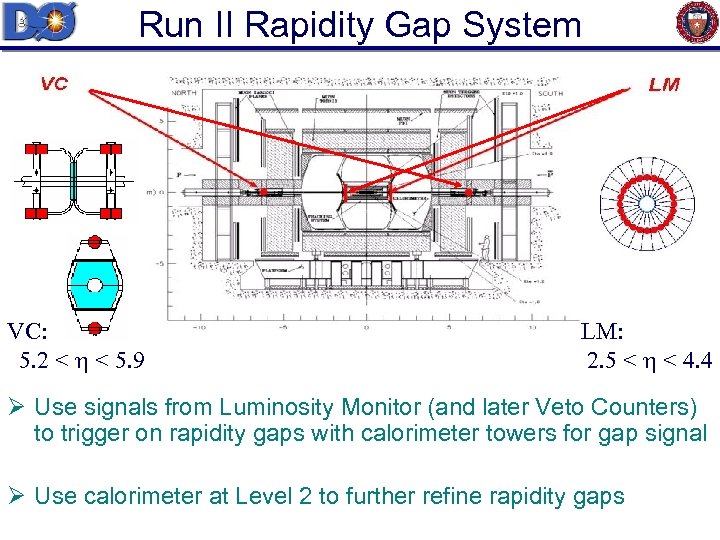
Run II Rapidity Gap System VC: 5. 2 < < 5. 9 LM: 2. 5 < < 4. 4 Ø Use signals from Luminosity Monitor (and later Veto Counters) to trigger on rapidity gaps with calorimeter towers for gap signal Ø Use calorimeter at Level 2 to further refine rapidity gaps
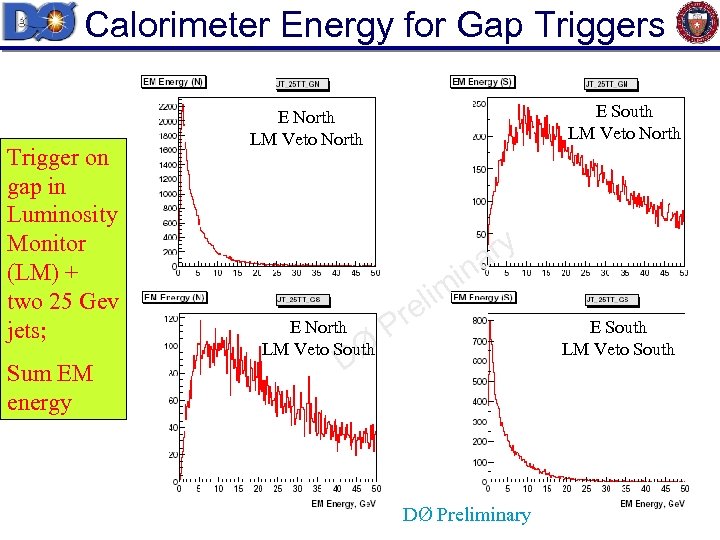
Calorimeter Energy for Gap Triggers Trigger on gap in Luminosity Monitor (LM) + two 25 Gev jets; Sum EM energy E South LM Veto North E North LM Veto North ry na i E North LM Veto South Ø D lim e Pr DØ Preliminary E South LM Veto South
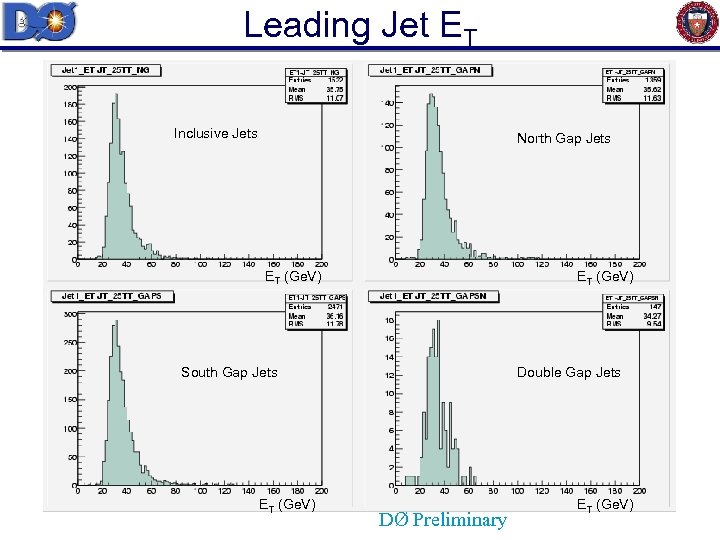
Leading Jet ET Inclusive Jets North Gap Jets ET (Ge. V) South Gap Jets ET (Ge. V) Double Gap Jets DØ Preliminary ET (Ge. V)
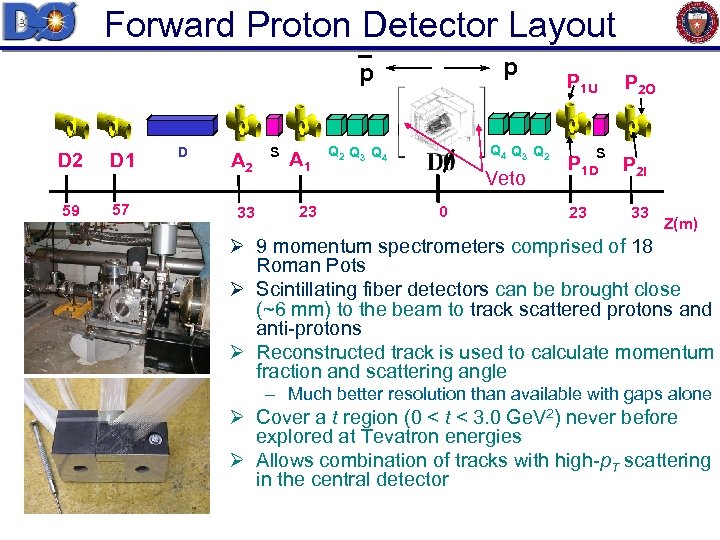
Forward Proton Detector Layout p p D 2 D 1 59 57 D A 2 33 S A 1 23 Q 4 Q 3 Q 2 Q 3 Q 4 Veto 0 P 1 U S P 2 O P 1 D P 2 I 23 33 Z(m) Ø 9 momentum spectrometers comprised of 18 Roman Pots Ø Scintillating fiber detectors can be brought close (~6 mm) to the beam to track scattered protons and anti-protons Ø Reconstructed track is used to calculate momentum fraction and scattering angle – Much better resolution than available with gaps alone Ø Cover a t region (0 < t < 3. 0 Ge. V 2) never before explored at Tevatron energies Ø Allows combination of tracks with high-p. T scattering in the central detector
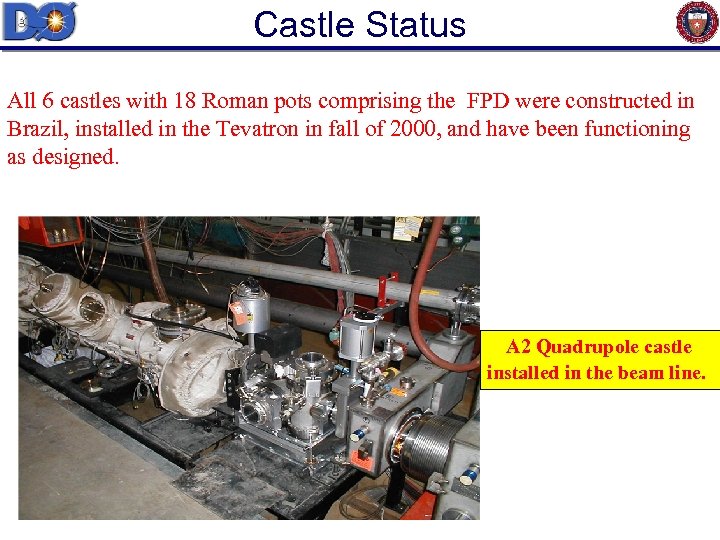
Castle Status All 6 castles with 18 Roman pots comprising the FPD were constructed in Brazil, installed in the Tevatron in fall of 2000, and have been functioning as designed. A 2 Quadrupole castle installed in the beam line.
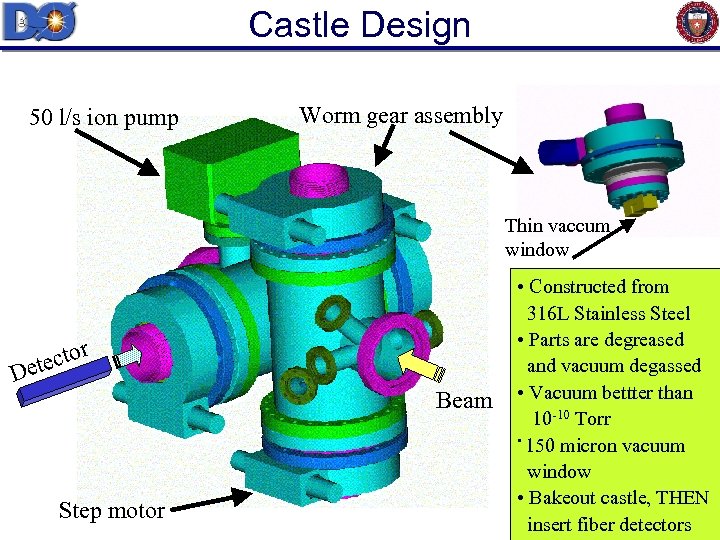
Castle Design 50 l/s ion pump Worm gear assembly Thin vaccum window r tecto De Step motor Beam • Constructed from 316 L Stainless Steel • Parts are degreased and vacuum degassed • Vacuum bettter than 10 -10 Torr • 150 micron vacuum window • Bakeout castle, THEN insert fiber detectors
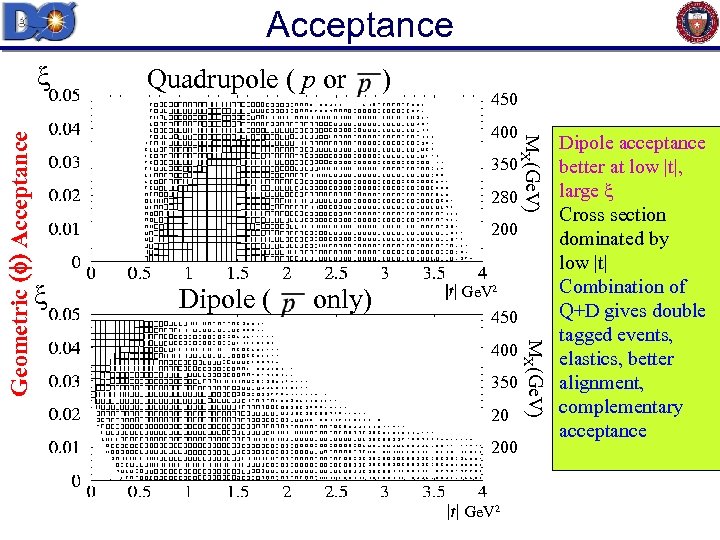
Acceptance Quadrupole ( p or ) 450 400 350 280 MX(Ge. V) 200 Dipole ( only) Ge. V 2 450 400 350 20 200 Ge. V 2 MX(Ge. V) Geometric ( ) Acceptance Dipole acceptance better at low |t|, large Cross section dominated by low |t| Combination of Q+D gives double tagged events, elastics, better alignment, complementary acceptance
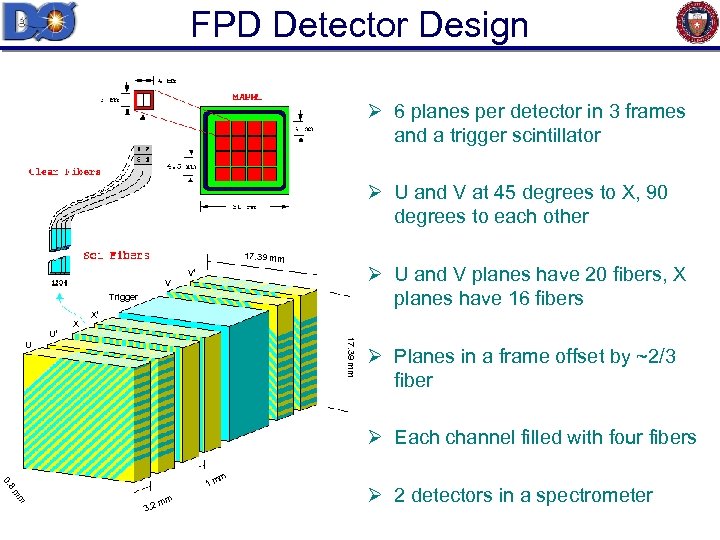
FPD Detector Design Ø 6 planes per detector in 3 frames and a trigger scintillator Ø U and V at 45 degrees to X, 90 degrees to each other 17. 39 mm Ø U and V planes have 20 fibers, X planes have 16 fibers V’ V Trigger X X’ 17. 39 mm U’ U Ø Planes in a frame offset by ~2/3 fiber Ø Each channel filled with four fibers 8 0. m 1 m m m 3. 2 mm Ø 2 detectors in a spectrometer
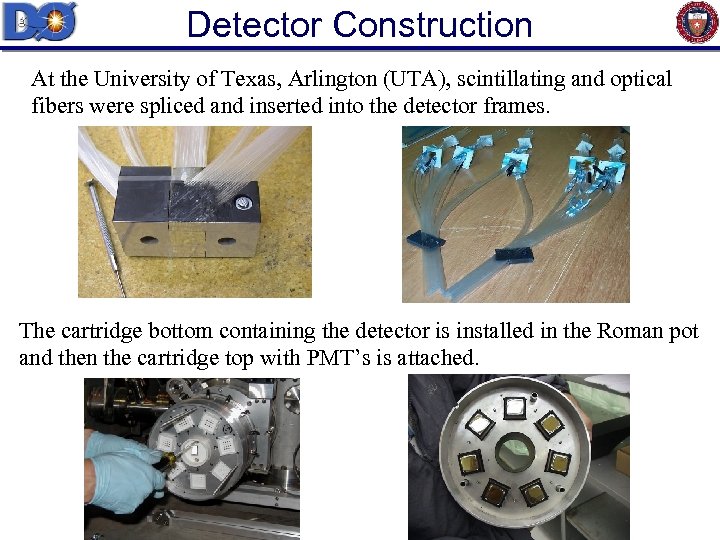
Detector Construction At the University of Texas, Arlington (UTA), scintillating and optical fibers were spliced and inserted into the detector frames. The cartridge bottom containing the detector is installed in the Roman pot and then the cartridge top with PMT’s is attached.
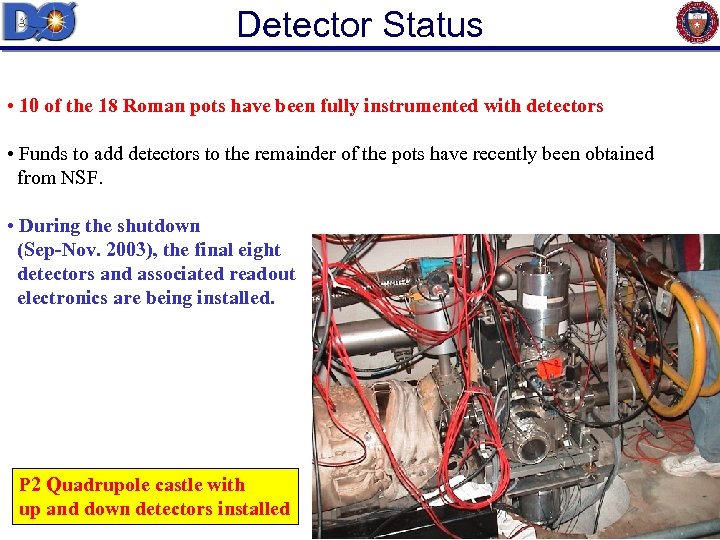
Detector Status • 10 of the 18 Roman pots have been fully instrumented with detectors • Funds to add detectors to the remainder of the pots have recently been obtained from NSF. • During the shutdown (Sep-Nov. 2003), the final eight detectors and associated readout electronics are being installed. P 2 Quadrupole castle with up and down detectors installed
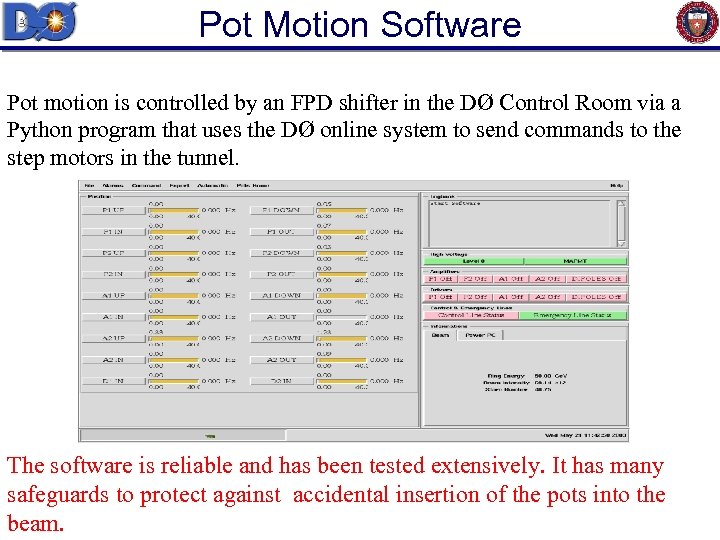
Pot Motion Software Pot motion is controlled by an FPD shifter in the DØ Control Room via a Python program that uses the DØ online system to send commands to the step motors in the tunnel. The software is reliable and has been tested extensively. It has many safeguards to protect against accidental insertion of the pots into the beam.
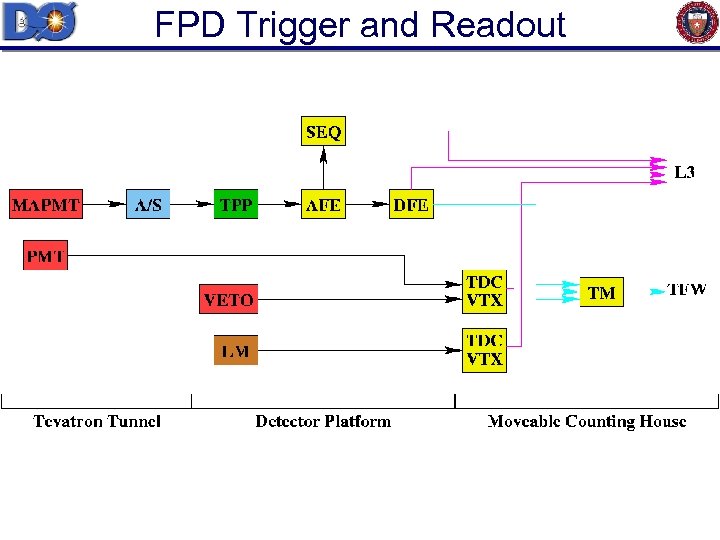
FPD Trigger and Readout
FPD Integration Substantial, if not speedy, progress (stand-alone DAQ in parallel) I) AFE 1) 2) 3) 4) 5) 6) 7) 8) 9) Added FPD system to fiber tracker database (all experts gone!) Modified sequencer for FPD timing Modified AFE firmware for FPD timing Built and extensively tested transition board (TPP) between detector cables and flex cables Overcame several installation difficulties, grounding noise, etc. Updated FPD AFE packing code Created FPD examine to look at data Integration tests with dipole spectrometer (operational since Feb. 2003) Full system in readout after shutdown II) DFE 1) Trigger equation firmware operational, will u III) LM 2) LM electronics to read out trigger scintillator and for FPD trigger expected to be available near end of shutdown IV) TM 1) Components installed, cables laid, commissioning beginning
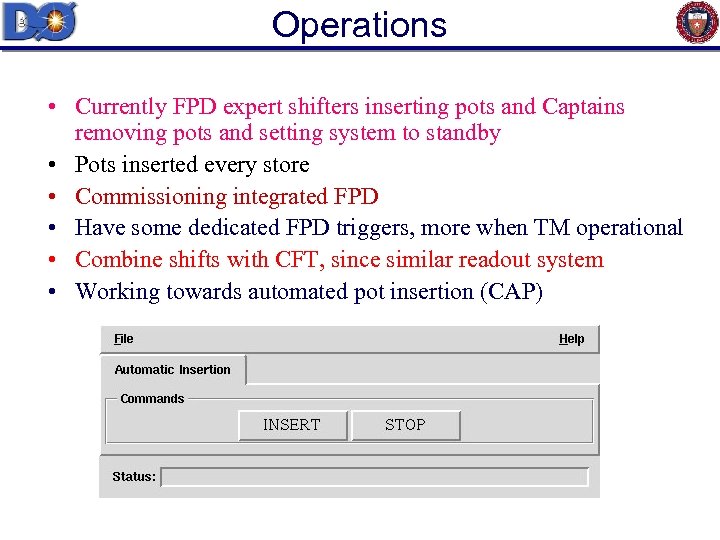
Operations • Currently FPD expert shifters inserting pots and Captains removing pots and setting system to standby • Pots inserted every store • Commissioning integrated FPD • Have some dedicated FPD triggers, more when TM operational • Combine shifts with CFT, since similar readout system • Working towards automated pot insertion (CAP)
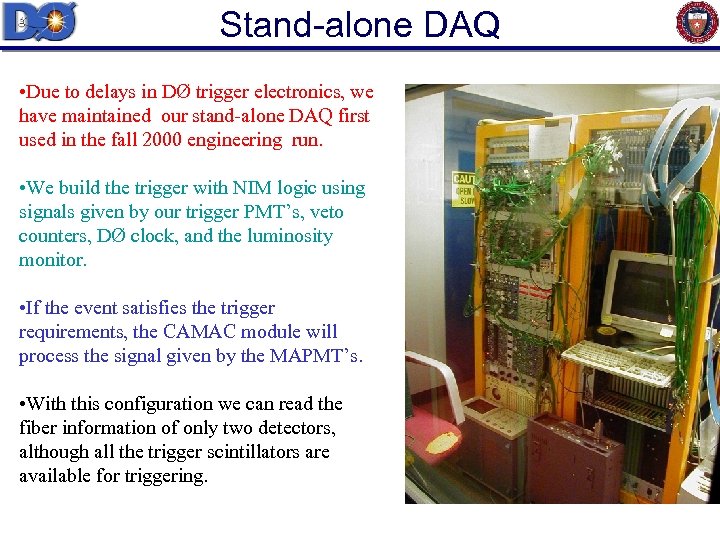
Stand-alone DAQ • Due to delays in DØ trigger electronics, we have maintained our stand-alone DAQ first used in the fall 2000 engineering run. • We build the trigger with NIM logic using signals given by our trigger PMT’s, veto counters, DØ clock, and the luminosity monitor. • If the event satisfies the trigger requirements, the CAMAC module will process the signal given by the MAPMT’s. • With this configuration we can read the fiber information of only two detectors, although all the trigger scintillators are available for triggering.
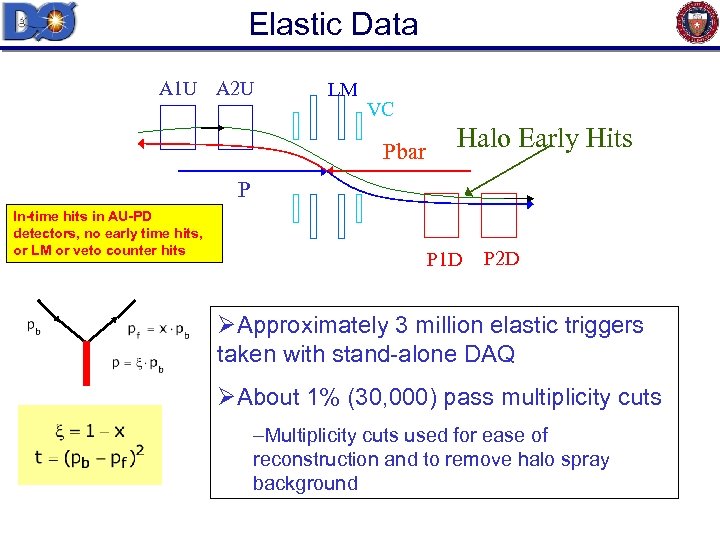
Elastic Data A 1 U A 2 U LM VC Pbar Halo Early Hits P In-time hits in AU-PD detectors, no early time hits, or LM or veto counter hits P 1 D P 2 D ØApproximately 3 million elastic triggers taken with stand-alone DAQ ØAbout 1% (30, 000) pass multiplicity cuts –Multiplicity cuts used for ease of reconstruction and to remove halo spray background
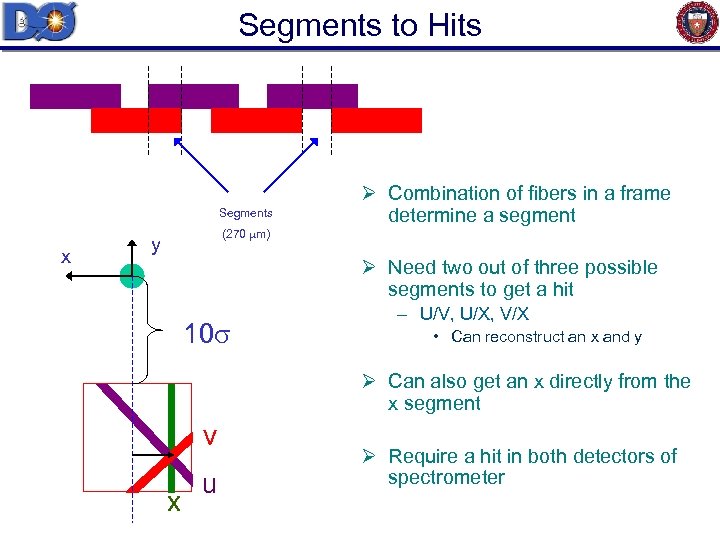
Segments to Hits Segments x Ø Combination of fibers in a frame determine a segment (270 m) y Ø Need two out of three possible segments to get a hit 10 – U/V, U/X, V/X • Can reconstruct an x and y Ø Can also get an x directly from the x segment v x u Ø Require a hit in both detectors of spectrometer
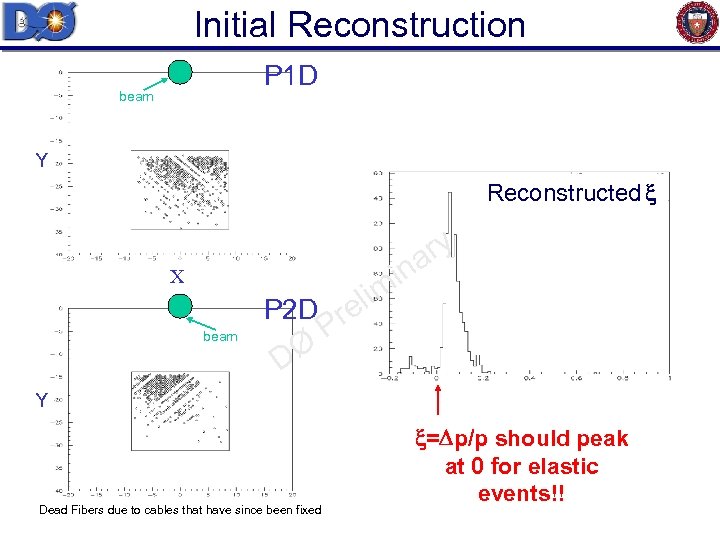
Initial Reconstruction P 1 D beam Y Reconstructed ry na i X lim e beam P 2 D r P Ø D Y Dead Fibers due to cables that have since been fixed = p/p should peak at 0 for elastic events!!
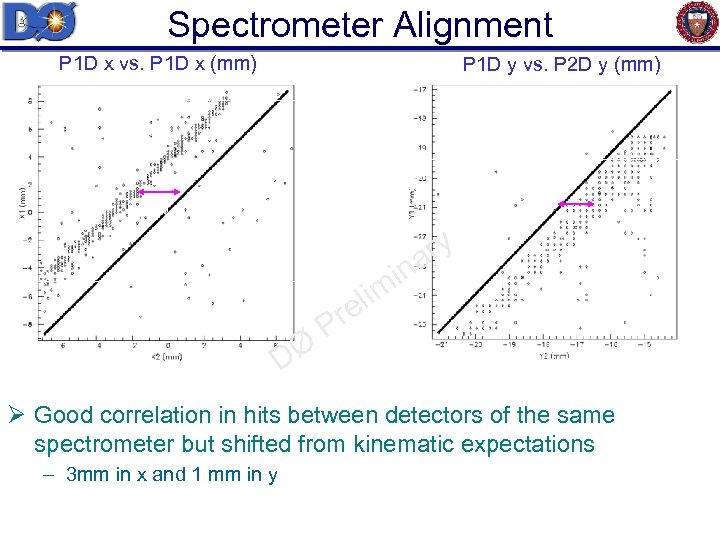
Spectrometer Alignment P 1 D x vs. P 1 D x (mm) P 1 D y vs. P 2 D y (mm) ry na i lim e Ø D Pr Ø Good correlation in hits between detectors of the same spectrometer but shifted from kinematic expectations – 3 mm in x and 1 mm in y
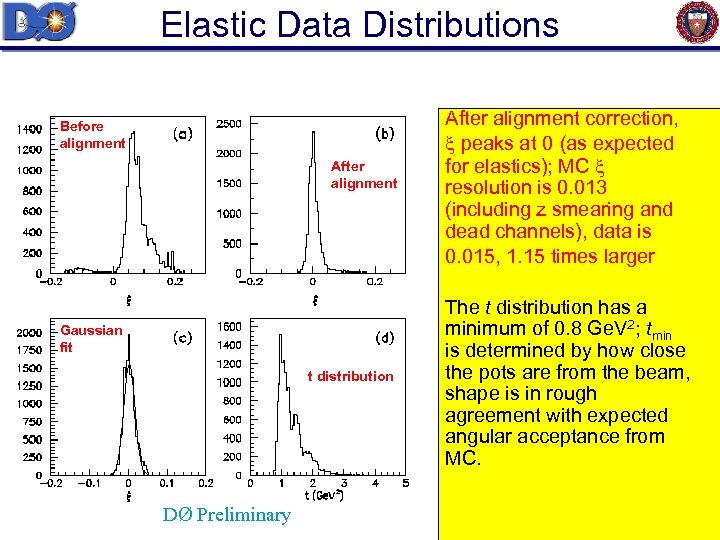
Elastic Data Distributions Before alignment After alignment Gaussian fit t distribution DØ Preliminary After alignment correction, peaks at 0 (as expected for elastics); MC resolution is 0. 013 (including z smearing and dead channels), data is 0. 015, 1. 15 times larger The t distribution has a minimum of 0. 8 Ge. V 2; tmin is determined by how close the pots are from the beam, shape is in rough agreement with expected angular acceptance from MC.
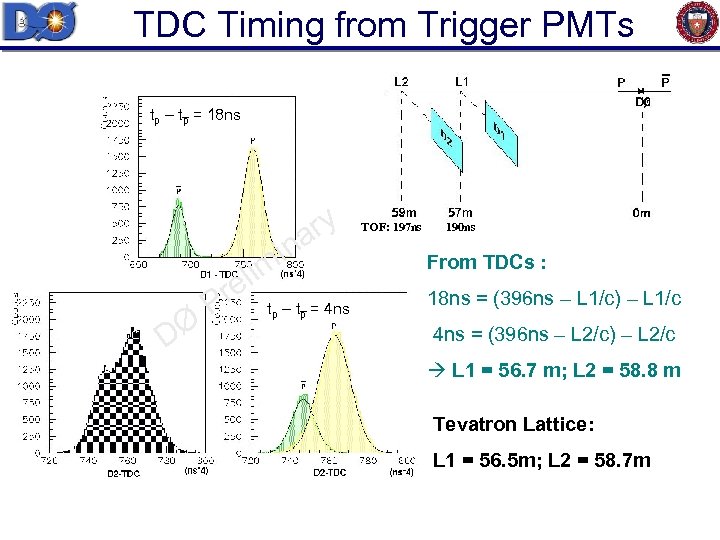
TDC Timing from Trigger PMTs tp – tp = 18 ns ry na i Ø D Pr lim e tp – tp = 4 ns TOF: 197 ns 190 ns From TDCs : 18 ns = (396 ns – L 1/c) – L 1/c 4 ns = (396 ns – L 2/c) – L 2/c L 1 = 56. 7 m; L 2 = 58. 8 m Tevatron Lattice: L 1 = 56. 5 m; L 2 = 58. 7 m
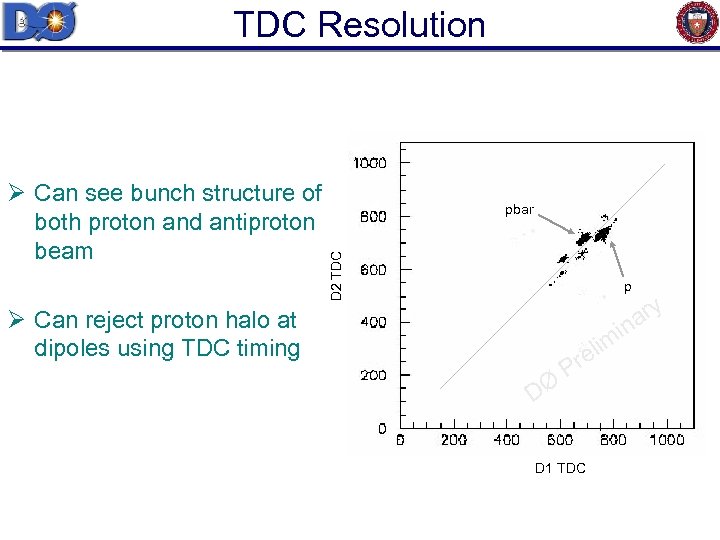
TDC Resolution pbar D 2 TDC Ø Can see bunch structure of both proton and antiproton beam p Ø Can reject proton halo at dipoles using TDC timing m y ar in DØ eli r P D 1 TDC
Summary and Future Plans Ø Run II analysis still in early stages Ø Early FPD stand-alone analysis shows that detectors work Ø FPD now integrated into DØ readout (detectors still work) Ø Commissioning of FPD and trigger in progress Ø Definition of rapidity gaps in Run II detector underway Ø Full 18 pot FPD will start taking data after shutdown (12/03) Ø Tune in next year for first FPD physics results
Скачать презентацию Why study Diffractive W Boson Data Samples
6b1bb9259b3a8881d65c34ed1f9ab1ad.ppt