


 Скачать презентацию Why RTI RTI Defined and RTI On
ce581b2b1b3fd152b5e192fb23507430.ppt
- Количество слайдов: 132
 Why RTI? , RTI Defined and RTI On the Ground NASDSE Satellite Conference Steve Kukic Vice President, SOPRIS West Educational Services Lana Michelson Director, Bureau of Children, Family and Community Service Iowa Department of Education W. David Tilly III Heartland Area Education Agency 11 November 17, 2004 Correspondence about this presentation should be directed to Steve Kukic, email is stevek@sopriswest. com, Lana Michelson, email is lana. michelson@iowa. gov or David Tilly, email is dtilly@aea 11. k 12. ia. us.
 From the History Channel to CNN: LD Identification from one IDEA to Another Steve Kukic VP Sopris West Educational Services stevek@sopriswest. com
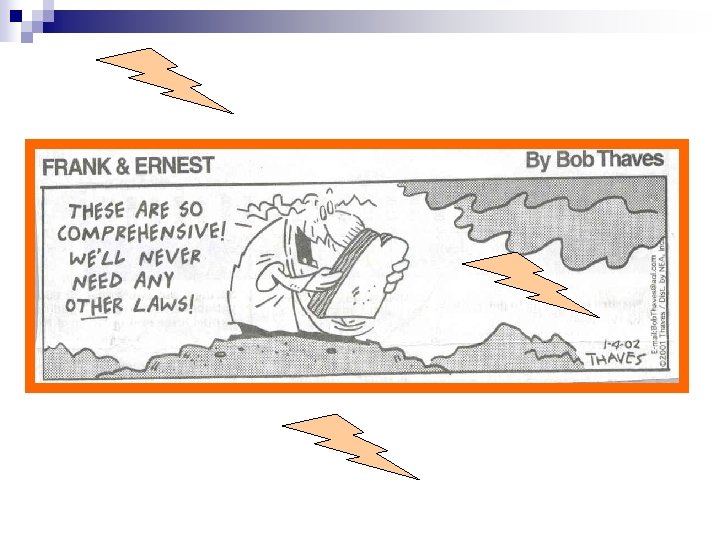
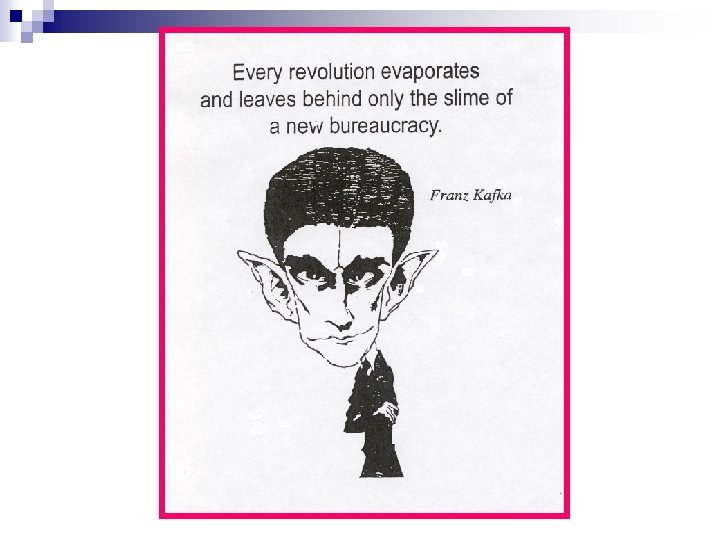
 Due process does not, unfortunately, put more bread on the table; government can set benefits at whatever level it wants. What due process puts on the table is a thick manual of rules designed to ensure uniformity and procedural regularity. Paternalism is replaced with bloodless formalism. People in need get lots of law. --Howard, 1994
 In the decades since World War II, we have constructed a system of regulatory law that basically outlaws common sense. Modern law, in an effort to be “self-executing”, has shut our humanity. The motives were logical enough: Specific legal mandates would keep government in close check and provide crisp guidelines for private citizens. But it doesn’t work. Human activity can’t be regulated without judgment by humans. --Howard, 1994
 In 1975 Congress passed the Education for All Handicapped Children Act (now known as the Individuals with Disabilities Education Act). Our confusion over government’s role was complete: We wanted it to solve social ills, but distrusted it to do so. Congress had resolved this dilemma by using rights to transfer governmental powers to special interest groups. Howard, 1994
 Statutory Definition of LD n The term “specific learning disability” means a disorder in one or more of the basic psychological processes involved in understanding or in using language, spoken or written, which may manifest itself in an imperfect ability to listen, speak, read, write, spell, or to do mathematical calculations. The term includes such conditions as perceptual handicaps, brain injury, minimal brain dysfunction, dyslexia, and developmental aphasia. The term does not include children who have learning disabilities which are primarily the result of visual, hearing, or motor handicaps, or mental retardation, or emotional disturbance, or of environmental, cultural, or economic disadvantage (USOE, 1968).
 1997 Federal Regulations n A team may determine that a child has a specific learning disability if: ¨ the child does not achieve commensurate with his or her age and ability levels in one or more of the areas listed in paragraph (a)(2) of this section, when provided with learning experiences appropriate for the child’s age and ability levels; and ¨ the team finds that a child has a severe discrepancy between achievement and intellectual ability in one or more of the following areas (IDEA, 1997).
 1977 Federal Regulations n A severe discrepancy between achievement and intellectual ability in one or more of the areas: 1. 2. 3. 4. 5. 6. 7. oral expression; listening comprehension; written expression; basic reading skill; reading comprehension; mathematics calculation; or mathematic reasoning.
 1977 Federal Regulations n. The child may not be identified as having a specific learning disability if the discrepancy between ability and achievement is primarily the result of: 1. a visual, hearing, or motor handicap; 2. mental retardation; 3. emotional disturbance; or 4. environmental, cultural, or economic disadvantage (USOE, 1977).
 No child left behind… No teacher left unsupported!
 Consensus Report – LD Summit 2001 n n n IQ/Achievement Discrepancy is neither necessary nor sufficient for identifying individuals with SLD (specific learning disabilities). IQ tests do not need to be given in most evaluations of children with SLD. There should be alternate ways to identify individuals with SLD in addition to achievement testing, history, and observations of the child.
 Consensus Report – Alternatives 2001 n n n Response to quality intervention is the most promising method of alternate identification and can both promote effective practices in schools and help to close the gap between identification and treatment. Any effort to scale up response to intervention should be based on problem solving models that use progress monitoring to gauge the intensity of intervention in relation to the student’s response to intervention. Problem solving models have been shown to be effective in public school settings and in research.
 The Demise of IQ Testing for Children with Learning Disabilities Presented by Robert H. Pasternack, Ph. D. Assistant Secretary, Office of Special Education and Rehabilitative Services National Association of School Psychologists 2002 Annual Convention Chicago, Illinois March 1, 2002
 Main Points n n Validity of the of LD concept does NOT hinge on the validity of IQ-Achievement Discrepancy as a means for identifying individuals with LD. IQ-Achievement Discrepancy is not a valid means for identifying individuals with LD. There is no compelling need for the use of IQ tests in the identification of LD. Elimination of IQ tests in the identification of LD will help shift the emphasis in Special Education away from eligibility and towards getting children the interventions they need to be successful learners.
 Response to Intervention Studies of responsiveness to intervention generally do not find relationships with IQ or IQ-discrepancy. n May seem counterintuitive, but IQ tests do not measure cognitive skills like phonological awareness that are closely associated with LD in reading. n
 Why give IQ Tests? n n n Eligibility evaluations are costly: IQ tests are time consuming and do not contribute to treatment planning. Wait to fail model- we wait for kids to fail to provide services. All the research we have points to the value of early intervention. IQ tests contribute to over- representation of minorities in special education. Role of school psychologist should change. CHANGE IS GOOD!
 LD Roundtable I: Finding Common Ground Initiative 2002 10 national organization with a deep interest in LD n OSEP funded n Discussion based on August 2001 LD Summit n Found common ground! n
 Finding Common Ground Initiative 2002 Agreed to work for the elimination of the IQ Achievement discrepancy n Agreed to the concept of the 3 tiered model for identification n
 Key Issues in IDEA Re-authorization n n HR 1350 The Improving Educational Results for Children with Disabilities Act S 1248 The Individuals with Disabilities Education Improvement Act ¨ IEP ¨ Discipline ¨ Research ¨ LD identification
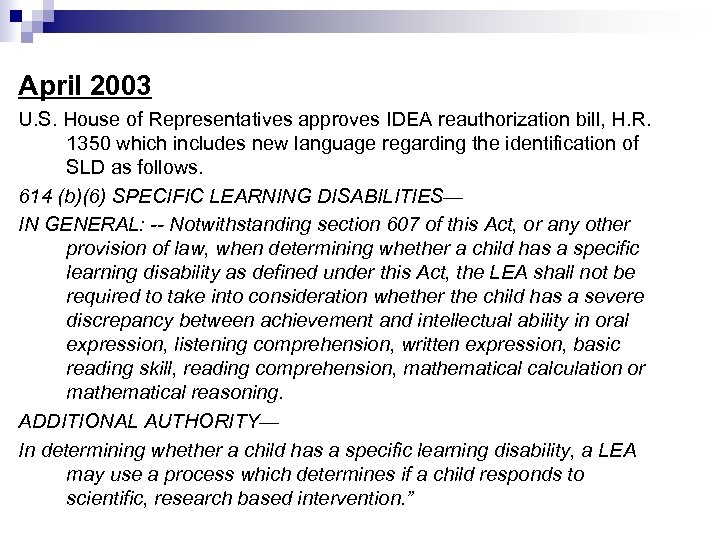 April 2003 U. S. House of Representatives approves IDEA reauthorization bill, H. R. 1350 which includes new language regarding the identification of SLD as follows. 614 (b)(6) SPECIFIC LEARNING DISABILITIES— IN GENERAL: -- Notwithstanding section 607 of this Act, or any other provision of law, when determining whether a child has a specific learning disability as defined under this Act, the LEA shall not be required to take into consideration whether the child has a severe discrepancy between achievement and intellectual ability in oral expression, listening comprehension, written expression, basic reading skill, reading comprehension, mathematical calculation or mathematical reasoning. ADDITIONAL AUTHORITY— In determining whether a child has a specific learning disability, a LEA may use a process which determines if a child responds to scientific, research based intervention. ”
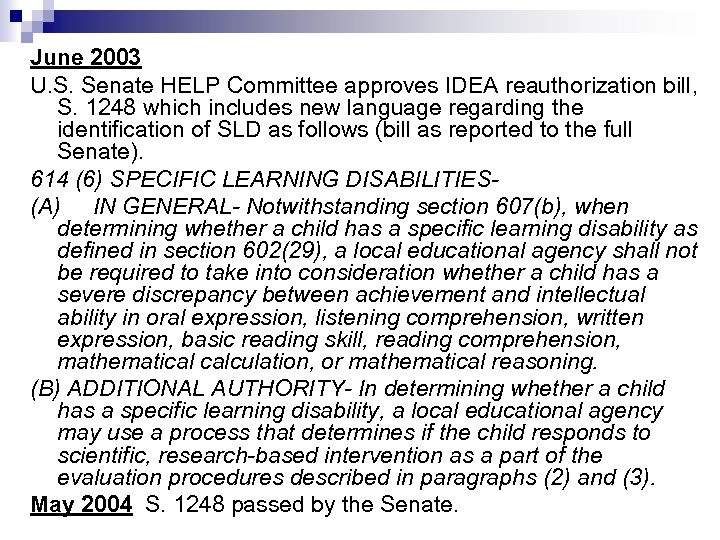 June 2003 U. S. Senate HELP Committee approves IDEA reauthorization bill, S. 1248 which includes new language regarding the identification of SLD as follows (bill as reported to the full Senate). 614 (6) SPECIFIC LEARNING DISABILITIES(A) IN GENERAL- Notwithstanding section 607(b), when determining whether a child has a specific learning disability as defined in section 602(29), a local educational agency shall not be required to take into consideration whether a child has a severe discrepancy between achievement and intellectual ability in oral expression, listening comprehension, written expression, basic reading skill, reading comprehension, mathematical calculation, or mathematical reasoning. (B) ADDITIONAL AUTHORITY- In determining whether a child has a specific learning disability, a local educational agency may use a process that determines if the child responds to scientific, research-based intervention as a part of the evaluation procedures described in paragraphs (2) and (3). May 2004 S. 1248 passed by the Senate.
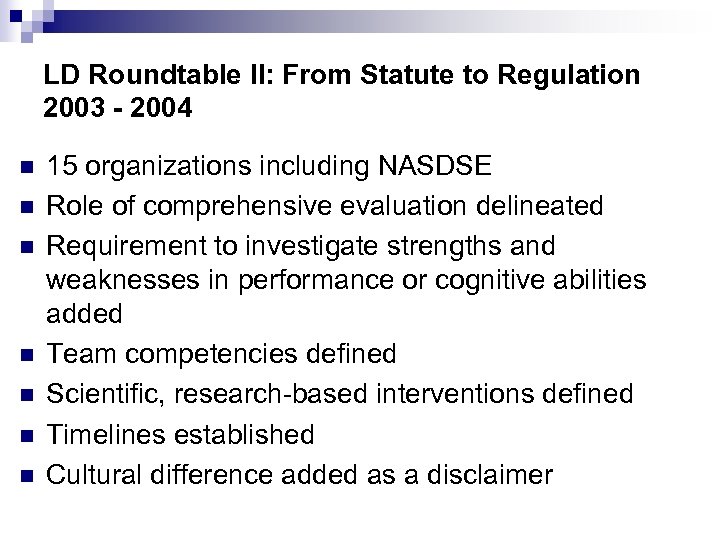 LD Roundtable II: From Statute to Regulation 2003 - 2004 n n n n 15 organizations including NASDSE Role of comprehensive evaluation delineated Requirement to investigate strengths and weaknesses in performance or cognitive abilities added Team competencies defined Scientific, research-based interventions defined Timelines established Cultural difference added as a disclaimer
 LD Roundtable III? Delivering research based reading instruction? n Developing (synthesizing) an RTI model? n Measuring the exclusionary factors (disclaimers)? n
 Fullan’s Tipping Points • The social attractors of moral purpose • Quality relationships • Quality ideas Moral purpose and quality ideas need to have sticky qualities. New relationships need law of the few to help kick start the process in order to create new role models and context. Fullan, 2003
 A deliberate strategy… Raise the Bar & Close the Gap… WITH A VENGEANCE! Fullan, 2003
 We are all caught up in an inescapable web of mutuality. –Martin Luther King, Jr.
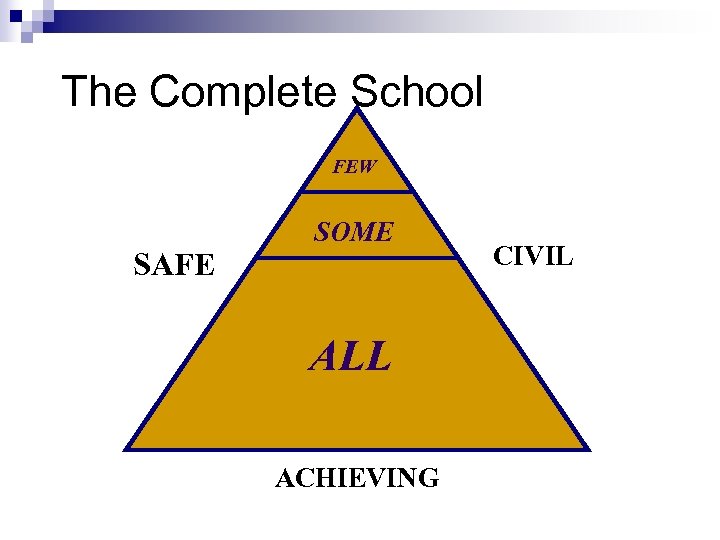 The Complete School FEW SAFE SOME ALL ACHIEVING CIVIL
 If our services do not result in a closing of the achievement gap, they are not effective. Kukic, 2003
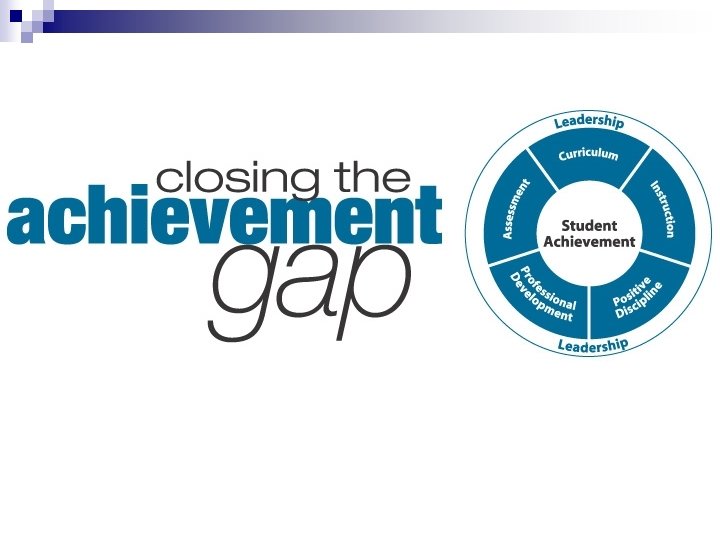
 Closing The Achievement Gap n Closing the gap is essential ¨ to student success ¨ to district success ¨ to our nation’s future n Closing the gap requires prevention AND intervention
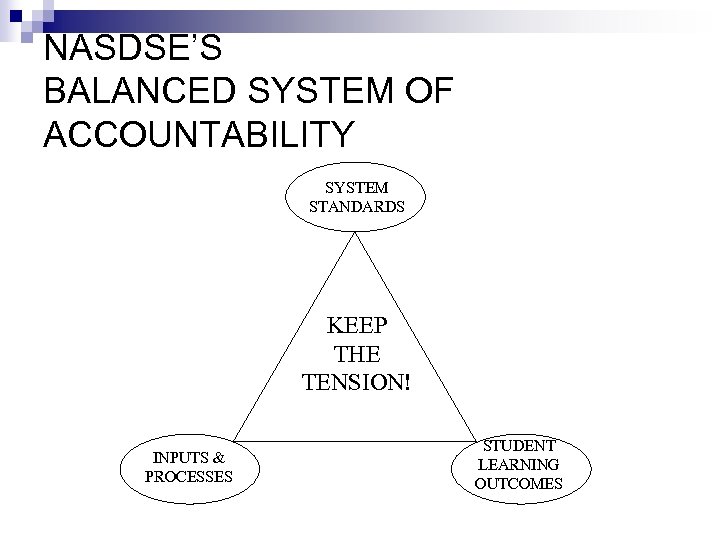 NASDSE’S BALANCED SYSTEM OF ACCOUNTABILITY SYSTEM STANDARDS KEEP THE TENSION! INPUTS & PROCESSES STUDENT LEARNING OUTCOMES
 PIECEMEAL CHANGE will always disappear Bill Spady, 1992
 Going to scale means fundamentally developing the system at all levels. Fullan, 1999
 ODYSSEY, Pepsi to Apple…a Journey of Adventure, Ideas, and the Future “The Best way to predict the future is to invent it. ” John Sculley, 1987
 If you’re not hopelessly confused, you’re out of touch! If you are hopelessly confused, then you only have one choice — try stuff. Embracing Chaos, 1993
 Above all, Try something. Franklin D. Roosevelt
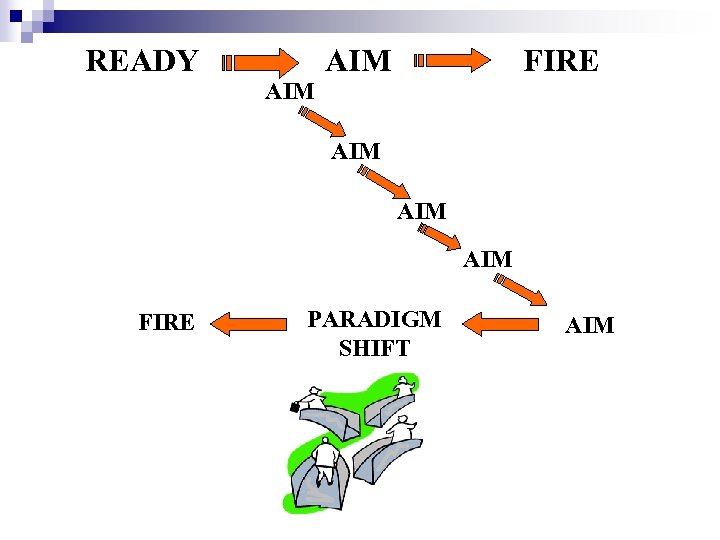 READY AIM FIRE AIM AIM FIRE PARADIGM SHIFT AIM
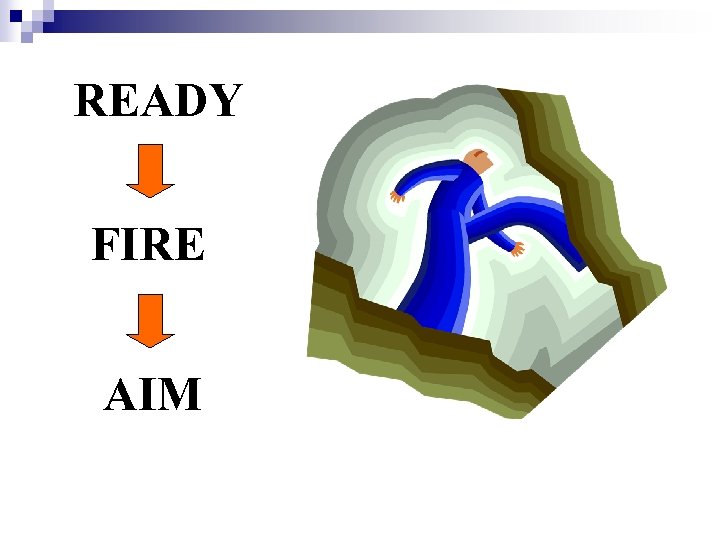 READY FIRE AIM
 From CNN To “The Real World”: Improved Education for All Children Lana Michelson Bureau Chief Bureau of Children, Family and Community Services Iowa Department of Education Lana. Michelson@Iowa. gov
 How it all started n n Began in 1986 -1987 Statewide innovation Examine current literature Ask questions
 A Series of Questions Were Asked n n What is working with the current system? What components of the system are in need of reconsideration? What barriers get in the way of trying these changes? Important - There was no presumption that we were doing was not being done well.
 Assumptions n n Change in thinking is as critical as change in behavior Our historical system was predicated on a series of assumptions – these pervade practice today Basing our service delivery system on them has not resulted in broad-based and consistently replicable positive student achievement results for students with disabilities Last purpose of IDEA-To assess and ensure the effectiveness of efforts to education children with disabilities
 We Need A New Logic Begin with the idea that the purpose of the system is student achievement n Acknowledge that student needs exist on a continuum rather than in typological groupings n Organize resources to make educational resources available in direct proportion to student need n
 The Reality n The effectiveness of any educational strategy for an individual can only be determined through its implementation.
 Response to Intervention RTI RTI RTI ¨ About a system of decision making ¨ Matching amount of student resources to degree of student need ¨ Matching precise nature of student need to instruction ¨ Being strategic and judicious in using instructional resources ¨ Using student data to maximize student learning ¨ Having data to tell you whether what you are doing is working
 Vocabulary – Convergence of Thinking n Problem Solving Model (PS): Proposed, implemented and refined since the early ’ 80 s in special education as an alternative system to the traditional Refer-Test-Place system. It encompasses both general education and special education systems. Initially was individual student focused. n Response To Intervention (RTI) – Also called a Standard Treatment Approach (STA), Resistance to Intervention and Responsiveness to Intervention: Being proposed by researchers across the country as an alternative method for identifying individuals with Learning Disabilities. An opportunity to link IDEA thinking with NCLB thinking. n School-Wide Model (SWM): An integrative way of thinking logically and rationally about meeting All children’s needs in a school. It represents a promising way for schools to comprehensively draw together and allocate their resources to meet children’s educational needs. It is a “smart” system.
 Important Points n n n These terms are similar in critical ways They represent different spins on the same core thinking by different people The same “big components” are there
 Beliefs that Support Response to Intervention n All children can learn n n Educators are responsible to teach them Parents have vast knowledge about their children and should be partners in the educational system Children should be assisted when concerns arise, before problems grow Children’s needs should be met in the general education setting whenever appropriate
 Beliefs that Support Response to Intervention n Teachers and parents deserve the resources necessary to meet the educational needs of children The best educational strategy is the one that works; the response to intervention approach evaluates effectiveness frequently Assistance is designed to improve learning; accurate information about student progress should be communicated regularly
 Why Use a Response to Intervention Approach? n n n Model is not just conceptual but practical Multidisciplinary. . . it actually increases teaming Preventative / early intervention focus Increases amount of services to children Increases parental awareness and involvement Frees staff to make professional decisions Process is developmental. . . requires flexibility Limited only by teams in ability to generate solutions Emphasis is always on least-restrictive environment Emphasis is on exit as much as entrance Match with our beliefs about education for all kids. . .
 Implementation Myths Categorical n Access to adult services n Requires a waiver n Lack of data n
 Categorical Specific All kids n Support Services And Related Services n
 Limits Access to Adult Services Vocational Rehabilitation n AHEAD criteria n
 Requires a wavier n n n There is tremendous flexibility within IDEA One of Iowa’s greatest learnings as a state was that “we did it to ourselves” That is, most of the restrictions we perceived as barriers to changing what we were doing – they were self imposed by our state’s interpretation of the Federal Law and Regulations
 Road Map n n n Began with Teacher Assistance Teams or Student Assistance Teams Systematic Progress Monitoring of interventions Parents engaged in the process as soon as their was an identified problem Interventions were implemented based on functional assessment information in general education Used the data gathered during the intervention as teams examined entitlement and eligibility decisions Institutionalized ¨ Eligibility Document ¨ Administrative Rules of Special Education
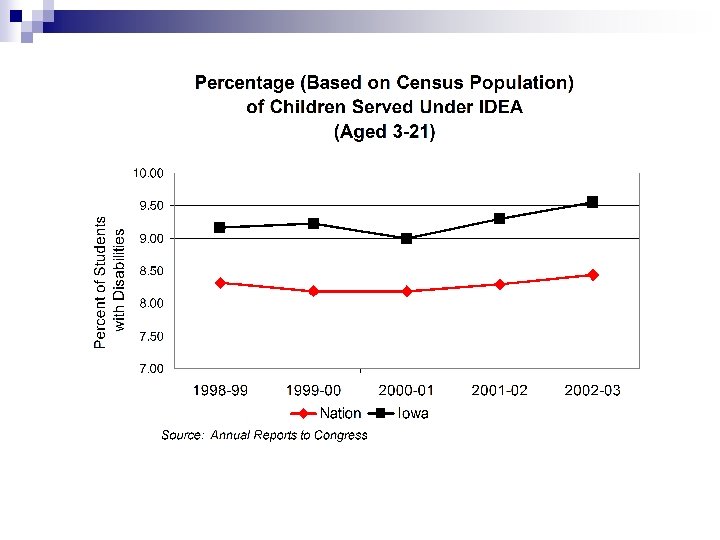
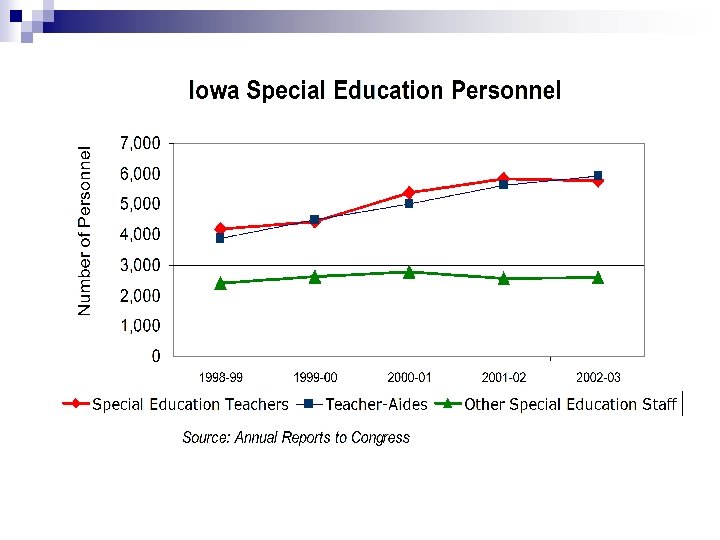
 There is a lack of data n n n Census data Due Process data Personnel data Quality Implementation data Customer Satisfaction
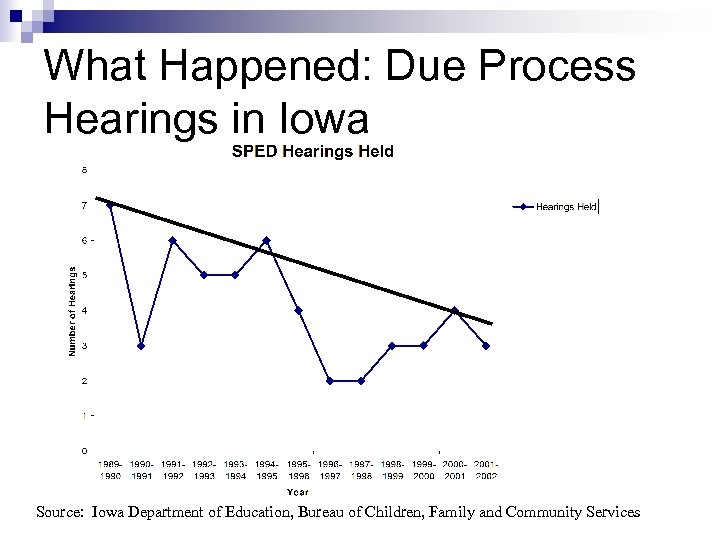 What Happened: Due Process Hearings in Iowa Source: Iowa Department of Education, Bureau of Children, Family and Community Services
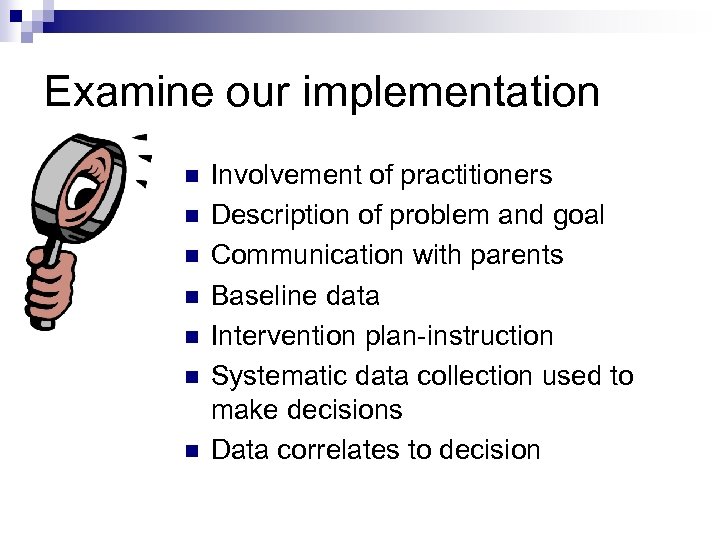 Examine our implementation n n n Involvement of practitioners Description of problem and goal Communication with parents Baseline data Intervention plan-instruction Systematic data collection used to make decisions Data correlates to decision
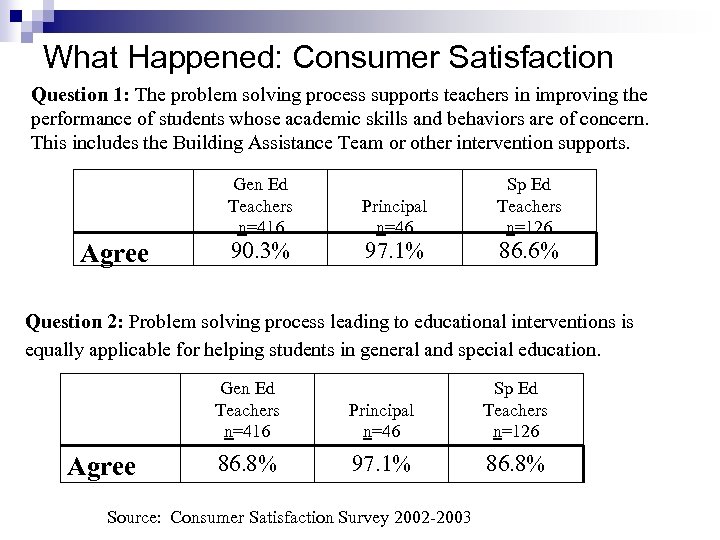 What Happened: Consumer Satisfaction Question 1: The problem solving process supports teachers in improving the performance of students whose academic skills and behaviors are of concern. This includes the Building Assistance Team or other intervention supports. Gen Ed Teachers n=416 Agree Principal n=46 Sp Ed Teachers n=126 90. 3% 97. 1% 86. 6% Question 2: Problem solving process leading to educational interventions is equally applicable for helping students in general and special education. Gen Ed Teachers n=416 Agree Principal n=46 Sp Ed Teachers n=126 86. 8% 97. 1% 86. 8% Source: Consumer Satisfaction Survey 2002 -2003
 Lessons Learned/System Change
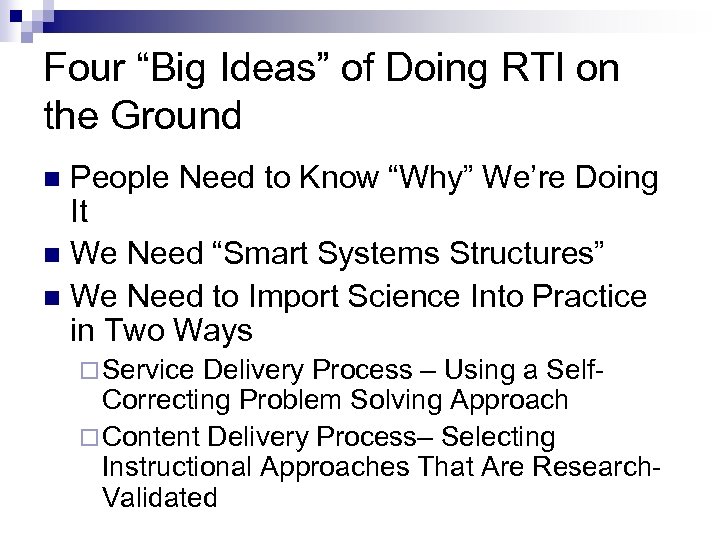 Four “Big Ideas” of Doing RTI on the Ground People Need to Know “Why” We’re Doing It n We Need “Smart Systems Structures” n We Need to Import Science Into Practice in Two Ways n ¨ Service Delivery Process – Using a Self- Correcting Problem Solving Approach ¨ Content Delivery Process– Selecting Instructional Approaches That Are Research. Validated
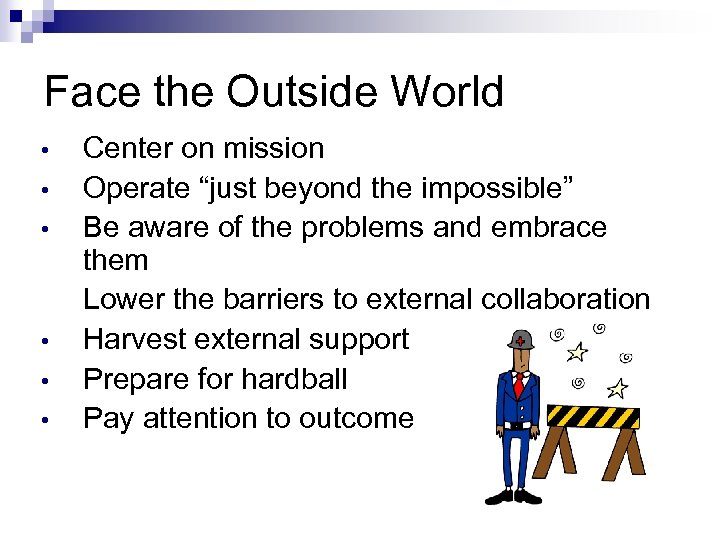 Face the Outside World • • • Center on mission Operate “just beyond the impossible” Be aware of the problems and embrace them Lower the barriers to external collaboration Harvest external support Prepare for hardball Pay attention to outcome
 Create the Freedom to Imagine • § § § Create room to experiment Lower the barriers to internal collaboration Prime the organization for innovation Create a marketplace of ideas Prepare for stress Maximize diversity
 Leadership • • Be clear about who decides Issue a call for ideas Give the permission to fail Communicate Pay attention to sequencing Teach the organization how to say no and why to say yes Keep faith and intuition alive and in perspective
 Manage the System • • Measure performance Celebrate success Have fun Build mission into systems, not vice versa Be disciplined about management Listen to the stakeholders and organization Keep learning
 Bottom lines Come together and work together n Stick together for the long haul n Confront the present situation n Create a vision for a more effective system n Attend to change n Have an implementation plan n Develop performance measures n
 Thinking Differently n n n Knowing why problems occur and what will solve them is important Intervention is derived from analysis results “Functional” means different things New information will not be gathered until you know what you don’t already have Assessments will serve multiple purposes
 Thinking Differently Student problems can be defined and changed n Questions will drive assessments n Assessments will lead to instructional decisions and be low in inference n Enabled learning rather than discrepancy or diagnosis is the goal n
 Quote n We have witnessed over the last 30 years numerous attempts at planned educational change. The benefits have not nearly equaled the costs, and all too often, the situation has seemed to worsen. We have, however, gained clearer and clearer insights over this period about the do’s and don’ts of bringing about change…. One of the most promising features of this new knowledge about change is that successful examples of innovation are based on what might be most accurately labeled “organized common sense. ” (Fullan, 1991, p. xi-xii) n Fullan, M. G. (1991). The new meaning of educational change. New York, NY : Teachers College Press.
 Into Reality: To Get To All, Attend To Every W. David Tilly III Coordinator of Assessment Services Heartland Area Education Agency Johnston, Iowa dtilly@aea 11. k 12. ia. us
 So Let’s Put This All in Context
 We Can Do Better Than We’ve Ever Done Before n n n Advances in knowledge Advances in practice Flexibility in our structures Federal Law acceptance of different methods/approaches One goal – all students must become proficient (Consistent with NCLB)
 To Get There in Practice: We Need to Do Three Things 1. 2. 3. Adopt “Smart” system structures Import the “Scientific Method” into practice Use scientifically validated teaching practices to the greatest degree possible
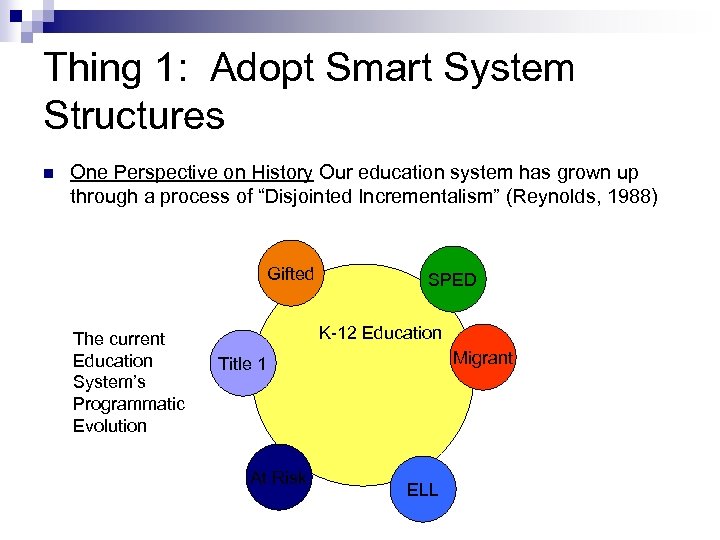 Thing 1: Adopt Smart System Structures n One Perspective on History Our education system has grown up through a process of “Disjointed Incrementalism” (Reynolds, 1988) Gifted The current Education System’s Programmatic Evolution SPED K-12 Education Migrant Title 1 At Risk ELL
 Thing 1: Adopt Smart System Structures Unintended Effects n n n Conflicting programs Conflicting funding streams Redundacy Lack of coordination across programs Nonsensical rules about program availability for students Extreme complexity in administration and implementation of the programs
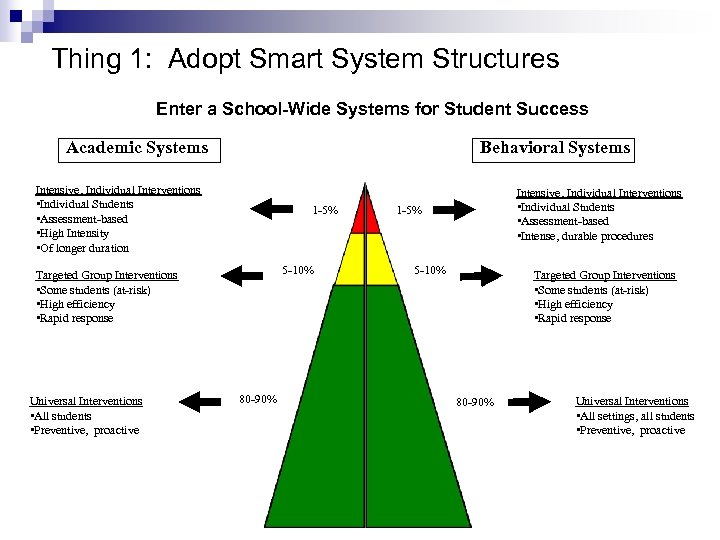 Thing 1: Adopt Smart System Structures Enter a School-Wide Systems for Student Success Academic Systems Behavioral Systems Intensive, Individual Interventions • Individual Students • Assessment-based • High Intensity • Of longer duration 1 -5% 5 -10% Targeted Group Interventions • Some students (at-risk) • High efficiency • Rapid response Universal Interventions • All students • Preventive, proactive 80 -90% Intensive, Individual Interventions • Individual Students • Assessment-based • Intense, durable procedures 1 -5% 5 -10% Targeted Group Interventions • Some students (at-risk) • High efficiency • Rapid response 80 -90% Universal Interventions • All settings, all students • Preventive, proactive
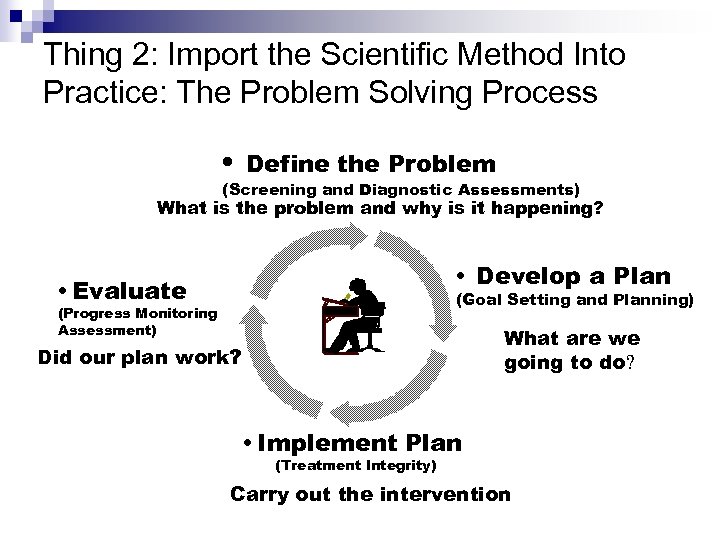 Thing 2: Import the Scientific Method Into Practice: The Problem Solving Process • Define the Problem (Screening and Diagnostic Assessments) What is the problem and why is it happening? • Develop a Plan • Evaluate (Goal Setting and Planning) (Progress Monitoring Assessment) What are we going to do? Did our plan work? • Implement Plan (Treatment Integrity) Carry out the intervention
 Thing 2: In RTI, We Differentiate Assessment for the Purpose of Differentiating Instruction n Def: Assessment, is the process of collecting information for the purpose of making decisions or answering questions (Salvia and Ysseldyke, 1991) Different kinds of assessment data are needed for different decisions within the system 3 Major Types of Decisions/Assessments
 Thing 2: Three Primary Types of Assessment 1. 2. 3. Screening Assessments: – assessments used to determine if additional investigation is warranted Diagnostic Assessments: Assessment conducted at any time during the school year when more in-depth analysis of a student’s strengths and weaknesses is needed to guide instruction (Institute for the Development of Educational Achievement, 2003) Progress Monitoring Assessments: Assessment conducted a minimum of three times a year or on a routine basis (i. e. , weekly, monthly, or quarterly) using comparable and multiple test forms to (a) estimate rates of student improvement, (b) identify children who are not demonstrating adequate progress and therefore require additional or different forms of instruction, and/or (c) compare the efficacy of different forms of instruction for struggling readers and thereby design more effective, individualized instructional programs for those at-risk learners. (adapted from Institute for the Development of Educational Achievement, 2003)
 Thing 3: Use Scientifically Validated Practices to the Extent Possible n n n Investigate the research base Know your own context and needs Match up strategies/approaches with your needs Monitor the extent to which they are effective Change ineffective programs and strategies
 A Thumbnail of RTI in Practice
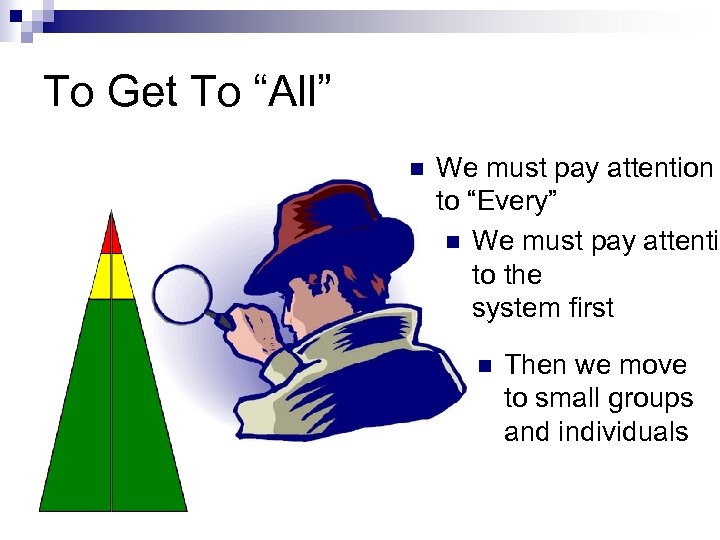 To Get To “All” n We must pay attention to “Every” n We must pay attentio to the system first n Then we move to small groups and individuals
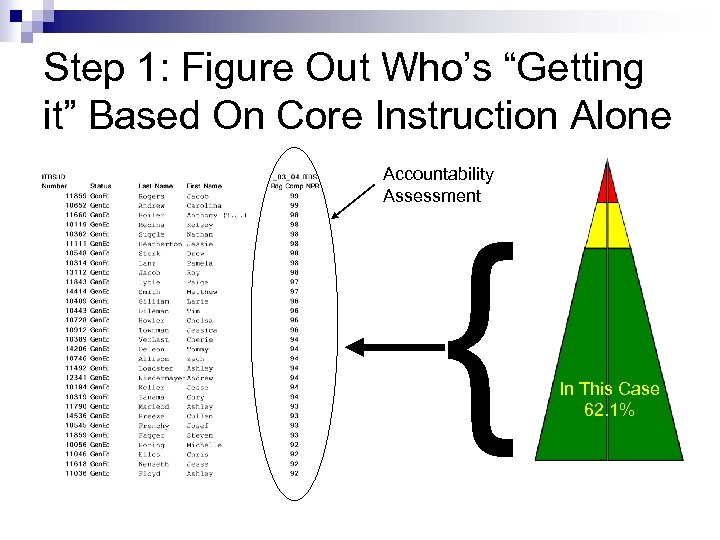 Step 1: Figure Out Who’s “Getting it” Based On Core Instruction Alone Accountability Assessment { In This Case 62. 1%
 For Those Successful Based on Core Instruction n n Further diagnostics typically not needed Progress monitoring occurs yearly with district accountability assessment and progress in classes
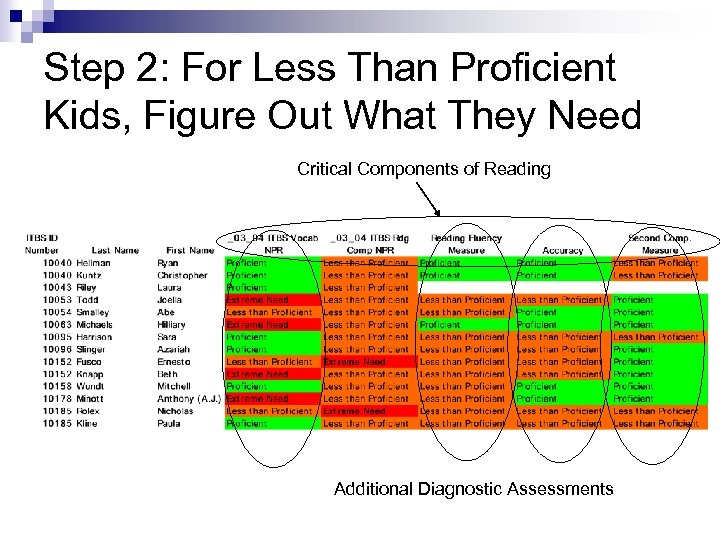 Step 2: For Less Than Proficient Kids, Figure Out What They Need Critical Components of Reading Additional Diagnostic Assessments
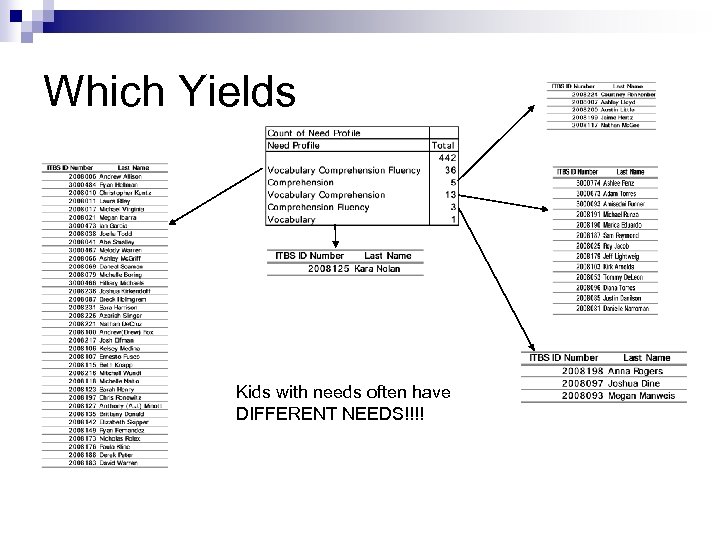 Which Yields Kids with needs often have DIFFERENT NEEDS!!!!
 Which Brings Up the Issues n n How do we get these kids supplemental instruction, focused on their needs? In addition to their Core. How do we get progress monitored at a group level? How do we create flexible groupings, responding to the data? Keep what is working, change what is not
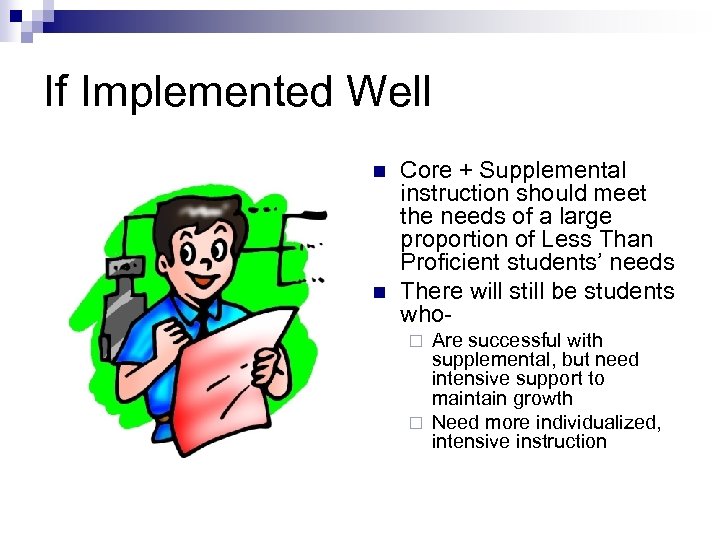 If Implemented Well n n Core + Supplemental instruction should meet the needs of a large proportion of Less Than Proficient students’ needs There will still be students who. Are successful with supplemental, but need intensive support to maintain growth ¨ Need more individualized, intensive instruction ¨
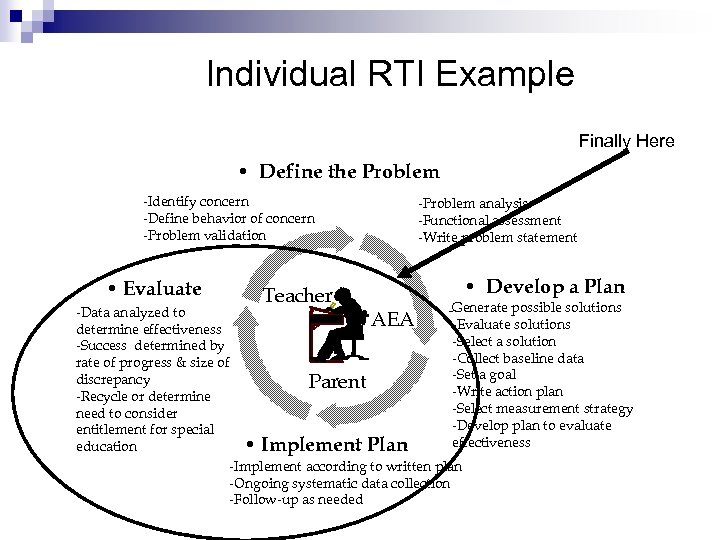
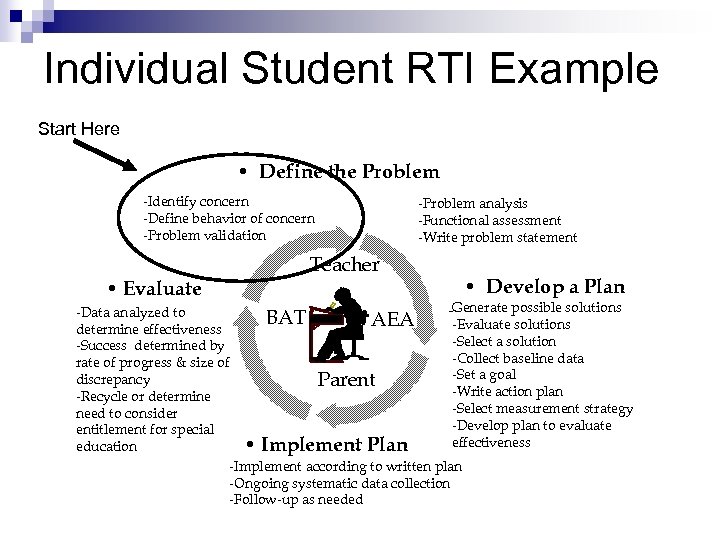 Individual Student RTI Example Start Here • Define the Problem -Identify concern -Define behavior of concern -Problem validation • Evaluate Teacher -Problem analysis -Functional assessment -Write problem statement • Develop a Plan -Generate possible solutions -Data analyzed to BAT AEA -Evaluate solutions determine effectiveness -Select a solution -Success determined by -Collect baseline data rate of progress & size of -Set a goal discrepancy Parent -Write action plan -Recycle or determine -Select measurement strategy need to consider -Develop plan to evaluate entitlement for special effectiveness • Implement Plan education -Implement according to written plan -Ongoing systematic data collection -Follow-up as needed
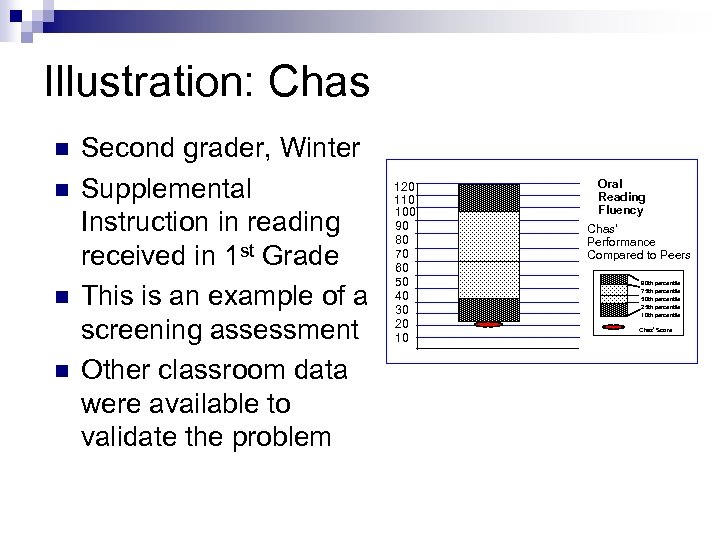 Illustration: Chas n n Second grader, Winter Supplemental Instruction in reading received in 1 st Grade This is an example of a screening assessment Other classroom data were available to validate the problem 120 110 100 90 80 70 60 50 40 30 20 5 10 Oral Reading Fluency Chas’ Performance Compared to Peers 90 th percentile 75 th percentile 50 th percentile 25 th percentile 10 th percentile Chas’ Score
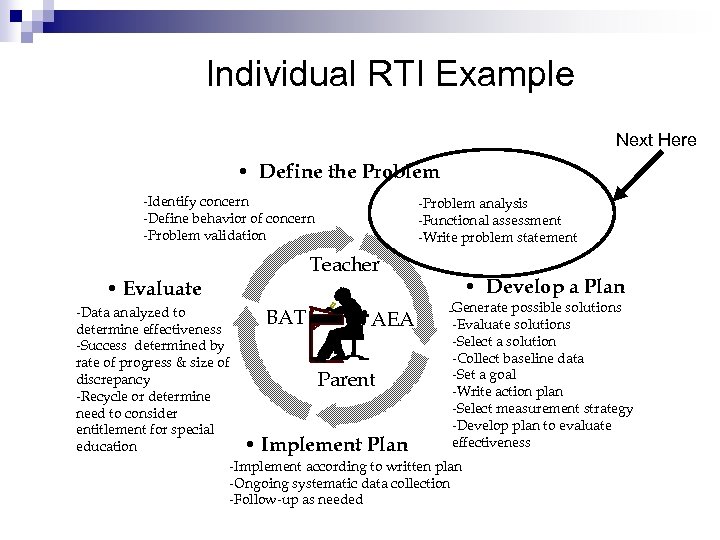 Individual RTI Example Next Here • Define the Problem -Identify concern -Define behavior of concern -Problem validation • Evaluate Teacher -Problem analysis -Functional assessment -Write problem statement • Develop a Plan -Generate possible solutions -Data analyzed to BAT AEA -Evaluate solutions determine effectiveness -Select a solution -Success determined by -Collect baseline data rate of progress & size of -Set a goal discrepancy Parent -Write action plan -Recycle or determine -Select measurement strategy need to consider -Develop plan to evaluate entitlement for special effectiveness • Implement Plan education -Implement according to written plan -Ongoing systematic data collection -Follow-up as needed
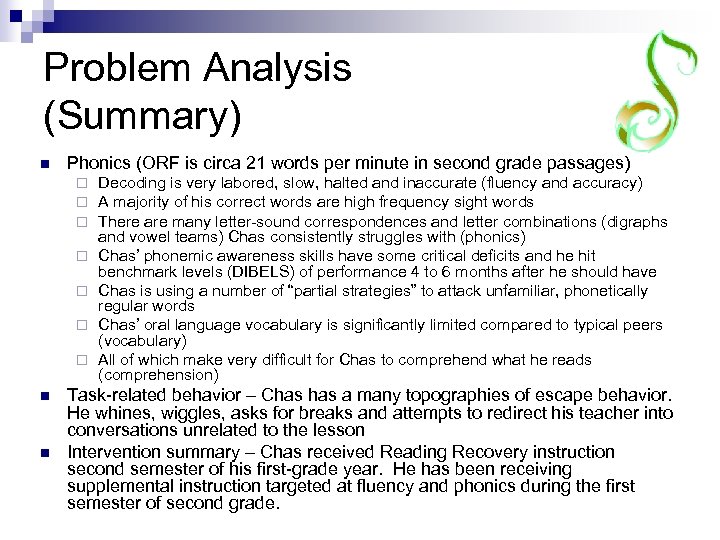 Problem Analysis (Summary) n Phonics (ORF is circa 21 words per minute in second grade passages) ¨ ¨ ¨ ¨ n n Decoding is very labored, slow, halted and inaccurate (fluency and accuracy) A majority of his correct words are high frequency sight words There are many letter-sound correspondences and letter combinations (digraphs and vowel teams) Chas consistently struggles with (phonics) Chas’ phonemic awareness skills have some critical deficits and he hit benchmark levels (DIBELS) of performance 4 to 6 months after he should have Chas is using a number of “partial strategies” to attack unfamiliar, phonetically regular words Chas’ oral language vocabulary is significantly limited compared to typical peers (vocabulary) All of which make very difficult for Chas to comprehend what he reads (comprehension) Task-related behavior – Chas a many topographies of escape behavior. He whines, wiggles, asks for breaks and attempts to redirect his teacher into conversations unrelated to the lesson Intervention summary – Chas received Reading Recovery instruction second semester of his first-grade year. He has been receiving supplemental instruction targeted at fluency and phonics during the first semester of second grade.
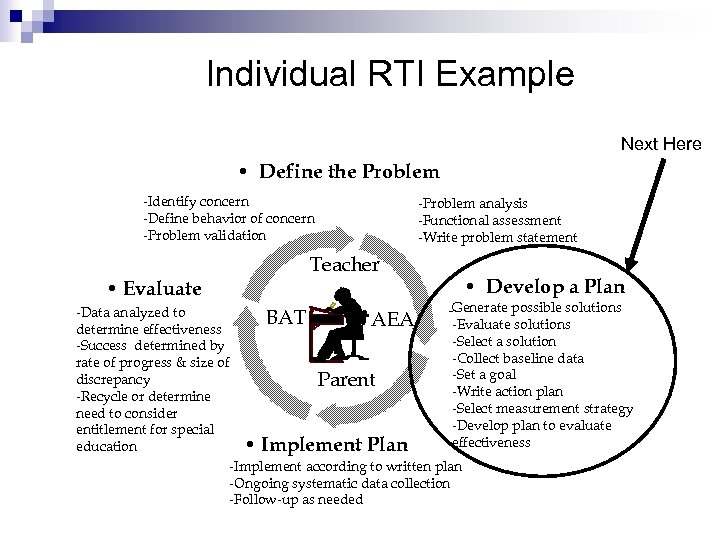 Individual RTI Example Next Here • Define the Problem -Identify concern -Define behavior of concern -Problem validation • Evaluate Teacher -Problem analysis -Functional assessment -Write problem statement • Develop a Plan -Generate possible solutions -Data analyzed to BAT AEA -Evaluate solutions determine effectiveness -Select a solution -Success determined by -Collect baseline data rate of progress & size of -Set a goal discrepancy Parent -Write action plan -Recycle or determine -Select measurement strategy need to consider -Develop plan to evaluate entitlement for special effectiveness • Implement Plan education -Implement according to written plan -Ongoing systematic data collection -Follow-up as needed
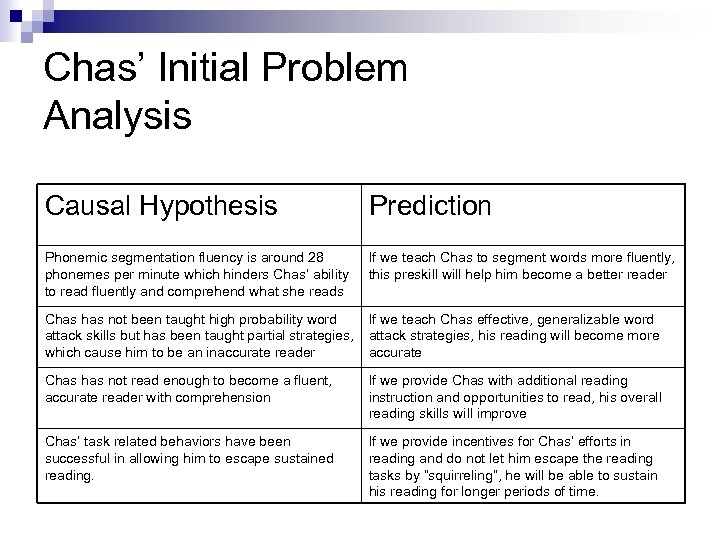 Chas’ Initial Problem Analysis Causal Hypothesis Prediction Phonemic segmentation fluency is around 28 phonemes per minute which hinders Chas’ ability to read fluently and comprehend what she reads If we teach Chas to segment words more fluently, this preskill will help him become a better reader Chas not been taught high probability word If we teach Chas effective, generalizable word attack skills but has been taught partial strategies, attack strategies, his reading will become more which cause him to be an inaccurate reader accurate Chas not read enough to become a fluent, accurate reader with comprehension If we provide Chas with additional reading instruction and opportunities to read, his overall reading skills will improve Chas’ task related behaviors have been successful in allowing him to escape sustained reading. If we provide incentives for Chas’ efforts in reading and do not let him escape the reading tasks by “squirreling”, he will be able to sustain his reading for longer periods of time.
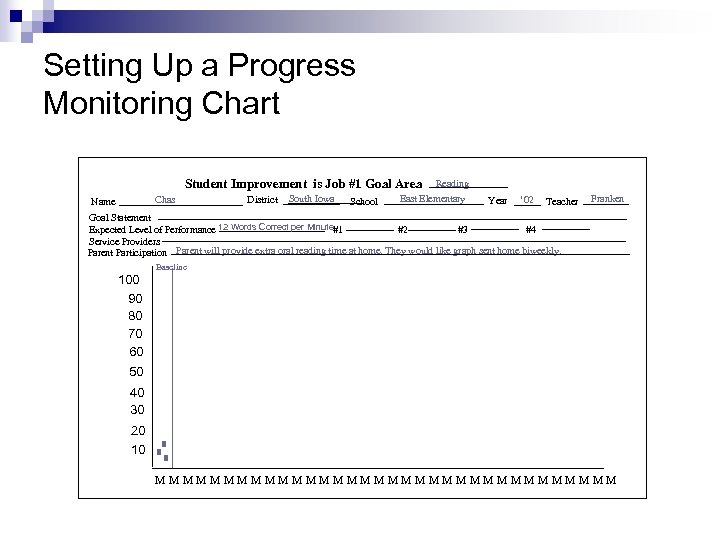 Setting Up a Progress Monitoring Chart Student Improvement is Job #1 Goal Area Chas Name District South Iowa School Reading East Elementary Year ‘ 02 Teacher Franken Goal Statement Expected Level of Performance 12 Words Correct per Minute#1 #2 #3 #4 Service Providers Parent Participation Parent will provide extra oral reading time at home. They would like graph sent home biweekly. 100 90 80 70 60 50 Baseline 40 30 20 10 MMMMMMMMMMMMMMMMM
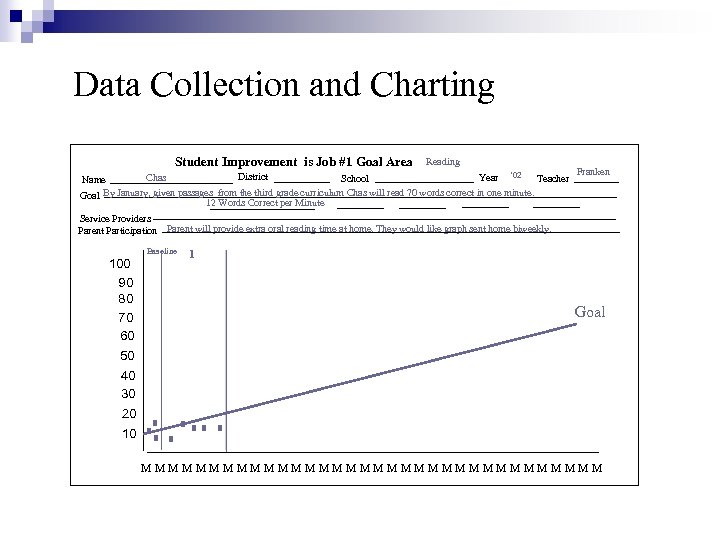
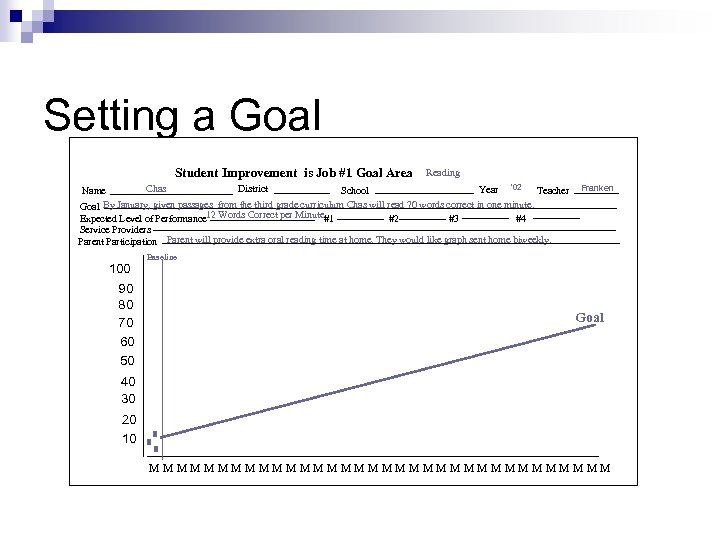 Setting a Goal Baseline Student Improvement is Job #1 Goal Area Reading District Chas Year ‘ 02 School Teacher Name By January, given passages from the third grade curriculum Chas will read 70 words correct in one minute. Goal Expected Level of Performance 12 Words Correct per Minute#1 #2 #3 #4 Service Providers Parent Participation Parent will provide extra oral reading time at home. They would like graph sent home biweekly. 100 90 80 70 60 50 Franken Baseline Goal 40 30 20 10 MMMMMMMMMMMMMMMMM
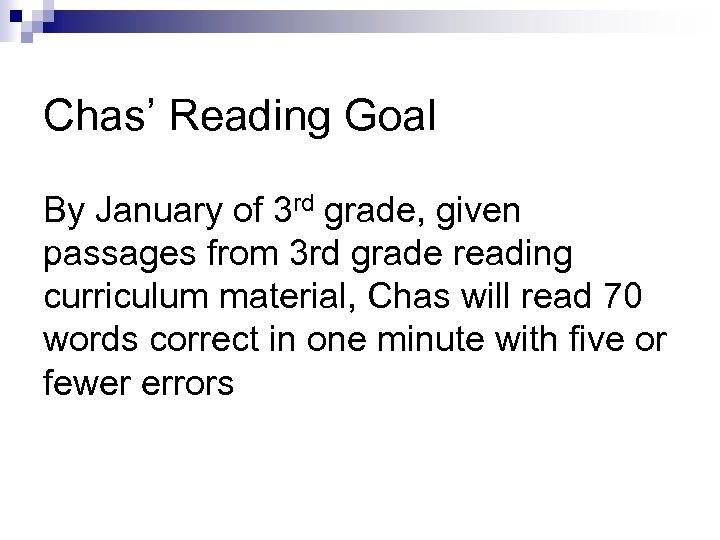 Chas’ Reading Goal By January of 3 rd grade, given passages from 3 rd grade reading curriculum material, Chas will read 70 words correct in one minute with five or fewer errors
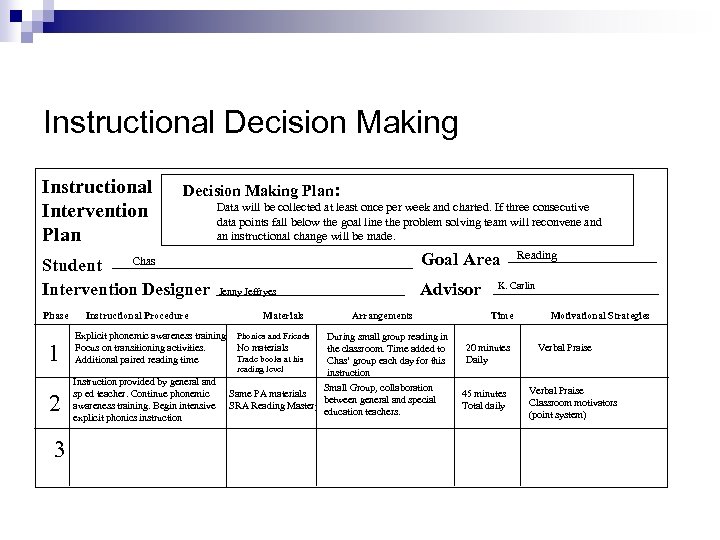
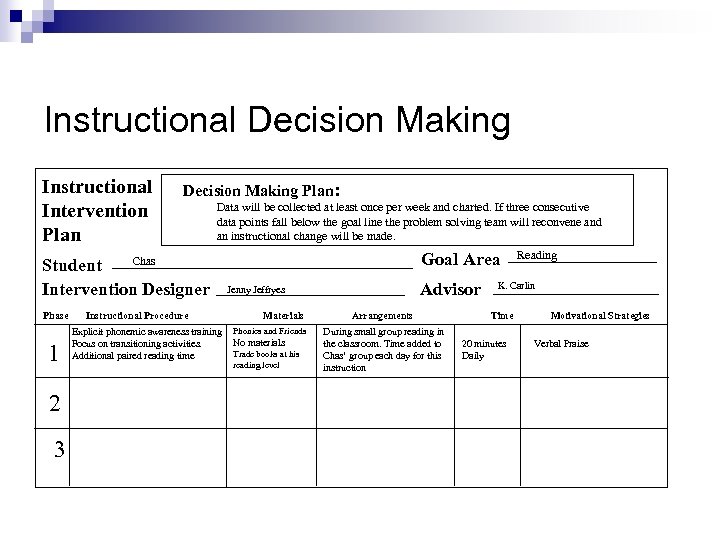 Instructional Decision Making Instructional Intervention Plan Decision Making Plan: Chas Student Intervention Designer Phase 1 2 3 Instructional Procedure Data will be collected at least once per week and charted. If three consecutive data points fall below the goal line the problem solving team will reconvene and an instructional change will be made. Goal Area Advisor Jenny Jeffryes Materials Explicit phonemic awareness training. Phonics and Friends No materials Focus on transitioning activities. Trade books at his Additional paired reading time reading level Arrangements During small group reading in the classroom. Time added to Chas’ group each day for this instruction Reading K. Carlin Time 20 minutes Daily Motivational Strategies Verbal Praise
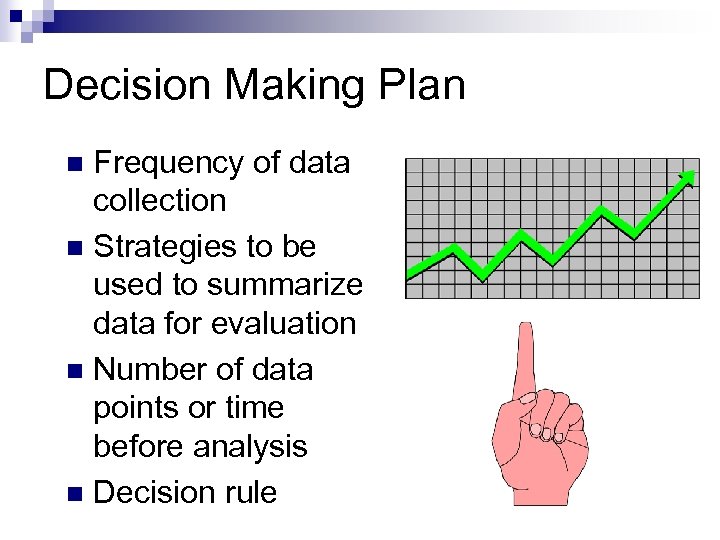 Decision Making Plan Frequency of data collection n Strategies to be used to summarize data for evaluation n Number of data points or time before analysis n Decision rule n
 Instructional Decisions Instructional procedures n Materials n Arrangements n Time n Motivational Strategies n
 Individual RTI Example Finally Here • Define the Problem -Identify concern -Define behavior of concern -Problem validation • Evaluate Teacher -Problem analysis -Functional assessment -Write problem statement • Develop a Plan -Generate possible solutions -Data analyzed to AEA -Evaluate solutions determine effectiveness -Select a solution -Success determined by -Collect baseline data rate of progress & size of -Set a goal discrepancy Parent -Write action plan -Recycle or determine -Select measurement strategy need to consider -Develop plan to evaluate entitlement for special effectiveness • Implement Plan education -Implement according to written plan -Ongoing systematic data collection -Follow-up as needed
 Data Collection and Charting Student Improvement is Job #1 Goal Area Reading District Chas Year ‘ 02 School Teacher Name Goal By January, given passages from the third grade curriculum Chas will read 70 words correct in one minute. 12 Words Correct per Minute Franken Service Providers Parent Participation Parent will provide extra oral reading time at home. They would like graph sent home biweekly. 100 90 80 70 60 50 Baseline 1 Goal 40 30 20 10 MMMMMMMMMMMMMMMMM
 Instructional Decision Making Instructional Intervention Plan Decision Making Plan: Chas Student Intervention Designer Phase 1 2 3 Instructional Procedure Data will be collected at least once per week and charted. If three consecutive data points fall below the goal line the problem solving team will reconvene and an instructional change will be made. Goal Area Materials Explicit phonemic awareness training. Phonics and Friends No materials Focus on transitioning activities. Trade books at his Additional paired reading time Instruction provided by general and sp ed teacher. Continue phonemic awareness training. Begin intensive explicit phonics instruction Advisor Jenny Jeffryes Arrangements During small group reading in the classroom. Time added to Chas’ group each day for this reading level instruction Small Group, collaboration Same PA materials between general and special SRA Reading Mastery education teachers. Reading K. Carlin Time 20 minutes Daily 45 minutes Total daily Motivational Strategies Verbal Praise Classroom motivators (point system)
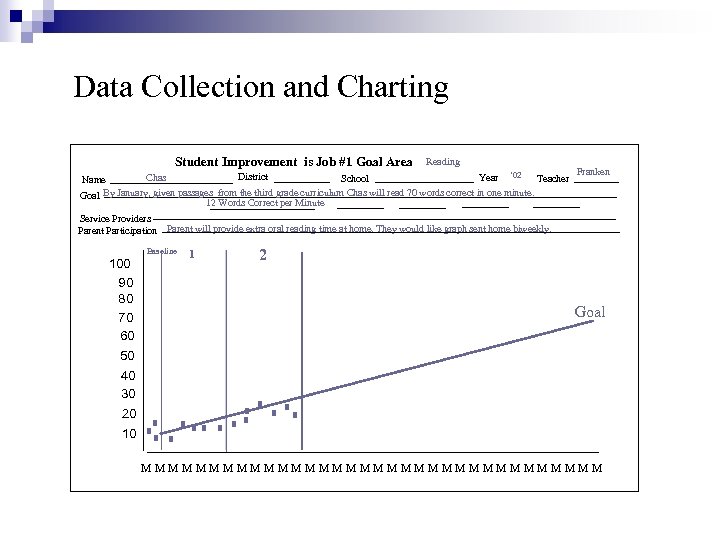 Data Collection and Charting Student Improvement is Job #1 Goal Area Reading District Chas Year ‘ 02 School Teacher Name Goal By January, given passages from the third grade curriculum Chas will read 70 words correct in one minute. 12 Words Correct per Minute Franken Service Providers Parent Participation Parent will provide extra oral reading time at home. They would like graph sent home biweekly. 100 90 80 70 60 50 Baseline 1 2 Goal 40 30 20 10 MMMMMMMMMMMMMMMMM
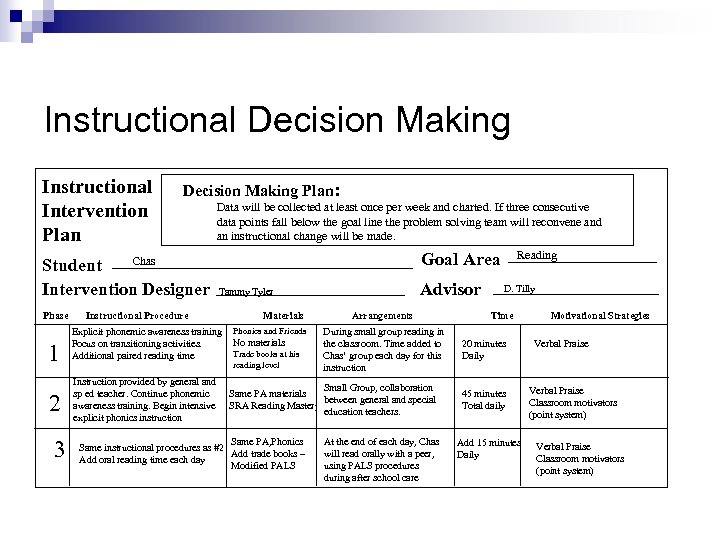 Instructional Decision Making Instructional Intervention Plan Decision Making Plan: Chas Student Intervention Designer Phase 1 2 3 Instructional Procedure Data will be collected at least once per week and charted. If three consecutive data points fall below the goal line the problem solving team will reconvene and an instructional change will be made. Advisor Tammy Tyler Materials Explicit phonemic awareness training. Phonics and Friends No materials Focus on transitioning activities. Trade books at his Additional paired reading time reading level Instruction provided by general and sp ed teacher. Continue phonemic awareness training. Begin intensive explicit phonics instruction Reading Goal Area Arrangements During small group reading in the classroom. Time added to Chas’ group each day for this instruction Small Group, collaboration Same PA materials between general and special SRA Reading Mastery education teachers. Same PA, Phonics Same instructional procedures as #2 Add trade books – Add oral reading time each day Modified PALS At the end of each day, Chas will read orally with a peer, using PALS procedures during after school care D. Tilly Time 20 minutes Daily 45 minutes Total daily Add 15 minutes Daily Motivational Strategies Verbal Praise Classroom motivators (point system)
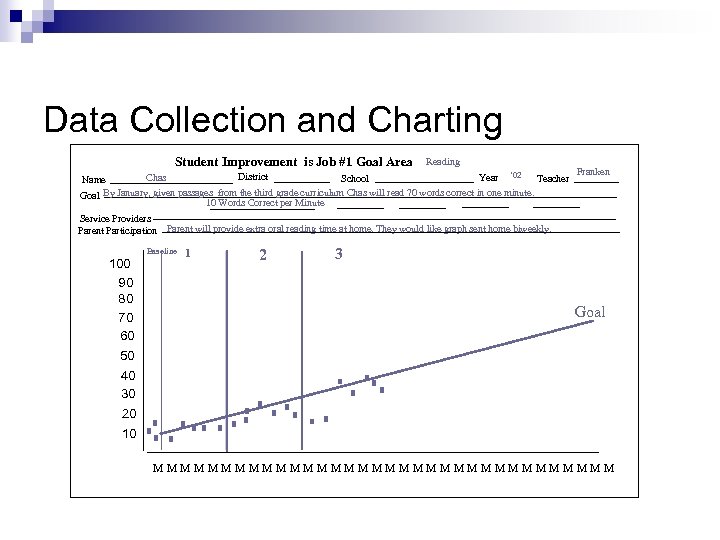 Data Collection and Charting Student Improvement is Job #1 Goal Area Reading District Chas Year ‘ 02 School Teacher Name Goal By January, given passages from the third grade curriculum Chas will read 70 words correct in one minute. 10 Words Correct per Minute Franken Service Providers Parent Participation Parent will provide extra oral reading time at home. They would like graph sent home biweekly. 100 90 80 70 60 50 Baseline 1 2 3 Goal 40 30 20 10 MMMMMMMMMMMMMMMMM
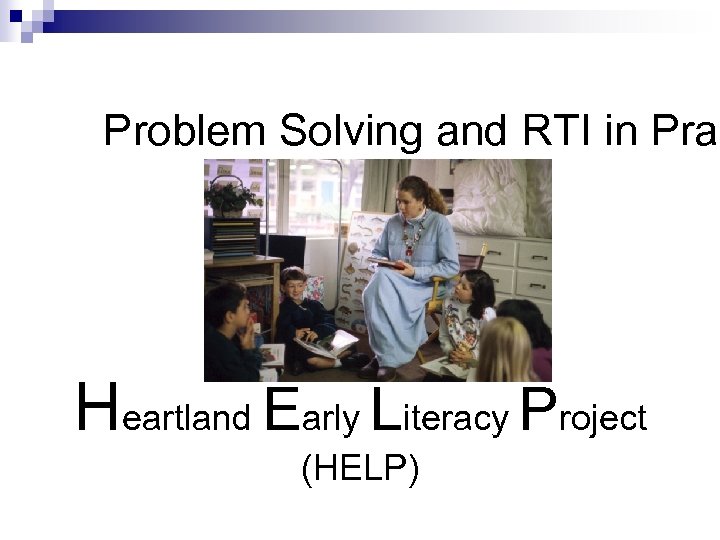 Problem Solving and RTI in Prac Heartland Early Literacy Project (HELP) “Helping Children Read. . . Helping Teachers Teach”
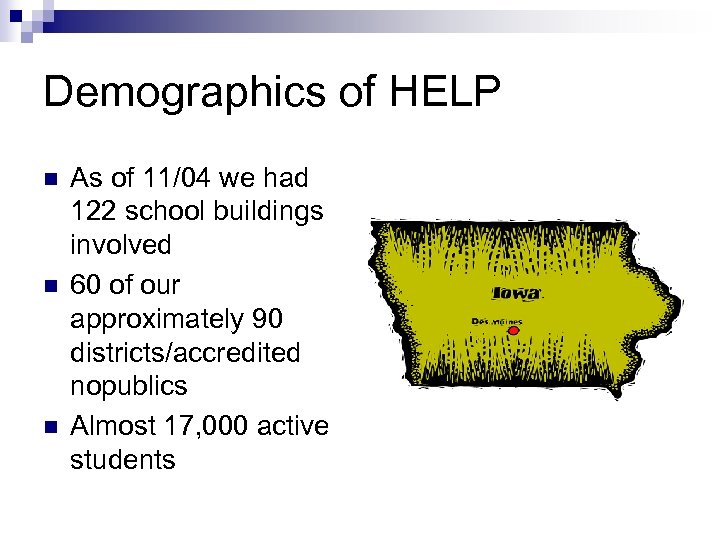 Demographics of HELP n n n As of 11/04 we had 122 school buildings involved 60 of our approximately 90 districts/accredited nopublics Almost 17, 000 active students
 Key Features of HELP n n DIBELS Student interventions based on response to instruction ¨ Benchmark ¨ Strategic ¨ Intensive n n Ongoing Monitoring Instructional changes based on data ¨ Literacy Team ¨ Administrative support Process was adapted from Kame’enui and Simmons (2000)
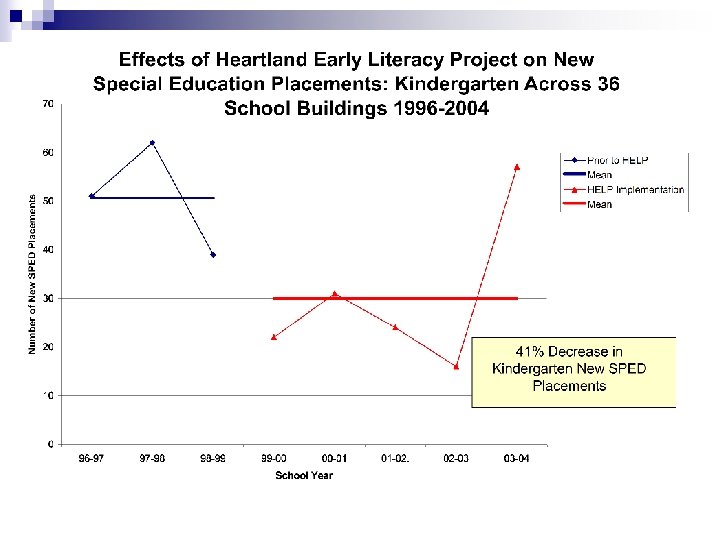
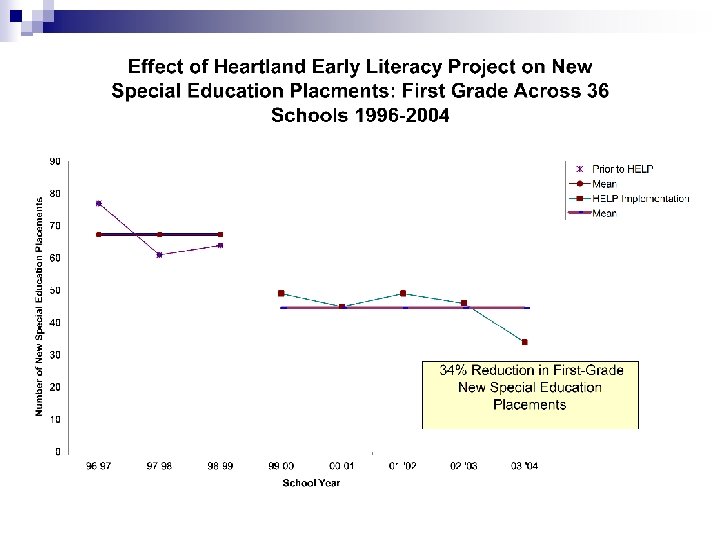
 6 Sets of Results Indicators n Near In DIBELS Measures Benchmark Attainment – Project Wide ¨ HELP Results – Translated into Effect Sizes ¨ n More Distal Changes in CBM Norms 1994 -2002 ¨ Number of HELP Heartland buildings identified on the NCLB “watch list” or “Schools In Need of Assistance” (SINA) ¨ Special Education Incidence Rates in 36 early adopter buildings ¨ ITBS Progress (esp. 4 th Grade) ¨
 Near In Measures
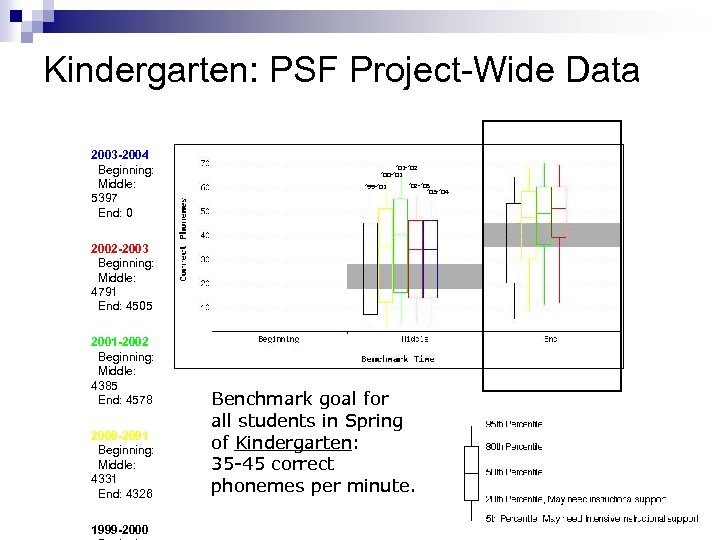 Kindergarten: PSF Project-Wide Data 2003 -2004 Beginning: Middle: 5397 End: 0 ’ 01 -’ 02 ’ 00 -’ 01 ’ 99 -’ 01 ’ 02 -’ 03 -’ 04 2002 -2003 Beginning: Middle: 4791 End: 4505 2001 -2002 Beginning: Middle: 4385 End: 4578 2000 -2001 Beginning: Middle: 4331 End: 4326 1999 -2000 Benchmark goal for all students in Spring of Kindergarten: 35 -45 correct phonemes per minute.
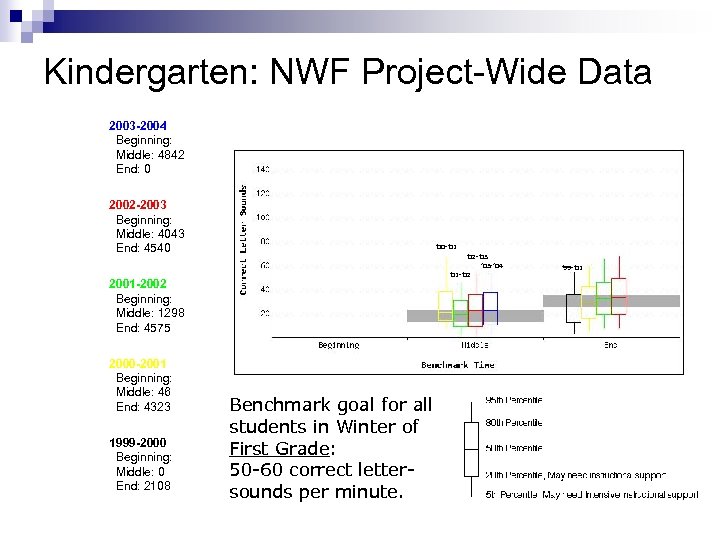 Kindergarten: NWF Project-Wide Data 2003 -2004 Beginning: Middle: 4842 End: 0 2002 -2003 Beginning: Middle: 4043 End: 4540 ’ 00 -’ 01 ’ 02 -’ 03 -’ 04 ’ 01 -’ 02 2001 -2002 Beginning: Middle: 1298 End: 4575 2000 -2001 Beginning: Middle: 46 End: 4323 1999 -2000 Beginning: Middle: 0 End: 2108 Benchmark goal for all students in Winter of First Grade: 50 -60 correct lettersounds per minute. ’ 99 -’ 01
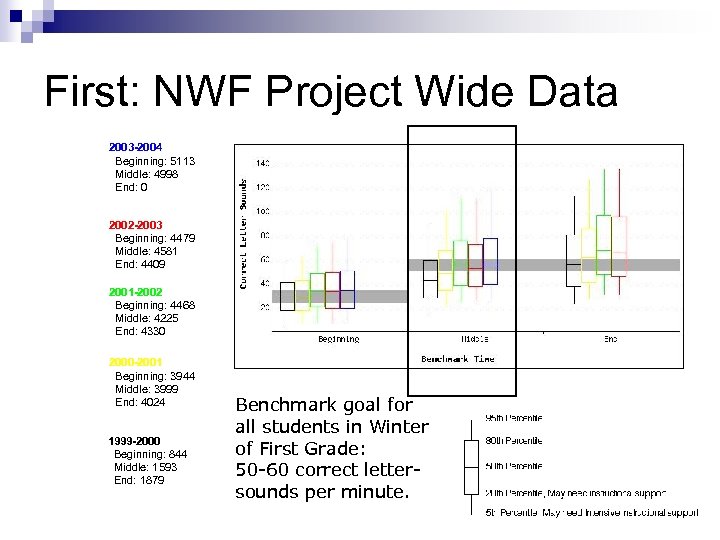 First: NWF Project Wide Data 2003 -2004 Beginning: 5113 Middle: 4998 End: 0 2002 -2003 Beginning: 4479 Middle: 4581 End: 4409 2001 -2002 Beginning: 4468 Middle: 4225 End: 4330 2000 -2001 Beginning: 3944 Middle: 3999 End: 4024 1999 -2000 Beginning: 844 Middle: 1593 End: 1879 Benchmark goal for all students in Winter of First Grade: 50 -60 correct lettersounds per minute.
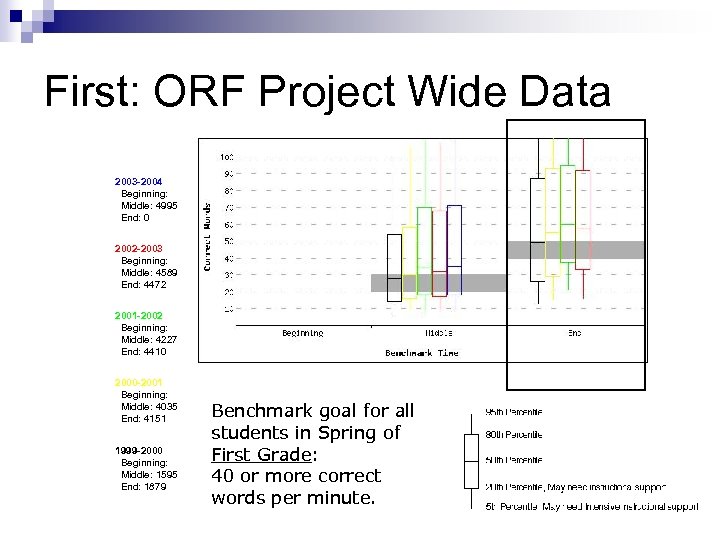 First: ORF Project Wide Data 2003 -2004 Beginning: Middle: 4995 End: 0 2002 -2003 Beginning: Middle: 4589 End: 4472 2001 -2002 Beginning: Middle: 4227 End: 4410 2000 -2001 Beginning: Middle: 4035 End: 4151 1999 -2000 Beginning: Middle: 1595 End: 1879 Benchmark goal for all students in Spring of First Grade: 40 or more correct words per minute.
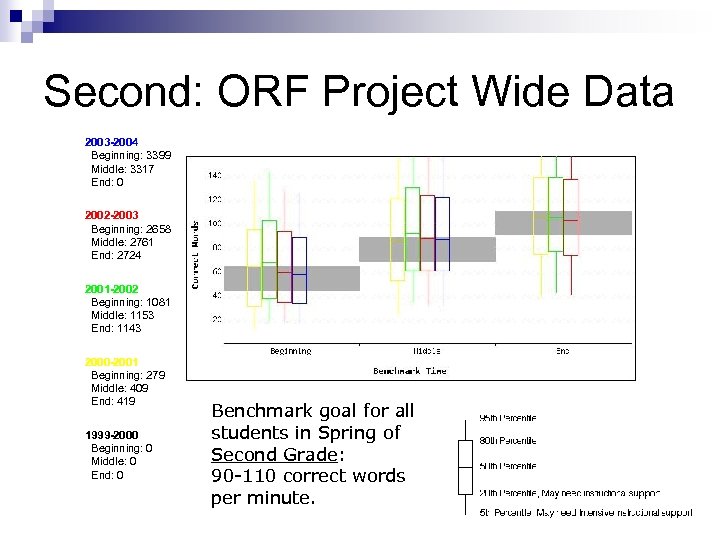 Second: ORF Project Wide Data 2003 -2004 Beginning: 3399 Middle: 3317 End: 0 2002 -2003 Beginning: 2658 Middle: 2761 End: 2724 2001 -2002 Beginning: 1081 Middle: 1153 End: 1143 2000 -2001 Beginning: 279 Middle: 409 End: 419 1999 -2000 Beginning: 0 Middle: 0 End: 0 Benchmark goal for all students in Spring of Second Grade: 90 -110 correct words per minute.
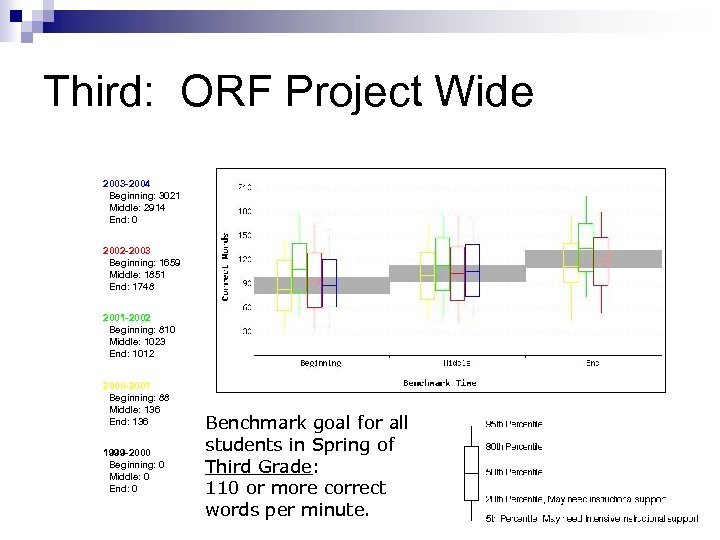 Third: ORF Project Wide 2003 -2004 Beginning: 3021 Middle: 2914 End: 0 2002 -2003 Beginning: 1659 Middle: 1851 End: 1748 2001 -2002 Beginning: 810 Middle: 1023 End: 1012 2000 -2001 Beginning: 88 Middle: 136 End: 136 1999 -2000 Beginning: 0 Middle: 0 End: 0 Benchmark goal for all students in Spring of Third Grade: 110 or more correct words per minute.
 What Happened In the Larger System?
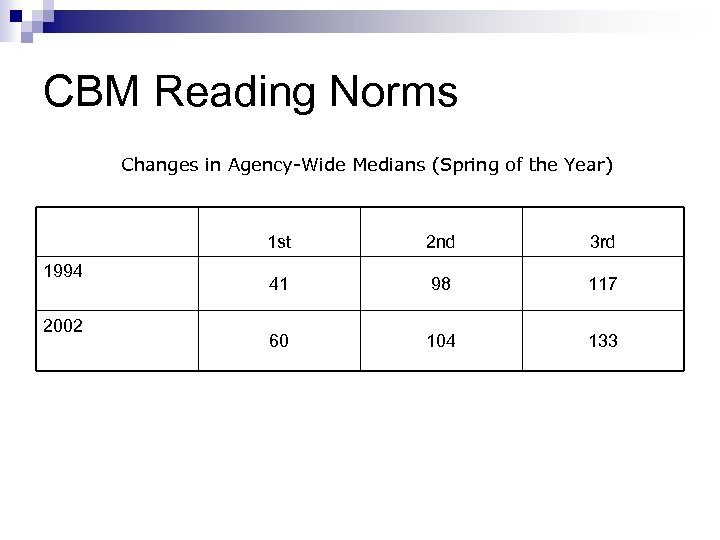 CBM Reading Norms Changes in Agency-Wide Medians (Spring of the Year) 1 st 1994 2002 2 nd 3 rd 41 98 117 60 104 133
 SINA
SINA
 List of Heartland Elementary Schools, Implementing HELP Who Were on the NCLB Watch List or SINA in 2003 -2004
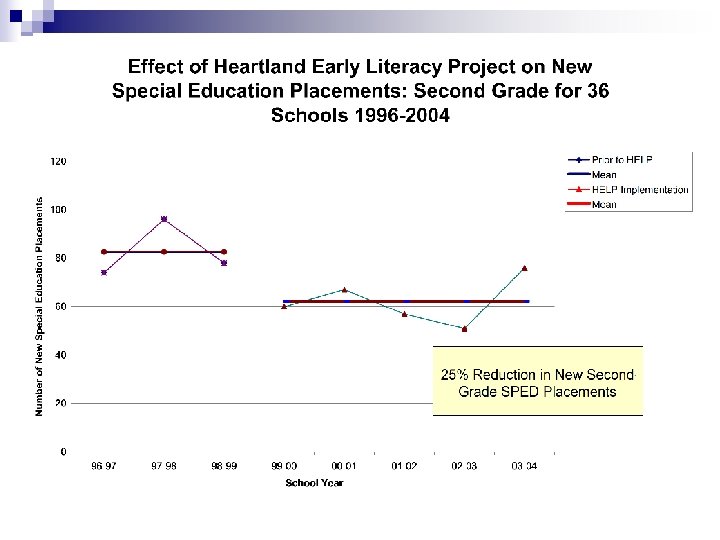
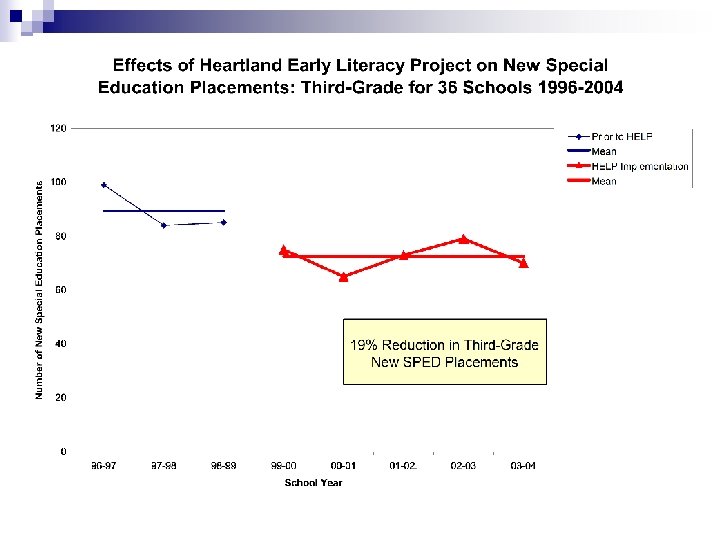
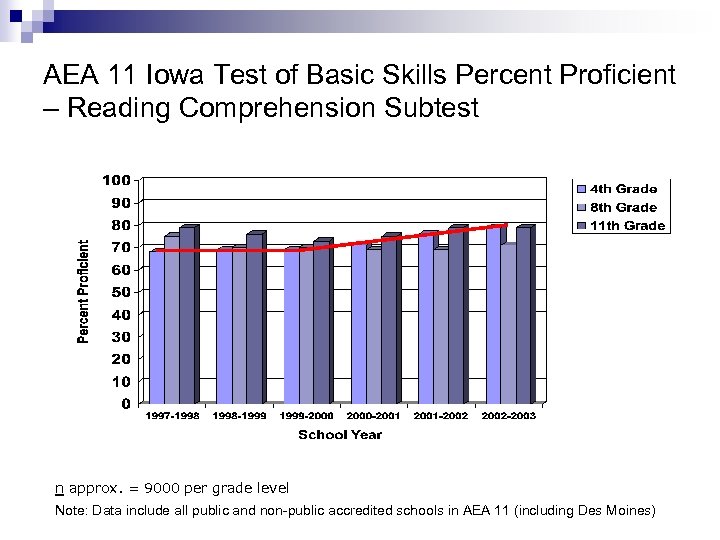 AEA 11 Iowa Test of Basic Skills Percent Proficient – Reading Comprehension Subtest n approx. = 9000 per grade level Note: Data include all public and non-public accredited schools in AEA 11 (including Des Moines)
 Perhaps Most Centrally To do this takes leadership
 A leader is a person you will follow to a place that you wouldn't go by yourself. Joel Barker, 1992, Future Edge