 Скачать презентацию Why multilayered distribution works best in Europe Annual
d68d8e81082deb16a9276ecdb4054a71.ppt
- Количество слайдов: 52



Why multilayered distribution works best in Europe Annual Global Conference Sept. 2009 Chicago, Illinois
Agenda 1. Europe, a complicated concept 2. Changing European distribution models 3. Advises on how to succeed in Europe Annual Global Conference 2009 – 9026 X 064/ML/th 2
1. Europe, a complicated concept § Facts & figures about Europe § European logistics § Transportation modes in Europe Annual Global Conference 2009 – 9026 X 064/ML/th 3
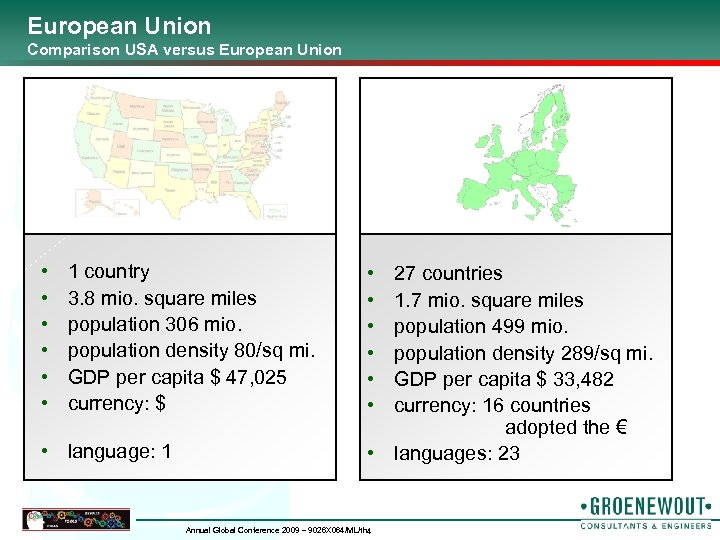
European Union Comparison USA versus European Union • • • 1 country 3. 8 mio. square miles population 306 mio. population density 80/sq mi. GDP per capita $ 47, 025 currency: $ • language: 1 • • • 27 countries 1. 7 mio. square miles population 499 mio. population density 289/sq mi. GDP per capita $ 33, 482 currency: 16 countries adopted the € • languages: 23 Annual Global Conference 2009 – 9026 X 064/ML/th 4
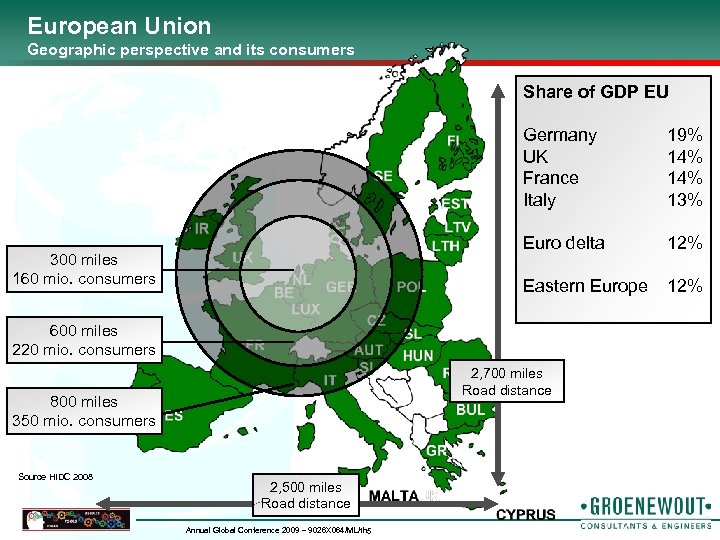
European Union Geographic perspective and its consumers Share of GDP EU Germany UK France Italy Euro delta 12% Eastern Europe 300 miles 160 mio. consumers 19% 14% 13% 12% 600 miles 220 mio. consumers 2, 700 miles Road distance 800 miles 350 mio. consumers Source HIDC 2008 2, 500 miles Road distance Annual Global Conference 2009 – 9026 X 064/ML/th 5
European Union The logistics playing field (1) • Legacy country logistics autonomy has created a consumer market with high service demands in lead-time Annual Global Conference 2009 – 9026 X 064/ML/th 6
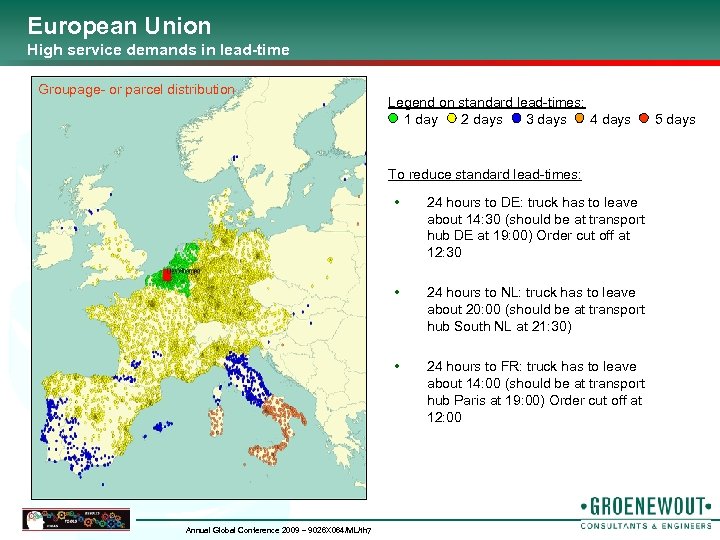
European Union High service demands in lead-time Groupage- or parcel distribution Legend on standard lead-times: 1 day 2 days 3 days 4 days To reduce standard lead-times: • • 24 hours to NL: truck has to leave about 20: 00 (should be at transport hub South NL at 21: 30) • Annual Global Conference 2009 – 9026 X 064/ML/th 7 24 hours to DE: truck has to leave about 14: 30 (should be at transport hub DE at 19: 00) Order cut off at 12: 30 24 hours to FR: truck has to leave about 14: 00 (should be at transport hub Paris at 19: 00) Order cut off at 12: 00 5 days
European Union The logistics playing field (1) • Country logistics autonomy has created a consumer market with high service demands in lead-time • The limited (product) harmonization and the different languages lead to an elevated number of Stock Keeping Units (SKU’s) Annual Global Conference 2009 – 9026 X 064/ML/th 8
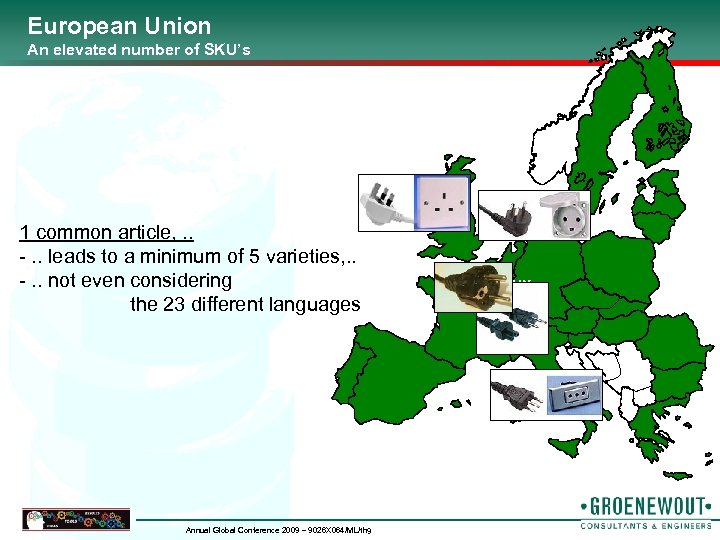
European Union An elevated number of SKU’s 1 common article, . . -. . leads to a minimum of 5 varieties, . . -. . not even considering the 23 different languages Annual Global Conference 2009 – 9026 X 064/ML/th 9 DK IR LUX
European Union The logistics playing field (1) • Country logistics autonomy has created a consumer market with high service demands in lead-time • The limited (product) harmonization and the different languages lead to an elevated number of Stock Keeping Units (SKU’s) • The practice of National Sales Organizations (NSO’s) requires distribution structures following country borders rather than transport efficiency (i. e. distances) Annual Global Conference 2009 – 9026 X 064/ML/th 10
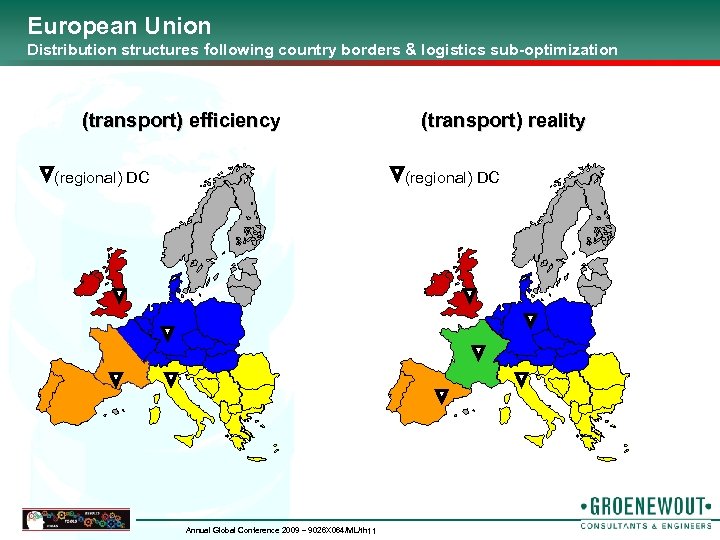
European Union Distribution structures following country borders & logistics sub-optimization (transport) efficiency (regional) DC (transport) reality (regional) DC Annual Global Conference 2009 – 9026 X 064/ML/th 11
European Union The logistics playing field (1) • Country logistics autonomy has created a consumer market with high service demands in lead-time • The limited (product) harmonization and the different languages lead to an elevated number of Stock Keeping Units (SKU’s) • The practice of National Sales Organizations (NSO’s) requires distribution structures following country borders rather than transport efficiency (i. e. distances) • Lack of cultural integration/and geographic economic disparity contribute to logistics sub-optimization Annual Global Conference 2009 – 9026 X 064/ML/th 12
Relocating operations to CEE § Many Manufacturing activities have been relocated § All kinds of assembly work § Mainly for operations with FCL-FTL in/out § Some have moved for a second time already, e. g. Czech to Rumania § Less shifts in capital intensive industries (chemical, pharmaceuticals) § Hardly any shifts in warehouses for distribution (yet): § § § GDP of all 10 countries that joined EU in ’ 04 < GDP of the Netherlands Market place is still mainly in WE (biggest spending power) CDC for WE in CEE: huge distribution costs (outbound transport) Lead time and costs of inbound will increase drastically for most products For CEE markets two RDCs: north CEE / south CEE Annual Global Conference 2009 – 9026 X 064/ML/th 13
European Union The logistics playing field (1) • Country logistics autonomy has created a consumer market with high service demands in lead-time • The limited (product) harmonization and the different languages lead to an elevated number of Stock Keeping Units (SKU’s) • The practice of National Sales Organizations (NSO’s) requires distribution structures following country borders rather than transport efficiency (i. e. distances) • Lack of cultural integration drives logistics sub-optimization • There is no true pan-European transport & warehousing network, as nearly every Logistics Service Providers (LSP’s) has a geographic focus Annual Global Conference 2009 – 9026 X 064/ML/th 14
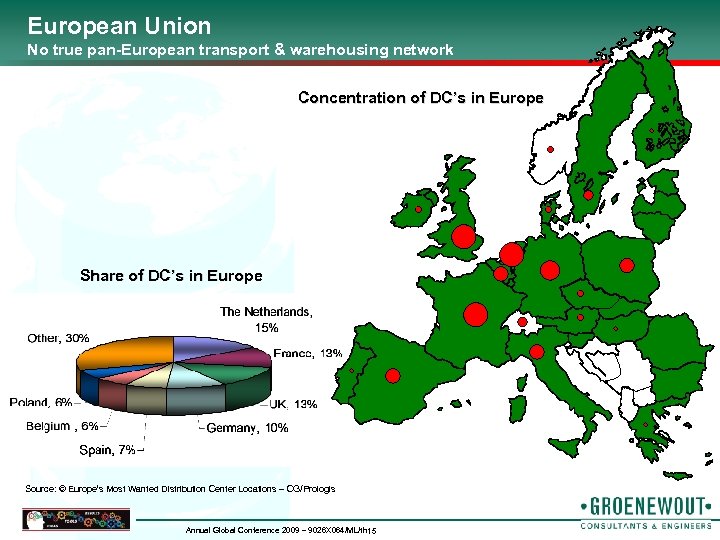
European Union No true pan-European transport & warehousing network Concentration of DC’s in Europe Share of DC’s in Europe Source: © Europe’s Most Wanted Distribution Center Locations – CG/Prologis Annual Global Conference 2009 – 9026 X 064/ML/th 15
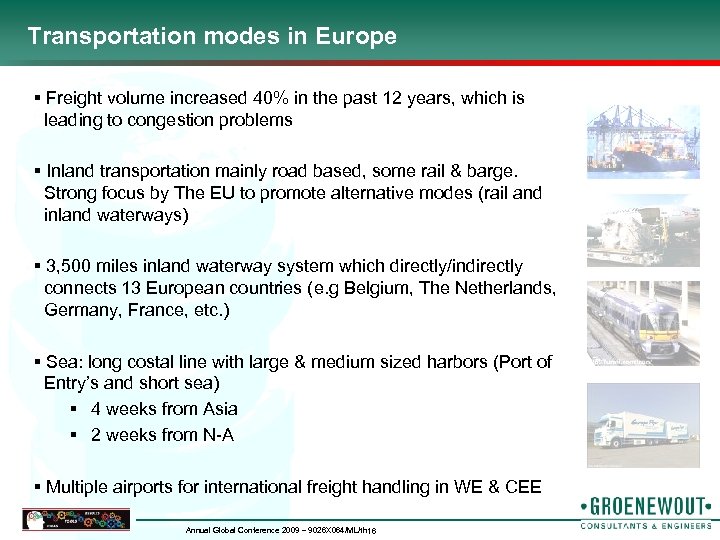
Transportation modes in Europe § Freight volume increased 40% in the past 12 years, which is leading to congestion problems § Inland transportation mainly road based, some rail & barge. Strong focus by The EU to promote alternative modes (rail and inland waterways) § 3, 500 miles inland waterway system which directly/indirectly connects 13 European countries (e. g Belgium, The Netherlands, Germany, France, etc. ) § Sea: long costal line with large & medium sized harbors (Port of Entry’s and short sea) § 4 weeks from Asia § 2 weeks from N-A § Multiple airports for international freight handling in WE & CEE Annual Global Conference 2009 – 9026 X 064/ML/th 16
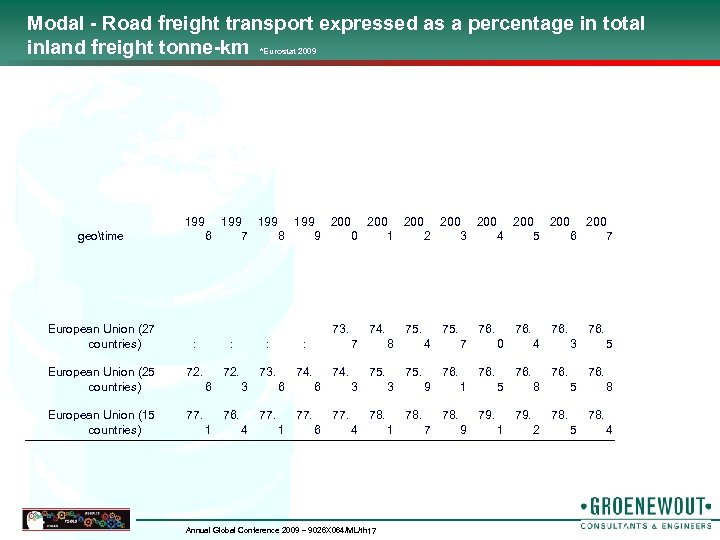
Modal - Road freight transport expressed as a percentage in total inland freight tonne-km *Eurostat 2009 199 geotime European Union (27 countries) 199 6 199 7 199 8 200 9 200 0 73. : European Union (25 countries) 72. European Union (15 countries) : 77. : 72. 6 73. 3 76. 1 : 77. 4 74. 6 77. 1 1 7 74. 6 75. Annual Global Conference 2009 – 9026 X 064/ML/th 17 75. 78. 76. 5 76. 5 78. 2 7 3 8 79. 1 200 6 4 5 79. 9 200 5 0 1 78. 7 200 4 7 9 78. 1 200 3 4 200 2 8 3 77. 6 200 8 78. 5 4
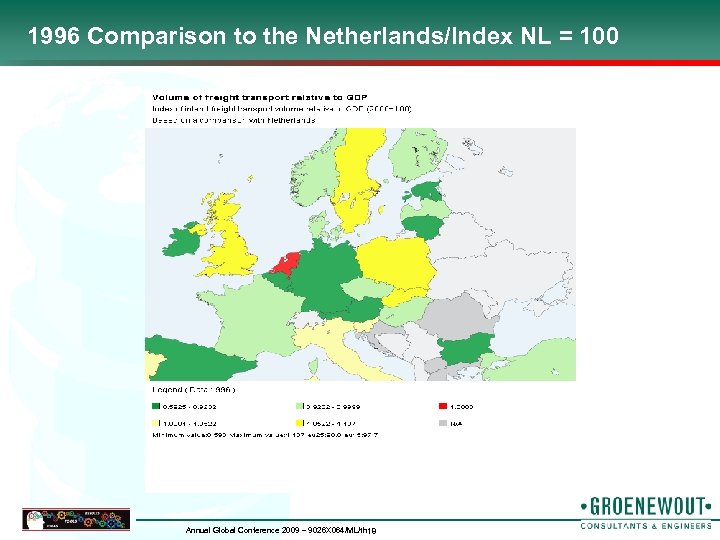
1996 Comparison to the Netherlands/Index NL = 100 Annual Global Conference 2009 – 9026 X 064/ML/th 18
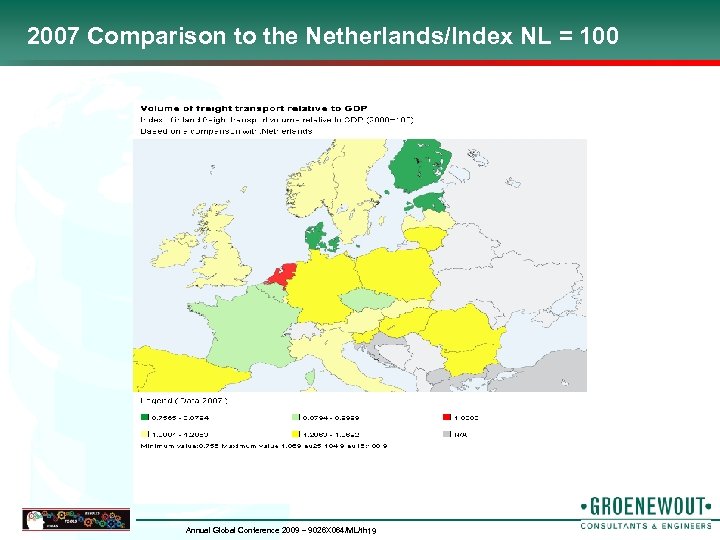
2007 Comparison to the Netherlands/Index NL = 100 Annual Global Conference 2009 – 9026 X 064/ML/th 19
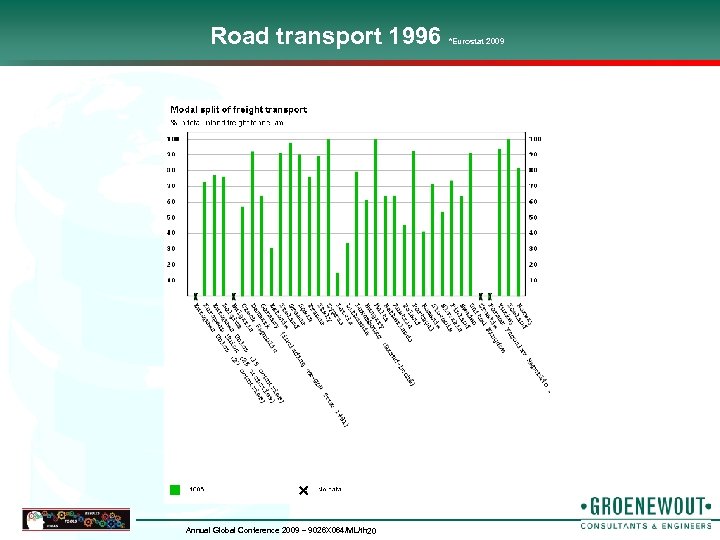
Road transport 1996 Annual Global Conference 2009 – 9026 X 064/ML/th 20 *Eurostat 2009
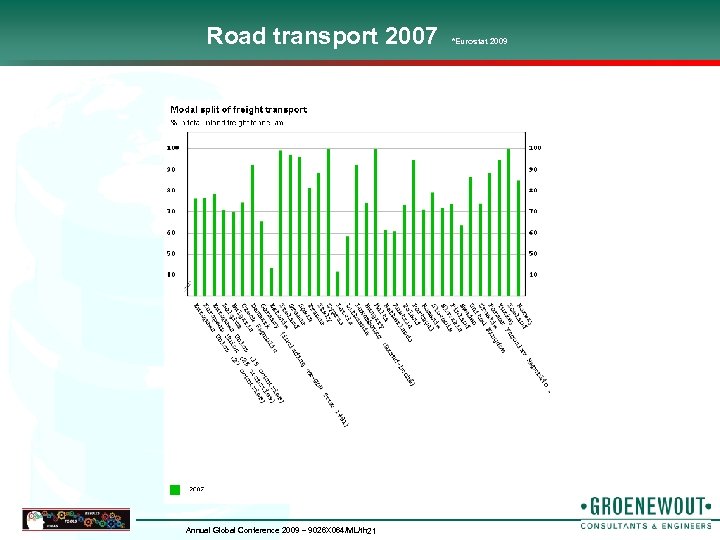
Road transport 2007 Annual Global Conference 2009 – 9026 X 064/ML/th 21 *Eurostat 2009
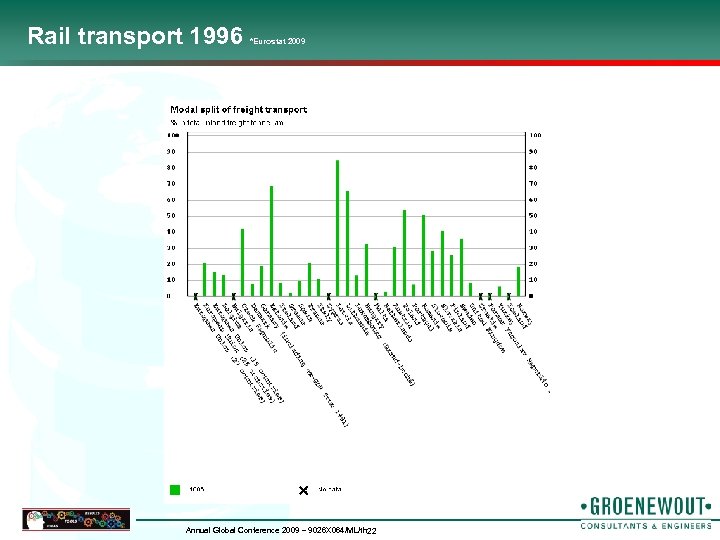
Rail transport 1996 *Eurostat 2009 Annual Global Conference 2009 – 9026 X 064/ML/th 22
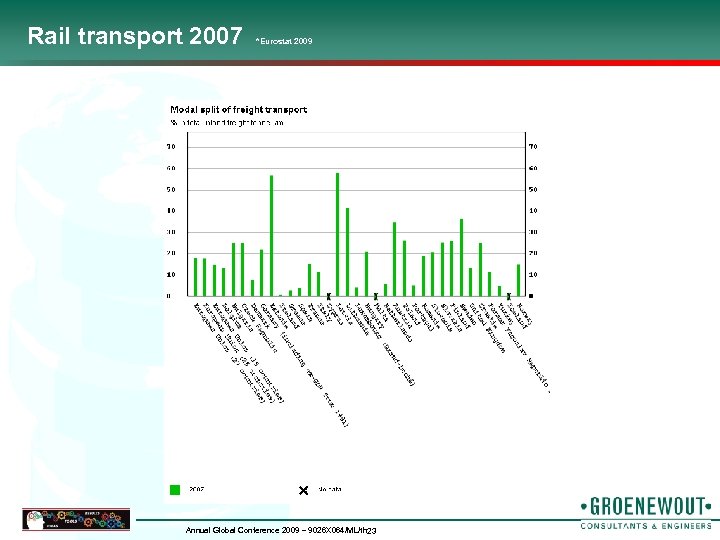
Rail transport 2007 *Eurostat 2009 Annual Global Conference 2009 – 9026 X 064/ML/th 23
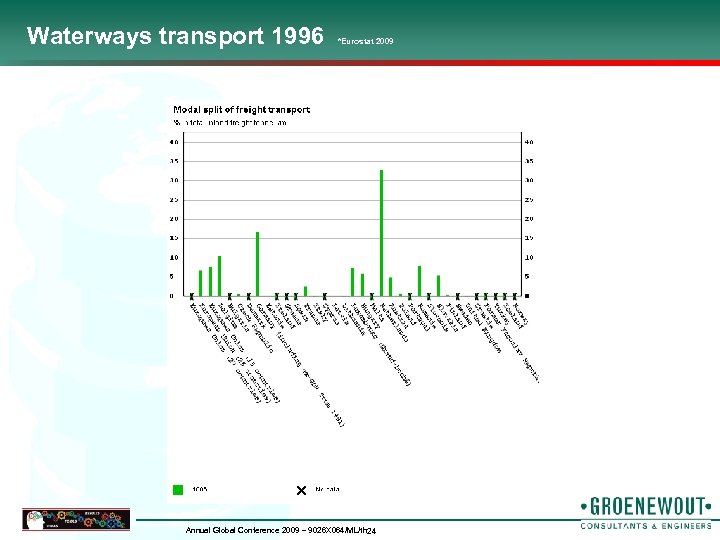
Waterways transport 1996 *Eurostat 2009 Annual Global Conference 2009 – 9026 X 064/ML/th 24
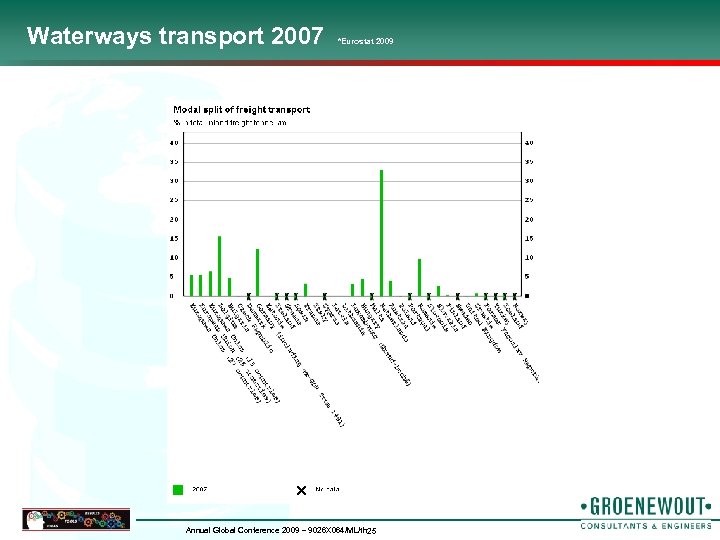
Waterways transport 2007 *Eurostat 2009 Annual Global Conference 2009 – 9026 X 064/ML/th 25
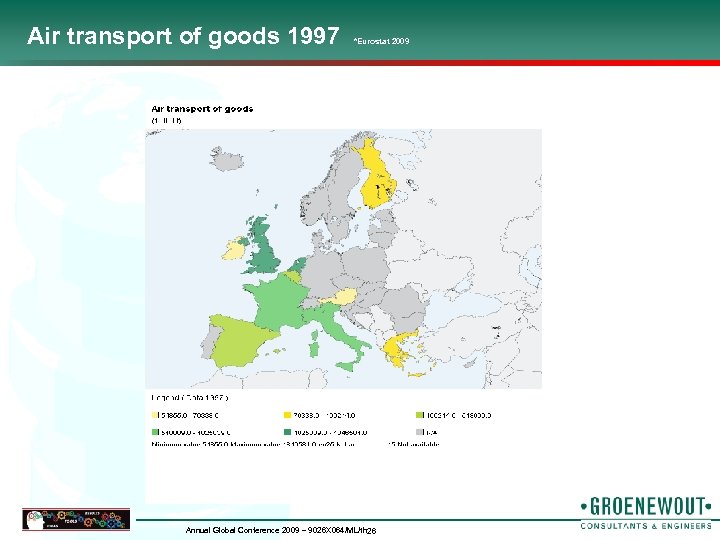
Air transport of goods 1997 *Eurostat 2009 Annual Global Conference 2009 – 9026 X 064/ML/th 26
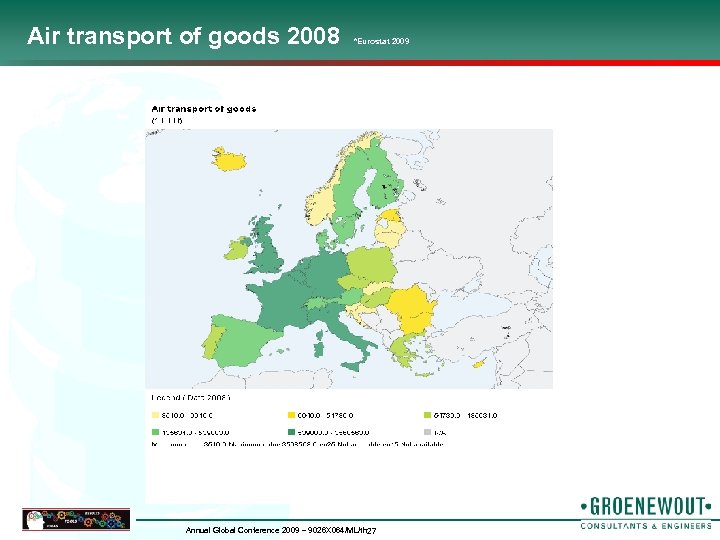
Air transport of goods 2008 *Eurostat 2009 Annual Global Conference 2009 – 9026 X 064/ML/th 27
Agenda 1. Europe, a complicated concept 2. Changing European distribution models 3. Advises on how to succeed in Europe Annual Global Conference 2009 – 9026 X 064/ML/th 28
2. Changing European distribution modals Best-practices of European Supply Chain footprints are always in evolution § Distribution Network trade-offs - theory § Supply Chain footprint prior to 1985 § Supply Chain footprint between 1985 and 2000 § Supply Chain footprint of last few years § Today’s trends Annual Global Conference 2009 – 9026 X 064/ML/th 29
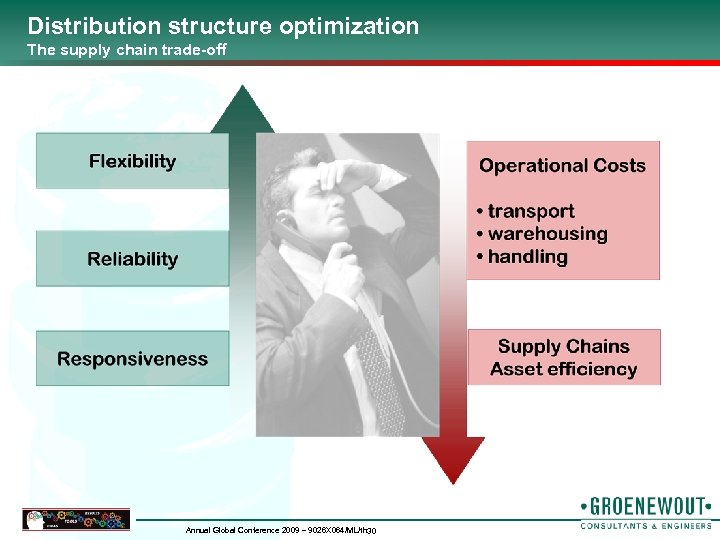
Distribution structure optimization The supply chain trade-off Annual Global Conference 2009 – 9026 X 064/ML/th 30
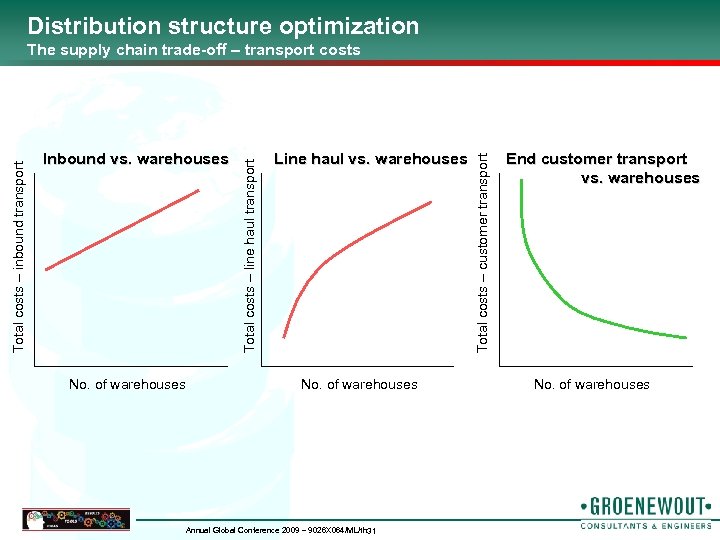
Distribution structure optimization No. of warehouses Line haul vs. warehouses No. of warehouses Annual Global Conference 2009 – 9026 X 064/ML/th 31 Total costs – customer transport Inbound vs. warehouses Total costs – line haul transport Total costs – inbound transport The supply chain trade-off – transport costs End customer transport vs. warehouses No. of warehouses
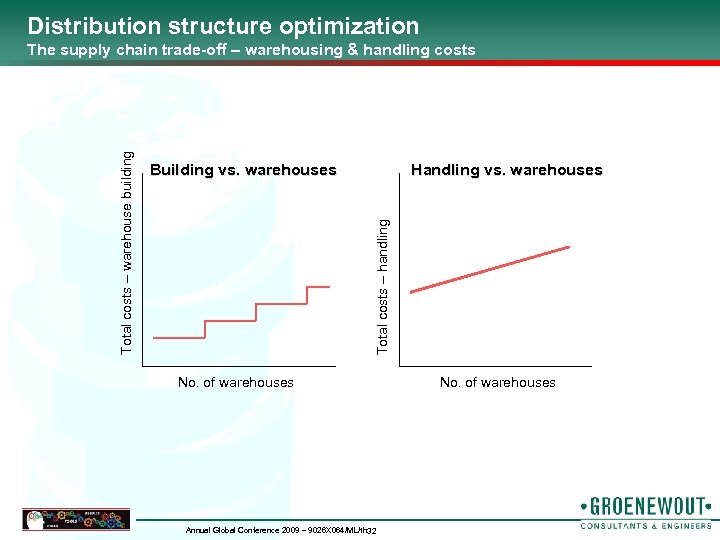
Distribution structure optimization Building vs. warehouses Handling vs. warehouses Total costs – handling Total costs – warehouse building The supply chain trade-off – warehousing & handling costs No. of warehouses Annual Global Conference 2009 – 9026 X 064/ML/th 32 No. of warehouses
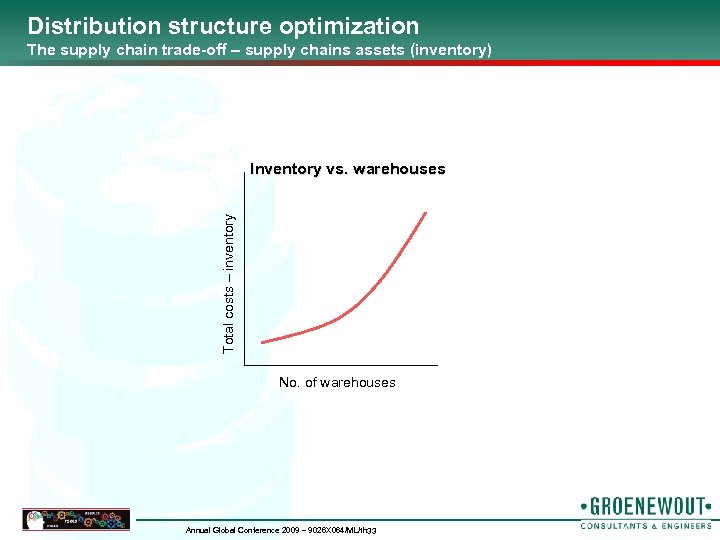
Distribution structure optimization The supply chain trade-off – supply chains assets (inventory) Total costs – inventory Inventory vs. warehouses No. of warehouses Annual Global Conference 2009 – 9026 X 064/ML/th 33
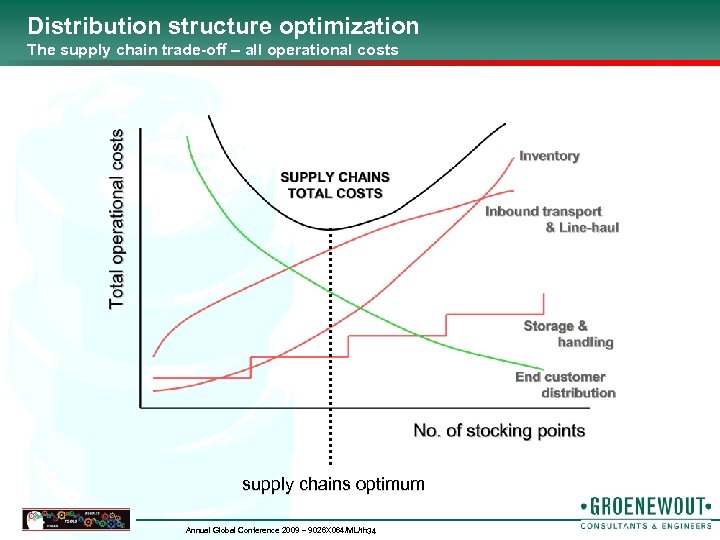
Distribution structure optimization The supply chain trade-off – all operational costs supply chains optimum Annual Global Conference 2009 – 9026 X 064/ML/th 34
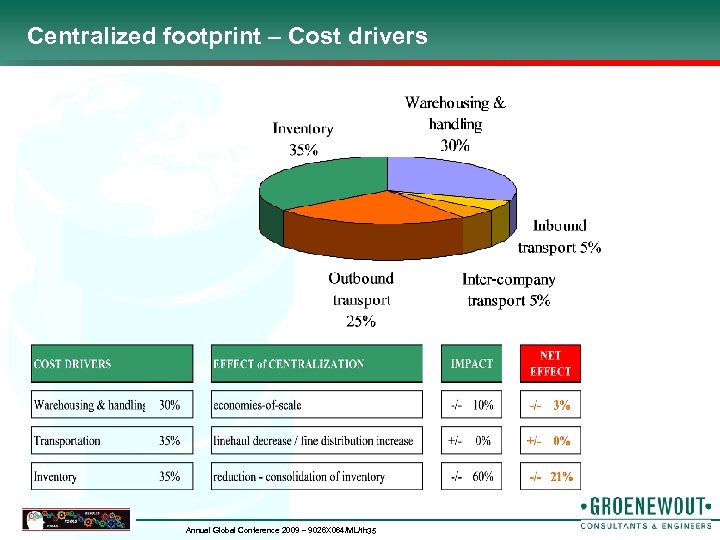
Centralized footprint – Cost drivers Annual Global Conference 2009 – 9026 X 064/ML/th 35
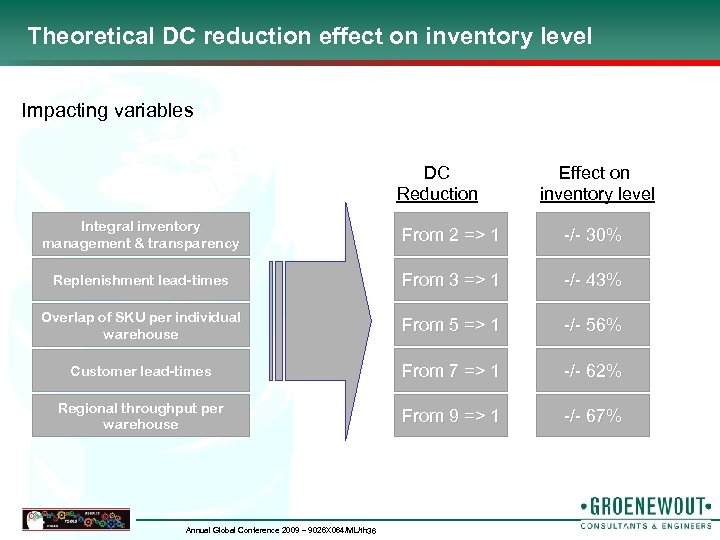
Theoretical DC reduction effect on inventory level Impacting variables DC Reduction Effect on inventory level Integral inventory management & transparency From 2 => 1 -/- 30% Replenishment lead-times From 3 => 1 -/- 43% Overlap of SKU per individual warehouse From 5 => 1 -/- 56% Customer lead-times From 7 => 1 -/- 62% Regional throughput per warehouse From 9 => 1 -/- 67% Annual Global Conference 2009 – 9026 X 064/ML/th 36
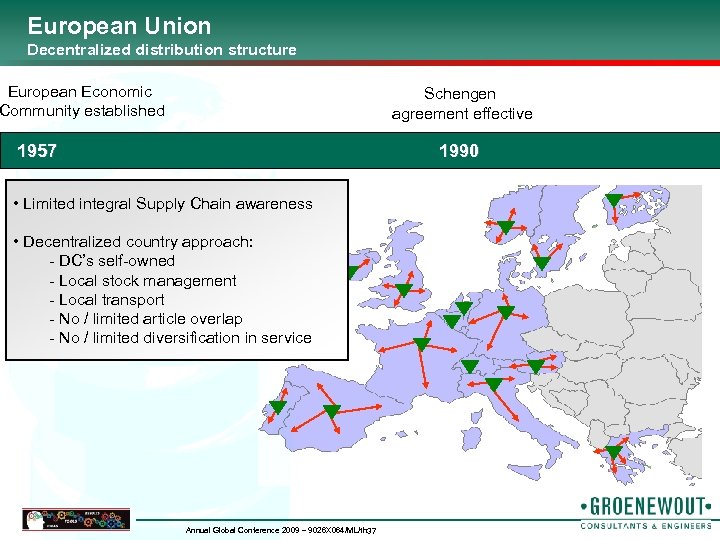
European Union Decentralized distribution structure European Economic Community established Schengen agreement effective 1957 1990 • Limited integral Supply Chain awareness • Decentralized country approach: - DC’s self-owned - Local stock management - Local transport - No / limited article overlap - No / limited diversification in service Annual Global Conference 2009 – 9026 X 064/ML/th 37
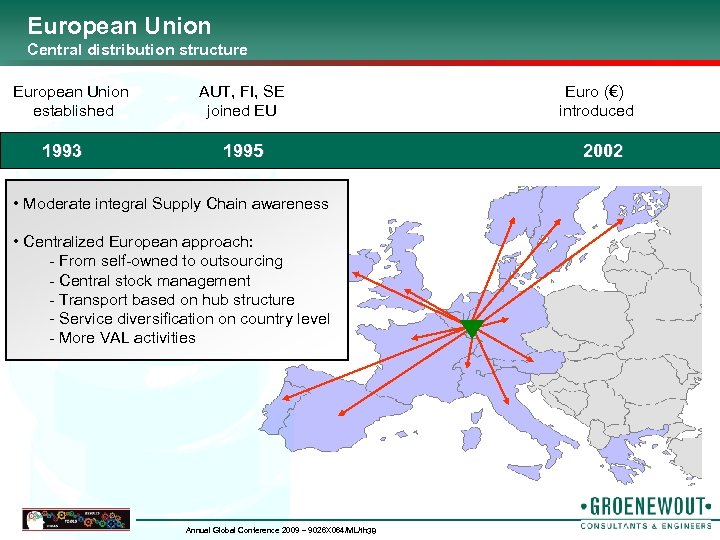
European Union Central distribution structure European Union established 1993 AUT, FI, SE joined EU 1995 • Moderate integral Supply Chain awareness • Centralized European approach: - From self-owned to outsourcing - Central stock management - Transport based on hub structure - Service diversification on country level - More VAL activities Annual Global Conference 2009 – 9026 X 064/ML/th 38 Euro (€) introduced 2002
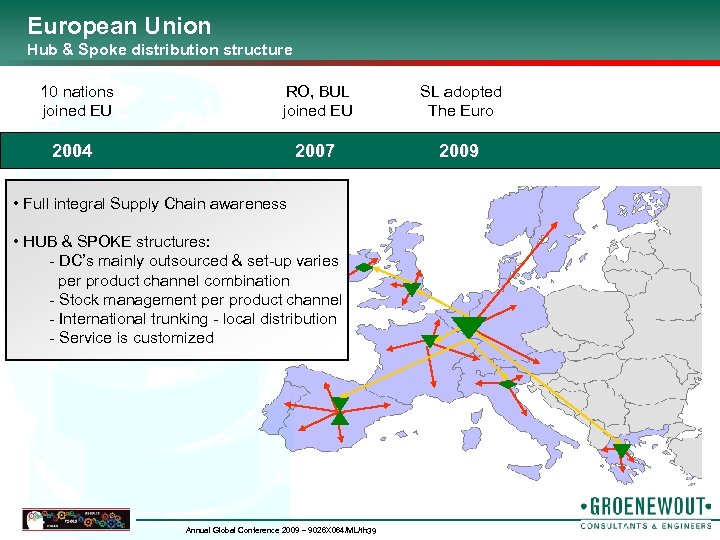
European Union Hub & Spoke distribution structure 10 nations joined EU RO, BUL joined EU SL adopted The Euro 2007 2009 2004 • Full integral Supply Chain awareness • HUB & SPOKE structures: - DC’s mainly outsourced & set-up varies per product channel combination - Stock management per product channel - International trunking - local distribution - Service is customized Annual Global Conference 2009 – 9026 X 064/ML/th 39
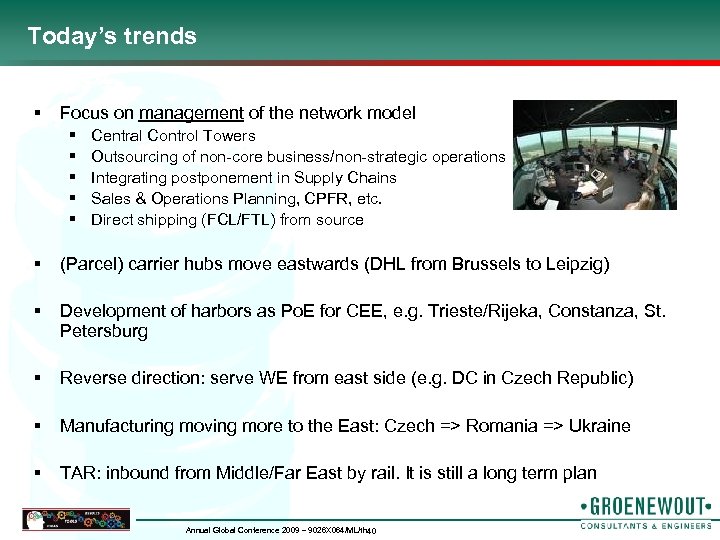
Today’s trends § Focus on management of the network model § § § Central Control Towers Outsourcing of non-core business/non-strategic operations Integrating postponement in Supply Chains Sales & Operations Planning, CPFR, etc. Direct shipping (FCL/FTL) from source § (Parcel) carrier hubs move eastwards (DHL from Brussels to Leipzig) § Development of harbors as Po. E for CEE, e. g. Trieste/Rijeka, Constanza, St. Petersburg § Reverse direction: serve WE from east side (e. g. DC in Czech Republic) § Manufacturing moving more to the East: Czech => Romania => Ukraine § TAR: inbound from Middle/Far East by rail. It is still a long term plan Annual Global Conference 2009 – 9026 X 064/ML/th 40
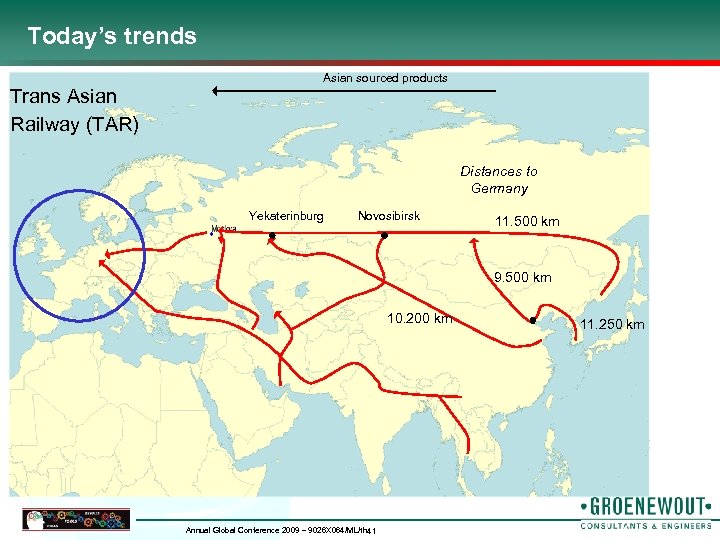
Today’s trends Trans Asian Railway (TAR) Asian sourced products Distances to Germany Yekaterinburg Novosibirsk 11. 500 km 9. 500 km 10. 200 km Annual Global Conference 2009 – 9026 X 064/ML/th 41 11. 250 km
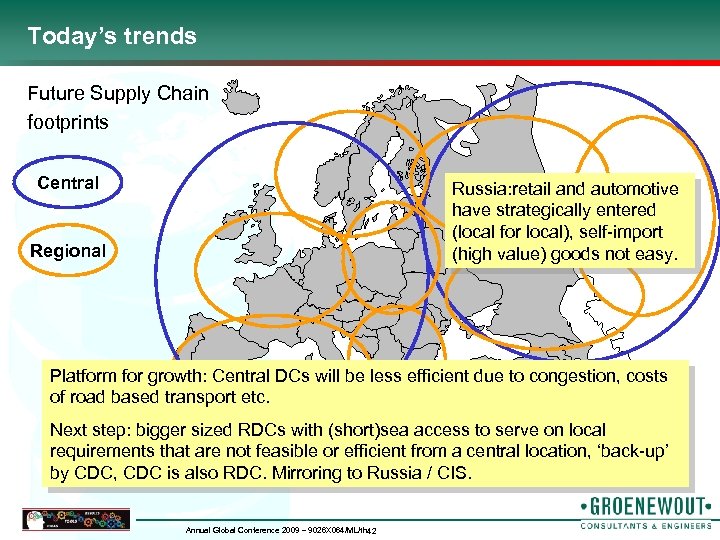
Today’s trends Future Supply Chain footprints Central Russia: retail and automotive Russia; retailand automotive have strategically entered (local for local), self-import (high value) goods not easy. Regional Platform for growth: Central DCs will be less efficient due to congestion, costs of road based transport etc. Next step: bigger sized RDCs with (short)sea access to serve on local requirements that are not feasible or efficient from a central location, ‘back-up’ by CDC, CDC is also RDC. Mirroring to Russia / CIS. Annual Global Conference 2009 – 9026 X 064/ML/th 42
Agenda 1. Europe, a complicated concept 2. Changing European distribution models 3. Advises on how to succeed in Europe Annual Global Conference 2009 – 9026 X 064/ML/th 43
Advises on how to succeed in Europe § Do not copy-paste USA solutions in Europe may seem to be one big country, it isn’t! § Design multilayered Supply Chains that encompasses local, regional and pan. European structures to serve all national markets effectively. § Challenge local requirements thoroughly § Meet the customer, preferably their supply chain professional § Try to understand your competitor’s market propositions § Use suppliers/providers with a ‘local’ presence § Local operational IT-solutions (e. g. WMS) and support § One local/regional independent Consultant to help you setting up your businesses § Do consider the difference between countries before choosing the location for a logistics operation Annual Global Conference 2009 – 9026 X 064/ML/th 44
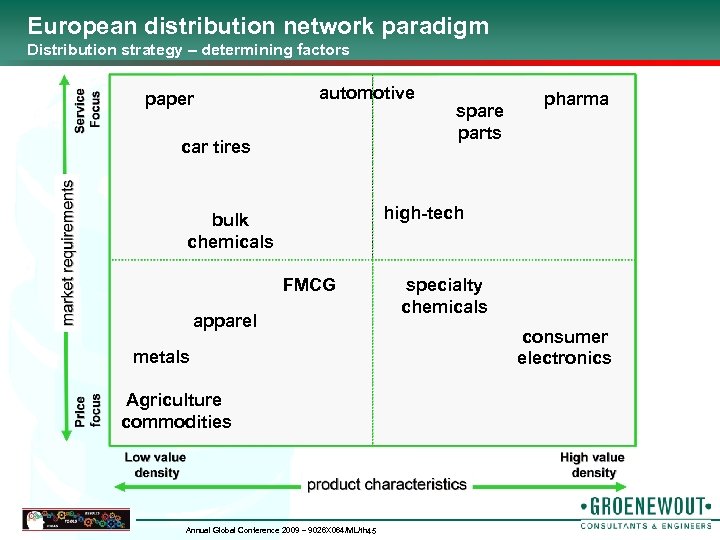
European distribution network paradigm Distribution strategy – determining factors paper automotive car tires spare parts pharma high-tech bulk chemicals FMCG apparel metals Agriculture commodities Annual Global Conference 2009 – 9026 X 064/ML/th 45 specialty chemicals consumer electronics
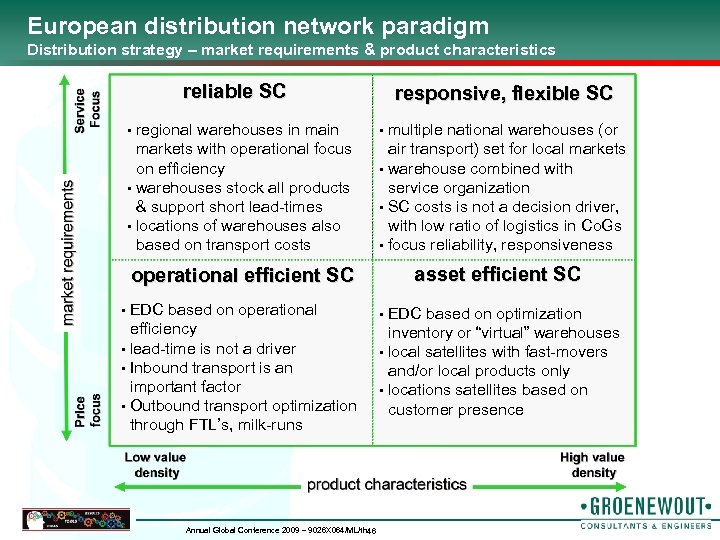
European distribution network paradigm Distribution strategy – market requirements & product characteristics reliable SC regional warehouses in markets with operational focus on efficiency • warehouses stock all products & support short lead-times • locations of warehouses also based on transport costs • responsive, flexible SC multiple national warehouses (or air transport) set for local markets • warehouse combined with service organization • SC costs is not a decision driver, with low ratio of logistics in Co. Gs • focus reliability, responsiveness • asset efficient SC operational efficient SC EDC based on operational efficiency • lead-time is not a driver • Inbound transport is an important factor • Outbound transport optimization through FTL’s, milk-runs • Annual Global Conference 2009 – 9026 X 064/ML/th 46 EDC based on optimization inventory or “virtual” warehouses • local satellites with fast-movers and/or local products only • locations satellites based on customer presence •
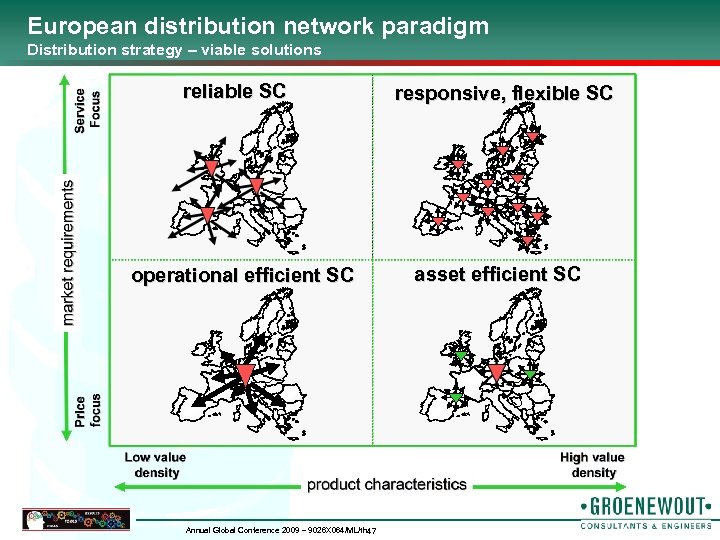
European distribution network paradigm Distribution strategy – viable solutions reliable SC operational efficient SC Annual Global Conference 2009 – 9026 X 064/ML/th 47 responsive, flexible SC asset efficient SC
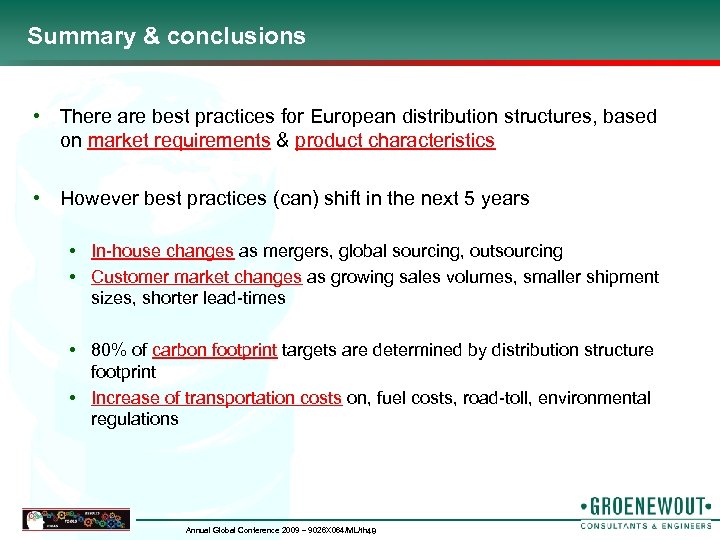
Summary & conclusions • There are best practices for European distribution structures, based on market requirements & product characteristics • However best practices (can) shift in the next 5 years • In-house changes as mergers, global sourcing, outsourcing • Customer market changes as growing sales volumes, smaller shipment sizes, shorter lead-times • 80% of carbon footprint targets are determined by distribution structure footprint • Increase of transportation costs on, fuel costs, road-toll, environmental regulations Annual Global Conference 2009 – 9026 X 064/ML/th 48

Nijverheidssingel 313, P. O. Box 3290 4800 DG Breda The Netherlands Tel: +31 (0)76 5330440 Fax: +31 (0)76 5310191 Visit us at www. groenewout. com
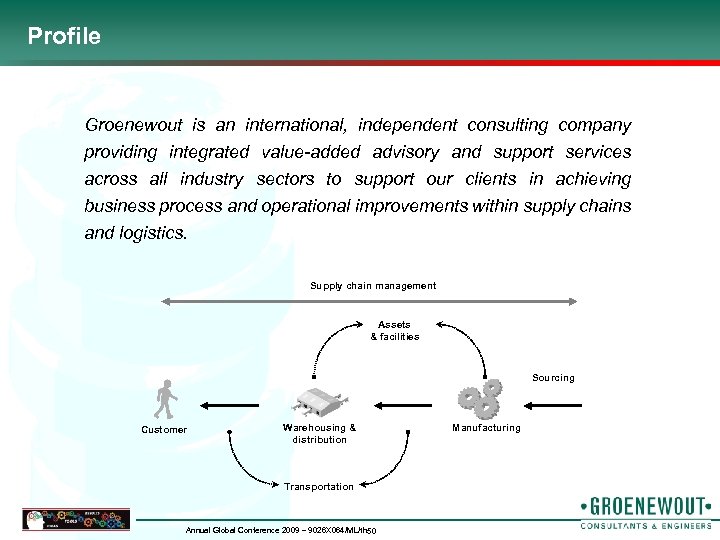
Profile Groenewout is an international, independent consulting company providing integrated value-added advisory and support services across all industry sectors to support our clients in achieving business process and operational improvements within supply chains and logistics. Supply chain management Assets & facilities Sourcing Customer Warehousing & distribution Transportation Annual Global Conference 2009 – 9026 X 064/ML/th 50 Manufacturing
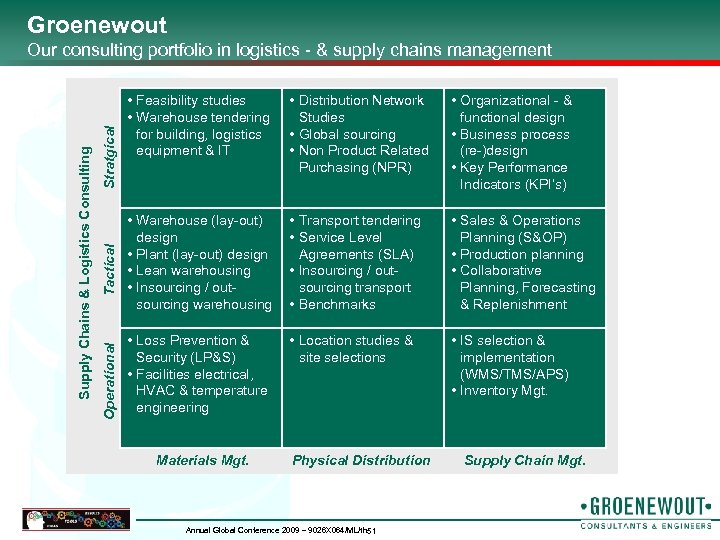
Groenewout Stratgical Tactical Operational Supply Chains & Logistics Consulting Our consulting portfolio in logistics - & supply chains management • Feasibility studies • Warehouse tendering for building, logistics equipment & IT • Distribution Network Studies • Global sourcing • Non Product Related Purchasing (NPR) • Organizational - & functional design • Business process (re-)design • Key Performance Indicators (KPI’s) • Warehouse (lay-out) design • Plant (lay-out) design • Lean warehousing • Insourcing / outsourcing warehousing • Transport tendering • Service Level Agreements (SLA) • Insourcing / outsourcing transport • Benchmarks • Sales & Operations Planning (S&OP) • Production planning • Collaborative Planning, Forecasting & Replenishment • Loss Prevention & Security (LP&S) • Facilities electrical, HVAC & temperature engineering • Location studies & site selections • IS selection & implementation (WMS/TMS/APS) • Inventory Mgt. Materials Mgt. Physical Distribution Annual Global Conference 2009 – 9026 X 064/ML/th 51 Supply Chain Mgt.
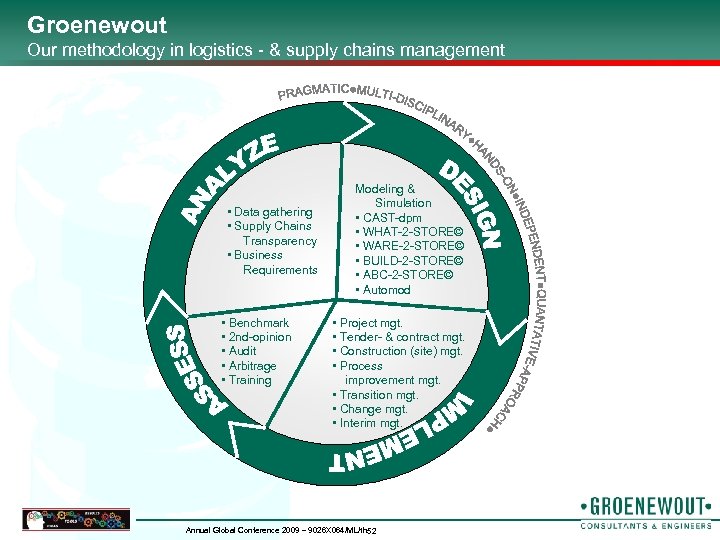
Groenewout Our methodology in logistics - & supply chains management • Data gathering • Supply Chains Transparency • Business Requirements • Benchmark • 2 nd-opinion • Audit • Arbitrage • Training Modeling & Simulation • CAST-dpm • WHAT-2 -STORE© • WARE-2 -STORE© • BUILD-2 -STORE© • ABC-2 -STORE© • Automod • Project mgt. • Tender- & contract mgt. • Construction (site) mgt. • Process improvement mgt. • Transition mgt. • Change mgt. • Interim mgt. Annual Global Conference 2009 – 9026 X 064/ML/th 52
Скачать презентацию Why multilayered distribution works best in Europe Annual
d68d8e81082deb16a9276ecdb4054a71.ppt