


 Скачать презентацию Why Manufacturing Matters in Thailand 1 How
89610970b139ee676361c18d5fda83c2.ppt
- Количество слайдов: 37
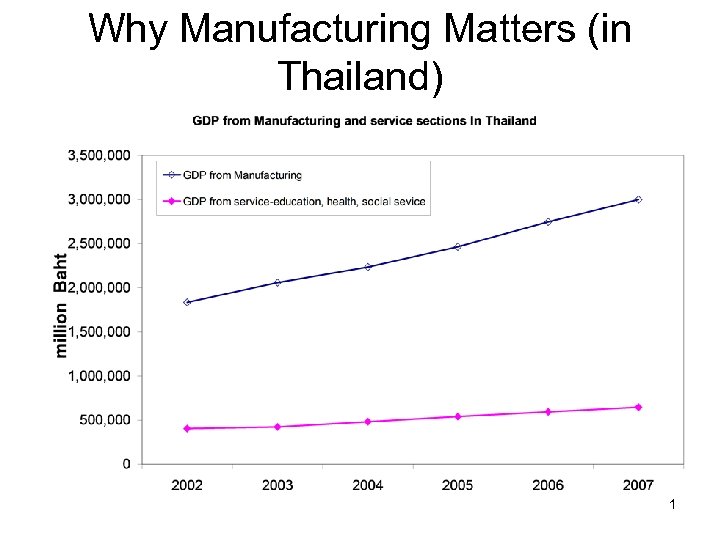 Why Manufacturing Matters (in Thailand) 1
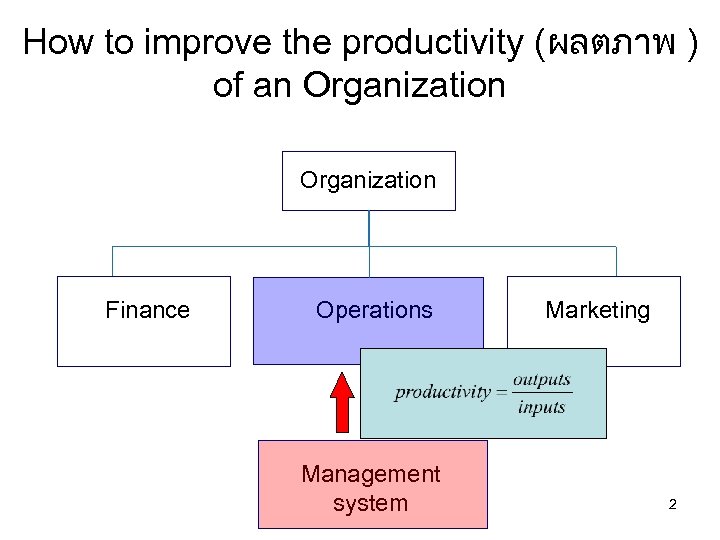 How to improve the productivity (ผลตภาพ ) of an Organization Finance Operations Management system Marketing 2
 Operations Management (supplement topic) • APICS defines operations management as "the field of study that focuses on the effective planning, scheduling, use and control of a manufacturing or service organization through the study of concepts from design engineering, industrial engineering, management information systems, quality management, production management, inventory management, accounting, and other functions as they affect the organization" (APICS Dictionary, 11 th edition) • APICS was founded in 1957 as the American Production and Inventory Control Society • Currently, APICS becomes The Association for operations management , a not-for-profit international education organization, offering certification programs, training tools and networking opportunities to increase workplace performance. 3
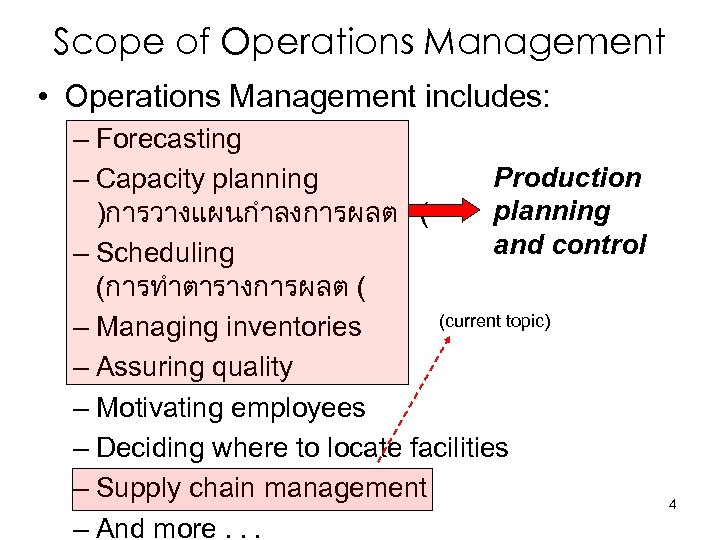 Scope of Operations Management • Operations Management includes: – Forecasting Production – Capacity planning )การวางแผนกำลงการผลต ( and control – Scheduling (การทำตารางการผลต ( (current topic) – Managing inventories – Assuring quality – Motivating employees – Deciding where to locate facilities – Supply chain management – And more. . . 4
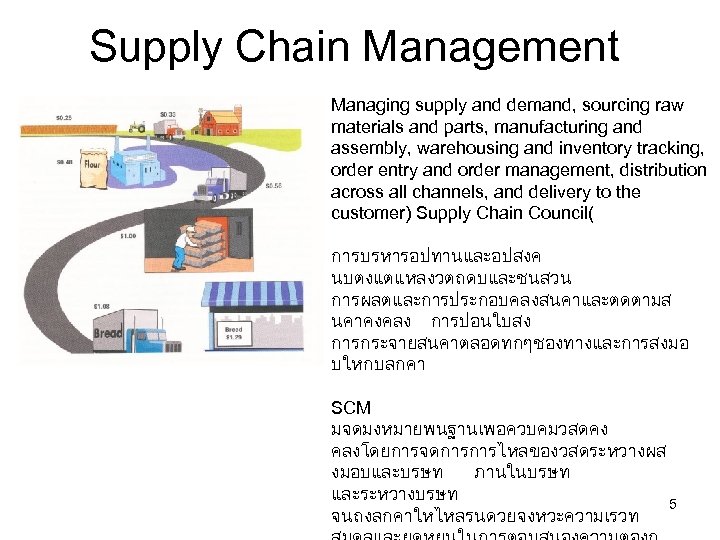 Supply Chain Management Managing supply and demand, sourcing raw materials and parts, manufacturing and assembly, warehousing and inventory tracking, order entry and order management, distribution across all channels, and delivery to the customer) Supply Chain Council( การบรหารอปทานและอปสงค นบตงแตแหลงวตถดบและชนสวน การผลตและการประกอบคลงสนคาและตดตามส นคาคงคลง การปอนใบสง การกระจายสนคาตลอดทกๆชองทางและการสงมอ บใหกบลกคา SCM มจดมงหมายพนฐานเพอควบคมวสดคง คลงโดยการจดการการไหลของวสดระหวางผส งมอบและบรษท ภานในบรษท และระหวางบรษท 5 จนถงลกคาใหไหลรนดวยจงหวะความเรวท
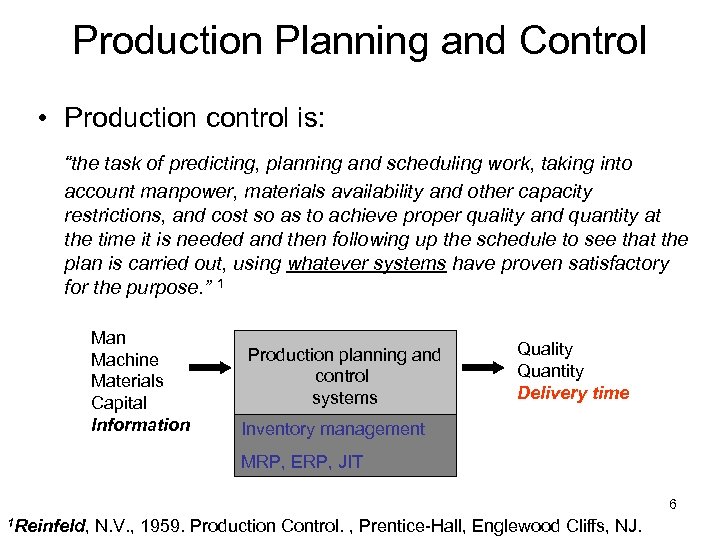 Production Planning and Control • Production control is: “the task of predicting, planning and scheduling work, taking into account manpower, materials availability and other capacity restrictions, and cost so as to achieve proper quality and quantity at the time it is needed and then following up the schedule to see that the plan is carried out, using whatever systems have proven satisfactory for the purpose. ” 1 Man Machine Materials Capital Information Production planning and control systems Quality Quantity Delivery time Inventory management MRP, ERP, JIT 6 1 Reinfeld, N. V. , 1959. Production Control. , Prentice-Hall, Englewood Cliffs, NJ.
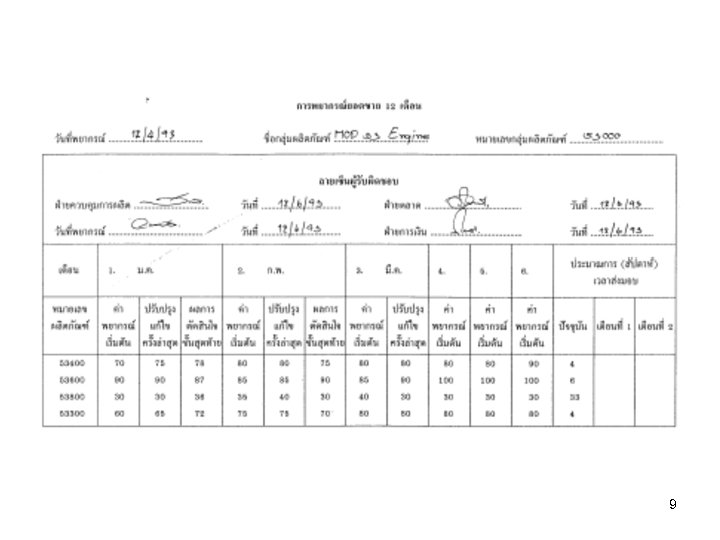
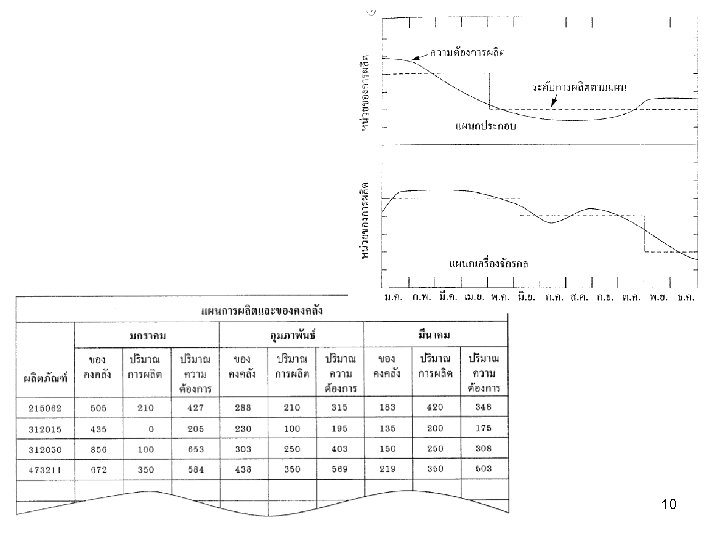
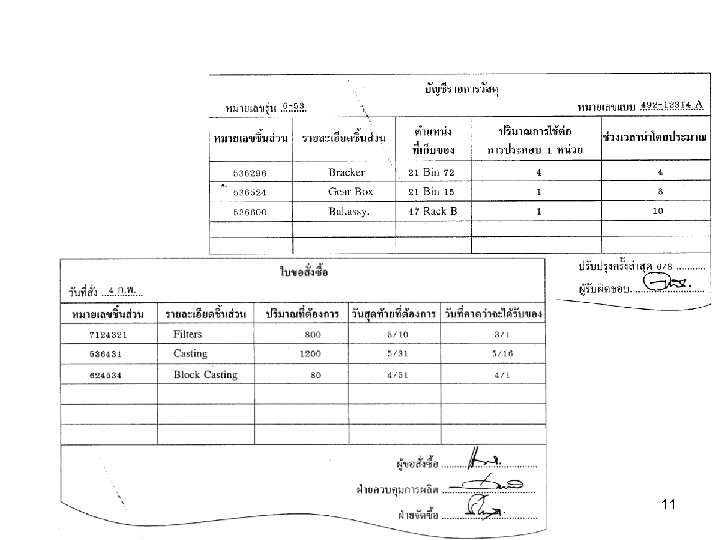
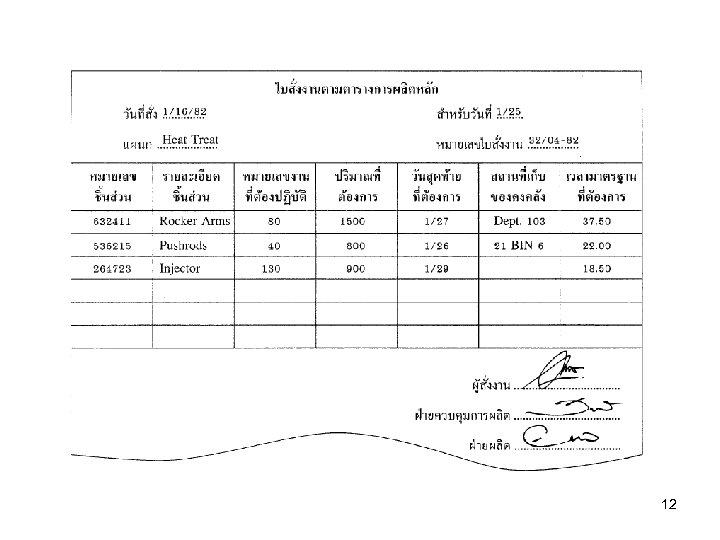
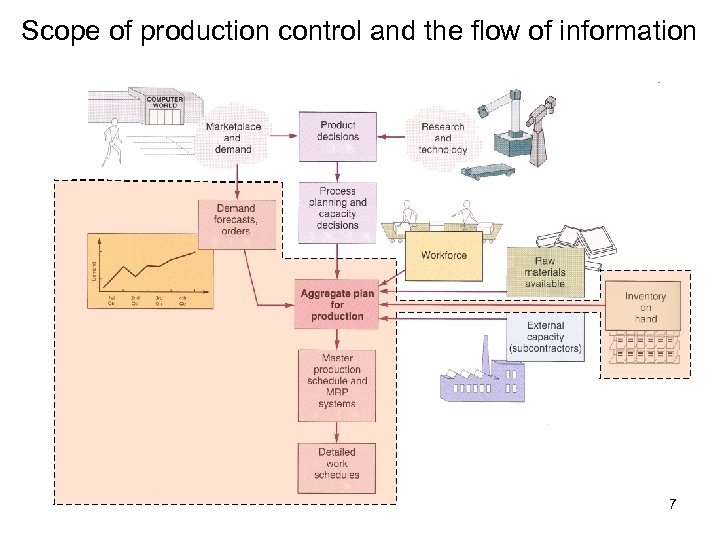 Scope of production control and the flow of information 7
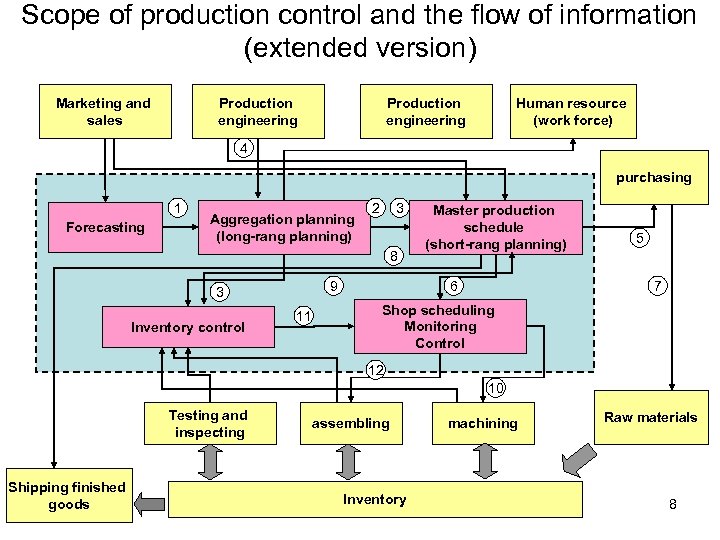 Scope of production control and the flow of information (extended version) Marketing and sales Production engineering Human resource (work force) 4 purchasing 1 Forecasting Aggregation planning (long-rang planning) 2 3 8 9 3 Inventory control 11 Master production schedule (short-rang planning) 6 5 7 Shop scheduling Monitoring Control 12 10 Testing and inspecting Shipping finished goods assembling Inventory machining Raw materials 8
 9
9
 10
10
 11
11
 12
12
 13
13
 14
14
 15
15
 Production planning and control • Pond draining/re-order point system • Push System/ Material Requirement Planning System (MRP) • Pull System/ Just In Time (JIT) 16
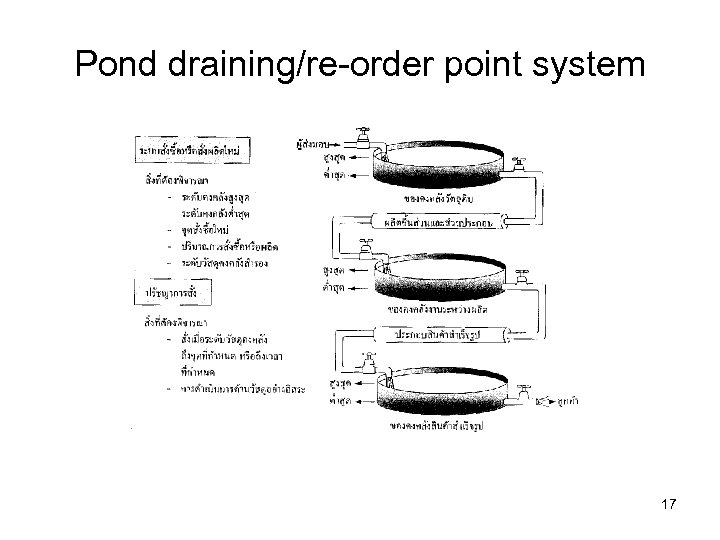 Pond draining/re-order point system 17
 Push System/ Material Requirement Planning System (MRP) 18
 Pull System/ Just In Time (JIT) 19
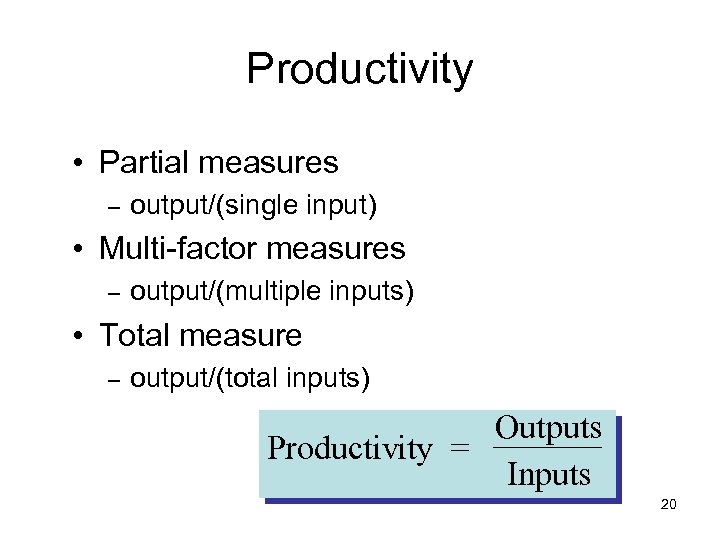 Productivity • Partial measures – output/(single input) • Multi-factor measures – output/(multiple inputs) • Total measure – output/(total inputs) Outputs Productivity = Inputs 20
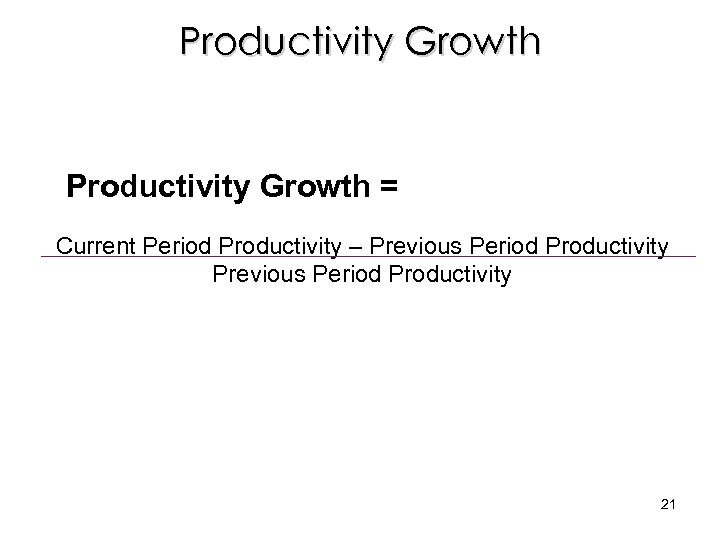 Productivity Growth = Current Period Productivity – Previous Period Productivity 21
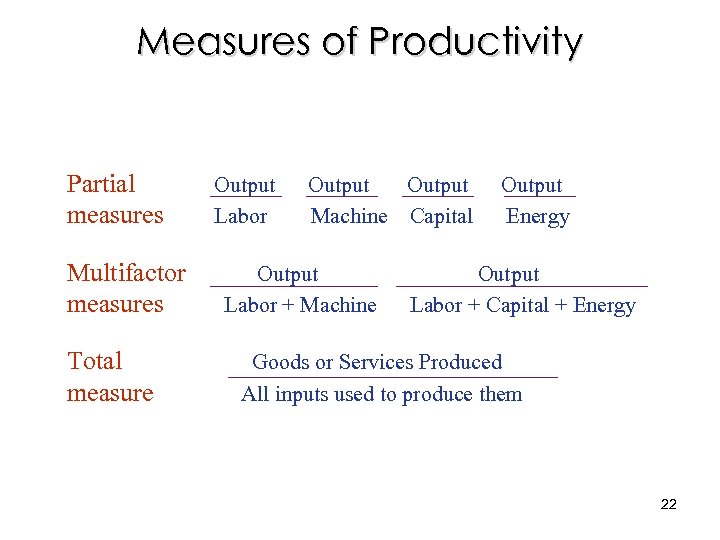 Measures of Productivity Partial measures Multifactor measures Total measure Output Labor Output Machine Capital Output Labor + Machine Output Energy Output Labor + Capital + Energy Goods or Services Produced All inputs used to produce them 22
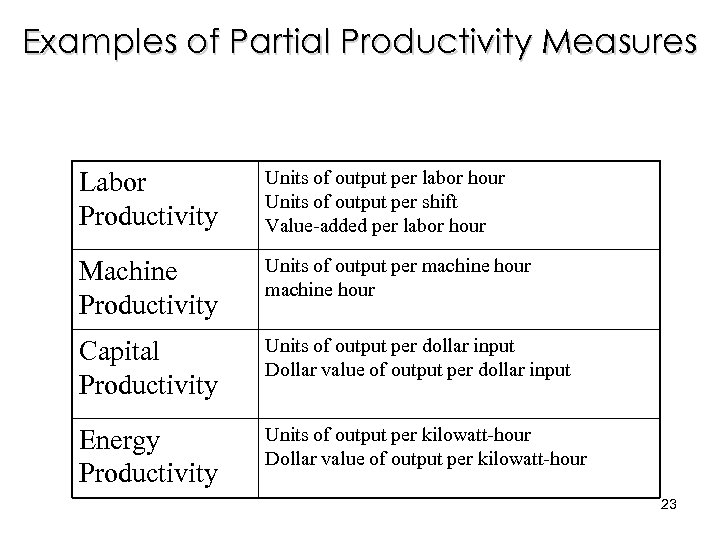 Examples of Partial Productivity Measures Labor Productivity Units of output per labor hour Units of output per shift Value-added per labor hour Machine Productivity Units of output per machine hour Capital Productivity Units of output per dollar input Dollar value of output per dollar input Energy Productivity Units of output per kilowatt-hour Dollar value of output per kilowatt-hour 23
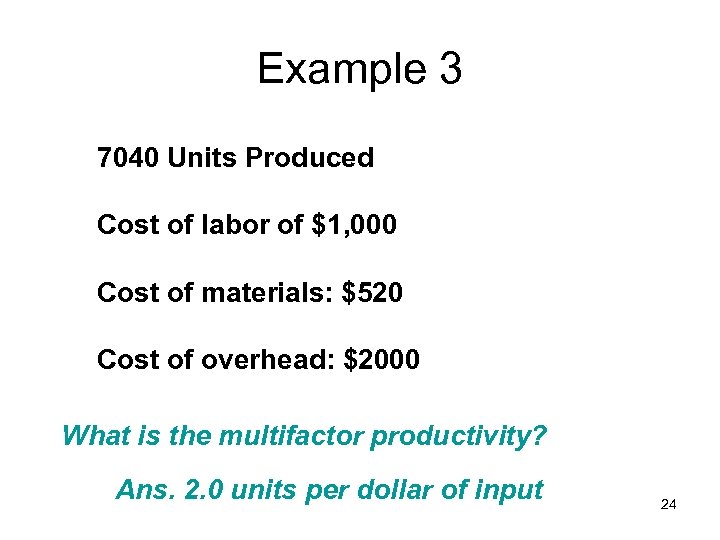 Example 3 7040 Units Produced Cost of labor of $1, 000 Cost of materials: $520 Cost of overhead: $2000 What is the multifactor productivity? Ans. 2. 0 units per dollar of input 24
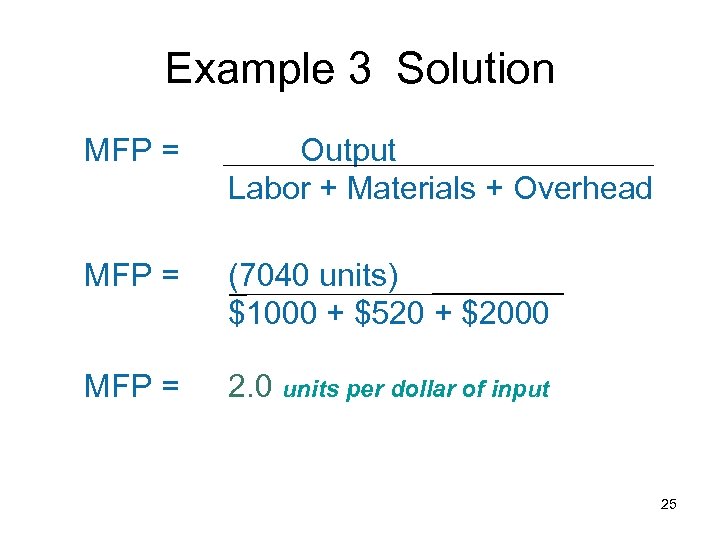 Example 3 Solution MFP = Output Labor + Materials + Overhead MFP = (7040 units) $1000 + $520 + $2000 MFP = 2. 0 units per dollar of input 25
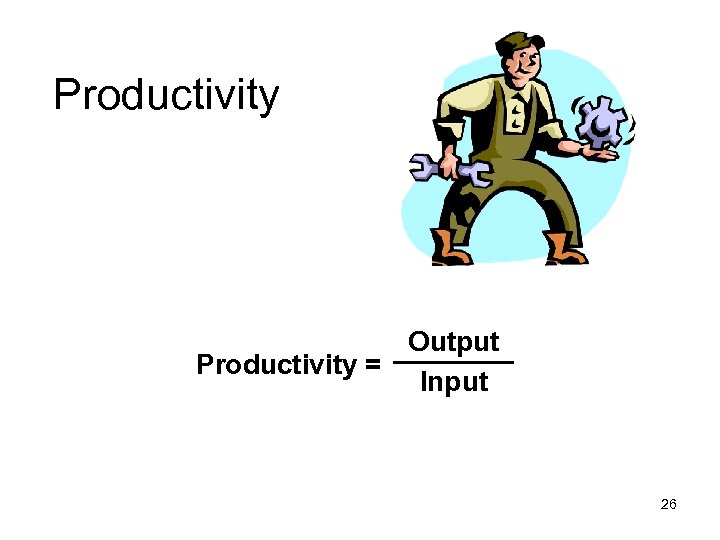 Productivity Output Productivity = Input 26
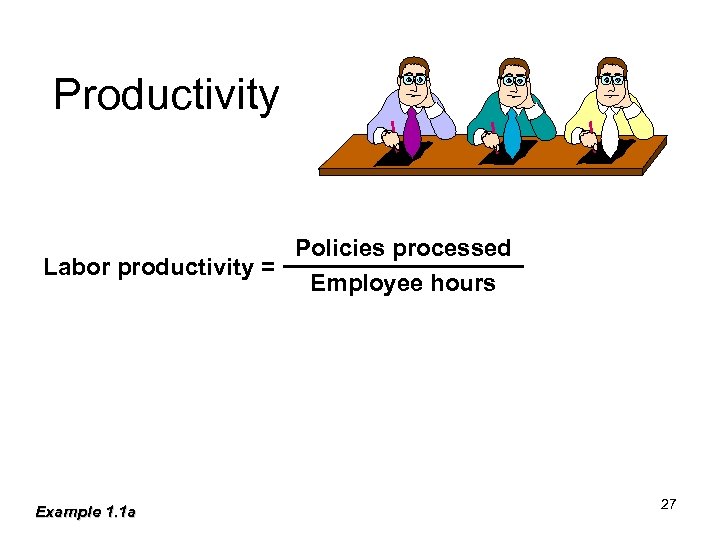 Productivity Policies processed Labor productivity = Employee hours Example 1. 1 a 27
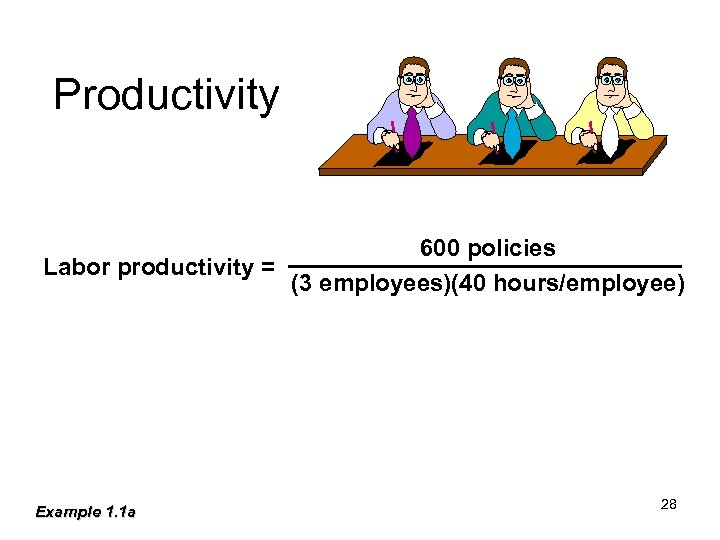 Productivity 600 policies Labor productivity = (3 employees)(40 hours/employee) Example 1. 1 a 28
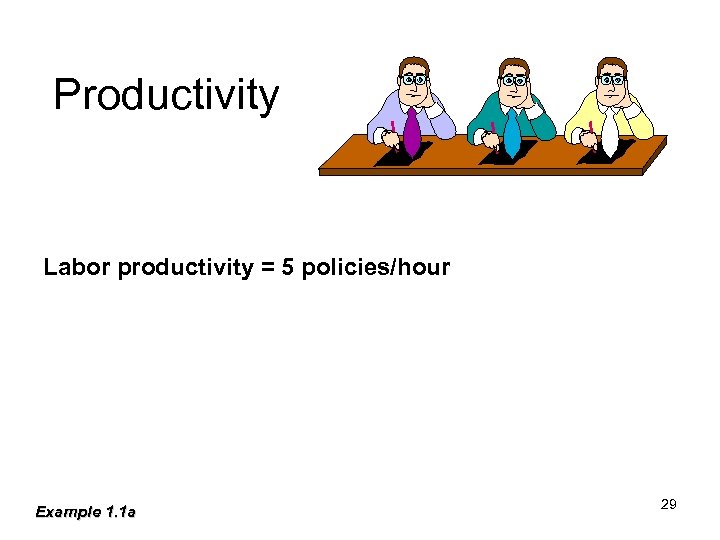 Productivity Labor productivity = 5 policies/hour Example 1. 1 a 29
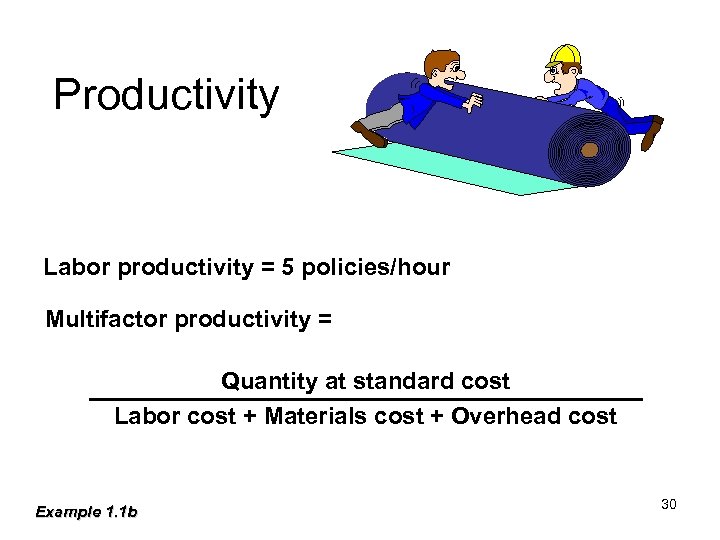 Productivity Labor productivity = 5 policies/hour Multifactor productivity = Quantity at standard cost Labor cost + Materials cost + Overhead cost Example 1. 1 b 30
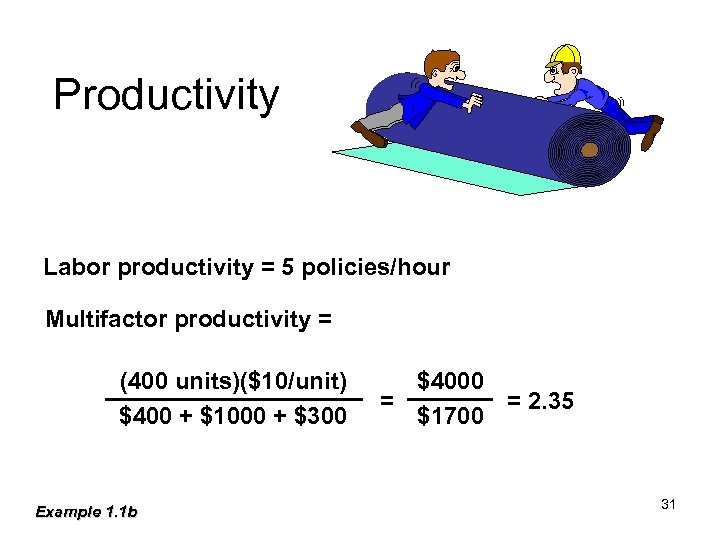 Productivity Labor productivity = 5 policies/hour Multifactor productivity = (400 units)($10/unit) $400 + $1000 + $300 Example 1. 1 b $4000 = = 2. 35 $1700 31
 Productivity Measures 32
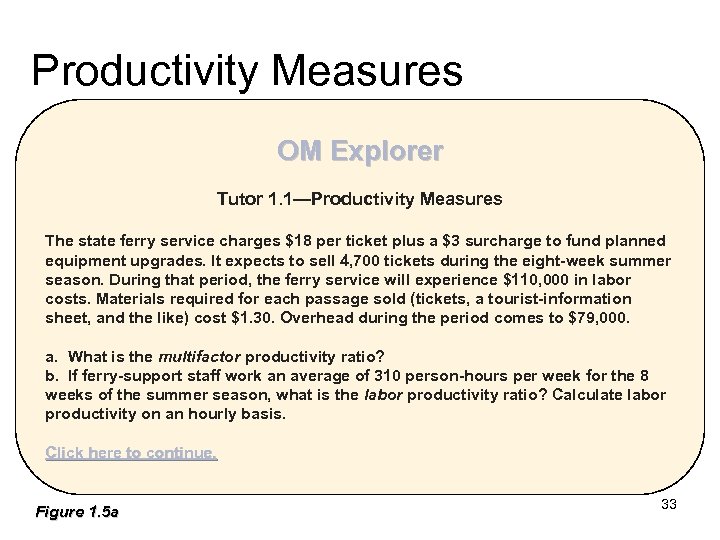 Productivity Measures OM Explorer Tutor 1. 1—Productivity Measures The state ferry service charges $18 per ticket plus a $3 surcharge to fund planned equipment upgrades. It expects to sell 4, 700 tickets during the eight-week summer season. During that period, the ferry service will experience $110, 000 in labor costs. Materials required for each passage sold (tickets, a tourist-information sheet, and the like) cost $1. 30. Overhead during the period comes to $79, 000. a. What is the multifactor productivity ratio? b. If ferry-support staff work an average of 310 person-hours per week for the 8 weeks of the summer season, what is the labor productivity ratio? Calculate labor productivity on an hourly basis. Click here to continue. Figure 1. 5 a 33
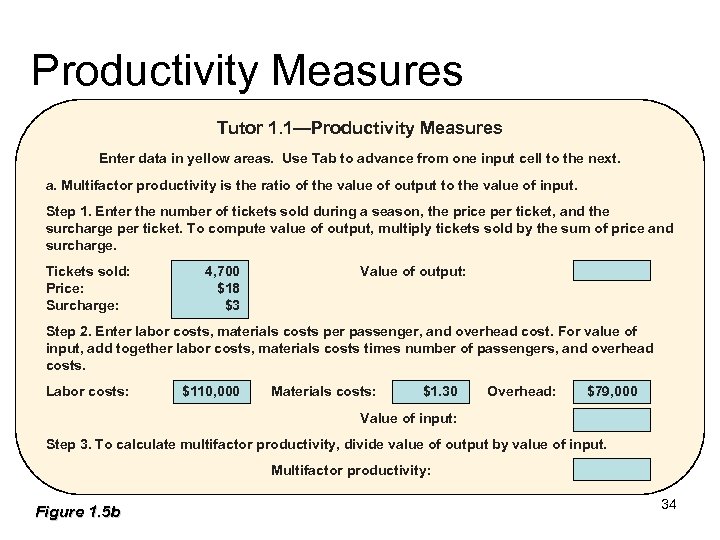 Productivity Measures Tutor 1. 1—Productivity Measures Enter data in yellow areas. Use Tab to advance from one input cell to the next. a. Multifactor productivity is the ratio of the value of output to the value of input. Step 1. Enter the number of tickets sold during a season, the price per ticket, and the surcharge per ticket. To compute value of output, multiply tickets sold by the sum of price and surcharge. Tickets sold: Price: Surcharge: 4, 700 $18 $3 Value of output: Step 2. Enter labor costs, materials costs per passenger, and overhead cost. For value of input, add together labor costs, materials costs times number of passengers, and overhead costs. Labor costs: $110, 000 Materials costs: $1. 30 Overhead: $79, 000 Value of input: Step 3. To calculate multifactor productivity, divide value of output by value of input. Multifactor productivity: Figure 1. 5 b 34
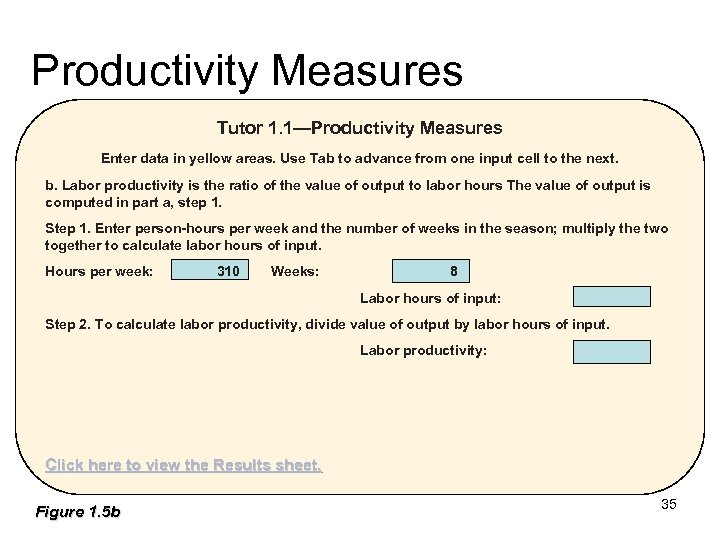 Productivity Measures Tutor 1. 1—Productivity Measures Enter data in yellow areas. Use Tab to advance from one input cell to the next. b. Labor productivity is the ratio of the value of output to labor hours The value of output is computed in part a, step 1. Step 1. Enter person-hours per week and the number of weeks in the season; multiply the two together to calculate labor hours of input. Hours per week: 310 Weeks: 8 Labor hours of input: Step 2. To calculate labor productivity, divide value of output by labor hours of input. Labor productivity: Click here to view the Results sheet. Figure 1. 5 b 35
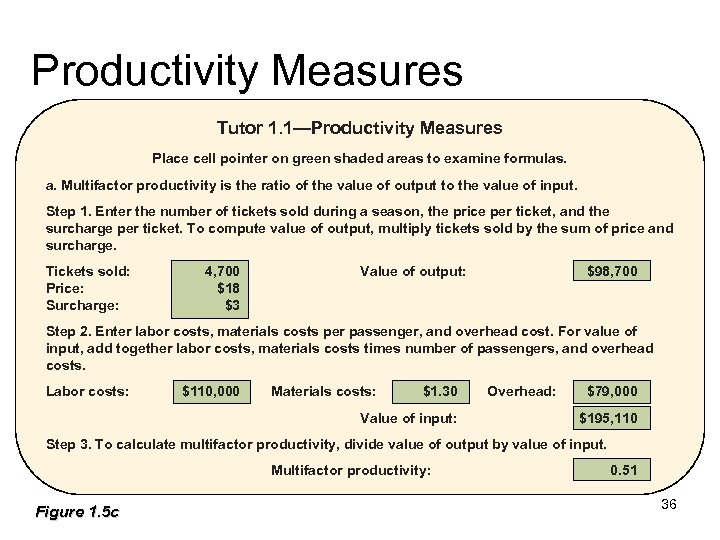 Productivity Measures Tutor 1. 1—Productivity Measures Place cell pointer on green shaded areas to examine formulas. a. Multifactor productivity is the ratio of the value of output to the value of input. Step 1. Enter the number of tickets sold during a season, the price per ticket, and the surcharge per ticket. To compute value of output, multiply tickets sold by the sum of price and surcharge. Tickets sold: Price: Surcharge: 4, 700 $18 $3 Value of output: $98, 700 Step 2. Enter labor costs, materials costs per passenger, and overhead cost. For value of input, add together labor costs, materials costs times number of passengers, and overhead costs. Labor costs: $110, 000 Materials costs: $1. 30 Value of input: Overhead: $79, 000 $195, 110 Step 3. To calculate multifactor productivity, divide value of output by value of input. Multifactor productivity: Figure 1. 5 c 0. 51 36
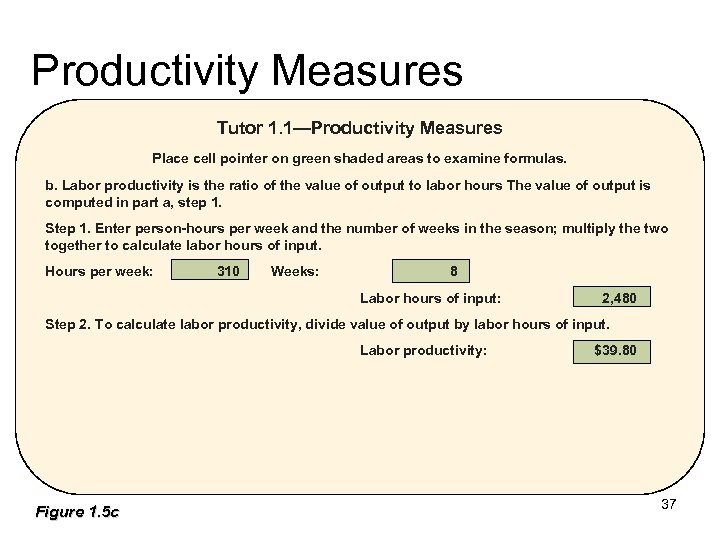 Productivity Measures Tutor 1. 1—Productivity Measures Place cell pointer on green shaded areas to examine formulas. b. Labor productivity is the ratio of the value of output to labor hours The value of output is computed in part a, step 1. Step 1. Enter person-hours per week and the number of weeks in the season; multiply the two together to calculate labor hours of input. Hours per week: 310 Weeks: 8 Labor hours of input: 2, 480 Step 2. To calculate labor productivity, divide value of output by labor hours of input. Labor productivity: Figure 1. 5 c $39. 80 37