


 Скачать презентацию Why immunotherapy fails Stephen Durham Imperial College
46da230943c7c65edf3328b429319154.ppt
- Количество слайдов: 50
 Why immunotherapy fails ? Stephen Durham Imperial College and Royal Brompton Hospital, London UK
 Declaration • Research funding, consultancy and lecture fees from ALK Abello • Lecture fees from Allergy Therapeutics
 Why immunotherapy fails ? • • • wrong set up wrong patient wrong allergen(s) wrong dose wrong duration
 Why immunotherapy succeeds ? • • • right set up right patient right allergen(s) right dose right duration
 Why immunotherapy succeeds ? • • • right set up right patient right allergen(s) right dose right duration
 Immunotherapy clinic
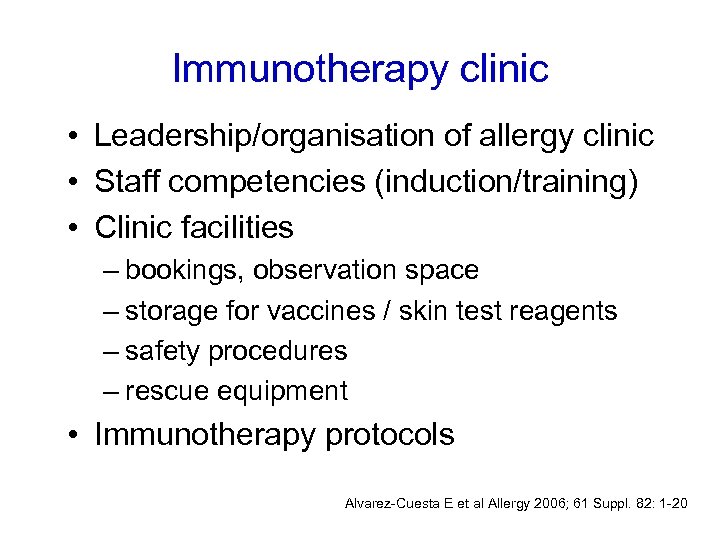 Immunotherapy clinic • Leadership/organisation of allergy clinic • Staff competencies (induction/training) • Clinic facilities – bookings, observation space – storage for vaccines / skin test reagents – safety procedures – rescue equipment • Immunotherapy protocols Alvarez-Cuesta E et al Allergy 2006; 61 Suppl. 82: 1 -20
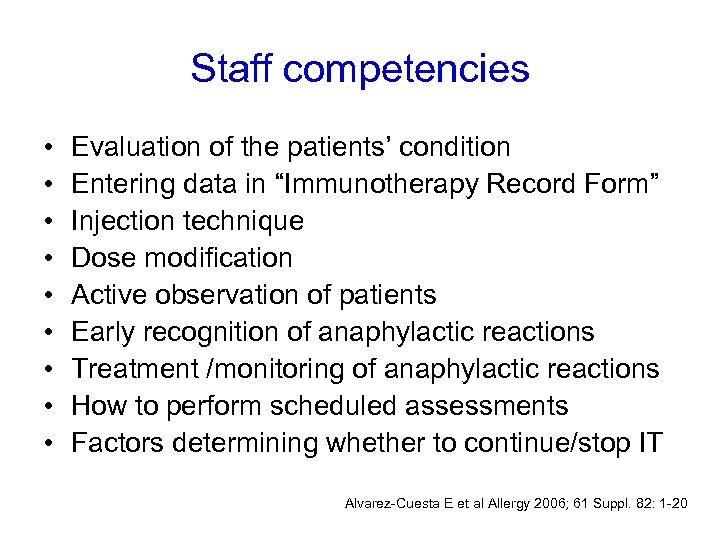 Staff competencies • • • Evaluation of the patients’ condition Entering data in “Immunotherapy Record Form” Injection technique Dose modification Active observation of patients Early recognition of anaphylactic reactions Treatment /monitoring of anaphylactic reactions How to perform scheduled assessments Factors determining whether to continue/stop IT Alvarez-Cuesta E et al Allergy 2006; 61 Suppl. 82: 1 -20
 Why immunotherapy succeeds ? • • • right set up right patient right allergen(s) right dose right duration
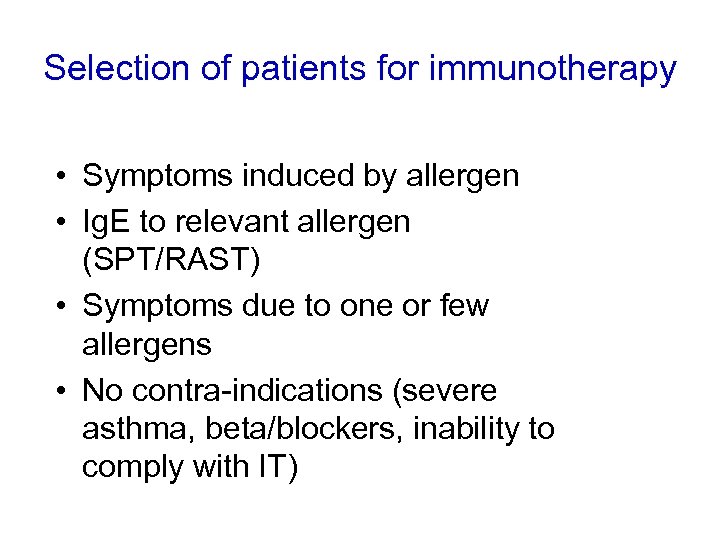 Selection of patients for immunotherapy • Symptoms induced by allergen • Ig. E to relevant allergen (SPT/RAST) • Symptoms due to one or few allergens • No contra-indications (severe asthma, beta/blockers, inability to comply with IT)
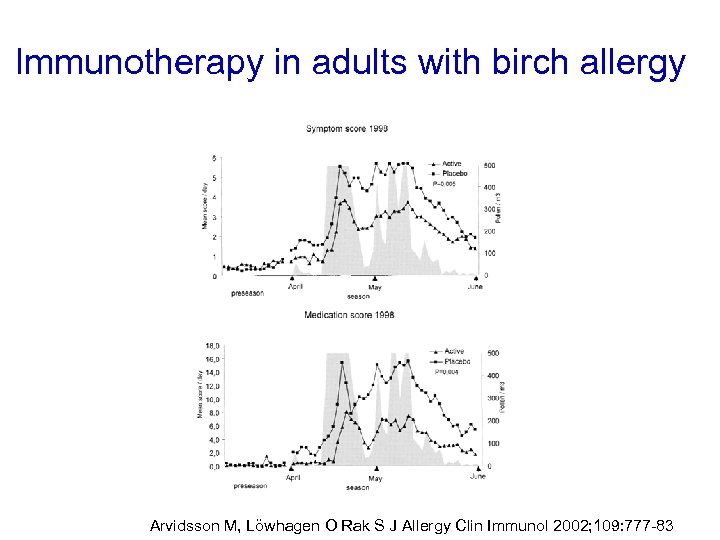 Immunotherapy in adults with birch allergy Arvidsson M, Löwhagen O Rak S J Allergy Clin Immunol 2002; 109: 777 -83
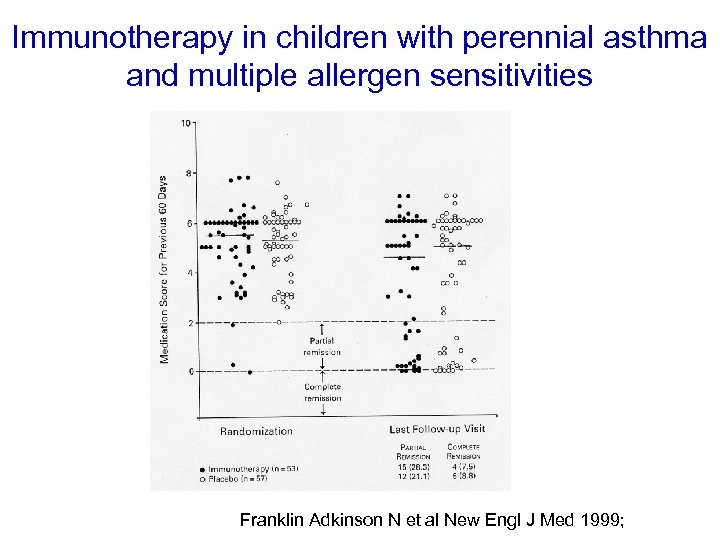 Immunotherapy in children with perennial asthma and multiple allergen sensitivities Franklin Adkinson N et al New Engl J Med 1999;
 Why immunotherapy succeeds ? • • • right set up right patient right allergen(s) right dose right duration
 Selection of allergen extracts • Standardisation - in-house reference standards (IHRs) - units of biologic potency - major allergen content (5 -20 mcg major Ag) - recombinant allergens • Documented benefit (controlled trials) - efficacy - safety - children and adults - longterm effects
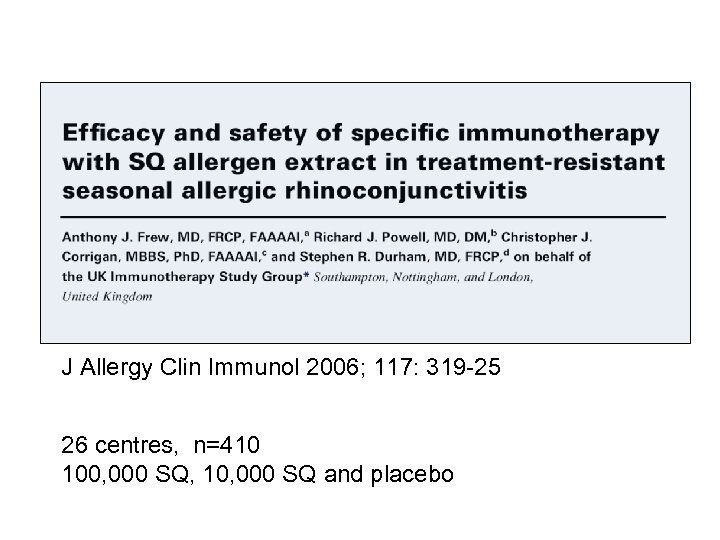 J Allergy Clin Immunol 2006; 117: 319 -25 26 centres, n=410 100, 000 SQ, 10, 000 SQ and placebo
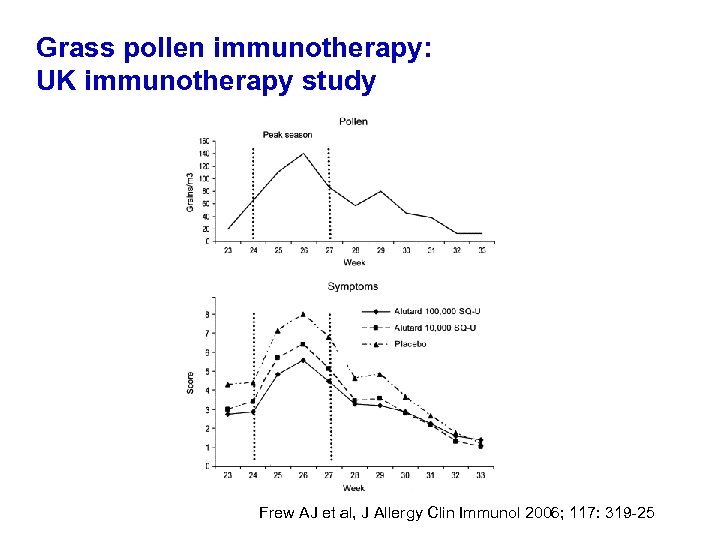 Grass pollen immunotherapy: UK immunotherapy study Frew AJ et al, J Allergy Clin Immunol 2006; 117: 319 -25
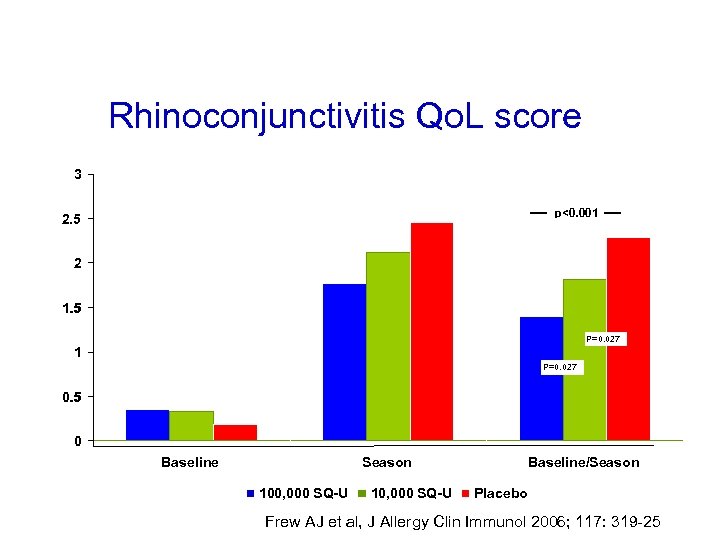 Rhinoconjunctivitis Qo. L score 3 p<0. 001 2. 5 2 1. 5 p=0. 027 P=0. 027 1 p=0. 027 P=0. 027 0. 5 0 Baseline Season 100, 000 SQ-U 10, 000 SQ-U Baseline/Season Placebo Frew AJ et al, J Allergy Clin Immunol 2006; 117: 319 -25
 Why immunotherapy succeeds ? • • • right set up right patient right allergen(s) right dose right duration
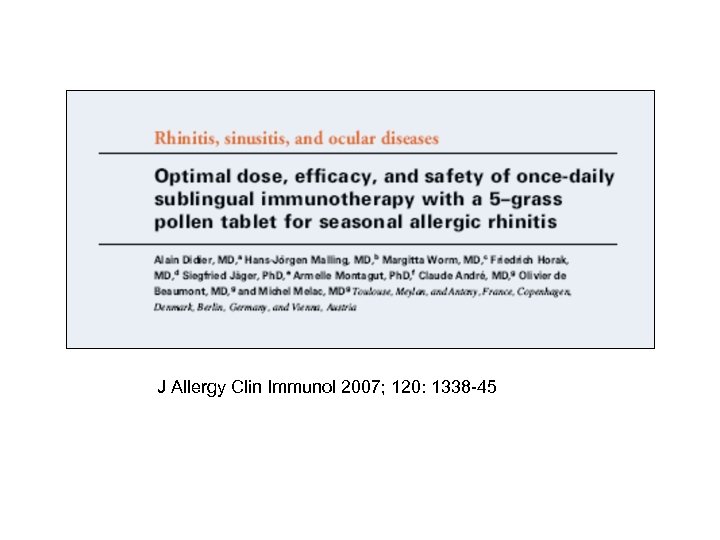 J Allergy Clin Immunol 2007; 120: 1338 -45
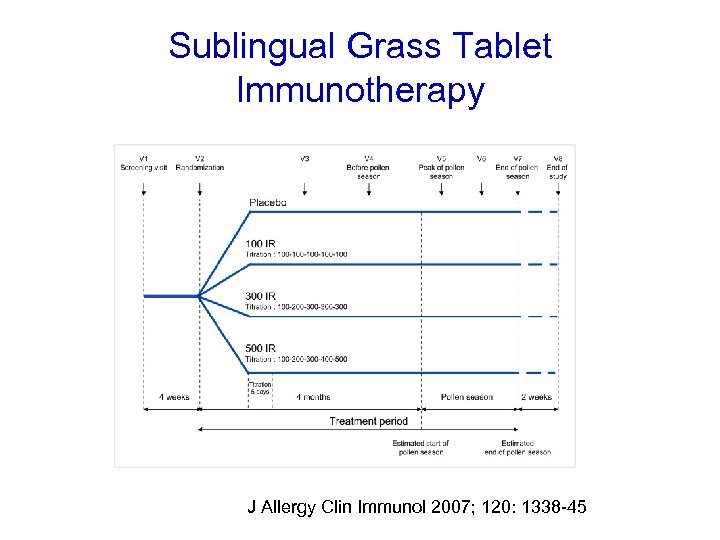 Sublingual Grass Tablet Immunotherapy J Allergy Clin Immunol 2007; 120: 1338 -45
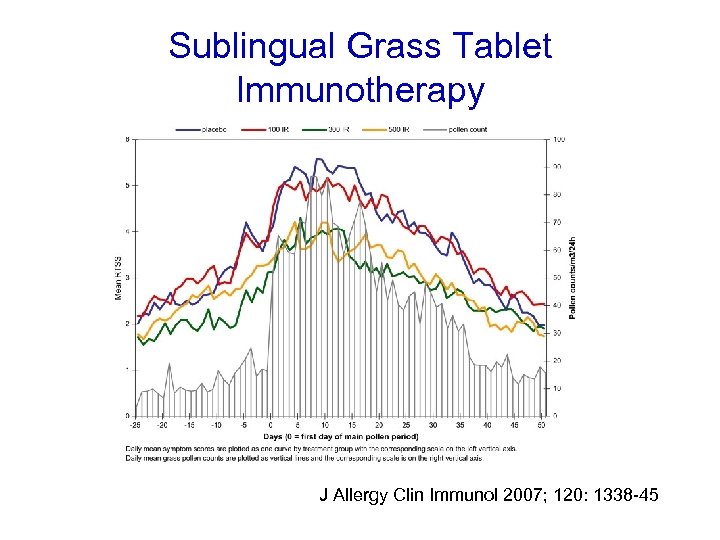 Sublingual Grass Tablet Immunotherapy J Allergy Clin Immunol 2007; 120: 1338 -45
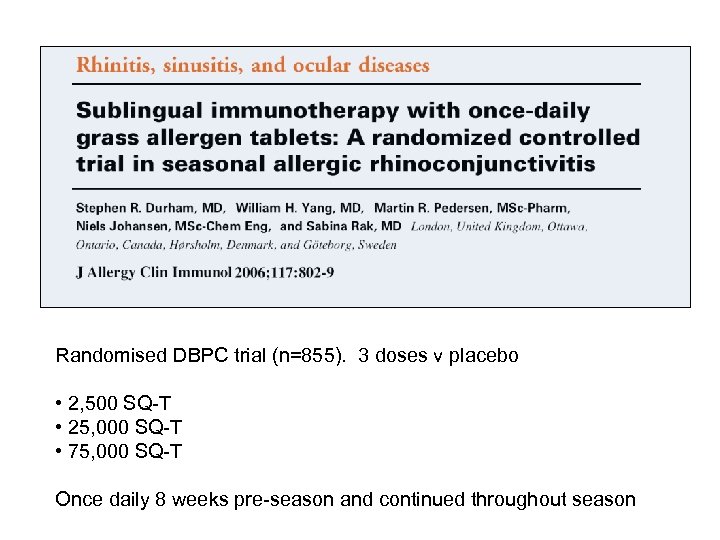 Randomised DBPC trial (n=855). 3 doses v placebo • 2, 500 SQ-T • 25, 000 SQ-T • 75, 000 SQ-T Once daily 8 weeks pre-season and continued throughout season
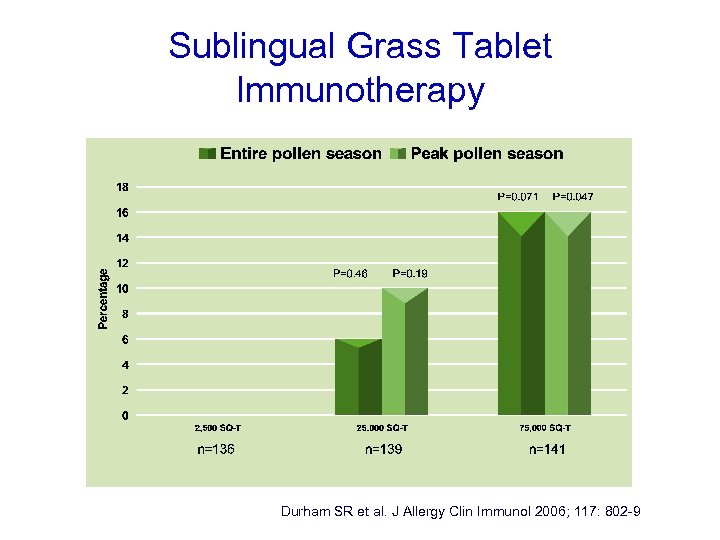 Sublingual Grass Tablet Immunotherapy Durham SR et al. J Allergy Clin Immunol 2006; 117: 802 -9
 Why immunotherapy succeeds ? • • • right set up right patient right allergen(s) right dose right duration
 Why immunotherapy succeeds ? • • • right set up right patient right allergen(s) right dose right duration - efficacy - tolerance
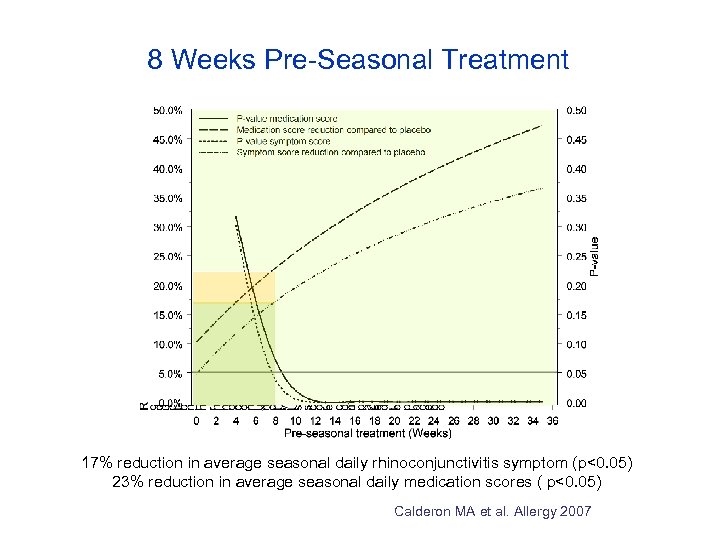 8 Weeks Pre-Seasonal Treatment 17% reduction in average seasonal daily rhinoconjunctivitis symptom (p<0. 05) 23% reduction in average seasonal daily medication scores ( p<0. 05) Calderon MA et al. Allergy 2007
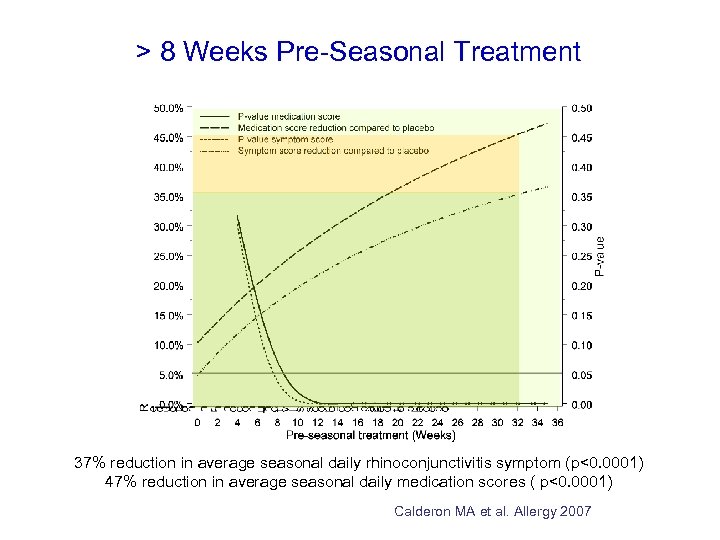 > 8 Weeks Pre-Seasonal Treatment 37% reduction in average seasonal daily rhinoconjunctivitis symptom (p<0. 0001) 47% reduction in average seasonal daily medication scores ( p<0. 0001) Calderon MA et al. Allergy 2007
 Why immunotherapy succeeds ? • • • right set up right patient right allergen(s) right dose right duration - efficacy - tolerance (persistent efficacy after withdrawal)
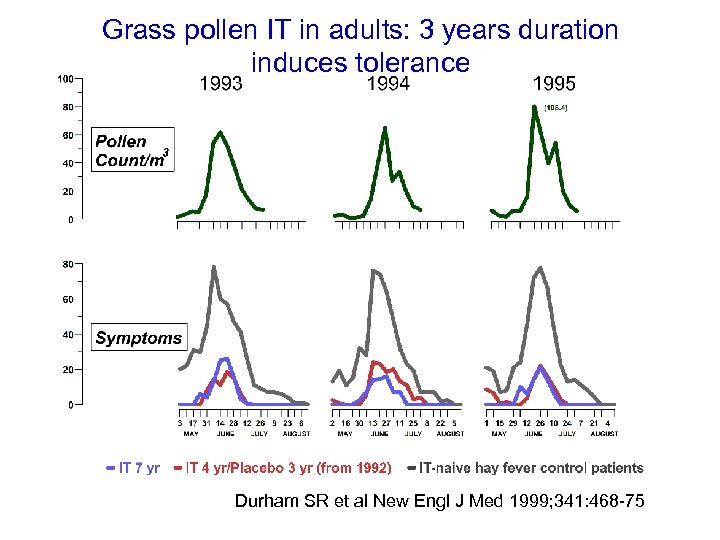 Grass pollen IT in adults: 3 years duration induces tolerance Durham SR et al New Engl J Med 1999; 341: 468 -75
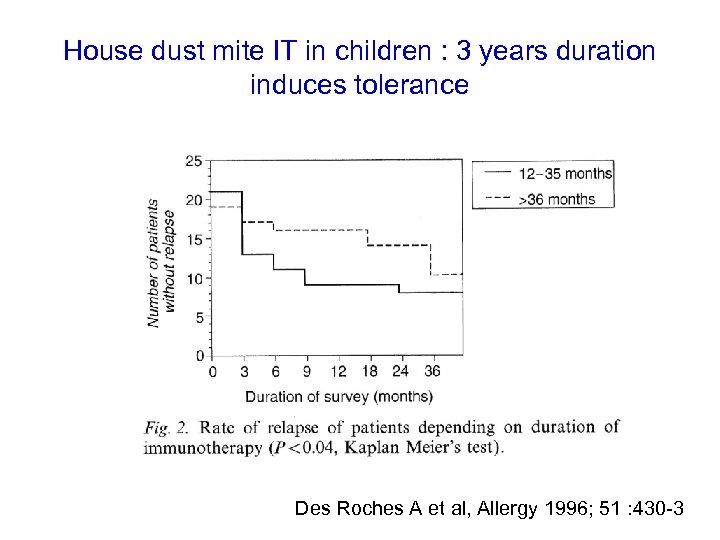 House dust mite IT in children : 3 years duration induces tolerance Des Roches A et al, Allergy 1996; 51 : 430 -3
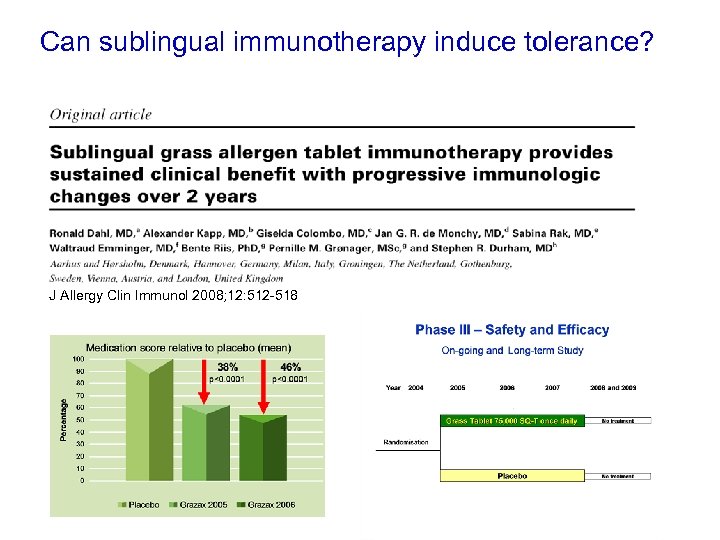 Can sublingual immunotherapy induce tolerance? J Allergy Clin Immunol 2008; 12: 512 -518
 Why immunotherapy succeeds ? • • • right set up right patient right allergen(s) right dose right duration - efficacy - tolerance
 Why immunotherapy fails? • • • wrong set up wrong patient wrong allergen(s) wrong dose wrong duration - no efficacy - no tolerance
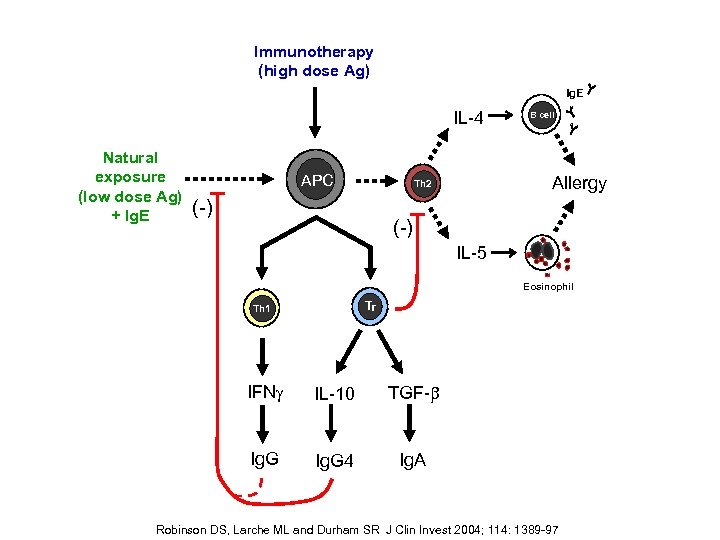
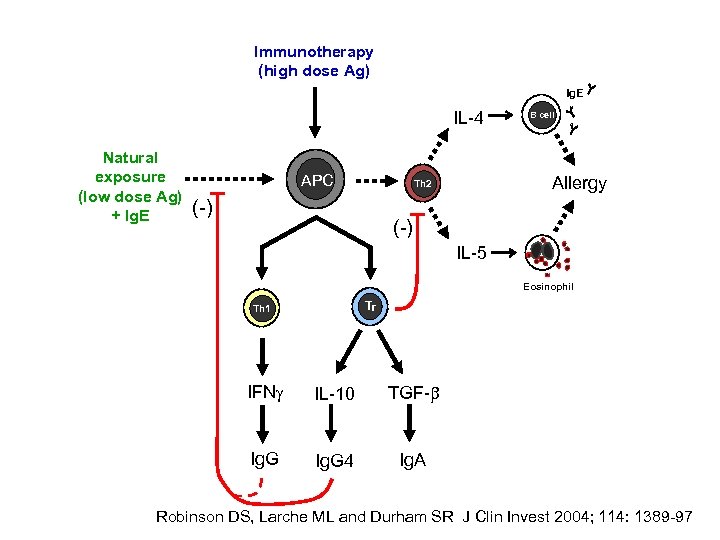 Immunotherapy (high dose Ag) Ig. E IL-4 Natural exposure (low dose Ag) + Ig. E APC Allergy Th 2 (-) B cell (-) IL-5 Eosinophil Tr Th 1 IFNg IL-10 TGF-b Ig. G 4 Ig. A Robinson DS, Larche ML and Durham SR J Clin Invest 2004; 114: 1389 -97
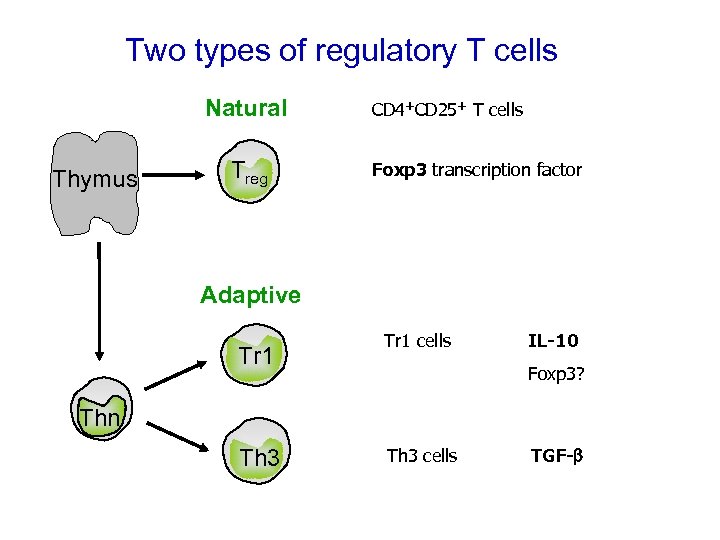 Two types of regulatory T cells Natural Thymus Treg CD 4+CD 25+ T cells Foxp 3 transcription factor Adaptive Tr 1 cells IL-10 Foxp 3? Thn Th 3 cells TGF-b
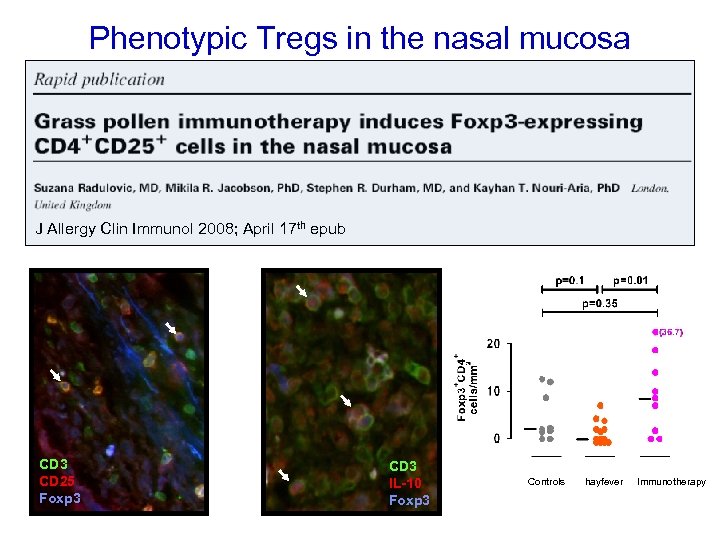 Phenotypic Tregs in the nasal mucosa J Allergy Clin Immunol 2008; April 17 th epub CD 3 CD 25 Foxp 3 CD 3 IL-10 Foxp 3 Controls hayfever Immunotherapy
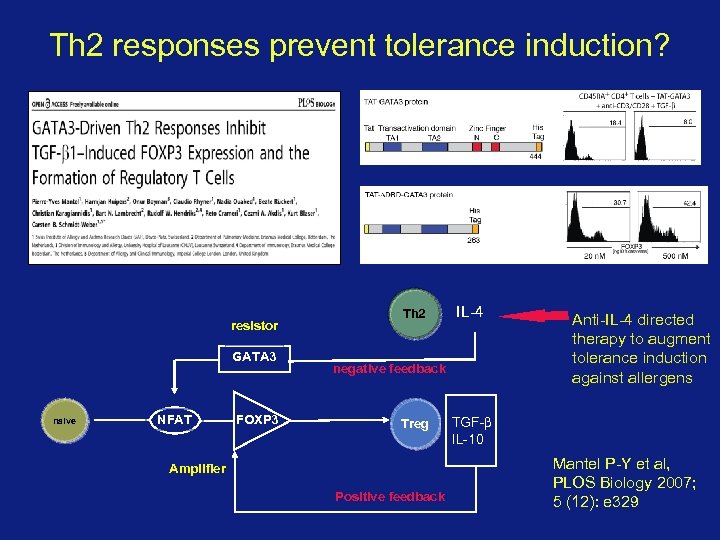 Th 2 responses prevent tolerance induction? resistor GATA 3 naive NFAT FOXP 3 Th 2 IL-4 negative feedback Treg Amplifier Positive feedback TGF-β, IL-10 TGF-b IL-27 IL-10 IL-35 Anti-IL-4 directed therapy to augment tolerance induction against allergens Mantel P-Y et al, PLOS Biology 2007; 5 (12): e 329
 Can we predict success or failure of immunotherapy?
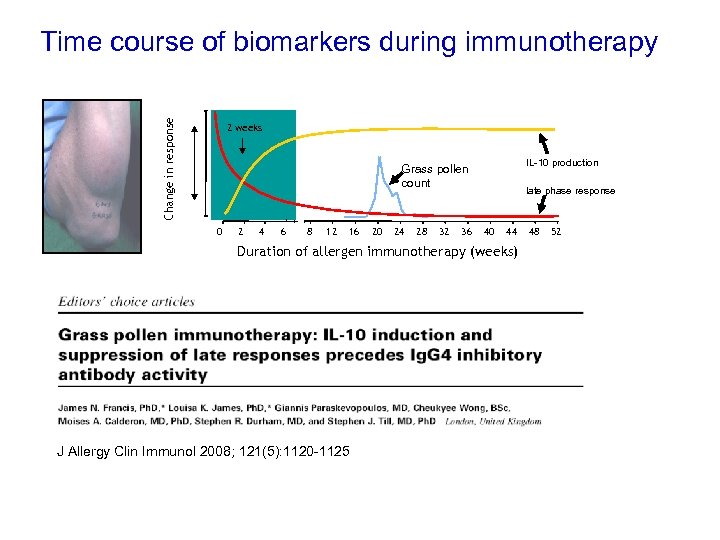 Change in response Time course of biomarkers during immunotherapy 2 weeks IL-10 production Grass pollen count 0 2 4 6 8 12 16 20 24 28 32 36 late phase response 40 44 Duration of allergen immunotherapy (weeks) J Allergy Clin Immunol 2008; 121(5): 1120 -1125 48 52
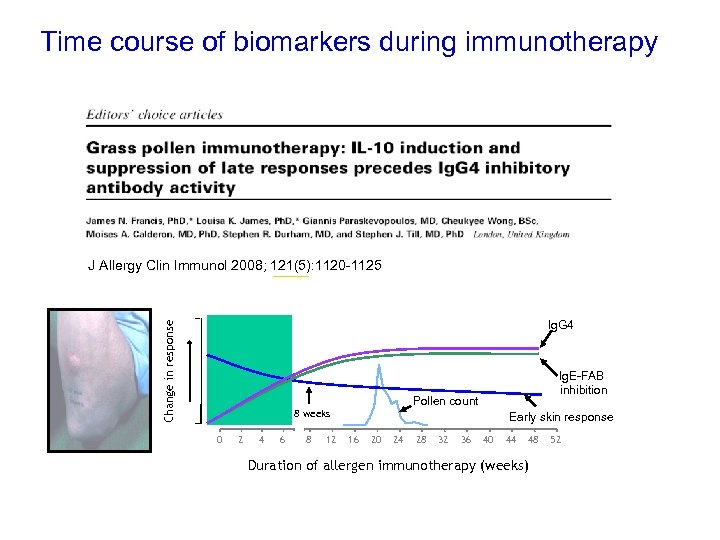 Time of biomarkers during immunotherapy Time course of changes in IL-10 and Ig. G-associated inhibitory activity Change in response Late allergen-induced Skin Response 4 weeks Grass Pollen season 0 2 4 6 8 12 16 20 24 28 32 36 40 44 48 52 Duration of allergen immunotherapy (weeks) late phase J Allergy Clin Immunol 2008; 121(5): 1120 -1125 response Change in response Ig. G 4 Pollen count 8 weeks 0 2 4 6 8 12 Ig. E-FAB inhibition Early skin response 16 20 24 28 32 36 40 44 48 Duration of allergen immunotherapy (weeks) 52






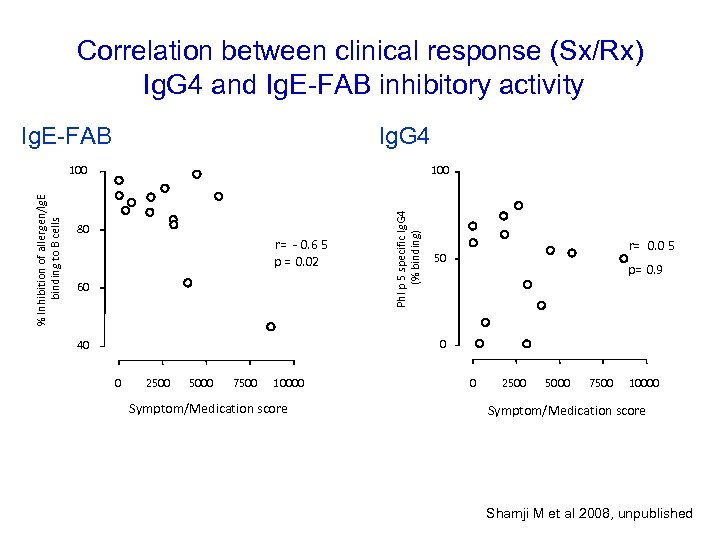 Correlation between clinical response (Sx/Rx) Ig. G 4 and Ig. E-FAB inhibitory activity Ig. E-FAB Ig. G 4 100 80 r= - 0. 6 5 p = 0. 02 60 Phl p 5 specific Ig. G 4 (% binding) % Inhibition of allergen/Ig. E binding to B cells 100 r= 0. 0 5 50 p= 0. 9 0 40 0 2500 5000 7500 10000 Symptom/Medication score Shamji M et al 2008, unpublished
 Immunotherapy (high dose Ag) Ig. E IL-4 Natural exposure (low dose Ag) + Ig. E APC Allergy Th 2 (-) B cell (-) IL-5 Eosinophil Tr Th 1 IFNg IL-10 TGF-b Ig. G 4 Ig. A Robinson DS, Larche ML and Durham SR J Clin Invest 2004; 114: 1389 -97
 Allergy and Clinical Immunology, Imperial College and Royal Brompton Hospital, London, UK M Calderon D R Wilson C Pilette S Radulovic K T Nouri-Aria M R Jacobson J N Francis M Shamji G Paraskavopoulos L Wilcock C Schmidt-Weber S J Till