


 Скачать презентацию Why do we do science What are the
eacb659bd54071bb4f067202c2b49362.ppt
- Количество слайдов: 27
 Why do we do science? What are the goals of science ? Understanding ? Explanation ? Discovery ? Prediction? Description? A mixture of these? In what order? In what proportions? 1
 The goals of science Different views: “Bacon: the role of science is the search for the causes of the different phenomena. Explanation is the goal of science” (Bacon) • “The goal of marine biology is to (predict and) understand the distribution and abundance of life in the sea” (Redfield 1958) • “Ecology is the branch of science that predicts the distribution, abundance, biomass, and kinds (sizes, ecotypes, species. . . ) of organisms” (Peters 1980) 2
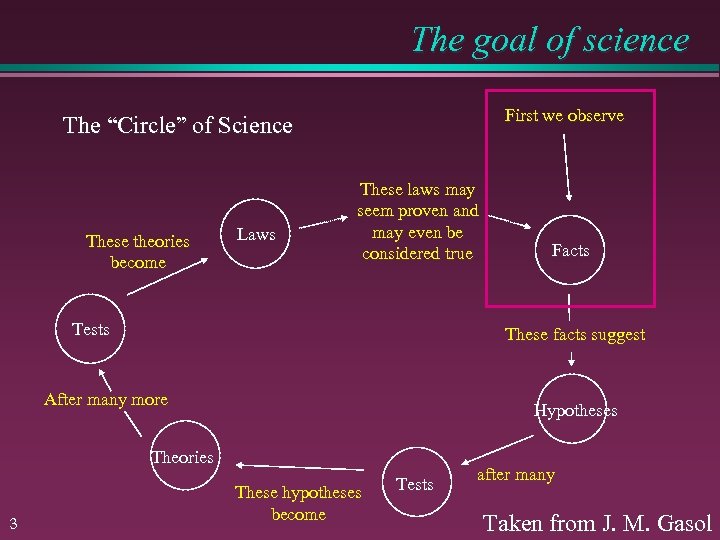 The goal of science First we observe The “Circle” of Science These theories become Laws These laws may seem proven and may even be considered true Tests These facts suggest After many more Hypotheses Theories 3 Facts These hypotheses become Tests after many Taken from J. M. Gasol
 The reality “Too much research is done for the same reason that a mountain is climbed: “because it is there”, and too little time is spent questioning the motives for doing so” (Rigler and Peters 1995) 4
 Pace 2001 5 Emphasizes the importance of prediction as one of the main goals in contemporary science Points to the dichothomy that has existed between the “empiricists” and the “mechanicists” Suggests this dichothomy is useless and counter productive
 Prediction versus understanding 6 Prediction is often associated to empirical, comparative studies that generate patterns and statistical models that describe these patterns Understanding is often associated to experimental, manipulative studies that address mechanisms, and to analytical, deterministic models that use the mechanistic knowledge for prediction
 Prediction and understanding One does not need to understand mechanisms and processes in order to predict (or forecast) Sishi Chaohou Tu (< 1056) 7
 Prediction and understanding Understanding the mechanisms or processes does not necessarily allow prediction » Example: We now know that primary production is limited by iron availability in large oceanic areas, and we understand many of the underlying biogeochemical and physiological mechanisms » But can we predict the outcome of iron fertilization? 8
 Explanation Being able to explain a phenomenon does not guarantee that we will be able to predict the future occurrence of other similar or related phenomena Retrospective Explanation ≠ Prediction 9
 Understanding versus prediction 10 A common view is that we must first understand, and then attempt to predict
 Understanding versus prediction 11 A common view is that we must first understand, and then attempt to predict So how do we decide that we understand enough?
 Understanding versus prediction 12 A common view is that we must first understand, and then attempt to predict So how do we decide that we understand enough? And how can we test the accuracy of our understanding?
 Understanding versus prediction 13 A common view is that we must first understand, and then attempt to predict So how do we decide that we understand enough? And how test the accuracy of our understanding? Pace proposes that scientific understanding should be assessed in terms of the quality of the predictions that can result from it
 Understanding versus prediction 14 A common view is that we must first understand, and then attempt to predict So how do we decide that we understand enough? And how test the accuracy of our understanding? Pace proposes that scientific understanding should be assessed in terms of the quality of the predictions that can result from it Understanding is difficult to judge, but predictions can be quantitatively falsified
 Importance of prediction Pace 2001 15 Testing predictions is one means to judge the adequacy of understanding Needed for practial reasons and management Important both for the establishment and evaluation of theory Predictive objectives for research may help to discriminate among lines of research Predictive orientation keeps research efforts focused on central questions
 Rigler’s story 16 Frank Rigler worked on P regeneration by zooplankton in lakes for over 2 decades All along he worked on the basis that he was contributing a piece to a much bigger puzzle, and that eventually when all the pieces were put together into the “big model”, we would finally be able to predict P in lakes One day, he realized the big model would never come, not at least during his lifetime He dropped his detailed mechanistic studies and started to focus on large-scale patterns in P (and other important variables)
 The story of phosphorous in lakes + 17 +
 We want to understand, but understand what? 18 Understand the how a general process works? Understand how a small portion of the system works, to eventually add all these portions so that we will understand the whole? Limnology has traditionally suffered from “My Lake Syndrome”, people often sought to understand “their lake” because their lake was surely different In oceanography, people may also try to understand their “patch” of ocean?
 We like to describe, but what should we describe? In the same way a pile of bricks does not make a house, a whole bunch of data or facts are not necessarily science How do we judge when description is necessary and when is it enough? » Example: The description of microbial diversity using molecular approaches 19
 We would like to predict things, but what? 20 Although empirical predictive models do not require an understanding of mechanisms, they should be based on prior knowledge and theory We should seek to predict features of the ecosystem that are not only relevant, but also feasable We should do a better job in dealing with uncertainty and error
 We would like to predict things, but what? Primary production under scenarios of changing water temperature and movement, and nutrient inputs Shifts in the biological pump Fish production Shifts in food web structure and in material and energy fluxes in food webs Occurrence of toxic algal blooms 21
 Some potential benefits of comparative studies The value of pattern » Help identify key forcing factors » Help identify ranges within which these key factors operate » Help identify interactions and feedbacks between forcing factors » Help identify regional or ecosystem-specific The value of outliers » Help identify local deviations from general patterns » Help identify non-linearities » Help identify major state changes 22
 A good example Redfield was one of the first “Comparative” scientists. The R Ratio was so compelling in part because it was a general pattern The R Ratio generated multiple lines of research, some showing how other systems comformed to the pattern, others trying to explain departures 23
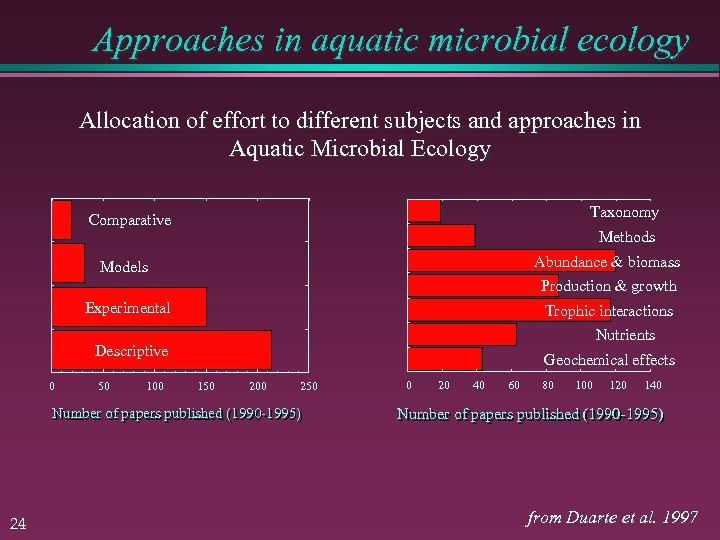 Approaches in aquatic microbial ecology Allocation of effort to different subjects and approaches in Aquatic Microbial Ecology Taxonomy Comparative Methods Abundance & biomass Models Production & growth Experimental Trophic interactions Nutrients Descriptive 0 50 100 Geochemical effects 150 200 250 Number of papers published (1990 -1995) 24 0 20 40 60 80 100 120 140 Number of papers published (1990 -1995) from Duarte et al. 1997
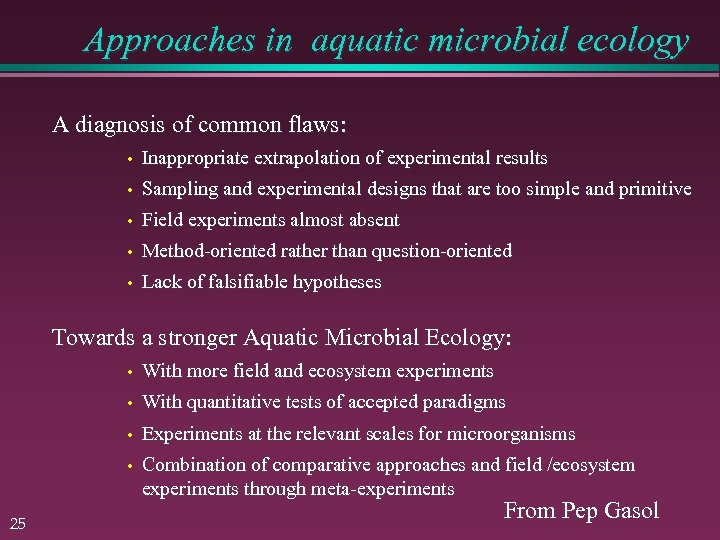 Approaches in aquatic microbial ecology A diagnosis of common flaws: • Inappropriate extrapolation of experimental results • Sampling and experimental designs that are too simple and primitive • Field experiments almost absent • Method-oriented rather than question-oriented • Lack of falsifiable hypotheses Towards a stronger Aquatic Microbial Ecology: • • With quantitative tests of accepted paradigms • Experiments at the relevant scales for microorganisms • 25 With more field and ecosystem experiments Combination of comparative approaches and field /ecosystem experiments through meta-experiments From Pep Gasol
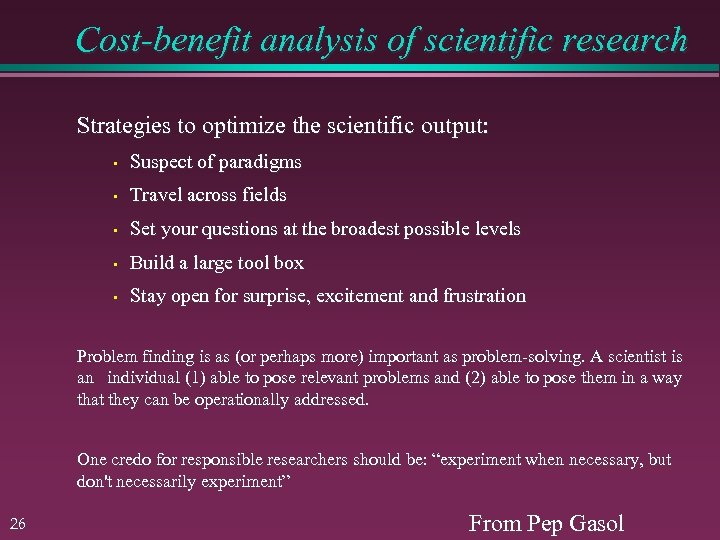 Cost-benefit analysis of scientific research Strategies to optimize the scientific output: • Suspect of paradigms • Travel across fields • Set your questions at the broadest possible levels • Build a large tool box • Stay open for surprise, excitement and frustration Problem finding is as (or perhaps more) important as problem-solving. A scientist is an individual (1) able to pose relevant problems and (2) able to pose them in a way that they can be operationally addressed. One credo for responsible researchers should be: “experiment when necessary, but don't necessarily experiment” 26 From Pep Gasol
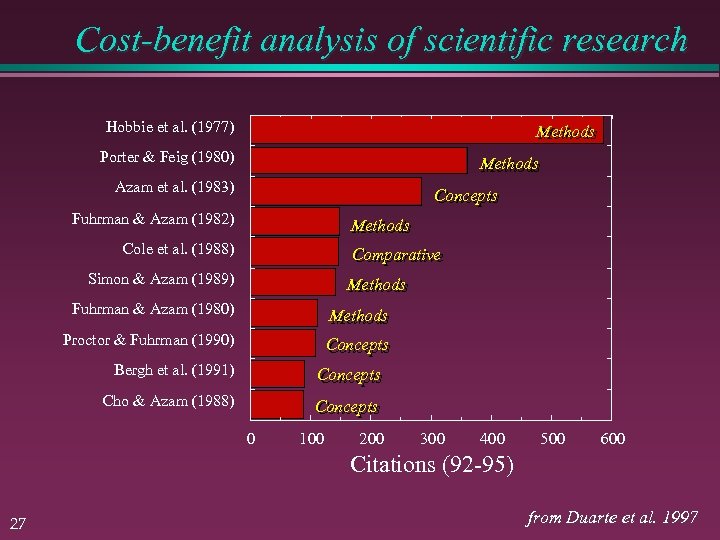 Cost-benefit analysis of scientific research Hobbie et al. (1977) Methods Porter & Feig (1980) Methods Azam et al. (1983) Concepts Fuhrman & Azam (1982) Methods Cole et al. (1988) Comparative Simon & Azam (1989) Methods Fuhrman & Azam (1980) Methods Proctor & Fuhrman (1990) Concepts Bergh et al. (1991) Concepts Cho & Azam (1988) Concepts 0 100 200 300 400 500 600 Citations (92 -95) 27 from Duarte et al. 1997