


 Скачать презентацию Why Computer Security The past decade has
1efb29b4ab21fec3d22374921efce202.ppt
- Количество слайдов: 107
 Why Computer Security • The past decade has seen an explosion in the concern for the security of information – Malicious codes (viruses, worms, etc. ) caused over $28 billion in economic losses in 2003, and will grow to over $75 billion by 2007 • Jobs and salaries for technology professionals have lessened in recent years. BUT … • Security specialists markets are expanding ! – “ Full-time information security professionals will rise almost 14% per year around the world, going past 2. 1 million in 2008” (IDC report)
 Why Computer Security (cont’d) • Internet attacks are increasing in frequency, severity and sophistication • Denial of service (Do. S) attacks – Cost $1. 2 billion in 2000 – 1999 CSI/FBI survey 32% of respondents detected Do. S attacks directed to their systems – Thousands of attacks per week in 2001 – Yahoo, Amazon, e. Bay, Microsoft, White House, etc. , attacked
 Why Computer Security (cont’d) • Virus and worms faster and powerful – Melissa, Nimda, Code Red II, Slammer … – Cause over $28 billion in economic losses in 2003, growing to over $75 billion in economic losses by 2007. – Code Red (2001): 13 hours infected >360 K machines $2. 4 billion loss – Slammer (2003): 10 minutes infected > 75 K machines $1 billion loss • Spams, phishing … • New Internet security landscape emerging: BOTNETS !
 Outline • History of Security and Definitions • Overview of Cryptography • Symmetric Cipher – Classical Symmetric Cipher – Modern Symmetric Ciphers (DES and AES) • Asymmetric Cipher • One-way Hash Functions and Message Digest
 The History of Computing • For a long time, security was largely ignored in the community – The computer industry was in “survival mode”, struggling to overcome technological and economic hurdles – As a result, a lot of comers were cut and many compromises made – There was lots of theory, and even examples of systems built with very good security, but were largely ignored or unsuccessful • E. g. , ADA language vs. C (powerful and easy to use)
 Computing Today is Very Different • Computers today are far from “survival mode” – Performance is abundant and the cost is very cheap – As a result, computers now ubiquitous at every facet of society • Internet – Computers are all connected and interdependent – This codependency magnifies the effects of any failures
 Biological Analogy • Computing today is very homogeneous. – A single architecture and a handful of OS dominates • In biology, homogeneous populations are in danger – A single disease or virus can wipe them out overnight because they all share the same weakness – The disease only needs a vector to travel among hosts • Computers are like the animals, the Internet provides the vector. – It is like having only one kind of cow in the world, and having them drink from one single pool of water!
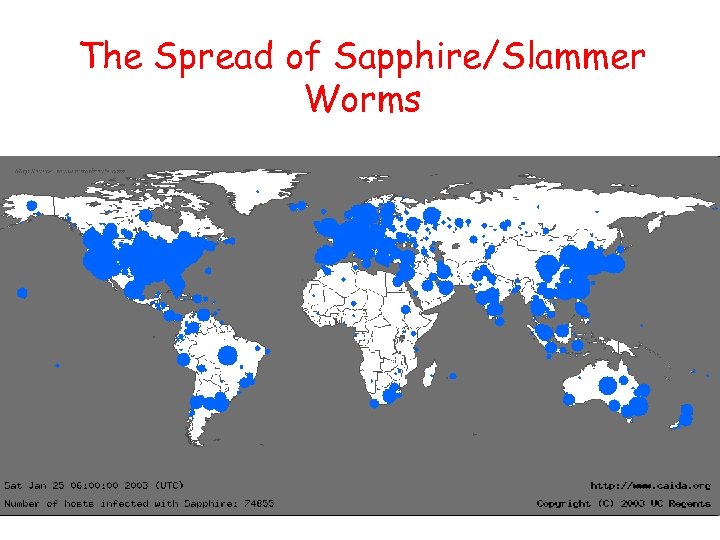 The Spread of Sapphire/Slammer Worms
 The Flash Worm • Slammer worm infected 75, 000 machines in <15 minutes • A properly designed worm, flash worm, can take less than 1 second to compromise 1 million vulnerable machines in the Internet – The Top Speed of Flash Worms. S. Staniford, D. Moore, V. Paxson and N. Weaver, ACM WORM Workshop 2004. – Exploit many vectors such as P 2 P file sharing, intelligent scanning, hitlists, etc.
 The Definition of Computer Security • Security is a state of well-being of information and infrastructures in which the possibility of successful yet undetected theft, tampering, and disruption of information and services is kept low or tolerable • Security rests on confidentiality, authenticity, integrity, and availability
 The Basic Components • Confidentiality is the concealment of information or resources. – E. g. , only sender, intended receiver should “understand” message contents • Authenticity is the identification and assurance of the origin of information. • Integrity refers to the trustworthiness of data or resources in terms of preventing improper and unauthorized changes. • Availability refers to the ability to use the information or resource desired.
 Security Threats and Attacks • A threat/vulnerability is a potential violation of security. – Flaws in design, implementation, and operation. • An attack is any action that violates security. – Active adversary • An attack has an implicit concept of “intent” – Router mis-configuration or server crash can also cause loss of availability, but they are not attacks
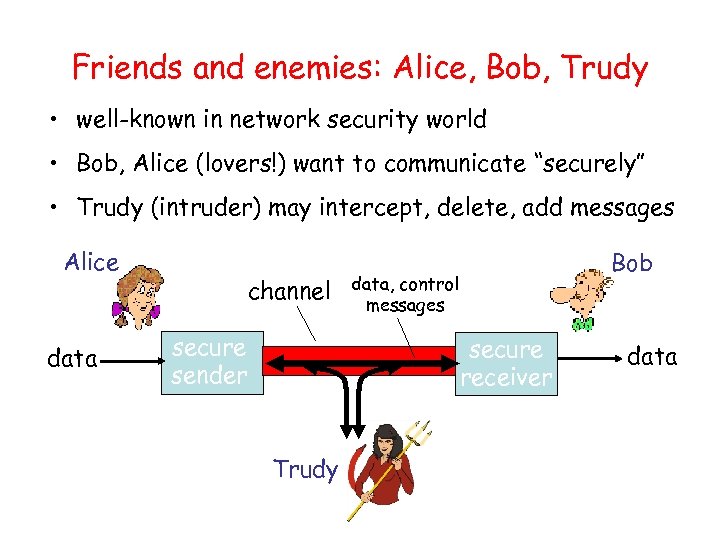 Friends and enemies: Alice, Bob, Trudy • well-known in network security world • Bob, Alice (lovers!) want to communicate “securely” • Trudy (intruder) may intercept, delete, add messages Alice data channel secure sender Bob data, control messages secure receiver Trudy data
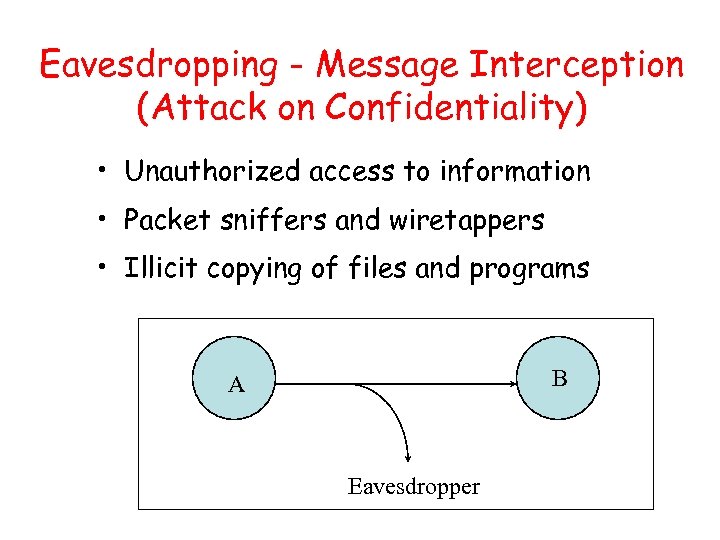 Eavesdropping - Message Interception (Attack on Confidentiality) • Unauthorized access to information • Packet sniffers and wiretappers • Illicit copying of files and programs B A Eavesdropper
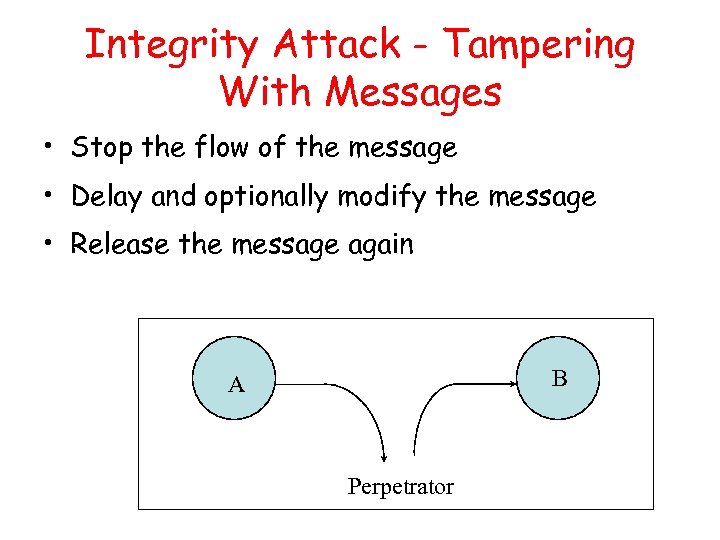 Integrity Attack - Tampering With Messages • Stop the flow of the message • Delay and optionally modify the message • Release the message again B A Perpetrator
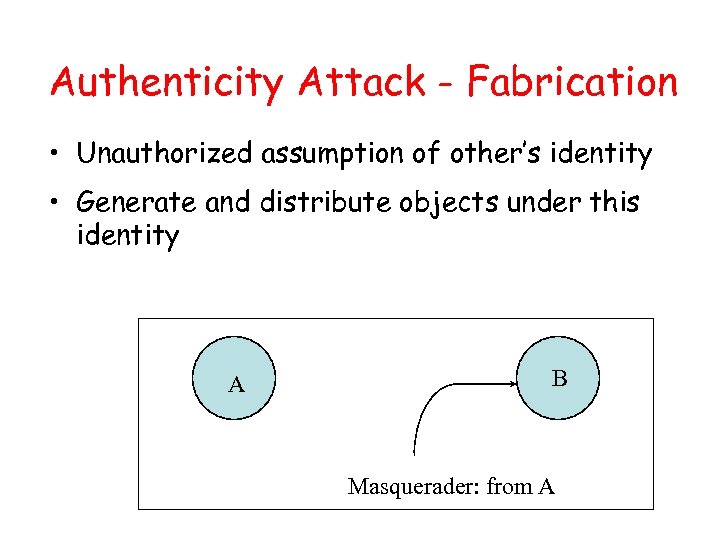 Authenticity Attack - Fabrication • Unauthorized assumption of other’s identity • Generate and distribute objects under this identity A B Masquerader: from A
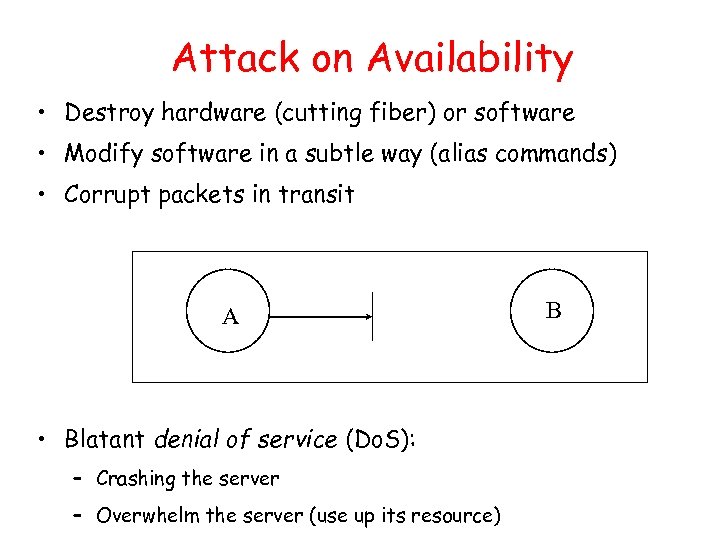 Attack on Availability • Destroy hardware (cutting fiber) or software • Modify software in a subtle way (alias commands) • Corrupt packets in transit A • Blatant denial of service (Do. S): – Crashing the server – Overwhelm the server (use up its resource) B
 Classify Security Attacks as • Passive attacks - eavesdropping on, or monitoring of, transmissions to: – obtain message contents, or – monitor traffic flows • Active attacks – modification of data stream to: – masquerade of one entity as some other – replay previous messages – modify messages in transit – denial of service
 Outline • Overview of Cryptography • Symmetric Cipher – Classical Symmetric Cipher – Modern Symmetric Ciphers (DES and AES) • Asymmetric Cipher • One-way Hash Functions and Message Digest
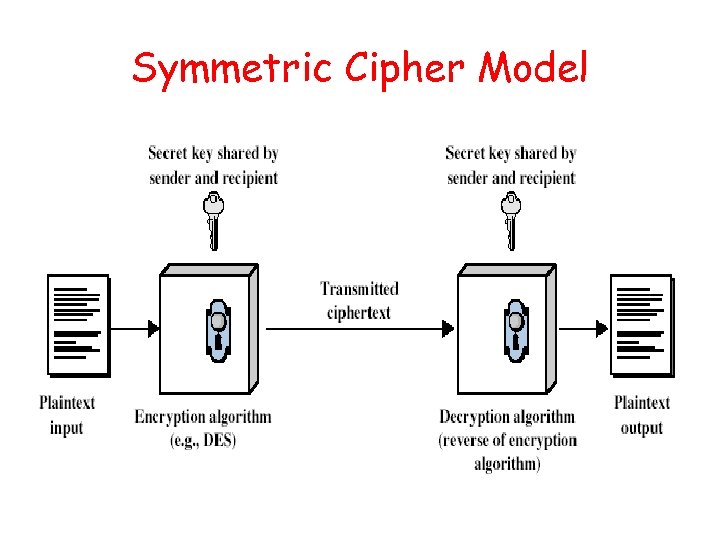
 Basic Terminology • plaintext - the original message • ciphertext - the coded message • cipher - algorithm for transforming plaintext to ciphertext • key - info used in cipher known only to sender/receiver • encipher (encrypt) - converting plaintext to ciphertext • decipher (decrypt) - recovering ciphertext from plaintext • cryptography - study of encryption principles/methods • cryptanalysis (codebreaking) - the study of principles/ methods of deciphering ciphertext without knowing key • cryptology - the field of both cryptography and cryptanalysis
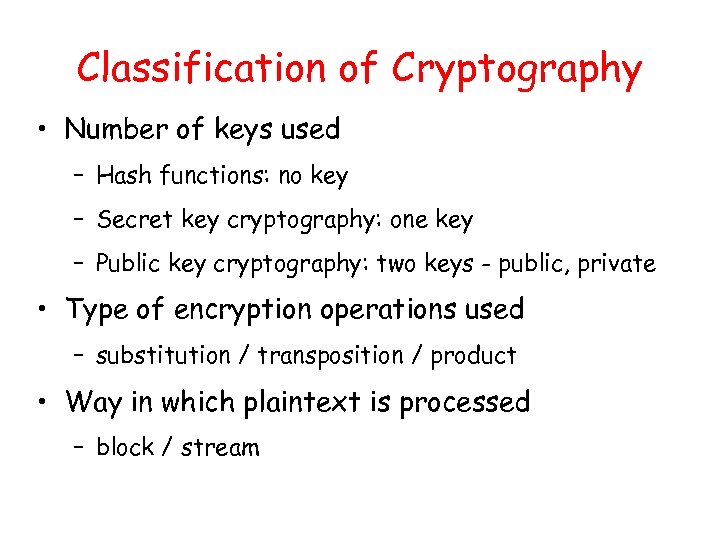 Classification of Cryptography • Number of keys used – Hash functions: no key – Secret key cryptography: one key – Public key cryptography: two keys - public, private • Type of encryption operations used – substitution / transposition / product • Way in which plaintext is processed – block / stream
 Secret Key vs. Secret Algorithm • Secret algorithm: additional hurdle • Hard to keep secret if used widely: – Reverse engineering, social engineering • Commercial: published – Wide review, trust • Military: avoid giving enemy good ideas
 Cryptanalysis Scheme • Ciphertext only: – Exhaustive search until “recognizable plaintext” – Need enough ciphertext • Known plaintext: – Secret may be revealed (by spy, time), thus
 Unconditional vs. Computational Security • Unconditional security – No matter how much computer power is available, the cipher cannot be broken – The ciphertext provides insufficient information to uniquely determine the corresponding plaintext – Only one-time pad scheme qualifies • Computational security – The cost of breaking the cipher exceeds the value of the encrypted info – The time required to break the cipher exceeds the useful lifetime of the info
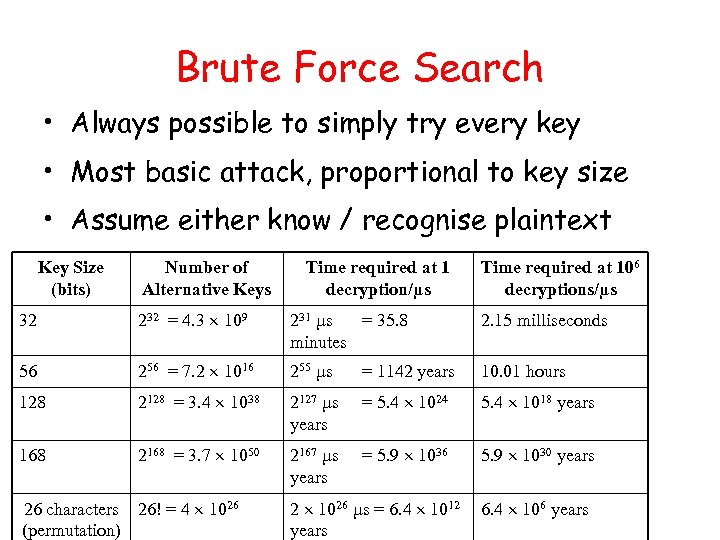 Brute Force Search • Always possible to simply try every key • Most basic attack, proportional to key size • Assume either know / recognise plaintext Key Size (bits) Number of Alternative Keys Time required at 1 decryption/µs Time required at 106 decryptions/µs 32 232 = 4. 3 109 231 µs = 35. 8 minutes 2. 15 milliseconds 56 256 = 7. 2 1016 255 µs = 1142 years 10. 01 hours 128 2128 = 3. 4 1038 2127 µs years = 5. 4 1024 5. 4 1018 years 168 2168 = 3. 7 1050 2167 µs years = 5. 9 1036 5. 9 1030 years 26 characters 26! = 4 1026 (permutation) 2 1026 µs = 6. 4 1012 years 6. 4 106 years
 Outline • Overview of Cryptography • Classical Symmetric Cipher – Substitution Cipher – Transposition Cipher • Modern Symmetric Ciphers (DES and AES) • Asymmetric Cipher • One-way Hash Functions and Message Digest
 Symmetric Cipher Model
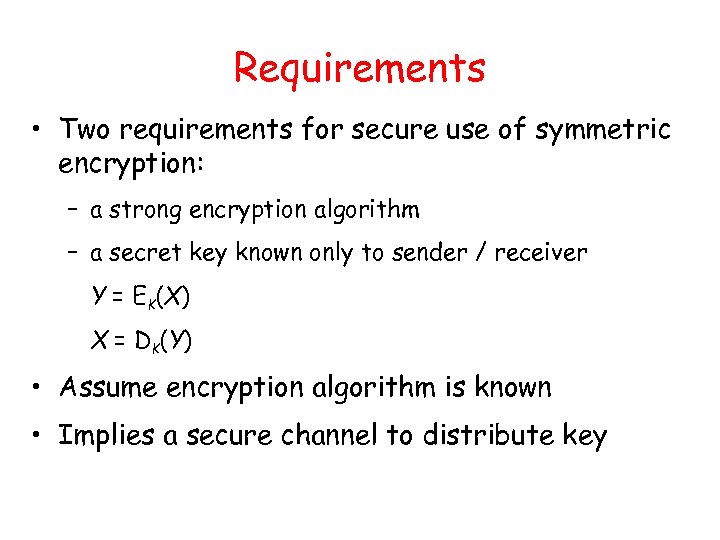 Requirements • Two requirements for secure use of symmetric encryption: – a strong encryption algorithm – a secret key known only to sender / receiver Y = EK(X) X = DK(Y) • Assume encryption algorithm is known • Implies a secure channel to distribute key
 Classical Substitution Ciphers • Letters of plaintext are replaced by other letters or by numbers or symbols • Plaintext is viewed as a sequence of bits, then substitution replaces plaintext bit patterns with ciphertext bit patterns
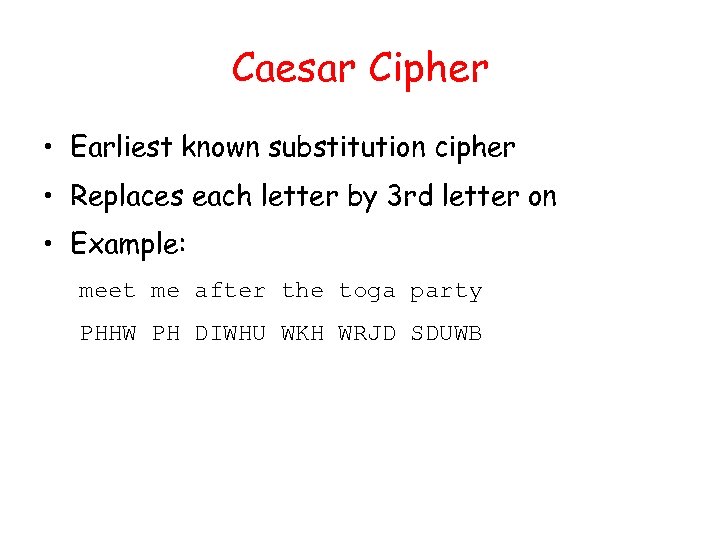 Caesar Cipher • Earliest known substitution cipher • Replaces each letter by 3 rd letter on • Example: meet me after the toga party PHHW PH DIWHU WKH WRJD SDUWB
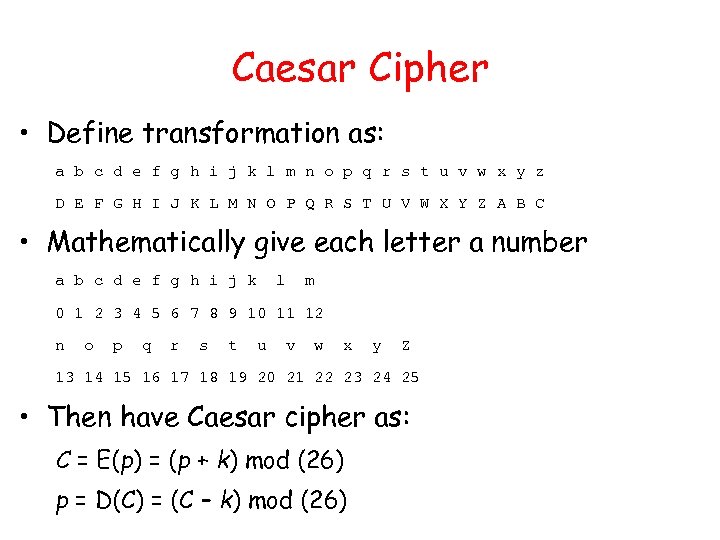 Caesar Cipher • Define transformation as: a b c d e f g h i j k l m n o p q r s t u v w x y z D E F G H I J K L M N O P Q R S T U V W X Y Z A B C • Mathematically give each letter a number a b c d e f g h i j k l m 0 1 2 3 4 5 6 7 8 9 10 11 12 n o p q r s t u v w x y Z 13 14 15 16 17 18 19 20 21 22 23 24 25 • Then have Caesar cipher as: C = E(p) = (p + k) mod (26) p = D(C) = (C – k) mod (26)
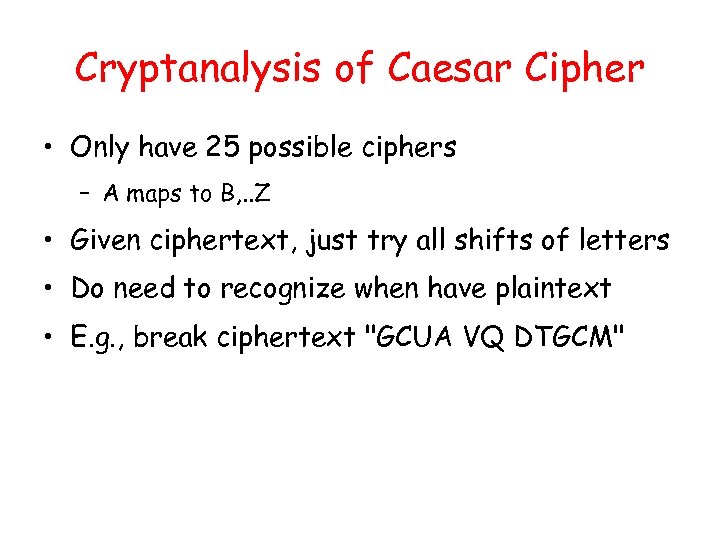 Cryptanalysis of Caesar Cipher • Only have 25 possible ciphers – A maps to B, . . Z • Given ciphertext, just try all shifts of letters • Do need to recognize when have plaintext • E. g. , break ciphertext "GCUA VQ DTGCM"
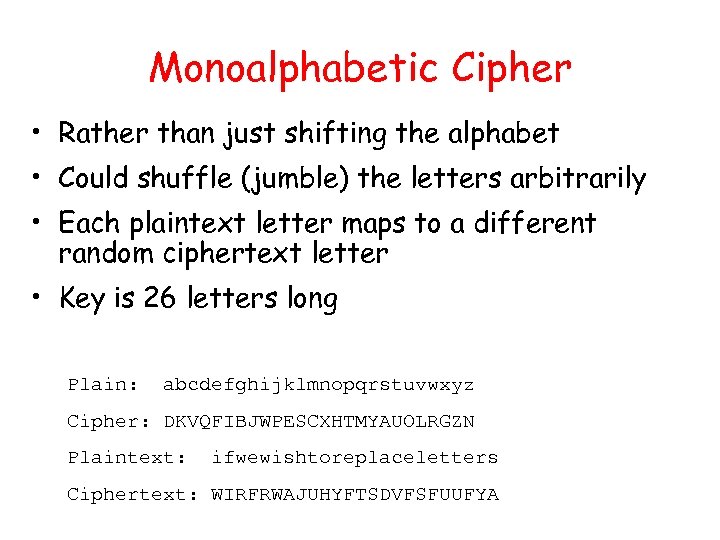 Monoalphabetic Cipher • Rather than just shifting the alphabet • Could shuffle (jumble) the letters arbitrarily • Each plaintext letter maps to a different random ciphertext letter • Key is 26 letters long Plain: abcdefghijklmnopqrstuvwxyz Cipher: DKVQFIBJWPESCXHTMYAUOLRGZN Plaintext: ifwewishtoreplaceletters Ciphertext: WIRFRWAJUHYFTSDVFSFUUFYA
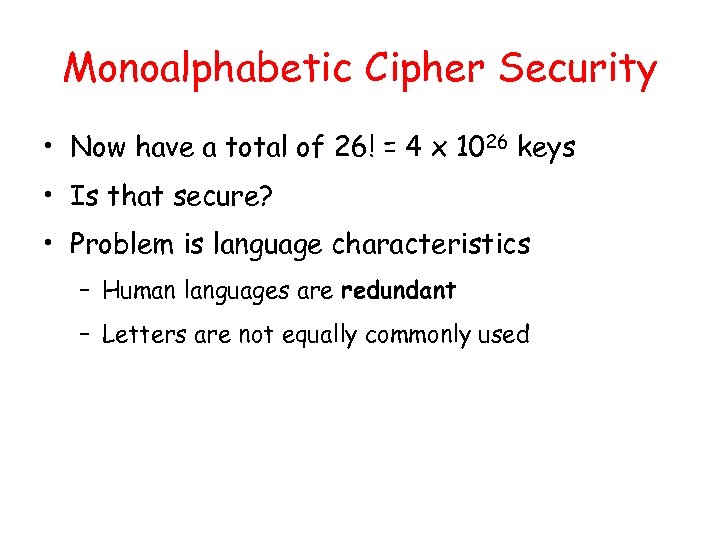 Monoalphabetic Cipher Security • Now have a total of 26! = 4 x 1026 keys • Is that secure? • Problem is language characteristics – Human languages are redundant – Letters are not equally commonly used
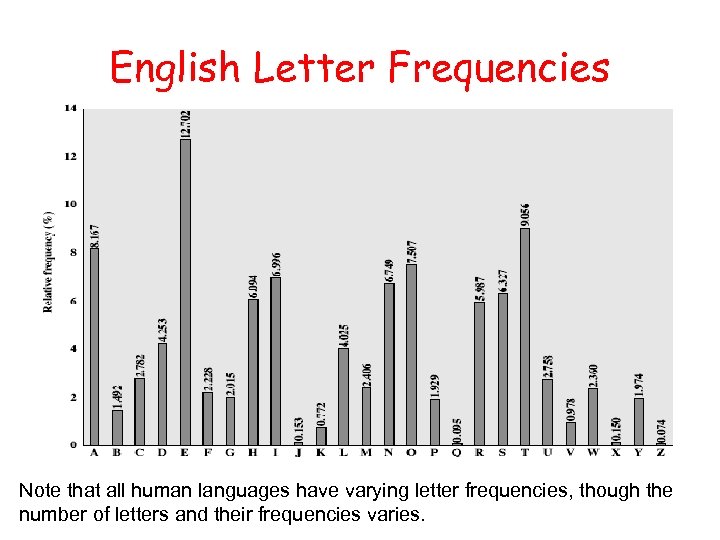 English Letter Frequencies Note that all human languages have varying letter frequencies, though the number of letters and their frequencies varies.
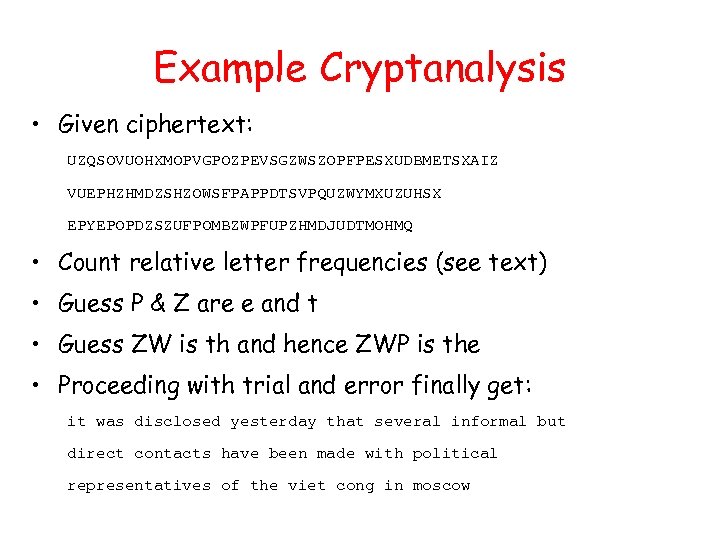 Example Cryptanalysis • Given ciphertext: UZQSOVUOHXMOPVGPOZPEVSGZWSZOPFPESXUDBMETSXAIZ VUEPHZHMDZSHZOWSFPAPPDTSVPQUZWYMXUZUHSX EPYEPOPDZSZUFPOMBZWPFUPZHMDJUDTMOHMQ • Count relative letter frequencies (see text) • Guess P & Z are e and t • Guess ZW is th and hence ZWP is the • Proceeding with trial and error finally get: it was disclosed yesterday that several informal but direct contacts have been made with political representatives of the viet cong in moscow
 One-Time Pad • If a truly random key as long as the message is used, the cipher will be secure - One-Time pad • E. g. , a random sequence of 0’s and 1’s XORed to plaintext, no repetition of keys • Unbreakable since ciphertext bears no statistical relationship to the plaintext • For any plaintext, it needs a random key of the same length – Hard to generate large amount of keys • Have problem of safe distribution of key
 Transposition Ciphers • Now consider classical transposition or permutation ciphers • These hide the message by rearranging the letter order, without altering the actual letters used • Any shortcut for breaking it? • Can recognise these since have the same frequency distribution as the original text
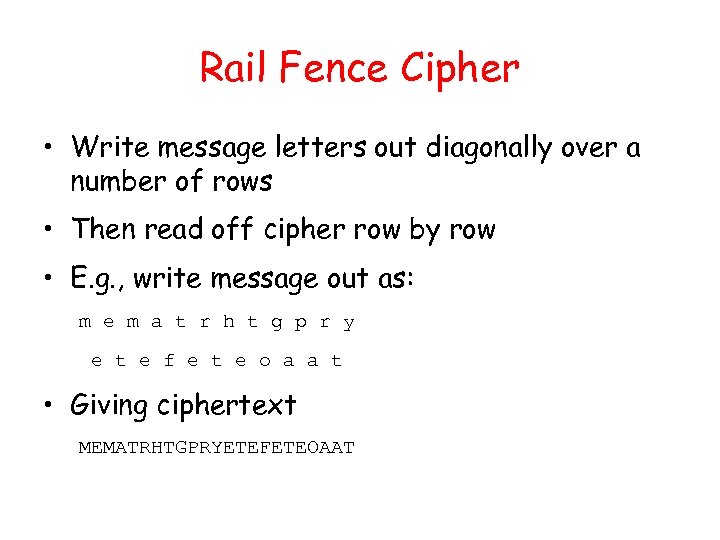 Rail Fence Cipher • Write message letters out diagonally over a number of rows • Then read off cipher row by row • E. g. , write message out as: m e m a t r h t g p r y e t e f e t e o a a t • Giving ciphertext MEMATRHTGPRYETEFETEOAAT
 Product Ciphers • Ciphers using substitutions or transpositions are not secure because of language characteristics • Hence consider using several ciphers in succession to make harder, but: – Two substitutions make another substitution – Two transpositions make a more complex transposition – But a substitution followed by a transposition makes a new much harder cipher • This is bridge from classical to modern ciphers
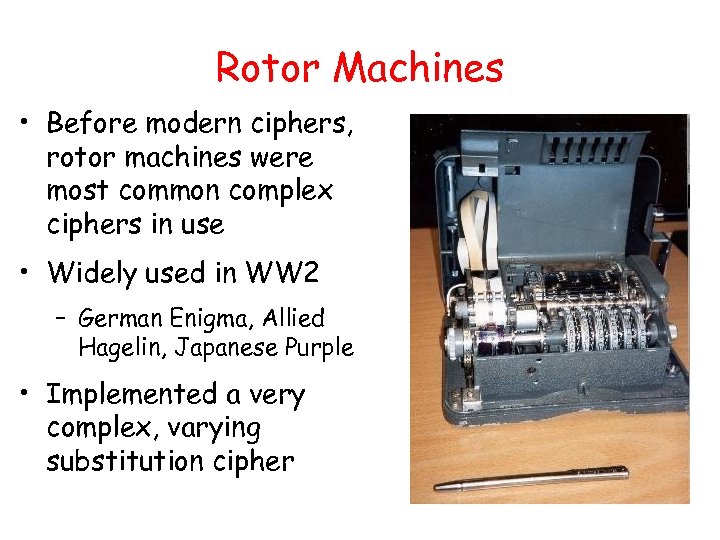 Rotor Machines • Before modern ciphers, rotor machines were most common complex ciphers in use • Widely used in WW 2 – German Enigma, Allied Hagelin, Japanese Purple • Implemented a very complex, varying substitution cipher
 Outline • Overview of Cryptography • Classical Symmetric Cipher • Modern Symmetric Ciphers (DES/AES) • Asymmetric Cipher • One-way Hash Functions and Message Digest
 Block vs Stream Ciphers • Block ciphers process messages in into blocks, each of which is then en/decrypted • Like a substitution on very big characters – 64 -bits or more • Stream ciphers process messages a bit or byte at a time when en/decrypting • Many current ciphers are block ciphers, one of the most widely used types of cryptographic algorithms
 Block Cipher Principles • Most symmetric block ciphers are based on a Feistel Cipher Structure • Block ciphers look like an extremely large substitution • Would need table of 264 entries for a 64 -bit block • Instead create from smaller building blocks • Using idea of a product cipher
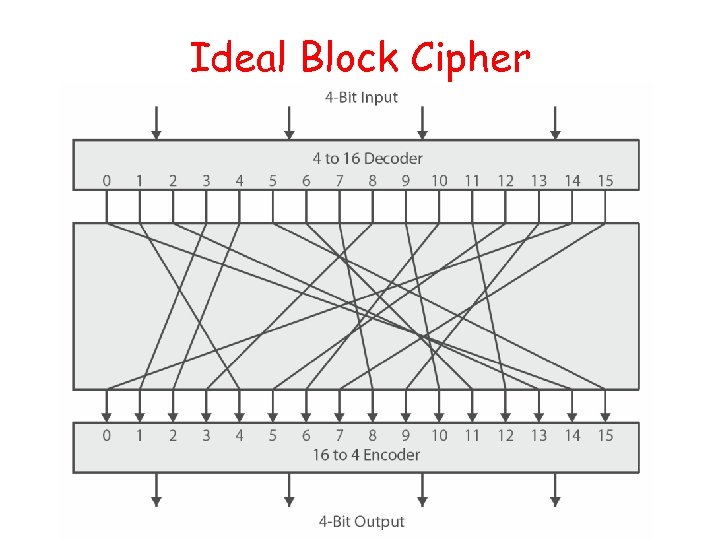 Ideal Block Cipher
![Substitution-Permutation Ciphers • Substitution-permutation (S-P) networks [Shannon, 1949] – modern substitution-transposition product cipher •](https://present5.com/presentation/1efb29b4ab21fec3d22374921efce202/image-46.jpg "Substitution-Permutation Ciphers • Substitution-permutation (S-P) networks [Shannon, 1949] – modern substitution-transposition product cipher •") Substitution-Permutation Ciphers • Substitution-permutation (S-P) networks [Shannon, 1949] – modern substitution-transposition product cipher • These form the basis of modern block ciphers • S-P networks are based on the two primitive cryptographic operations – substitution (S-box) – permutation (P-box) • provide confusion and diffusion of message
Substitution-Permutation Ciphers • Substitution-permutation (S-P) networks [Shannon, 1949] – modern substitution-transposition product cipher • These form the basis of modern block ciphers • S-P networks are based on the two primitive cryptographic operations – substitution (S-box) – permutation (P-box) • provide confusion and diffusion of message
 Confusion and Diffusion • Cipher needs to completely obscure statistical properties of original message • A one-time pad does this • More practically Shannon suggested S-P networks to obtain: • Diffusion – dissipates statistical structure of plaintext over bulk of ciphertext • Confusion – makes relationship between ciphertext and key as complex as possible
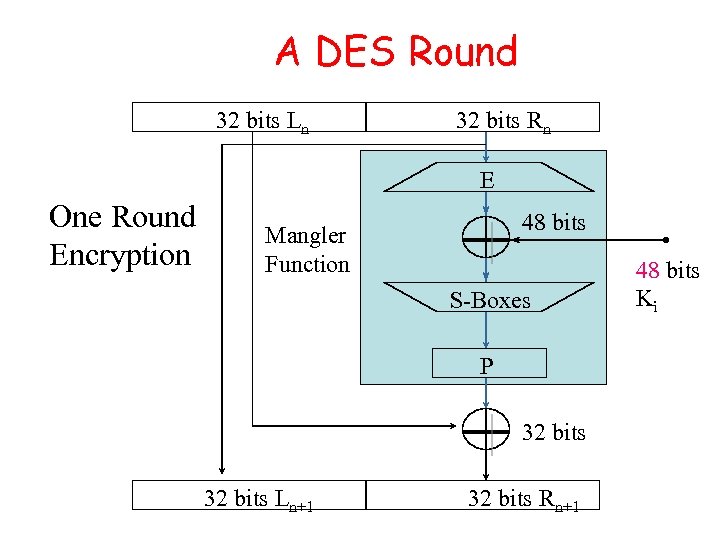
 Feistel Cipher Structure • Feistel cipher implements Shannon’s S-P network concept – based on invertible product cipher • Process through multiple rounds which – partitions input block into two halves – perform a substitution on left data half – based on round function of right half & subkey – then have permutation swapping halves
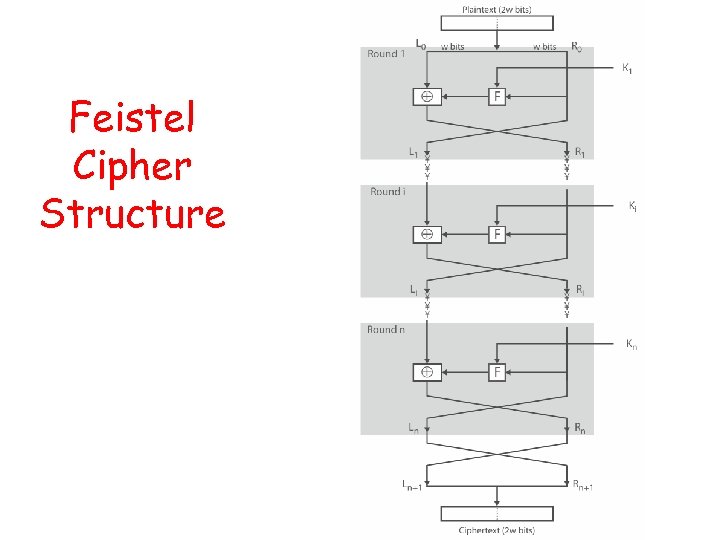 Feistel Cipher Structure
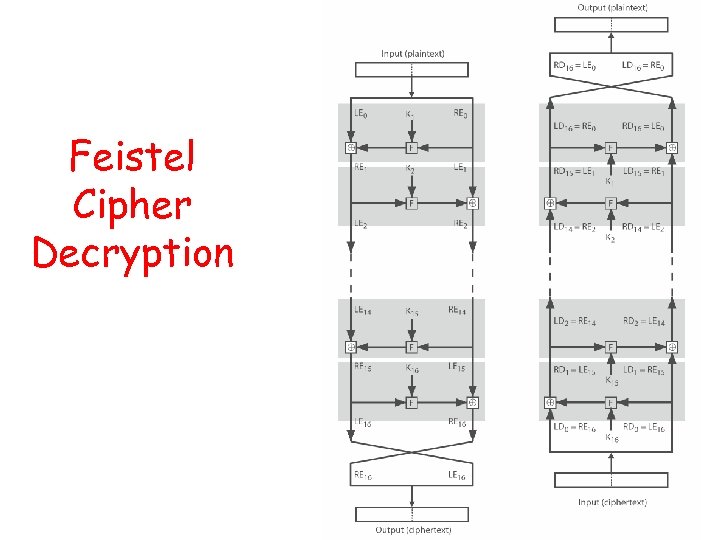 Feistel Cipher Decryption
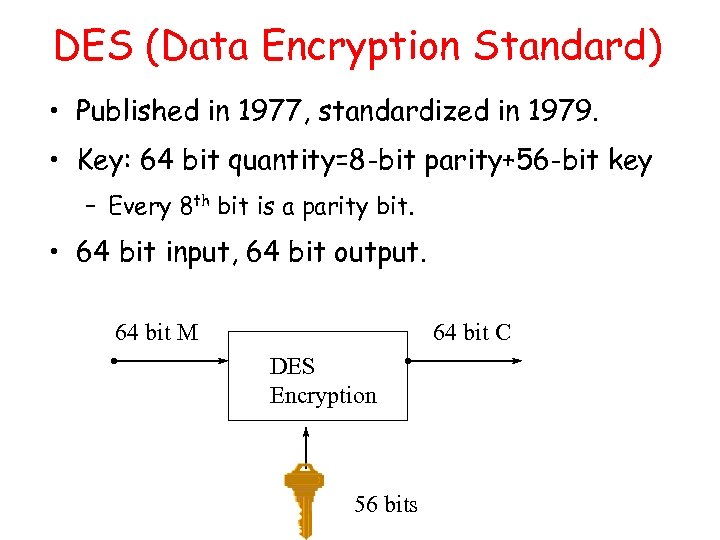 DES (Data Encryption Standard) • Published in 1977, standardized in 1979. • Key: 64 bit quantity=8 -bit parity+56 -bit key – Every 8 th bit is a parity bit. • 64 bit input, 64 bit output. 64 bit M 64 bit C DES Encryption 56 bits
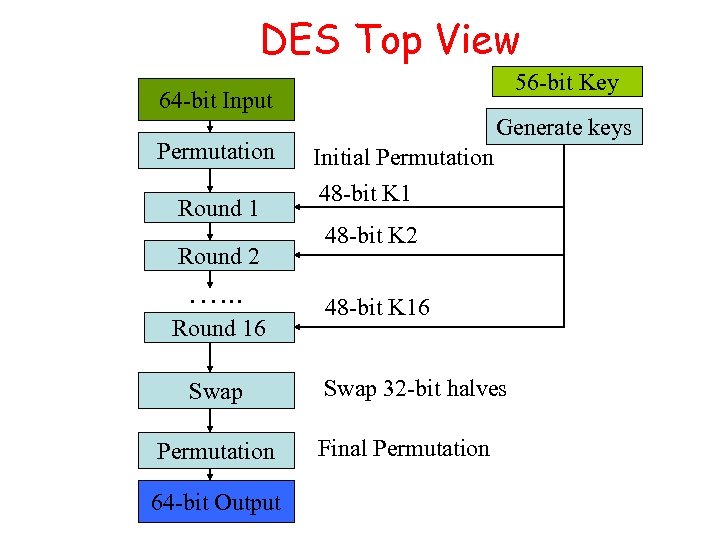 DES Top View 56 -bit Key 64 -bit Input 48 -bit K 1 Permutation Round 1 Round 2 …. . . Round 16 Swap Permutation 64 -bit Output Generate keys Initial Permutation 48 -bit K 1 48 -bit K 2 48 -bit K 16 Swap 32 -bit halves Final Permutation
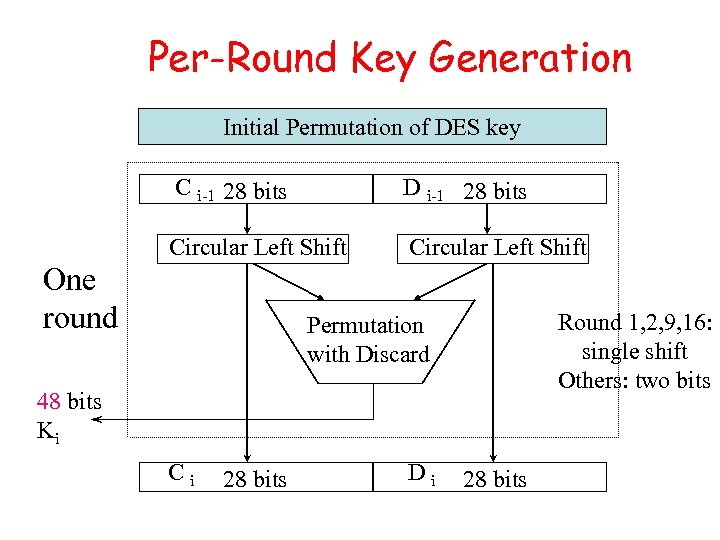
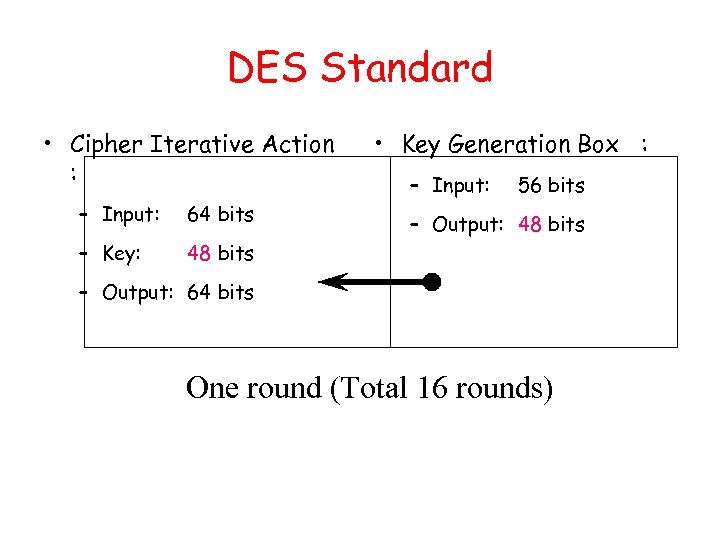 DES Standard • Cipher Iterative Action : – Input: 64 bits – Key: • Key Generation Box : – Input: 56 bits 48 bits – Output: 64 bits One round (Total 16 rounds)
 DES Box Summary • Simple, easy to implement: – Hardware/gigabits/second, software/megabits/second • 56 -bit key DES may be acceptable for noncritical applications but triple DES (DES 3) should be secure for most applications today • Supports several operation modes (ECB CBC, OFB, CFB) for different applications
 Avalanche Effect • Key desirable property of encryption alg • Where a change of one input or key bit results in changing more than half output bits • DES exhibits strong avalanche
 Strength of DES – Key Size • 56 -bit keys have 256 = 7. 2 x 10¹⁶ values • Brute force search looks hard • Recent advances have shown is possible – in 1997 on a huge cluster of computers over the Internet in a few months – in 1998 on dedicated hardware called “DES cracker” by EFF in a few days ($220, 000) – in 1999 above combined in 22 hrs! • Still must be able to recognize plaintext • No big flaw for DES algorithms
 DES Replacement • Triple-DES (3 DES) – 168 -bit key, no brute force attacks – Underlying encryption algorithm the same, no effective analytic attacks – Drawbacks • Performance: no efficient software codes for DES/3 DES • Efficiency/security: bigger block size desirable • Advanced Encryption Standards (AES) – US NIST issued call for ciphers in 1997 – Rijndael was selected as the AES in Oct-2000
 AES • Private key symmetric block cipher • 128 -bit data, 128/192/256 -bit keys • Stronger & faster than Triple-DES • Provide full specification & design details • Evaluation criteria – Security: effort to practically cryptanalysis – Cost: computational efficiency and memory requirement – Algorithm & implementation characteristics: flexibility to apps, hardware/software suitability, simplicity
 AES Shortlist • After testing and evaluation, shortlist in Aug-99: – MARS (IBM) - complex, fast, high security margin – RC 6 (USA) - v. simple, v. fast, low security margin – Rijndael (Belgium) - clean, fast, good security margin – Serpent (Euro) - slow, clean, v. high security margin – Twofish (USA) - complex, v. fast, high security margin • Then subject to further analysis & comment
 Outlines • Symmetric Cipher – Classical Symmetric Cipher – Modern Symmetric Ciphers (DES and AES) • Asymmetric Cipher • One-way Hash Functions and Message Digest
 Private-Key Cryptography • Private/secret/single key cryptography uses one key • Shared by both sender and receiver • If this key is disclosed communications are compromised • Also is symmetric, parties are equal • Hence does not protect sender from receiver forging a message & claiming is sent by sender
 Public-Key Cryptography • Probably most significant advance in the 3000 year history of cryptography • Uses two keys – a public & a private key • Asymmetric since parties are not equal • Uses clever application of number theoretic concepts to function • Complements rather than replaces private key crypto
 Public-Key Cryptography • Public-key/two-key/asymmetric cryptography involves the use of two keys: – a public-key, which may be known by anybody, and can be used to encrypt messages, and verify signatures – a private-key, known only to the recipient, used to decrypt messages, and sign (create) signatures • Asymmetric because – those who encrypt messages or verify signatures cannot decrypt messages or create signatures
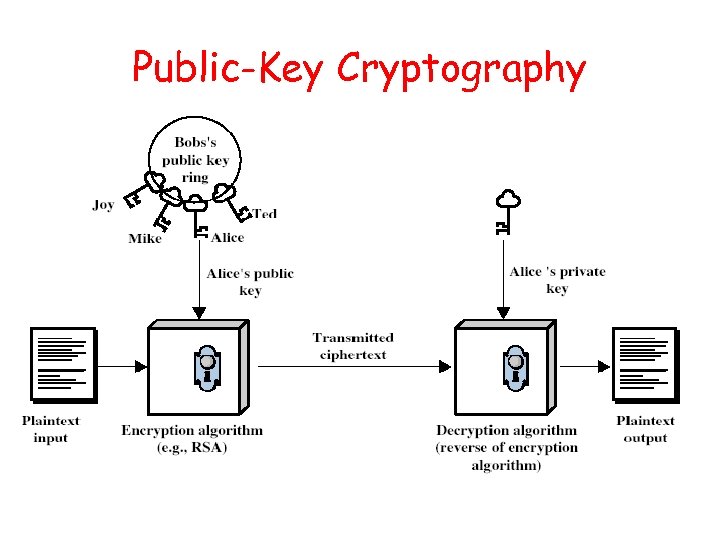 Public-Key Cryptography
 Public-Key Characteristics • Public-Key algorithms rely on two keys with the characteristics that it is: – computationally infeasible to find decryption key knowing only algorithm & encryption key – computationally easy to en/decrypt messages when the relevant (en/decrypt) key is known – either of the two related keys can be used for encryption, with the other used for decryption (in some schemes) • Analogy to delivery w/ a padlocked box
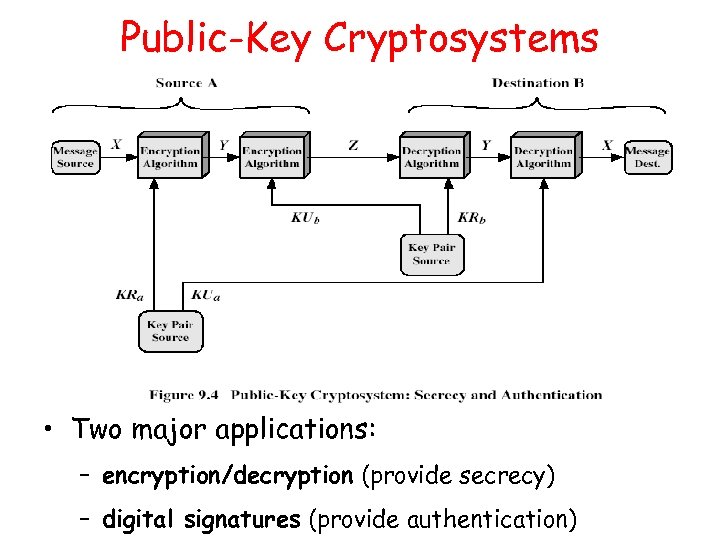 Public-Key Cryptosystems • Two major applications: – encryption/decryption (provide secrecy) – digital signatures (provide authentication)
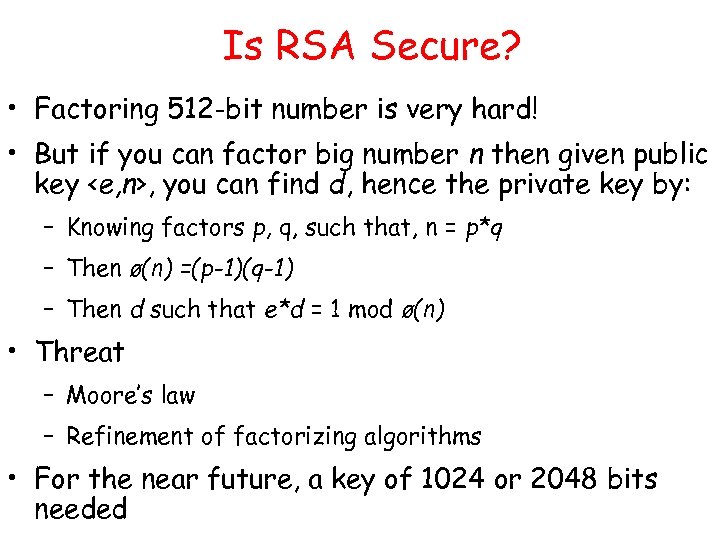
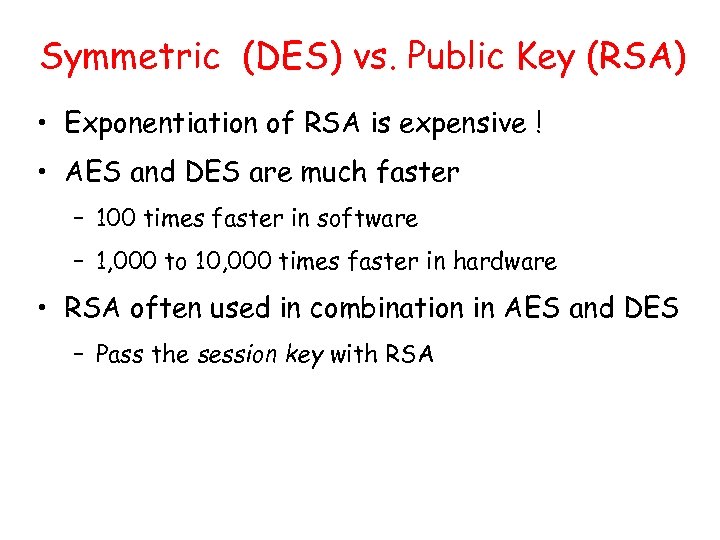
 RSA (Rivest, Shamir, Adleman) • The most popular one. • Support both public key encryption and digital signature. • Assumption/theoretical basis: – Factoring a big number is hard. • Variable key length (usually 512 bits). • Variable plaintext block size. – Plaintext must be “smaller” than the key. – Ciphertext block size is the same as the key length.
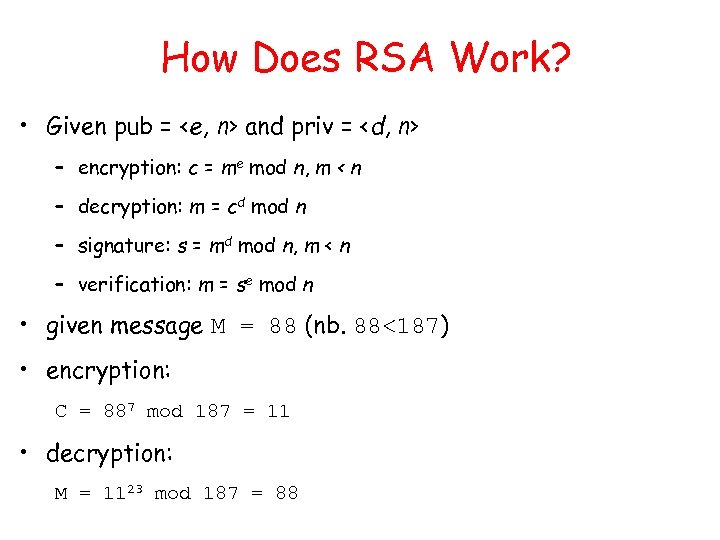
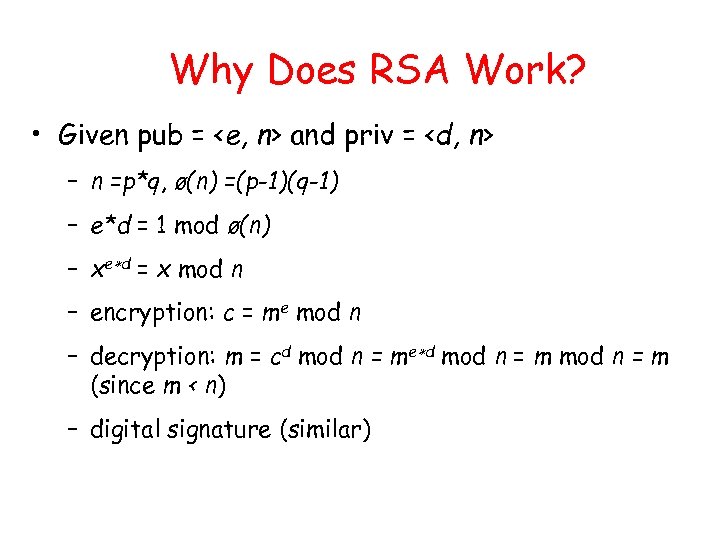
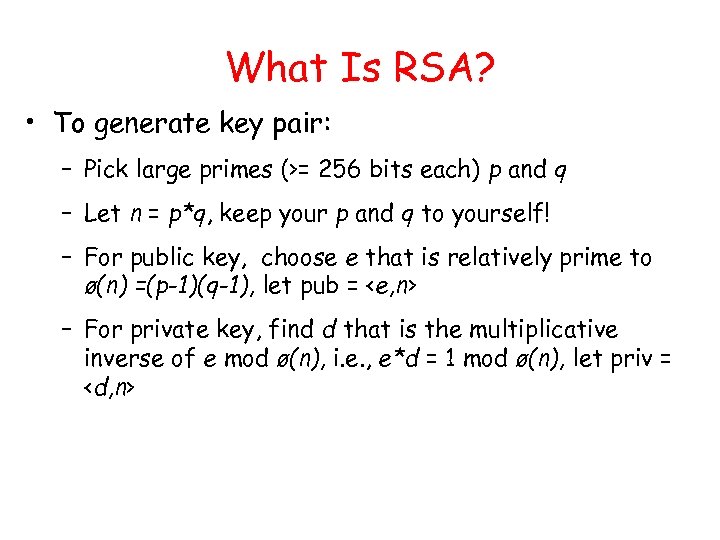 What Is RSA? • To generate key pair: – Pick large primes (>= 256 bits each) p and q – Let n = p*q, keep your p and q to yourself! – For public key, choose e that is relatively prime to ø(n) =(p-1)(q-1), let pub =
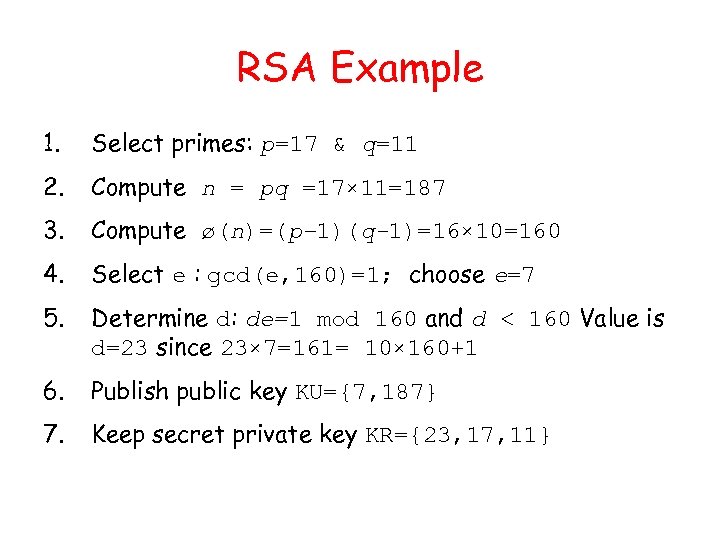 RSA Example 1. Select primes: p=17 & q=11 2. Compute n = pq =17× 11=187 3. Compute ø(n)=(p– 1)(q-1)=16× 10=160 4. Select e : gcd(e, 160)=1; choose e=7 5. Determine d: de=1 mod 160 and d < 160 Value is d=23 since 23× 7=161= 10× 160+1 6. Publish public key KU={7, 187} 7. Keep secret private key KR={23, 17, 11}
 How Does RSA Work? • Given pub =
 Why Does RSA Work? • Given pub =
 Is RSA Secure? • Factoring 512 -bit number is very hard! • But if you can factor big number n then given public key
 Symmetric (DES) vs. Public Key (RSA) • Exponentiation of RSA is expensive ! • AES and DES are much faster – 100 times faster in software – 1, 000 to 10, 000 times faster in hardware • RSA often used in combination in AES and DES – Pass the session key with RSA
 Outline • History of Security and Definitions • Overview of Cryptography • Symmetric Cipher – Classical Symmetric Cipher – Modern Symmetric Ciphers (DES and AES) • Asymmetric Cipher • One-way Hash Functions and Message Digest
 Confidentiality => Authenticity ? • Symmetric cipher ? – Plaintext has to be intelligible/understandable • Asymmetric cipher? – Straightforward use provides no authenticity – Coupled encryption • Too expensive • Requires intelligible text, otherwise message size doubles
 Hash Functions • Condenses arbitrary message to fixed size h = H(M) • Usually assume that the hash function is public and not keyed • Hash used to detect changes to message • Can use in various ways with message • Most often to create a digital signature
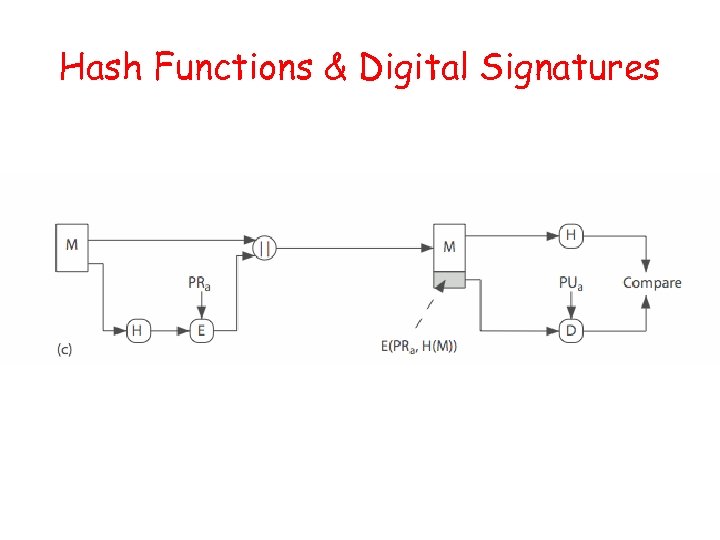 Hash Functions & Digital Signatures
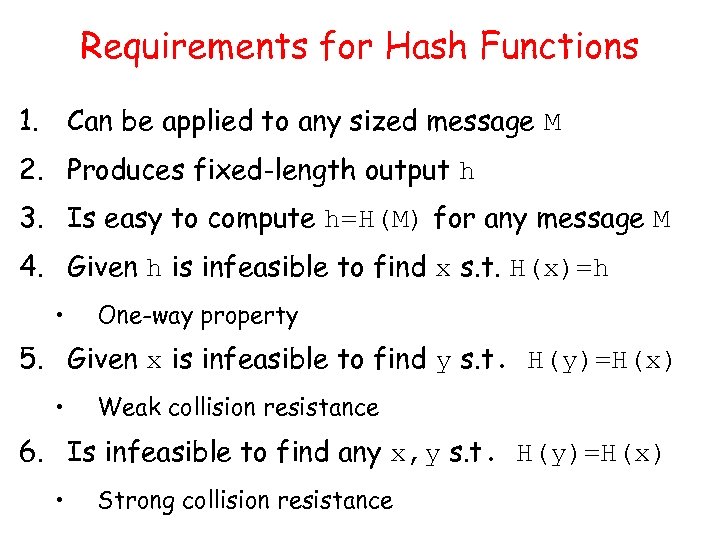 Requirements for Hash Functions 1. Can be applied to any sized message M 2. Produces fixed-length output h 3. Is easy to compute h=H(M) for any message M 4. Given h is infeasible to find x s. t. H(x)=h • One-way property 5. Given x is infeasible to find y s. t. H(y)=H(x) • Weak collision resistance 6. Is infeasible to find any x, y s. t. H(y)=H(x) • Strong collision resistance
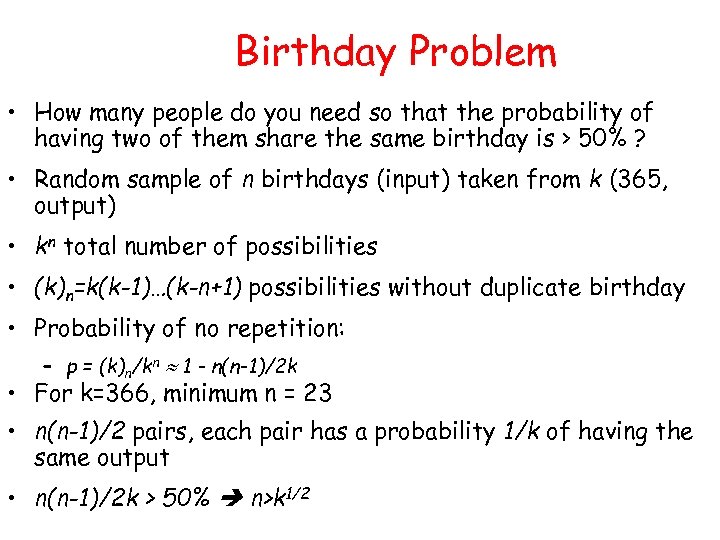 Birthday Problem • How many people do you need so that the probability of having two of them share the same birthday is > 50% ? • Random sample of n birthdays (input) taken from k (365, output) • kn total number of possibilities • (k)n=k(k-1)…(k-n+1) possibilities without duplicate birthday • Probability of no repetition: – p = (k)n/kn 1 - n(n-1)/2 k • For k=366, minimum n = 23 • n(n-1)/2 pairs, each pair has a probability 1/k of having the same output • n(n-1)/2 k > 50% n>k 1/2
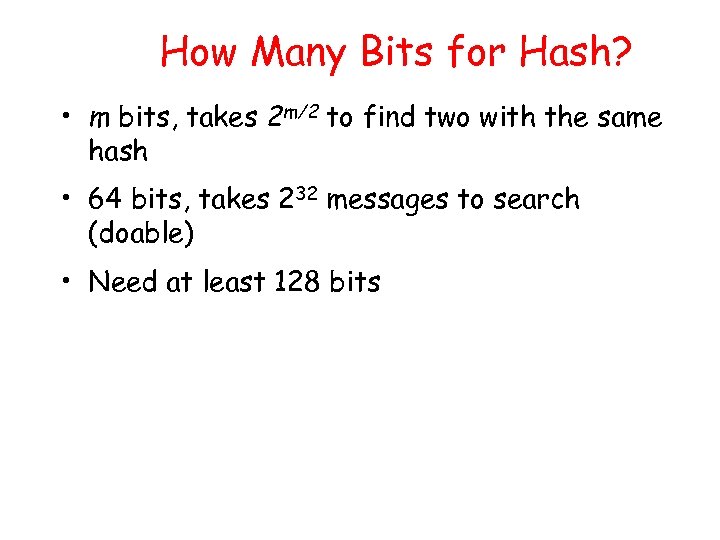 How Many Bits for Hash? • m bits, takes 2 m/2 to find two with the same hash • 64 bits, takes 232 messages to search (doable) • Need at least 128 bits
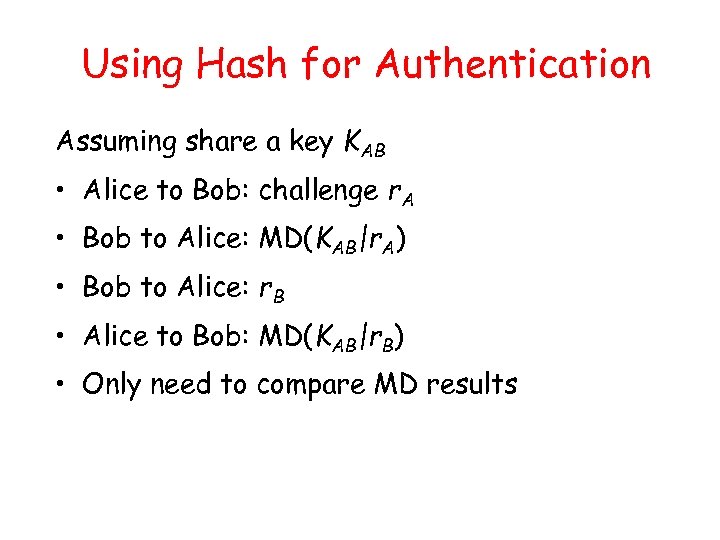 Using Hash for Authentication Assuming share a key KAB • Alice to Bob: challenge r. A • Bob to Alice: MD(KAB|r. A) • Bob to Alice: r. B • Alice to Bob: MD(KAB|r. B) • Only need to compare MD results
 Using Hash to Encrypt • One-time pad with KAB – Compute bit streams using MD, and K • b 1=MD(KAB), bi=MD(KAB|bi-1), … – with message blocks – Is this a real one-time pad ? – Add a random 64 bit number (aka IV) b 1=MD(KAB|IV), bi=MD(KAB|bi-1), …
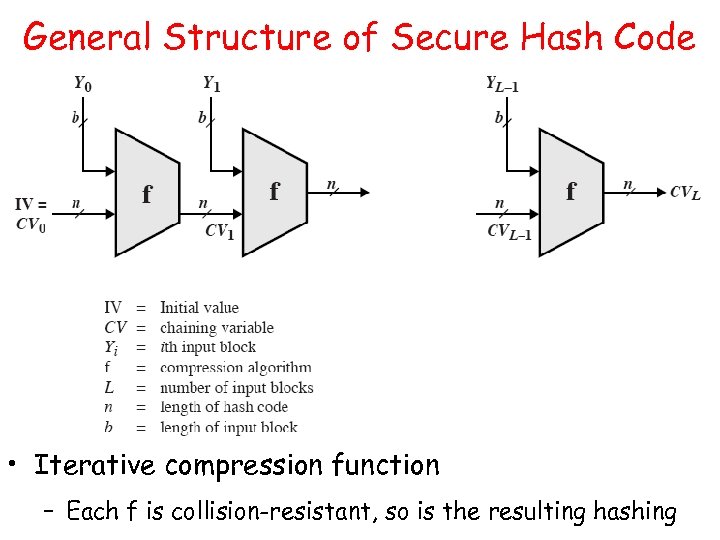 General Structure of Secure Hash Code • Iterative compression function – Each f is collision-resistant, so is the resulting hashing
 MD 5: Message Digest Version 5 input Message Output 128 bits Digest • Until recently the most widely used hash algorithm – in recent times have both brute-force & cryptanalytic concerns • Specified as Internet standard RFC 1321
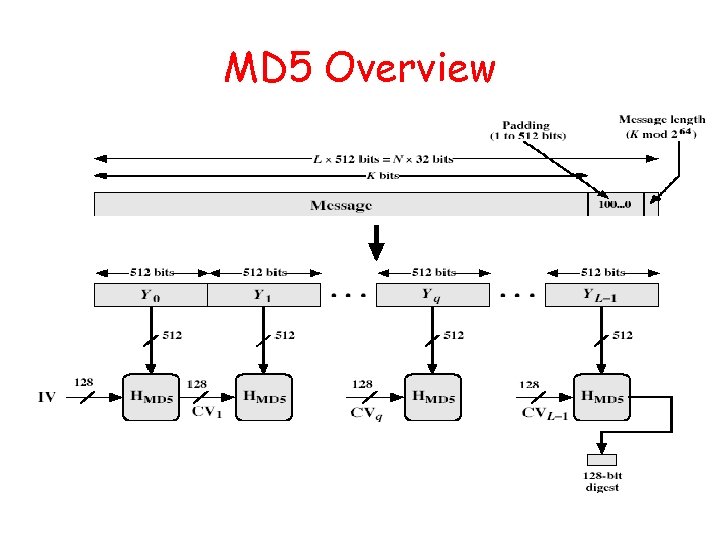 MD 5 Overview
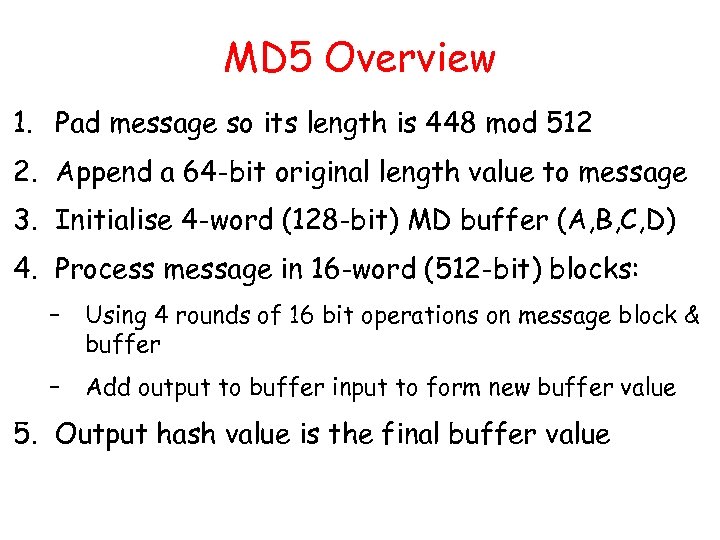 MD 5 Overview 1. Pad message so its length is 448 mod 512 2. Append a 64 -bit original length value to message 3. Initialise 4 -word (128 -bit) MD buffer (A, B, C, D) 4. Process message in 16 -word (512 -bit) blocks: – Using 4 rounds of 16 bit operations on message block & buffer – Add output to buffer input to form new buffer value 5. Output hash value is the final buffer value
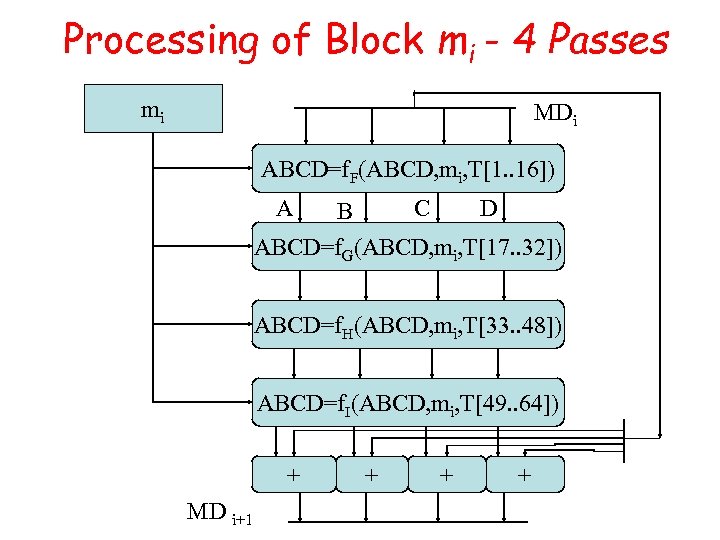 Processing of Block mi - 4 Passes mi MDi ABCD=f. F(ABCD, mi, T[1. . 16]) A C B D ABCD=f. G(ABCD, mi, T[17. . 32]) ABCD=f. H(ABCD, mi, T[33. . 48]) ABCD=f. I(ABCD, mi, T[49. . 64]) + MD i+1 + + +
 Secure Hash Algorithm • Developed by NIST, specified in the Secure Hash Standard (SHS, FIPS Pub 180), 1993 • SHA is specified as the hash algorithm in the Digital Signature Standard (DSS), NIST
 General Logic • Input message must be < 264 bits – not really a problem • Message is processed in 512 -bit blocks sequentially • Message digest is 160 bits • SHA design is similar to MD 5, a little slower, but a lot stronger
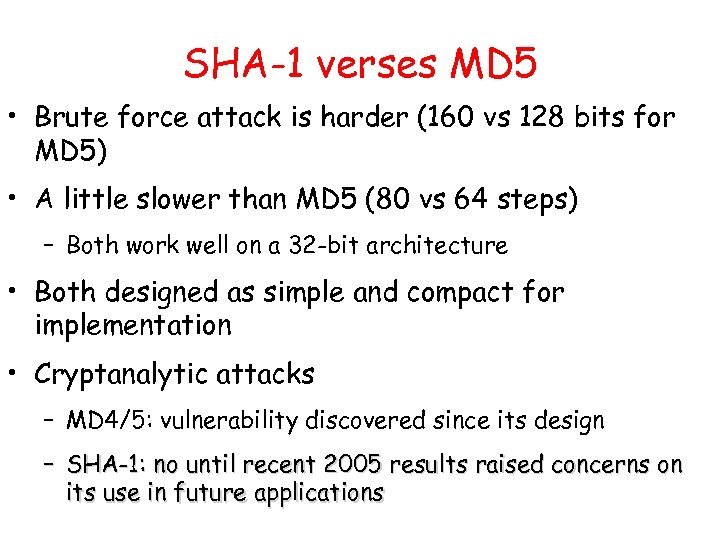 SHA-1 verses MD 5 • Brute force attack is harder (160 vs 128 bits for MD 5) • A little slower than MD 5 (80 vs 64 steps) – Both work well on a 32 -bit architecture • Both designed as simple and compact for implementation • Cryptanalytic attacks – MD 4/5: vulnerability discovered since its design – SHA-1: no until recent 2005 results raised concerns on its use in future applications
 Revised Secure Hash Standard • NIST have issued a revision FIPS 180 -2 in 2002 • Adds 3 additional hash algorithms • SHA-256, SHA-384, SHA-512 – Collectively called SHA-2 • Designed for compatibility with increased security provided by the AES cipher • Structure & detail are similar to SHA-1 • Hence analysis should be similar, but security levels are rather higher
 Backup Slides
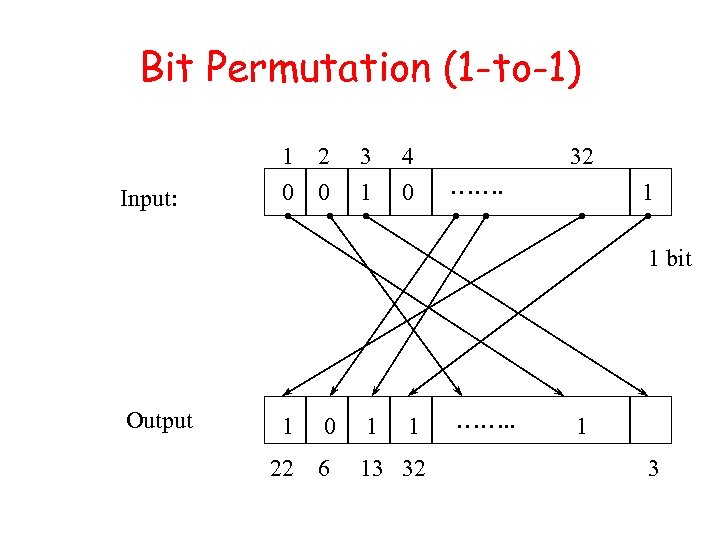 Bit Permutation (1 -to-1) Input: 1 2 0 0 3 1 4 0 32 ……. 1 1 bit Output 1 0 1 1 22 6 13 32 ……. . 1 3
 Per-Round Key Generation Initial Permutation of DES key C i-1 28 bits D i-1 28 bits Circular Left Shift One round Round 1, 2, 9, 16: single shift Others: two bits Permutation with Discard 48 bits Ki Ci 28 bits Di 28 bits
 A DES Round 32 bits Ln 32 bits Rn E One Round Encryption 48 bits Mangler Function S-Boxes P 32 bits Ln+1 32 bits Rn+1 48 bits Ki
 Mangler Function 4 4 4 4 6 6 6 + + + 6 + 6 Permutation 6 6 6 6 + S 1 S 2 S 3 S 4 S 5 S 6 S 7 S 8 4 4 4 4 6 The permutation produces “spread” among the chunks/S-boxes!
 Bits Expansion (1 -to-m) 1 0 Input: 2 0 3 1 4 0 5 ……. 1 32 1 Output 1 0 0 1 0 1 1 2 3 4 5 6 7 8 ……. . 1 0 48
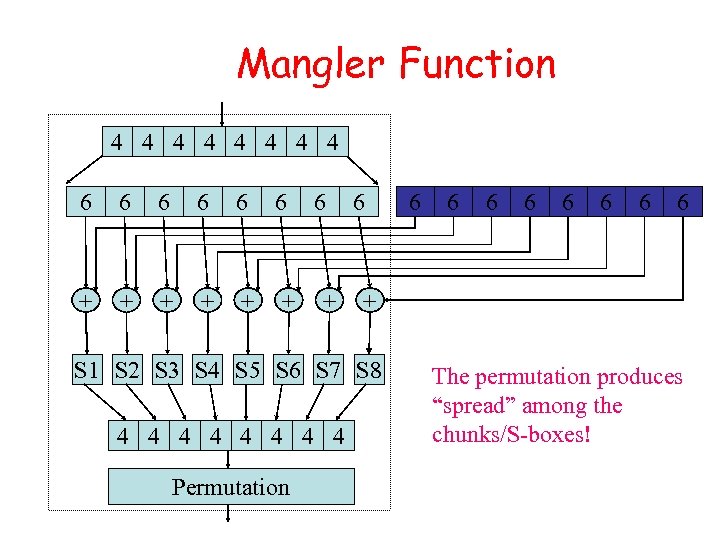
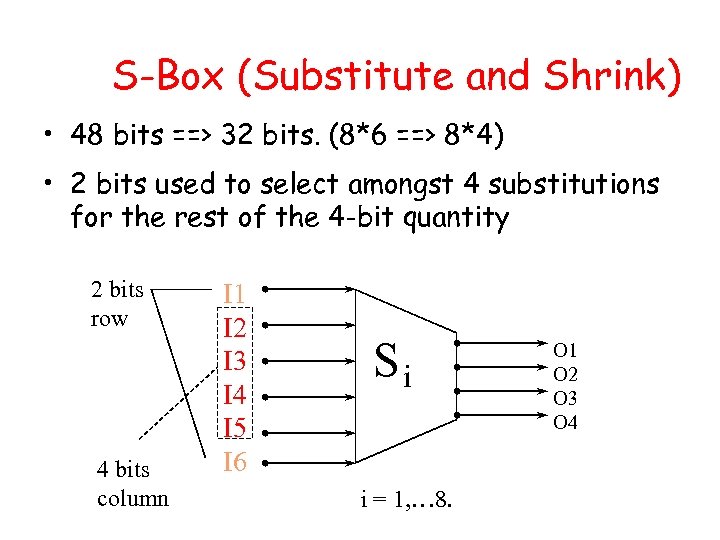 S-Box (Substitute and Shrink) • 48 bits ==> 32 bits. (8*6 ==> 8*4) • 2 bits used to select amongst 4 substitutions for the rest of the 4 -bit quantity 2 bits row 4 bits column I 1 I 2 I 3 I 4 I 5 I 6 Si i = 1, … 8. O 1 O 2 O 3 O 4
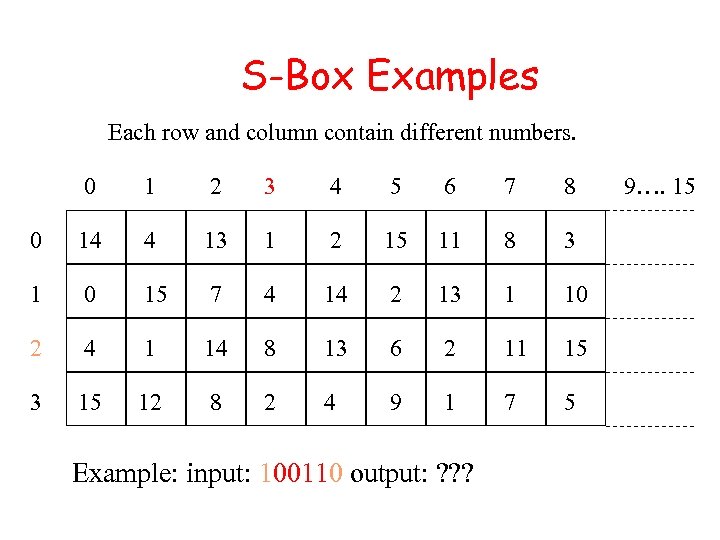 S-Box Examples Each row and column contain different numbers. 0 1 2 3 4 5 6 7 8 0 14 4 13 1 2 15 11 8 3 1 0 15 7 4 14 2 13 1 10 2 4 1 14 8 13 6 2 11 15 3 15 12 8 2 4 9 1 7 5 Example: input: 100110 output: ? ? ? 9…. 15
 Padding Twist • Given original message M, add padding bits “ 10*” such that resulting length is 64 bits less than a multiple of 512 bits. • Append (original length in bits mod 264), represented in 64 bits to the padded message • Final message is chopped 512 bits a block
 MD 5 Process • As many stages as the number of 512 -bit blocks in the final padded message • Digest: 4 32 -bit words: MD=A|B|C|D • Every message block contains 16 32 -bit words: m 0|m 1|m 2…|m 15 – Digest MD 0 initialized to: A=01234567, B=89 abcdef, C=fedcba 98, D=76543210 – Every stage consists of 4 passes over the message block, each modifying MD • Each block 4 rounds, each round 16 steps
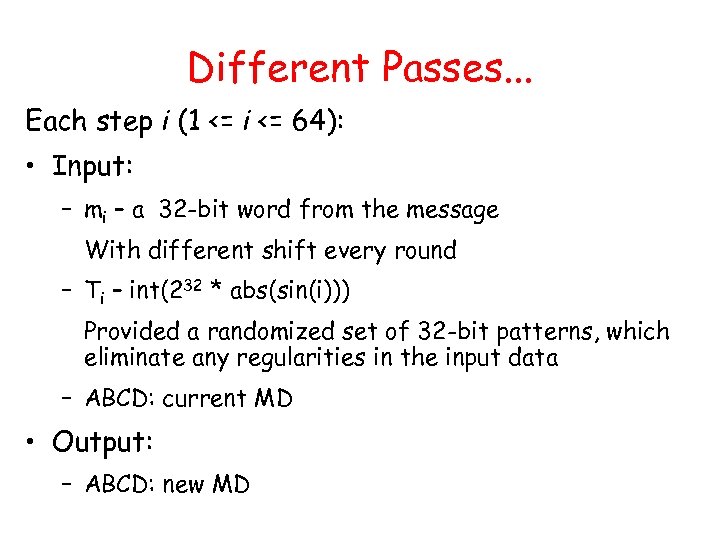 Different Passes. . . Each step i (1 <= i <= 64): • Input: – mi – a 32 -bit word from the message With different shift every round – Ti – int(232 * abs(sin(i))) Provided a randomized set of 32 -bit patterns, which eliminate any regularities in the input data – ABCD: current MD • Output: – ABCD: new MD
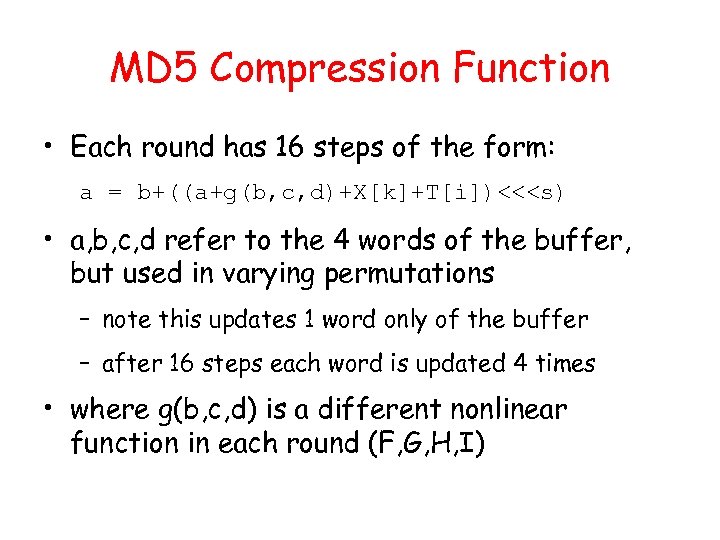 MD 5 Compression Function • Each round has 16 steps of the form: a = b+((a+g(b, c, d)+X[k]+T[i])<<
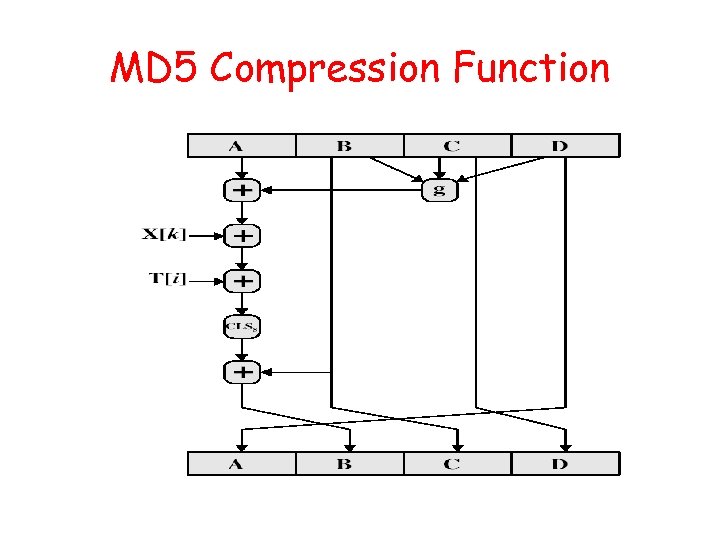 MD 5 Compression Function
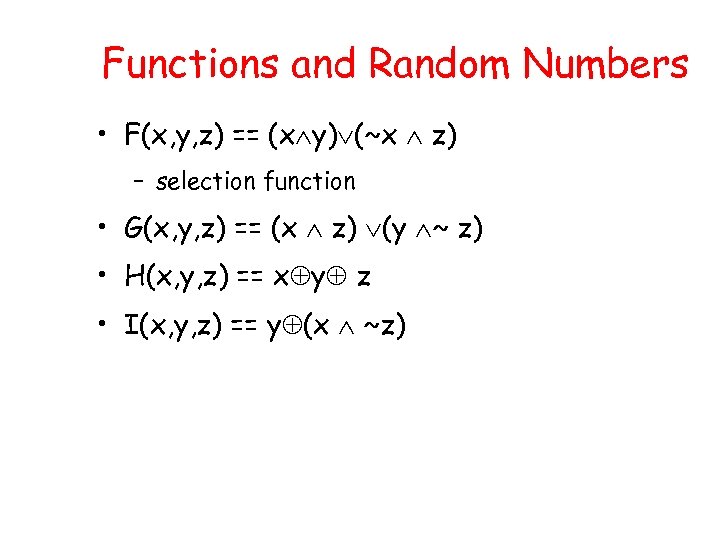 Functions and Random Numbers • F(x, y, z) == (x y) (~x z) – selection function • G(x, y, z) == (x z) (y ~ z) • H(x, y, z) == x y z • I(x, y, z) == y (x ~z)
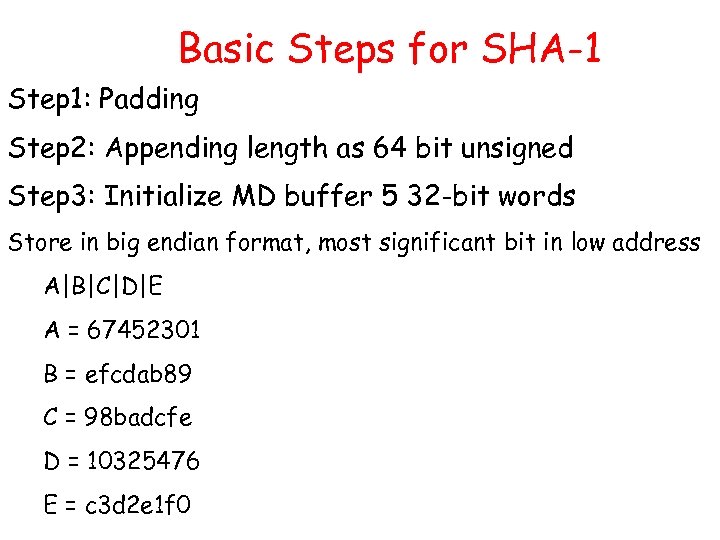 Basic Steps for SHA-1 Step 1: Padding Step 2: Appending length as 64 bit unsigned Step 3: Initialize MD buffer 5 32 -bit words Store in big endian format, most significant bit in low address A|B|C|D|E A = 67452301 B = efcdab 89 C = 98 badcfe D = 10325476 E = c 3 d 2 e 1 f 0
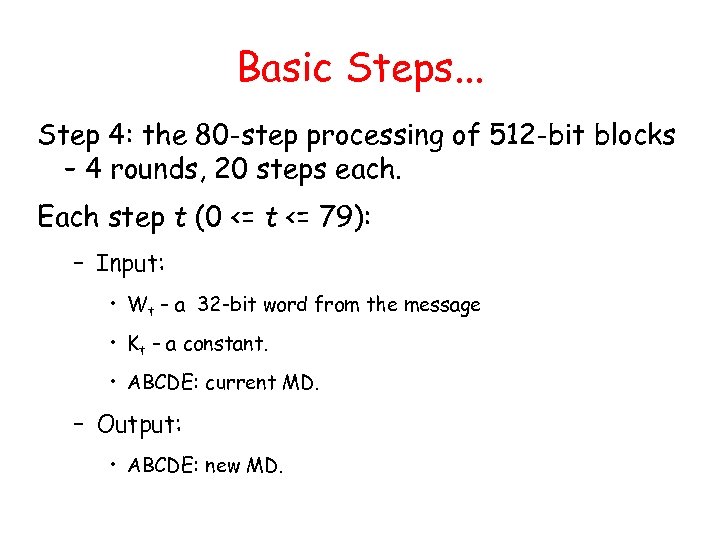 Basic Steps. . . Step 4: the 80 -step processing of 512 -bit blocks – 4 rounds, 20 steps each. Each step t (0 <= t <= 79): – Input: • Wt – a 32 -bit word from the message • Kt – a constant. • ABCDE: current MD. – Output: • ABCDE: new MD.