 Скачать презентацию Why Are Yield Spreads on Bank Issued Subordinated
4841f1fa45a8b377a14fb7e49ea20320.ppt
- Количество слайдов: 22



Why Are Yield Spreads on Bank. Issued Subordinated Notes and Debentures Not Sensitive to Bank Risks? Bhanu Balasubramnian Emporia State University Ken Cyree The University of Mississippi
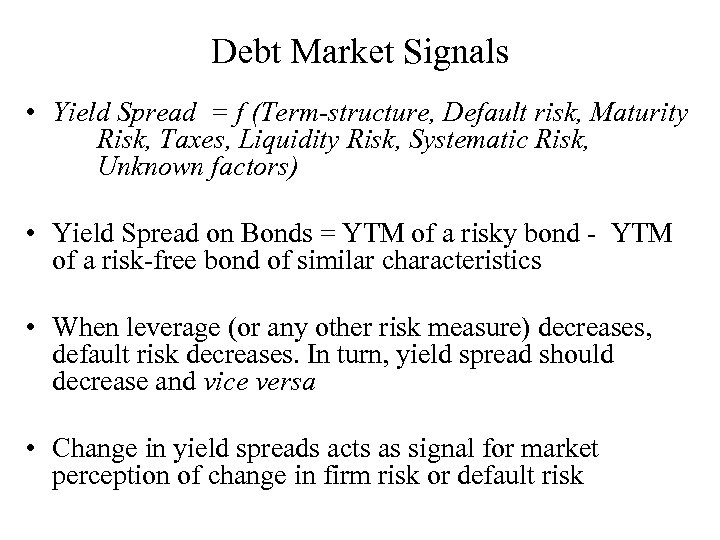
Debt Market Signals • Yield Spread = f (Term-structure, Default risk, Maturity Risk, Taxes, Liquidity Risk, Systematic Risk, Unknown factors) • Yield Spread on Bonds = YTM of a risky bond - YTM of a risk-free bond of similar characteristics • When leverage (or any other risk measure) decreases, default risk decreases. In turn, yield spread should decrease and vice versa • Change in yield spreads acts as signal for market perception of change in firm risk or default risk
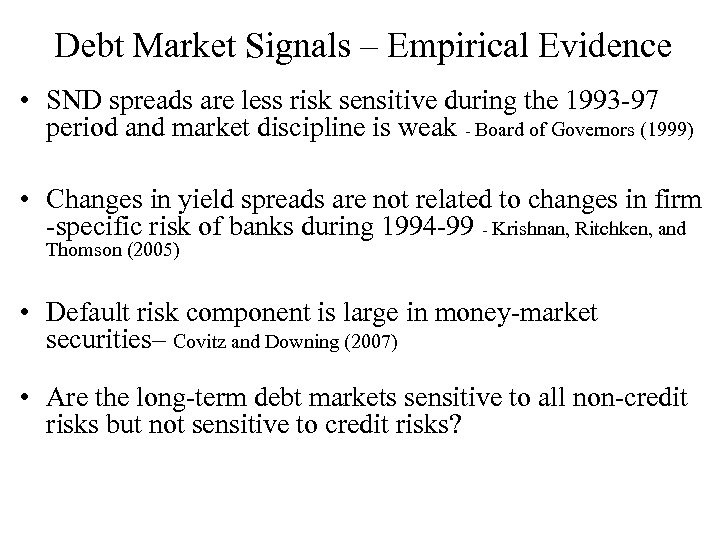
Debt Market Signals – Empirical Evidence • SND spreads are less risk sensitive during the 1993 -97 period and market discipline is weak - Board of Governors (1999) • Changes in yield spreads are not related to changes in firm -specific risk of banks during 1994 -99 - Krishnan, Ritchken, and Thomson (2005) • Default risk component is large in money-market securities– Covitz and Downing (2007) • Are the long-term debt markets sensitive to all non-credit risks but not sensitive to credit risks?
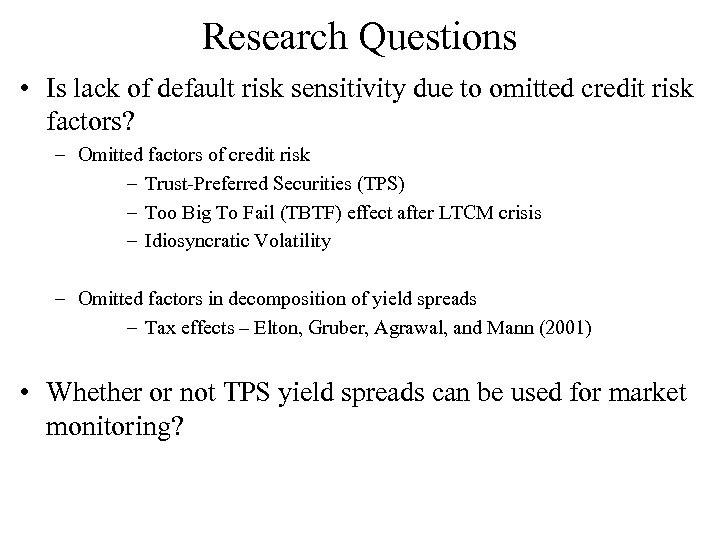
Research Questions • Is lack of default risk sensitivity due to omitted credit risk factors? – Omitted factors of credit risk – Trust-Preferred Securities (TPS) – Too Big To Fail (TBTF) effect after LTCM crisis – Idiosyncratic Volatility – Omitted factors in decomposition of yield spreads – Tax effects – Elton, Gruber, Agrawal, and Mann (2001) • Whether or not TPS yield spreads can be used for market monitoring?
Data Sources • National Association of Insurance Commissioners (NAIC) database for bond transactions for the years 1994 – 1999 • SDC Platinum database - bond issue characteristics • FR Y-9 C reports for banks • CRSP for stock market data • H-15 Reports from St. Louis Fed for daily Treasury rates
Sample Selection • Select fixed-rate, U. S. dollar, plain-vanilla bonds with investment grade credit ratings • No put or call options, collateral, sinking fund • Should not be convertible, Yankee, global, serial, LBO • Only bank-issued SND transactions • With at least two years of remaining maturity • At least 10 transactions per SND issue • 6620 buys and 4072 sell transactions • 300 SND issues by 71 BHCs
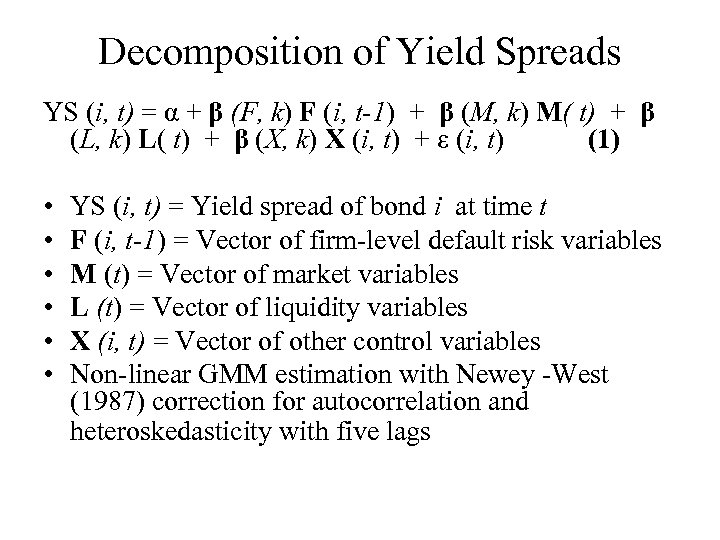
Decomposition of Yield Spreads YS (i, t) = α + β (F, k) F (i, t-1) + β (M, k) M( t) + β (L, k) L( t) + β (X, k) X (i, t) + ε (i, t) (1) • • • YS (i, t) = Yield spread of bond i at time t F (i, t-1) = Vector of firm-level default risk variables M (t) = Vector of market variables L (t) = Vector of liquidity variables X (i, t) = Vector of other control variables Non-linear GMM estimation with Newey -West (1987) correction for autocorrelation and heteroskedasticity with five lags
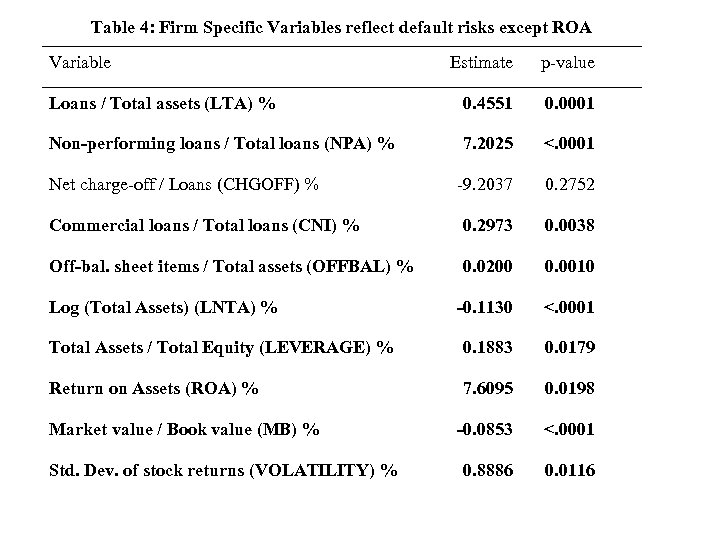
Table 4: Firm Specific Variables reflect default risks except ROA Variable Estimate p-value Loans / Total assets (LTA) % 0. 4551 0. 0001 Non-performing loans / Total loans (NPA) % 7. 2025 <. 0001 -9. 2037 0. 2752 Commercial loans / Total loans (CNI) % 0. 2973 0. 0038 Off-bal. sheet items / Total assets (OFFBAL) % 0. 0200 0. 0010 -0. 1130 <. 0001 Total Assets / Total Equity (LEVERAGE) % 0. 1883 0. 0179 Return on Assets (ROA) % 7. 6095 0. 0198 -0. 0853 <. 0001 0. 8886 0. 0116 Net charge-off / Loans (CHGOFF) % Log (Total Assets) (LNTA) % Market value / Book value (MB) % Std. Dev. of stock returns (VOLATILITY) %
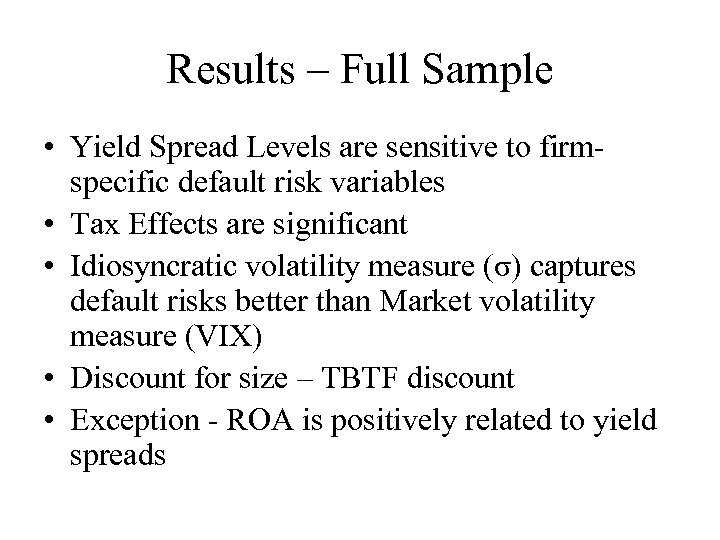
Results – Full Sample • Yield Spread Levels are sensitive to firmspecific default risk variables • Tax Effects are significant • Idiosyncratic volatility measure (σ) captures default risks better than Market volatility measure (VIX) • Discount for size – TBTF discount • Exception - ROA is positively related to yield spreads
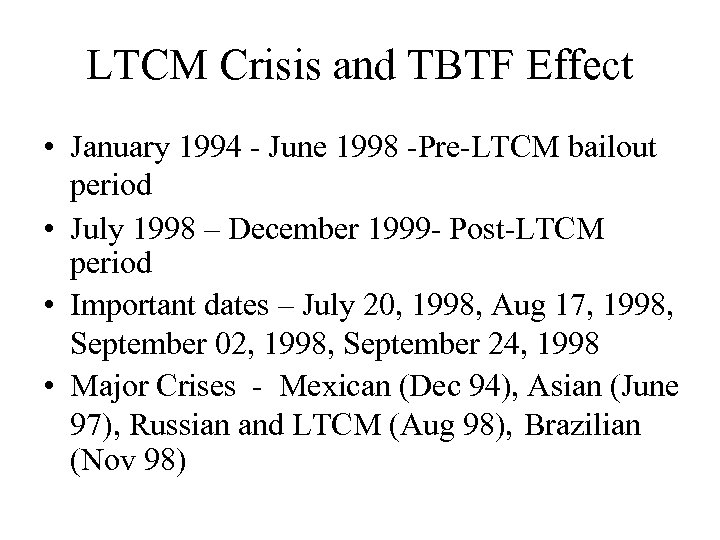
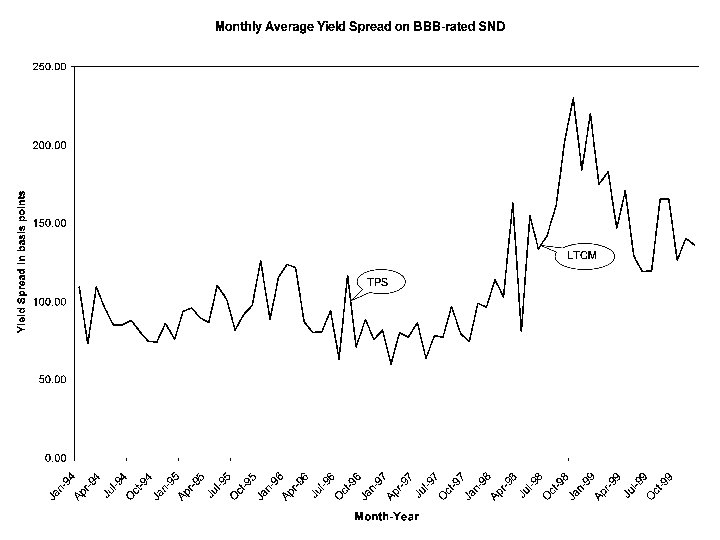
LTCM Crisis and TBTF Effect • January 1994 - June 1998 -Pre-LTCM bailout period • July 1998 – December 1999 - Post-LTCM period • Important dates – July 20, 1998, Aug 17, 1998, September 02, 1998, September 24, 1998 • Major Crises - Mexican (Dec 94), Asian (June 97), Russian and LTCM (Aug 98), Brazilian (Nov 98)
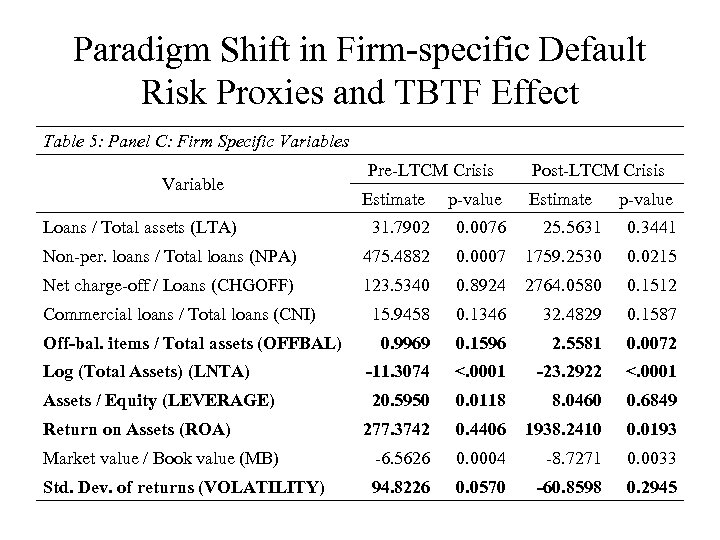
Paradigm Shift in Firm-specific Default Risk Proxies and TBTF Effect Table 5: Panel C: Firm Specific Variables Variable Pre-LTCM Crisis Post-LTCM Crisis Estimate p-value 31. 7902 0. 0076 25. 5631 0. 3441 Non-per. loans / Total loans (NPA) 475. 4882 0. 0007 1759. 2530 0. 0215 Net charge-off / Loans (CHGOFF) 123. 5340 0. 8924 2764. 0580 0. 1512 15. 9458 0. 1346 32. 4829 0. 1587 0. 9969 0. 1596 2. 5581 0. 0072 -11. 3074 <. 0001 -23. 2922 <. 0001 20. 5950 0. 0118 8. 0460 0. 6849 277. 3742 0. 4406 1938. 2410 0. 0193 Market value / Book value (MB) -6. 5626 0. 0004 -8. 7271 0. 0033 Std. Dev. of returns (VOLATILITY) 94. 8226 0. 0570 -60. 8598 0. 2945 Loans / Total assets (LTA) Commercial loans / Total loans (CNI) Off-bal. items / Total assets (OFFBAL) Log (Total Assets) (LNTA) Assets / Equity (LEVERAGE) Return on Assets (ROA) Estimate p-value
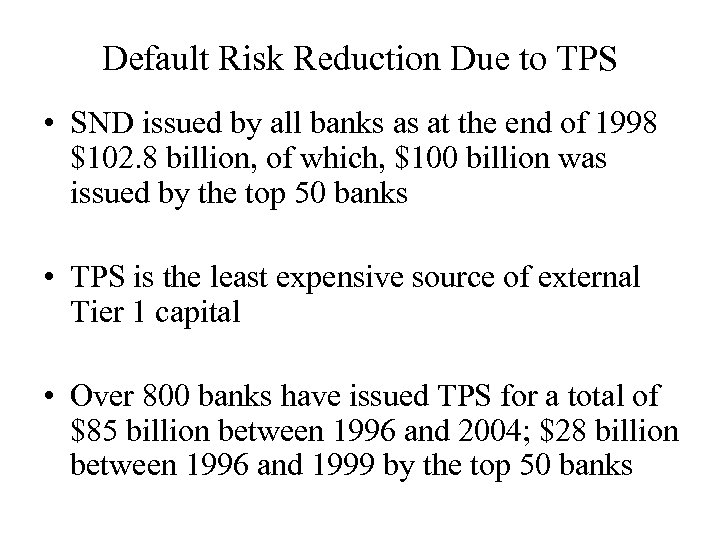
Default Risk Reduction Due to TPS • SND issued by all banks as at the end of 1998 $102. 8 billion, of which, $100 billion was issued by the top 50 banks • TPS is the least expensive source of external Tier 1 capital • Over 800 banks have issued TPS for a total of $85 billion between 1996 and 2004; $28 billion between 1996 and 1999 by the top 50 banks
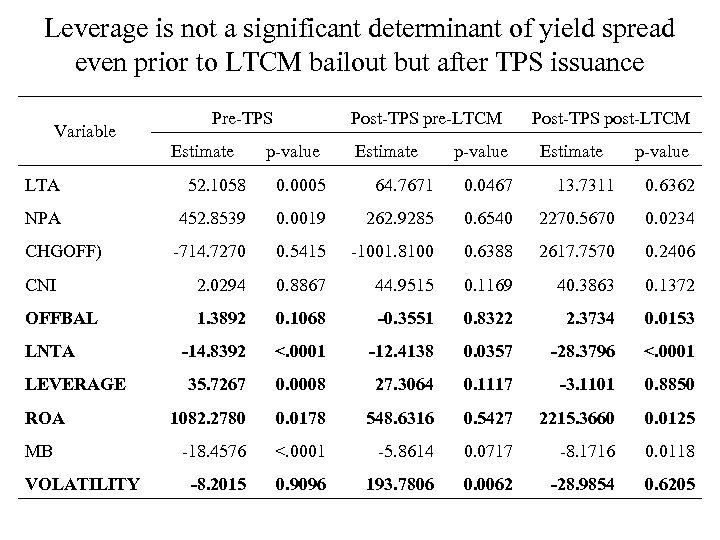
Leverage is not a significant determinant of yield spread even prior to LTCM bailout but after TPS issuance Variable Pre-TPS Estimate p-value Post-TPS pre-LTCM Estimate p-value Post-TPS post-LTCM Estimate p-value LTA 52. 1058 0. 0005 64. 7671 0. 0467 13. 7311 0. 6362 NPA 452. 8539 0. 0019 262. 9285 0. 6540 2270. 5670 0. 0234 -714. 7270 0. 5415 -1001. 8100 0. 6388 2617. 7570 0. 2406 CNI 2. 0294 0. 8867 44. 9515 0. 1169 40. 3863 0. 1372 OFFBAL 1. 3892 0. 1068 -0. 3551 0. 8322 2. 3734 0. 0153 -14. 8392 <. 0001 -12. 4138 0. 0357 -28. 3796 <. 0001 35. 7267 0. 0008 27. 3064 0. 1117 -3. 1101 0. 8850 1082. 2780 0. 0178 548. 6316 0. 5427 2215. 3660 0. 0125 -18. 4576 <. 0001 -5. 8614 0. 0717 -8. 1716 0. 0118 -8. 2015 0. 9096 193. 7806 0. 0062 -28. 9854 0. 6205 CHGOFF) LNTA LEVERAGE ROA MB VOLATILITY
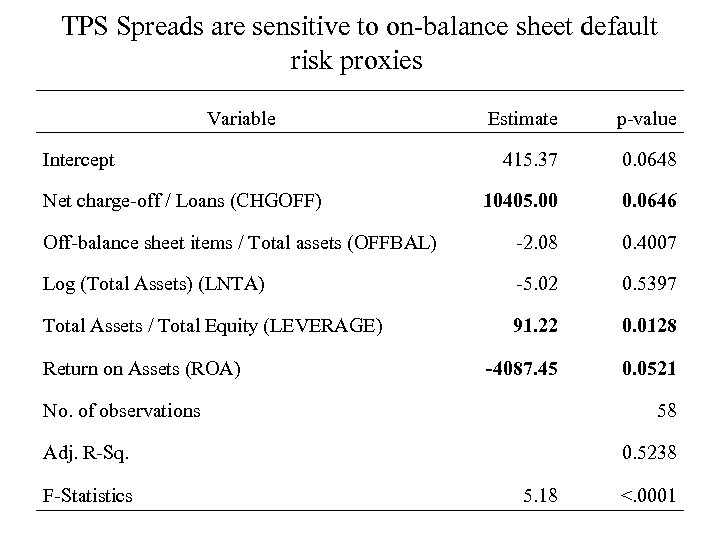
TPS Spreads are sensitive to on-balance sheet default risk proxies Variable Estimate p-value 415. 37 0. 0648 10405. 00 0. 0646 Off-balance sheet items / Total assets (OFFBAL) -2. 08 0. 4007 Log (Total Assets) (LNTA) -5. 02 0. 5397 Total Assets / Total Equity (LEVERAGE) 91. 22 0. 0128 -4087. 45 0. 0521 Intercept Net charge-off / Loans (CHGOFF) Return on Assets (ROA) No. of observations 58 Adj. R-Sq. F-Statistics 0. 5238 5. 18 <. 0001
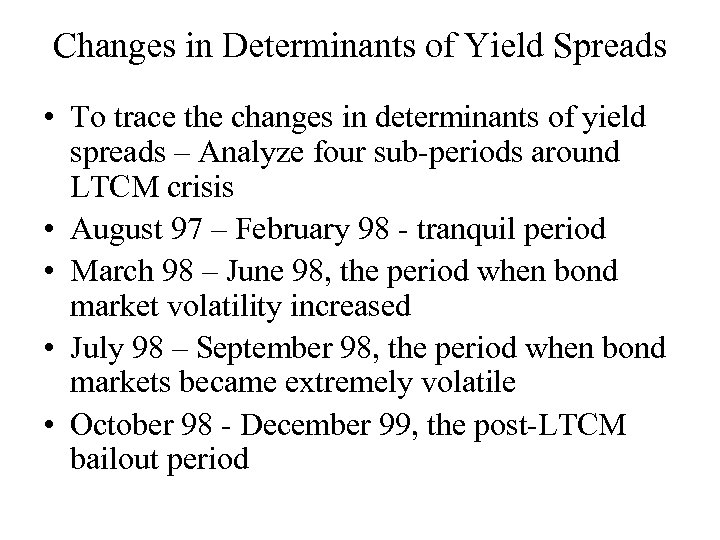
Changes in Determinants of Yield Spreads • To trace the changes in determinants of yield spreads – Analyze four sub-periods around LTCM crisis • August 97 – February 98 - tranquil period • March 98 – June 98, the period when bond market volatility increased • July 98 – September 98, the period when bond markets became extremely volatile • October 98 - December 99, the post-LTCM bailout period
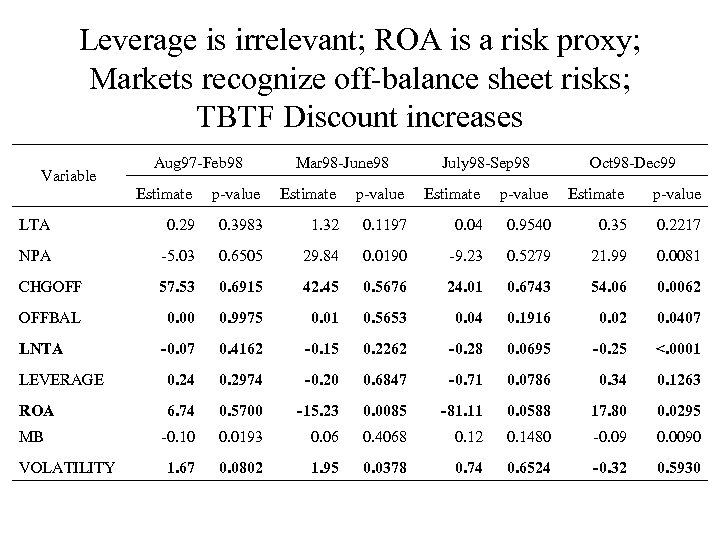
Leverage is irrelevant; ROA is a risk proxy; Markets recognize off-balance sheet risks; TBTF Discount increases Variable Aug 97 -Feb 98 Mar 98 -June 98 July 98 -Sep 98 Oct 98 -Dec 99 Estimate p-value LTA 0. 29 0. 3983 1. 32 0. 1197 0. 04 0. 9540 0. 35 0. 2217 NPA -5. 03 0. 6505 29. 84 0. 0190 -9. 23 0. 5279 21. 99 0. 0081 CHGOFF 57. 53 0. 6915 42. 45 0. 5676 24. 01 0. 6743 54. 06 0. 0062 OFFBAL 0. 00 0. 9975 0. 01 0. 5653 0. 04 0. 1916 0. 02 0. 0407 -0. 07 0. 4162 -0. 15 0. 2262 -0. 28 0. 0695 -0. 25 <. 0001 LEVERAGE 0. 24 0. 2974 -0. 20 0. 6847 -0. 71 0. 0786 0. 34 0. 1263 ROA 6. 74 0. 5700 -15. 23 0. 0085 -81. 11 0. 0588 17. 80 0. 0295 -0. 10 0. 0193 0. 06 0. 4068 0. 12 0. 1480 -0. 09 0. 0090 1. 67 0. 0802 1. 95 0. 0378 0. 74 0. 6524 -0. 32 0. 5930 LNTA MB VOLATILITY
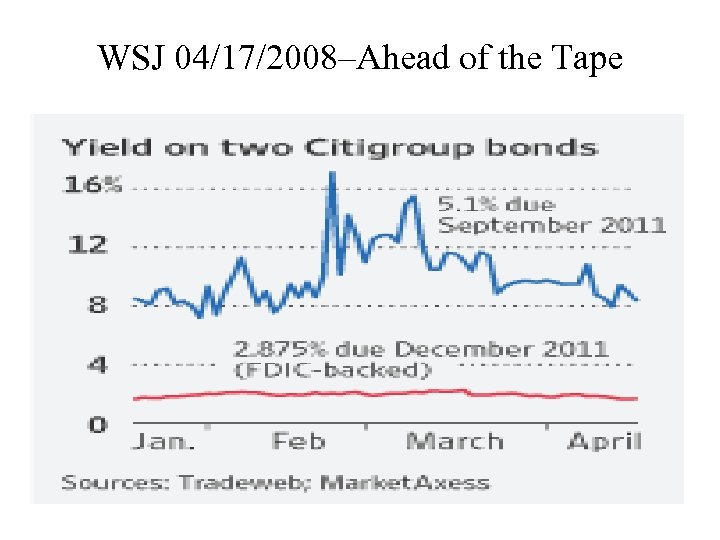
WSJ 04/17/2008–Ahead of the Tape
Results • Yield spread levels on SND are sensitive to conventional risk measures prior to TPS issuance by banks • Risk sensitivity of conventional risk measures decrease after the introduction of TPS • No TBTF effect before the LTCM bailout but size discount doubles after the LTCM bailout • Idiosyncratic volatility is a better proxy for firm-specific risks • Omitting the tax effects in yield spreads leads to measurement errors • Yield spreads on TPS provide market signals
Results • Bond markets are sensitive to default risks, but paradigm changes in the determinants of yield spreads after LTCM bailout • Default risk proxies vary with time and available information – Leverage is not a proxy – ROA is a proxy for changes in risk-taking – Off-balance sheet items is a proxy
Policy Implications • Implicit guarantees and market discipline • Can TPS provide better market signals? – Needs further investigation after TARP • Disclosure Levels of off-balance sheet items • Can TPS and SND be capital securities without risk of capital loss? • Risk-weighting of earnings for CAMELS

Thank You Questions? Suggestions?
Скачать презентацию Why Are Yield Spreads on Bank Issued Subordinated
4841f1fa45a8b377a14fb7e49ea20320.ppt