


 Скачать презентацию Whom to marry how to cook and where
55f6d82f348413c7f4777d976cbf84e8.ppt
- Количество слайдов: 57
 Whom to marry, how to cook and where to buy gas: solving dilemmas of daily life, one algorithm at a time SAMIR KHULLER Dept. of Computer Science University of Maryland
 A typical conversation Person: What do you do? Me: I am a computer science professor. Person: I have a problem with my PC, can you fix it? Me: No, I don’t think I can do that. Person: You will not fix my PC? Me: I cannot fix my PC, let alone yours. Person: Then what exactly do you do? Me: I study algorithms. Person: Oh, I know that. Me: Really? Person: Yes! I learnt logarithms in high school.
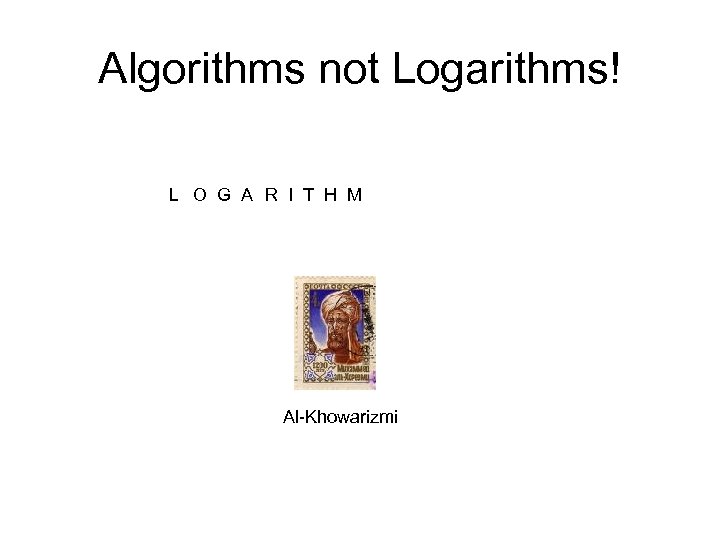 Algorithms not Logarithms! L O G A R I T H M Al-Khowarizmi
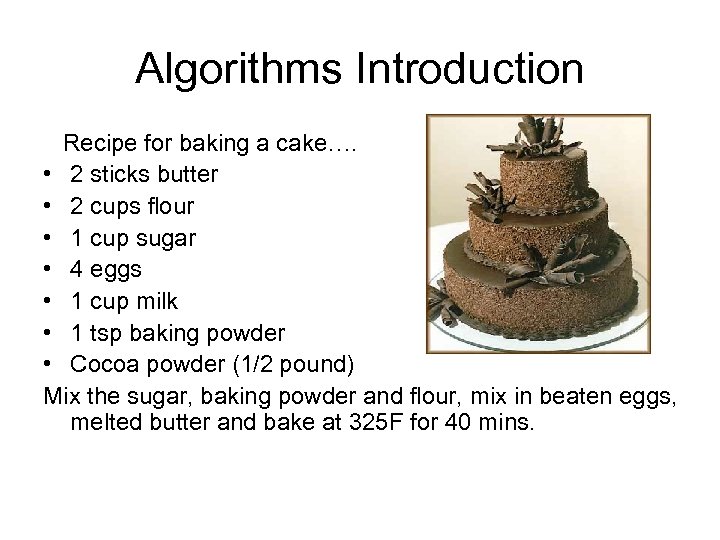 Algorithms Introduction Recipe for baking a cake…. • 2 sticks butter • 2 cups flour • 1 cup sugar • 4 eggs • 1 cup milk • 1 tsp baking powder • Cocoa powder (1/2 pound) Mix the sugar, baking powder and flour, mix in beaten eggs, melted butter and bake at 325 F for 40 mins.
 ALGORITHMS • Set of instructions for solving a problem, to find a solution. • What is a problem? • What is an instruction? • What is a solution?
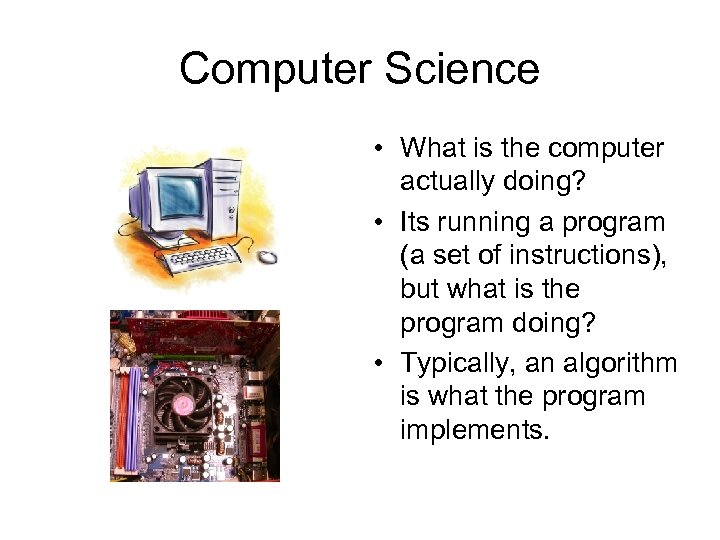 Computer Science • What is the computer actually doing? • Its running a program (a set of instructions), but what is the program doing? • Typically, an algorithm is what the program implements.
 Outline of talk • • • Algorithms and their Applications Whom to Marry? How to Cook? Where to buy gas? A few favorite projects of mine. . Acknowledgements
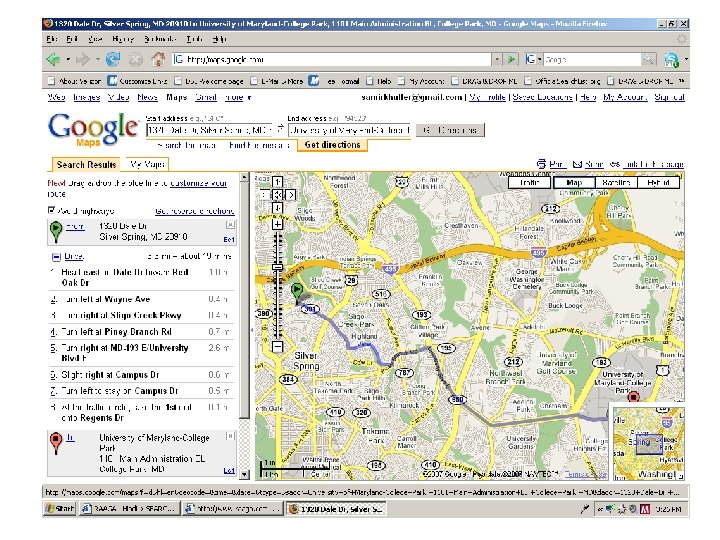
 Why are algorithms central to computing? • An airport shuttle company needs to schedule pickups delivering everyone to the airport on time. Who goes in which shuttle, and in what order do the pickups occur? • A delivery company has several customers and trucks that can carry objects. How should they schedule deliveries to the customers to minimize their cost? This leads to interesting algorithmic problems…
 There are lots of feasible solutions! • How should we pick amongst these solutions? • Some solutions are cheap, and others may be expensive or undesirable. • The number of potential solutions is so large that even a fast computer cannot evaluate all these solutions. • Algorithms tell us how to find good solutions!
 A disclaimer • I have chosen a set of problems whose algorithms are quite simple. • Towards the end of the talk I will also mention some recent projects that are a little more involved, and its hard to really describe the algorithms and methods used since they are quite complex.
 The Marriage Problem • N men, N women • Each person provides a ranking of the members of the opposite sex • Can we find a “good marriage”? • First studied by Gale and Shapley (1962)
 An application: resident matching program • Each resident rank orders the hospitals, and each hospital rank orders the residents. • How do we choose an assignment of residents to hospitals? • We do not want a situation that a resident prefers another hospital, and that hospital preferred this resident to the person assigned to them.
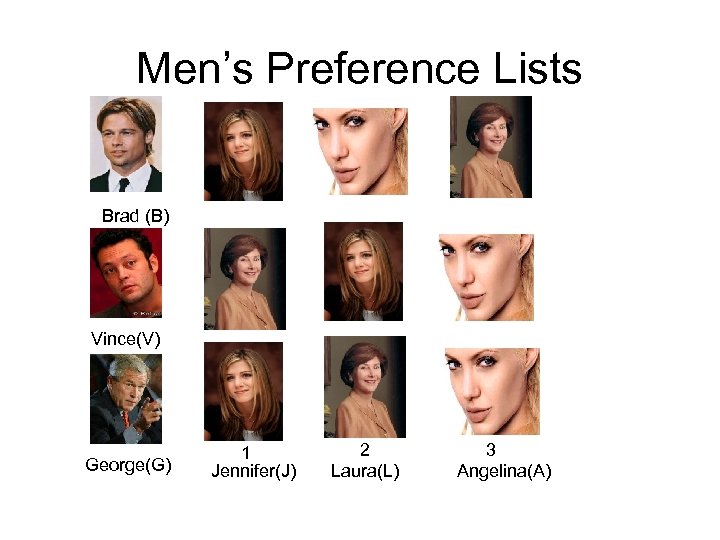 Men’s Preference Lists Brad (B) Vince(V) George(G) 1 Jennifer(J) 2 Laura(L) 3 Angelina(A)
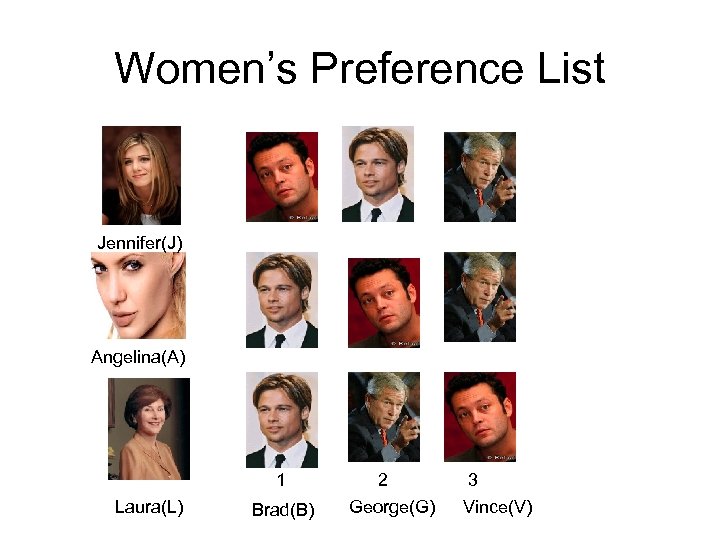 Women’s Preference List Jennifer(J) Angelina(A) 1 Laura(L) Brad(B) 2 George(G) 3 Vince(V)
 Stable Marriage Problem • A marriage is unstable if there is a pair of people, not married to each other, such that both prefer each other to their current partners. In other words, they have an incentive to elope…. • Can we find a “stable” marriage?
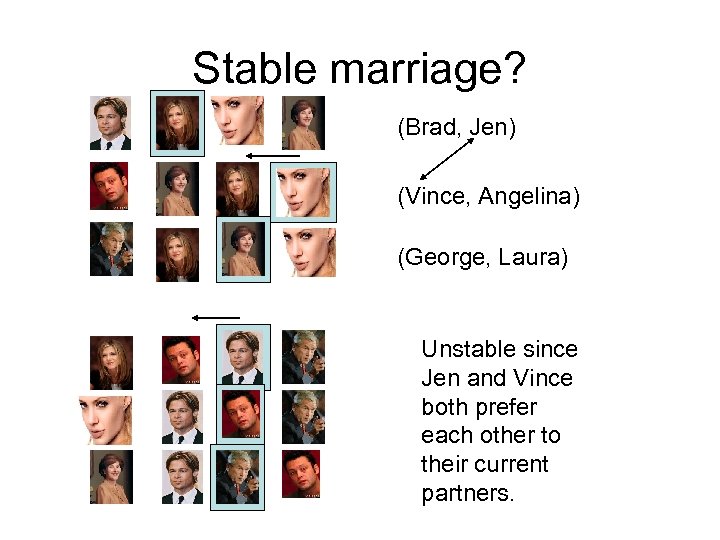 Stable marriage? (Brad, Jen) (Vince, Angelina) (George, Laura) Unstable since Jen and Vince both prefer each other to their current partners.
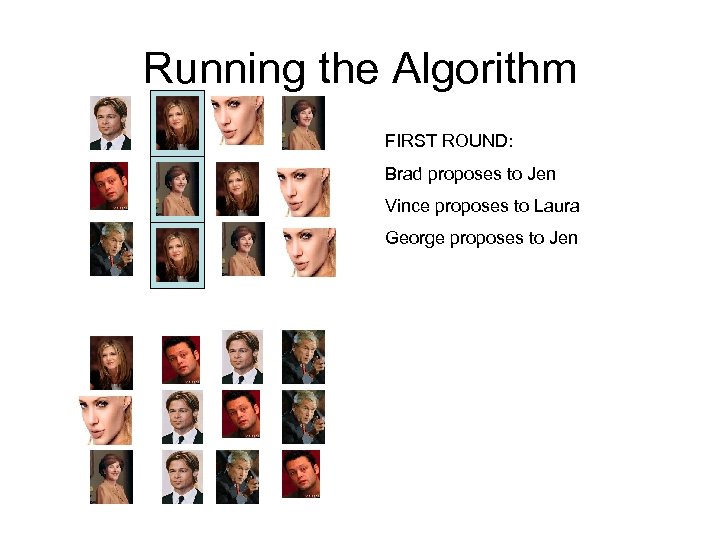 Running the Algorithm FIRST ROUND: Brad proposes to Jen Vince proposes to Laura George proposes to Jen
 Brad proposes!
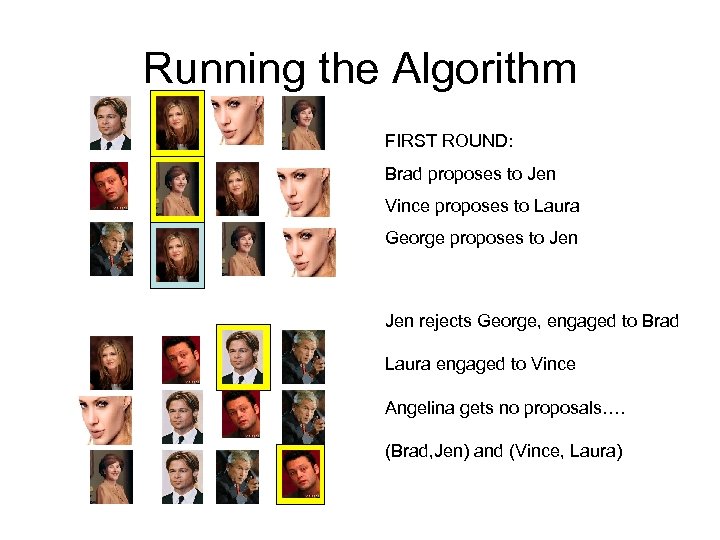 Running the Algorithm FIRST ROUND: Brad proposes to Jen Vince proposes to Laura George proposes to Jen rejects George, engaged to Brad Laura engaged to Vince Angelina gets no proposals…. (Brad, Jen) and (Vince, Laura)
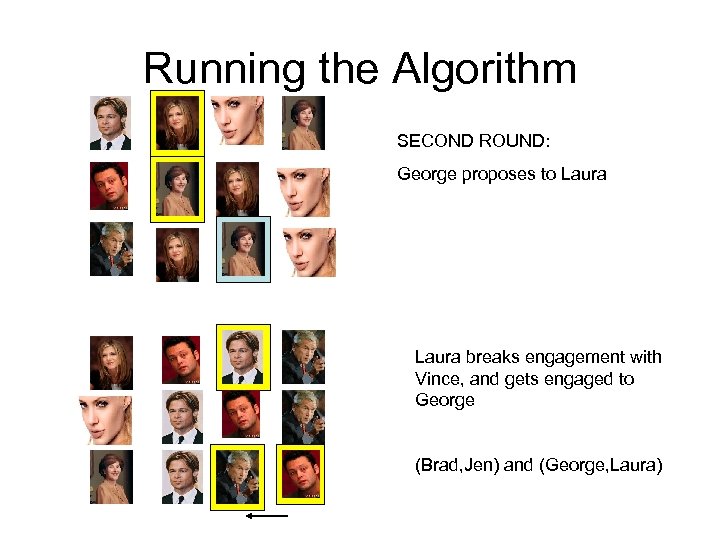 Running the Algorithm SECOND ROUND: George proposes to Laura breaks engagement with Vince, and gets engaged to George (Brad, Jen) and (George, Laura)
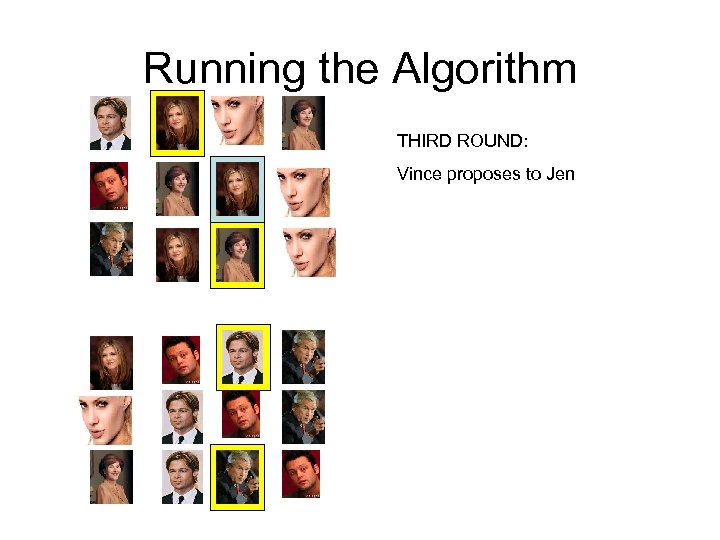 Running the Algorithm THIRD ROUND: Vince proposes to Jen

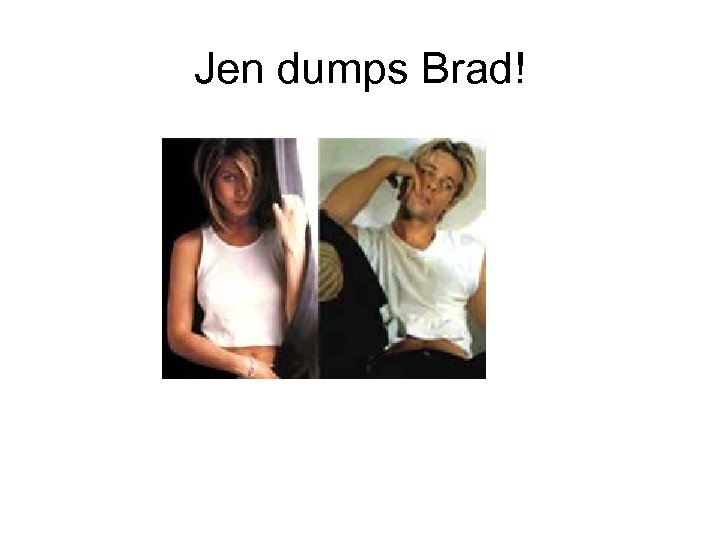 Jen dumps Brad!
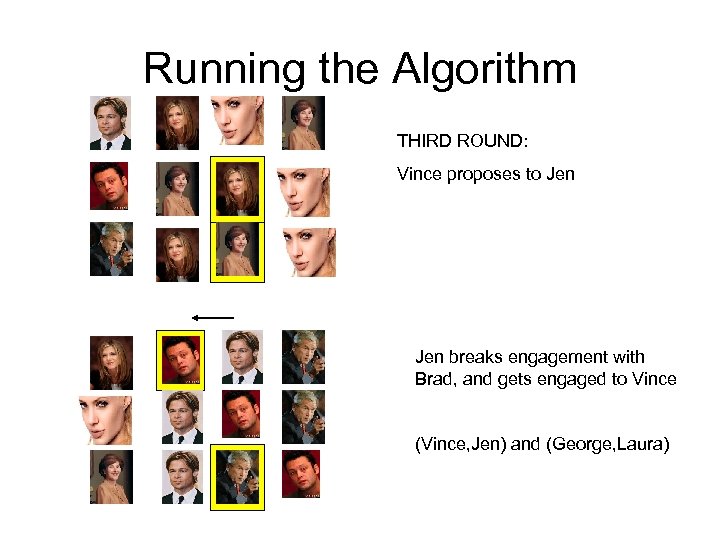 Running the Algorithm THIRD ROUND: Vince proposes to Jen breaks engagement with Brad, and gets engaged to Vince (Vince, Jen) and (George, Laura)
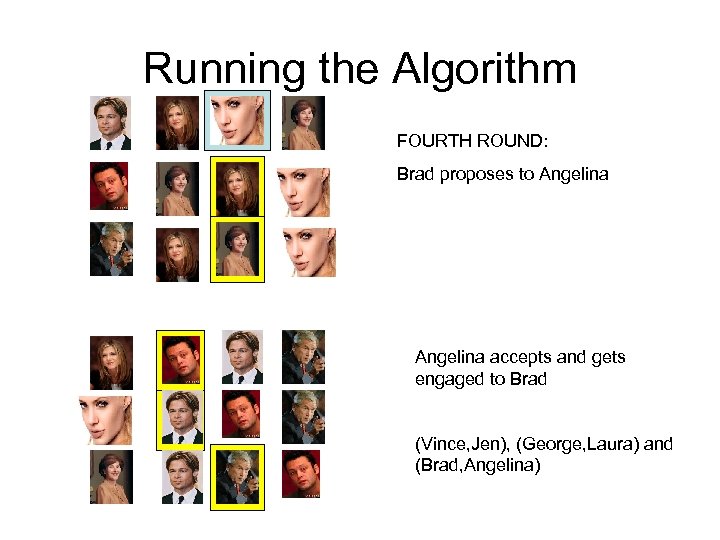 Running the Algorithm FOURTH ROUND: Brad proposes to Angelina accepts and gets engaged to Brad (Vince, Jen), (George, Laura) and (Brad, Angelina)
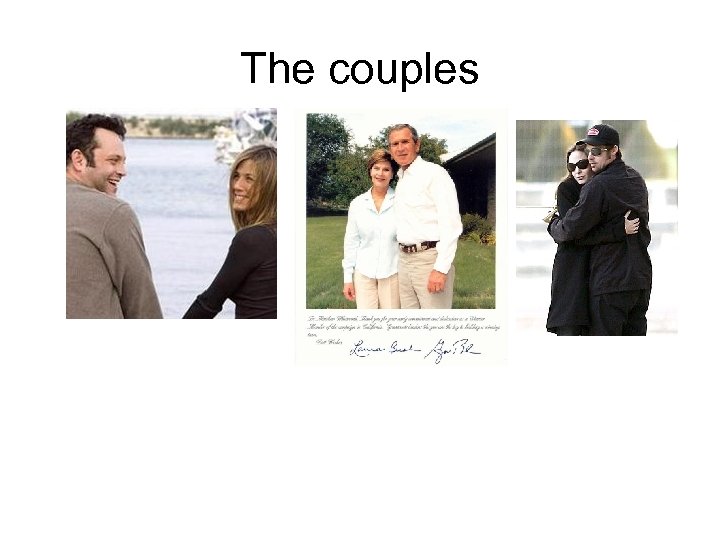 The couples
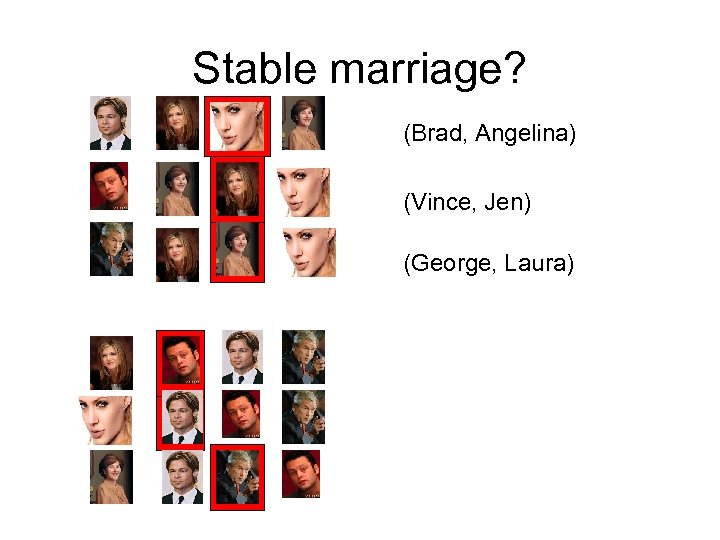 Stable marriage? (Brad, Angelina) (Vince, Jen) (George, Laura)
 This solution is stable! (Vince, Jen) (George, Laura) (Brad, Angelina) • Vince prefers Laura to his partner Jen, but Laura would rather be with George. • Brad prefers Jen to Angelina, but Jen would rather be with Vince. • George prefers Jen to Laura, but Jen would rather be with Vince.
 Optimal from the men’s point of view • Each man gets the “best” possible partner in ANY stable solution. • Unintuitive: look’s like the marriage is a good one for the women as well, or is it…?
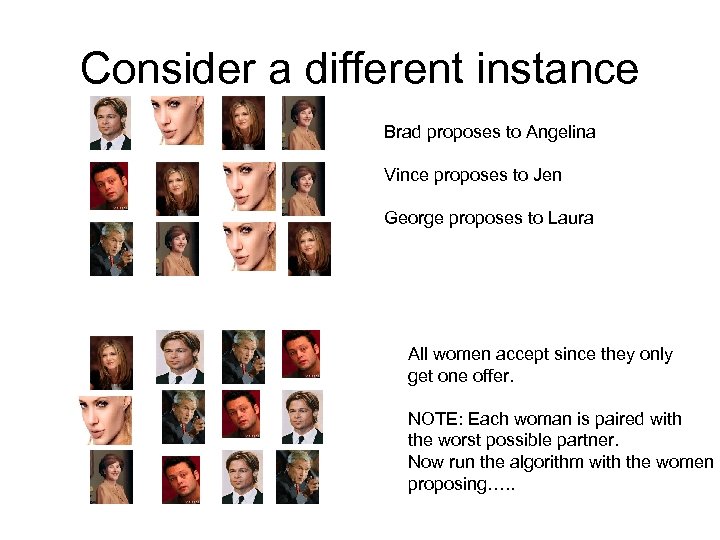 Consider a different instance Brad proposes to Angelina Vince proposes to Jen George proposes to Laura All women accept since they only get one offer. NOTE: Each woman is paired with the worst possible partner. Now run the algorithm with the women proposing…. .
 Online stable marriages • Assume that women’s preferences are known in advance. The men arrive one at a time and pick their most preferred available partner. • This does not give a stable solution, and in fact may have MANY unstable pairs. Paper by Khuller, Mitchell and Vazirani (1991).
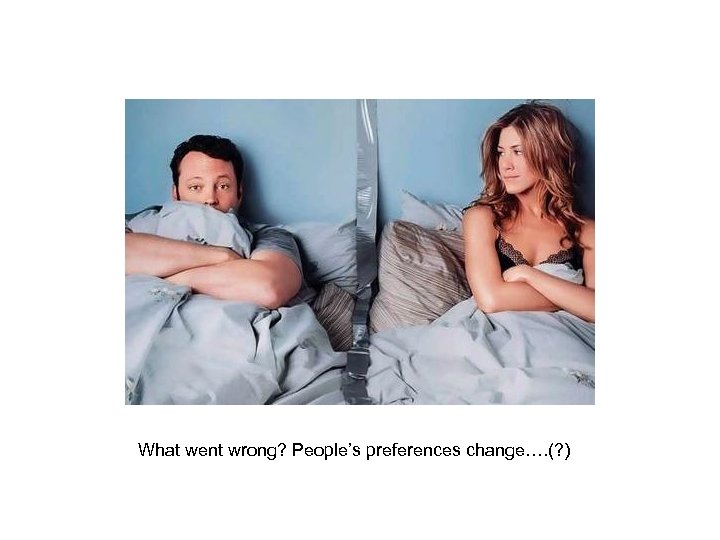 What went wrong? People’s preferences change…. (? )
 Scheduling Problems • Arise in many industrial applications…. • Computers schedule multiple tasks, people multi-task, complex projects have several interacting sub-parts. • With large companies manufacturing many products, many interesting scheduling problems arise.
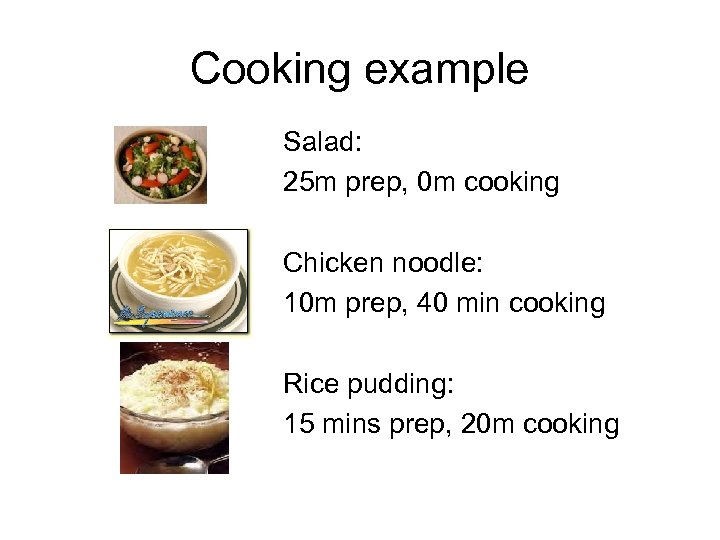 Cooking example Salad: 25 m prep, 0 m cooking Chicken noodle: 10 m prep, 40 min cooking Rice pudding: 15 mins prep, 20 m cooking
 In what order should Martha make the dishes? • Martha can work on preparing one dish at a time, however once something is cooking, she can prepare another dish. • How quickly can she get all the dishes ready? • She starts at 5 pm, and her guests will arrive at 6 pm….
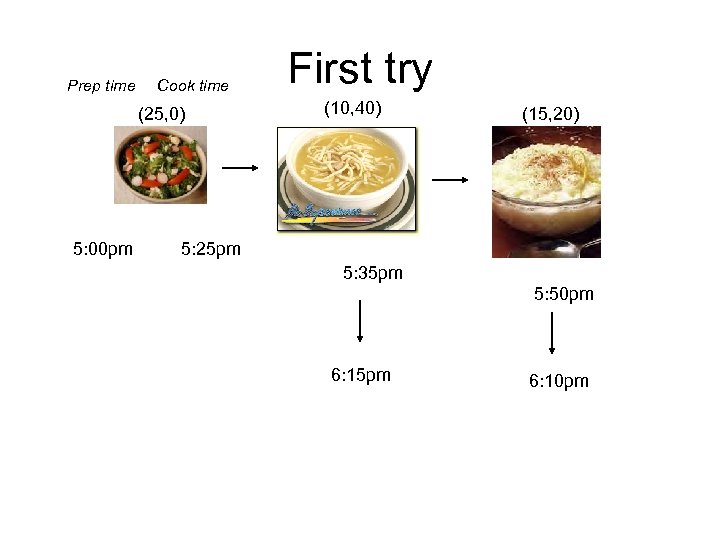 Prep time Cook time (25, 0) 5: 00 pm First try (10, 40) (15, 20) 5: 25 pm 5: 35 pm 5: 50 pm 6: 15 pm 6: 10 pm
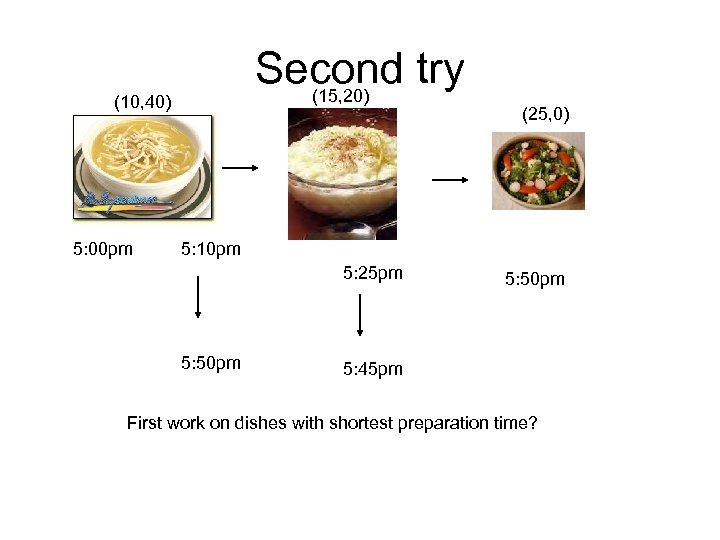 Second try (15, 20) (10, 40) 5: 00 pm (25, 0) 5: 10 pm 5: 25 pm 5: 50 pm 5: 45 pm First work on dishes with shortest preparation time?
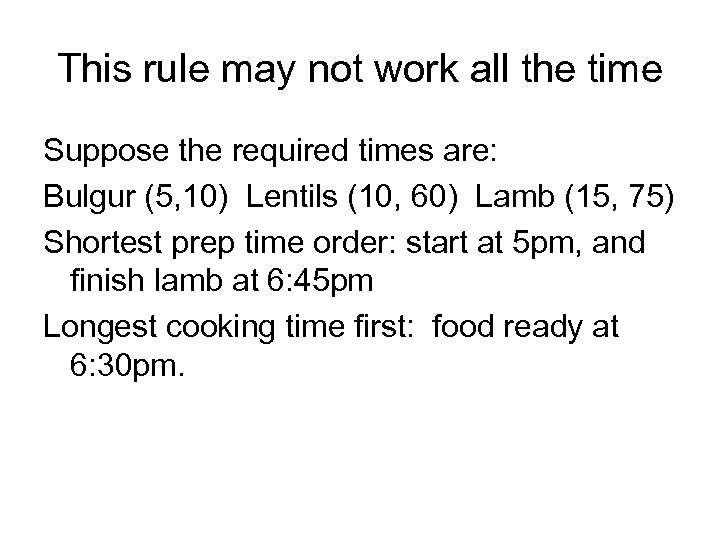 This rule may not work all the time Suppose the required times are: Bulgur (5, 10) Lentils (10, 60) Lamb (15, 75) Shortest prep time order: start at 5 pm, and finish lamb at 6: 45 pm Longest cooking time first: food ready at 6: 30 pm.
 What if she had to make several dishes? • For 3 dishes, there are only 6 possible orders. SCR, SRC, RSC, RCS, CSR, CRS. • The number of possible orderings of 10 dishes is 3, 628, 800. • For 15 dishes the number of possible orderings is 1, 307, 674, 368, 000! • This leads to a combinatorial explosion.
 Key Idea • Order dishes in longest cooking time order. • Chicken noodle soup goes first (40 mins of cook time), next is the Rice pudding (20 mins of cook time), followed by the Salad (0 mins of cook time). • This is the best ordering. In other words, no other order can take less time. • This does not work if there are very few stovetops (now the problem becomes really difficult).
 What if we had a small number of burners? • Problem becomes very difficult if we have 2, 3, 4 burners. . • Problem can be solved optimally if we only have one burner (Johnson, 1954)
 Where to fill gas? The Gas Station Problem (Khuller, Malekian, Mestre), Eur. Symp. of Algorithms • Suppose you want to go on a road trip across the US. You start from New York City and would like to drive to San Francisco. • You have : – roadmap – gas station locations and their gas prices • Want to: – minimize travel cost
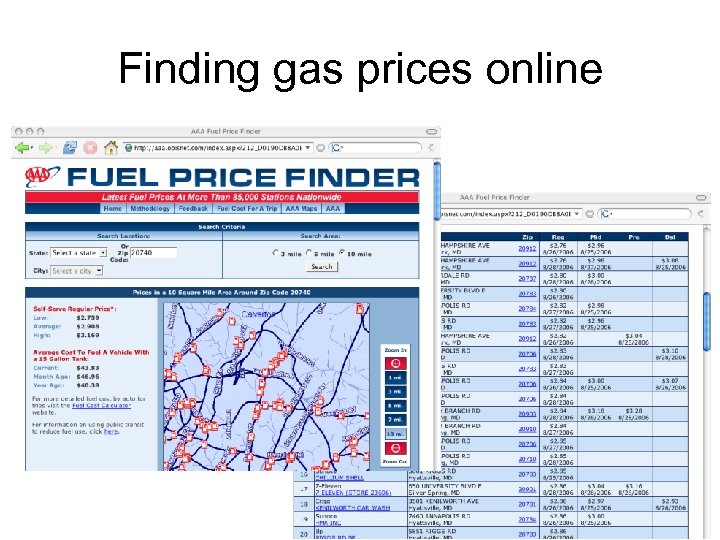 Finding gas prices online
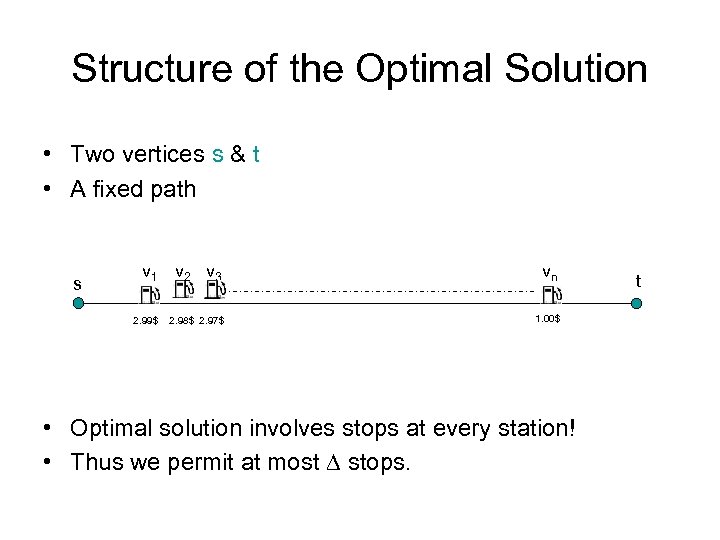 Structure of the Optimal Solution • Two vertices s & t • A fixed path s v 1 v 2 v 3 2. 99$ 2. 98$ 2. 97$ vn 1. 00$ • Optimal solution involves stops at every station! • Thus we permit at most stops. t
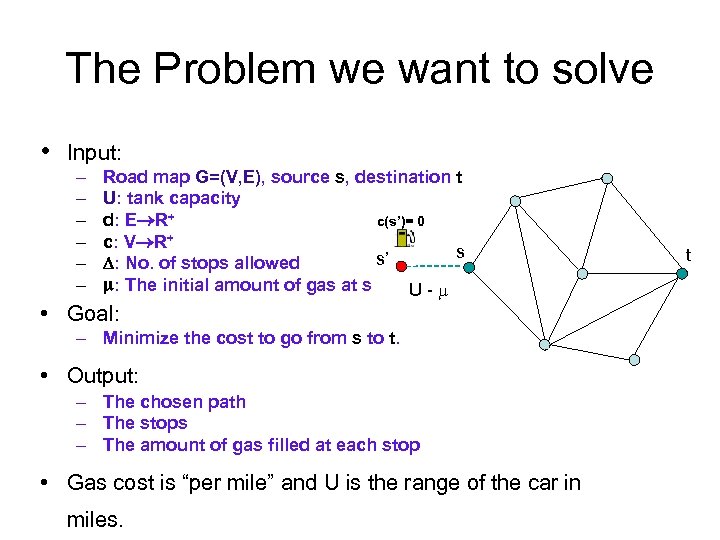 The Problem we want to solve • Input: – – – Road map G=(V, E), source s, destination t U: tank capacity d: E R+ c(s’)= 0 c: V R+ s s’ : No. of stops allowed : The initial amount of gas at s U- • Goal: – Minimize the cost to go from s to t. • Output: – The chosen path – The stops – The amount of gas filled at each stop • Gas cost is “per mile” and U is the range of the car in miles. t
![Dynamic Programming OPT[x, q, g] = Minimum cost to go from x to t](https://present5.com/presentation/55f6d82f348413c7f4777d976cbf84e8/image-47.jpg "Dynamic Programming OPT[x, q, g] = Minimum cost to go from x to t") Dynamic Programming OPT[x, q, g] = Minimum cost to go from x to t in q stops, starting with g units of gas. • Assuming all values are integral, we can find an optimal solution in O(n 2 ∆ U 2) time. • Not strongly polynomial time. The problem could be weakly NP-hard!
Dynamic Programming OPT[x, q, g] = Minimum cost to go from x to t in q stops, starting with g units of gas. • Assuming all values are integral, we can find an optimal solution in O(n 2 ∆ U 2) time. • Not strongly polynomial time. The problem could be weakly NP-hard!
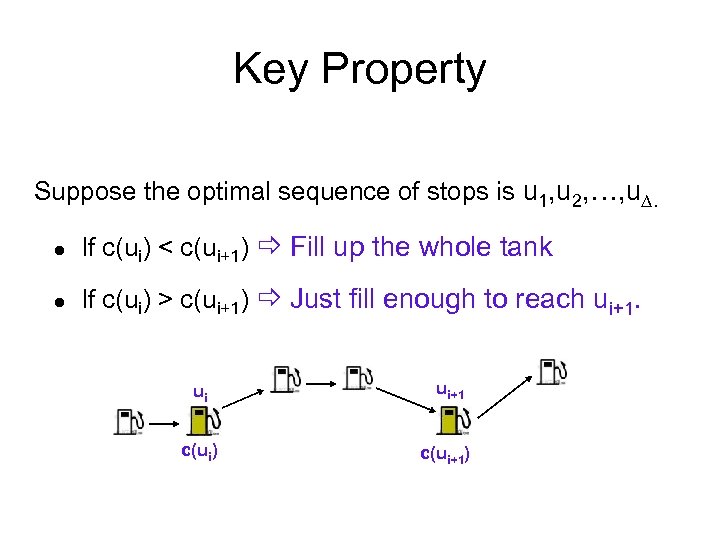 Key Property Suppose the optimal sequence of stops is u 1, u 2, …, u. l If c(ui) < c(ui+1) Fill up the whole tank l If c(ui) > c(ui+1) Just fill enough to reach ui+1. ui ui+1 c(ui) c(ui+1)
 Tour Gas Station problem • Would like to visit a set of cities T. • We have access to set of gas stations S. • Assume gas prices are uniform. – The problem is extremely hard even with this restriction. – We may have a deal with a particular gas company.
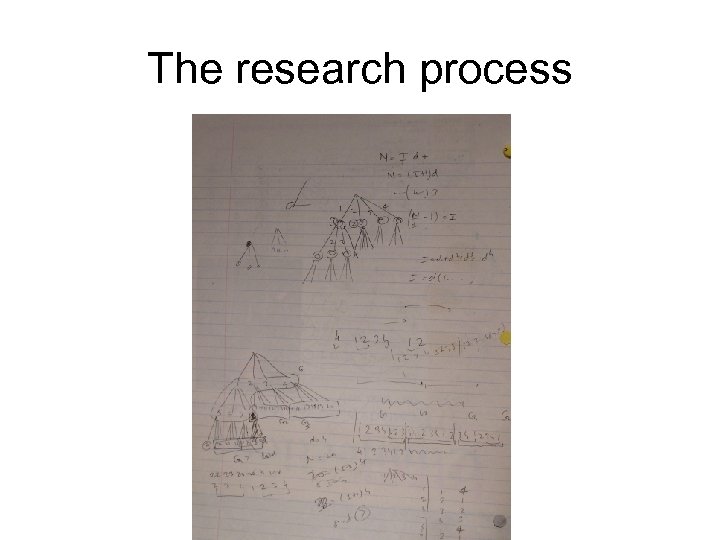 The research process
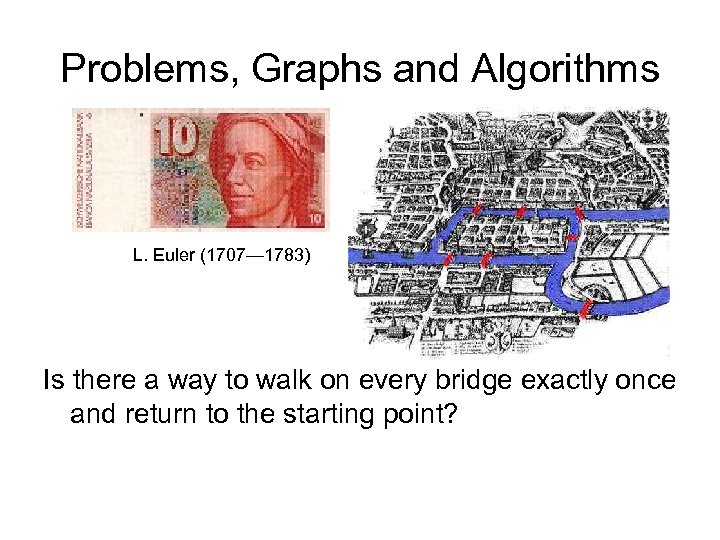 Problems, Graphs and Algorithms L. Euler (1707— 1783) Is there a way to walk on every bridge exactly once and return to the starting point?
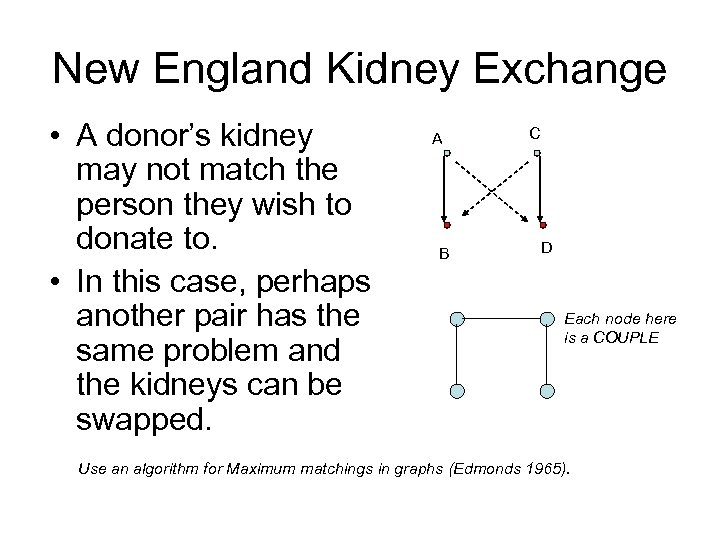 New England Kidney Exchange • A donor’s kidney may not match the person they wish to donate to. • In this case, perhaps another pair has the same problem and the kidneys can be swapped. A B C D Each node here is a COUPLE Use an algorithm for Maximum matchings in graphs (Edmonds 1965).
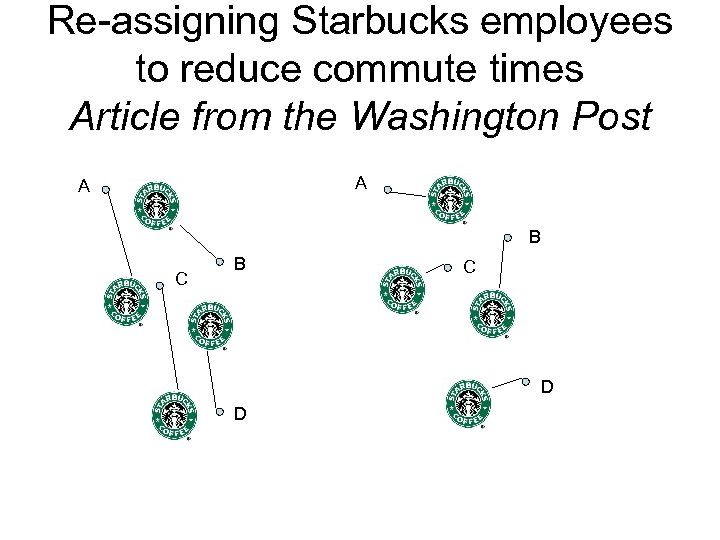 Re-assigning Starbucks employees to reduce commute times Article from the Washington Post A A B C D D
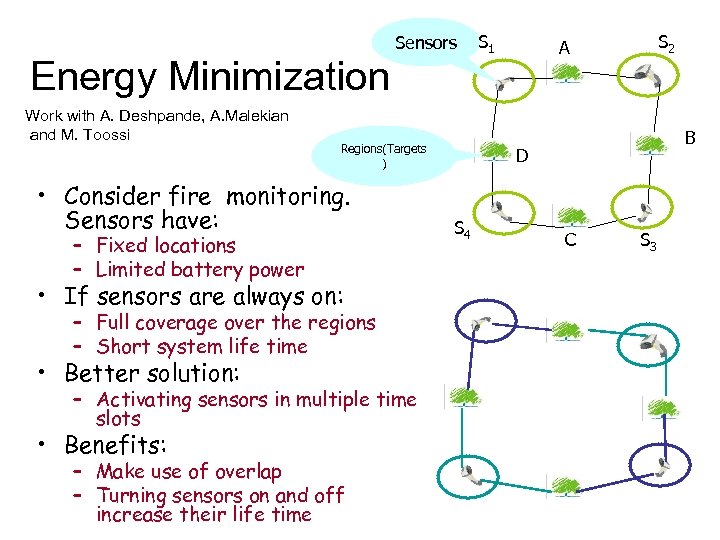 Sensors Energy Minimization Work with A. Deshpande, A. Malekian and M. Toossi Regions(Targets ) • Consider fire monitoring. Sensors have: – Fixed locations – Limited battery power • If sensors are always on: – Full coverage over the regions – Short system life time • Better solution: – Activating sensors in multiple time slots • Benefits: – Make use of overlap – Turning sensors on and off increase their life time S 1 S 2 A B D S 4 C S 3
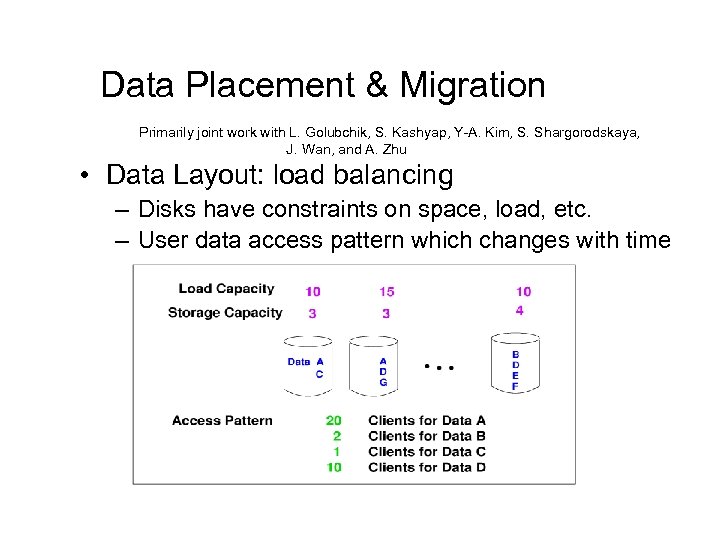 Data Placement & Migration Primarily joint work with L. Golubchik, S. Kashyap, Y-A. Kim, S. Shargorodskaya, J. Wan, and A. Zhu • Data Layout: load balancing – Disks have constraints on space, load, etc. – User data access pattern which changes with time
 Approximation Algorithms • For many problems, no simple (or complex!) rules seem to work. • Such problems arise very frequently – the famous Traveling Salesperson Problem is an example. • How should we cope with this? • Our attempt is to develop a set of tools that would give rise to methods for approaching such problems. Even if we cannot find the optimal solutions quickly, perhaps we can find almost optimal solutions quickly? • Greedy Methods, LP rounding methods, Primal-Dual methods. • In general, these methods also provide lower bounding methods
 Acknowledgements Lecture dedicated to the memory of my grandfather, Prof. Ish Kumar (1902— 1999). Academic Influence Prof. R. Karp, Prof. V. Vazirani, Prof. J. Mitchell, Prof. E. Arkin, Prof. U. Vishkin My wonderful co-authors, especially, B. Raghavachari, N. Young, A. Srinivasan, L. Golubchik, B. Bhattacharjee, D. Mount, S. Mitchell, B. Schieber, A. Rosenfeld, J. Naor, R. Hassin, S. Guha, M. Charikar, R. Thurimella, R. Pless, M Shayman, G. Kortsarz. My Ph. D. students – R. Bhatia, Y. Sussmann, R. Gandhi, Y-A. Kim, J. Wan, J. Mestre, S. Kashyap, A. Malekian. Undergrads – K. Matherly, D. Hakim, J. Pierce, B. Wulfe, A. Zhu, S. Shargorodskaya, C. Dixon, J. Chang, M. Mc. Cutchen. Above all, a BIG thanks to all members of my family, friends and relatives. I cannot express my thanks deeply enough.