 Скачать презентацию Whole Life Costs Toolkits Brad Bamfield Chairman wlcf org
dee22e745a4d42c5734340fd92003625.ppt
- Количество слайдов: 50



Whole Life Costs Toolkits Brad Bamfield Chairman@wlcf. org. uk Brad_Bamfield@thesolutionorganisation. com
Today • • • What is Whole Life Cost Worked examples WLC methods Rules of thumb How to do it – tools Whole life performance – Sustainability
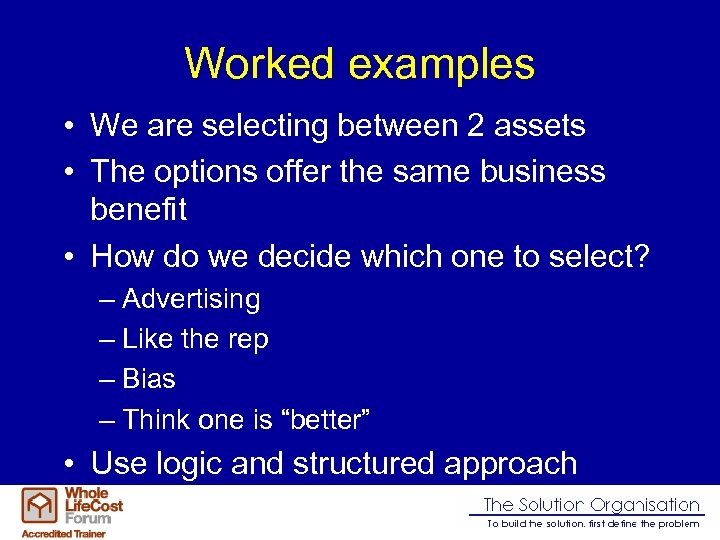
Worked examples • We are selecting between 2 assets • The options offer the same business benefit • How do we decide which one to select? – Advertising – Like the rep – Bias – Think one is “better” • Use logic and structured approach
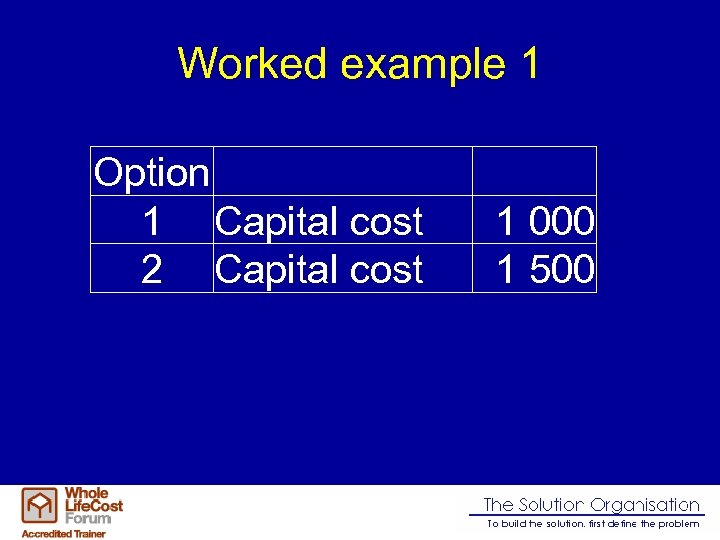
Worked example 1 Option 1 Capital cost 2 Capital cost 1 000 1 500
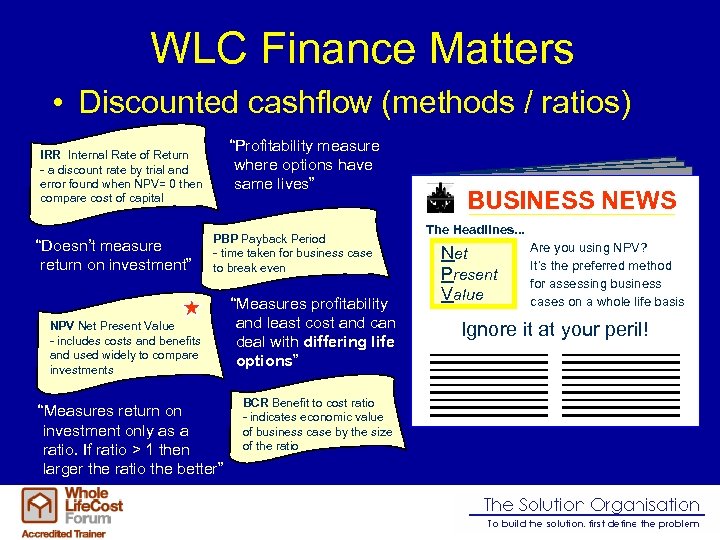
WLC Finance Matters • Discounted cashflow (methods / ratios) “Profitability measure where options have same lives” IRR Internal Rate of Return - a discount rate by trial and error found when NPV= 0 then compare cost of capital “Doesn’t measure return on investment” PBP Payback Period - time taken for business case to break even NPV Net Present Value - includes costs and benefits and used widely to compare investments “Measures return on investment only as a ratio. If ratio > 1 then larger the ratio the better” “Measures profitability and least cost and can deal with differing life options” BCR Benefit to cost ratio - indicates economic value of business case by the size of the ratio BUSINESS NEWS The Headlines. . . Are you using NPV? Net It’s the preferred method Present for assessing business Value cases on a whole life basis Ignore it at your peril!
WLCF definition of WLC Whole Life Cost is the analysis of all relevant and identifiable financial cashflows regarding the acquisition and use of an asset.
WLC is • • A method to help decision making Capital costs Revenue costs Does it include end of life cost for any project exceeding 10 years? – Demolition is first cost of next project – How do I cost what I don’t know
WLCF definition of WLC Whole Life Cost is the analysis of relevant and identifiable all relevant and identifiable financial cashflows regarding the acquisition and use of an asset.
WLC is • • A method to help decision making Capital costs Revenue costs Does it include end of life cost for any project exceeding 10 years? – Demolition is first cost of next project – How do I cost what I don’t know • Expressed as an annual cashflow for the life of the asset
What is an asset? • An asset is anything that we buy or construct • Can be a facility (building) • Can be a component • Any number of assets can be combined • The asset can be income generating or not.
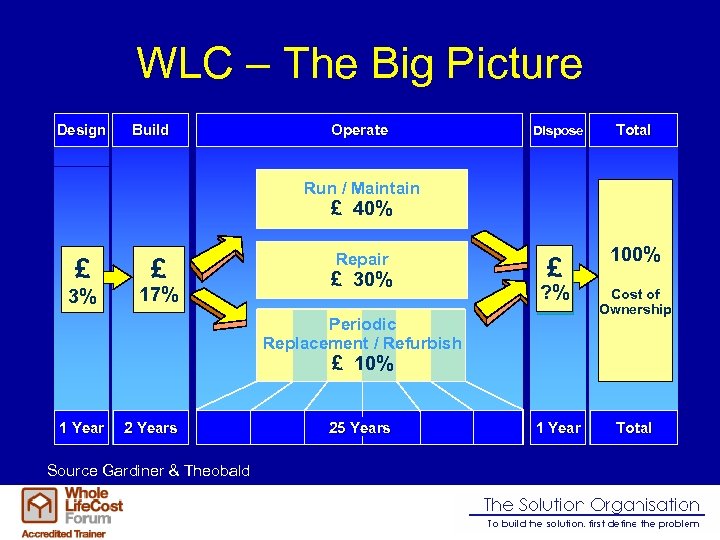
WLC – The Big Picture Design Build Operate Dispose Total Run / Maintain £ 40% £ 3% £ 17% Repair £ 30% £ 100% ? % Cost of Ownership 1 Year Total Periodic Replacement / Refurbish £ 10% 1 Year 2 Years Source Gardiner & Theobald 25 Years
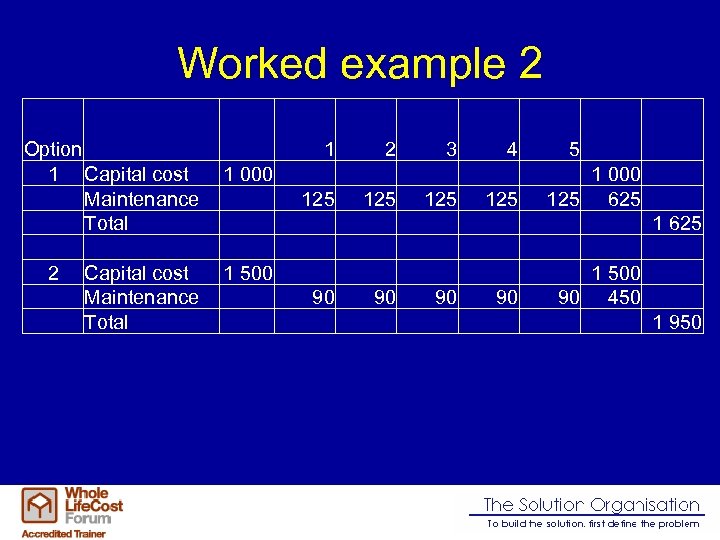
Worked example 2 Option 1 Capital cost Maintenance Total 2 Capital cost Maintenance Total 1 2 3 4 1 000 125 125 5 1 000 125 625 1 500 90 90 1 500 90 450 1 950
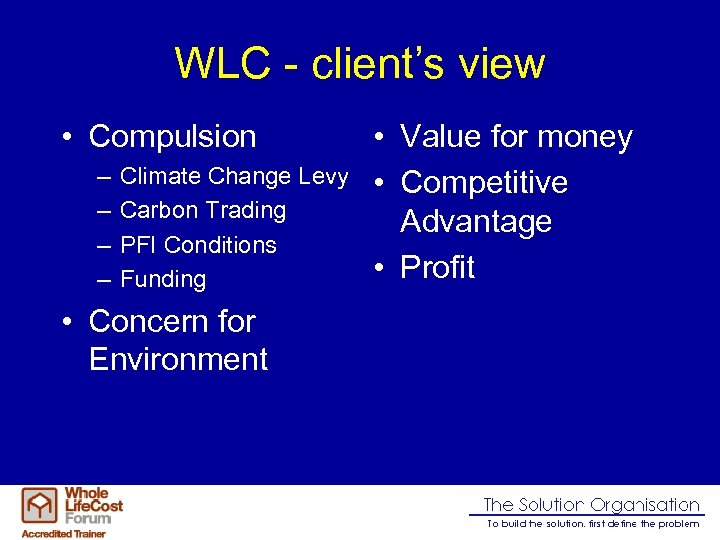
WLC - client’s view • Compulsion – – Climate Change Levy Carbon Trading PFI Conditions Funding • Concern for Environment • Value for money • Competitive Advantage • Profit
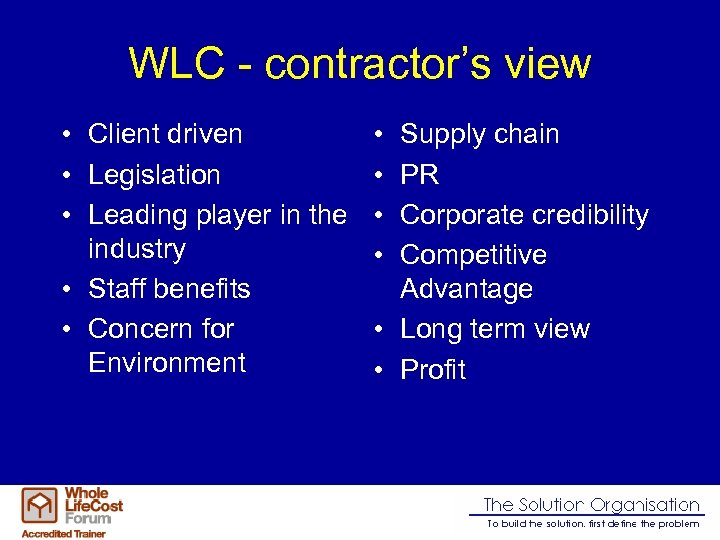
WLC - contractor’s view • Client driven • Legislation • Leading player in the industry • Staff benefits • Concern for Environment • • Supply chain PR Corporate credibility Competitive Advantage • Long term view • Profit
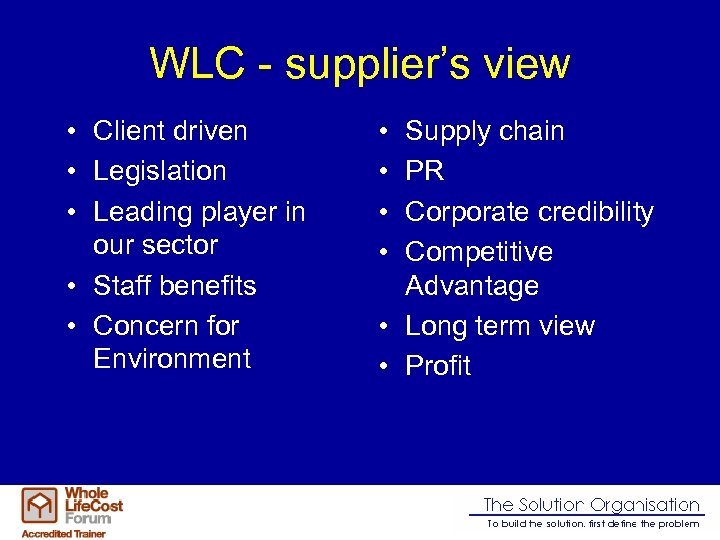
WLC - supplier’s view • Client driven • Legislation • Leading player in our sector • Staff benefits • Concern for Environment • • Supply chain PR Corporate credibility Competitive Advantage • Long term view • Profit
What is common to all Profit
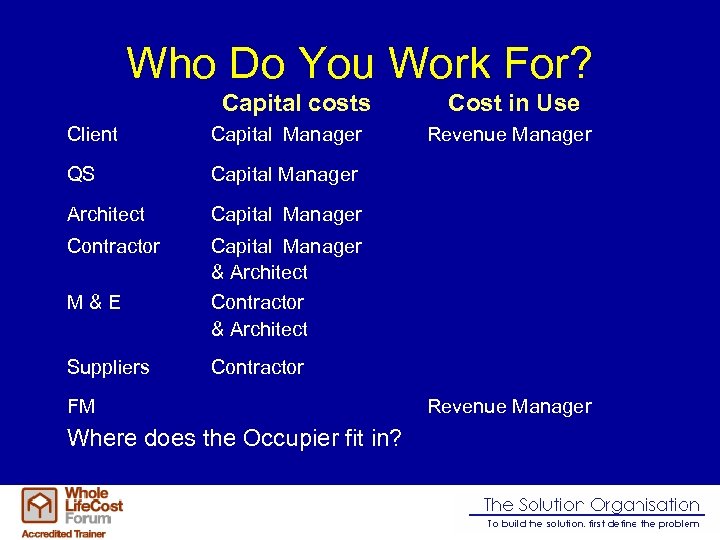
Who Do You Work For? Capital costs Client Capital Manager QS Capital Manager Architect Capital Manager Contractor Capital Manager & Architect M & E Contractor & Architect Suppliers Cost in Use Contractor FM Where does the Occupier fit in? Revenue Manager
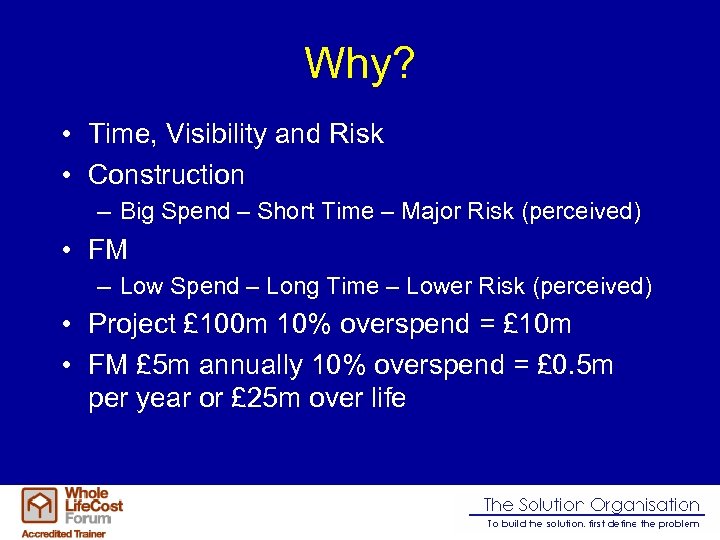
Why? • Time, Visibility and Risk • Construction – Big Spend – Short Time – Major Risk (perceived) • FM – Low Spend – Long Time – Lower Risk (perceived) • Project £ 100 m 10% overspend = £ 10 m • FM £ 5 m annually 10% overspend = £ 0. 5 m per year or £ 25 m over life
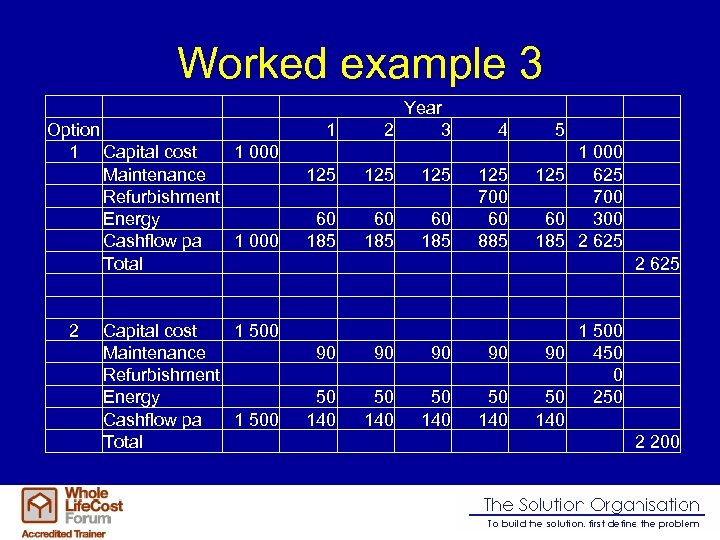
Worked example 3 Option 1 Capital cost 1 000 Maintenance Refurbishment Energy Cashflow pa 1 000 Total 2 Capital cost 1 500 Maintenance Refurbishment Energy Cashflow pa 1 500 Total 1 Year 2 3 125 125 60 185 4 125 700 60 885 5 1 000 125 625 700 60 300 185 2 625 90 90 50 140 1 500 90 450 0 50 250 140 2 200
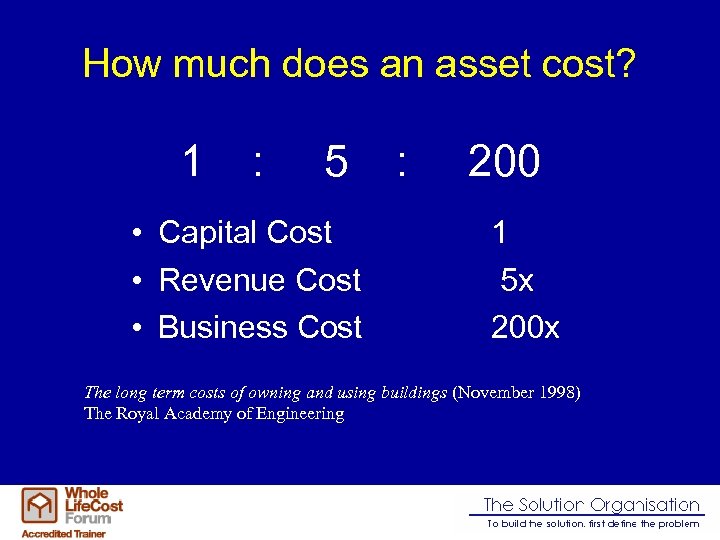
How much does an asset cost? 1 : 5 • Capital Cost • Revenue Cost • Business Cost : 200 1 5 x 200 x The long term costs of owning and using buildings (November 1998) The Royal Academy of Engineering
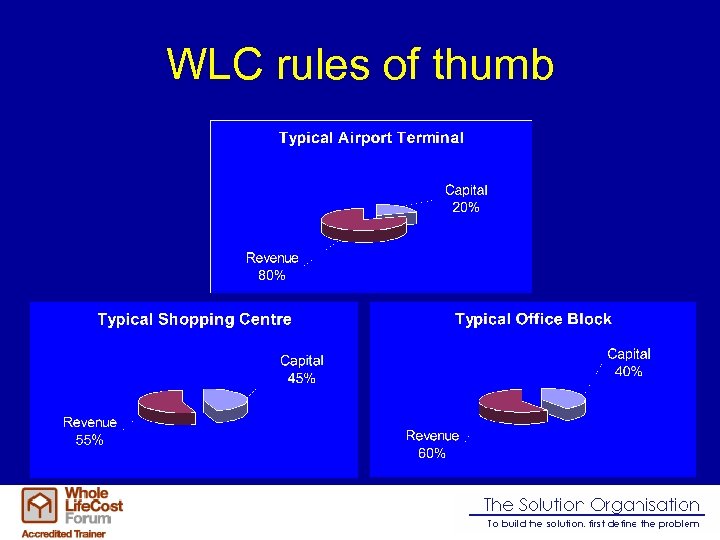
WLC rules of thumb
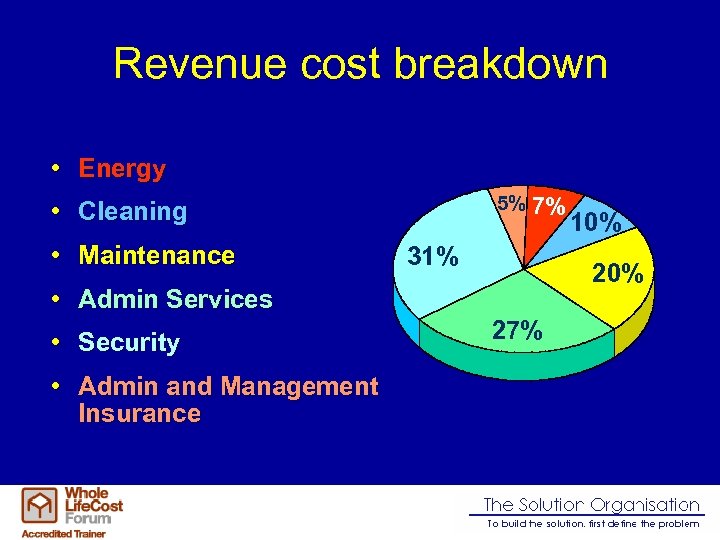
Revenue cost breakdown • Energy 5% 7% • Cleaning • Maintenance 31% 20% • Admin Services • Security • Admin and Management Insurance 10% 27%
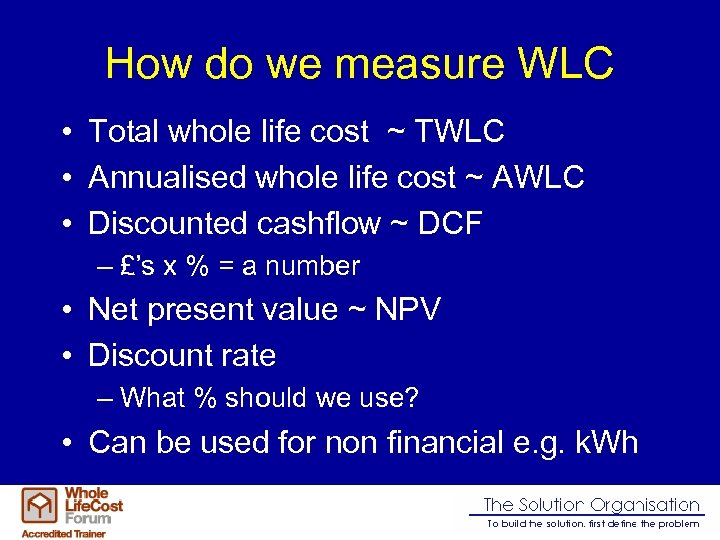
How do we measure WLC • Total whole life cost ~ TWLC • Annualised whole life cost ~ AWLC • Discounted cashflow ~ DCF – £’s x % = a number • Net present value ~ NPV • Discount rate – What % should we use? • Can be used for non financial e. g. k. Wh
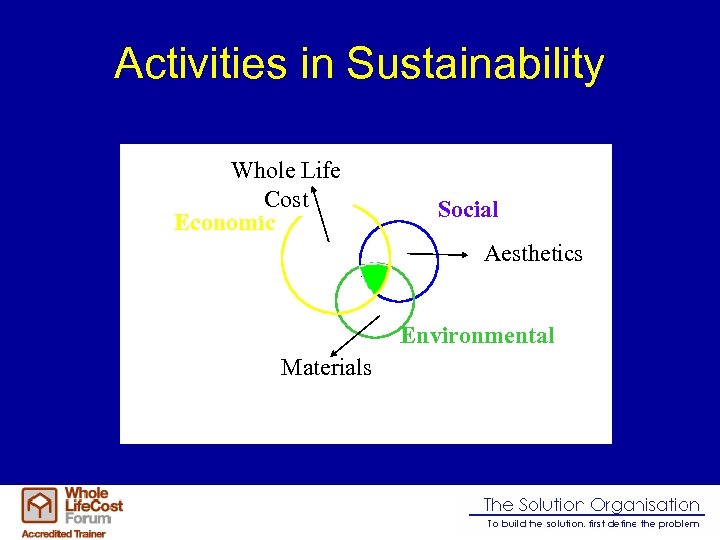
Activities in Sustainability Whole Life Cost Economic Social Aesthetics Environmental Materials
But there are questions • What is the “Life”?
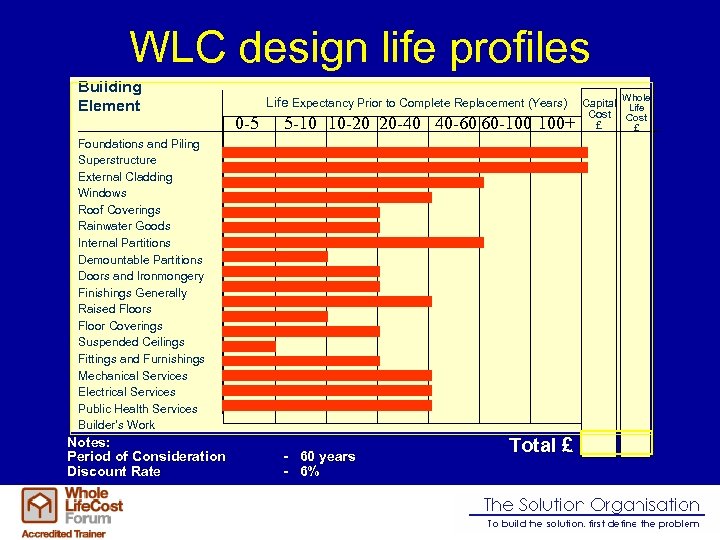
WLC design life profiles Building Element Life Expectancy Prior to Complete Replacement (Years) 0 -5 5 -10 10 -20 20 -40 40 -60 60 -100 100+ Foundations and Piling Superstructure External Cladding Windows Roof Coverings Rainwater Goods Internal Partitions Demountable Partitions Doors and Ironmongery Finishings Generally Raised Floors Floor Coverings Suspended Ceilings Fittings and Furnishings Mechanical Services Electrical Services Public Health Services Builder’s Work Notes: Period of Consideration Discount Rate - 60 years - 6% Total £ Whole Capital Life Cost £ £
But there are questions • • What is the “Life”? When does Year 1 start? What does the Discount Rate include? Should the Suppliers pick their own Discount Rate? • What is the right Discount Rate? • What Discount Rate range do we expect? • Do we apply a Test Discount Rate?
Discount Rate • The % is a combination of factors • Including – The weighted cost of capital of the business – Risk – project and client • Letting suppliers set own Discount Rate tells us a lot • See www. wlcf. org. uk for more
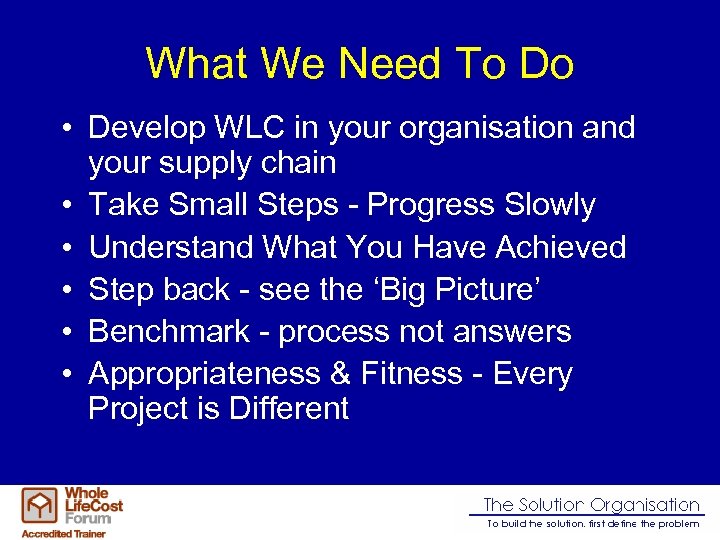
What We Need To Do • Develop WLC in your organisation and your supply chain • Take Small Steps - Progress Slowly • Understand What You Have Achieved • Step back - see the ‘Big Picture’ • Benchmark - process not answers • Appropriateness & Fitness - Every Project is Different
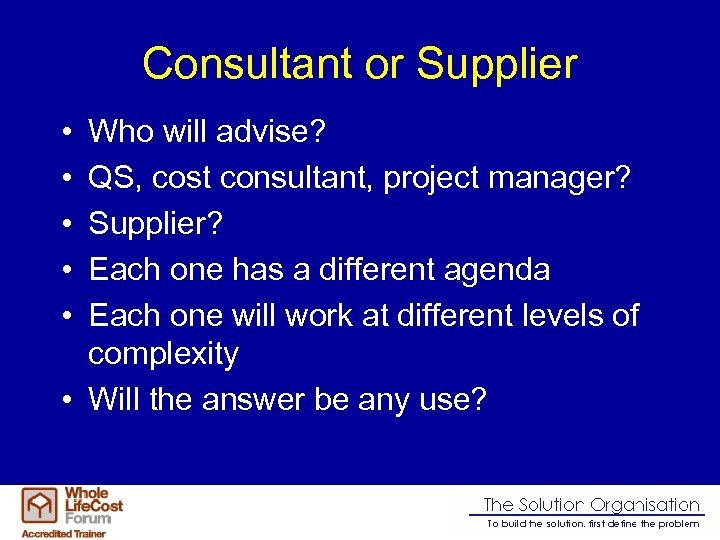
Consultant or Supplier • • • Who will advise? QS, cost consultant, project manager? Supplier? Each one has a different agenda Each one will work at different levels of complexity • Will the answer be any use?
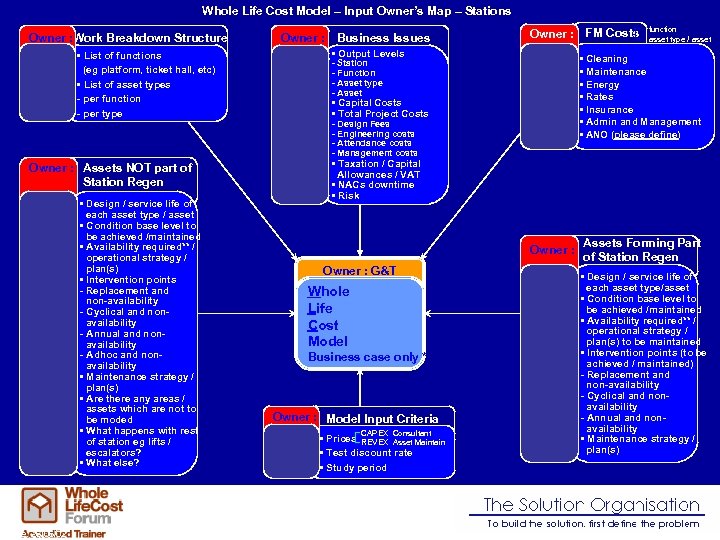
Whole Life Cost Model – Input Owner’s Map – Stations Owner : Work Breakdown Structure • List of functions (eg platform, ticket hall, etc) • List of asset types - per function - per type Owner : Assets NOT part of Station Regen • Design / service life of each asset type / asset • Condition base level to be achieved /maintained • Availability required** / operational strategy / plan(s) • Intervention points - Replacement and non-availability - Cyclical and nonavailability - Annual and nonavailability - Adhoc and nonavailability • Maintenance strategy / plan(s) • Are there any areas / assets which are not to be moded • What happens with rest of station eg lifts / escalators? • What else? Date: 26/06/02 Owner : Business Issues By function Owner : FM Costs. By asset type / asset • Output Levels • Cleaning • Maintenance • Energy • Rates • Insurance • Admin and Management • ANO (please define) - Station - Function - Asset type - Asset • Capital Costs • Total Project Costs - Design Fees - Engineering costs - Attendance costs - Management costs • Taxation / Capital Allowances / VAT • NACs downtime • Risk Owner : G&T Whole Life Cost Model Business case only * Owner : Model Input Criteria CAPEX Consultant • Prices REVEX Asset Maintain • Test discount rate • Study period Key: ** NACs are related to asset availability / performance requirements Assets Forming Part of Station Regen • Design / service life of each asset type/asset • Condition base level to be achieved /maintained • Availability required** / operational strategy / plan(s) to be maintained • Intervention points (to be achieved / maintained) - Replacement and non-availability - Cyclical and nonavailability - Annual and nonavailability • Maintenance strategy / plan(s) Drawn by K. Owen G&T /
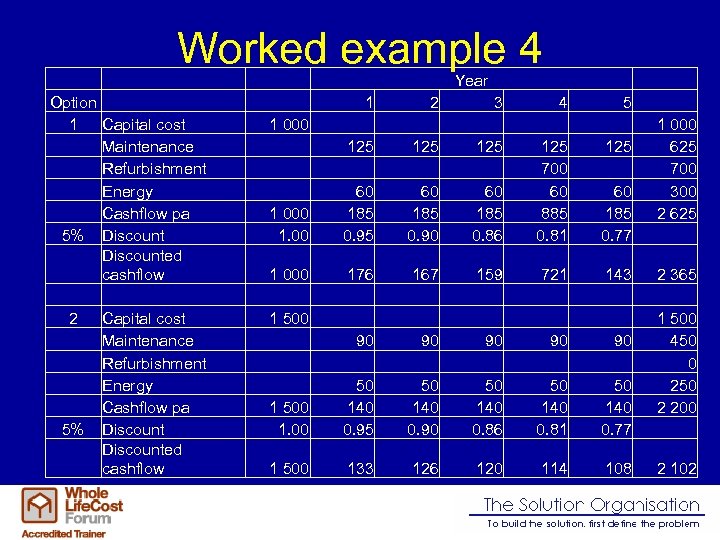
Worked example 4 Year Option 1 Capital cost Maintenance Refurbishment Energy Cashflow pa 5% Discounted cashflow 2 5% Capital cost Maintenance Refurbishment Energy Cashflow pa Discounted cashflow 1 2 3 4 5 1 000 125 125 60 185 0. 86 125 700 60 885 0. 81 1 000 1. 00 60 185 0. 95 60 185 0. 90 1 000 176 167 125 60 185 0. 77 159 721 143 1 500 90 90 90 1 500 1. 00 50 140 0. 95 50 140 0. 90 50 140 0. 86 50 140 0. 81 50 140 0. 77 1 500 133 126 120 114 108 1 000 625 700 300 2 625 2 365 1 500 450 0 250 2 200 2 102
What is industry looking for? • • • Business Added Value Performance Improvements Alternative Solutions/Profiling Design Lives Common Standards • Benchmarking • Credibility
WLC improves performance • Question why do we do things the way we do. • Why buy in first place? • Can we rent or lease? • When we buy a boiler what are we really providing? – Heat – What are the alternatives?
WLC Improves Performance • • Accept we all hate new things & changes Adopt simple easy to use processes Use them all the time Require your supply chain to provide the information • Ensure that the decision information is accurate • Validation & accreditation
WLC Tools • Rules of thumb • Spreadsheet – Simple, easy to use, easy to manipulate • Proprietary – Restrictive • WLCF – Uses WLCF view and is supplier based – Can be used for Buildings
The WLCF
WLCF helps you • • • The web based WLC Comparator Tool Common Data Structures Common Calculation Methodologies Access to Database Optioneering Benchmarking Credibility Help - You Are Not Alone Accreditation
WLCF Web Site
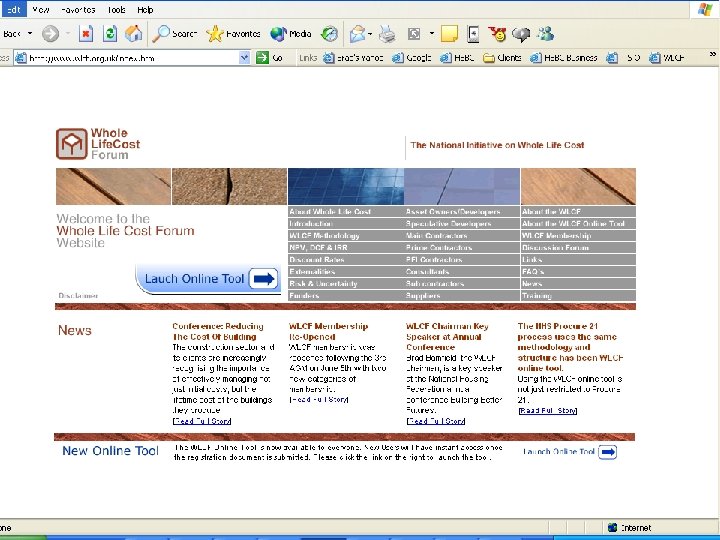
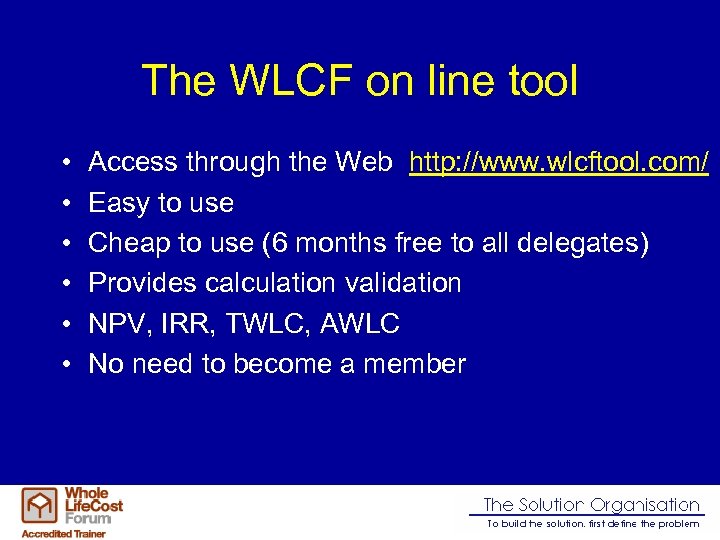
The WLCF on line tool • • • Access through the Web http: //www. wlcftool. com/ Easy to use Cheap to use (6 months free to all delegates) Provides calculation validation NPV, IRR, TWLC, AWLC No need to become a member
The Solution Organisation • Whole Life Costs – Processes – Training • PFI Bid and tender support • Sustainability – Environment – Social • Discount rate tables – http: //www. thesolutionorganisation. com/library. html
How to use WLC - Clients • Ask only for the things that will help • Don’t ask for the impossible • Ask what, how and when, the tenderers will use WLC • Ask for the WLC processes & how it will be demonstrated • Start with something simple – Energy consumption prediction & measure
How to use WLC – Design Team • • WLC starts with design, Good design starts with WLC Ask suppliers for Cost in Use information Use WLC when every element within the options is considered • Don’t jump to conclusions
How to use WLC - Contractors • Understand why the Client needs you to use WLC • Develop simple WLC processes that can be used at every decision point • Develop the reporting process • Work with your supply chain to develop everyone in it • Drop suppliers that won’t engage & try
How to use WLC - Suppliers • Start now – even if your clients don’t ask for it • What are the costs in use for your products? • Would you offer supply and maintain? – If not why not? • Ask your client to help measure the results
Process • • Use the method that suits you NPV - allow Discount Rate freedom Use for every decision point Report the results
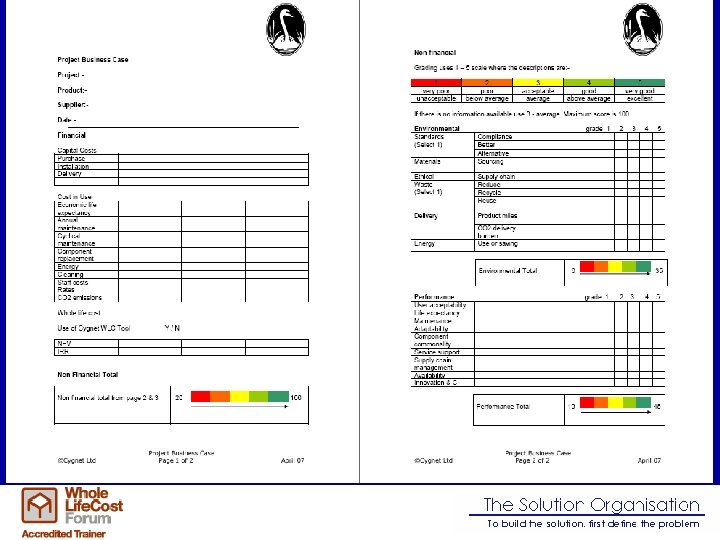
Moving on to WLP • Whole Life Performance • WLC + Non financial measures – Environmental – Social • Reduce to NPV and single score – Example
Summary • WLC – Why – Methods – How – Benefits • WLCF – On line Tool • Next steps
Скачать презентацию Whole Life Costs Toolkits Brad Bamfield Chairman wlcf org
dee22e745a4d42c5734340fd92003625.ppt