


 Скачать презентацию Who wins and who loses from EYE ONS
02a40c17cce2099d25330beb0e88d851.ppt
- Количество слайдов: 59
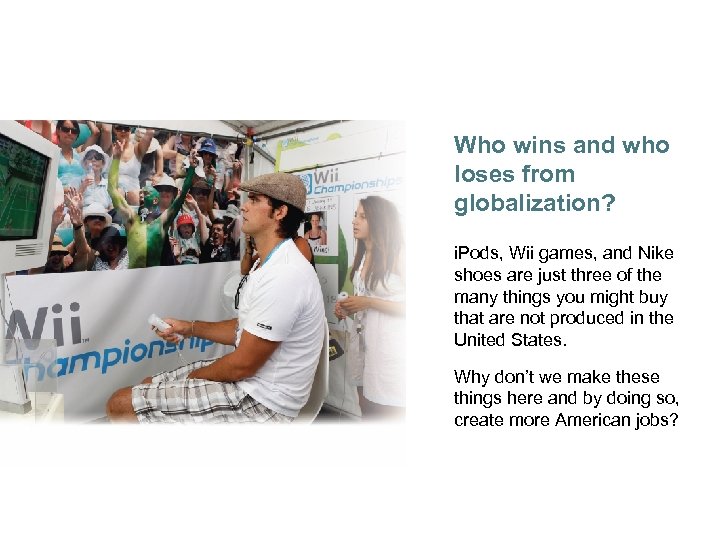 Who wins and who loses from EYE ONS globalization? i. Pods, Wii games, and Nike shoes are just three of the many things you might buy that are not produced in the United States. Why don’t we make these things here and by doing so, create more American jobs?
 18 International Trade Policy CHAPTER CHECKLIST When you have completed your study of this chapter, you will be able to 1 Explain how markets work with international trade and identify the gains from international trade and its winners and losers. 2 Explain the effects of international trade barriers. 3 Explain and evaluate arguments used to justify restricting international trade. © 2011 Pearson Education
 18. 1 HOW GLOBAL MARKETS WORK Imports are the good and services that we buy from people in other countries. Exports are the goods and services we sell to people in other countries.
 18. 1 HOW GLOBAL MARKETS WORK
 18. 1 HOW GLOBAL MARKETS WORK The United States trades internationally in goods and services. In 2009, U. S. exports of services were $0. 5 trillion (33 percent of total exports) and U. S. imports of services were $0. 4 trillion (21 percent of total imports). The largest U. S. exports of goods are airplanes. The largest U. S. imports of goods are crude oil and automobiles. The largest U. S. exports of services are banking, insurance, business consulting, and other private services.
 18. 1 HOW GLOBAL MARKETS WORK
 18. 1 HOW GLOBAL MARKETS WORK The opportunity cost of producing a T-shirt is lower in China than in the United States, so China has a comparative advantage in producing T-shirts. The opportunity cost of producing an airplane is lower in the United States than in China, so the United States has a comparative advantage in producing airplanes. Both countries can reap gains from trade by specializing in the production of the good at which they have a comparative advantage and then trading. Both countries are better off.
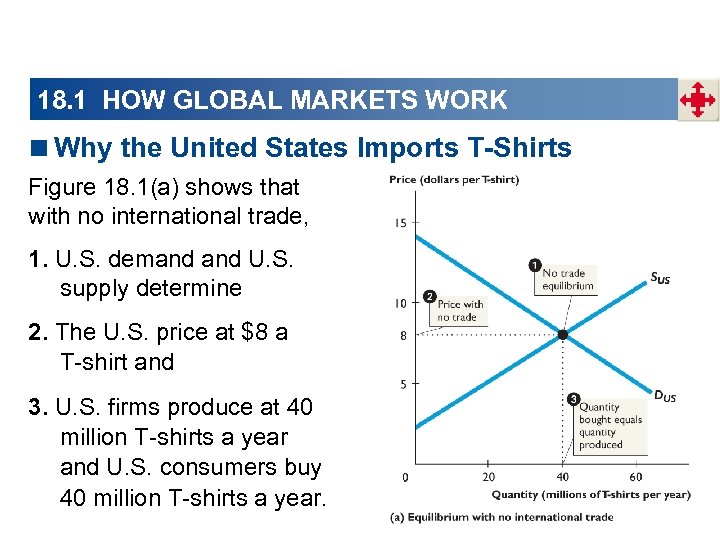 18. 1 HOW GLOBAL MARKETS WORK
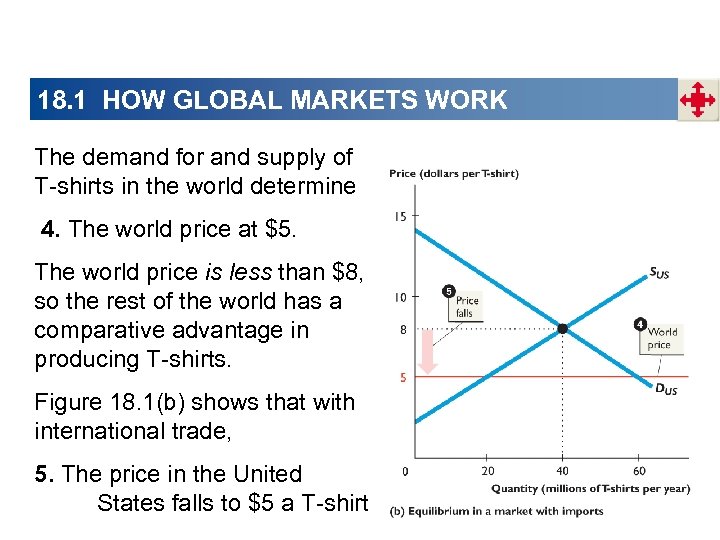 18. 1 HOW GLOBAL MARKETS WORK The demand for and supply of T-shirts in the world determine 4. The world price at $5. The world price is less than $8, so the rest of the world has a comparative advantage in producing T-shirts. Figure 18. 1(b) shows that with international trade, 5. The price in the United States falls to $5 a T-shirt.
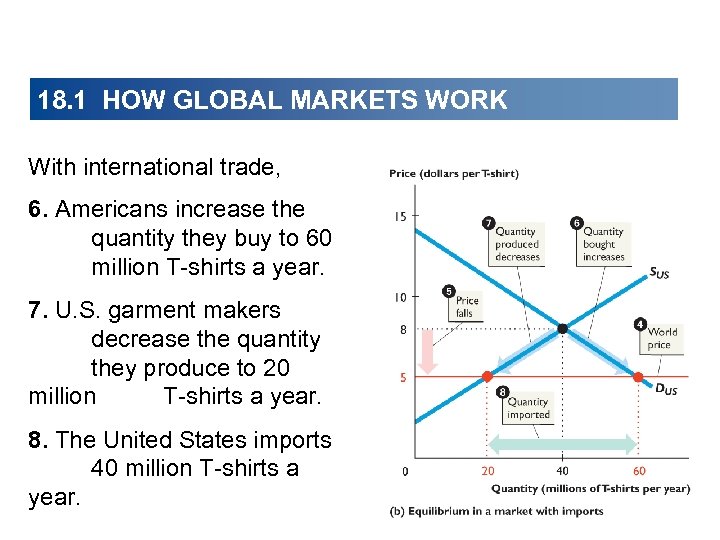 18. 1 HOW GLOBAL MARKETS WORK With international trade, 6. Americans increase the quantity they buy to 60 million T-shirts a year. 7. U. S. garment makers decrease the quantity they produce to 20 million T-shirts a year. 8. The United States imports 40 million T-shirts a year.
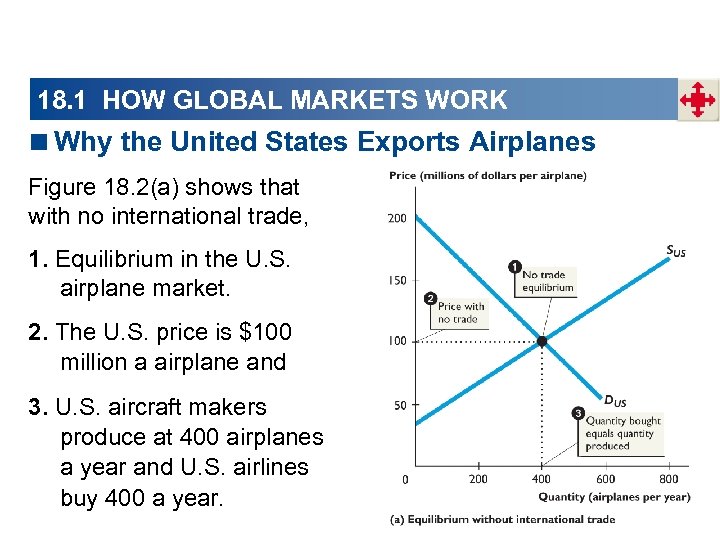 18. 1 HOW GLOBAL MARKETS WORK
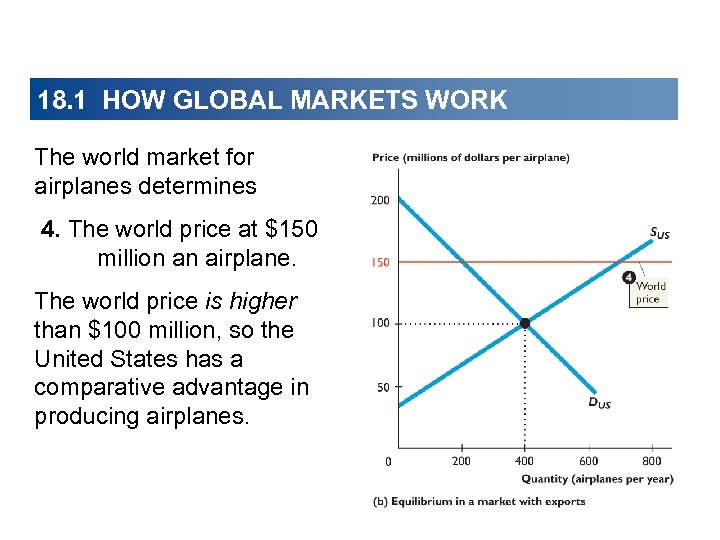 18. 1 HOW GLOBAL MARKETS WORK The world market for airplanes determines 4. The world price at $150 million an airplane. The world price is higher than $100 million, so the United States has a comparative advantage in producing airplanes.
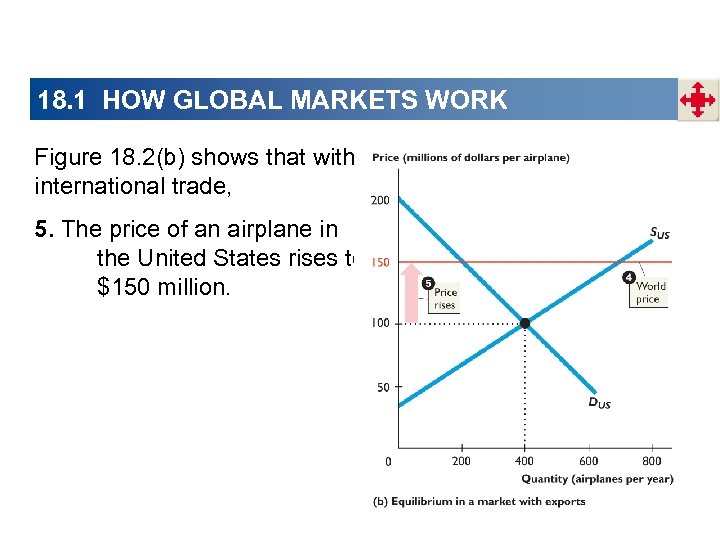 18. 1 HOW GLOBAL MARKETS WORK Figure 18. 2(b) shows that with international trade, 5. The price of an airplane in the United States rises to $150 million.
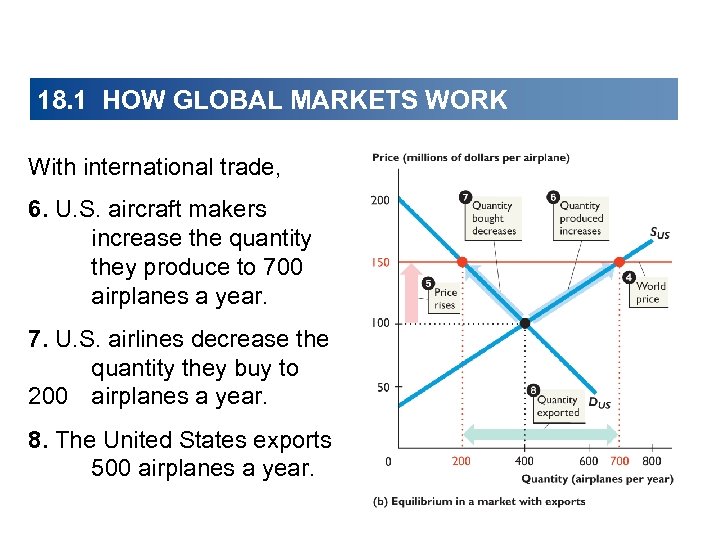 18. 1 HOW GLOBAL MARKETS WORK With international trade, 6. U. S. aircraft makers increase the quantity they produce to 700 airplanes a year. 7. U. S. airlines decrease the quantity they buy to 200 airplanes a year. 8. The United States exports 500 airplanes a year.
 18. 1 HOW GLOBAL MARKETS WORK
 18. 1 HOW GLOBAL MARKETS WORK Gains and Losses from Imports Domestic Consumers Gain from Imports Compared to a situation with no international trade, the price paid by domestic consumers falls and the quantity consumed increases. The domestic consumers gain. The greater the price fall and the increase in quantity bought, the greater is the consumers’ gain.
 18. 1 HOW GLOBAL MARKETS WORK Domestic Producers Lose from Imports Compared to a situation with no international trade, the price received by the domestic producer of the imported good falls. The quantity sold by domestic producers of the imported good decreases. Domestic producers of the imported good lose from international trade.
 18. 1 HOW GLOBAL MARKETS WORK Gains and Losses from Exports Domestic Consumers Lose from Exports Compared to a situation with no international trade, the price paid by domestic consumers rises and the quantity bought decreases. The domestic consumers lose. The greater the price rise and the decrease in quantity bought, the greater is the consumers’ loss.
 18. 1 HOW GLOBAL MARKETS WORK Domestic Producers Lose from Exports Compared to a situation with no international trade, the price received by the domestic producer of the exported good rises. The quantity sold by domestic producers of the exported good increases. Domestic producers of the exported good gain from international trade.
 18. 1 HOW GLOBAL MARKETS WORK Net Gain Export producers and import consumers gain. Export consumers and import producers lose. But the gains are greater than the losses. In the case of imports, consumers gain what producers lose and then even more from the cheaper imports. In the case of exports, producers gain what consumers lose and then even more from the items exported. So international trade provides a net gain for a country.
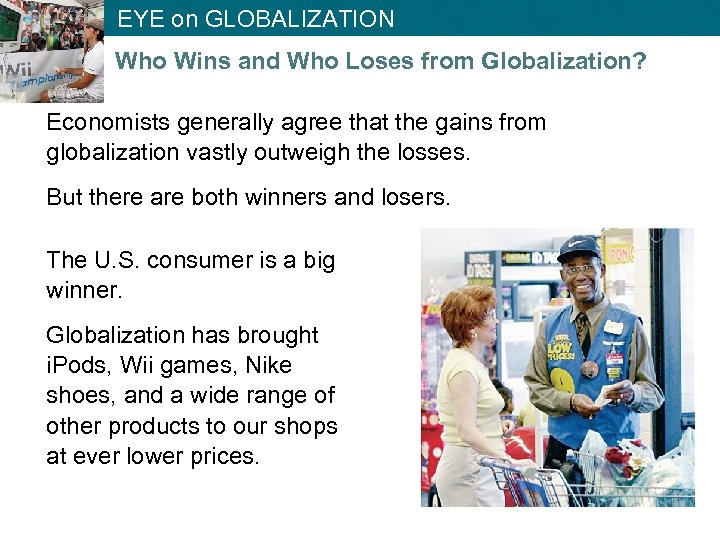 EYE on GLOBALIZATION Who Wins and Who Loses from Globalization? Economists generally agree that the gains from globalization vastly outweigh the losses. But there are both winners and losers. The U. S. consumer is a big winner. Globalization has brought i. Pods, Wii games, Nike shoes, and a wide range of other products to our shops at ever lower prices.
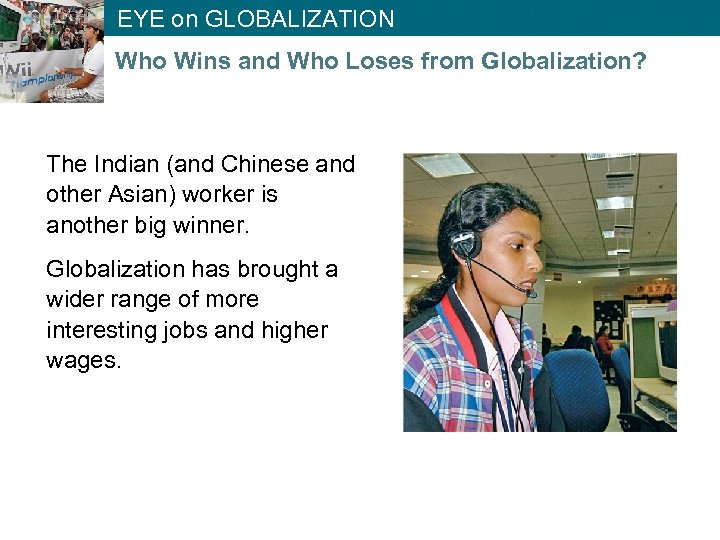 EYE on GLOBALIZATION Who Wins and Who Loses from Globalization? The Indian (and Chinese and other Asian) worker is another big winner. Globalization has brought a wider range of more interesting jobs and higher wages.
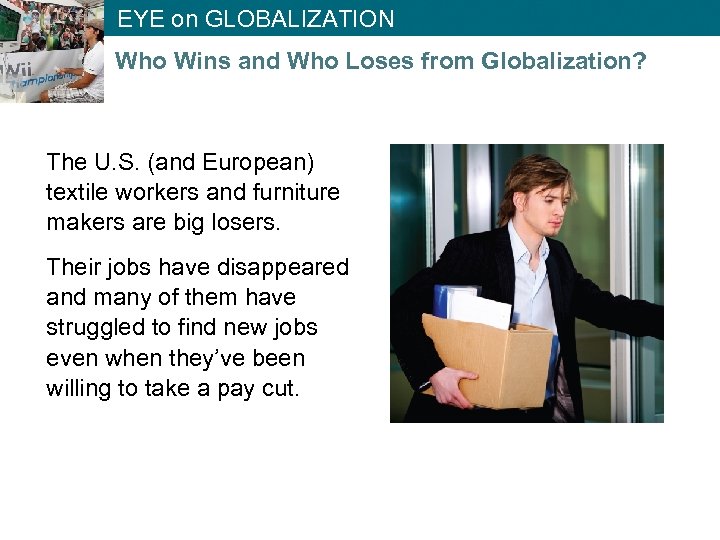 EYE on GLOBALIZATION Who Wins and Who Loses from Globalization? The U. S. (and European) textile workers and furniture makers are big losers. Their jobs have disappeared and many of them have struggled to find new jobs even when they’ve been willing to take a pay cut.
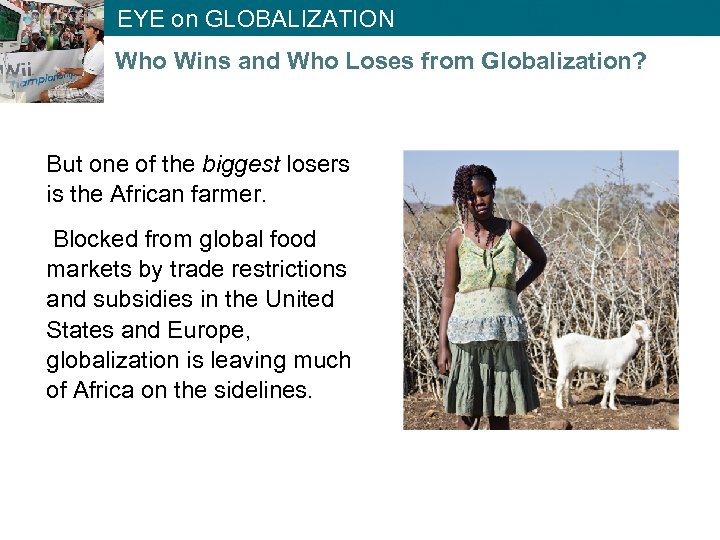 EYE on GLOBALIZATION Who Wins and Who Loses from Globalization? But one of the biggest losers is the African farmer. Blocked from global food markets by trade restrictions and subsidies in the United States and Europe, globalization is leaving much of Africa on the sidelines.
 18. 2 INTERNATIONAL TRADE RESTRICTIONS Governments restrict international trade to protect domestic producers from competition. The four sets of tools they use are • Tariffs • Import quotas • Other import restrictions • Export subsidies
 18. 2 INTERNATIONAL TRADE RESTRICTIONS
 18. 2 INTERNATIONAL TRADE RESTRICTIONS The Effects of a Tariff With free international trade, the world price of a T-shirt is $5 and the United States imports 40 million T-shirts a year. Imagine that the United States imposes a tariff of $2 on each T-shirt imported. The price of a T-shirt in the United States rises by $2. Figure 18. 3 shows the effect of the tariff on the market for T-shirts in the United States.
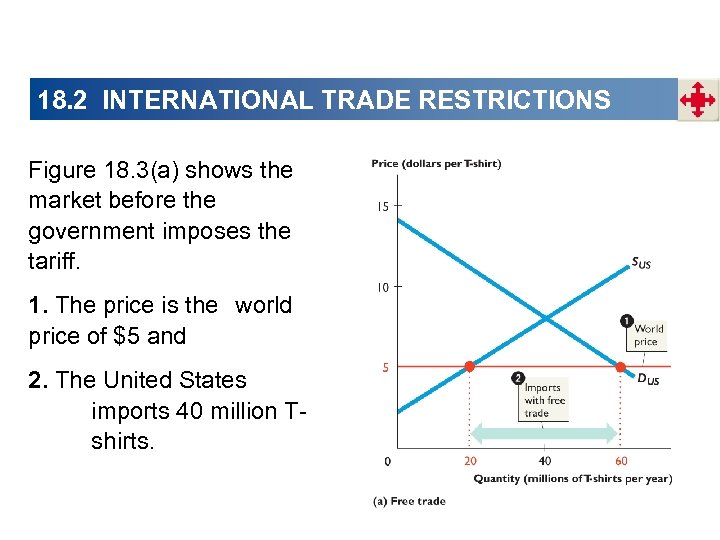 18. 2 INTERNATIONAL TRADE RESTRICTIONS Figure 18. 3(a) shows the market before the government imposes the tariff. 1. The price is the world price of $5 and 2. The United States imports 40 million Tshirts.
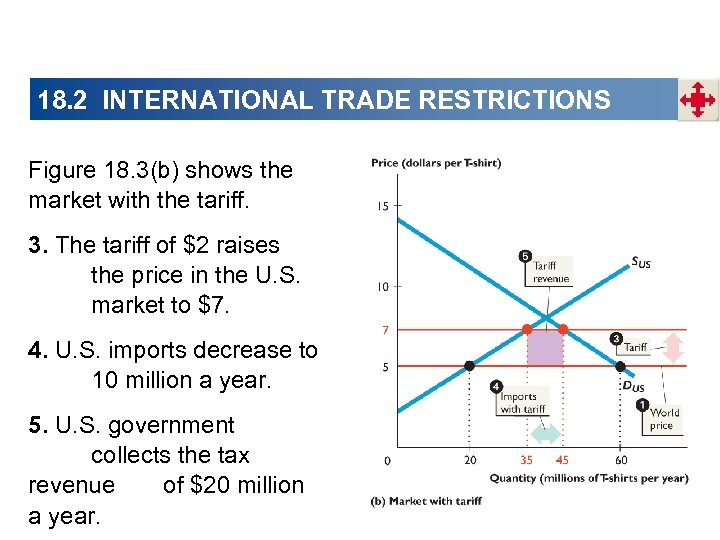 18. 2 INTERNATIONAL TRADE RESTRICTIONS Figure 18. 3(b) shows the market with the tariff. 3. The tariff of $2 raises the price in the U. S. market to $7. 4. U. S. imports decrease to 10 million a year. 5. U. S. government collects the tax revenue of $20 million a year.
 18. 2 INTERNATIONAL TRADE RESTRICTIONS Winners, Losers, and Social Loss from a Tariff When the U. S. government imposes a tariff on imported T-shirts: • U. S. consumers of T-shirts lose. • U. S. producers of T-shirts gain. • U. S. consumers lose more than U. S. producers gain.
 18. 2 INTERNATIONAL TRADE RESTRICTIONS U. S. Consumers of T-shirts Lose U. S. buyers of T-shirts now pay a higher price (the world price plus the tariff), so they buy fewer T-shirts. The combination of a higher price and a smaller quantity bought makes consumers worse off. Consumers also pay tariff revenue to the government. Consumers lose from the tariff.
 18. 2 INTERNATIONAL TRADE RESTRICTIONS U. S. Producers of T-shirts Gain U. S. producers receive a higher price (the world price plus the tariff), so produce more T-shirts. Producers gain from the tariff. But the higher price paid to domestic producers pays for the higher cost of production.
 18. 2 INTERNATIONAL TRADE RESTRICTIONS U. S. Consumers Lose More than U. S. Producers Gain Consumers lose from a tariff. The tariff revenue is a loss to consumers of T-shirts but a gain to consumers of public services paid for by the tariff revenue. Because the higher price paid to domestic producers pays for the higher cost of domestic production, consumers lose and no one gains from decreased quantity of T-shirts produced.
 18. 2 INTERNATIONAL TRADE RESTRICTIONS
 18. 2 INTERNATIONAL TRADE RESTRICTIONS The Effects of an Import Quota With free international trade, the world price of a T-shirt is $5 and the United States imports 40 million T-shirts a year. Imagine that the United States imposes a quota of 10 million on imported T-shirts. Figure 18. 4 shows the effect of the quota on the market for T-shirts in the United States.
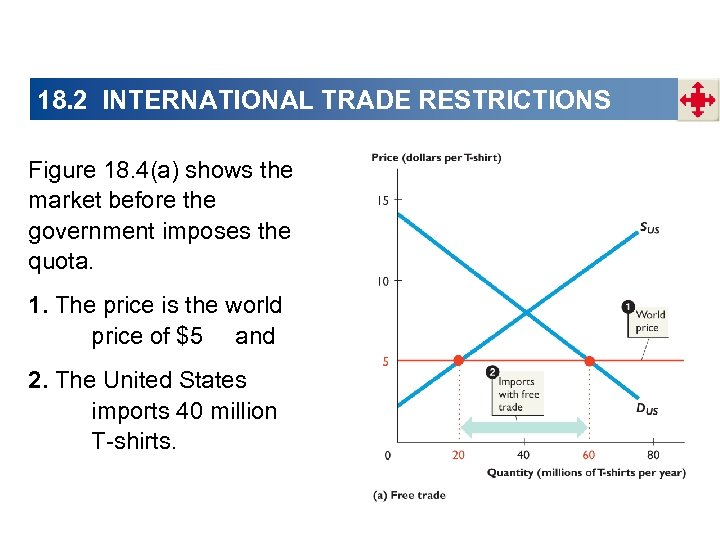 18. 2 INTERNATIONAL TRADE RESTRICTIONS Figure 18. 4(a) shows the market before the government imposes the quota. 1. The price is the world price of $5 and 2. The United States imports 40 million T-shirts.
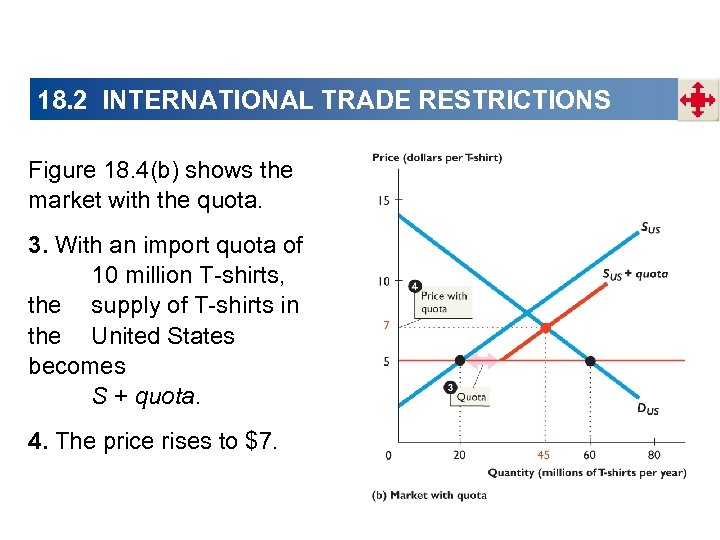 18. 2 INTERNATIONAL TRADE RESTRICTIONS Figure 18. 4(b) shows the market with the quota. 3. With an import quota of 10 million T-shirts, the supply of T-shirts in the United States becomes S + quota. 4. The price rises to $7.
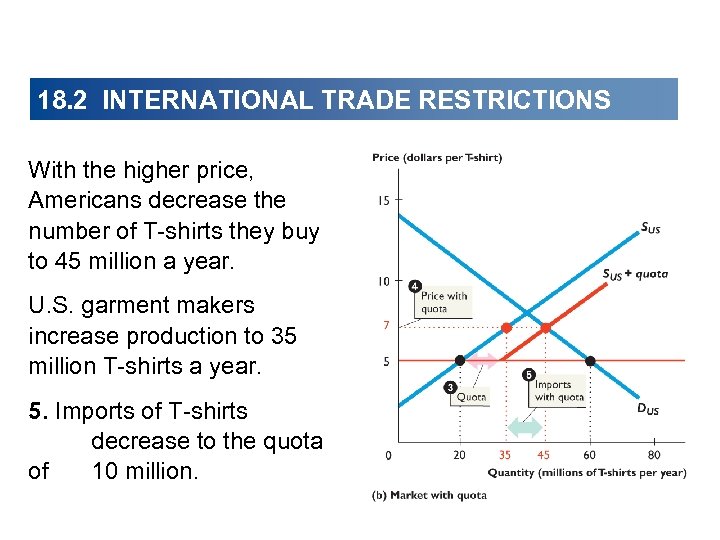 18. 2 INTERNATIONAL TRADE RESTRICTIONS With the higher price, Americans decrease the number of T-shirts they buy to 45 million a year. U. S. garment makers increase production to 35 million T-shirts a year. 5. Imports of T-shirts decrease to the quota of 10 million.
 18. 2 INTERNATIONAL TRADE RESTRICTIONS Winners, Losers, and Social Loss from an Import Quota When the U. S. government imposes a quota on imported T-shirts: • U. S. consumers of T-shirts lose. • U. S. producers of T-shirts gain. • Importers of T-shirts gain. • Society loses.
 18. 2 INTERNATIONAL TRADE RESTRICTIONS U. S. Consumers of T-shirts Lose U. S. buyers of T-shirts now pay a higher price, so they buy fewer T-shirts. The combination of a higher price and a smaller quantity bought makes U. S. consumers worse off. U. S. consumers lose from the import quota.
 18. 2 INTERNATIONAL TRADE RESTRICTIONS U. S. Producers of T-shirts Gain U. S. producers receive a higher price, so produce more T-shirts. Producers gain from the import quota. Importers of T-shirts Gain The importer buys T-shirts on the world market at the world price and sells them in the U. S. market at the U. S. domestic price. Because the U. S. price exceeds the world price, the importer gains.
 18. 2 INTERNATIONAL TRADE RESTRICTIONS Society Loses The loss to consumers exceeds the gains of domestic producers and importers, so society loses. A social loss arises because • The higher price paid to domestic producers pays the higher cost of domestic production and • The quantity of the good consumed at the higher price decreases.
 18. 2 INTERNATIONAL TRADE RESTRICTIONS
 18. 2 INTERNATIONAL TRADE RESTRICTIONS A voluntary export restraint is like a quota allocated to a foreign exporter of the good. A voluntary export restraint decreases imports just like a quota does but the foreign exporter gets the profit from the gap between the domestic price and the world price.
 18. 3 THE CASE AGAINST PROTECTION Despite the fact that free trade promotes prosperity for all countries, trade is restricted.
 18. 3 THE CASE AGAINST PROTECTION The National Security Argument A country must protect industries that produce defense equipment and armaments and those on which the defense industries rely for their raw materials and other intermediate inputs. This argument for protection can be taken too far.
 18. 3 THE CASE AGAINST PROTECTION The Infant-Industry Argument The infant-industry argument is that it is necessary to protect a new industry from import competition to enable it to grow into a mature industry that can compete in world markets. This argument is based on the concept of dynamic competitive advantage, which can arise from learning-by -doing. Learning-by-doing is a powerful engine of productivity growth, but this fact does not justify protection.
 18. 3 THE CASE AGAINST PROTECTION The Dumping Argument Dumping occurs when foreign a firm sells its exports at a lower price than its cost of production. Two reasons why a firm might engage in dumping are • Predatory pricing—when a firm sells below cost in the hope of driving out competitors • Subsidy—a firm receiving a subsidy can sell profitable at price below cost.
 18. 3 THE CASE AGAINST PROTECTION This argument does not justify protection because 1. It is virtually impossible to determine a firm’s costs; 2. If there was a natural global monopoly, it would be more efficient to regulate it than to impose a tariff against it. 3. If the market is truly a global monopoly, better to regulate it rather than restrict trade.
 18. 3 THE CASE AGAINST PROTECTION
 18. 3 THE CASE AGAINST PROTECTION Saves Jobs The idea that buying foreign goods costs domestic jobs is wrong. Free trade destroys some jobs and creates other better jobs. Free trade also increases foreign incomes and enables foreigners to buy more domestic production. Protection to save particular jobs is very costly.
 18. 3 THE CASE AGAINST PROTECTION Allows Us to Compete with Cheap Foreign Labor The idea that a high-wage country cannot compete with a low-wage country is wrong. Low-wage labor is less productive than high-wage labor. And wages and productivity tell us nothing about the source of gains from trade, which is comparative advantage.
 18. 3 THE CASE AGAINST PROTECTION Brings Diversity and Stability A diversified investment portfolio is less risky than one that has all of its eggs in one basket. The same is true for an economy’s production. A diversified economy fluctuates less than an economy that produces only one or two goods. But big, rich, diversified economies like those of the United States, Japan, and Europe do not have this type of stability problem.
 18. 3 THE CASE AGAINST PROTECTION Penalizes Lax Environmental Standards The idea that protection is good for the environment is wrong. Free trade increases incomes and poor countries have lower environmental standards than rich countries. These countries cannot afford to spend as much on the environment as a rich country can and sometimes they have a comparative advantage at doing “dirty” work, which helps the global environment achieve higher environmental standards.
 18. 3 THE CASE AGAINST PROTECTION
 18. 3 THE CASE AGAINST PROTECTION Those who gain from free trade are the millions of consumers of low-cost imports. But the benefit per individual consumer is small. Those who lose are the producers of import-competing items. Compared to the millions of consumers, there are only a few thousand producers.
 18. 3 THE CASE AGAINST PROTECTION Because the gain from a tariff is large, producers have a strong incentive to incur the expense of lobbying for a tariff and against free trade. Because each consumer’s loss is small, consumers have little incentive to organize and incur the expense of lobbying for free trade. The gain from free trade for any one person is too small for that person to spend much time or money on a political organization to lobby for free trade.
 18. 3 THE CASE AGAINST PROTECTION Each group weighs benefits against costs and chooses the best action for themselves. But the group against free trade will undertake more political lobbying than will the group for free trade.