 Скачать презентацию Who will become a global financial center Shanghai
1917e5c3ad9f4c8dfb02521f344ac34c.ppt
- Количество слайдов: 36



Who will become a global financial center, Shanghai or Hong Kong? Cheung Yan-leung Dean & Professor (Chair) of Finance School of Business Hong Kong Baptist University
Agenda 1. 2. 3. 4. 5. 6. The definition of Global financial centre Global Financial Centre Index Background & advantage of Shanghai Background & advantage of Hong Kong Threat of Shanghai How to face to the Competition
Global Financial Center “have sufficient critical mass of financial services institutions to dispense with intermediaries and to connect international, national and regional financial services participants directly” (City of London)
Global Financial Centres Index (GFCI) Published by the Z/Yen Group of the City of London A ranking of the competitiveness of financial centre based 57 instrumental factors and an online questionnaire on 26, 629 financial centre assessments Ratings for 62 financial centres calculated by a ‘factor assessment model’.
Instrumental factors Provided by a number of reputable organizations; Executive MBA Global Rakings (financial Times), Human Development Index (UNDP), Business Environment (Economist Intelligence Unit), Corruption Perception Index (transparency International), Ease of Doing Business Index (world Bank), Global Competitiveness Index (World Economic Forum) etc…
Online Questionnaire A simple questionnaire of not more than 20 questions About the market perception on the ranking of Global Financial Centres
Five Key Aspects People • Availability of good personnel, the flexibility of the labor market, business education and the development of ‘human capital’ Business Environment • Regulation, tax rates, levels of corruption, economic freedom and the ease of doing business. Regulation, a major component of the business environment
Five Key Aspects Market Access • The levels of securitization, volume and value of trading in equities and bonds, as well as the clustering effect of having many firms involved in the financial services sector together in one centre. General Competitiveness • Overall competitiveness of centres in terms of more general economic factors
Five Key Aspects Infrastructure • Focus on the cost and availability of buildings and office space, it also includes other infrastructure factors such as transport
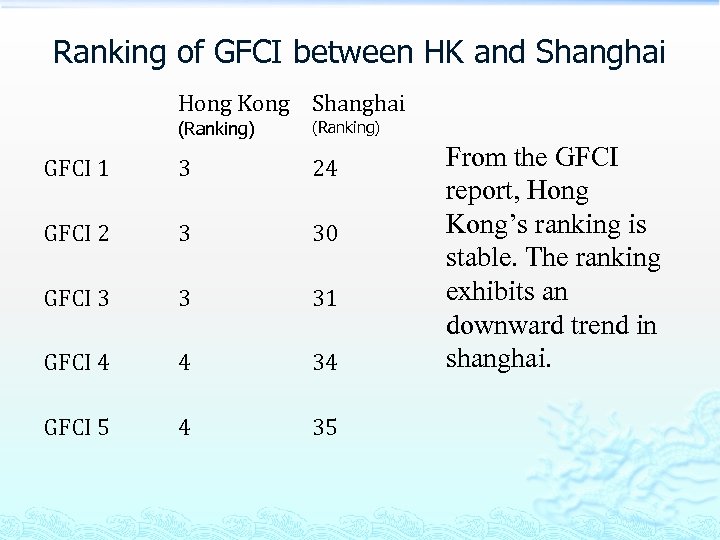
Ranking of GFCI between HK and Shanghai Hong Kong Shanghai (Ranking) GFCI 1 3 24 GFCI 2 3 30 GFCI 3 3 31 GFCI 4 4 34 GFCI 5 4 35 From the GFCI report, Hong Kong’s ranking is stable. The ranking exhibits an downward trend in shanghai.
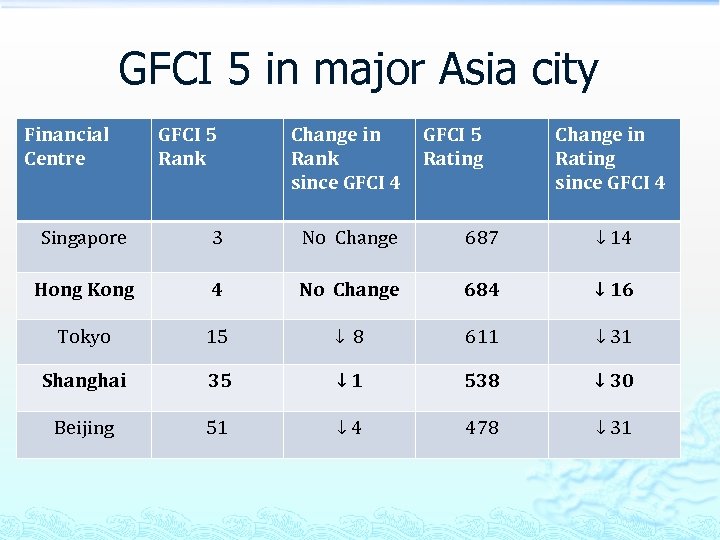
GFCI 5 in major Asia city Financial Centre GFCI 5 Rank Change in Rank since GFCI 4 GFCI 5 Rating Change in Rating since GFCI 4 Singapore 3 No Change 687 ↓ 14 Hong Kong 4 No Change 684 ↓ 16 Tokyo 15 ↓ 8 611 ↓ 31 Shanghai 35 ↓ 1 538 ↓ 30 Beijing 51 ↓ 4 478 ↓ 31
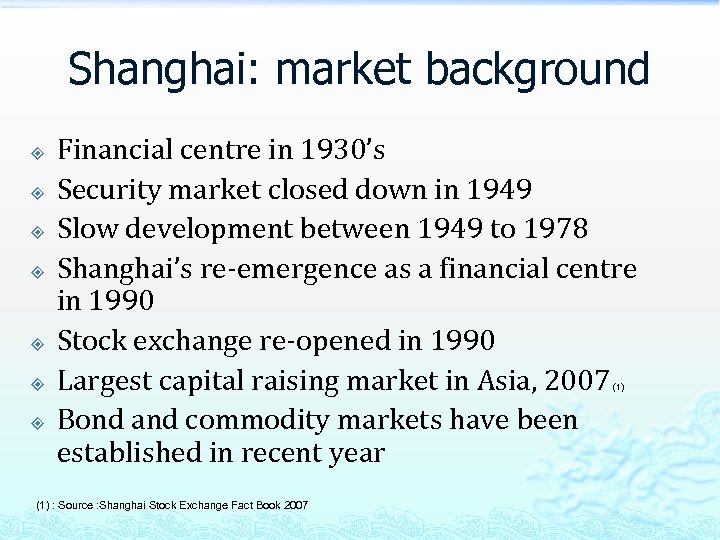
Shanghai: market background Financial centre in 1930’s Security market closed down in 1949 Slow development between 1949 to 1978 Shanghai’s re-emergence as a financial centre in 1990 Stock exchange re-opened in 1990 Largest capital raising market in Asia, 2007 Bond and commodity markets have been established in recent year (1) : Source : Shanghai Stock Exchange Fact Book 2007 (1)
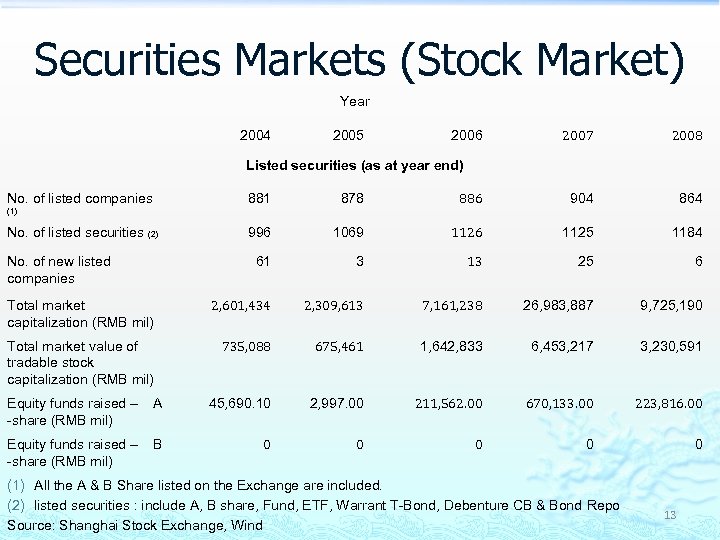
Securities Markets (Stock Market) Year 2004 2005 2006 2007 2008 Listed securities (as at year end) 881 878 886 904 864 996 1069 1126 1125 1184 61 3 13 25 6 Total market capitalization (RMB mil) 2, 601, 434 2, 309, 613 7, 161, 238 26, 983, 887 9, 725, 190 Total market value of tradable stock capitalization (RMB mil) 735, 088 675, 461 1, 642, 833 6, 453, 217 3, 230, 591 No. of listed companies (1) No. of listed securities (2) No. of new listed companies Equity funds raised – -share (RMB mil) A 45, 690. 10 2, 997. 00 211, 562. 00 670, 133. 00 223, 816. 00 Equity funds raised – -share (RMB mil) B 0 0 0 (1) All the A & B Share listed on the Exchange are included. (2) listed securities : include A, B share, Fund, ETF, Warrant T-Bond, Debenture CB & Bond Repo Source: Shanghai Stock Exchange, Wind 13
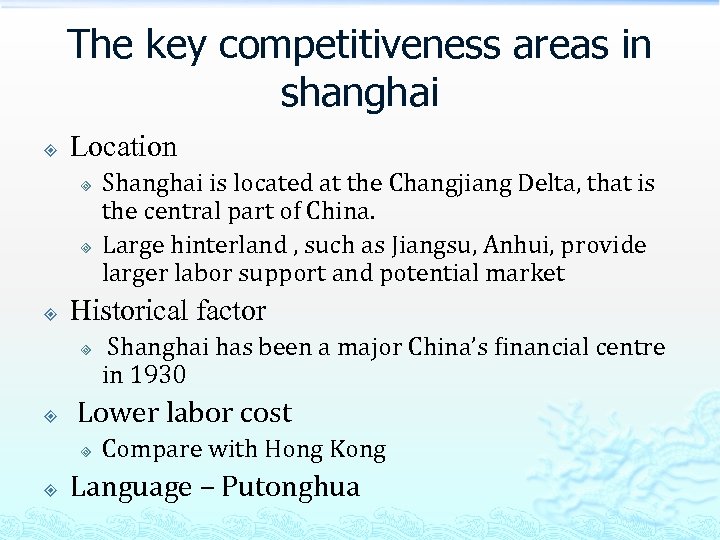
The key competitiveness areas in shanghai Location ³ ³ Historical factor ³ Shanghai has been a major China’s financial centre in 1930 Lower labor cost ³ Shanghai is located at the Changjiang Delta, that is the central part of China. Large hinterland , such as Jiangsu, Anhui, provide larger labor support and potential market Compare with Hong Kong Language – Putonghua
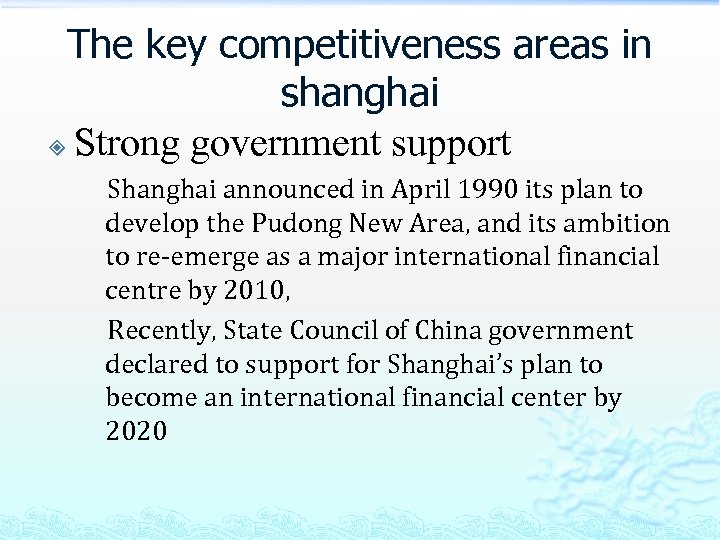
The key competitiveness areas in shanghai Strong government support Shanghai announced in April 1990 its plan to develop the Pudong New Area, and its ambition to re-emerge as a major international financial centre by 2010, Recently, State Council of China government declared to support for Shanghai’s plan to become an international financial center by 2020
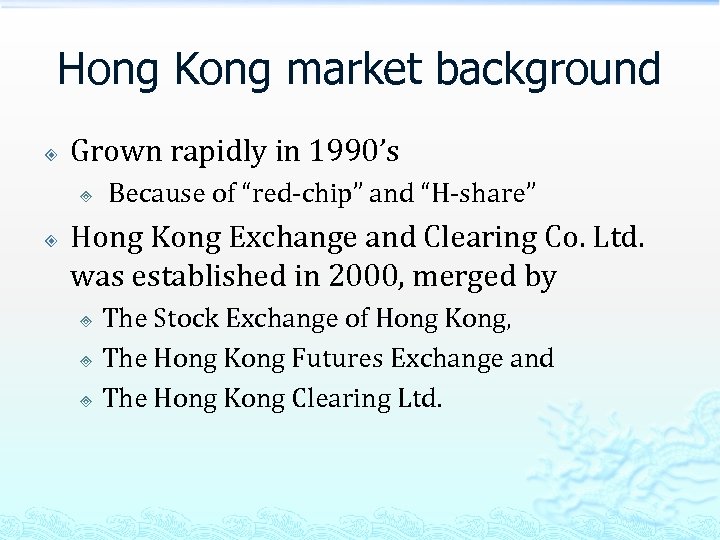
Hong Kong market background Grown rapidly in 1990’s ³ Because of “red-chip” and “H-share” Hong Kong Exchange and Clearing Co. Ltd. was established in 2000, merged by The Stock Exchange of Hong Kong, ³ The Hong Kong Futures Exchange and ³ The Hong Kong Clearing Ltd. ³
Hong Kong market background Focus on product development in recent year Warrant ³ Callable Bull/Bear Contracts (CBBC) ³ Exchange-Traded Funds (ETFs) ³ Real Estate Investment Trusts (REITs) ³ The largest derivative warrant market in the world , 2007
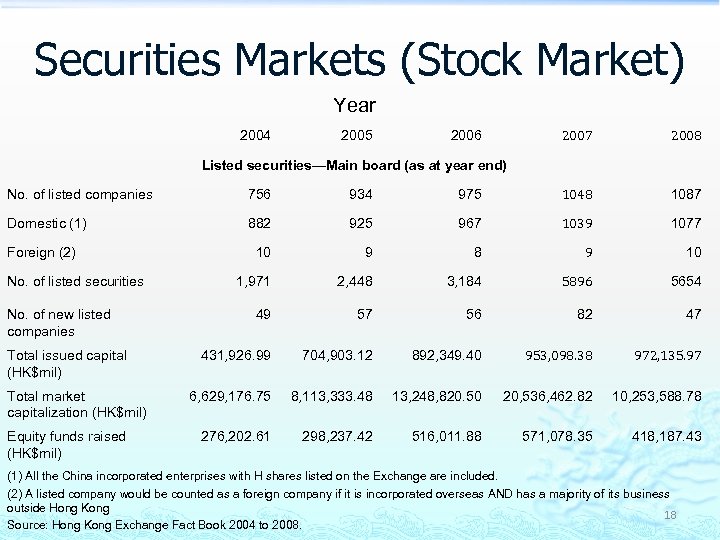
Securities Markets (Stock Market) Year 2004 2005 2007 2006 2008 Listed securities—Main board (as at year end) No. of listed companies 756 934 975 1048 1087 Domestic (1) 882 925 967 1039 1077 10 9 8 9 10 1, 971 2, 448 3, 184 5896 5654 49 57 56 82 47 431, 926. 99 704, 903. 12 892, 349. 40 953, 098. 38 972, 135. 97 6, 629, 176. 75 8, 113, 333. 48 13, 248, 820. 50 20, 536, 462. 82 10, 253, 588. 78 276, 202. 61 298, 237. 42 516, 011. 88 571, 078. 35 418, 187. 43 Foreign (2) No. of listed securities No. of new listed companies Total issued capital (HK$mil) Total market capitalization (HK$mil) Equity funds raised (HK$mil) (1) All the China incorporated enterprises with H shares listed on the Exchange are included. (2) A listed company would be counted as a foreign company if it is incorporated overseas AND has a majority of its business outside Hong Kong 18 Source: Hong Kong Exchange Fact Book 2004 to 2008.
The key competitiveness areas in Hong Kong From the GFCI 5 report, Hong Kong has performed well in all of the sub-Indices by Area of competitiveness. Include: People ³ Business Environment ³ Market Access ³ Infrastructure General ³ Environment Competitiveness ³
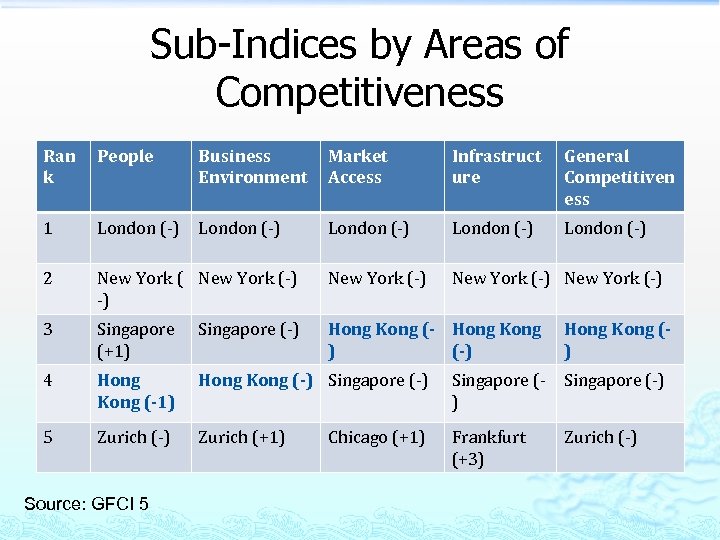
Sub-Indices by Areas of Competitiveness Ran k People Business Environment Market Access Infrastruct ure General Competitiven ess 1 London (-) London (-) 2 New York (-) -) New York (-) 3 Singapore (+1) Singapore (-) Hong Kong (- Hong Kong ) (-) 4 Hong Kong (-1) Hong Kong (-) Singapore () Singapore (-) 5 Zurich (-) Zurich (+1) Frankfurt (+3) Zurich (-) Source: GFCI 5 Chicago (+1) Hong Kong ()
The key competitiveness areas in Hong Kong People § § § ³ Well educated labor Our universities have top rankings in the world flexible immigration policy Business Environment • • Simple and straightforward tax regime in both of corporate and personal tax Laissez fare economy Stable country currency system-Linked to the U. S. dollar free flow of information
The key competitiveness areas in Hong Kong Business Environment (Cont’) • • Low corruption rate The World Bank publishes a measure of regulation and corruption under the title Governance Matters. Hong Kong stands in top ranking
The key competitiveness areas in Hong Kong Market Access • • • High access to international market No barrier for the foreign exchange Concentration of international banks and financial institutions Infrastructure • • Sufficient A-Grade office has been continuously improving and upgrading the infrastructure
Threat From Shanghai Rapid improvement in business environment • • • Infrastructure Living quality Human resource Replay Hong Kong to become a “gateway” to China market The report of GFCI 5 shows that the investors concentrate on shanghai rather than Hong Kong
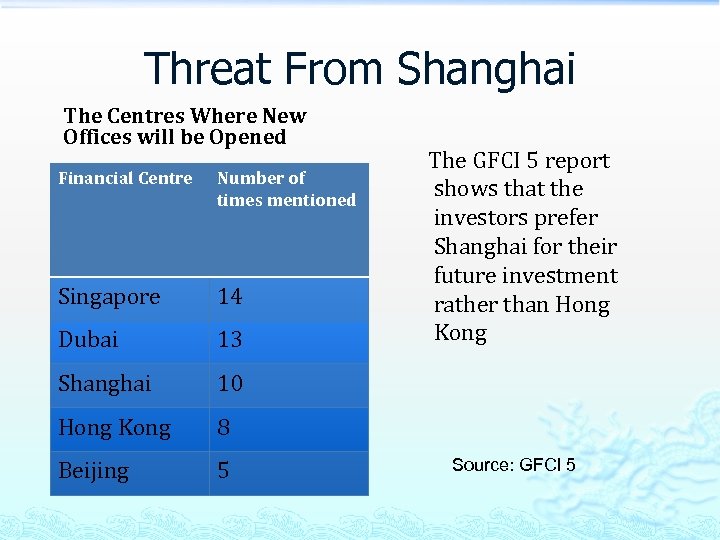
Threat From Shanghai The Centres Where New Offices will be Opened Financial Centre Number of times mentioned Singapore 14 Dubai 13 Shanghai 10 Hong Kong 8 Beijing 5 The GFCI 5 report shows that the investors prefer Shanghai for their future investment rather than Hong Kong Source: GFCI 5
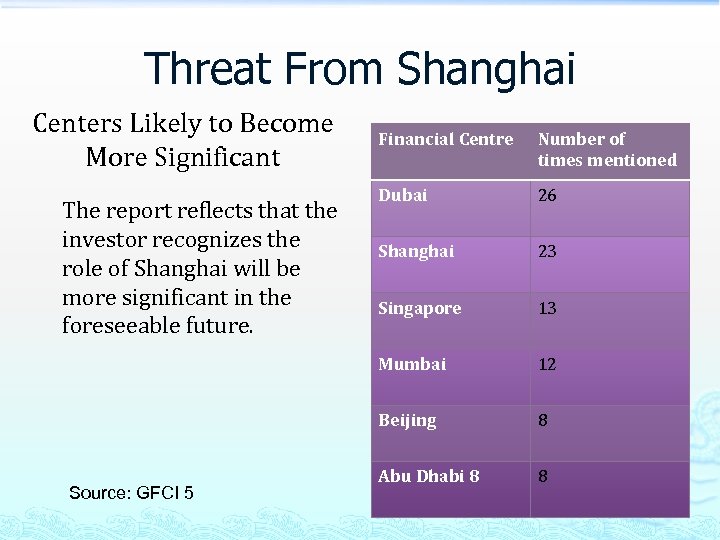
Threat From Shanghai Centers Likely to Become More Significant Dubai 26 Shanghai 23 Singapore 13 12 Beijing Source: GFCI 5 Number of times mentioned Mumbai The report reflects that the investor recognizes the role of Shanghai will be more significant in the foreseeable future. Financial Centre 8 Abu Dhabi 8 8
What should we do? Bond Market Development The bond market develops slowly. Up to July 2007, the total amount of corporate bond was up to USD 82 billion, while in 2002 that is USD 53. 3 billion. Hong Kong market can facilitate more China Enterprises to issue corporate bond.
What should we do? Insurance Industry Development “Hong Kong remains a strong financial centre and is in 3 rd or 4 th place in all industry sector sub-indices, except Insurance, and in all areas of competitiveness. ” Source: Comment from GFCI 5 report
What should we do? Improve the quality of the listing company Hong Kong should focus on the improvement of transparency for listing companies. Frequency of financial reports remains limited to annual and interims, whole reporting deadlines is well below international best practice.
What should we do? Diversify our industrial structure Hong Kong should diversify the industry, for example: Biological technology, education, tourism, logistics, as well as IT and other high-tech industries Now, Hong Kong focuses mainly on the tertiary industries, esp. financial industry
What should we do? Regulation of the financial institutions v “Lehman brother” event leads the public to lose confidence to the financial institutions. v Financial crisis shows that Hong Kong needs to strengthen the regulation framework for the financial institutions v It is wishful thinking that financial institutions can be self-regulated.
What should we do? Strengthen the co-operation to Guangdong Region Hong Kong needs to focus not only on the “hardware” co- operation with Guangdong Region only. Hong Kong lacks of co-operations in education, training, tourism, financial server etc with Guangdong Region
Can we co-operation? Before full convertibility of the RMB Hong Kong can be a “bridge” for the Chinese and foreign companies the wealth management centre Offshore RMB settlement centre Can be a “instructor” to the Shanghai for develop the financial centre.
Can we co-operation? After full convertibility of the RMB To separate the role, similar to New York and Chicago Shanghai can focus on the traditional business related to local enterprise and citizen, such as stock, bond and banking service.
Can we co-operation? After full convertibility of the RMB (cont’) Our international market experience can help Chinese company to develop their business into oversea market Hong Kong can focus on business related to financial innovation, derivative product, wealth management, foreign exchange The gateway for the South Asian investor to China market

~END~
Скачать презентацию Who will become a global financial center Shanghai
1917e5c3ad9f4c8dfb02521f344ac34c.ppt