 Скачать презентацию WHO UNICEF Technical Briefing Seminar on Essential Medicines Policies
7d7dbfda13c77482a5e70ebbb56cd2c0.ppt
- Количество слайдов: 24



WHO/UNICEF Technical Briefing Seminar on Essential Medicines Policies Geneva, 8 -12 October 2007 Atieno Ojoo, Technical Specialist, HIV/AIDs and malaria
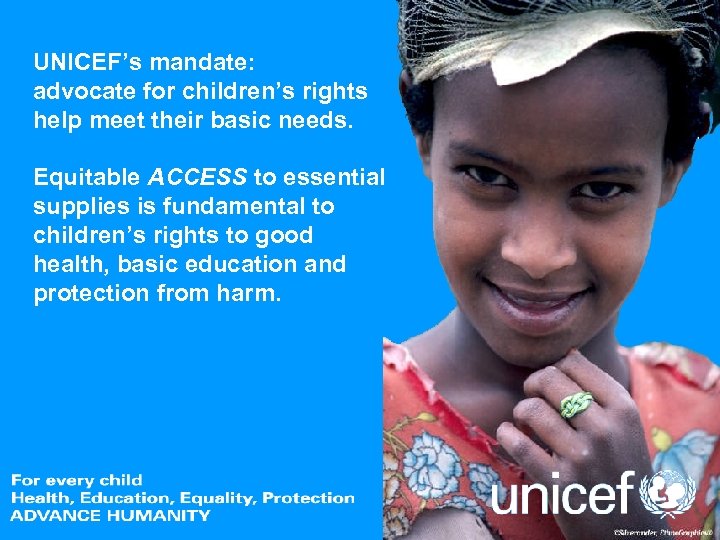
UNICEF’s mandate: advocate for children’s rights help meet their basic needs. Equitable ACCESS to essential supplies is fundamental to children’s rights to good health, basic education and protection from harm.
Presentation outline • Contextualize the access framework • Discuss Current Concerns • Outline how to bridge the need/access gap
The access framework • Access to essential Medicines is a Human right (Alma Ata 1978, MDG) – Rational Selection – Standards for medicine quality – Affordable prices – Sustainable financing – Reliable supply systems – Geographical access
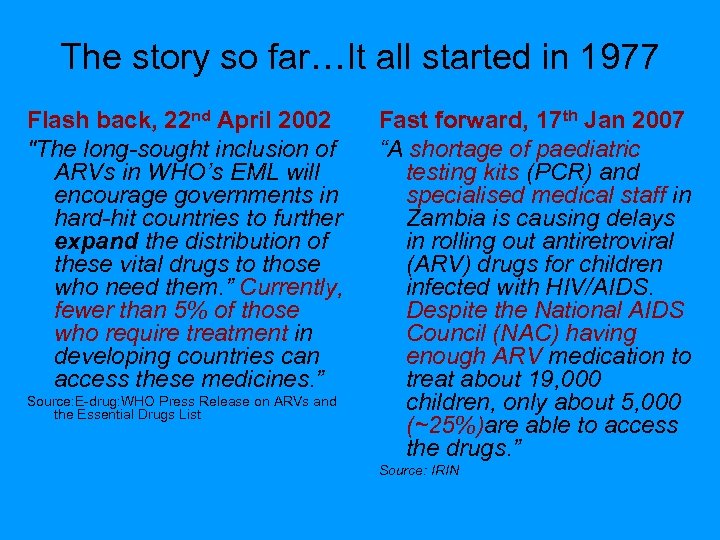
The story so far…It all started in 1977 Flash back, 22 nd April 2002 "The long-sought inclusion of ARVs in WHO’s EML will encourage governments in hard-hit countries to further expand the distribution of these vital drugs to those who need them. ” Currently, fewer than 5% of those who require treatment in developing countries can access these medicines. ” Source: E-drug: WHO Press Release on ARVs and the Essential Drugs List Fast forward, 17 th Jan 2007 “A shortage of paediatric testing kits (PCR) and specialised medical staff in Zambia is causing delays in rolling out antiretroviral (ARV) drugs for children infected with HIV/AIDS. Despite the National AIDS Council (NAC) having enough ARV medication to treat about 19, 000 children, only about 5, 000 (~25%)are able to access the drugs. ” Source: IRIN
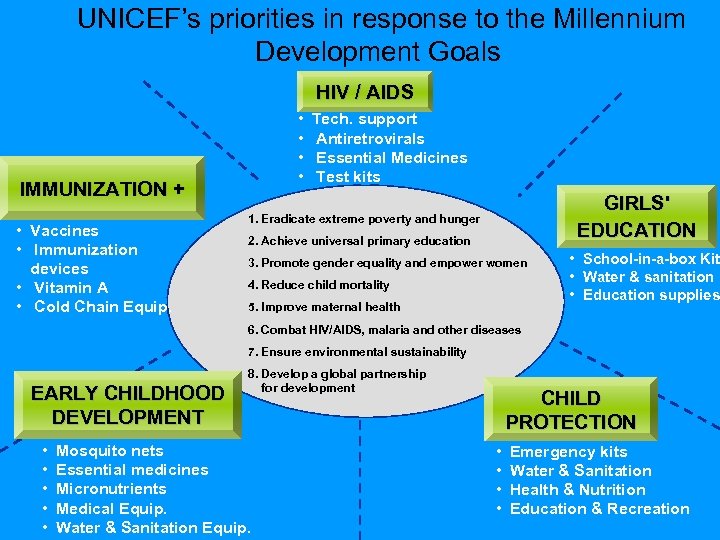
UNICEF’s priorities in response to the Millennium Development Goals HIV / AIDS • • IMMUNIZATION + • Vaccines • Immunization devices • Vitamin A • Cold Chain Equip. Tech. support Antiretrovirals Essential Medicines Test kits GIRLS' EDUCATION 1. Eradicate extreme poverty and hunger 2. Achieve universal primary education 3. Promote gender equality and empower women 4. Reduce child mortality 5. Improve maternal health • School-in-a-box Kit • Water & sanitation • Education supplies 6. Combat HIV/AIDS, malaria and other diseases 7. Ensure environmental sustainability EARLY CHILDHOOD DEVELOPMENT • • • 8. Develop a global partnership for development Mosquito nets Essential medicines Micronutrients Medical Equip. Water & Sanitation Equip. CHILD PROTECTION • • Emergency kits Water & Sanitation Health & Nutrition Education & Recreation
Current concerns
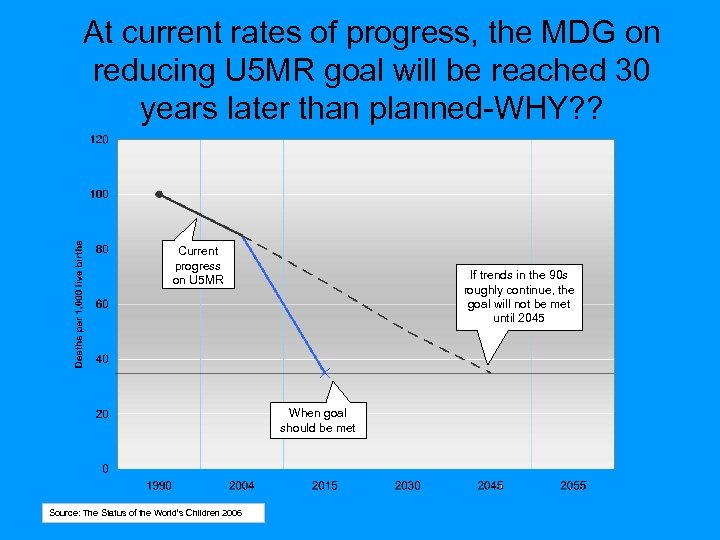
At current rates of progress, the MDG on reducing U 5 MR goal will be reached 30 years later than planned-WHY? ? Current progress on U 5 MR If trends in the 90 s roughly continue, the goal will not be met until 2045 When goal should be met Source: The Status of the World’s Children 2006
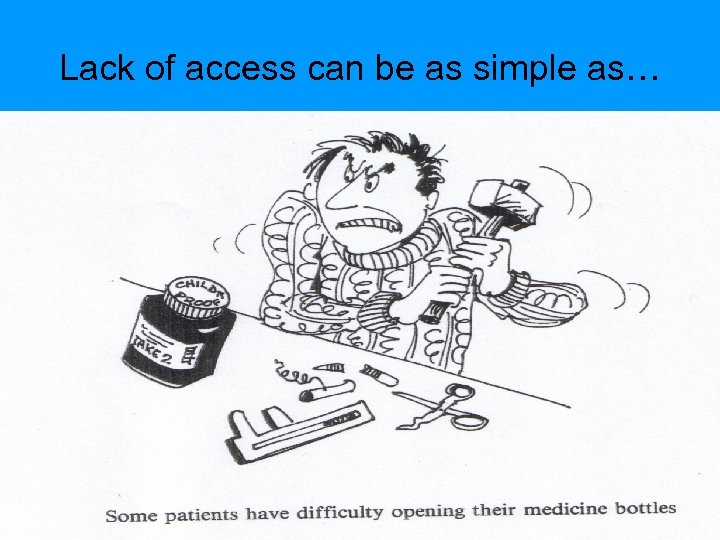
Lack of access can be as simple as…
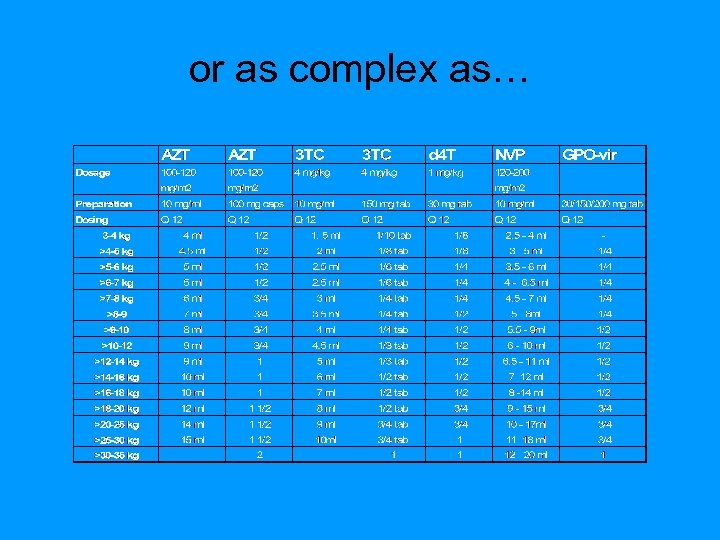
or as complex as…
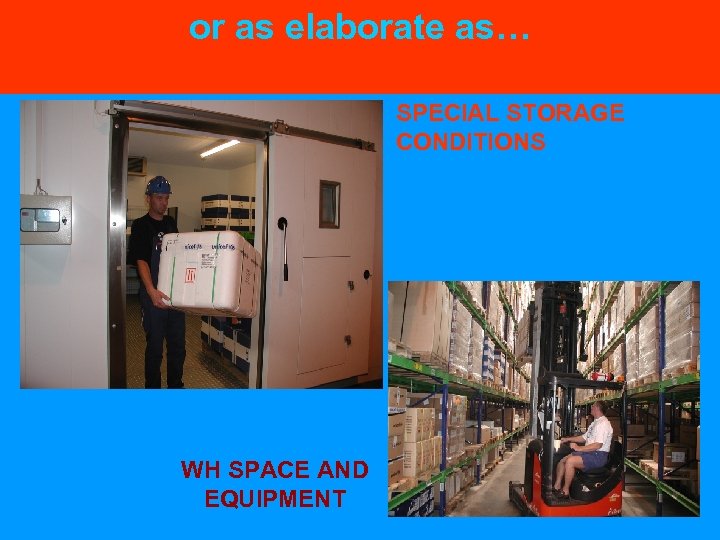
or as elaborate as… SPECIAL STORAGE CONDITIONS WH SPACE AND EQUIPMENT
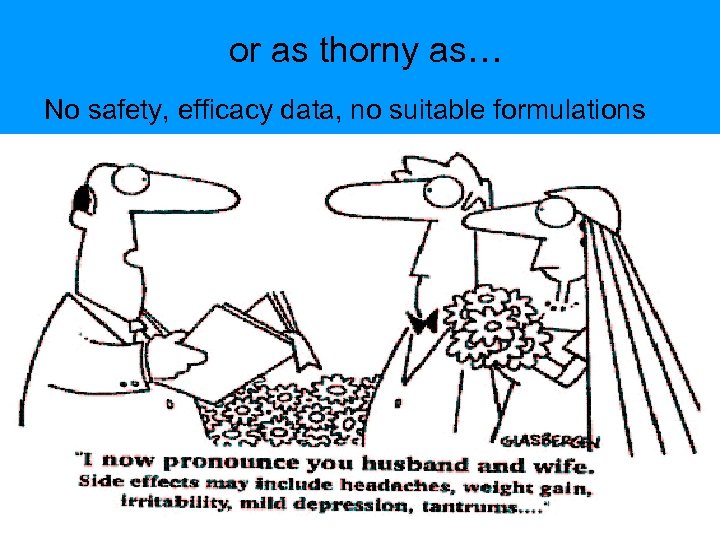
or as thorny as… No safety, efficacy data, no suitable formulations
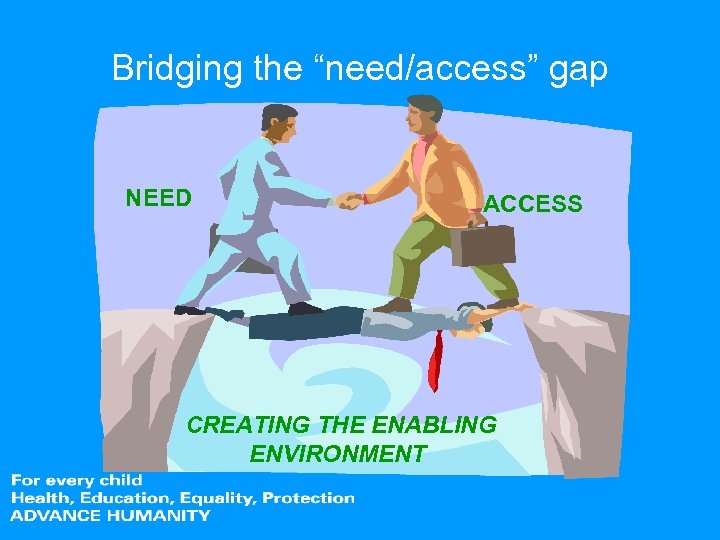
Bridging the “need/access” gap NEED ACCESS CREATING THE ENABLING ENVIRONMENT
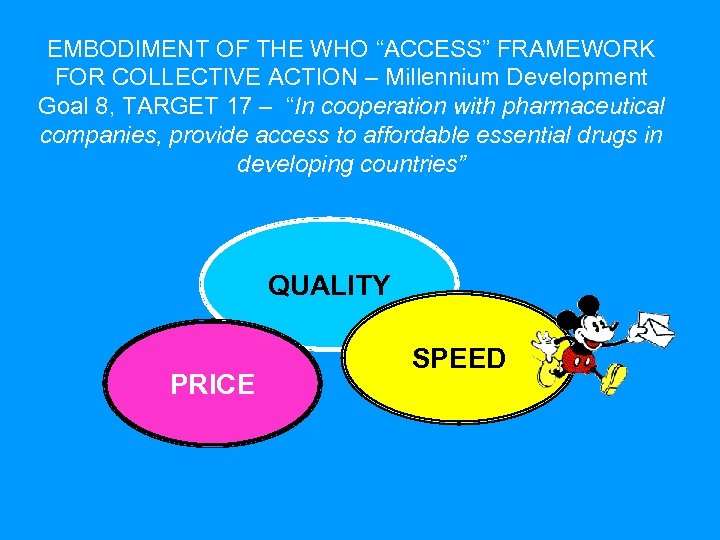
EMBODIMENT OF THE WHO “ACCESS” FRAMEWORK FOR COLLECTIVE ACTION – Millennium Development Goal 8, TARGET 17 – “In cooperation with pharmaceutical companies, provide access to affordable essential drugs in developing countries” QUALITY PRICE SPEED
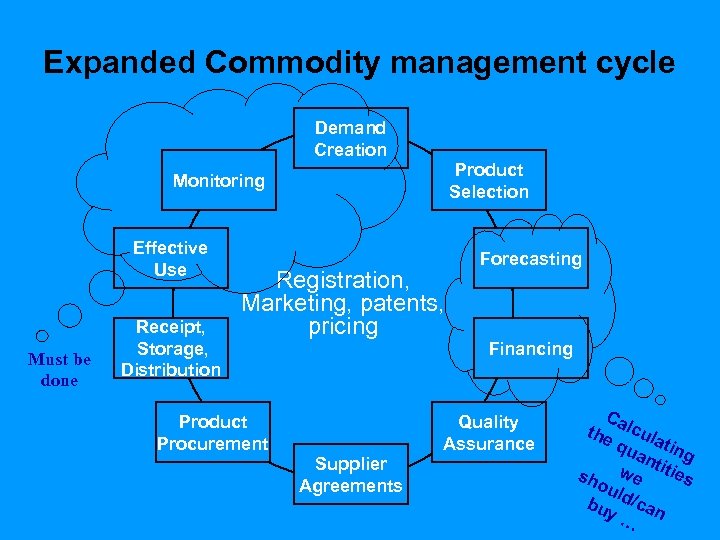
Expanded Commodity management cycle Demand Creation Product Selection Monitoring Effective Use Must be done Receipt, Storage, Distribution Registration, Marketing, patents, pricing Product Procurement Forecasting Financing Quality Assurance Supplier Agreements Ca the lcula t qu an ing t sh we ities ou l bu d/can y…
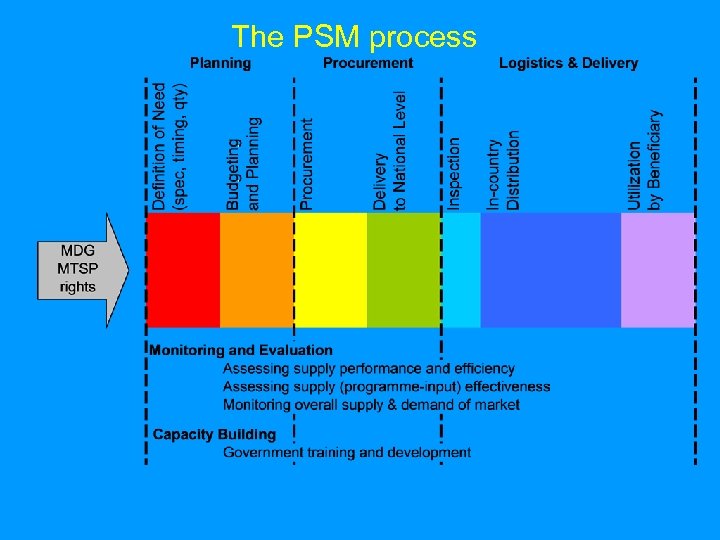
The PSM process
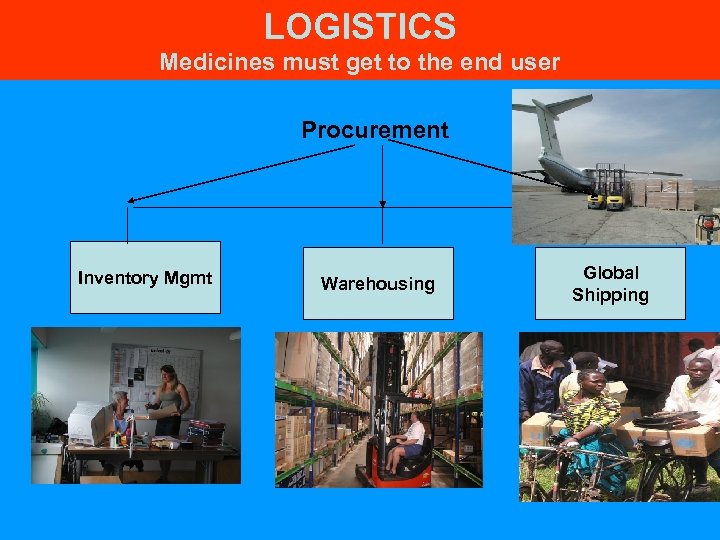
LOGISTICS Medicines must get to the end user Procurement Inventory Mgmt Warehousing Global Shipping
Importance of inventory management The recent Viracept (Nelfinavir) recall • Good points – Ability to track batch records to in country & programme delivery points – Providing options for Rx change • Challenges – Not able to track product up to patient level – Re-export for destruction-countries without ability to safely destroy pharmaceuticals – Weak Pharmacovigilance mechanisms
Conclusion • Access to medicines is part of an intervention : Always understand the big picture • PSM requires systematic/co-ordinated organisation: Define system in detail, assign responsibilities and accountabilities, routinely monitor • Financing is critical: Secure & manage funds effectively, efficiently. Remember administrative costs • Human resource capacity: Recruit, motivate, train competent and trustworthy personnel • Principles: Follow tried and tested good practices
Conclusion contd • Legislative, regulatory and commercial context: understand ensure full compliance in advance. • Supplier integrity: pre-qualify suppliers, manage tender process transparently, monitor performance. • Product and process quality: monitor and evaluate and take action. • Information system: maintain information integrity and flow for action.
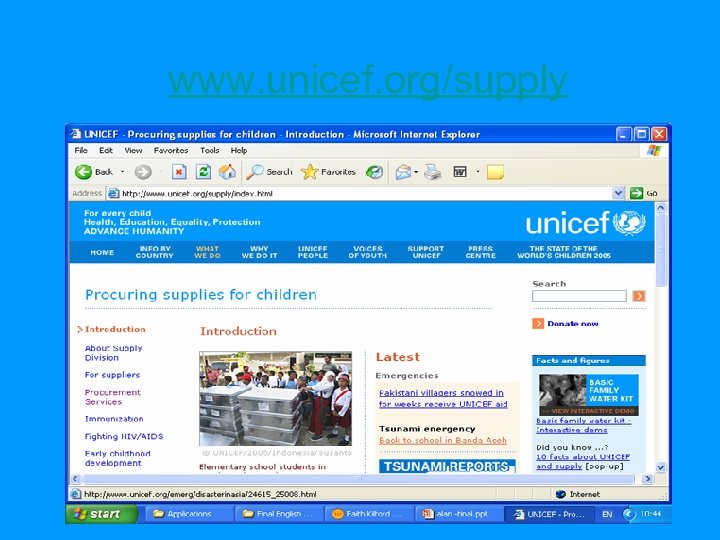
www. unicef. org/supply
THANK YOU aojoo@unicef. org, tel: +45 35 27 31 03
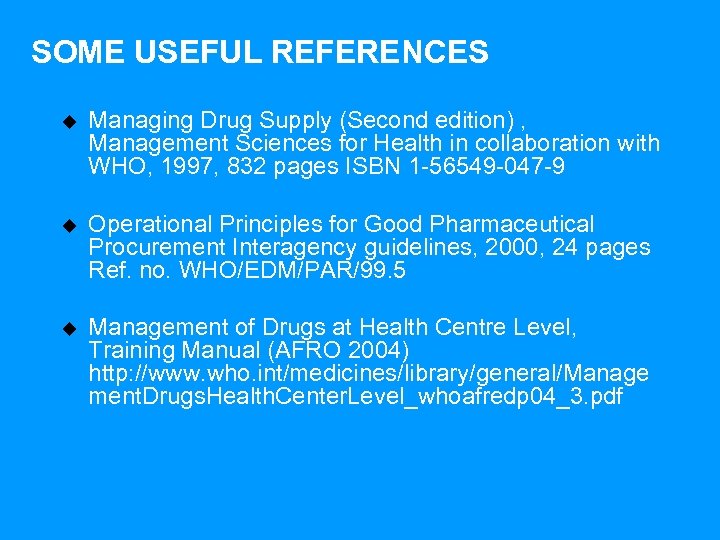
SOME USEFUL REFERENCES u Managing Drug Supply (Second edition) , Management Sciences for Health in collaboration with WHO, 1997, 832 pages ISBN 1 -56549 -047 -9 u Operational Principles for Good Pharmaceutical Procurement Interagency guidelines, 2000, 24 pages Ref. no. WHO/EDM/PAR/99. 5 u Management of Drugs at Health Centre Level, Training Manual (AFRO 2004) http: //www. who. int/medicines/library/general/Manage ment. Drugs. Health. Center. Level_whoafredp 04_3. pdf
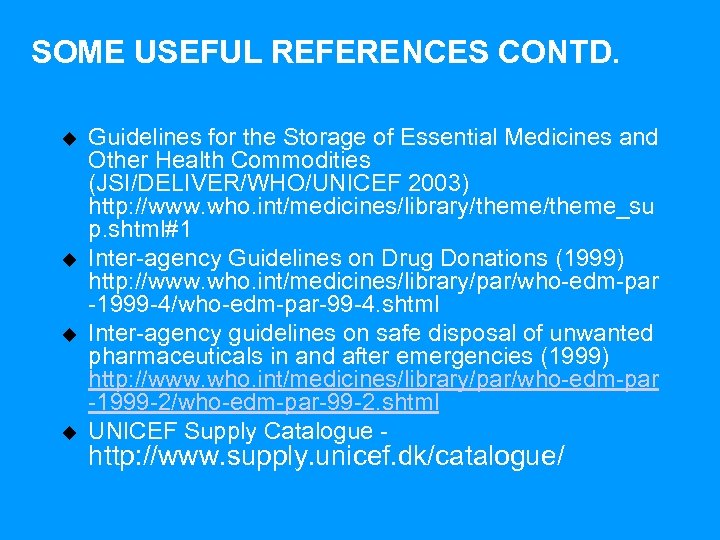
SOME USEFUL REFERENCES CONTD. u u Guidelines for the Storage of Essential Medicines and Other Health Commodities (JSI/DELIVER/WHO/UNICEF 2003) http: //www. who. int/medicines/library/theme_su p. shtml#1 Inter-agency Guidelines on Drug Donations (1999) http: //www. who. int/medicines/library/par/who-edm-par -1999 -4/who-edm-par-99 -4. shtml Inter-agency guidelines on safe disposal of unwanted pharmaceuticals in and after emergencies (1999) http: //www. who. int/medicines/library/par/who-edm-par -1999 -2/who-edm-par-99 -2. shtml UNICEF Supply Catalogue - http: //www. supply. unicef. dk/catalogue/
Скачать презентацию WHO UNICEF Technical Briefing Seminar on Essential Medicines Policies
7d7dbfda13c77482a5e70ebbb56cd2c0.ppt