


 Скачать презентацию WHO-FIC Education Committee WHO-FIC IFHRO Joint Committee
a2396b47a0aeee482eda282315a30034.ppt
- Количество слайдов: 39
 WHO-FIC Education Committee WHO-FIC – IFHRO Joint Committee Alexandria, Virginia May 4 -6, 2006 A training package on certification of causes of death for European professionals Monica Pace ISTAT - Italian National Institute of Statistics, Central Directorate on Social Statistics - “Management of Health Classifications” Unit mopace@istat. it
 The Project “Development of an EU training package on certification of causes of death” v Financed in the framework of the European Statistical 2003 -2007 Programme v Leader Institution: Istat (Italian National Institute of Statistics) v Duration: 18 months (Dec 2002 – June 2004) v Involved countries: all EU 15 Member States, EEA/EFTA (European Economic Area / European Free Trade Association) countries and CEEC (Central and. Eastern Countries: Europe Candidate Countries and Western Balkan Countries or CARDS Countries) for a total of 40 countries/regions. v The training package has been adopted by the “Eurostat Technical Meeting on causes of death (Co. D) statistics” in October 2004. v. The “Eurostat Working Group on Public Health Statistics” has expressed its support to the implementation and use of the EU training package. v Member States should now take action for national adaptation, translation and use of the tool.
 Project Aims v To provide a common training background for European physicians in the completion of the medical part of death certificate v To address to Co. D certifying professionals and students, by recognizing their central role in the mortality data production v To comply with the WHO guidelines and EUROSTAT Co. D task force recommendations. v To develop a strong interaction with all the participating countries on the products’ structure and contents v To develop generalized products requiring subsequent national adaptations by each country to own certificate’ format, certification practices and laws.
 Project outputs v Technical report (English) v Manual (English and French) v Web-based e-learning tool (English) v Leaflet (English and French)
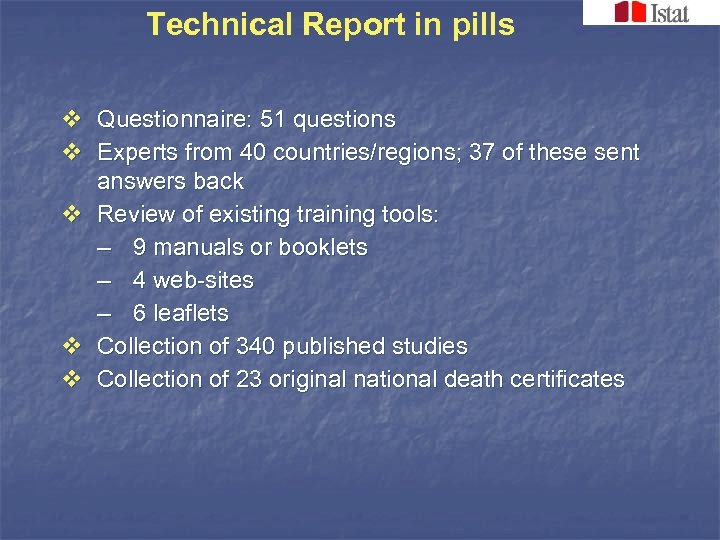 Technical Report in pills v Questionnaire: 51 questions v Experts from 40 countries/regions; 37 of these sent answers back v Review of existing training tools: – 9 manuals or booklets – 4 web-sites – 6 leaflets v Collection of 340 published studies v Collection of 23 original national death certificates
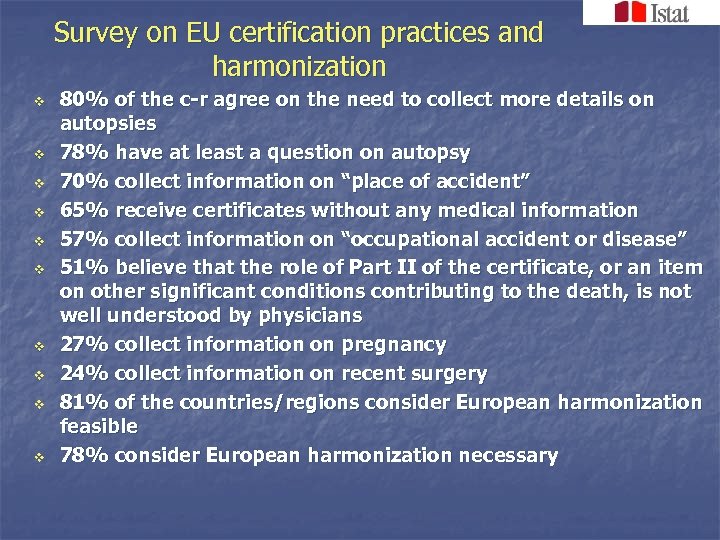 Survey on EU certification practices and harmonization v v v v v 80% of the c-r agree on the need to collect more details on autopsies 78% have at least a question on autopsy 70% collect information on “place of accident” 65% receive certificates without any medical information 57% collect information on “occupational accident or disease” 51% believe that the role of Part II of the certificate, or an item on other significant conditions contributing to the death, is not well understood by physicians 27% collect information on pregnancy 24% collect information on recent surgery 81% of the countries/regions consider European harmonization feasible 78% consider European harmonization necessary
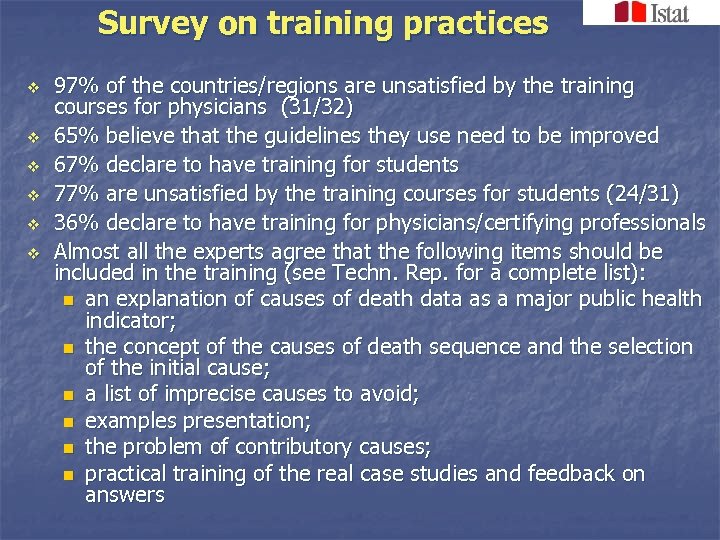 Survey on training practices v v v 97% of the countries/regions are unsatisfied by the training courses for physicians (31/32) 65% believe that the guidelines they use need to be improved 67% declare to have training for students 77% are unsatisfied by the training courses for students (24/31) 36% declare to have training for physicians/certifying professionals Almost all the experts agree that the following items should be included in the training (see Techn. Rep. for a complete list): n an explanation of causes of death data as a major public health indicator; n the concept of the causes of death sequence and the selection of the initial cause; n a list of imprecise causes to avoid; n examples presentation; n the problem of contributory causes; n practical training of the real case studies and feedback on answers
 MANUAL contact person at Eurostat: Sabine. GAGEL@cec. eu. int
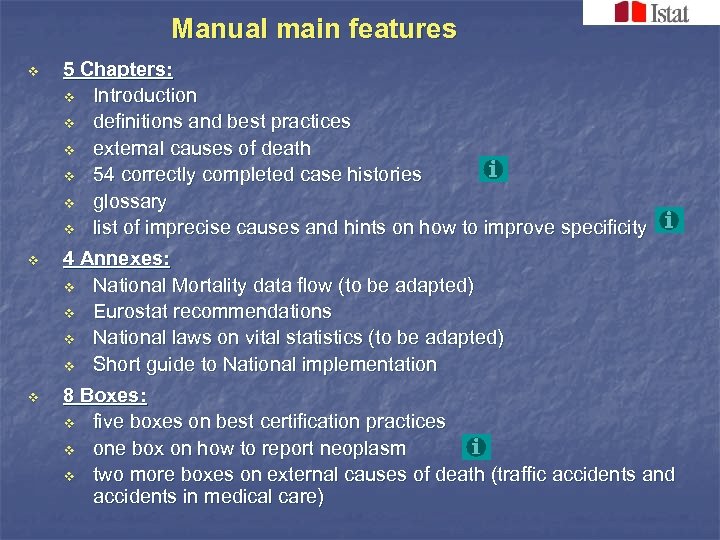 Manual main features v 5 Chapters: v Introduction v definitions and best practices v external causes of death v 54 correctly completed case histories v glossary v list of imprecise causes and hints on how to improve specificity v 4 Annexes: v National Mortality data flow (to be adapted) v Eurostat recommendations v National laws on vital statistics (to be adapted) v Short guide to National implementation v 8 Boxes: v five boxes on best certification practices v one box on how to report neoplasm v two more boxes on external causes of death (traffic accidents and accidents in medical care)
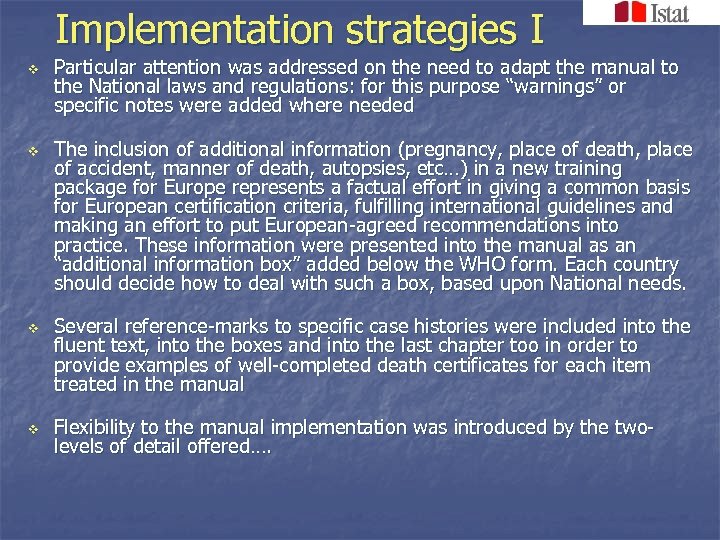 Implementation strategies I v v Particular attention was addressed on the need to adapt the manual to the National laws and regulations: for this purpose “warnings” or specific notes were added where needed The inclusion of additional information (pregnancy, place of death, place of accident, manner of death, autopsies, etc…) in a new training package for Europe represents a factual effort in giving a common basis for European certification criteria, fulfilling international guidelines and making an effort to put European-agreed recommendations into practice. These information were presented into the manual as an “additional information box” added below the WHO form. Each country should decide how to deal with such a box, based upon National needs. Several reference-marks to specific case histories were included into the fluent text, into the boxes and into the last chapter too in order to provide examples of well-completed death certificates for each item treated in the manual Flexibility to the manual implementation was introduced by the twolevels of detail offered….
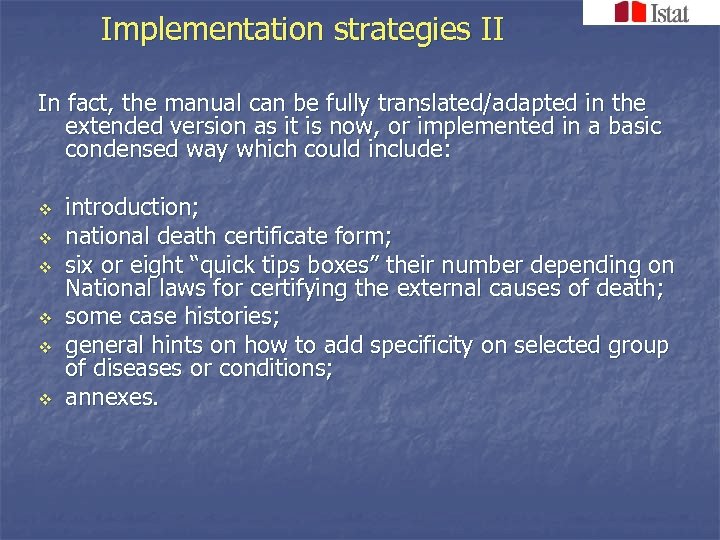 Implementation strategies II In fact, the manual can be fully translated/adapted in the extended version as it is now, or implemented in a basic condensed way which could include: v v v introduction; national death certificate form; six or eight “quick tips boxes” their number depending on National laws for certifying the external causes of death; some case histories; general hints on how to add specificity on selected group of diseases or conditions; annexes.
 WEB-BASED E-LEARNING TOOL contact person at Eurostat: Sabine. GAGEL@cec. eu. int
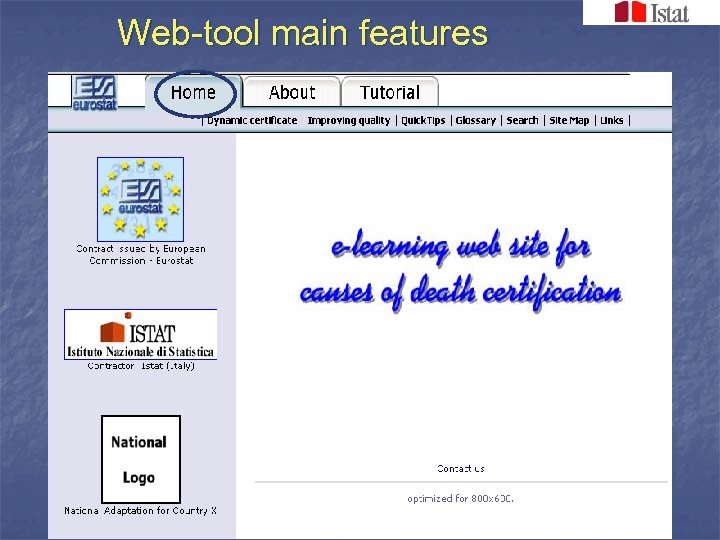
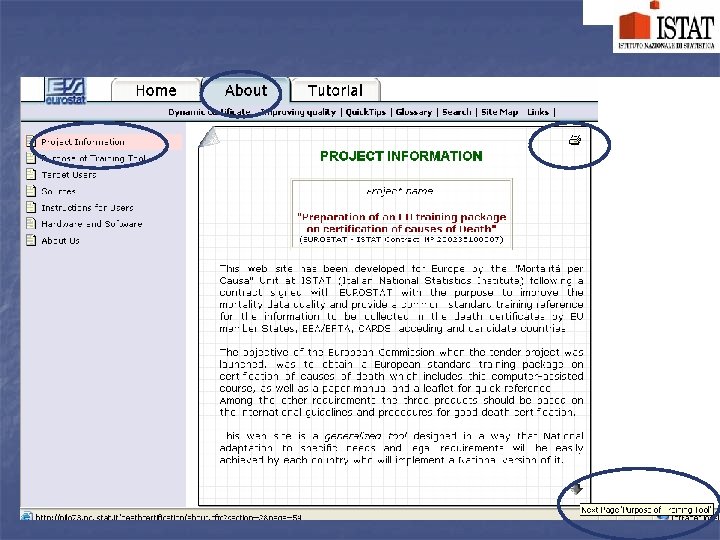
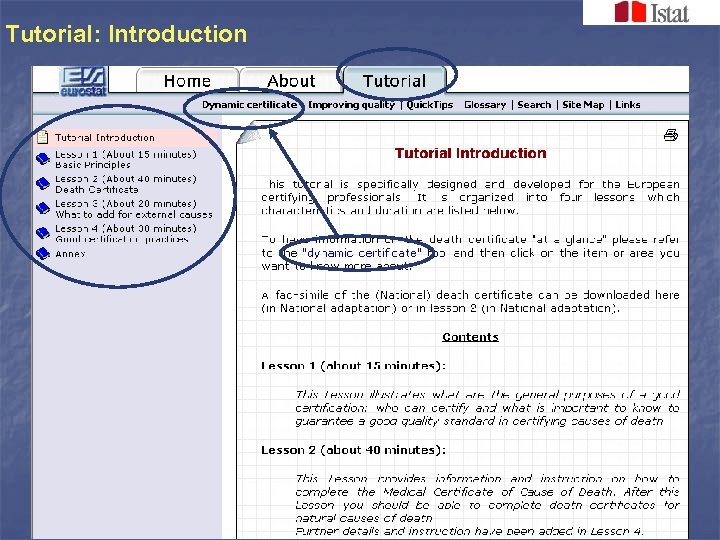
 Some Web-based tool specific aspects v v v Specific attention was devoted to e-learning aspects to organize the didactic pathways and some navigation options A balance between interactivity and usability was sought in order to provide a product using the web potentiality, but not excluding non-expert users The web-tool contents definition implied: n an adaptation of what was already developed for the manual, n the definition of new specifically developed funtionality; this is particularly true for the exercises (tests and case histories). Particular attention was given to the companion documentation (guides and helps) fully integrated into the web site, in order to facilitate the use and spreading of this product; A high level of parameterization was introduced in the product: the result is in our opinion a truly “generalized” product that allow easy national adaptations. Multiple evaluations of the web-tool were performed by about 50 different European professionals including physicians, medical schools professors, IT engineers, IT programmers, e-learning experts, statisticians, nosologists, represented by SB members, experts from Italy, England, Norway, Sweden; try-out responders; EUROSTAT experts.
 Web-tool main features
 Tutorial: Introduction
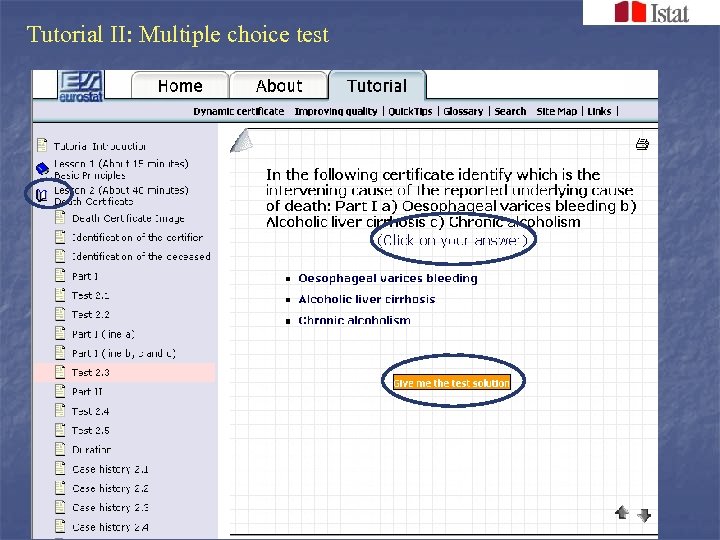 Tutorial II: Multiple choice test
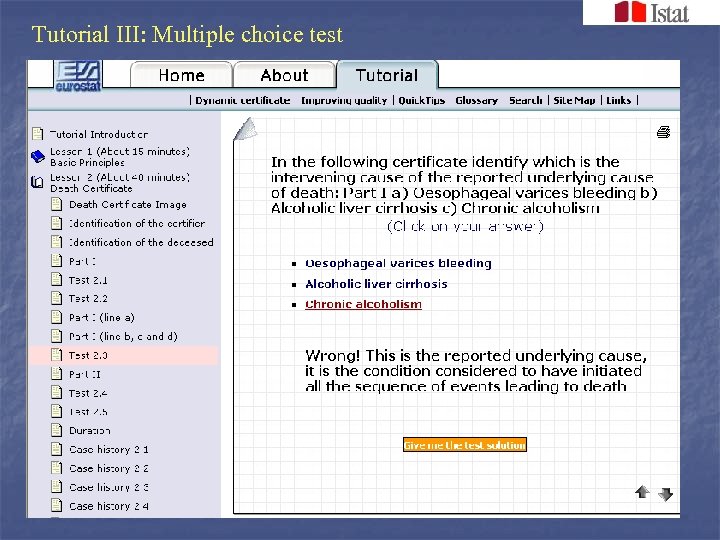 Tutorial III: Multiple choice test
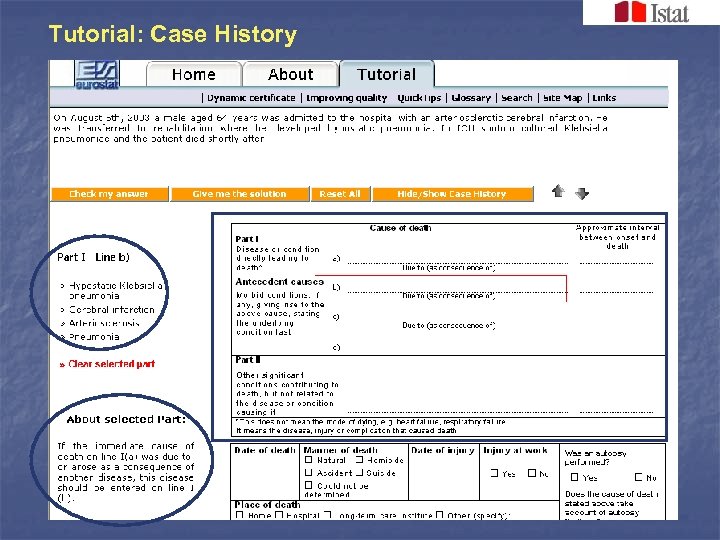 Tutorial: Case History
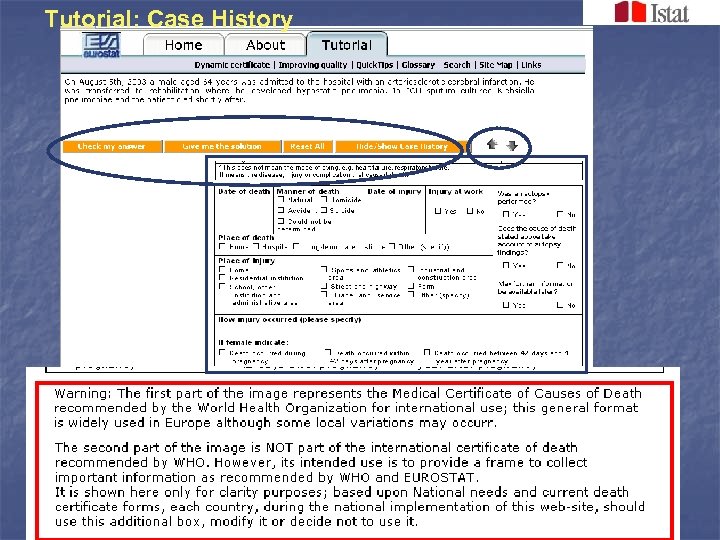 Tutorial: Case History
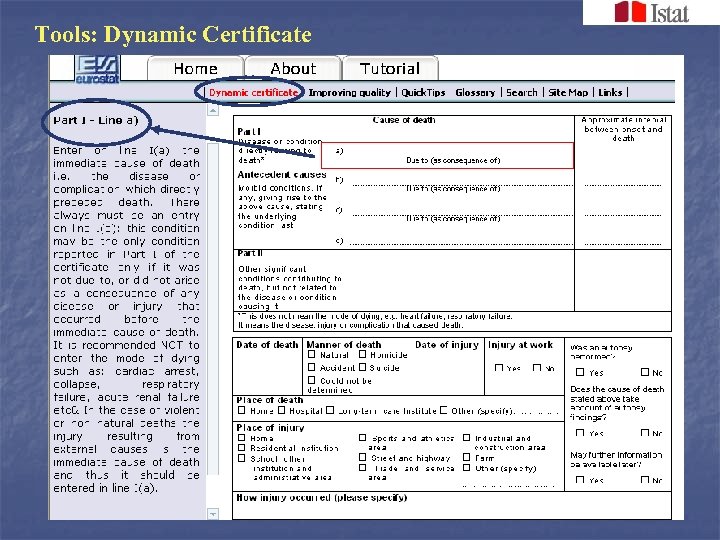 Tools: Dynamic Certificate
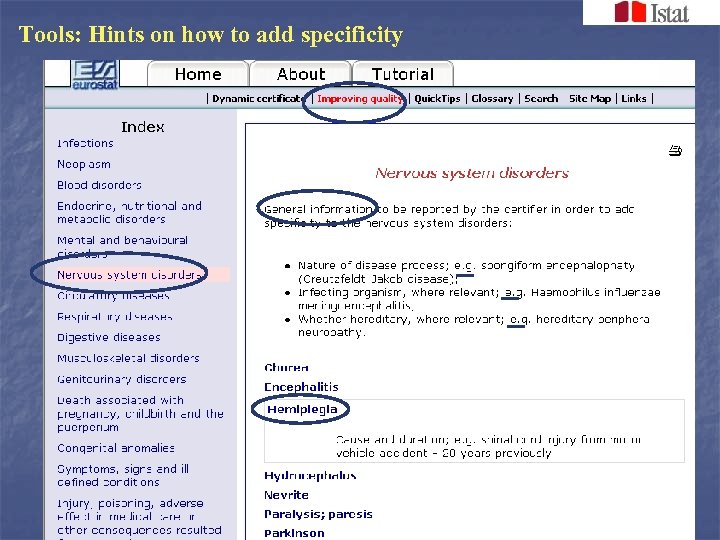 Tools: Hints on how to add specificity
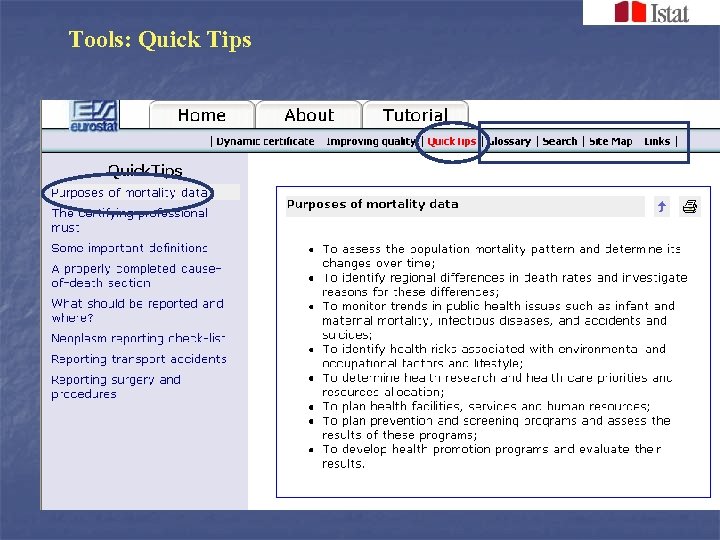 Tools: Quick Tips
 WEB-BASED E-LEARNING TOOL - ADMINISTRATION – contact person at Eurostat: Sabine. GAGEL@cec. eu. int
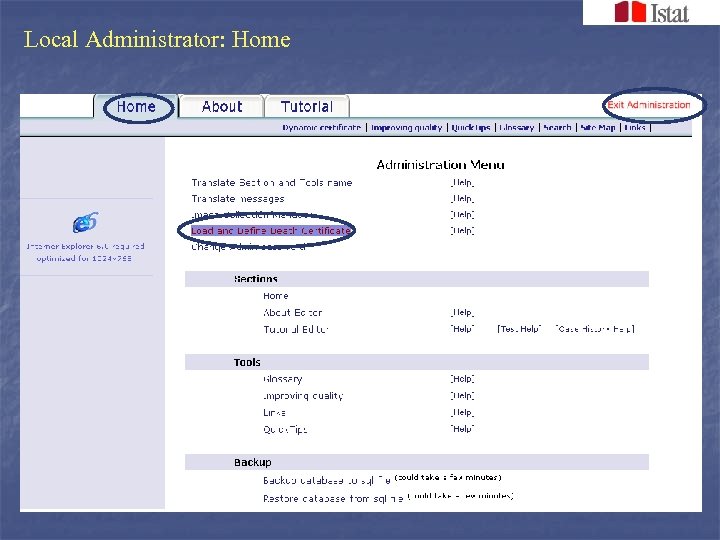 Local Administrator: Home
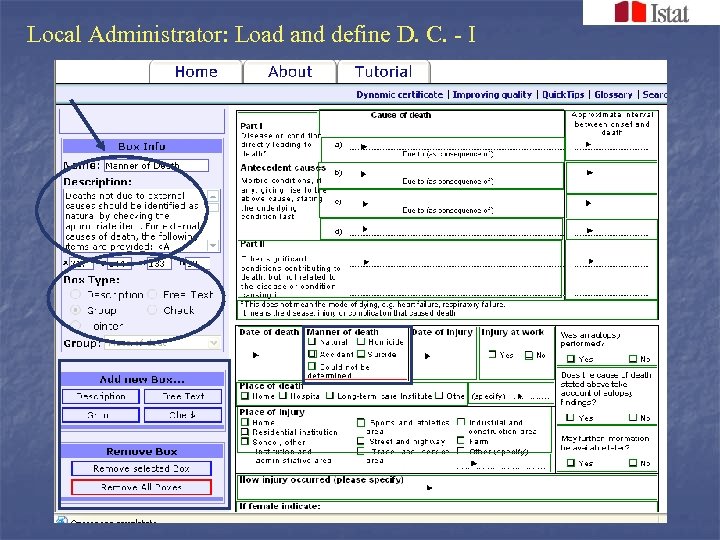 Local Administrator: Load and define D. C. - I
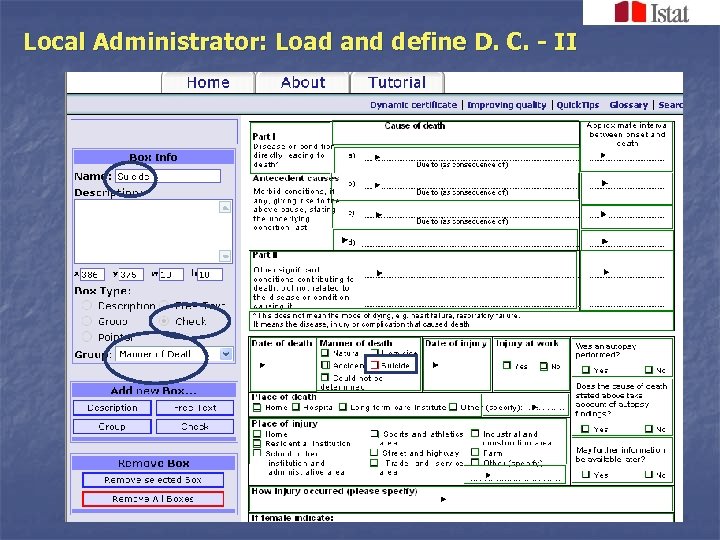 Local Administrator: Load and define D. C. - II
 LEAFLET contact person at Eurostat: Sabine. GAGEL@cec. eu. int
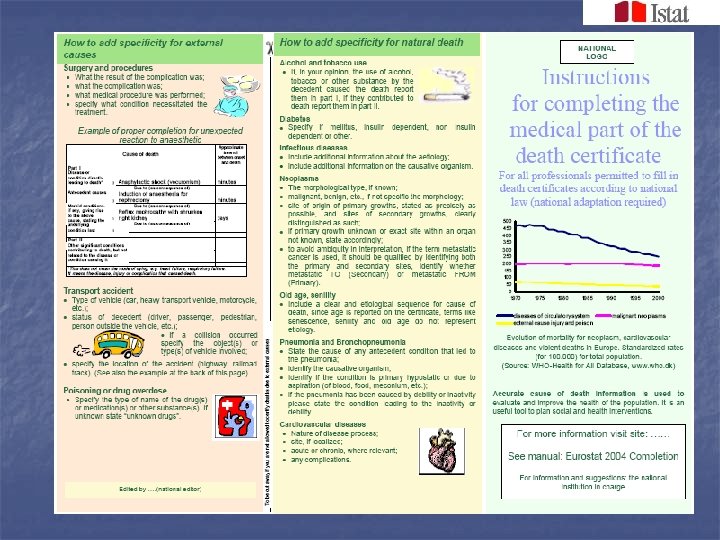
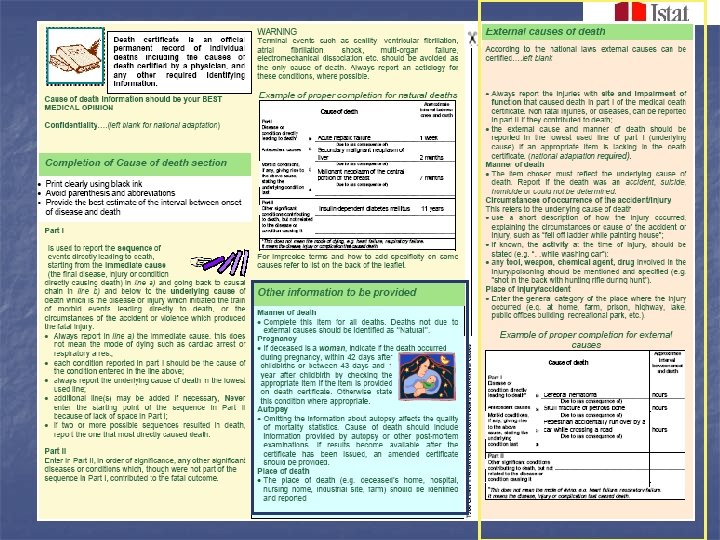
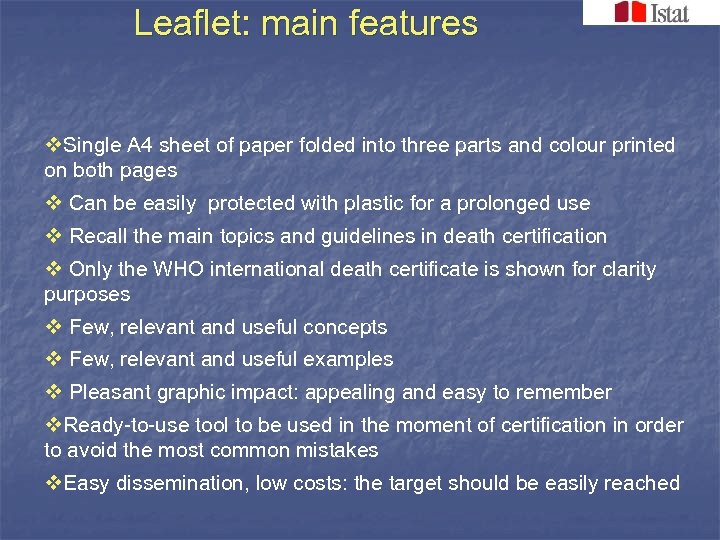 Leaflet: main features v. Single A 4 sheet of paper folded into three parts and colour printed on both pages v Can be easily protected with plastic for a prolonged use v Recall the main topics and guidelines in death certification v Only the WHO international death certificate is shown for clarity purposes v Few, relevant and useful concepts v Few, relevant and useful examples v Pleasant graphic impact: appealing and easy to remember v. Ready-to-use tool to be used in the moment of certification in order to avoid the most common mistakes v. Easy dissemination, low costs: the target should be easily reached
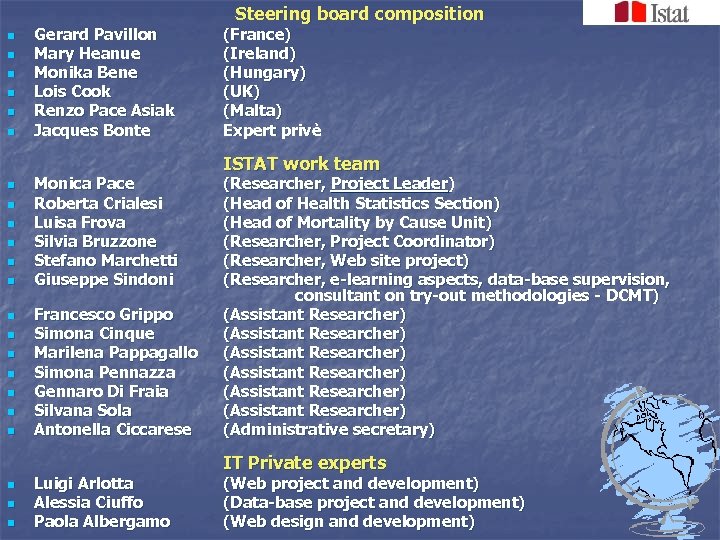 n n n n n n Gerard Pavillon Mary Heanue Monika Bene Lois Cook Renzo Pace Asiak Jacques Bonte Monica Pace Roberta Crialesi Luisa Frova Silvia Bruzzone Stefano Marchetti Giuseppe Sindoni Francesco Grippo Simona Cinque Marilena Pappagallo Simona Pennazza Gennaro Di Fraia Silvana Sola Antonella Ciccarese Luigi Arlotta Alessia Ciuffo Paola Albergamo Steering board composition (France) (Ireland) (Hungary) (UK) (Malta) Expert privè ISTAT work team (Researcher, Project Leader) (Head of Health Statistics Section) (Head of Mortality by Cause Unit) (Researcher, Project Coordinator) (Researcher, Web site project) (Researcher, e-learning aspects, data-base supervision, consultant on try-out methodologies - DCMT) (Assistant Researcher) (Assistant Researcher) (Administrative secretary) IT Private experts (Web project and development) (Data-base project and development) (Web design and development)
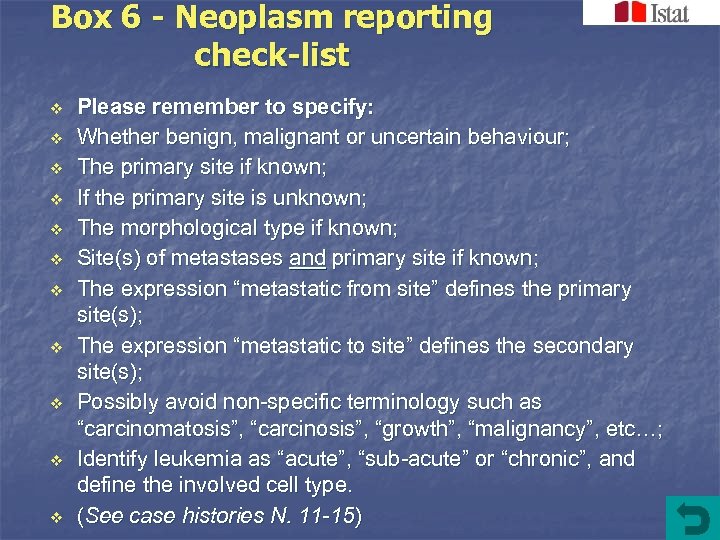 Box 6 - Neoplasm reporting check-list v v v Please remember to specify: Whether benign, malignant or uncertain behaviour; The primary site if known; If the primary site is unknown; The morphological type if known; Site(s) of metastases and primary site if known; The expression “metastatic from site” defines the primary site(s); The expression “metastatic to site” defines the secondary site(s); Possibly avoid non-specific terminology such as “carcinomatosis”, “carcinosis”, “growth”, “malignancy”, etc…; Identify leukemia as “acute”, “sub-acute” or “chronic”, and define the involved cell type. (See case histories N. 11 -15)
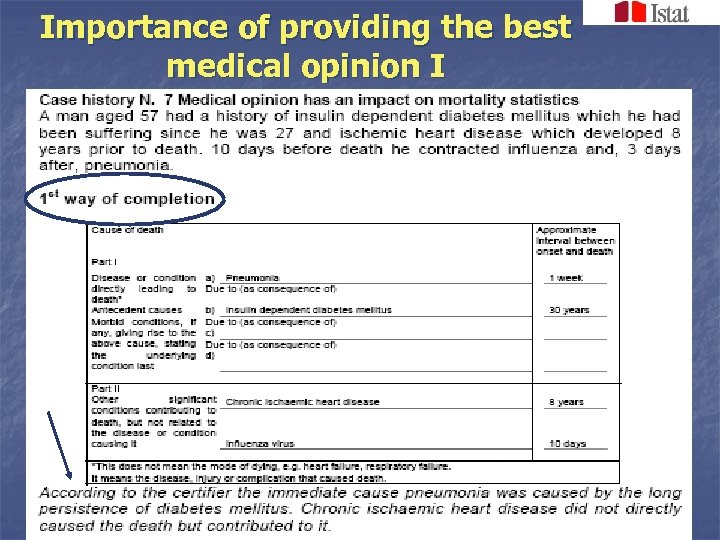 Importance of providing the best medical opinion I
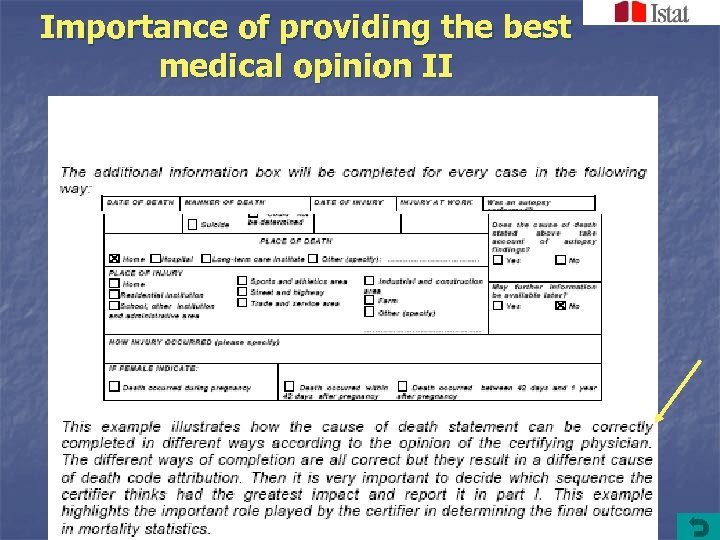 Importance of providing the best medical opinion II
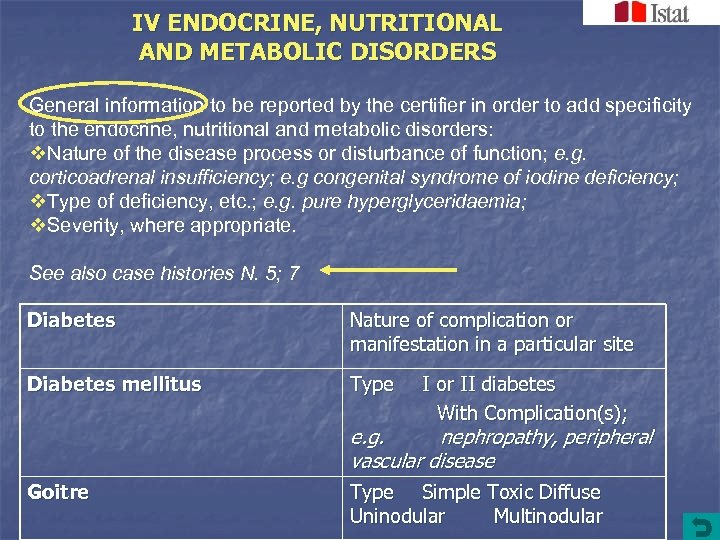 IV ENDOCRINE, NUTRITIONAL AND METABOLIC DISORDERS General information to be reported by the certifier in order to add specificity to the endocrine, nutritional and metabolic disorders: v. Nature of the disease process or disturbance of function; e. g. corticoadrenal insufficiency; e. g congenital syndrome of iodine deficiency; v. Type of deficiency, etc. ; e. g. pure hyperglyceridaemia; v. Severity, where appropriate. See also case histories N. 5; 7 Diabetes Nature of complication or manifestation in a particular site Diabetes mellitus Type I or II diabetes With Complication(s); e. g. nephropathy, peripheral vascular disease Goitre Type Simple Toxic Diffuse Uninodular Multinodular
 Conclusions v v v This project represents a real effort in the improvement of quality and comparability of mortality statistics in Europe The intent has been to provide a common set of existing rules on certification of causes of death in the respect of International guidelines and of National practices and laws as well Management of the web-tool is a crucial point that could be done at three different levels: on the EUROSTAT server for all countries, on a different central server for all countries, or on each interested country server. The decision on this aspect deserves particular attention for its consequences in terms of technical management as well as in terms of economic resources to be allocated for each solution by different European or National Institutions
 Future perspectives I v v Dissemination and sensitization of the European countries to adopt the developed products is a critical point now because such a work deserves to be implemented and used to be effective (EUROSTAT recommendations 30 -32) Collaboration with WHO should be sought and specific campaigns should be done to reach this goal in the next few years (EUROSTAT recomm. 33 -36) A system to keep the collected information updated for all European countries should be organized, and some suggestions came from this project (EUROSTAT recommendation 21) One of the most interesting and promising results of this project is the possibility to load a national death certificate instead of limiting the training to the “neutral” international death certificate form. Such a new approach opens new possibilities in the effectiveness of training on certification of causes of death, and most important, offers a first experimental use of IT technology in Europe to train certifiers to complete an electronic image of their National certificate. This innovation could represents the first step towards the electronic death certificate (EUROSTAT recommendation 22)
 Future perspectives II v v The use of the WHO international death certificate form and the definition and future use of agreed additional information (EUROSTAT recommendations 15 -20) may represent a first step towards the European Death Certificate The infant mortality certification issue still remain to be defined and future efforts should be done in this direction both on the definition of a common informative basis (for certificate format, age of reference, etc. . . ) as well as on the certification practices (EUROSTAT recommendations 11 -14).