 Скачать презентацию Who are the Value and Growth Investors Sebastien
0d47c416bfacb26df3f3009fe9f9193c.ppt
- Количество слайдов: 10



Who are the Value and Growth Investors? Sebastien Betermier, Laurent E. Calvet, and Paolo Sodini Discussion by Frank de Jong Tilburg University 9 th Financial Risks Forum, 21 -22 March 2016 1
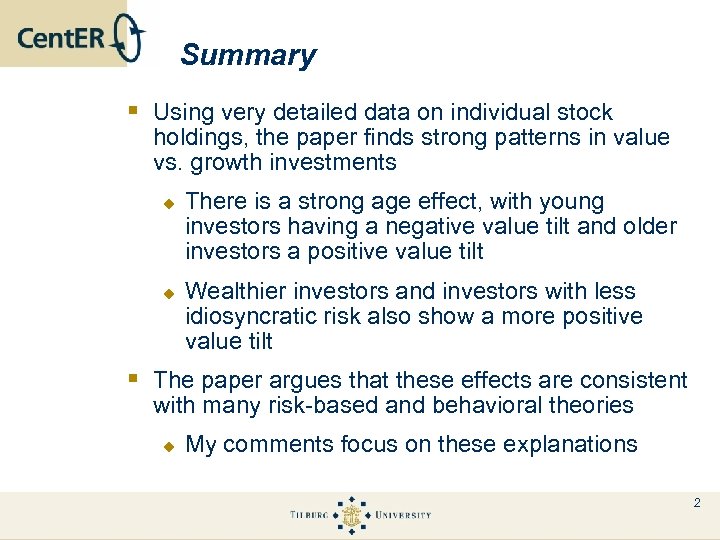
Summary § Using very detailed data on individual stock holdings, the paper finds strong patterns in value vs. growth investments u u There is a strong age effect, with young investors having a negative value tilt and older investors a positive value tilt Wealthier investors and investors with less idiosyncratic risk also show a more positive value tilt § The paper argues that these effects are consistent with many risk-based and behavioral theories u My comments focus on these explanations 2
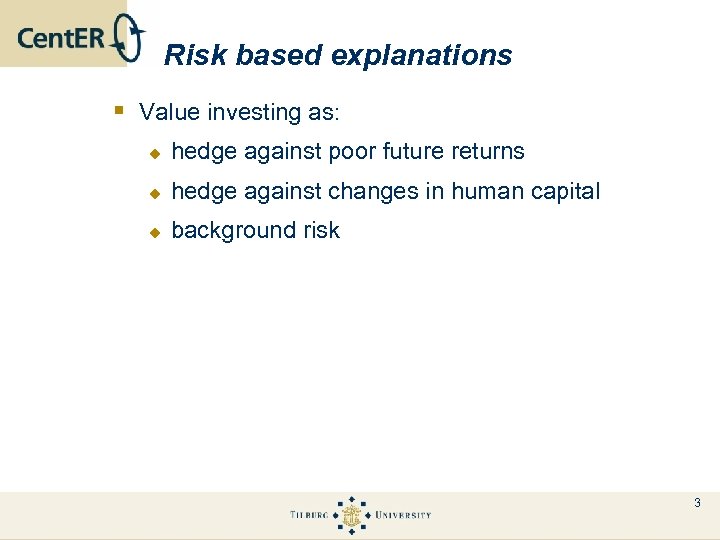
Risk based explanations § Value investing as: u hedge against poor future returns u hedge against changes in human capital u background risk 3
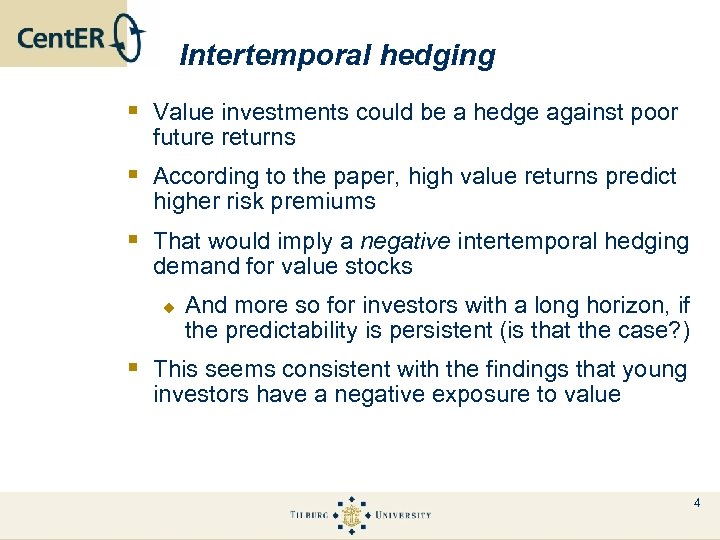
Intertemporal hedging § Value investments could be a hedge against poor future returns § According to the paper, high value returns predict higher risk premiums § That would imply a negative intertemporal hedging demand for value stocks u And more so for investors with a long horizon, if the predictability is persistent (is that the case? ) § This seems consistent with the findings that young investors have a negative exposure to value 4
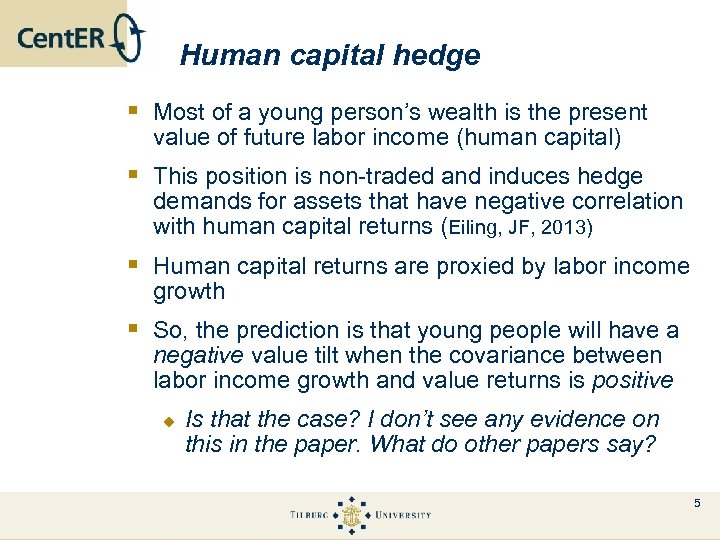
Human capital hedge § Most of a young person’s wealth is the present value of future labor income (human capital) § This position is non-traded and induces hedge demands for assets that have negative correlation with human capital returns (Eiling, JF, 2013) § Human capital returns are proxied by labor income growth § So, the prediction is that young people will have a negative value tilt when the covariance between labor income growth and value returns is positive u Is that the case? I don’t see any evidence on this in the paper. What do other papers say? 5
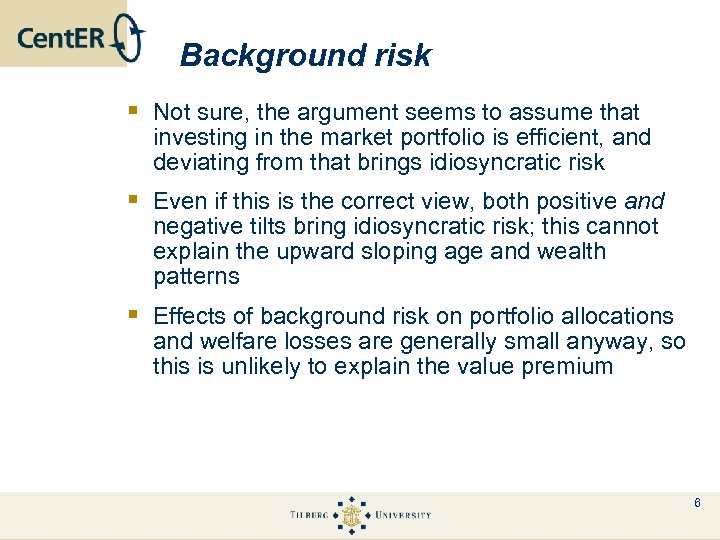
Background risk § Not sure, the argument seems to assume that investing in the market portfolio is efficient, and deviating from that brings idiosyncratic risk § Even if this is the correct view, both positive and negative tilts bring idiosyncratic risk; this cannot explain the upward sloping age and wealth patterns § Effects of background risk on portfolio allocations and welfare losses are generally small anyway, so this is unlikely to explain the value premium 6
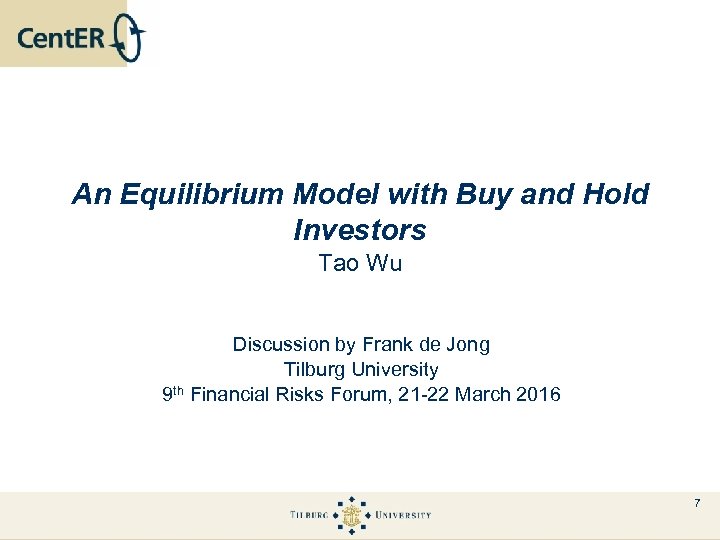
An Equilibrium Model with Buy and Hold Investors Tao Wu Discussion by Frank de Jong Tilburg University 9 th Financial Risks Forum, 21 -22 March 2016 7
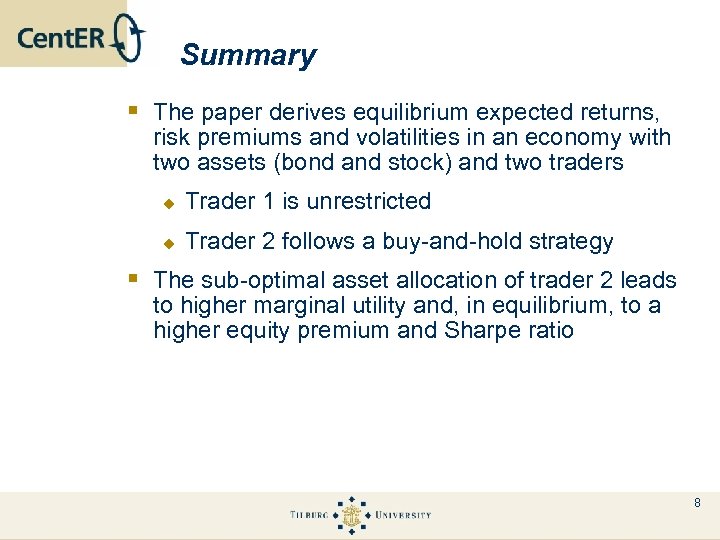
Summary § The paper derives equilibrium expected returns, risk premiums and volatilities in an economy with two assets (bond and stock) and two traders u Trader 1 is unrestricted u Trader 2 follows a buy-and-hold strategy § The sub-optimal asset allocation of trader 2 leads to higher marginal utility and, in equilibrium, to a higher equity premium and Sharpe ratio 8
Comments § The paper summarizes the effect of the buy-andhold investor in two additional state variable, capturing the fraction of stocks held by the buyand-hold investor, η(t), and the “exchange rate” between the consumption of both investors, λ(t) § This makes the problem Markovian and it can be solved § But this makes the investment opportunity set for the investors stochastic, and I expected the state variables to show up in asset demands u Intertemporal hedging effects 9
Comments § The parameter choices for the comparative statics seem fairly extreme: u u Investment horizon is T=50 years; but it seems quite extreme never to rebalance a portfolio over such a long horizon With more frequent rebalancing, welfare losses and pricing effects are typically fairly small, see e. g. Ang, Papanikolaiou and Westerfield § Investors are willing to forego 2% of their wealth to hedge against illiquidity crises occurring once every ten years. § Also, η(t)=1 and λ(t)=4 seem extreme and unlikely to appear in this economy u Simulate the model to generate ‘reasonable’ paths 10
Скачать презентацию Who are the Value and Growth Investors Sebastien
0d47c416bfacb26df3f3009fe9f9193c.ppt