


 Скачать презентацию where The current operational SFMR retrieval process
997df1bfd4242cc043d4e83c513153d5.ppt
- Количество слайдов: 1
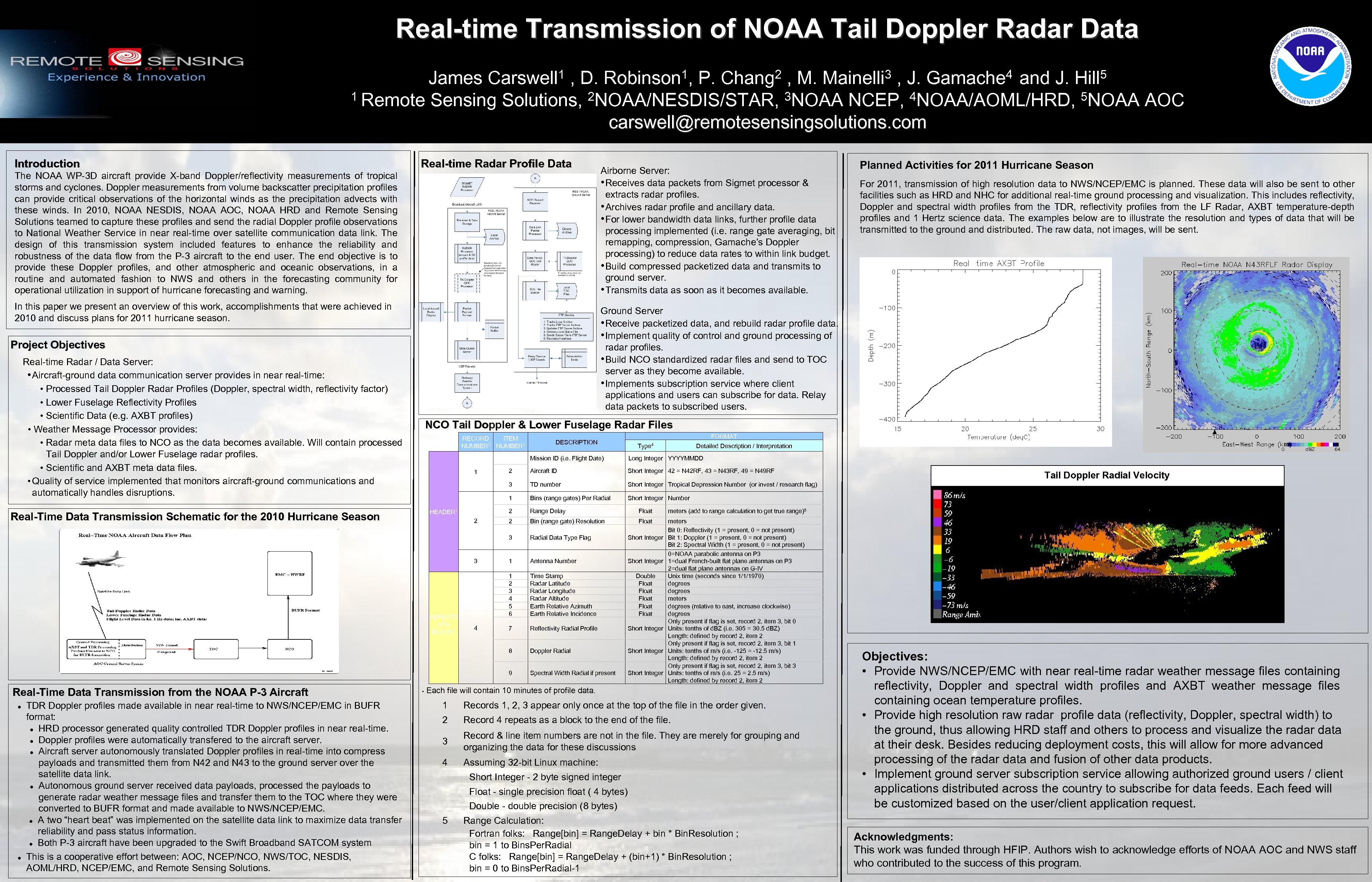 where, The current operational SFMR retrieval process uses an absorption model that was reported in [Jiang et al, 2006]. This model has three empirically derived parameters ( Rm, Re and Fe) and is given below: Real-time Transmission of NOAA Tail Doppler Radar Data 1 , D. Robinson 1, P. Chang 2 , M. Mainelli 3 , J. Gamache 4 and J. Hill 5 James Carswell 1 Remote Sensing Solutions, 2 NOAA/NESDIS/STAR, 3 NOAA NCEP, 4 NOAA/AOML/HRD, 5 NOAA AOC carswell@remotesensingsolutions. com Introduction Real-time Radar Profile Data The NOAA WP-3 D aircraft provide X-band Doppler/reflectivity measurements of tropical storms and cyclones. Doppler measurements from volume backscatter precipitation profiles can provide critical observations of the horizontal winds as the precipitation advects with these winds. In 2010, NOAA NESDIS, NOAA AOC, NOAA HRD and Remote Sensing Solutions teamed to capture these profiles and send the radial Doppler profile observations to National Weather Service in near real-time over satellite communication data link. The design of this transmission system included features to enhance the reliability and robustness of the data flow from the P-3 aircraft to the end user. The end objective is to provide these Doppler profiles, and other atmospheric and oceanic observations, in a routine and automated fashion to NWS and others in the forecasting community for operational utilization in support of hurricane forecasting and warning. In this paper we present an overview of this work, accomplishments that were achieved in 2010 and discuss plans for 2011 hurricane season. NCO Tail Doppler & Lower Fuselage Radar Files RECORD ITEM NUMBER 3 DESCRIPTION FORMAT Type 4 Detailed Description / Interpretation 1 TDR Doppler profiles made available in near real-time to NWS/NCEP/EMC in BUFR format: HRD processor generated quality controlled TDR Doppler profiles in near real-time. Doppler profiles were automatically transfered to the aircraft server. Aircraft server autonomously translated Doppler profiles in real-time into compress payloads and transmitted them from N 42 and N 43 to the ground server over the satellite data link. Autonomous ground server received data payloads, processed the payloads to generate radar weather message files and transfer them to the TOC where they were converted to BUFR format and made available to NWS/NCEP/EMC. A two “heart beat” was implemented on the satellite data link to maximize data transfer reliability and pass status information. Both P-3 aircraft have been upgraded to the Swift Broadband SATCOM system This is a cooperative effort between: AOC, NCEP/NCO, NWS/TOC, NESDIS, AOML/HRD, NCEP/EMC, and Remote Sensing Solutions. Short Integer Tropical Depression Number (or invest / research flag) Bins (range gates) Per Radial Short Integer Number Range Delay Float meters (add to range calculation to get true range)5 2 Bin (range gate) Resolution Float Radial Data Type Flag Short Integer 1 Antenna Number Short Integer Time Stamp Radar Latitude Radar Longitude Radar Altitude Earth Relative Azimuth Earth Relative Incidence Double Float Float 7 Reflectivity Radial Profile Short Integer Doppler Radial Short Integer 9 • TD number 1 2 3 4 5 6 4 Short Integer 42 = N 42 RF, 43 = N 43 RF, 49 = N 49 RF 8 REPEATD ATA BLOCK 2 Aircraft ID 3 3 2 2 2 Long Integer YYYYMMDD 1 HEADER 1 Mission ID (i. e. Flight Date) 3 1 Real-Time Data Transmission Schematic for the 2010 Hurricane Season Real-Time Data Transmission from the NOAA P-3 Aircraft For 2011, transmission of high resolution data to NWS/NCEP/EMC is planned. These data will also be sent to other facilities such as HRD and NHC for additional real-time ground processing and visualization. This includes reflectivity, Doppler and spectral width profiles from the TDR, reflectivity profiles from the LF Radar, AXBT temperature-depth profiles and 1 Hertz science data. The examples below are to illustrate the resolution and types of data that will be transmitted to the ground and distributed. The raw data, not images, will be sent. Ground Server • Receive packetized data, and rebuild radar profile data. • Implement quality of control and ground processing of radar profiles. • Build NCO standardized radar files and send to TOC server as they become available. • Implements subscription service where client applications and users can subscribe for data. Relay data packets to subscribed users. Project Objectives Real-time Radar / Data Server: • Aircraft-ground data communication server provides in near real-time: • Processed Tail Doppler Radar Profiles (Doppler, spectral width, reflectivity factor) • Lower Fuselage Reflectivity Profiles • Scientific Data (e. g. AXBT profiles) • Weather Message Processor provides: • Radar meta data files to NCO as the data becomes available. Will contain processed Tail Doppler and/or Lower Fuselage radar profiles. • Scientific and AXBT meta data files. • Quality of service implemented that monitors aircraft-ground communications and automatically handles disruptions. Airborne Server: • Receives data packets from Sigmet processor & extracts radar profiles. • Archives radar profile and ancillary data. • For lower bandwidth data links, further profile data processing implemented (i. e. range gate averaging, bit remapping, compression, Gamache’s Doppler processing) to reduce data rates to within link budget. • Build compressed packetized data and transmits to ground server. • Transmits data as soon as it becomes available. Planned Activities for 2011 Hurricane Season Spectral Width Radial if present Short Integer meters Bit 0: Reflectivity (1 = present, 0 = not present) Bit 1: Doppler (1 = present, 0 = not present) Bit 2: Spectral Width (1 = present, 0 = not present) 0=NOAA parabolic antenna on P 3 1=dual French-built flat plane antennas on P 3 2=dual flat plane antennas on G-IV Unix time (seconds since 1/1/1970) degrees meters degrees (relative to east, increase clockwise) degrees Only present if flag is set, record 2, item 3, bit 0 Units: tenths of d. BZ (i. e. 305 = 30. 5 d. BZ) Length: defined by record 2, item 2 Only present if flag is set, record 2, item 3, bit 1 Units: tenths of m/s (i. e. -125 = -12. 5 m/s) Length: defined by record 2, item 2 Only present if flag is set, record 2, item 3, bit 3 Units: tenths of m/s (i. e. 25 = 2. 5 m/s) Length: defined by record 2, item 2 Each file will contain 10 minutes of profile data. 1 Records 1, 2, 3 appear only once at the top of the file in the order given. 2 Record 4 repeats as a block to the end of the file. 3 Record & line item numbers are not in the file. They are merely for grouping and organizing the data for these discussions 4 Assuming 32 -bit Linux machine: Short Integer - 2 byte signed integer Float - single precision float ( 4 bytes) Double - double precision (8 bytes) 5 Range Calculation: Fortran folks: Range[bin] = Range. Delay + bin * Bin. Resolution ; bin = 1 to Bins. Per. Radial C folks: Range[bin] = Range. Delay + (bin+1) * Bin. Resolution ; bin = 0 to Bins. Per. Radial-1 Tail Doppler Radial Velocity Objectives: • Provide NWS/NCEP/EMC with near real-time radar weather message files containing reflectivity, Doppler and spectral width profiles and AXBT weather message files containing ocean temperature profiles. • Provide high resolution raw radar profile data (reflectivity, Doppler, spectral width) to the ground, thus allowing HRD staff and others to process and visualize the radar data at their desk. Besides reducing deployment costs, this will allow for more advanced processing of the radar data and fusion of other data products. • Implement ground server subscription service allowing authorized ground users / client applications distributed across the country to subscribe for data feeds. Each feed will be customized based on the user/client application request. Acknowledgments: This work was funded through HFIP. Authors wish to acknowledge efforts of NOAA AOC and NWS staff who contributed to the success of this program.