


 Скачать презентацию Where Texas Stands Launching the ACA Marketplace in
c4ffe1c488bc207f3308c14c57fe36c0.ppt
- Количество слайдов: 36
 Where Texas Stands: Launching the ACA Marketplace in 2014, and Texas’ Uninsured Coverage Gap Click to edit Master title style Click to edit Master subtitle style LWV Austin's annual kickoff meeting Anne Dunkelberg, Associate Director – dunkelberg@cppp. org Sunday, September 15, 2013 CPPP. org 1
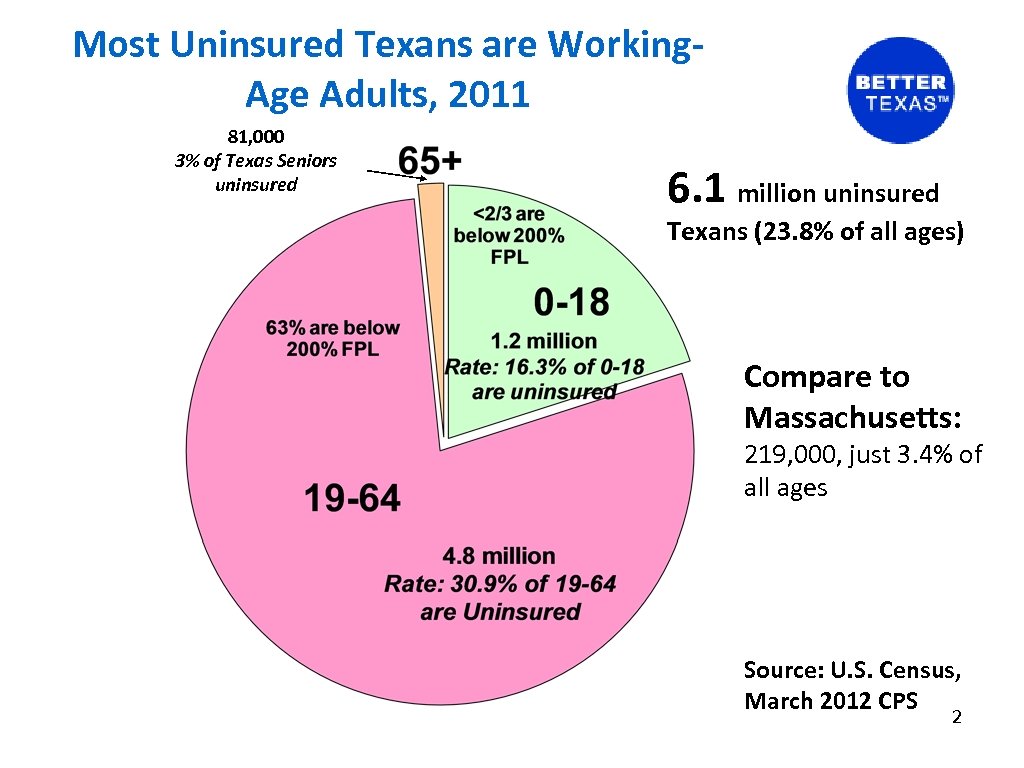 Most Uninsured Texans are Working- Age Adults, 2011 81, 000 3% of Texas Seniors uninsured 6. 1 million uninsured Texans (23. 8% of all ages) Compare to Massachusetts: 219, 000, just 3. 4% of all ages Source: U. S. Census, March 2012 CPS 2
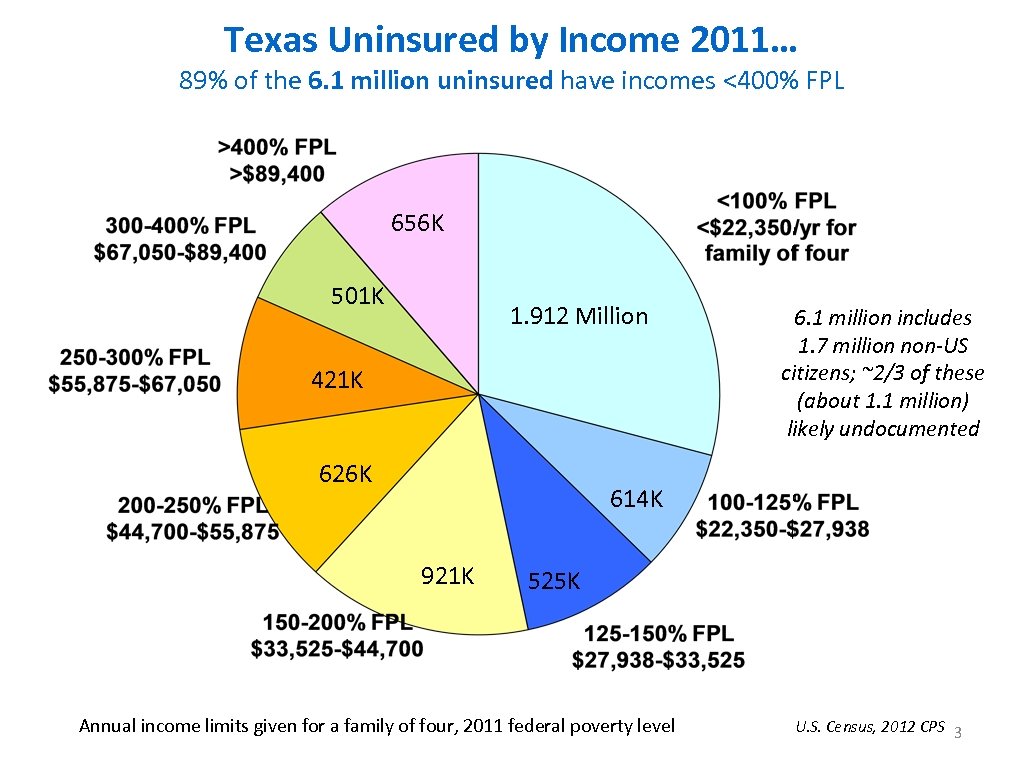 Texas Uninsured by Income 2011… 89% of the 6. 1 million uninsured have incomes <400% FPL 656 K 501 K 1. 912 Million 421 K 626 K 6. 1 million includes 1. 7 million non-US citizens; ~2/3 of these (about 1. 1 million) likely undocumented 614 K 921 K 525 K Annual income limits given for a family of four, 2011 federal poverty level U. S. Census, 2012 CPS 3
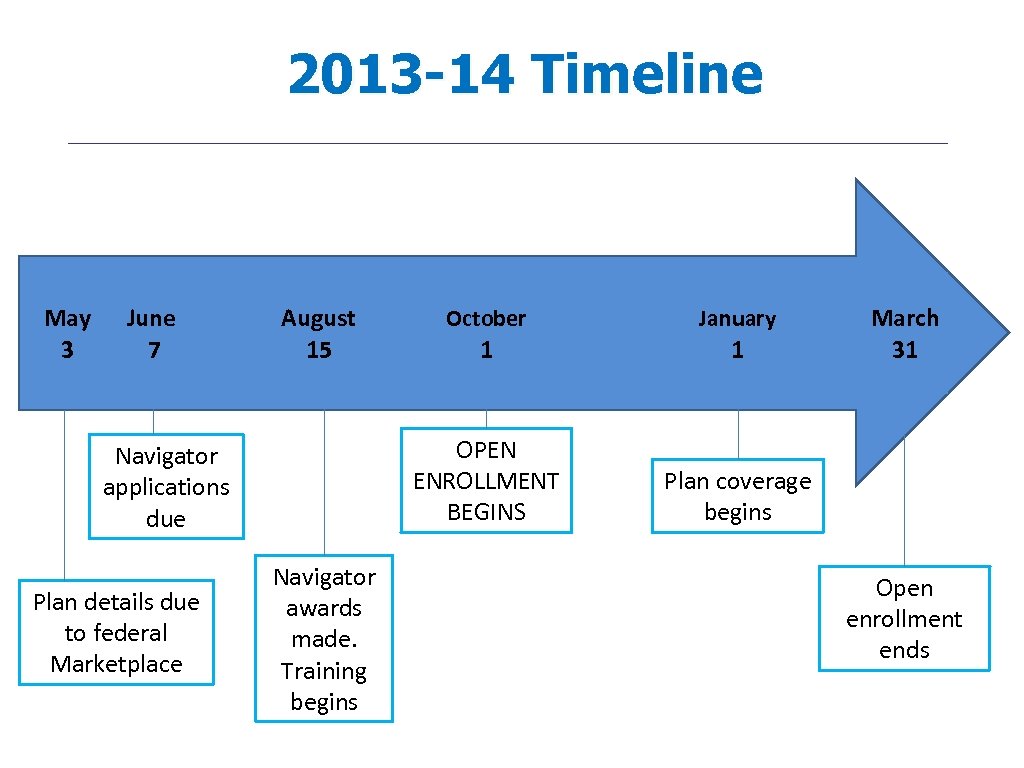 2013 -14 Timeline May 3 June 7 August 15 Plan details due to federal Marketplace Navigator awards made. Training begins January OPEN ENROLLMENT BEGINS Navigator applications due October Plan coverage begins 1 1 March 31 Open enrollment ends
 No Lifetime or Annual Caps • As of 2010, the lifetime caps on health insurance benefits that used to hurt the sickest insured folks are GONE. • No more will a health insurance plan drop your coverage when you get so sick that your medical bills hit the roof. • Also, annual caps began phasing out in 2010.
 No Pre-existing Conditions • As of 2010: children (ages 0 -18) can not be denied coverage based on pre-existing conditions. • Starting in 2014: No one can be denied insurance due to pre-existing conditions. • Starting in 2014: No one can be charged more because of health history or condition. • Only 3 things lead to higher premiums: age, tobacco use, and geography
 Preventive Care with no Co-Payment • Preventive Care: annual well check-ups, routine care, vaccines, birth control, mammograms, colonoscopy, screenings, etc. • As of 2010: Seniors, & disabled on Medicare receive preventive care with no co-pay; Also all new insurance plans for under-65. • Aug 1, 2012: Women get contraceptives and well woman care with no co-pay • Starting in 2014: All insured adults and kids get preventive care with no co-pay
 Essential Health Benefits The ACA is making sure that in 2014, ALL health insurance policies will cover 10 Essential Health Benefits. This means all health conditions should get the coverage they need! 1. 2. 3. 4. 5. ambulatory patient services; emergency services; hospitalization; maternity and newborn care; mental health and substance use disorder services, including behavioral health treatment; 6. prescription drugs; 7. rehabilitative and habilitative services and devices; 8. laboratory services; 9. preventive and wellness services and chronic disease management 10. pediatric services, including oral and vision care.
 Marketplace Basics • Terminology: Health Insurance Marketplace (formerly known as the Exchange) and SHOP for small employers • Compare private insurance plans based on price, benefits, quality, and other features • Most people will get a break on costs • “No wrong door” with Medicaid and CHIP • Open enrollment starts October 1, 2013, and coverage is effective beginning on January 1, 2014
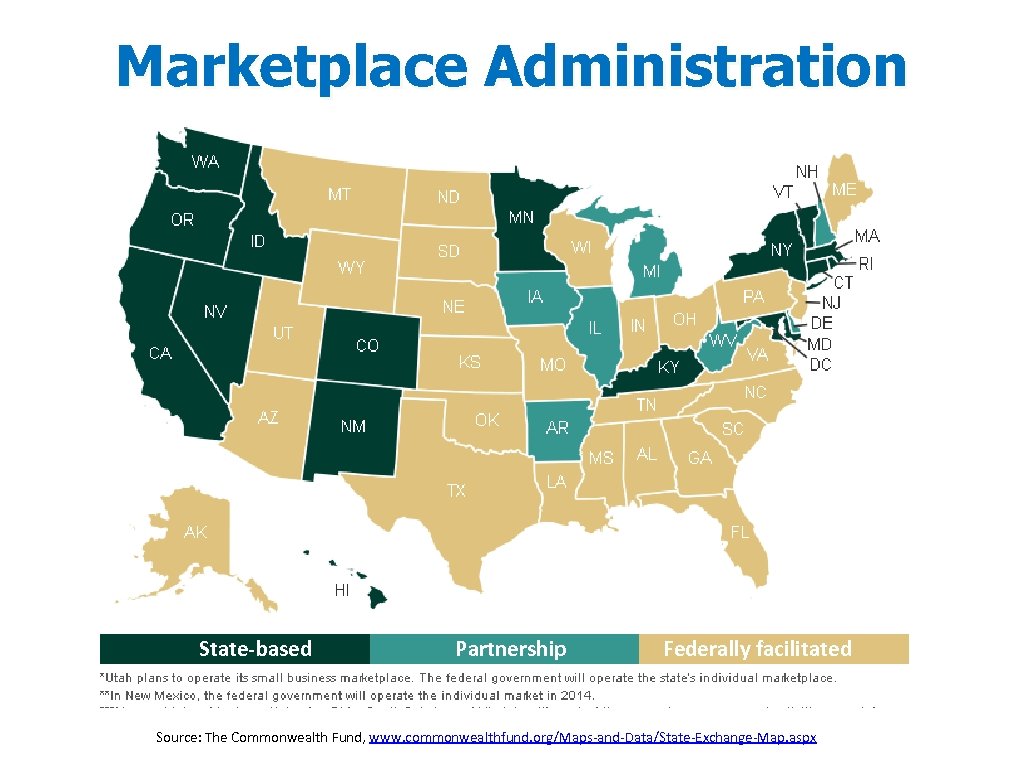 Marketplace Administration State-based Partnership Federally facilitated Source: The Commonwealth Fund, www. commonwealthfund. org/Maps-and-Data/State-Exchange-Map. aspx
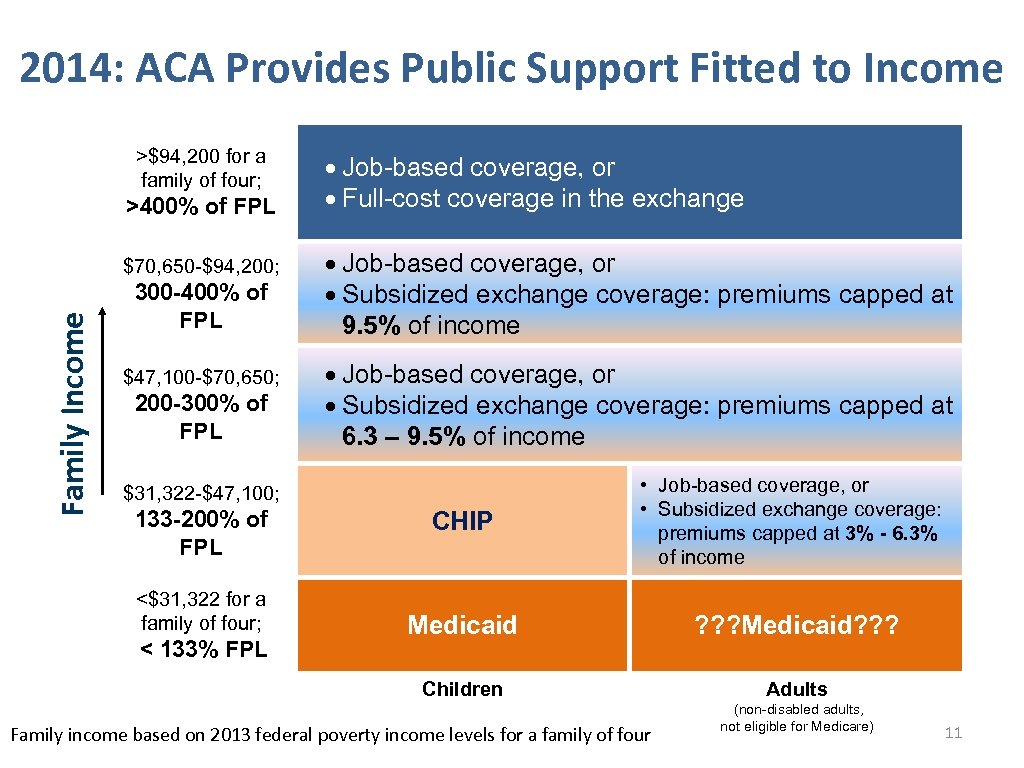 2014: ACA Provides Public Support Fitted to Income >$94, 200 for a family of four; >400% of FPL Family Income $70, 650 -$94, 200; 300 -400% of FPL $47, 100 -$70, 650; 200 -300% of FPL Job-based coverage, or Full-cost coverage in the exchange Job-based coverage, or Subsidized exchange coverage: premiums capped at 9. 5% of income Job-based coverage, or Subsidized exchange coverage: premiums capped at 6. 3 – 9. 5% of income CHIP • Job-based coverage, or • Subsidized exchange coverage: premiums capped at 3% - 6. 3% of income Medicaid ? ? ? Medicaid? ? ? Children Adults $31, 322 -$47, 100; 133 -200% of FPL <$31, 322 for a family of four; < 133% FPL Family income based on 2013 federal poverty income levels for a family of four (non-disabled adults, not eligible for Medicare) 11
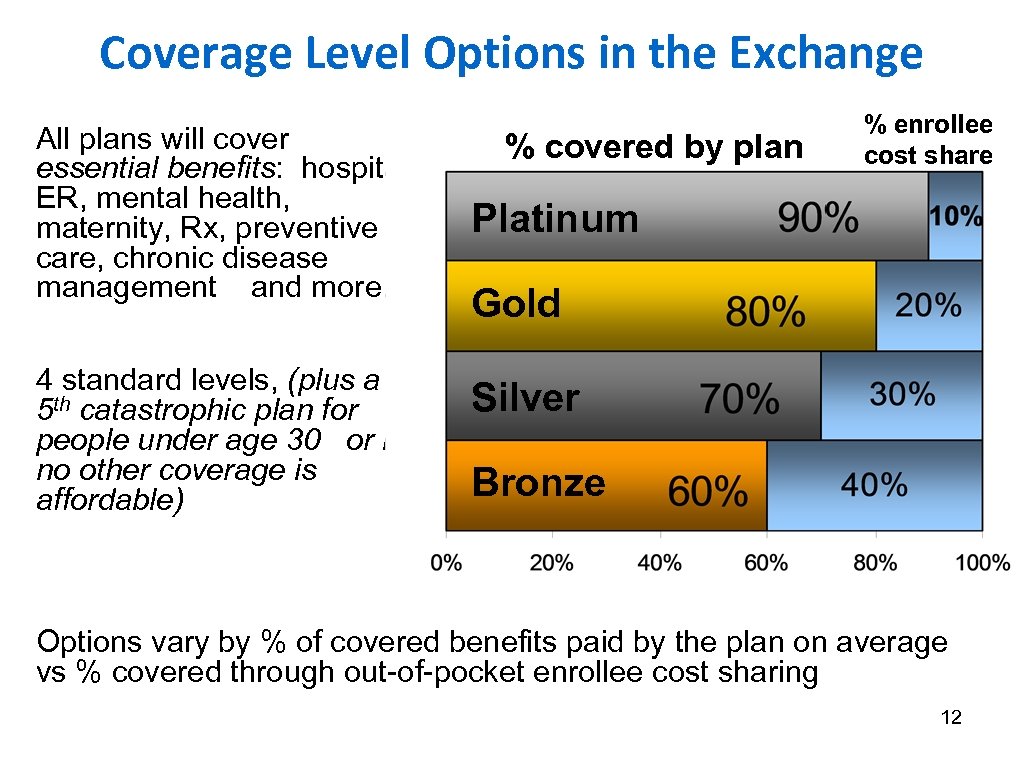 Coverage Level Options in the Exchange All plans will cover essential benefits: hospital, ER, mental health, maternity, Rx, preventive care, chronic disease management and more. 4 standard levels, (plus a 5 th catastrophic plan for people under age 30 or if no other coverage is affordable) % covered by plan % enrollee cost share Platinum Gold Silver Bronze Options vary by % of covered benefits paid by the plan on average vs % covered through out-of-pocket enrollee cost sharing 12
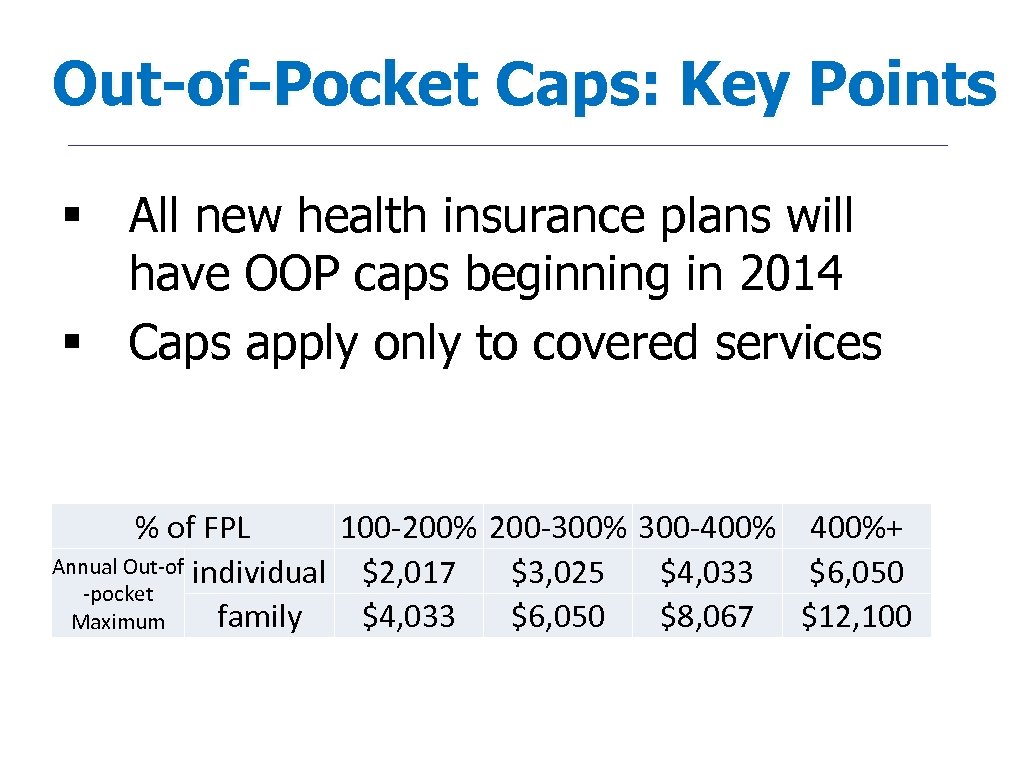 Out-of-Pocket Caps: Key Points § All new health insurance plans will have OOP caps beginning in 2014 § Caps apply only to covered services % of FPL 100 -200% 200 -300% 300 -400%+ Annual Out-of individual $2, 017 $3, 025 $4, 033 $6, 050 -pocket family $4, 033 $6, 050 $8, 067 $12, 100 Maximum
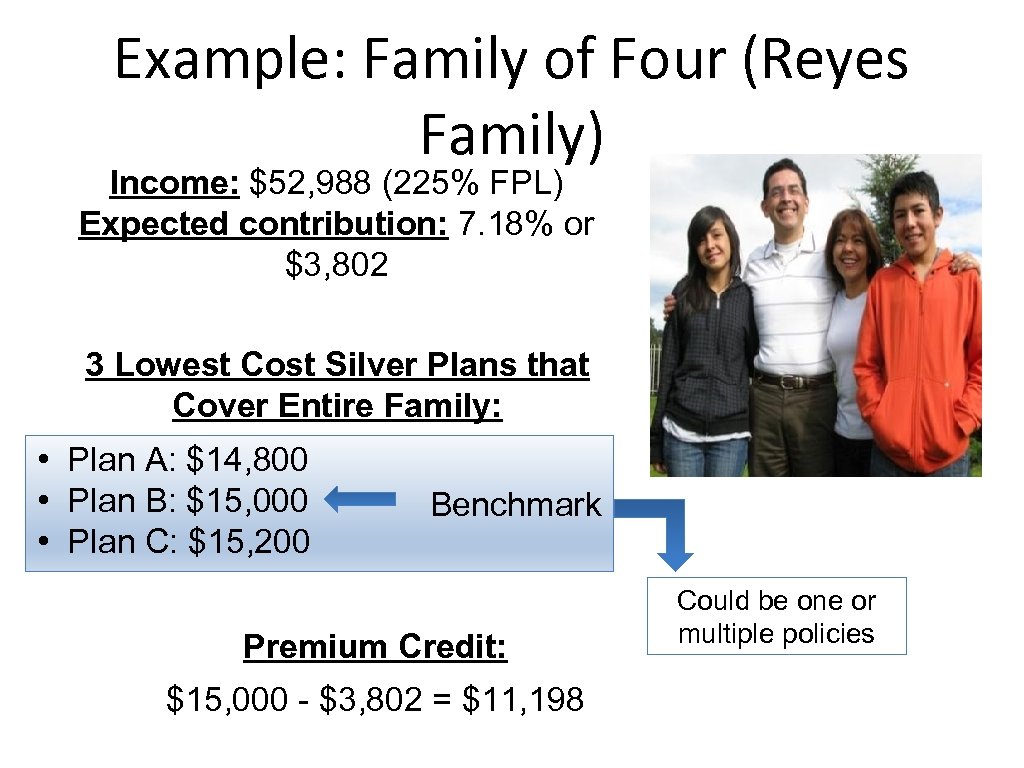 Example: Family of Four (Reyes Family) Income: $52, 988 (225% FPL) Expected contribution: 7. 18% or $3, 802 3 Lowest Cost Silver Plans that Cover Entire Family: • Plan A: $14, 800 • Plan B: $15, 000 • Plan C: $15, 200 Benchmark Premium Credit: $15, 000 - $3, 802 = $11, 198 Could be one or multiple policies
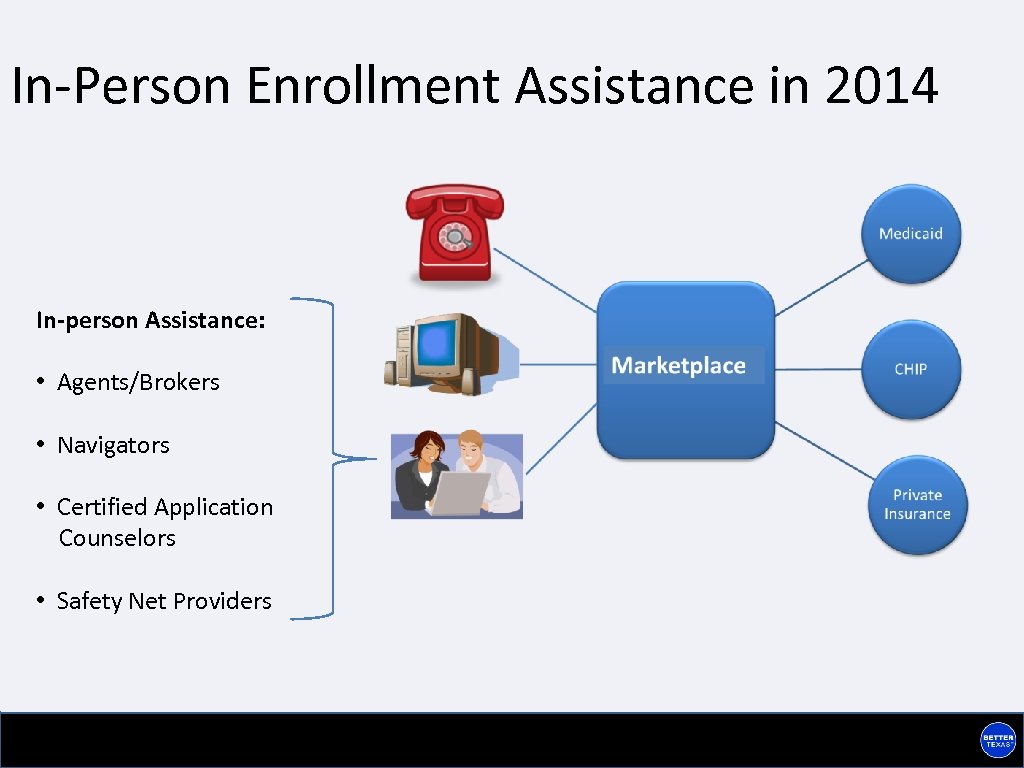 In-Person Enrollment Assistance in 2014 In-person Assistance: • Agents/Brokers • Navigators • Certified Application Counselors • Safety Net Providers
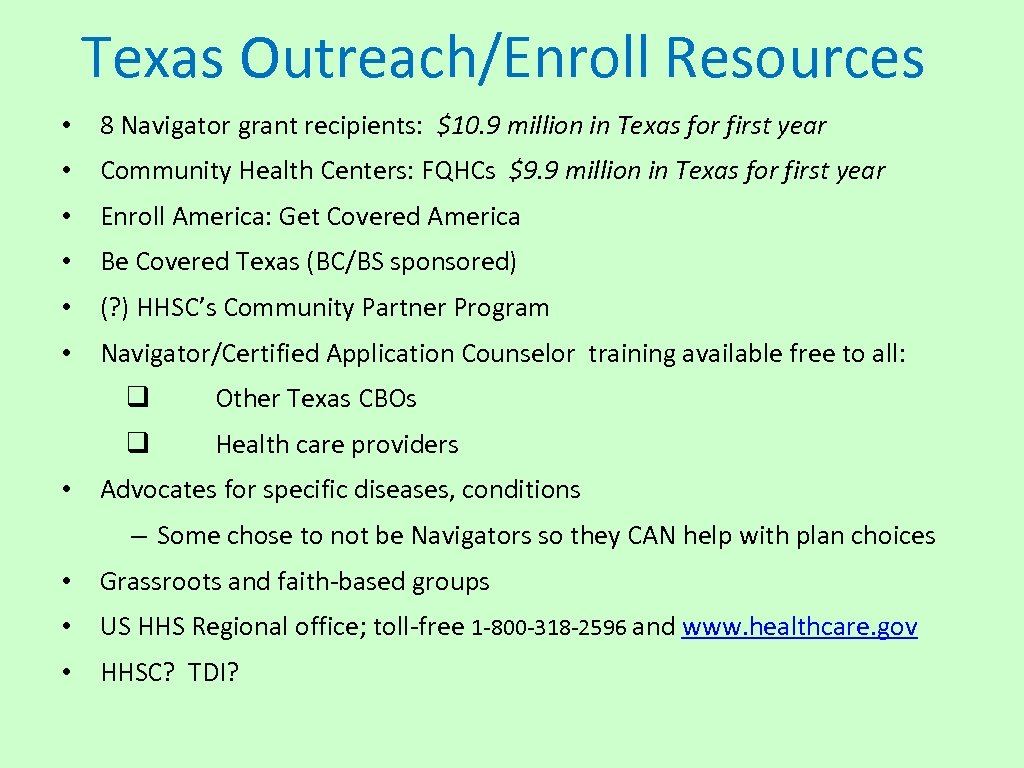 Texas Outreach/Enroll Resources • 8 Navigator grant recipients: $10. 9 million in Texas for first year • Community Health Centers: FQHCs $9. 9 million in Texas for first year • Enroll America: Get Covered America • Be Covered Texas (BC/BS sponsored) • (? ) HHSC’s Community Partner Program • Navigator/Certified Application Counselor training available free to all: q Other Texas CBOs q Health care providers • Advocates for specific diseases, conditions – Some chose to not be Navigators so they CAN help with plan choices • Grassroots and faith-based groups • US HHS Regional office; toll-free 1 -800 -318 -2596 and www. healthcare. gov • HHSC? TDI?
 INFORMATION NOW: Health. Care. gov Available 24/7: 1 -800 -318 -2596; TTY: 1 -855 -889 -4325 Or, Chat Online 17
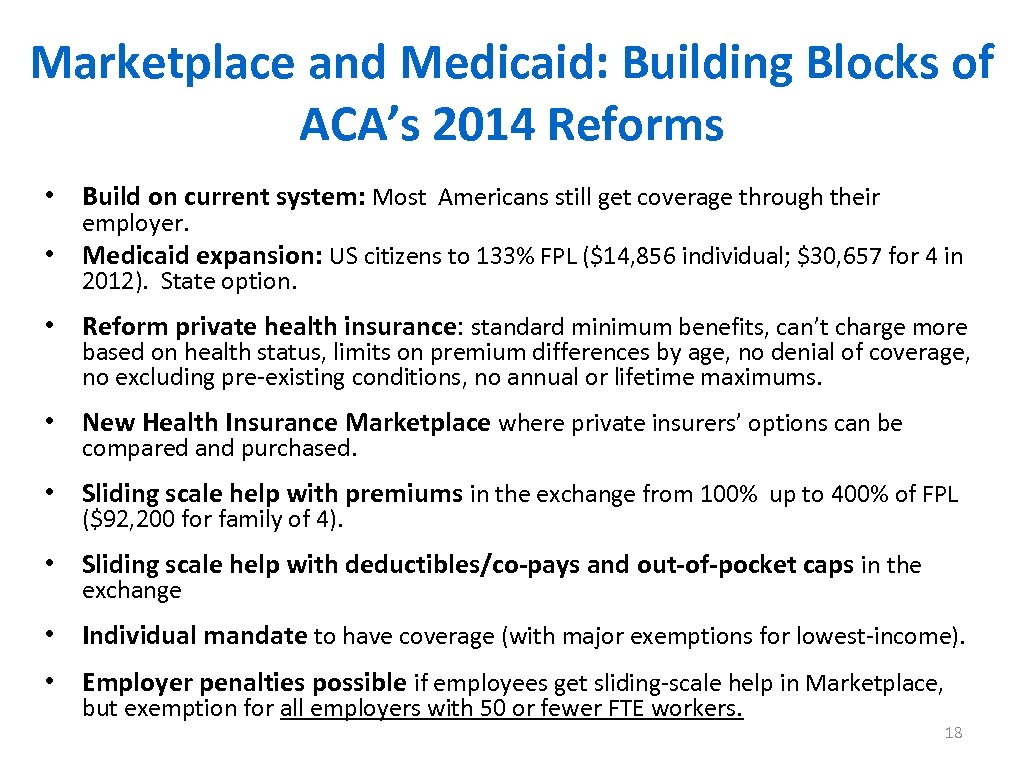 Marketplace and Medicaid: Building Blocks of ACA’s 2014 Reforms • Build on current system: Most Americans still get coverage through their employer. • Medicaid expansion: US citizens to 133% FPL ($14, 856 individual; $30, 657 for 4 in 2012). State option. • Reform private health insurance: standard minimum benefits, can’t charge more based on health status, limits on premium differences by age, no denial of coverage, no excluding pre-existing conditions, no annual or lifetime maximums. • New Health Insurance Marketplace where private insurers’ options can be compared and purchased. • Sliding scale help with premiums in the exchange from 100% up to 400% of FPL ($92, 200 for family of 4). • Sliding scale help with deductibles/co-pays and out-of-pocket caps in the exchange • Individual mandate to have coverage (with major exemptions for lowest-income). • Employer penalties possible if employees get sliding-scale help in Marketplace, but exemption for all employers with 50 or fewer FTE workers. 18
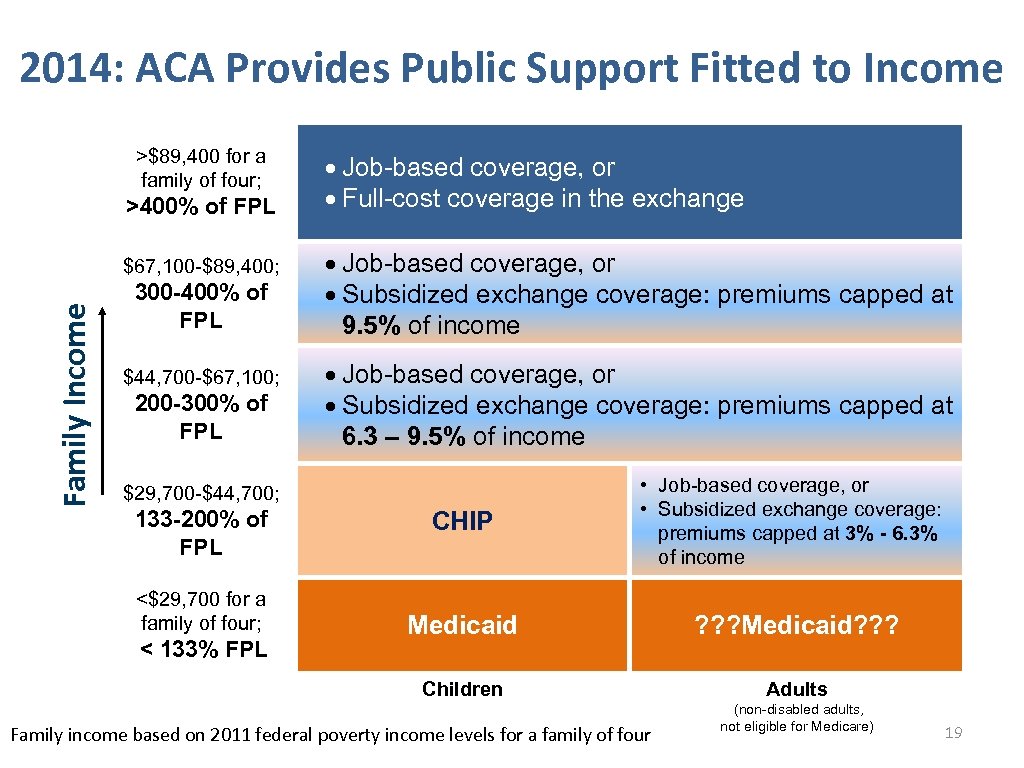 2014: ACA Provides Public Support Fitted to Income >$89, 400 for a family of four; >400% of FPL Family Income $67, 100 -$89, 400; 300 -400% of FPL $44, 700 -$67, 100; 200 -300% of FPL Job-based coverage, or Full-cost coverage in the exchange Job-based coverage, or Subsidized exchange coverage: premiums capped at 9. 5% of income Job-based coverage, or Subsidized exchange coverage: premiums capped at 6. 3 – 9. 5% of income CHIP • Job-based coverage, or • Subsidized exchange coverage: premiums capped at 3% - 6. 3% of income Medicaid ? ? ? Medicaid? ? ? Children Adults $29, 700 -$44, 700; 133 -200% of FPL <$29, 700 for a family of four; < 133% FPL Family income based on 2011 federal poverty income levels for a family of four (non-disabled adults, not eligible for Medicare) 19
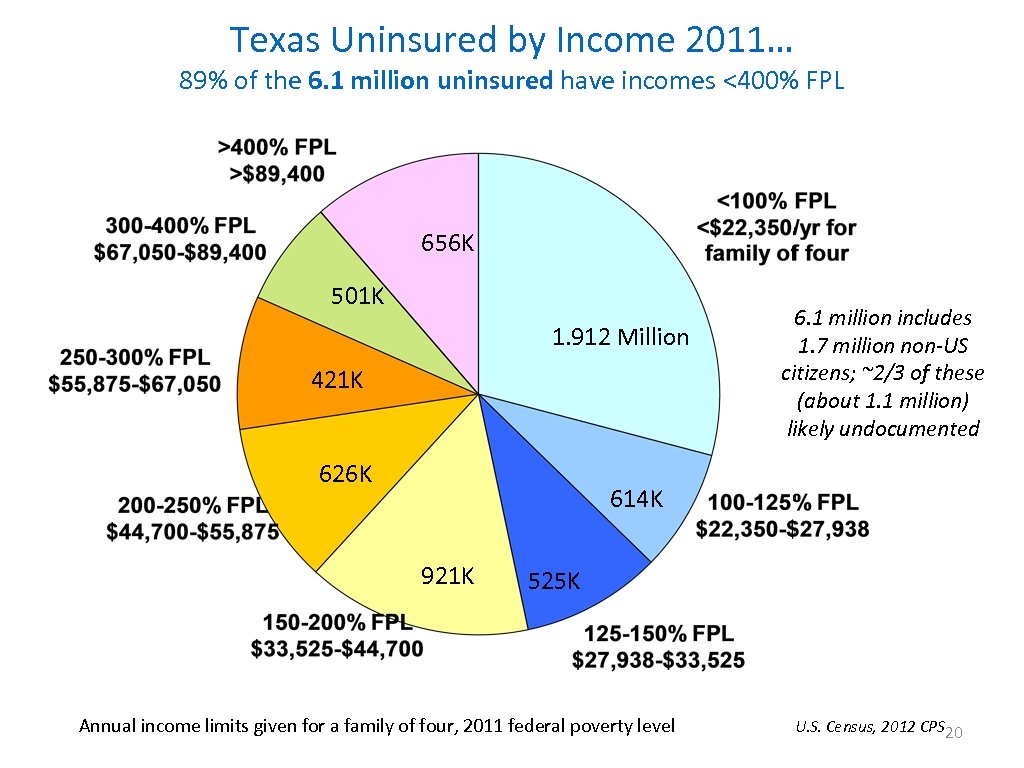 Texas Uninsured by Income 2011… 89% of the 6. 1 million uninsured have incomes <400% FPL 656 K 501 K 1. 912 Million 421 K 626 K 6. 1 million includes 1. 7 million non-US citizens; ~2/3 of these (about 1. 1 million) likely undocumented 614 K 921 K 525 K Annual income limits given for a family of four, 2011 federal poverty level U. S. Census, 2012 CPS 20
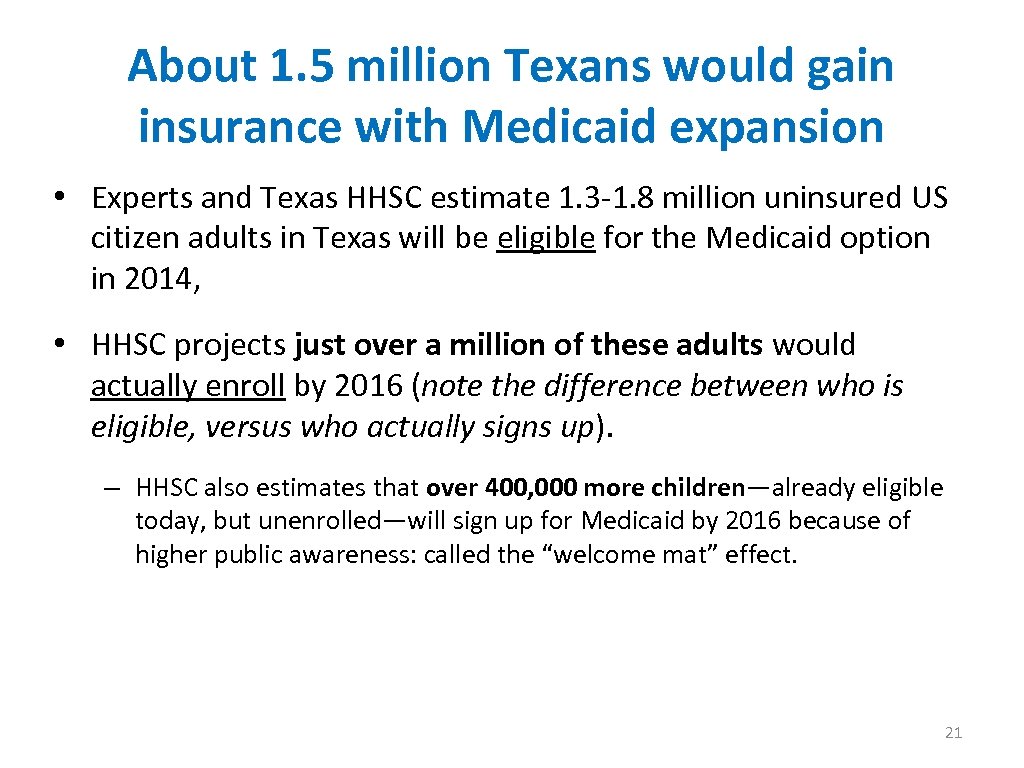 About 1. 5 million Texans would gain insurance with Medicaid expansion • Experts and Texas HHSC estimate 1. 3 -1. 8 million uninsured US citizen adults in Texas will be eligible for the Medicaid option in 2014, • HHSC projects just over a million of these adults would actually enroll by 2016 (note the difference between who is eligible, versus who actually signs up). – HHSC also estimates that over 400, 000 more children—already eligible today, but unenrolled—will sign up for Medicaid by 2016 because of higher public awareness: called the “welcome mat” effect. 21
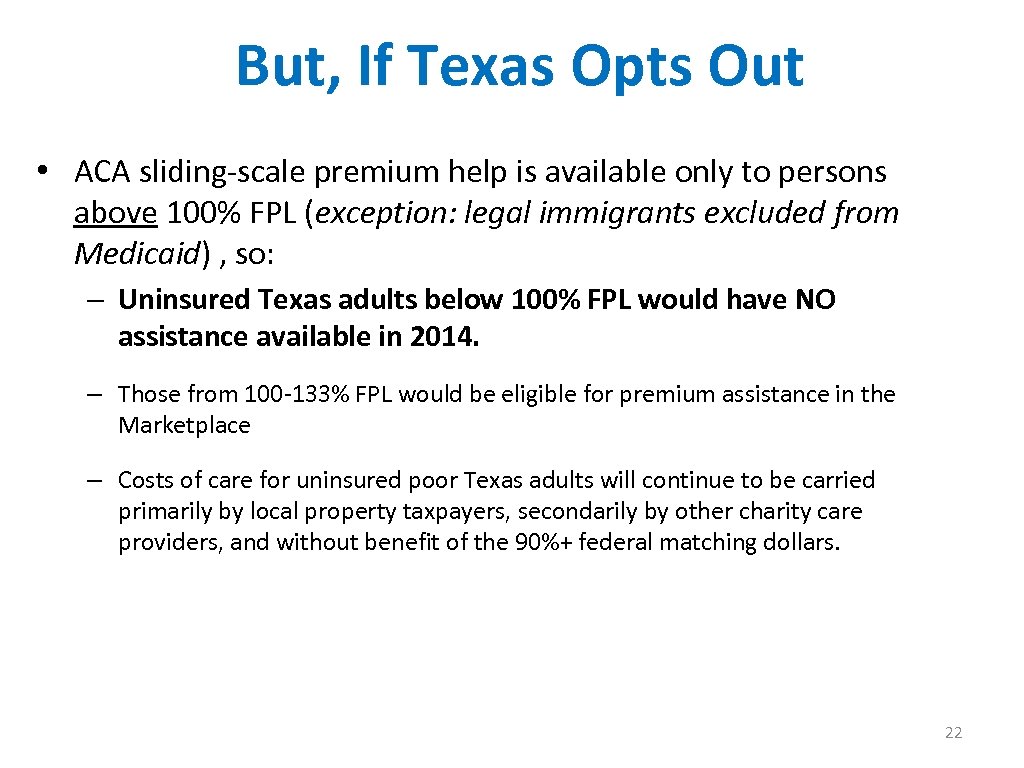 But, If Texas Opts Out • ACA sliding-scale premium help is available only to persons above 100% FPL (exception: legal immigrants excluded from Medicaid) , so: – Uninsured Texas adults below 100% FPL would have NO assistance available in 2014. – Those from 100 -133% FPL would be eligible for premium assistance in the Marketplace – Costs of care for uninsured poor Texas adults will continue to be carried primarily by local property taxpayers, secondarily by other charity care providers, and without benefit of the 90%+ federal matching dollars. 22
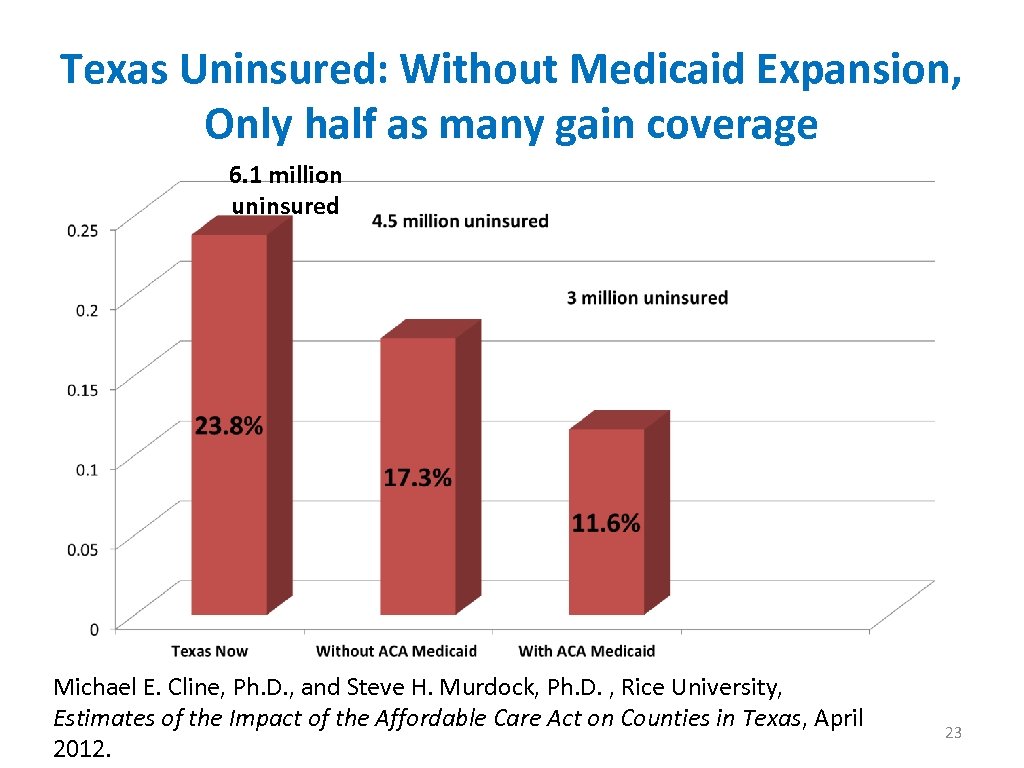 Texas Uninsured: Without Medicaid Expansion, Only half as many gain coverage 6. 1 million uninsured Michael E. Cline, Ph. D. , and Steve H. Murdock, Ph. D. , Rice University, Estimates of the Impact of the Affordable Care Act on Counties in Texas, April 2012. 23
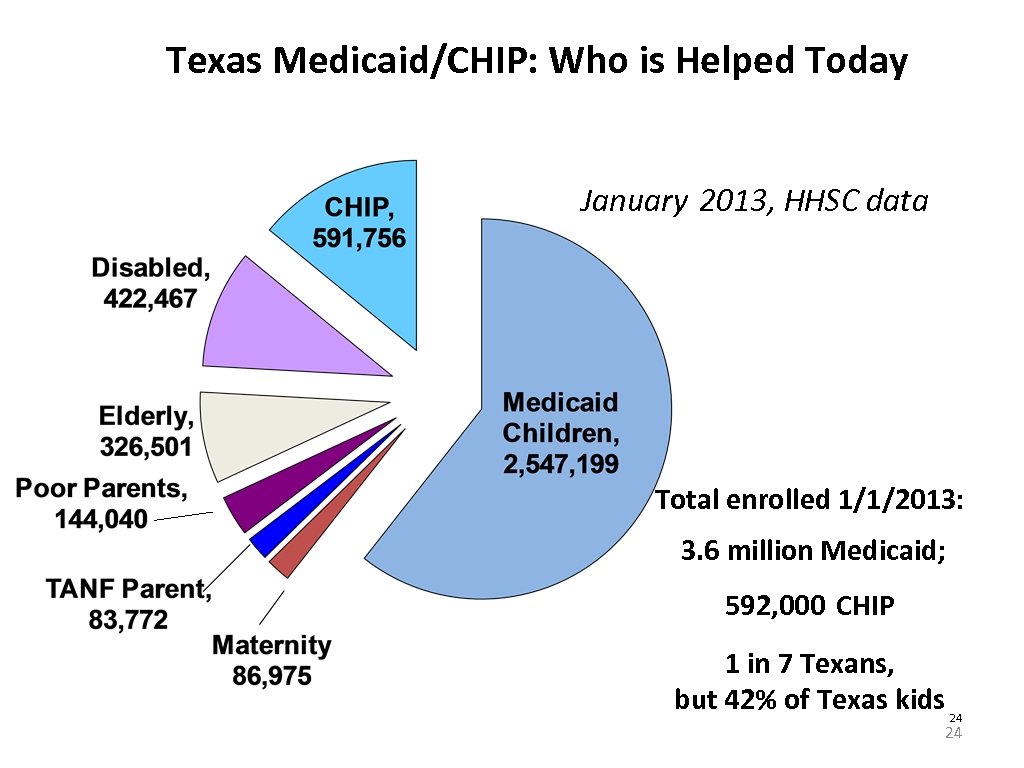 Texas Medicaid/CHIP: Who is Helped Today January 2013, HHSC data Total enrolled 1/1/2013: 3. 6 million Medicaid; 592, 000 CHIP 1 in 7 Texans, but 42% of Texas kids 24 24
 Why So Few Poor Parents Covered in Texas Medicaid • Texas Medicaid has VERY low coverage of parents (must live below 12% of poverty; work less than 10 hrs/wk @ min wage; must be under $308 a month for family of 3). – This dollar limit set by Texas legislature 1985 and never updated. • Today, about 226, 000 poor Texas parents get Medicaid, even though there about 2. 6 million children enrolled. • Medicaid Maternity coverage income limit is much higher, but coverage ends 2 months after birth. • Medicaid does not cover undocumented at any age. • LEGAL immigrant adults NOT covered in Texas Medicaid (state choice, AL, VA, , MS, ND, OH, WY also exclude). (Legal immigrant kids through age 18 are covered in Texas Medicaid and CHIP) 25
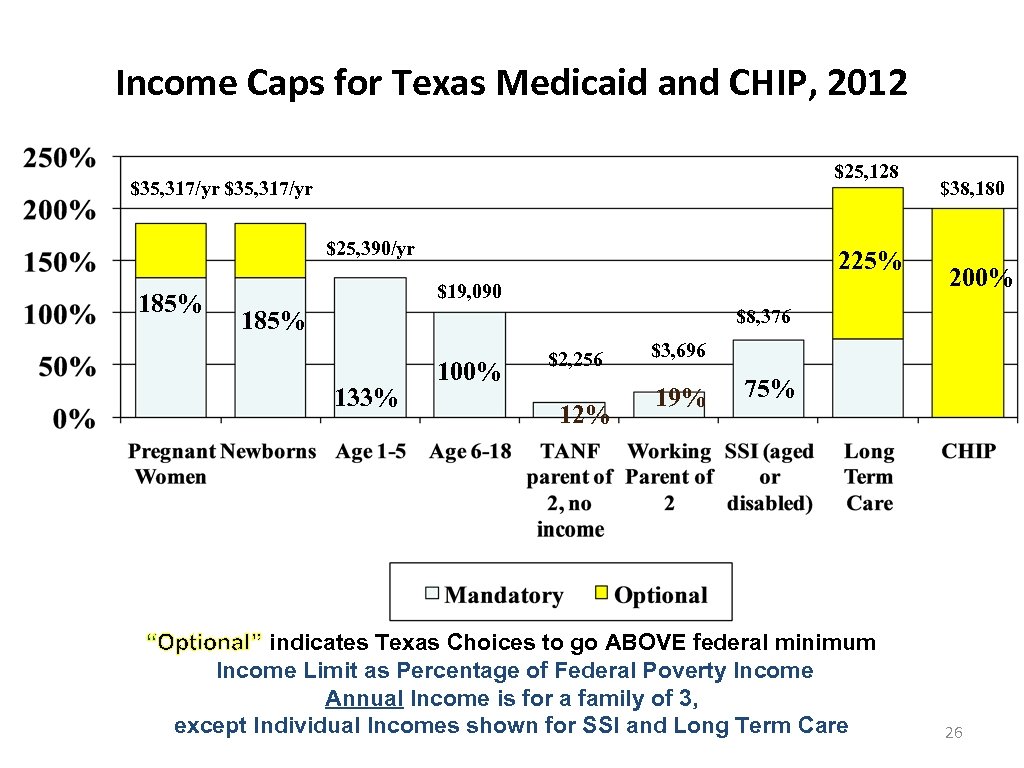 Income Caps for Texas Medicaid and CHIP, 2012 $25, 128 $35, 317/yr $25, 390/yr 185% 225% $19, 090 $38, 180 200% $8, 376 185% 133% 100% $2, 256 12% $3, 696 19% 75% “Optional” indicates Texas Choices to go ABOVE federal minimum Income Limit as Percentage of Federal Poverty Income Annual Income is for a family of 3, except Individual Incomes shown for SSI and Long Term Care 26
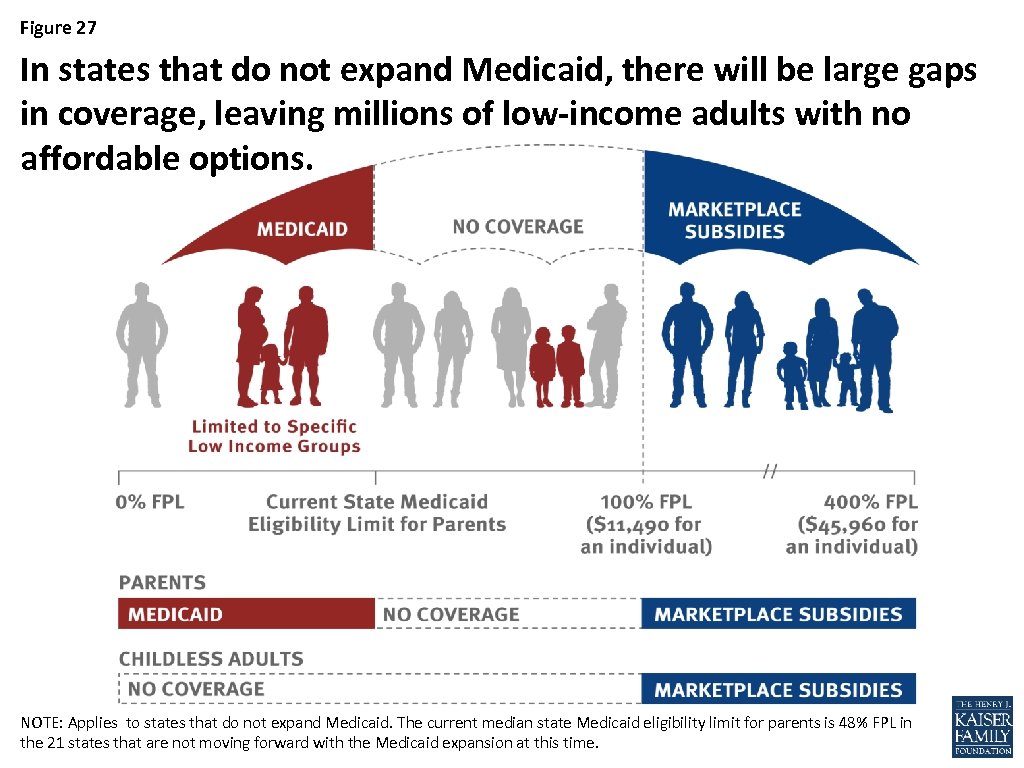 Figure 27 In states that do not expand Medicaid, there will be large gaps in coverage, leaving millions of low-income adults with no affordable options. NOTE: Applies to states that do not expand Medicaid. The current median state Medicaid eligibility limit for parents is 48% FPL in the 21 states that are not moving forward with the Medicaid expansion at this time.
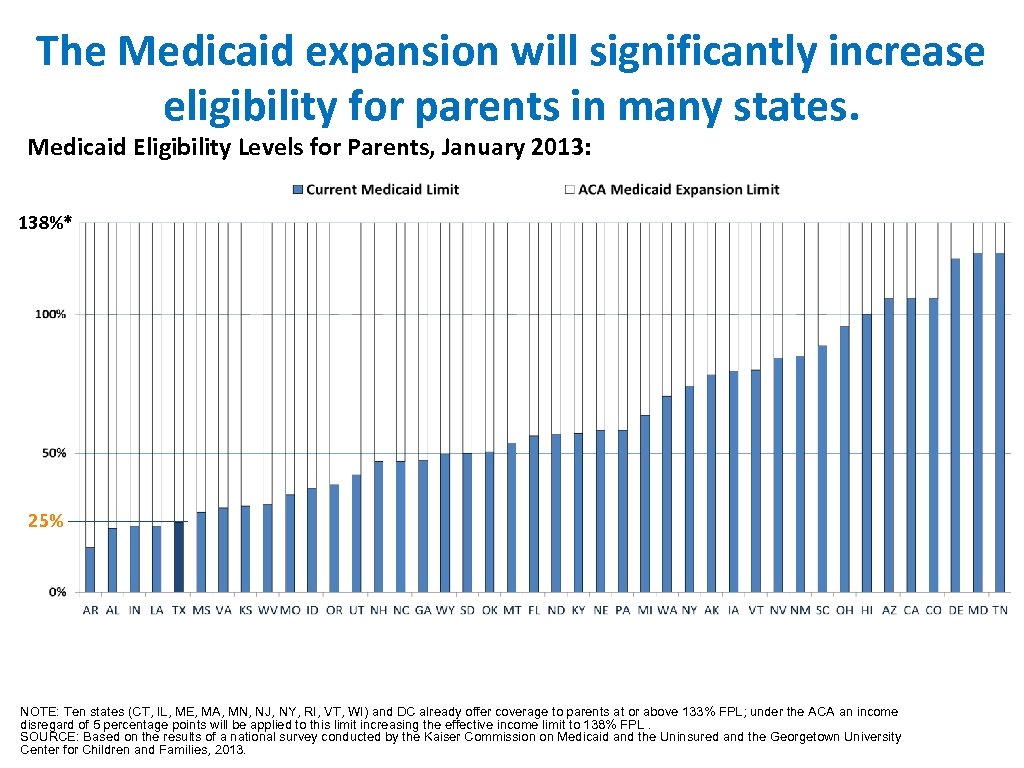 The Medicaid expansion will significantly increase eligibility for parents in many states. Medicaid Eligibility Levels for Parents, January 2013: 138%* 25% NOTE: Ten states (CT, IL, ME, MA, MN, NJ, NY, RI, VT, WI) and DC already offer coverage to parents at or above 133% FPL; under the ACA an income disregard of 5 percentage points will be applied to this limit increasing the effective income limit to 138% FPL. SOURCE: Based on the results of a national survey conducted by the Kaiser Commission on Medicaid and the Uninsured and the Georgetown University Center for Children and Families, 2013.
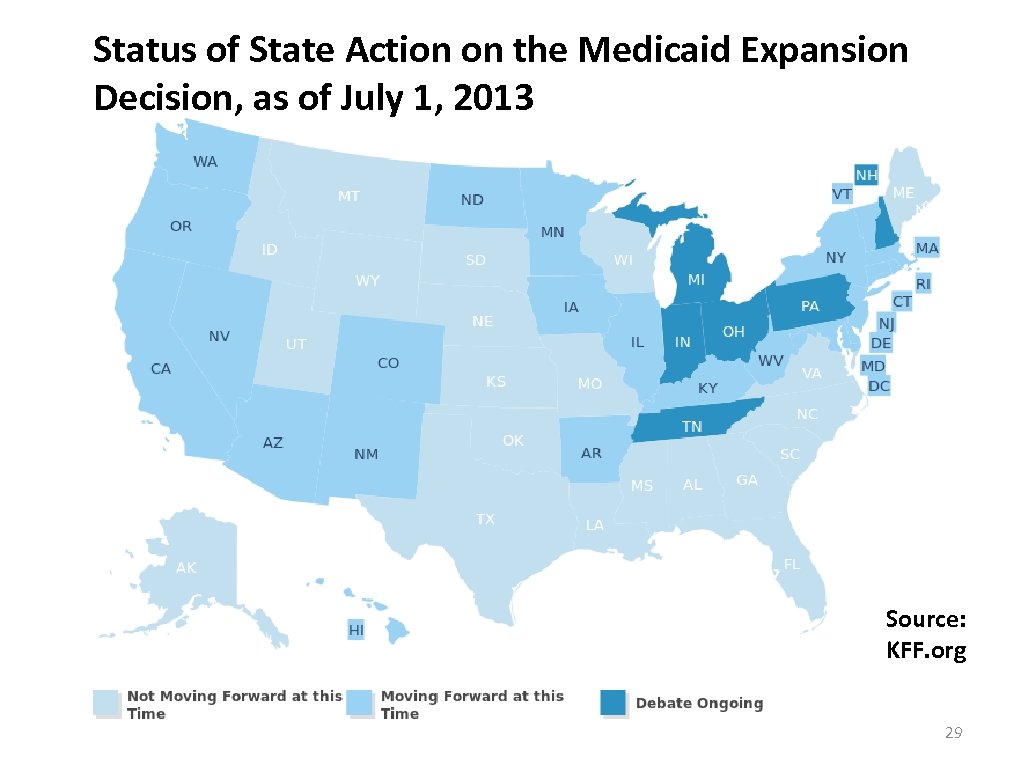 Status of State Action on the Medicaid Expansion Decision, as of July 1, 2013 Source: KFF. org 29
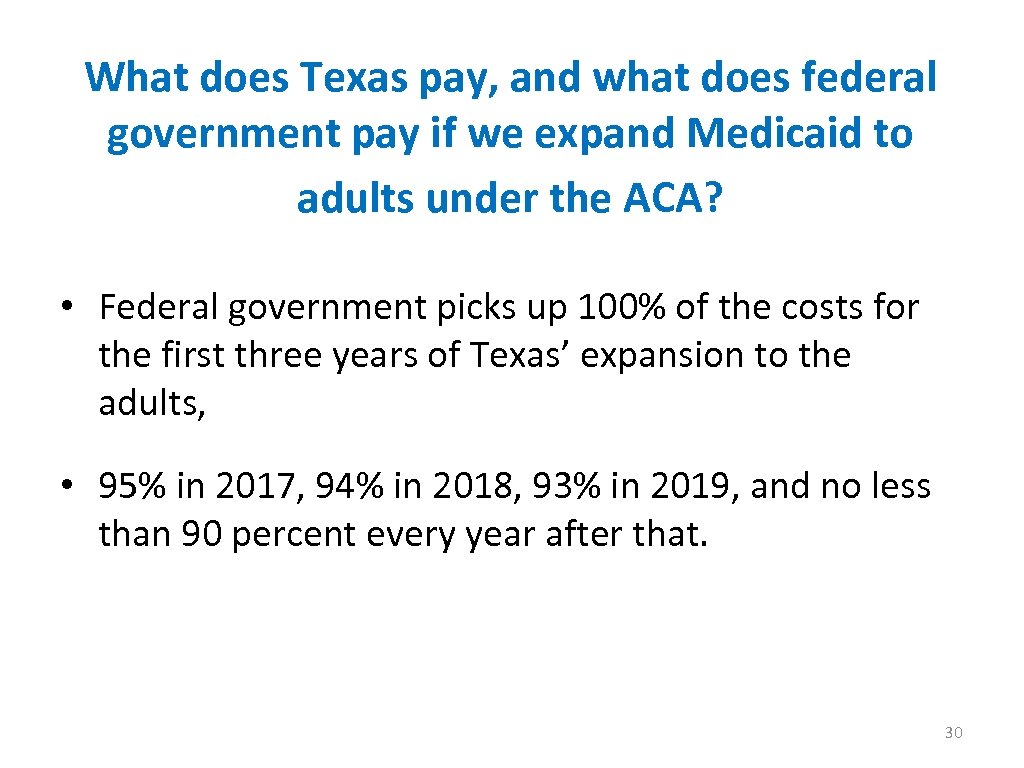 What does Texas pay, and what does federal government pay if we expand Medicaid to adults under the ACA? • Federal government picks up 100% of the costs for the first three years of Texas’ expansion to the adults, • 95% in 2017, 94% in 2018, 93% in 2019, and no less than 90 percent every year after that. 30
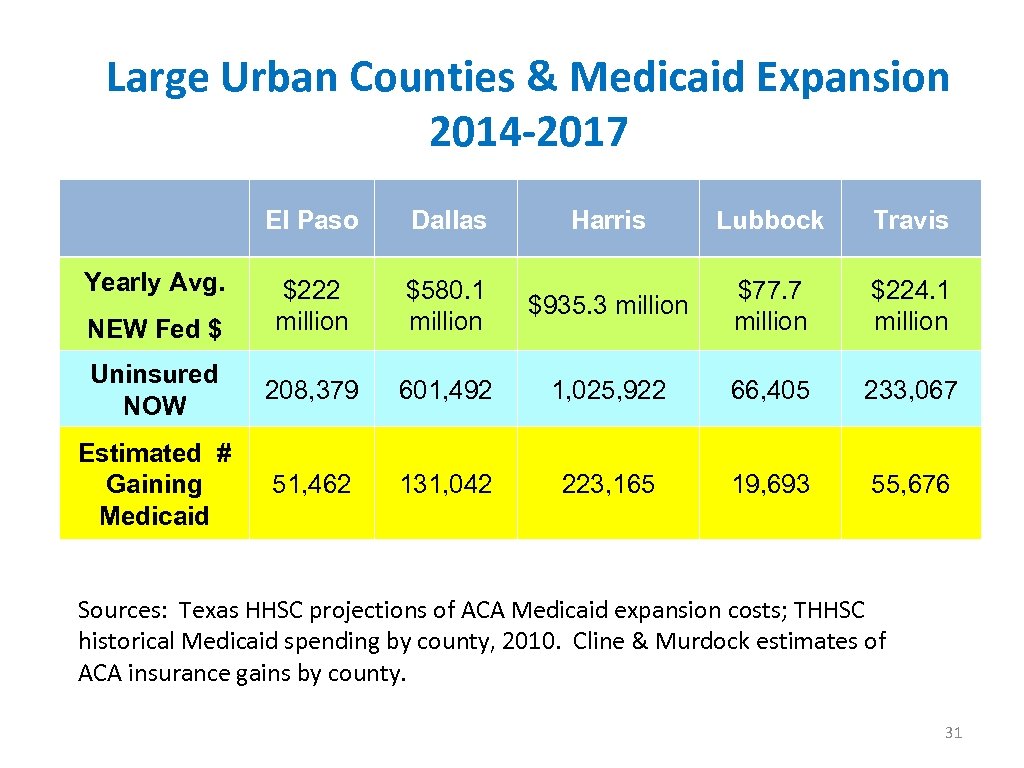 Large Urban Counties & Medicaid Expansion 2014 -2017 El Paso Dallas Yearly Avg. $222 million Uninsured NOW Estimated # Gaining Medicaid NEW Fed $ Harris Lubbock Travis $580. 1 million $935. 3 million $77. 7 million $224. 1 million 208, 379 601, 492 1, 025, 922 66, 405 233, 067 51, 462 131, 042 223, 165 19, 693 55, 676 Sources: Texas HHSC projections of ACA Medicaid expansion costs; THHSC historical Medicaid spending by county, 2010. Cline & Murdock estimates of ACA insurance gains by county. 31
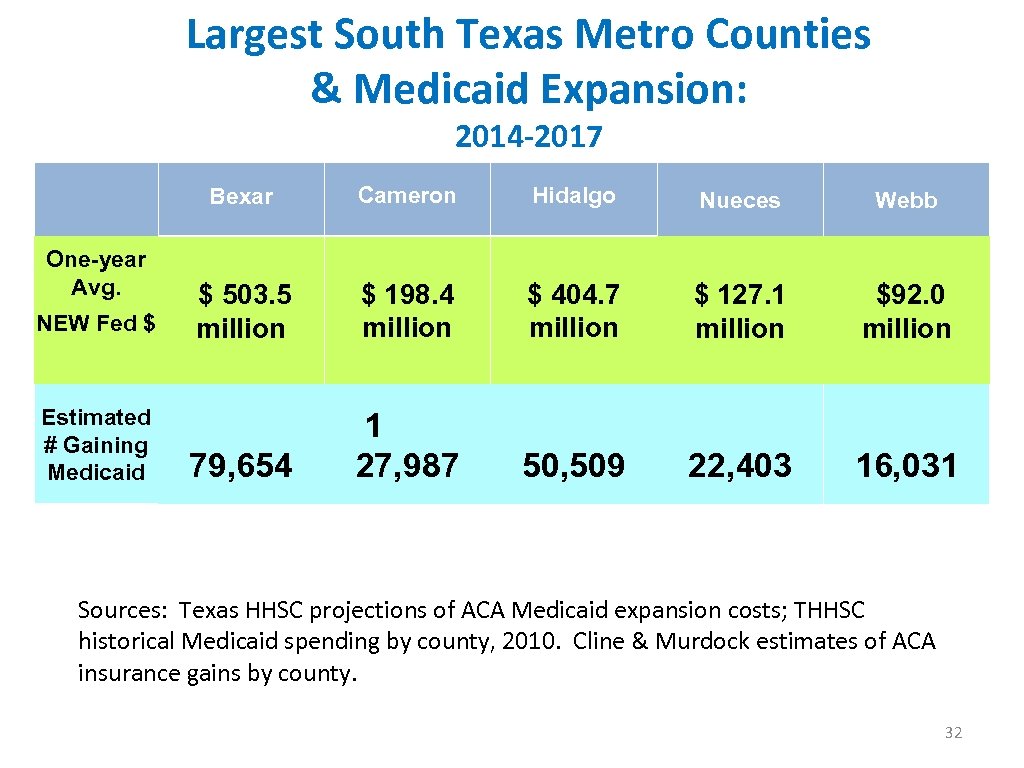 Largest South Texas Metro Counties & Medicaid Expansion: 2014 -2017 Bexar Cameron Hidalgo Nueces Webb NEW Fed $ $ 503. 5 million $ 198. 4 million $ 404. 7 million $ 127. 1 million $92. 0 million Estimated # Gaining Medicaid 1 79, 654 27, 987 50, 509 22, 403 16, 031 One-year Avg. Sources: Texas HHSC projections of ACA Medicaid expansion costs; THHSC historical Medicaid spending by county, 2010. Cline & Murdock estimates of ACA insurance gains by county. 32
 Research on Medicaid Expansion and Texas: 1. Choices and Challenges: How Texas County Uninsured Rates Will Drop Under Health Care Reform Cline & Murdock, of Rice U. (former Texas State Demographer and Director of the US Bureau of the Census) includes estimates of the much smaller reduction in uninsured rates expected if Texas does not accept the Medicaid Expansion. (see www. cppp. org) 2. Your County and the ACA Medicaid Expansion. CPPP compiled data for all 254 Texas counties on impact of ACA on uninsured, and the new federal dollars by county, based on Rice data above and the Texas Health and Human Services Commission’s latest official Medicaid expansion estimates. (see www. cppp. org) 3. Texas Has Only One Rational Choice: Expanding Medicaid Under the Affordable Care Act: Study by The Perryman Group Finds that Expanding Medicaid More than Pays for Itself. Analysis by The Perryman Group, every $1 spent by the State of Texas to expand Medicaid coverage under the Affordable Care Act (ACA) returns $1. 29 in dynamic State government revenue over the first 10 years of the expansion. http: //www. perrymangroup. com/ 4. Government Effectiveness and Efficiency Report 2013 (January 2013). This biennial report to the Legislature by Legislative Budget Board staff includes a chapter analyzing the costs and benefits of the ACA Medicaid expansion and recommending that counties be enabled to finance and implement the expansion. Smart, Affordable and Fair: Why Texas Should Extend Medicaid Coverage to Low-Income Adults (January 2013). This new report from Billy Hamilton Consulting provides a comprehensive model estimating the costs and benefits to local taxing authorities (including cities, counties and hospital districts) and state government. Using the Cline. Murdock model data, the authors conclude that state match needed for the Medicaid expansion are far less than current state, local, and hospitals spending on health care for low-income adults, and project $1. 8 billion in new state revenue will be generated by the expansion from 2014 through 2017, offsetting about half of the required state match. 5. 33
 What’s Happened? • 13 House and 6 Senate billed filed to expand Medicaid per ACA; each chamber included a bill authored by a Republican in a leadership role (Rep. Zerwas; Senator Deuell). – Also Senate budget “rider” by Finance committee Chairman Tommy Williams • Widespread Support, Executive Opposition. Statewide support for Medicaid expansion from doctors, hospitals, county officials, chambers of commerce, and even the Texas Association of Business eventually supporting the Zerwas coverage option. – Polling by Texas and national firms found 58 -59% of Texas voters support accepting federal ACA funds to cover the poorest uninsured adults. – Twenty-two chambers of commerce have called on the state to accept this funding, and new chambers continue to add their names to the list. • Despite this support, the Legislature did not move the veryconservative, market-based “Texas Solution” alternative offered by Rep. John Zerwas HB 3791. – There was more than sufficient support by House members for Zerwas’ “Texas Solution” bill. But the Governor’s office began to communicate a veto threat 34
 What’s Next? Texas’ decision means that in January 2014: • Texas adults above the poverty line will begin to get publicly funded sliding-scale help with health insurance, • but Texans below poverty will qualify for nothing. Estimates of the number of uninsured Texas adults who will be left without a coverage option in the near term range: • from around 935, 000 (HHSC, out of 1. 1 million below 138% of poverty) • to as high as 1. 3 million (Urban Institute/Kaiser Family Foundation, out of about 1. 7 million below 138% of poverty). A Diverse network of Texans and Texas Organizations will keep working to find health care for the Texans in the “Gap Group, ” to tell their stories, and to seek inclusion of Texas’ working poor in the ACA’s health reform. www. texaswellandhealthy. org 35
 FAMILY BUDGETS Use of This Presentation The Center for Public Policy Priorities encourages you to reproduce and distribute these slides, which were developed for use in making public presentations. If you reproduce these slides, please give appropriate credit to CPPP. The data presented here may become outdated. For the most recent information or to sign up for our email updates, visit our website. © CPPP Center for Public Policy Priorities 7020 Easy Wind Drive, Suite 200 Austin, TX 78752 P 512. 320. 0222 F 512. 320. 0227 Methodist Healthcare Ministries 4507 Medical Drive San Antonio, TX 78229 Toll-Free: 800. 959. 6673 P 210. 692. 0234 F 210. 614. 7563 www. MHM. org CPPP. org 36