 Скачать презентацию Where Science Means Business The case of Yissum
2314e8925c9403eb17de15f2f163d9f2.ppt
- Количество слайдов: 44



Where Science Means Business The case of Yissum – The Hebrew University of Jerusalem Renee Ben-Israel, Vice-President – Intellectual Property WIPO: Information Meeting on Intellectual Property Financing Geneva – 10 March 2009
Summary § Introduction § Patent strategy § Patents and Universities § Israel’s technology and Innovation § Israeli universities § Yissum § Food for thought
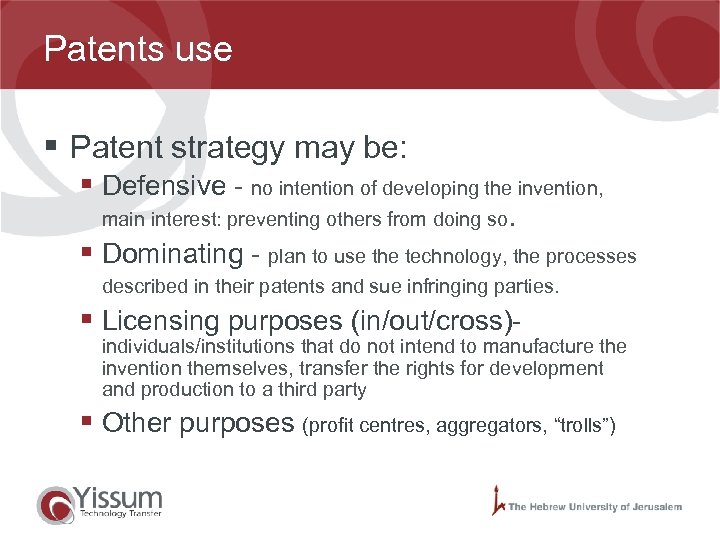
Patents use § Patent strategy may be: § Defensive - no intention of developing the invention, main interest: preventing others from doing so. § Dominating - plan to use the technology, the processes described in their patents and sue infringing parties. § Licensing purposes (in/out/cross)- individuals/institutions that do not intend to manufacture the invention themselves, transfer the rights for development and production to a third party § Other purposes (profit centres, aggregators, “trolls”)
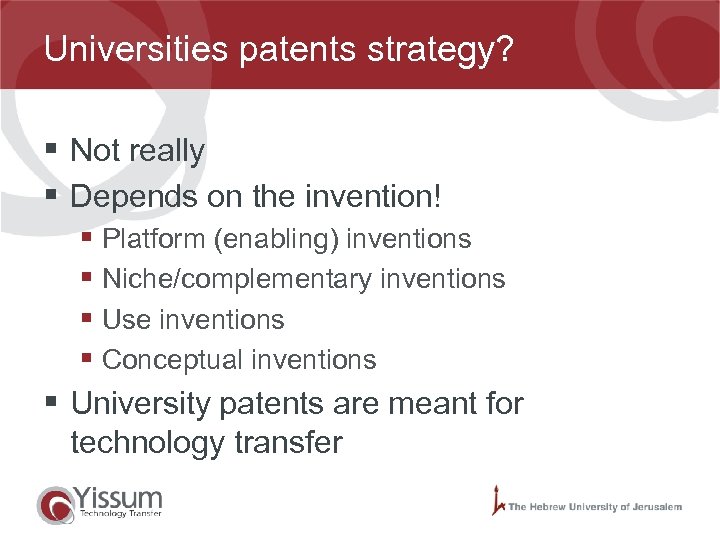
Universities patents strategy? § Not really § Depends on the invention! § Platform (enabling) inventions § Niche/complementary inventions § Use inventions § Conceptual inventions § University patents are meant for technology transfer
University patents § University classical mission: § Teaching, researching and divulging the knowledge § Universities’ patents: § Embryonic – feasibility/market unknown § Development requires high risk investment by industry § Intellectual property protection can be used as an incentive to make high risk investment § motivating the “first mover” by protecting against later competitors (strategy!)
Purposes of University Technology Transfer § Participate in innovation process § Facilitate the commercialization of research § § § results for the public good Retain and recruit researchers Create closer ties to industry Generate income for further research and education Promote economic growth Social responsibility
Purposes of University Technology Transfer Research => Invention (and IP)=> Development => Innovation § New products and medicines § Bring new technology into industry for economic competitiveness § Encourage entrepreneurship for local and national economic development (source: Lita Nelsen – MIT)
The Tech Transfer Bargain § University research leads to patent—but technology is § § unproven and high risk University is willing to grant exclusive patent license to Company who will commit to the risk of developing the technology If development succeeds, the patent protects the Company from competitors University benefits from product being developed and from royalties (shared with inventor) University also has the opportunity in the license to assure that patents are used “in the public interest”— requiring certain price or geographical concessions for developing countries, if appropriate (source: Lita Nelsen – MIT)
Patent protection is particularly critical for development of pharmaceuticals § Development of a new therapeutic or vaccine product is a particularly high risk activity § Time frames are long § Financial investment is very high § Clinical trials are very difficult § Probability of failure is high § Patent protection of the final product is necessary before companies (or biotech investors) will take the risk and make the investment (source: Lita Nelsen – MIT)
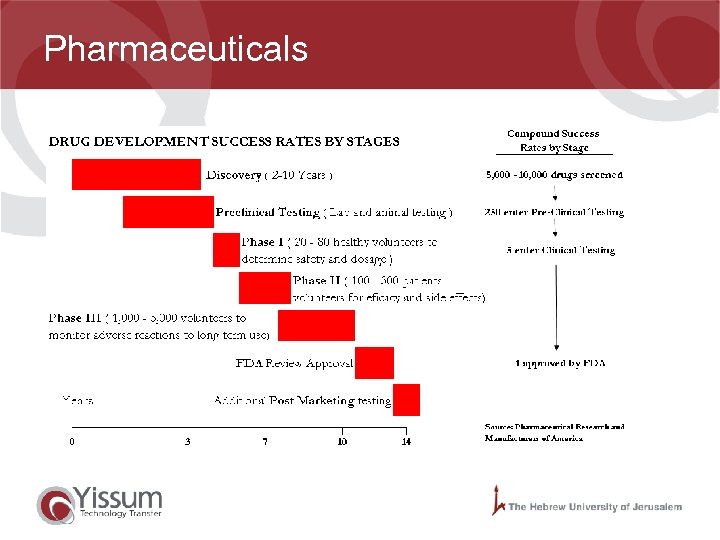
Pharmaceuticals
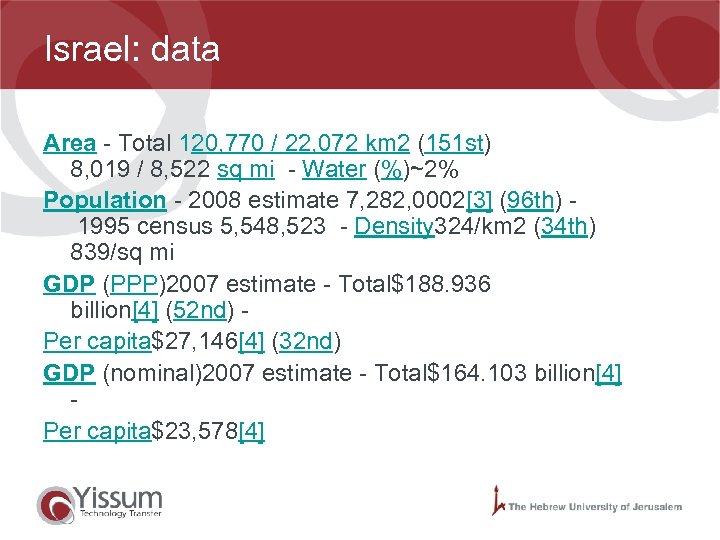
Israel: data Area - Total 120, 770 / 22, 072 km 2 (151 st) 8, 019 / 8, 522 sq mi - Water (%)~2% Population - 2008 estimate 7, 282, 0002[3] (96 th) 1995 census 5, 548, 523 - Density 324/km 2 (34 th) 839/sq mi GDP (PPP)2007 estimate - Total$188. 936 billion[4] (52 nd) - Per capita$27, 146[4] (32 nd) GDP (nominal)2007 estimate - Total$164. 103 billion[4] - Per capita$23, 578[4]
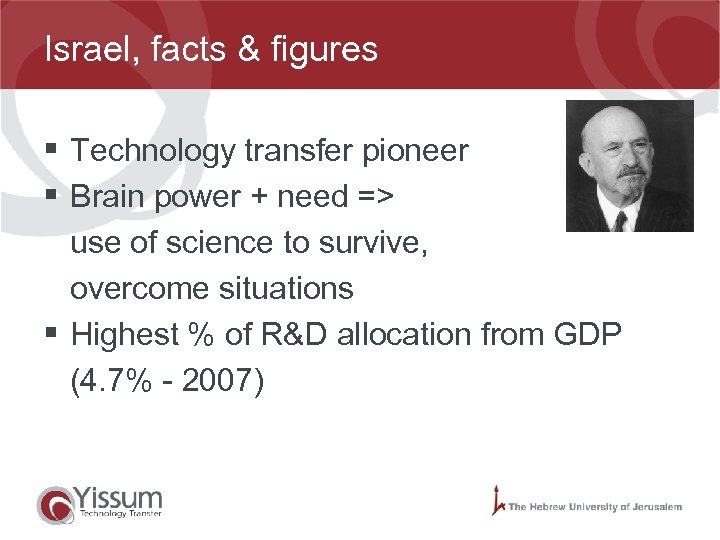
Israel, facts & figures § Technology transfer pioneer § Brain power + need => use of science to survive, overcome situations § Highest % of R&D allocation from GDP (4. 7% - 2007)
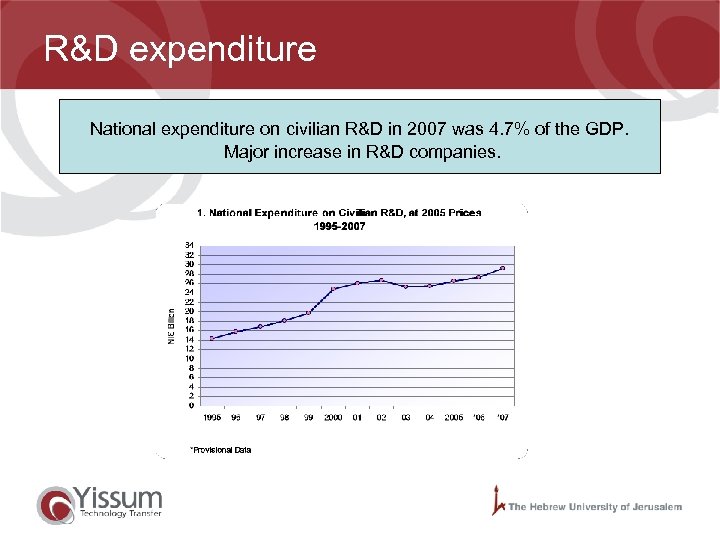
R&D expenditure National expenditure on civilian R&D in 2007 was 4. 7% of the GDP. Major increase in R&D companies.
Israel, facts & figures § § 1901 - TEVA’s foundation 1924 - The Technion (Polytechnic Institute) 1925 - The Hebrew University of Jerusalem Population with high scientific level, strong inclination to engineering and biological/medical sciences § Research units in hospitals – many experimental units § Access to…
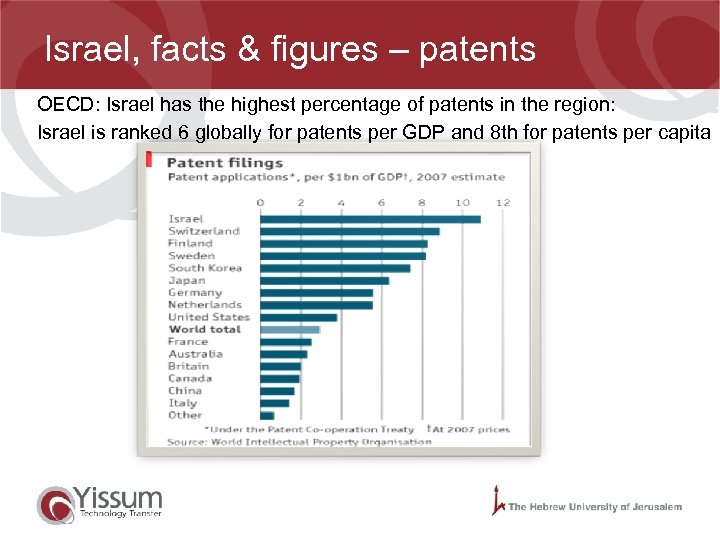
Israel, facts & figures – patents OECD: Israel has the highest percentage of patents in the region: Israel is ranked 6 globally for patents per GDP and 8 th for patents per capita
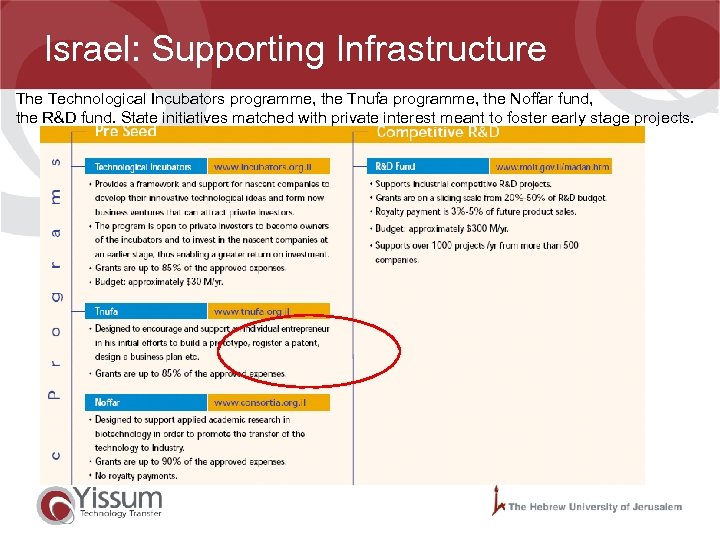
Israel: Supporting Infrastructure The Technological Incubators programme, the Tnufa programme, the Noffar fund, the R&D fund. State initiatives matched with private interest meant to foster early stage projects.
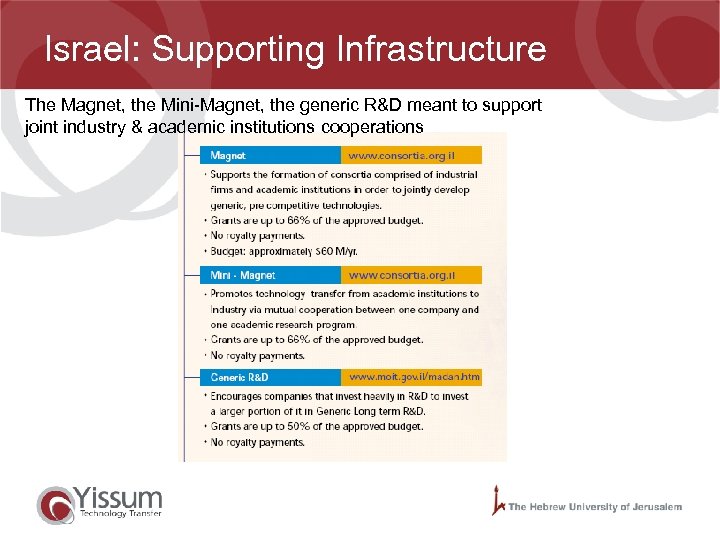
Israel: Supporting Infrastructure The Magnet, the Mini-Magnet, the generic R&D meant to support joint industry & academic institutions cooperations
Israeli Universities § Tech Transfer since 1959 (much before the Bayh. Dole act in the US!) § At all 7 universities & many research institutions, hospitals § Yeda: one of the wealthiest in the world § Yissum: 15 th in the world
Success stories – a sample § Yeda: § Bio-Hep B®, recombinant hepatitis B vaccine § Copaxone®, 1 st. Innovative drug in Israel, MS immunomodulator § Dunaliella®, β carotene health food form alga § NDS Ltd. , Encryption Algorithm, TV set-top box smart cards § Erbitux ®, Antibody therapy with synergism with chemotherapy § Technion: § Azilect®, Parkinsons Disease § And many others
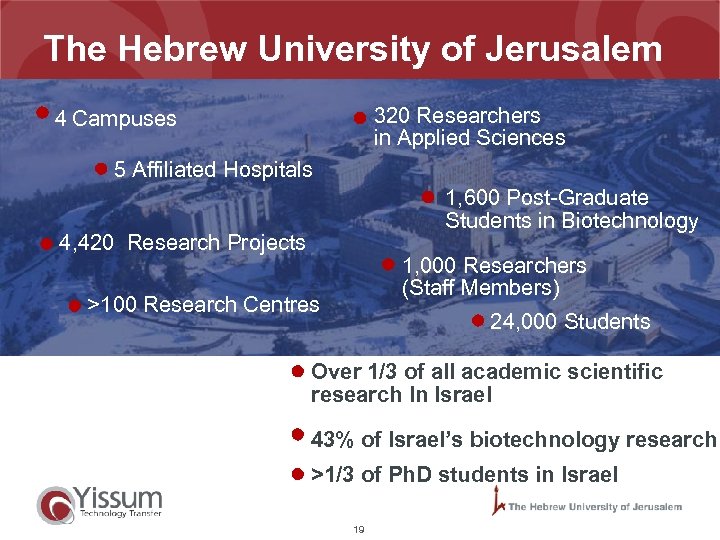
The Hebrew University of Jerusalem 320 Researchers in Applied Sciences 4 Campuses 5 Affiliated Hospitals 1, 600 Post-Graduate Students in Biotechnology 4, 420 Research Projects 1, 000 Researchers (Staff Members) >100 Research Centres 24, 000 Students Over 1/3 of all academic scientific research In Israel 43% of Israel’s biotechnology research >1/3 of Ph. D students in Israel 19
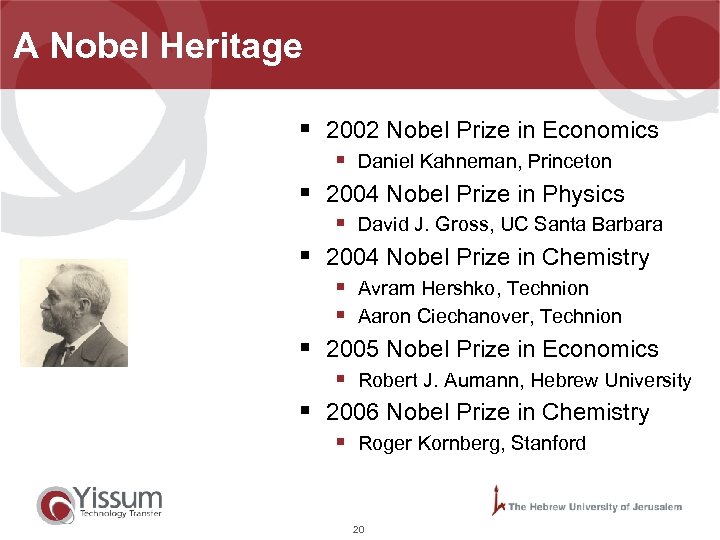
A Nobel Heritage § 2002 Nobel Prize in Economics § Daniel Kahneman, Princeton § 2004 Nobel Prize in Physics § David J. Gross, UC Santa Barbara § 2004 Nobel Prize in Chemistry § Avram Hershko, Technion § Aaron Ciechanover, Technion § 2005 Nobel Prize in Economics § Robert J. Aumann, Hebrew University § 2006 Nobel Prize in Chemistry § Roger Kornberg, Stanford 20
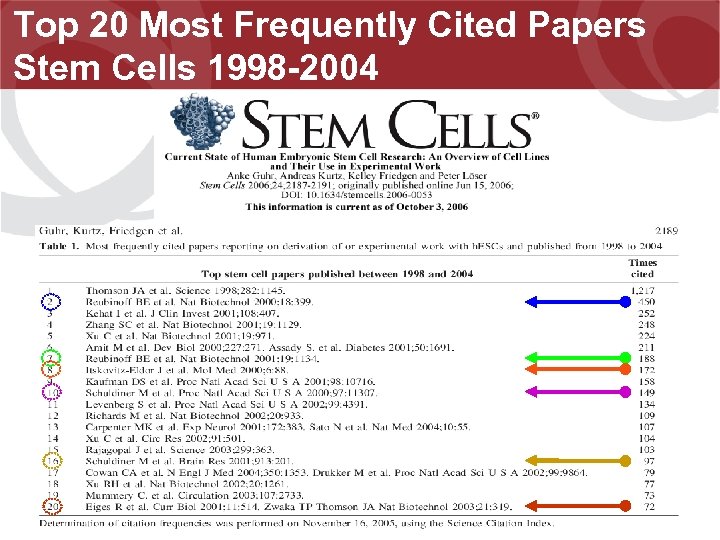
Top 20 Most Frequently Cited Papers Stem Cells 1998 -2004 21
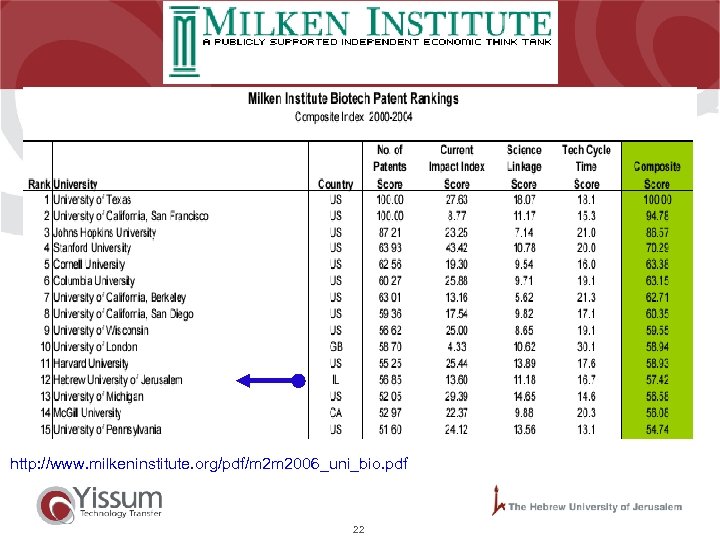
http: //www. milkeninstitute. org/pdf/m 2 m 2006_uni_bio. pdf 22
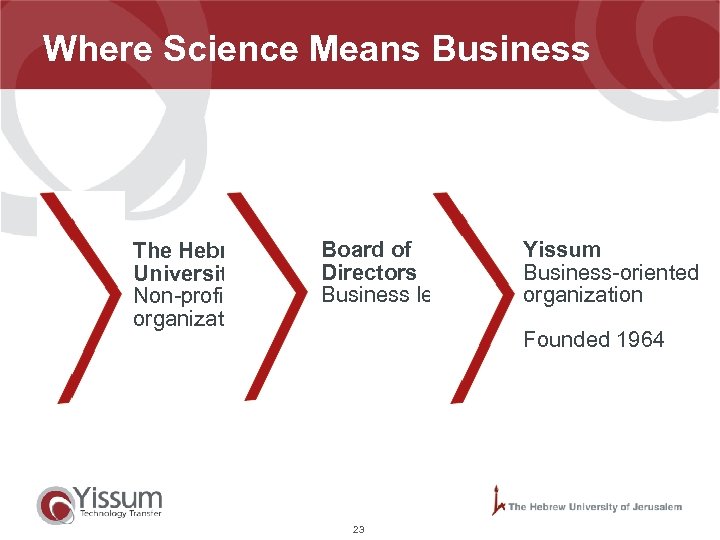
Where Science Means Business The Hebrew University Non-profit organization Board of Directors Business leaders Yissum Business-oriented organization Founded 1964 23
University Strategy § Created a positive atmosphere at the § § University Established good and clear policies as an incentive to researchers Budget incentives New opportunities Awards/prizes for achievements
Yissum’s Mission To promote the transfer of Hebrew University technology for the benefit of society, while maximizing returns to support research, education and scientific excellence Yissum = Hebrew for ‘application’ 25
It’s not that simple! § Academic world § Business world (Industry, VCs, Start-ups) (to say nothing about market instabilities…) § Intellectual Property legal world § Contracts – legal/commercial world The rules of the games are different.
Yissum’s strategy § Identifies the right situations - matching needs & opportunities § Identifies the key elements – to move the project forward § Flexibility § Professionalism § With no interference in the academic freedom!
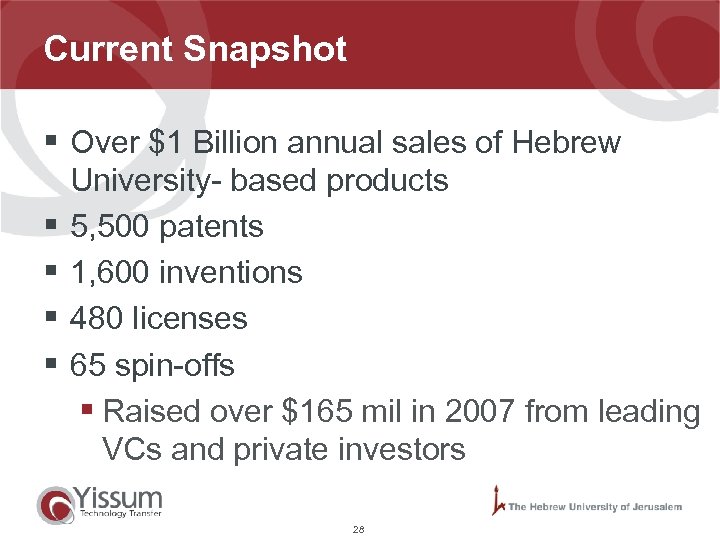
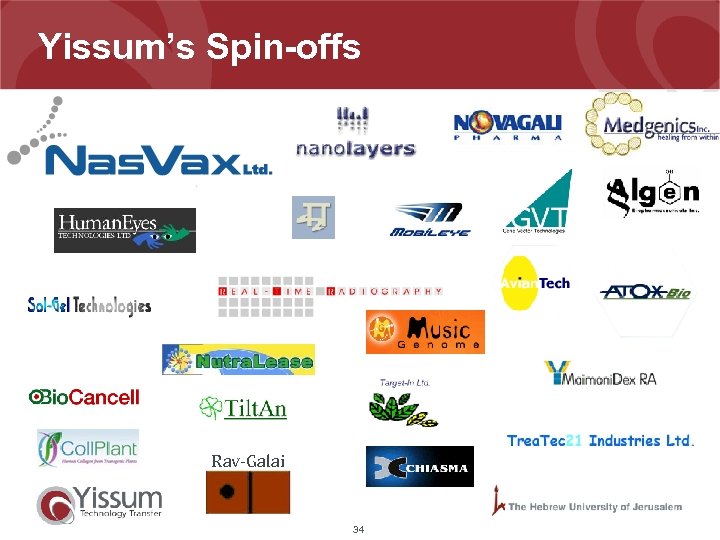
Current Snapshot § Over $1 Billion annual sales of Hebrew § § University- based products 5, 500 patents 1, 600 inventions 480 licenses 65 spin-offs § Raised over $165 mil in 2007 from leading VCs and private investors 28
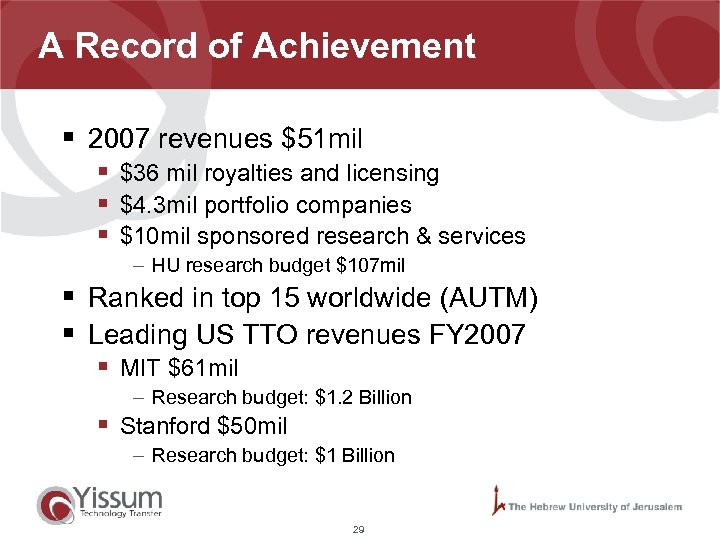
A Record of Achievement § 2007 revenues $51 mil § $36 mil royalties and licensing § $4. 3 mil portfolio companies § $10 mil sponsored research & services - HU research budget $107 mil § Ranked in top 15 worldwide (AUTM) § Leading US TTO revenues FY 2007 § MIT $61 mil - Research budget: $1. 2 Billion § Stanford $50 mil - Research budget: $1 Billion 29
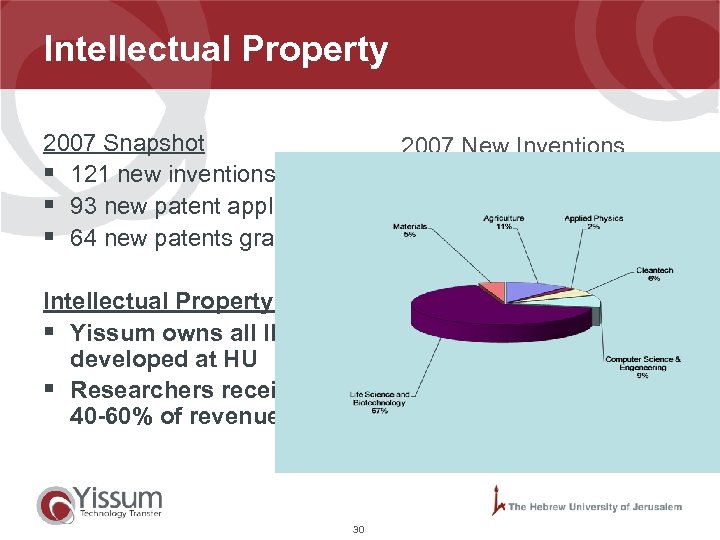
Intellectual Property 2007 Snapshot § 121 new inventions § 93 new patent applications § 64 new patents granted Intellectual Property at HU § Yissum owns all IP developed at HU § Researchers receive 40 -60% of revenues 30 2007 New Inventions
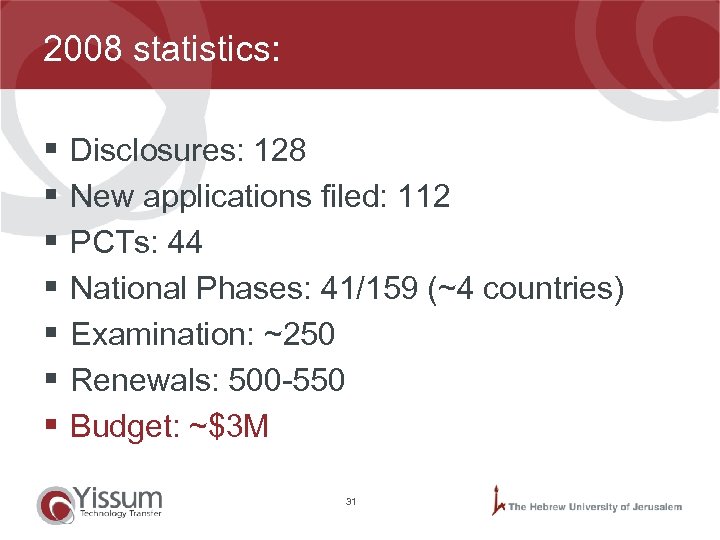
2008 statistics: § Disclosures: 128 § New applications filed: 112 § PCTs: 44 § National Phases: 41/159 (~4 countries) § Examination: ~250 § Renewals: 500 -550 § Budget: ~$3 M 31
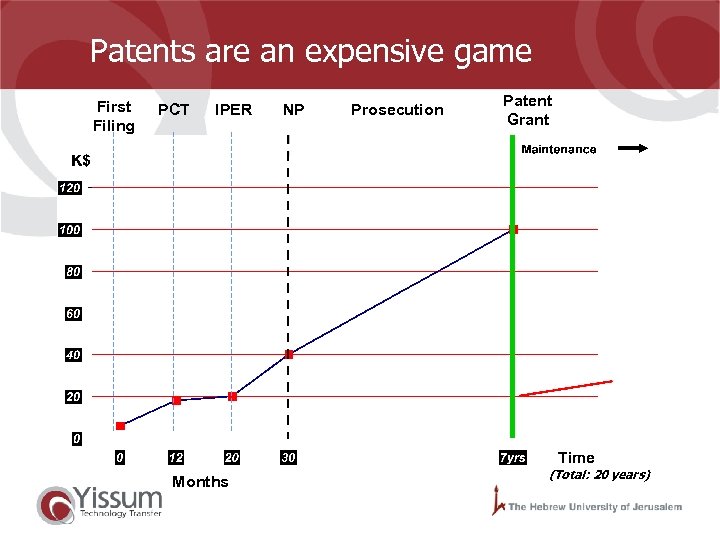
Patents First Filing PCT are an expensive game IPER Months NP Prosecution Patent Grant (Total: 20 years)
Global Reach 33
Yissum’s Spin-offs Rav-Galai 34
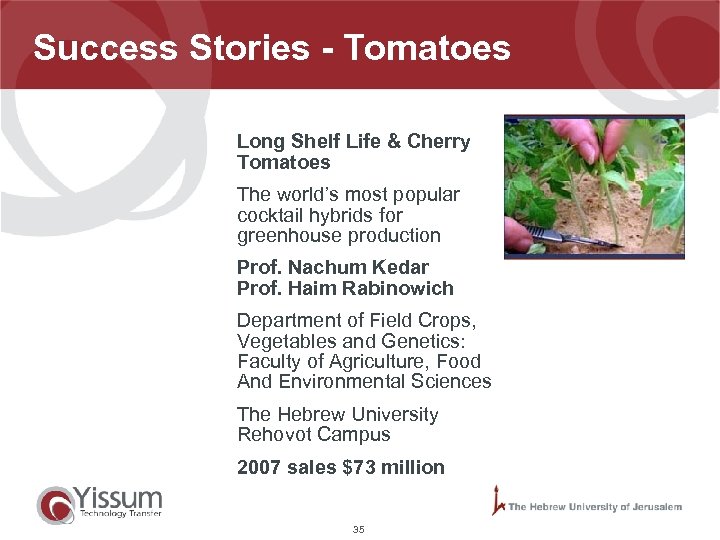
Success Stories - Tomatoes Long Shelf Life & Cherry Tomatoes The world’s most popular cocktail hybrids for greenhouse production Prof. Nachum Kedar Prof. Haim Rabinowich Department of Field Crops, Vegetables and Genetics: Faculty of Agriculture, Food And Environmental Sciences The Hebrew University Rehovot Campus 2007 sales $73 million 35

36
Success Stories - Doxil DOXIL® Doxorubicin HCI liposome injection Alza’s Lead Product for Oncology Prof. Yechezkel Barenholz Department of Biochemistry Faculty of Medicine The Hebrew University Of Jerusalem 2007 sales $417 million 37
Success Stories - Exelon For Treatment of Alzheimer’s Disease and Dementia Prof. Marta Weinstock-Rosin Department of Pharmacology Faculty of Medicine The Hebrew University Of Jerusalem 2007 sales $632 million 38
Food for thought § Will emphasis on tech transfer change nature of research from “discovery” to “applied”? § Will need to collaborate with industry be allowed to inhibit publication and dissemination of results?
Food for thought § Will “privatization” of research results retard the progress of science? § Will the universities remember their public mission—taking care that IP is used primarily for the public good?
Food for thought § Will the decrease in government investments in research create a dependency from commercial sources? § Will this deviate universities from their missions? It will certainly require a coordinated effort and thought of all involved parts!
Conclusion: § Is it worth the effort? § So far, our experience has been positive!
Thank you for your attention! 43
Скачать презентацию Where Science Means Business The case of Yissum
2314e8925c9403eb17de15f2f163d9f2.ppt