


 Скачать презентацию WHERE S RUSSIA WAY OF EDUCATION Secondary school
a61dba7422b6b645179ec61b4fe7932a.ppt
- Количество слайдов: 11
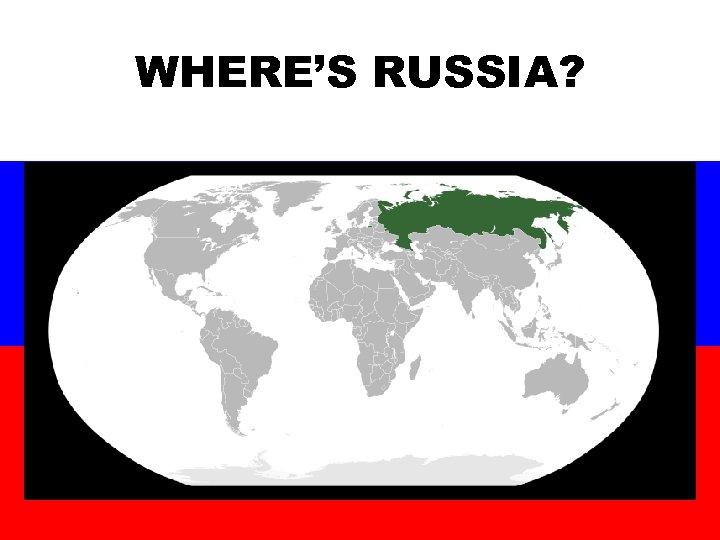 WHERE’S RUSSIA?
 WAY OF EDUCATION Secondary school Secondary education in Russia takes either ten (skipping the 4 th form) or eleven years to complete, depending on the school. After graduation from the 9 th grade, which is compulsory for all Russian citizens, a pupil obtains a Certificate of Incomplete Secondary Education. After that a pupil has to choose one of the following ways to complete his secondary education: to continue education for two more years at the secondary school or to pursue an associate degree at a Community College. The latter variant usually takes three to four years to complete but provides a pupil with educational qualification that is sufficient for most blue-collar jobs
 Community Collage After obtaining a Certificate of Complete Secondary Education a student can enter a University or a Community College. At a Community College students with complete secondary education can obtain an Associate Degree in one or two years. A student can choose a program of higher education with a duration of four to six years. There are three different degarees that are conferred by Russian universities: Bachelor's Degree (4 years), Specialist's Degree (5– 6 years), and Master's Degree (6 years). Bachelor's and Master's degrees were introduced relatively recently; they did not exist during the Soviet period. Even now they are not offered by many six-year institutions.
 "5" is the best mark, "2" is the worst. Technically. a grade of "1" is the worst grade, but over time, it has been phased out and now is so rarely given that it is basically equivalent to not just a failing grade, but failing "with distinction". This system is not compulsory and in rare cases, for example, a 10 -grade scale can be used.
 Unified State Exam This type of examination was adopted recently. It is a test which is passed at the end of 9 th and 11 th form. It consists of three parts: part A contains tasks where the student has to pick out the correct answer out of several, in part B the correct answer should be written in one word, and no variants are given, and in Part C the student has to write the full solution (as in mathematics) or a composition (as in literature). The answers are written on special blanks, digitally scanned, with parts A and B being checked automatically by the computer software.
 An excellent score ranges, depending on the subject, from 65 (mathematics) to 90 (foreign language) out of 100.
 AUTORS:
 THE END