


 Скачать презентацию Where is my child going to live Creating
53e442ba66dda653d114a5fd1fdc0c8a.ppt
- Количество слайдов: 24
 Where is my child going to live? Creating not just a house but a home Texas Transition Conference 2011 Rosemary Alexander, Ph. D
 What is your ideal home? Safe Comfortable and friendly Convenient Within my budget Provides supports as needed Opportunities for friendship and learning
 A house + supports A home is not just a house It's a system of supports A place for relationships, learning, caring, work, recreation, fun It's integrated into a community
 Overall long-term goal: A home for our children that is Sustainable after parents are gone Provides safety Is the basis for high quality of life
 What are the options for a place to live? A continuum: Institutional settings Group homes Dedicated communities Family/foster family Shared residence
 Institutional settings Residents: Large number Staff: large number on shifts Owner: state—a public facility Paid for: by the state Decision makers: the state
 Group homes Residents: 4 -6 Staff: small number, 24 hour awake staff Owner: private provider Paid for: State through MHMR, Medicaid Decision makers: the state, private provider
 Dedicated communities Residents: any #, say 10 -200 Staff: appropriate ratio, live there Owner: privately owned Paid for: public + private Decision makers: owner, provider, individuals, community
 Family/foster family Residents: family sized, natural mix of people Staff: family, lives there, helpers in & out Owner: family, owns or rents Paid for: private + public, individual Decision makers: family, individuals
 Shared residence Residents: natural mix of 1 -3 people Staff: family or just individuals, with helpers in & out Owner: individuals or family, owns or rents Paid for: private + public, individual Decision makers: individuals, household
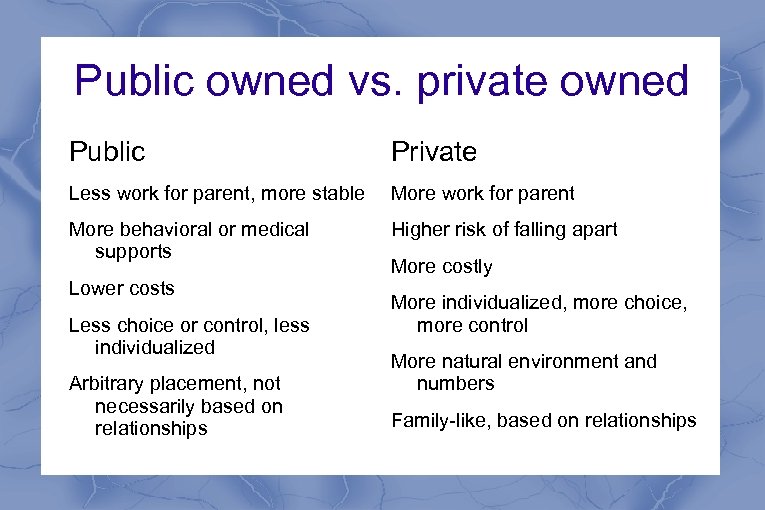 Public owned vs. private owned Public Private Less work for parent, more stable More work for parent More behavioral or medical supports Higher risk of falling apart Lower costs Less choice or control, less individualized Arbitrary placement, not necessarily based on relationships More costly More individualized, more choice, more control More natural environment and numbers Family-like, based on relationships
 Examples: group homes ICFMR—Intermediate Care Facility— 6 + residents HCS--provided by the Medicaid Waiver Program Home and Community–based Services, maximum of 4 residents
 Examples: dedicated communities Down Home Ranch, near Austin (40 residents, 20 with disabilities) Marbridge Ranch, near Austin (6 cottages of 14 each , a dorm, a nursing home) New Danville, near Houston (planning stages, many faceted)
 Examples: family/foster family HCS Foster family model—HCS Wavier Program pays a family to care for a person with a disability, either own parent or another family Shared parenting through CLASS program
 Examples: shared residences Lawrence, Kansas, the Turnbull's son lived in a house purchased through Section 8 Housing, shared with students from nearby university for 20 years Austin home, purchased by parent, 3 residents, using waivers creatively to provide supports
 Parent to Parent Co-op housing A small group of parents with similar needs for their children, create a living environment where expenses, values, staff are shared House rented or owned Responsibilities coordinated and shared by parents Alternative to a group home
 Renting Foundation Communities for low-income housing in Austin/Dallas-Ft Worth Mary Lee Foundation Section 8 Housing, run by HUD and local public housing authority, rent subsidy Jointly renting a house or apartment, use SSI to pay rent
 Owning your home HOYO—Home of Your Own Habitat for Humanity Inheriting parent's home Jointly owning a house Section 8 Housing and other programs may provide assistance to 1 st time buyers
 Co-housing (cohousing. org) Kaleidoscope Village—Austin, private homes with shared community, resources Generations of Hope—Illinois, for foster and adoptive families, retirees Henns of Ohio gained control of an HCS owned and operated home through a parent advisory board
 Intentional community Way to share resources, create social opportunity, often based on a common belief or purpose L'Arche—family-like homes where people with and without disabilities share their lives together
 L'Arche. . . persons with disabilities possess inherent qualities of welcome, wonderment, spirituality, and friendship. . . L’Arche believes that these qualities, expressed through vulnerability and simplicity, actually make those with a disability our real teachers about what is most important in life: to love and to be loved.
 Where to start Be sure your child is set to access the resources that are available: SSI/Medicaid at age 18: less than $2000 in liquid assets (special needs trust? ) Contact local mental health authority Child's name on the Medicaid Waiver Program waiting lists; if on the list already, know what number
 Where to start Use the school years for your child to learn independent living skills social skills vocational skills academic skills
 Where to start Create a vision for your child's future Learn about models, local and beyond Join or start parent groups focused on home issues Share your vision with your general community