


 Скачать презентацию Where How When What Why 2017 -18 Who
d566f96a68392e9e1944de58784d9a37.ppt
- Количество слайдов: 22
 Where? How? When? What? Why? 2017 -18 Who? Managerial Economics Stefan Markowski Market structures and conduct Competition and contestability The economics of competitive advantage
 Detailed course schedule Day no Topic Textbook ch. 1 (24 Nov; 3 hrs) 1. Introduction. Decision making process and its elements. The scope of economic decision making. Application of marginal analysis Chs. 1 -2 2 3 3 3 2. Demand analysis and demand elasticities Ch. 3 3. Buyer product valuation and choices. Consumer surplus. Buyer pricing decisions Ch. 4 4 (27 Nov; 2 hrs) 4. Production/transformation process. Production technologies and input-output structure Ch. 5 5 (28 Nov; 2 hrs) 5. Cost structure and cost drivers of producer pricing strategies. Production scale and scope. Chs. 5 and 7 6 (1 Dec; 3 hrs) 6. Structure-conduct-performance. Market structures: competition and contestability. Pricing strategies of buyers and sellers Ch. 8 7 (2 Dec; 3 hrs) 7. Market structures: monopoly/monopsony, monopolistic competition and oligopoly. Pricing strategies and strategic behaviour Chs. 9 -10 8 (3 Dec; 3 hrs) 8. Input sourcing and investment. Pricing and market power Chs. 6 and 11 9 (4 Dec; 2 hrs) 9. Decision making under conditions of uncertainty. Informational asymmetries and risk management Ch. 12 10 (5 Dec; 2 hrs) 10. Market research and market analysis. Auction and rings. Strategic behaviour Ch. 13 11 (8 Dec; 2 hrs ) 12 (9 Dec; 2 hrs) 11. Public sector perspective Ch. 14 12. Revision 13. Examination 13 (11 Dec; 2 hrs) Examination (25 Nov; hrs) (26 Nov; hrs)
 Topic 6: Structure-conduct-performance Market structures: competition and monopoly/monopsony Pricing strategies of buyers and sellers Topic Contents 6. 1 Managerial perspective 6. 6 6. 2 Market exchange supply and demand model Alternatives to vertical integration 6. 7 Transfer pricing 6. 8 Competition and contestability 6. 9 Further reading 6. 3 Competitive market and efficient market exchange 6. 4 Distorted market exchange 6. 5 Make or buy decision - Vertical integration
 6. 1 Managerial Perspective • Market - any collection of buyers and sellers trading outputs produced for sale and inputs purchased for use in production. Markets facilitate multilateral forms of exchange • The firm is an organisation in which centralised management replaces the decentralised, impersonal forces of the market. A crucial issue is whether firms have market power • Price makers have a degree of market power and make use of it • Many firms act strategically to increase their market power by trying to change the environment in which they and their rivals are competing
 6. 1 Managerial Perspective • Different market structures are a stylised way of framing the mechanics of market interactions between buyers and sellers • What is emphasised here is the distribution of market power between buyers and sellers, which drives their business conduct and outcomes/preformance • Market power should not be confused with the number of active market participants • The benchmark of economic efficiency is the competitive market structure where neither buyers nor sellers can exercise market power to influence the market price
 6. 3 Market exchange: Supply and demand model • The supply-demand model is perhaps the most powerful of all tools/models used by economists • The interaction between the demand supply curves determines a unique (equilibrium) pricequantity combination at which there is neither excess demand nor excess supply
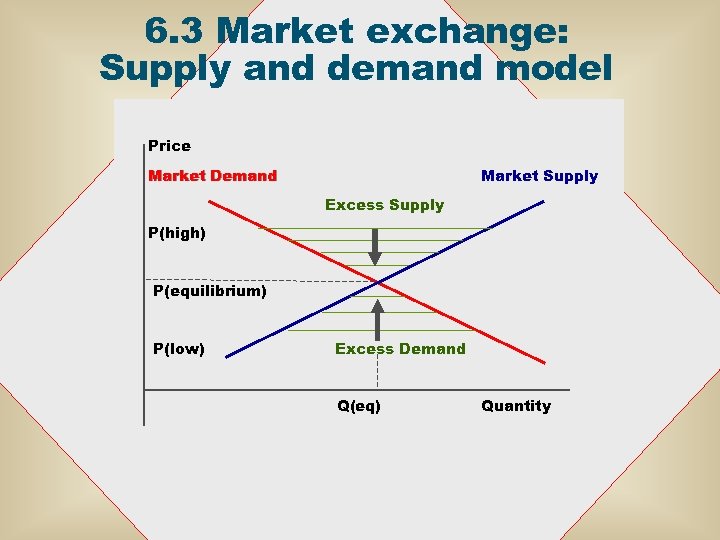 6. 3 Market exchange: Supply and demand model Price Market Demand Market Supply Excess Supply P(high) P(equilibrium) P(low) Excess Demand Q(eq) Quantity
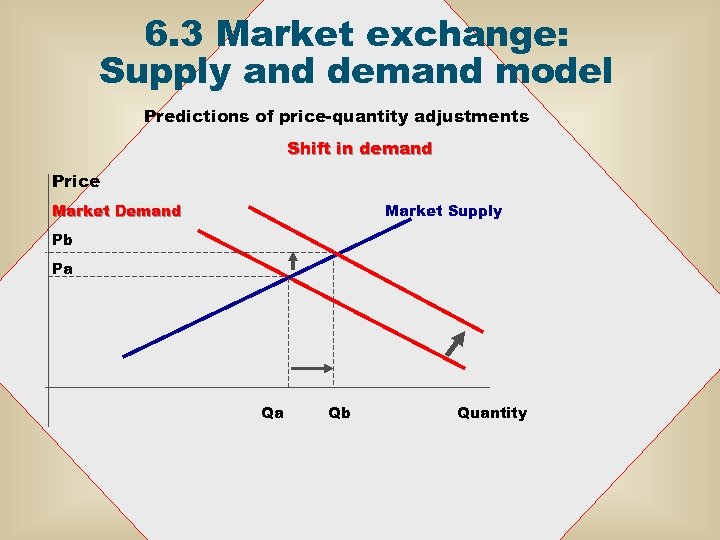 6. 3 Market exchange: Supply and demand model Predictions of price-quantity adjustments Shift in demand Price Market Demand Market Supply Pb Pa Qa Qb Quantity
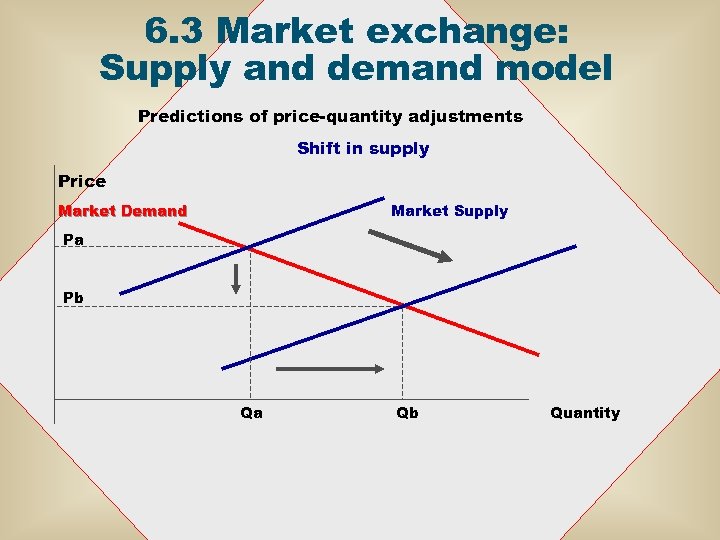 6. 3 Market exchange: Supply and demand model Predictions of price-quantity adjustments Shift in supply Price Market Demand Market Supply Pa Pb Qa Qb Quantity
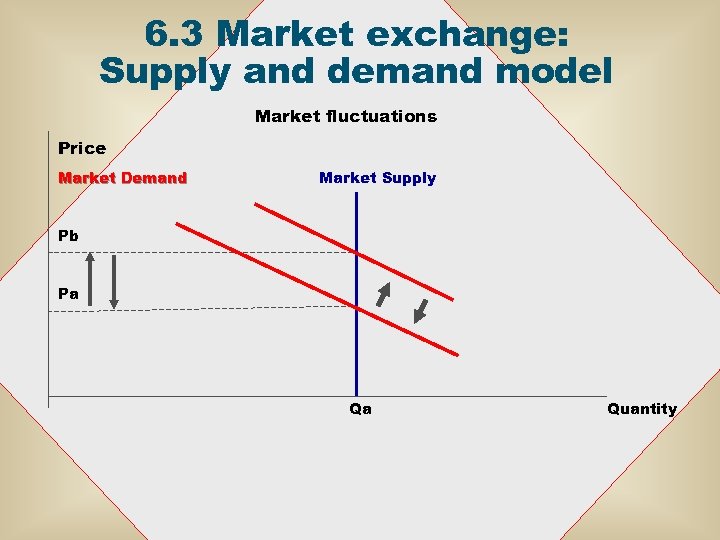 6. 3 Market exchange: Supply and demand model Market fluctuations Price Market Demand Market Supply Pb Pa Qa Quantity
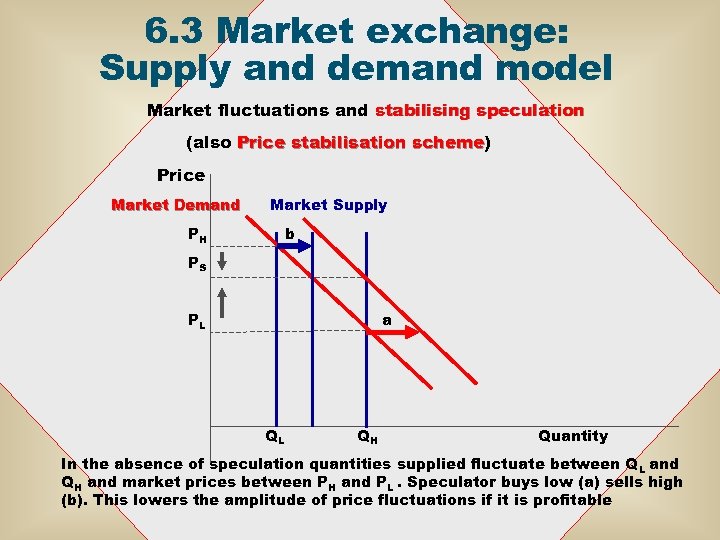 6. 3 Market exchange: Supply and demand model Market fluctuations and stabilising speculation (also Price stabilisation scheme) scheme Price Market Demand Market Supply PH b PS PL a QL QH Quantity In the absence of speculation quantities supplied fluctuate between Q L and QH and market prices between PH and PL. Speculator buys low (a) sells high (b). This lowers the amplitude of price fluctuations if it is profitable
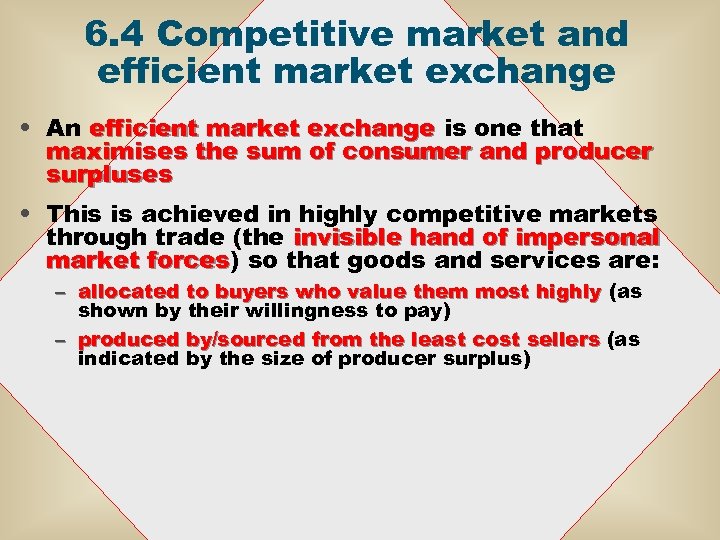 6. 4 Competitive market and efficient market exchange • An efficient market exchange is one that maximises the sum of consumer and producer surpluses • This is achieved in highly competitive markets through trade (the invisible hand of impersonal market forces) so that goods and services are: forces – allocated to buyers who value them most highly (as shown by their willingness to pay) – produced by/sourced from the least cost sellers (as indicated by the size of producer surplus)
 6. 5 Distorted market exchange • Impediments to free market exchange prevent buyers and sellers from realising the full potential of market interaction • Examples: – producer subsidy – tariffs – government price regulation
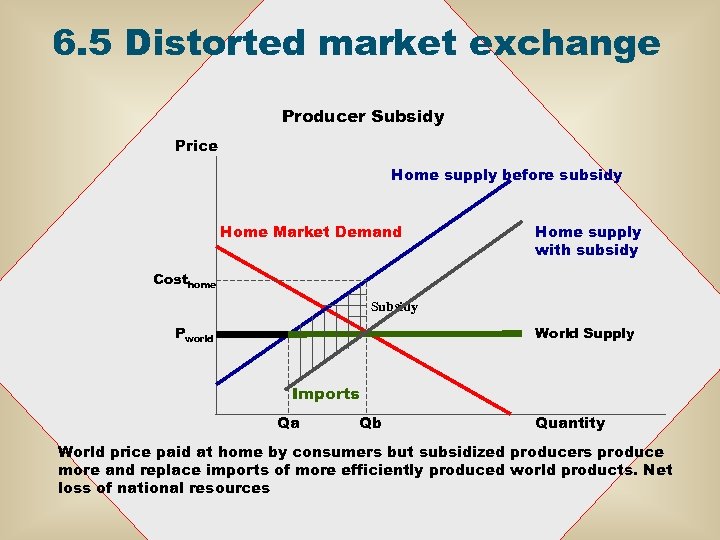 6. 5 Distorted market exchange Producer Subsidy Price Home supply before subsidy Home Market Demand Home supply with subsidy Costhome Subsidy Pworld World Supply Imports Qa Qb Quantity World price paid at home by consumers but subsidized producers produce more and replace imports of more efficiently produced world products. Net loss of national resources
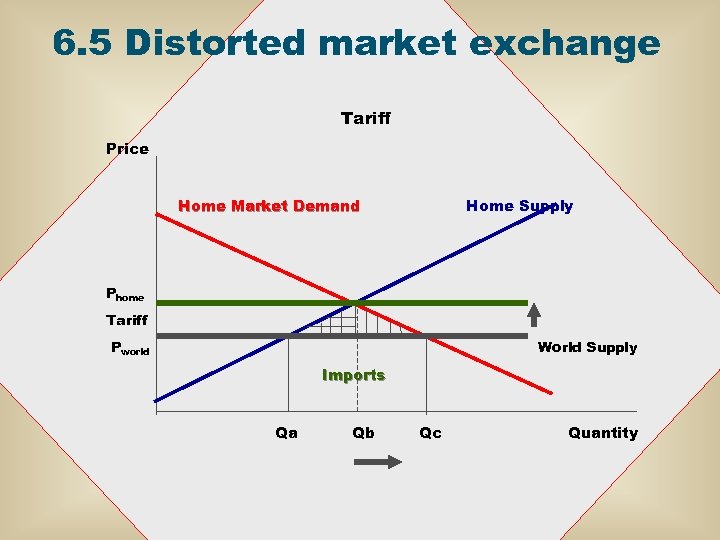 6. 5 Distorted market exchange Tariff Price Home Market Demand Home Supply Phome Tariff Pworld World Supply Imports Qa Qb Qc Quantity
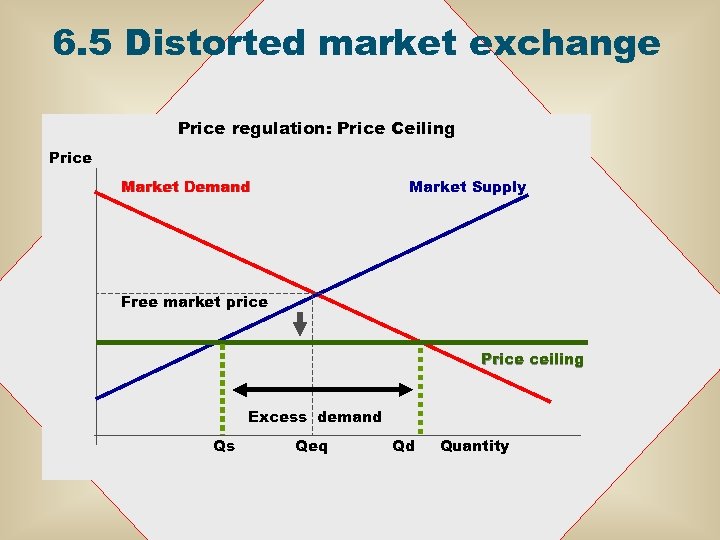 6. 5 Distorted market exchange Price regulation: Price Ceiling Price Market Demand Market Supply Free market price Price ceiling Excess demand Qs Qeq Qd Quantity
 6. 6 Make or buy decision: Vertical integration • Vertical integration - the consolidation of the production process/value adding chain under the control of a single corporate entity • Firms integrate vertically because – they seek more market power in input and/or output markets – or the cost of in-house production is less than that of sourcing similar inputs/components from suppliers • Firms may increase their market power by foreclosing the market through merger (a barrier to entry for competitors) • Vertical integration may – reduce their transaction cost of doing business with suppliers – or reduce the scope for opportunistic behaviour by suppliers • Quasi-vertical integration: contractual arrangements but no formal merger
 6. 7 Alternatives to vertical integration • Alternatives to vertical integration: – exclusive territories (may be combined with price ceilings and quotas) – exclusive dealerships (may be reinforced by warranties or after-sale support) – retail price maintenance (often illegal) – franchising
 6. 8 Transfer pricing • A vertically-integrated firm may adopt rules for internal resource allocation • Transfer pricing involves setting prices (in transfers between cost centres) for products which a firm produces for in-house • Transfer pricing decisions where: – there is an external, competitive market for the inhouse traded product – there is a market but it is not competitive – there is no external market for the product
 6. 9 Competition and contestability • Competitive market is a market where there are many atomistic buyers and sellers and none of these has market power to influence the market price or the volume of products traded • Perfectly competitive market - very large numbers of atomistic buyers and sellers, each buyer/seller operating as a utility/profit maximising price taker • A contestable market is a market where there are no significant barriers to entry and exit (no significant sunk costs) so that newcomers may enter and incumbents exit at a low cost • Decision rule MR = AR = P = MC s. t AC < AR
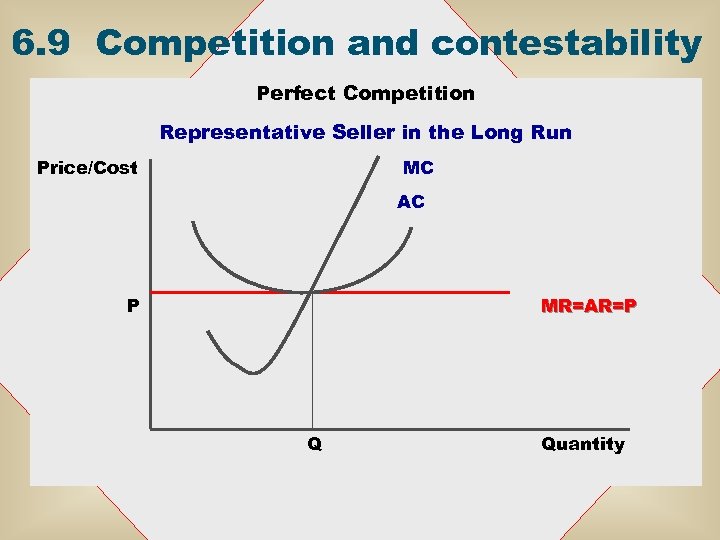 6. 9 Competition and contestability Perfect Competition Representative Seller in the Long Run Price/Cost MC AC P MR=AR=P Q Quantity
 6. 10 Further reading Baye (2010): chs. 7 -8 and 11