


 Скачать презентацию When the Wheels Fall Off UMass Older Driver
616c79892a3a94ed48b670dbd09611ad.ppt
- Количество слайдов: 32
 When the Wheels Fall Off UMass Older Driver Safety Summit Lissa Kapust MSW, Drive. Wise Program Director Beth Israel Deaconess Medical Center lkapust@bidmc. harvard. edu
 Overview • Experiential exercise • AFA video: This tells the “story” • Strategies to having “the conversation” • Drive. Wise 700 patients later • Clinical social work as “bookends” • Future directions and discussion
 AFA Award Winning Video “Your Time To Care; A Roadmap to Alzheimer’s Disease and Driving”
 Proactive Measures
 Having the Tough Conversations • Have conversations early, before the crisis • Have conversations often • Pick key family member • Add instructions to advance planning • “Bite size” pieces of reality • Involve health professionals
 Nobody wants to be the “bad guy” • Family • Friends • Neighbors • Physicians
 DRIVEWISE Beth Israel Deaconess Medical Center Division of Cognitive Neurology 617 667 -4074 Beth Israel Deaconess Medical Center
 To drive or not to drive: Preliminary results from road testing of patients with dementia Kapust LR, Weintraub S, 1992 • Case studies of patients with mild cognitive impairment • Neuropsychological testing • Social work evaluation • Different outcomes on road test • For the cognitively impaired, road test is important component of driving evaluation
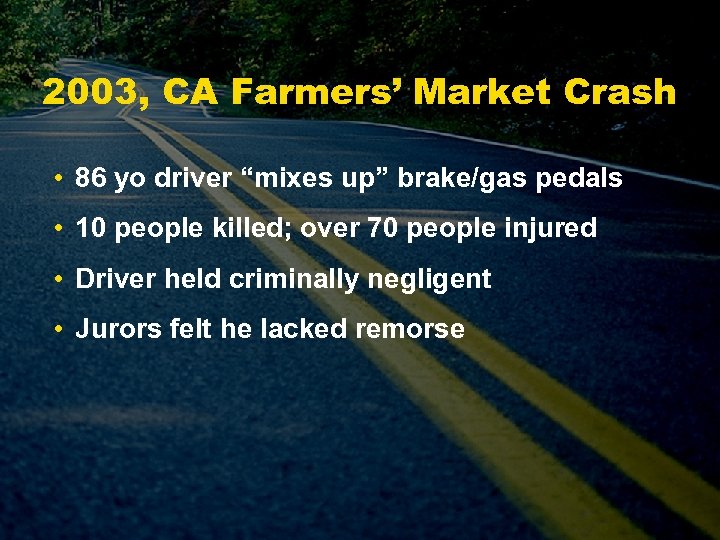 2003, CA Farmers’ Market Crash • 86 yo driver “mixes up” brake/gas pedals • 10 people killed; over 70 people injured • Driver held criminally negligent • Jurors felt he lacked remorse
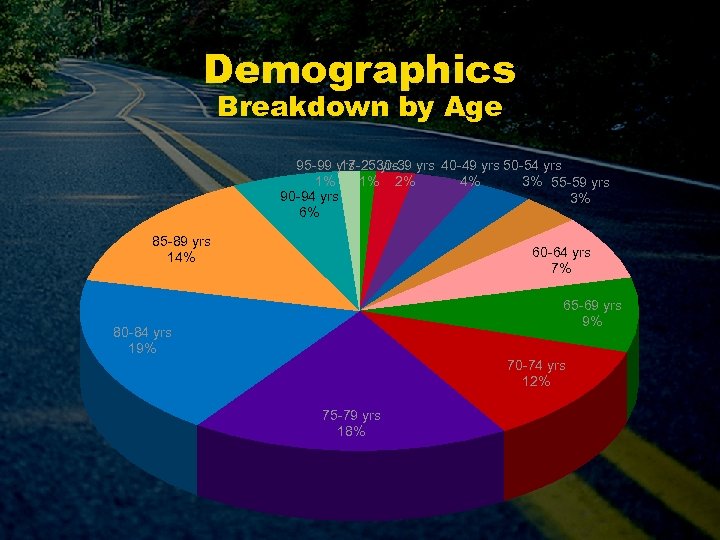 Demographics Breakdown by Age 95 -99 yrs 17 -2530 -39 yrs 40 -49 yrs 50 -54 yrs 1% 1% 2% 4% 3% 55 -59 yrs 90 -94 yrs 3% 6% 85 -89 yrs 14% 60 -64 yrs 7% 65 -69 yrs 9% 80 -84 yrs 19% 70 -74 yrs 12% 75 -79 yrs 18%
 Drive. Wise is the “Gold Standard” • Assesses driving performance on the basis of an on road evaluation • Interdisciplinary team approach in a medical -based setting • Provides supportive interventions for lifestyle changes related to driving safety • Research and education in addition to clinical practice
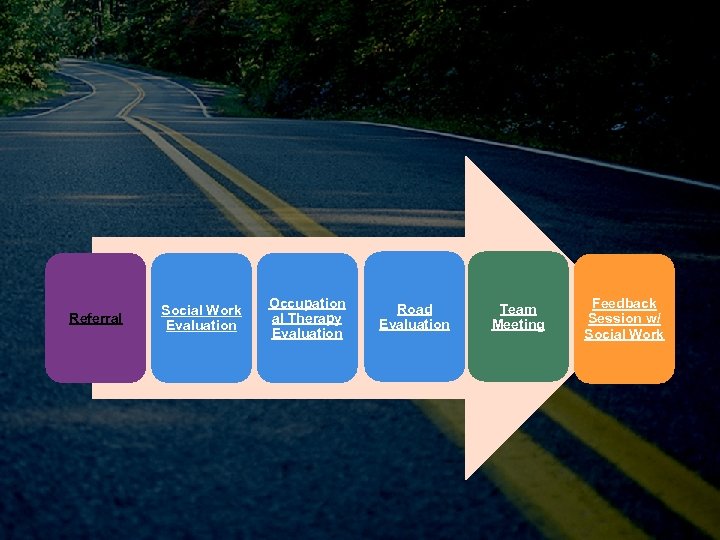 Referral Social Work Evaluation Occupation al Therapy Evaluation Road Evaluation Team Meeting Feedback Session w/ Social Work
 Social Work Evaluation • Review of the consent form – “The results of the driving evaluation may be shared with my physician, family member(s) designated, and if necessary with the RMV Medical Affairs office” • DW role in reporting to RMV
 Reporting to the RMV • Who can report? – Family members, physicians, law enforcement and other interested third parties (members of the community, private driving schools, physical therapists) – No guarantee of anonymity • Is there a legal requirement? – There is no legal requirement for a physician or other interested party to report
 Social Work Evaluation • Gather history and role of driving in the participant’s life • How are they driving? Have they called spouse to find way home? (crashes, near misses, getting lost) • Understand current emotional state, including recent losses and psychosocial stressors
 The voices of our patients
 “It was easier to learn I had cancer. ”
 “This is a pot of crock. I am not going to stop driving”
 “I survived Nazi Germany. Not driving is prison. ”
 Assessment Tool • Taking a driving history: The 4 C’s
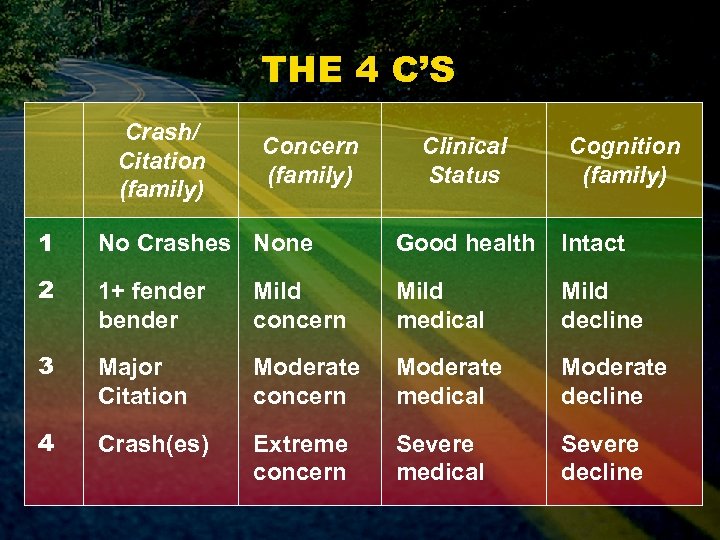 THE 4 C’S Crash/ Citation (family) Concern (family) Clinical Status Cognition (family) 1 No Crashes None Good health Intact 2 1+ fender bender Mild concern Mild medical Mild decline 3 Major Citation Moderate concern Moderate medical Moderate decline 4 Crash(es) Extreme concern Severe medical Severe decline
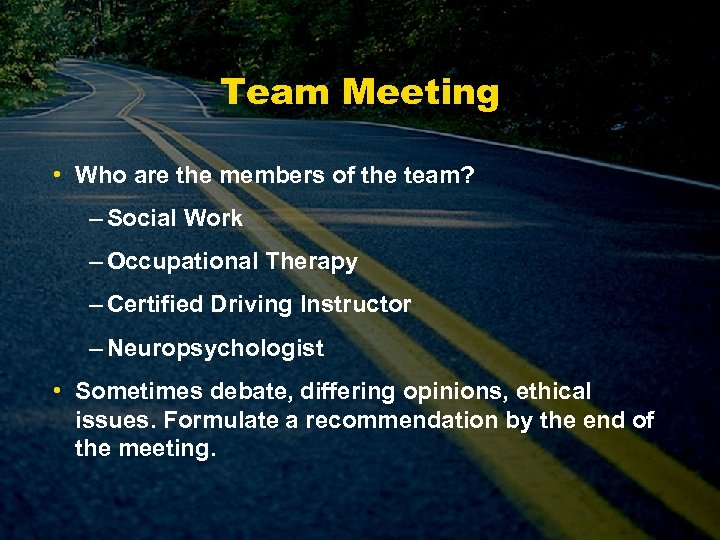 Team Meeting • Who are the members of the team? – Social Work – Occupational Therapy – Certified Driving Instructor – Neuropsychologist • Sometimes debate, differing opinions, ethical issues. Formulate a recommendation by the end of the meeting.
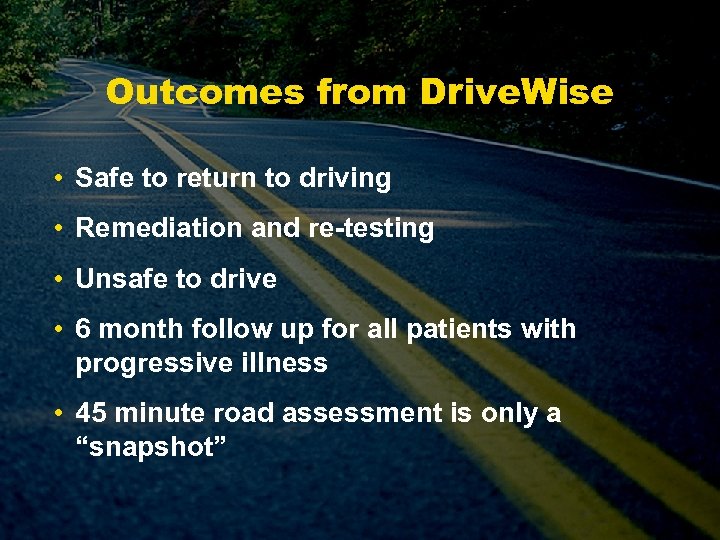 Outcomes from Drive. Wise • Safe to return to driving • Remediation and re-testing • Unsafe to drive • 6 month follow up for all patients with progressive illness • 45 minute road assessment is only a “snapshot”
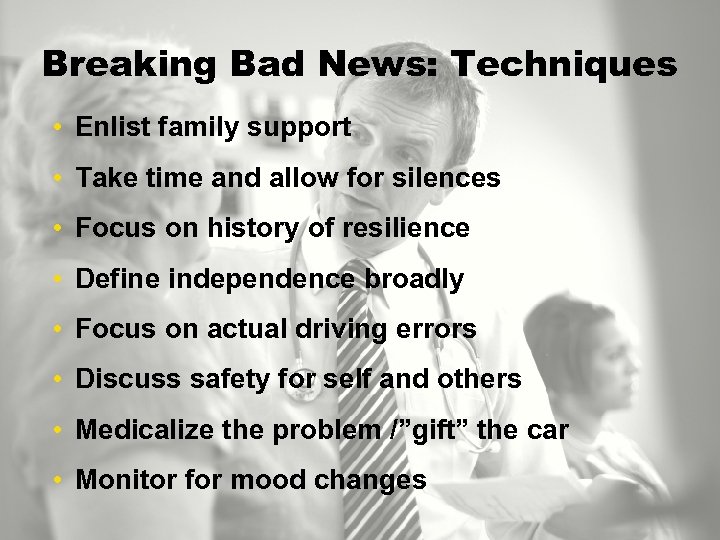 Breaking Bad News: Techniques • Enlist family support • Take time and allow for silences • Focus on history of resilience • Define independence broadly • Focus on actual driving errors • Discuss safety for self and others • Medicalize the problem /”gift” the car • Monitor for mood changes
 Warning Signs for Unsafe Driving • Getting lost • Can’t distinguish gas/brake • Inability to make quick decisions • Running on curbs • Can’t recognize road signs • Problems with left turns • Problems merging
 Future Directions • Bigger signs • Lighted signs • Wider striping • Broader use of “silver alert”
 Wellbeing Habilitation • Regular checkups • Current eye exams • Self monitor driving • Medication compliance • Ask others for input on driving
 Car habilitation • Good car maintanence • Use of seatbelts • Avoid distractions • When buying new cars consider pros/cons of new technology
 What our patients have taught us • The value of resilience • There is no “slam dunk” • Remediation can make a difference • Subjectivity is inevitable
 Take Home Message • Most of us will outlive our driving fitness by 7 -10 years • How will you plan for this in your life?
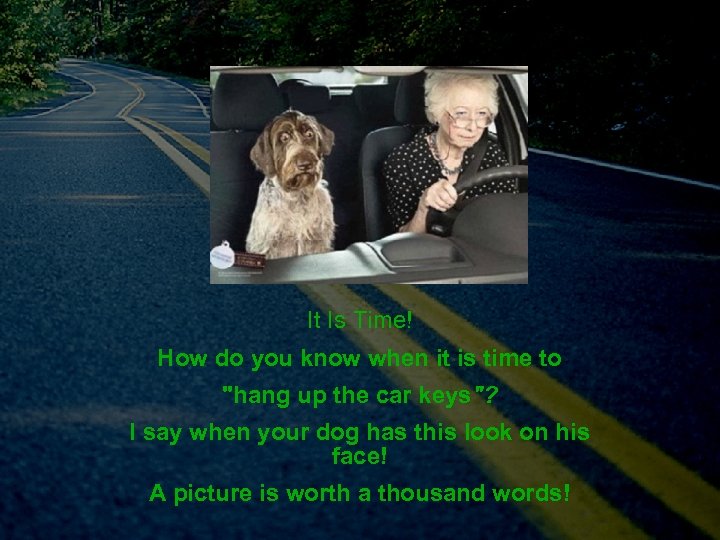 It Is Time! How do you know when it is time to "hang up the car keys"? I say when your dog has this look on his face! A picture is worth a thousand words!