 Скачать презентацию When s the Best Time to Invest Speaker s name
aa811d4c89db38b5e50b92e5b4715b06.ppt
- Количество слайдов: 32



When’s the Best Time to Invest Speaker’s name is 24 pt Speaker’s position is 24 pt Date IFS-A 052625 Ed. 02/2003
“When’s the Best Time to Invest? ” Neither the information contained herein nor any opinion expressed shall be construed as an offer to sell or a solicitation to buy any securities mentioned herein. Past performance is not indicative of future results. Securities products and services are offered through Pruco Securities Corporation, 751 Broad Street, Newark, NJ 07102 -3777; Prudential Securities Incorporated, 199 Water Street, New York, NY 10292; and Prudential Investment Management Services LLC (PIMS), Three Gateway Center, 14 th Floor, Newark, NJ 07102 -04077. All are Prudential Financial Companies and members SIPC. Prudential Financial is a service mark of The Prudential Insurance Company of America, Newark, NJ, and its affiliates. When’s the Best Time to Invest?
“Whenever You Have the Money” When’s the Best Time to Invest?
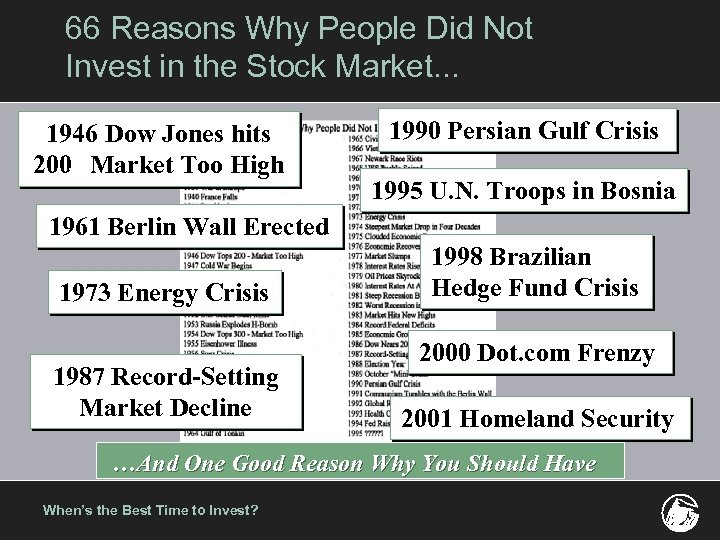
66 Reasons Why People Did Not Invest in the Stock Market. . . 1946 Dow Jones hits 200¾Market Too High 1990 Persian Gulf Crisis 1995 U. N. Troops in Bosnia 1961 Berlin Wall Erected 1973 Energy Crisis 1987 Record-Setting Market Decline 1998 Brazilian Hedge Fund Crisis 2000 Dot. com Frenzy 2001 Homeland Security …And One Good Reason Why You Should Have When’s the Best Time to Invest?
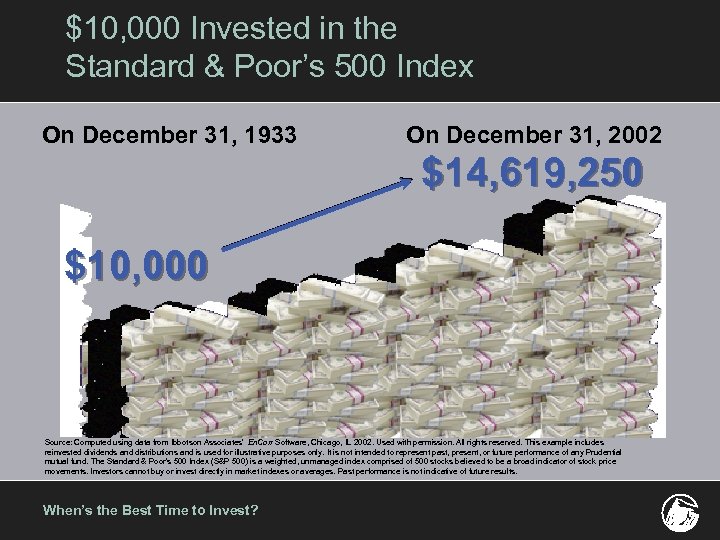
$10, 000 Invested in the Standard & Poor’s 500 Index On December 31, 1933 On December 31, 2002 $14, 619, 250 $10, 000 Source: Computed using data from Ibbotson Associates' En. Corr Software, Chicago, IL 2002. Used with permission. All rights reserved. This example includes reinvested dividends and distributions and is used for illustrative purposes only. It is not intended to represent past, present, or future performance of any Prudential mutual fund. The Standard & Poor's 500 Index (S&P 500) is a weighted, unmanaged index comprised of 500 stocks believed to be a broad indicator of stock price movements. Investors cannot buy or invest directly in market indexes or averages. Past performance is not indicative of future results. When’s the Best Time to Invest?
Stock Market Too VOLATILE to Invest Now… . . . Let’s Wait When’s the Best Time to Invest?
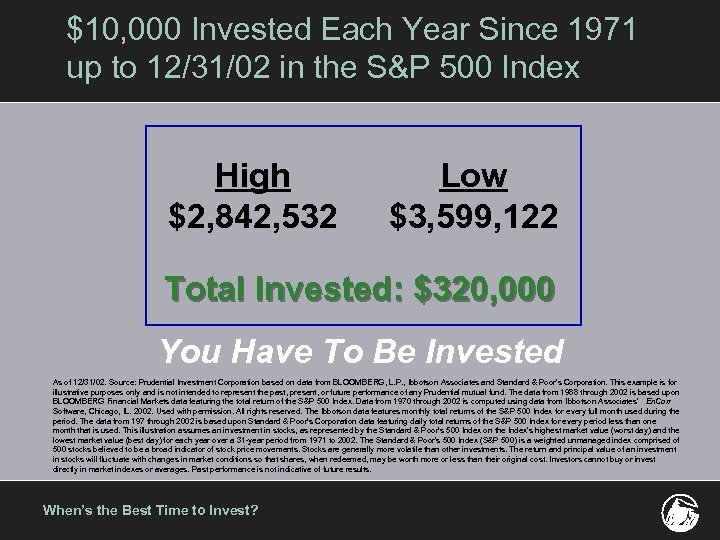
$10, 000 Invested Each Year Since 1971 up to 12/31/02 in the S&P 500 Index High $2, 842, 532 Low $3, 599, 122 Total Invested: $320, 000 You Have To Be Invested As of 12/31/02. Source: Prudential Investment Corporation based on data from BLOOMBERG, L. P. , Ibbotson Associates and Standard & Poor's Corporation. This example is for illustrative purposes only and is not intended to represent the past, present, or future performance of any Prudential mutual fund. The data from 1988 through 2002 is based upon BLOOMBERG Financial Markets data featuring the total return of the S&P 500 Index. Data from 1970 through 2002 is computed using data from Ibbotson Associates' En. Corr Software, Chicago, IL. 2002. Used with permission. All rights reserved. The Ibbotson data features monthly total returns of the S&P 500 Index for every full month used during the period. The data from 197 through 2002 is based upon Standard & Poor's Corporation data featuring daily total returns of the S&P 500 Index for every period less than one month that is used. This illustration assumes an investment in stocks, as represented by the Standard & Poor's 500 Index on the Index's highest market value (worst day) and the lowest market value (best day) for each year over a 31 -year period from 1971 to 2002. The Standard & Poor's 500 Index (S&P 500) is a weighted unmanaged index comprised of 500 stocks believed to be a broad indicator of stock price movements. Stocks are generally more volatile than other investments. The return and principal value of an investment in stocks will fluctuate with changes in market conditions so that shares, when redeemed, may be worth more or less than their original cost. Investors cannot buy or invest directly in market indexes or averages. Past performance is not indicative of future results. When’s the Best Time to Invest?
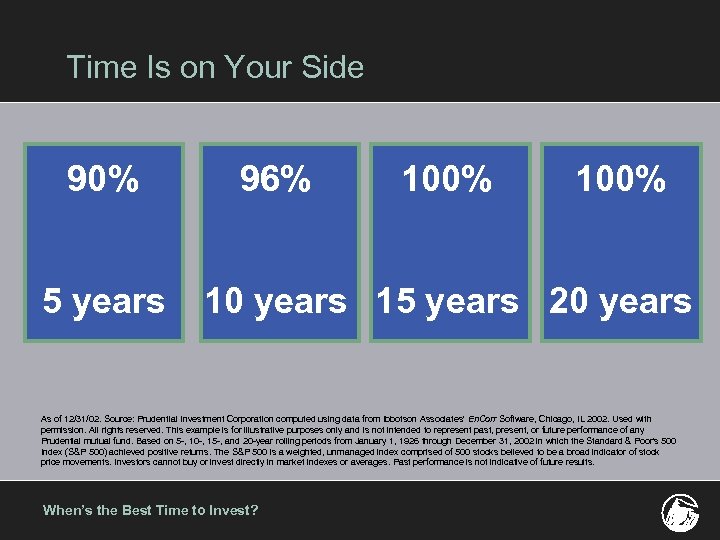
Time Is on Your Side 90% 5 years 96% 100% 10 years 15 years 20 years As of 12/31/02. Source: Prudential Investment Corporation computed using data from Ibbotson Associates' En. Corr Software, Chicago, IL 2002. Used with permission. All rights reserved. This example is for illustrative purposes only and is not intended to represent past, present, or future performance of any Prudential mutual fund. Based on 5 -, 10 -, 15 -, and 20 -year rolling periods from January 1, 1926 through December 31, 2002 in which the Standard & Poor's 500 Index (S&P 500) achieved positive returns. The S&P 500 is a weighted, unmanaged index comprised of 500 stocks believed to be a broad indicator of stock price movements. Investors cannot buy or invest directly in market indexes or averages. Past performance is not indicative of future results. When’s the Best Time to Invest?
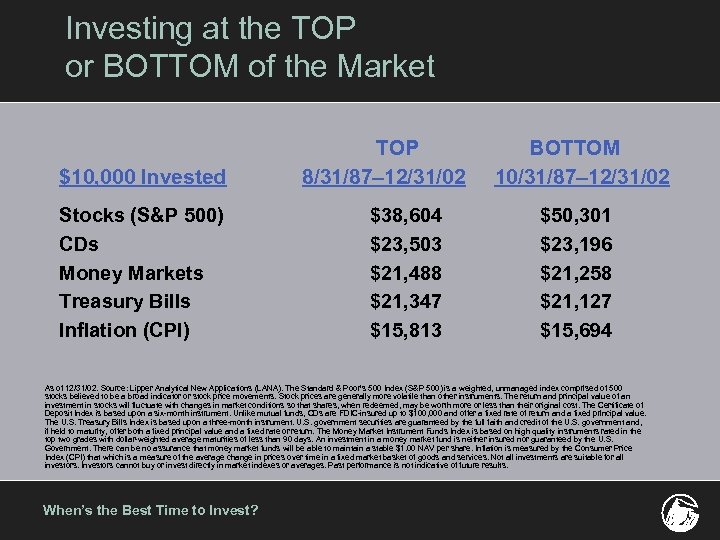
Investing at the TOP or BOTTOM of the Market $10, 000 Invested Stocks (S&P 500) CDs Money Markets Treasury Bills Inflation (CPI) TOP 8/31/87– 12/31/02 $38, 604 $23, 503 $21, 488 $21, 347 $15, 813 BOTTOM 10/31/87– 12/31/02 $50, 301 $23, 196 $21, 258 $21, 127 $15, 694 As of 12/31/02. Source: Lipper Analytical New Applications (LANA). The Standard & Poor's 500 Index (S&P 500) is a weighted, unmanaged index comprised of 500 stocks believed to be a broad indicator or stock price movements. Stock prices are generally more volatile than other instruments. The return and principal value of an investment in stocks will fluctuate with changes in market conditions so that shares, when redeemed, may be worth more or less than their original cost. The Certificate of Deposit Index is based upon a six-month instrument. Unlike mutual funds, CDs are FDIC-insured up to $100, 000 and offer a fixed rate of return and a fixed principal value. The U. S. Treasury Bills Index is based upon a three-month instrument. U. S. government securities are guaranteed by the full faith and credit of the U. S. government and, if held to maturity, offer both a fixed principal value and a fixed rate or return. The Money Market Instrument Funds Index is based on high quality instruments rated in the top two grades with dollar-weighted average maturities of less than 90 days. An investment in a money market fund is neither insured nor guaranteed by the U. S. Government. There can be no assurance that money market funds will be able to maintain a stable $1. 00 NAV per share. Inflation is measured by the Consumer Price Index (CPI) that which is a measure of the average change in prices over time in a fixed market basket of goods and services. Not all investments are suitable for all investors. Investors cannot buy or invest directly in market indexes or averages. Past performance is not indicative of future results. When’s the Best Time to Invest?
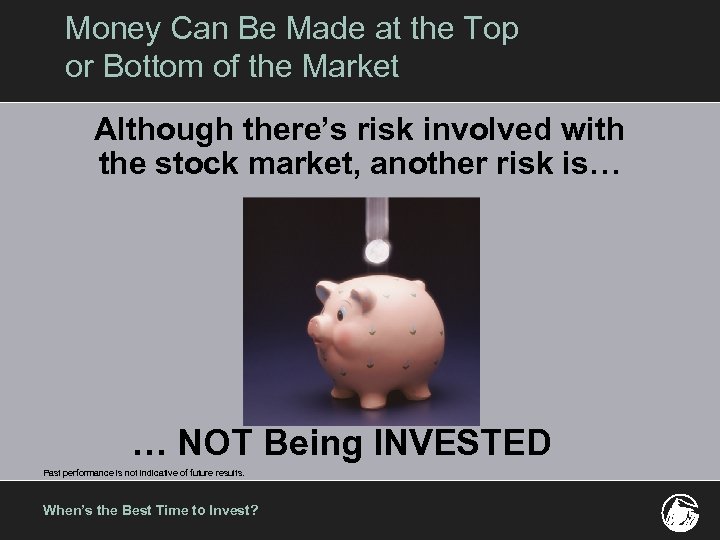
Money Can Be Made at the Top or Bottom of the Market Although there’s risk involved with the stock market, another risk is… … NOT Being INVESTED Past performance is not indicative of future results. When’s the Best Time to Invest?
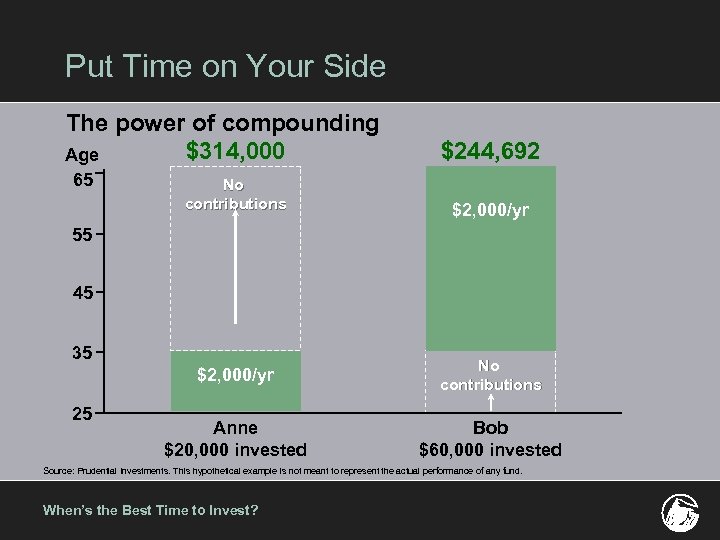
Put Time on Your Side The power of compounding $314, 000 Age 65 No contributions $244, 692 $2, 000/yr 55 45 35 $2, 000/yr 25 No contributions Anne $20, 000 invested Bob $60, 000 invested Source: Prudential Investments. This hypothetical example is not meant to represent the actual performance of any fund. When’s the Best Time to Invest?
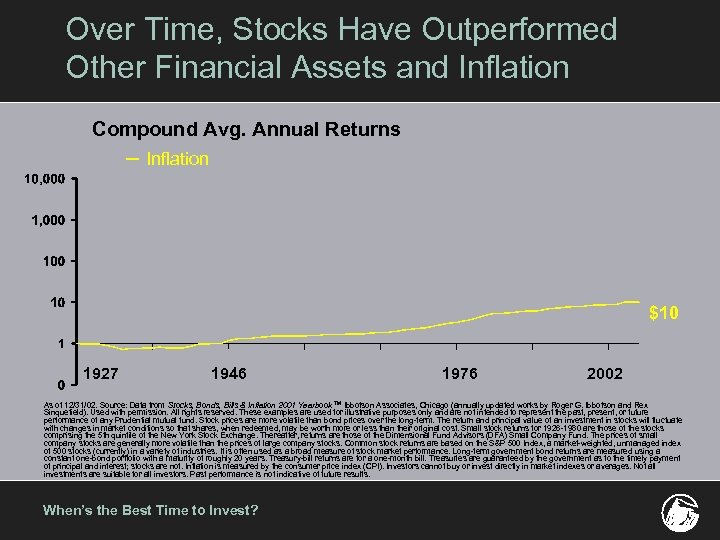
Over Time, Stocks Have Outperformed Other Financial Assets and Inflation Compound Avg. Annual Returns – Inflation $10 1927 1946 1976 2002 As of 12/31/02. Source: Data from Stocks, Bonds, Bills & Inflation 2001 Yearbook TM Ibbotson Associates, Chicago (annually updated works by Roger G. Ibbotson and Rex Sinquefield). Used with permission. All rights reserved. These examples are used for illustrative purposes only and are not intended to represent the past, present, or future performance of any Prudential mutual fund. Stock prices are more volatile than bond prices over the long-term. The return and principal value of an investment in stocks will fluctuate with changes in market conditions so that shares, when redeemed, may be worth more or less than their original cost. Small stock returns for 1926 -1980 are those of the stocks comprising the 5 th quintile of the New York Stock Exchange. Thereafter, returns are those of the Dimensional Fund Advisors (DFA) Small Company Fund. The prices of small company stocks are generally more volatile than the prices of large company stocks. Common stock returns are based on the S&P 500 Index, a market-weighted, unmanaged index of 500 stocks (currently) in a variety of industries. It is often used as a broad measure of stock market performance. Long-term government bond returns are measured using a constant one-bond portfolio with a maturity of roughly 20 years. Treasury-bill returns are for a one-month bill. Treasuries are guaranteed by the government as to the timely payment of principal and interest; stocks are not. Inflation is measured by the consumer price index (CPI). Investors cannot buy or invest directly in market indexes or averages. Not all investments are suitable for all investors. Past performance is not indicative of future results. When’s the Best Time to Invest?
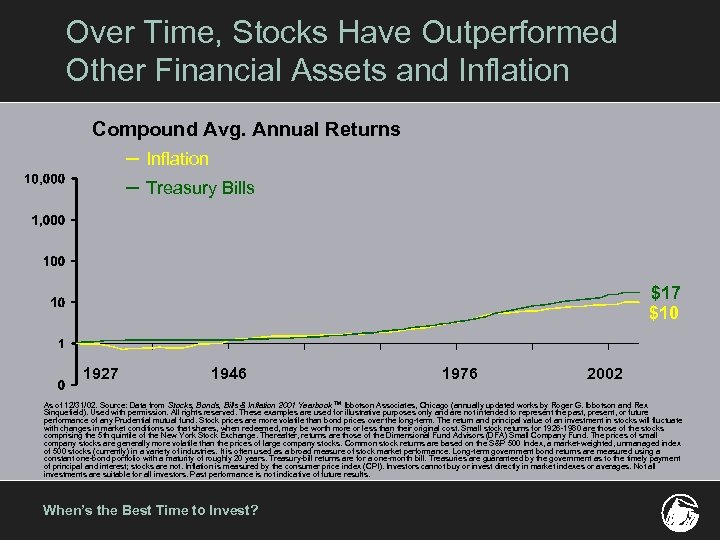
Over Time, Stocks Have Outperformed Other Financial Assets and Inflation Compound Avg. Annual Returns – Inflation – Treasury Bills $17 $10 1927 1946 1976 2002 As of 12/31/02. Source: Data from Stocks, Bonds, Bills & Inflation 2001 Yearbook TM Ibbotson Associates, Chicago (annually updated works by Roger G. Ibbotson and Rex Sinquefield). Used with permission. All rights reserved. These examples are used for illustrative purposes only and are not intended to represent the past, present, or future performance of any Prudential mutual fund. Stock prices are more volatile than bond prices over the long-term. The return and principal value of an investment in stocks will fluctuate with changes in market conditions so that shares, when redeemed, may be worth more or less than their original cost. Small stock returns for 1926 -1980 are those of the stocks comprising the 5 th quintile of the New York Stock Exchange. Thereafter, returns are those of the Dimensional Fund Advisors (DFA) Small Company Fund. The prices of small company stocks are generally more volatile than the prices of large company stocks. Common stock returns are based on the S&P 500 Index, a market-weighted, unmanaged index of 500 stocks (currently) in a variety of industries. It is often used as a broad measure of stock market performance. Long-term government bond returns are measured using a constant one-bond portfolio with a maturity of roughly 20 years. Treasury-bill returns are for a one-month bill. Treasuries are guaranteed by the government as to the timely payment of principal and interest; stocks are not. Inflation is measured by the consumer price index (CPI). Investors cannot buy or invest directly in market indexes or averages. Not all investments are suitable for all investors. Past performance is not indicative of future results. When’s the Best Time to Invest?
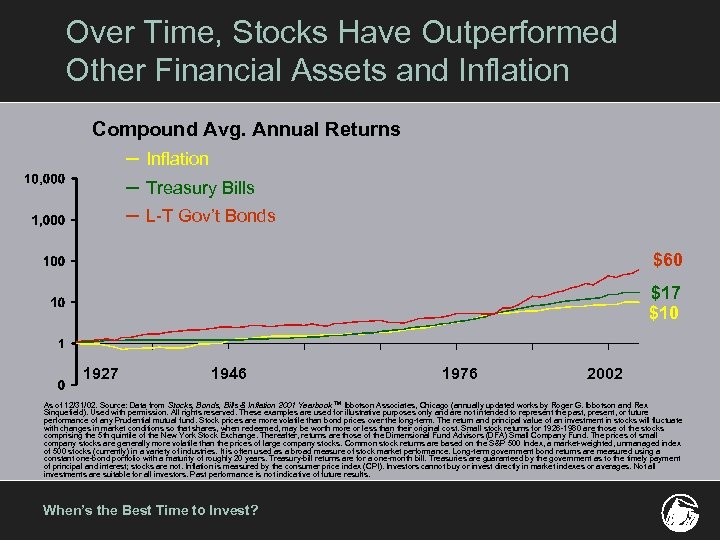
Over Time, Stocks Have Outperformed Other Financial Assets and Inflation Compound Avg. Annual Returns – Inflation – Treasury Bills – L-T Gov’t Bonds $60 $17 $10 1927 1946 1976 2002 As of 12/31/02. Source: Data from Stocks, Bonds, Bills & Inflation 2001 Yearbook TM Ibbotson Associates, Chicago (annually updated works by Roger G. Ibbotson and Rex Sinquefield). Used with permission. All rights reserved. These examples are used for illustrative purposes only and are not intended to represent the past, present, or future performance of any Prudential mutual fund. Stock prices are more volatile than bond prices over the long-term. The return and principal value of an investment in stocks will fluctuate with changes in market conditions so that shares, when redeemed, may be worth more or less than their original cost. Small stock returns for 1926 -1980 are those of the stocks comprising the 5 th quintile of the New York Stock Exchange. Thereafter, returns are those of the Dimensional Fund Advisors (DFA) Small Company Fund. The prices of small company stocks are generally more volatile than the prices of large company stocks. Common stock returns are based on the S&P 500 Index, a market-weighted, unmanaged index of 500 stocks (currently) in a variety of industries. It is often used as a broad measure of stock market performance. Long-term government bond returns are measured using a constant one-bond portfolio with a maturity of roughly 20 years. Treasury-bill returns are for a one-month bill. Treasuries are guaranteed by the government as to the timely payment of principal and interest; stocks are not. Inflation is measured by the consumer price index (CPI). Investors cannot buy or invest directly in market indexes or averages. Not all investments are suitable for all investors. Past performance is not indicative of future results. When’s the Best Time to Invest?
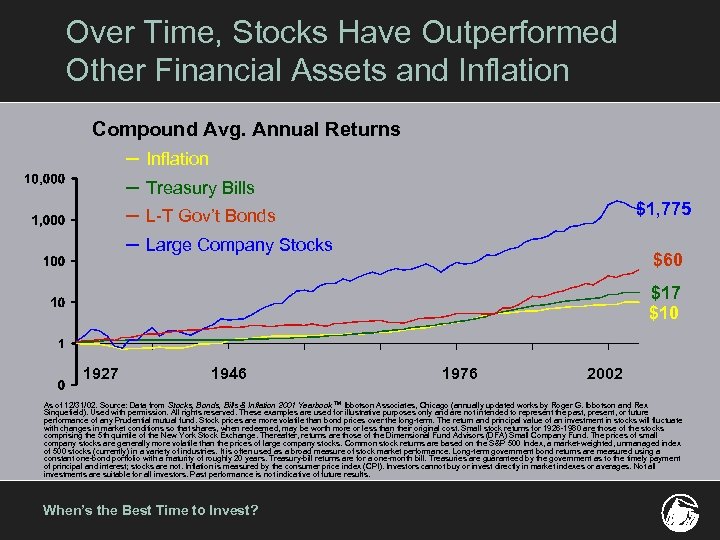
Over Time, Stocks Have Outperformed Other Financial Assets and Inflation Compound Avg. Annual Returns – Inflation – Treasury Bills – L-T Gov’t Bonds – Large Company Stocks $1, 775 $60 $17 $10 1927 1946 1976 2002 As of 12/31/02. Source: Data from Stocks, Bonds, Bills & Inflation 2001 Yearbook TM Ibbotson Associates, Chicago (annually updated works by Roger G. Ibbotson and Rex Sinquefield). Used with permission. All rights reserved. These examples are used for illustrative purposes only and are not intended to represent the past, present, or future performance of any Prudential mutual fund. Stock prices are more volatile than bond prices over the long-term. The return and principal value of an investment in stocks will fluctuate with changes in market conditions so that shares, when redeemed, may be worth more or less than their original cost. Small stock returns for 1926 -1980 are those of the stocks comprising the 5 th quintile of the New York Stock Exchange. Thereafter, returns are those of the Dimensional Fund Advisors (DFA) Small Company Fund. The prices of small company stocks are generally more volatile than the prices of large company stocks. Common stock returns are based on the S&P 500 Index, a market-weighted, unmanaged index of 500 stocks (currently) in a variety of industries. It is often used as a broad measure of stock market performance. Long-term government bond returns are measured using a constant one-bond portfolio with a maturity of roughly 20 years. Treasury-bill returns are for a one-month bill. Treasuries are guaranteed by the government as to the timely payment of principal and interest; stocks are not. Inflation is measured by the consumer price index (CPI). Investors cannot buy or invest directly in market indexes or averages. Not all investments are suitable for all investors. Past performance is not indicative of future results. When’s the Best Time to Invest?
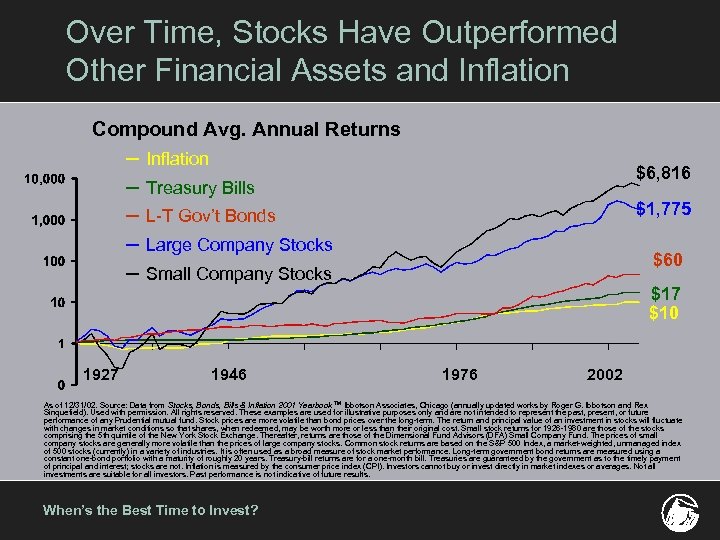
Over Time, Stocks Have Outperformed Other Financial Assets and Inflation Compound Avg. Annual Returns – Inflation – Treasury Bills – L-T Gov’t Bonds – Large Company Stocks – Small Company Stocks 1927 1946 $6, 816 $1, 775 $60 $17 $10 1976 2002 As of 12/31/02. Source: Data from Stocks, Bonds, Bills & Inflation 2001 Yearbook TM Ibbotson Associates, Chicago (annually updated works by Roger G. Ibbotson and Rex Sinquefield). Used with permission. All rights reserved. These examples are used for illustrative purposes only and are not intended to represent the past, present, or future performance of any Prudential mutual fund. Stock prices are more volatile than bond prices over the long-term. The return and principal value of an investment in stocks will fluctuate with changes in market conditions so that shares, when redeemed, may be worth more or less than their original cost. Small stock returns for 1926 -1980 are those of the stocks comprising the 5 th quintile of the New York Stock Exchange. Thereafter, returns are those of the Dimensional Fund Advisors (DFA) Small Company Fund. The prices of small company stocks are generally more volatile than the prices of large company stocks. Common stock returns are based on the S&P 500 Index, a market-weighted, unmanaged index of 500 stocks (currently) in a variety of industries. It is often used as a broad measure of stock market performance. Long-term government bond returns are measured using a constant one-bond portfolio with a maturity of roughly 20 years. Treasury-bill returns are for a one-month bill. Treasuries are guaranteed by the government as to the timely payment of principal and interest; stocks are not. Inflation is measured by the consumer price index (CPI). Investors cannot buy or invest directly in market indexes or averages. Not all investments are suitable for all investors. Past performance is not indicative of future results. When’s the Best Time to Invest?
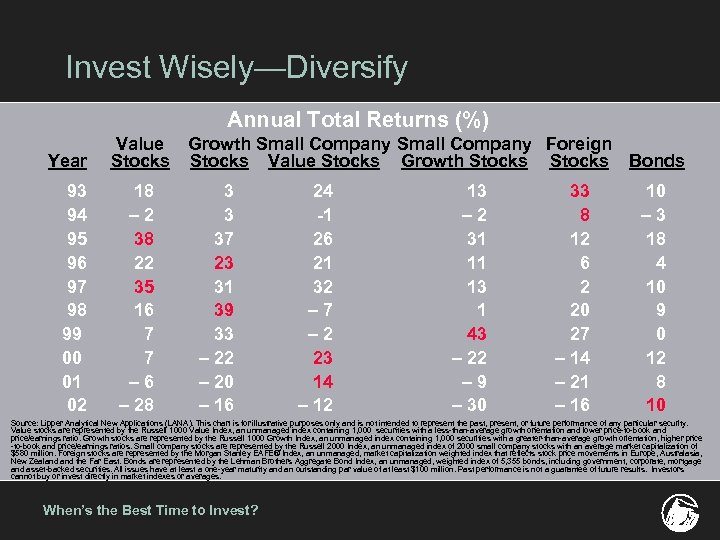
Invest Wisely—Diversify Annual Total Returns (%) Year 93 94 95 96 97 98 99 00 01 02 Value Stocks 18 – 2 38 22 35 16 7 7 – 6 – 28 Growth Small Company Foreign Stocks Value Stocks Growth Stocks Bonds 3 3 37 23 31 39 33 – 22 – 20 – 16 24 -1 26 21 32 – 7 – 2 23 14 – 12 13 – 2 31 11 13 1 43 – 22 – 9 – 30 33 8 12 6 2 20 27 – 14 – 21 – 16 10 – 3 18 4 10 9 0 12 8 10 Source: Lipper Analytical New Applications (LANA). This chart is for illustrative purposes only and is not intended to represent the past, present, or future performance of any particular security. Value stocks are represented by the Russell 1000 Value Index, an unmanaged index containing 1, 000 securities with a less-than-average growth orientation and lower price-to-book and price/earnings ratio. Growth stocks are represented by the Russell 1000 Growth Index, an unmanaged index containing 1, 000 securities with a greater-than-average growth orientation, higher price -to-book and price/earnings ratios. Small company stocks are represented by the Russell 2000 Index, an unmanaged index of 2000 small company stocks with an average market capitalization of $580 million. Foreign stocks are represented by the Morgan Stanley EAFE® Index, an unmanaged, market capitalization weighted index that reflects stock price movements in Europe, Australasia, New Zealand the Far East. Bonds are represented by the Lehman Brothers Aggregate Bond Index, an unmanaged, weighted index of 5, 355 bonds, including government, corporate, mortgage and asset-backed securities. All issues have at least a one-year maturity and an outstanding par value of at least $100 million. Past performance is not a guarantee of future results. Investors cannot buy or invest directly in market indexes or averages. When’s the Best Time to Invest?
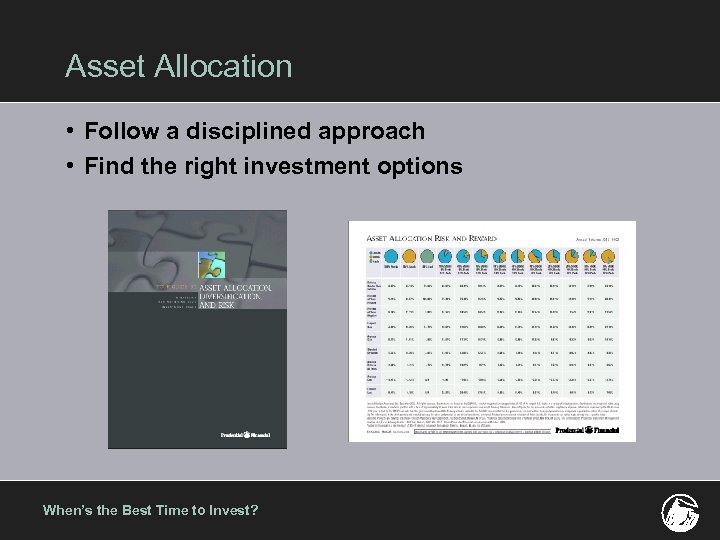
Asset Allocation • Follow a disciplined approach • Find the right investment options When’s the Best Time to Invest?
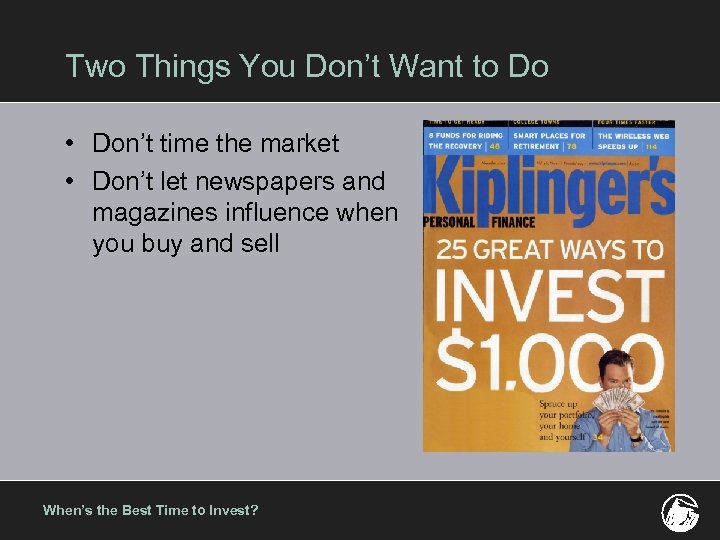
Two Things You Don’t Want to Do • Don’t time the market • Don’t let newspapers and magazines influence when you buy and sell When’s the Best Time to Invest?
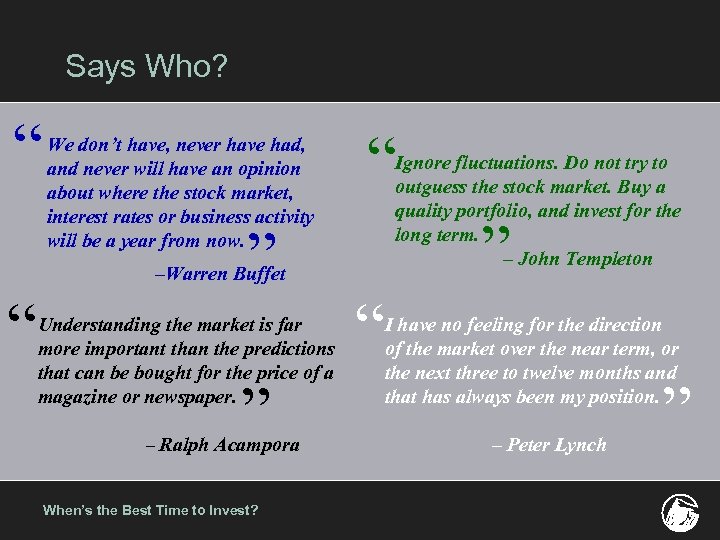
Says Who? “ We don’t have, never have had, and never will have an opinion about where the stock market, interest rates or business activity will be a year from now. ” “ Ignore fluctuations. Do not try to outguess the stock market. Buy a quality portfolio, and invest for the long term. – John Templeton ” –Warren Buffet “ Understanding the market is far more important than the predictions that can be bought for the price of a magazine or newspaper. ” – Ralph Acampora When’s the Best Time to Invest? “ I have no feeling for the direction of the market over the near term, or the next three to twelve months and that has always been my position. – Peter Lynch ”
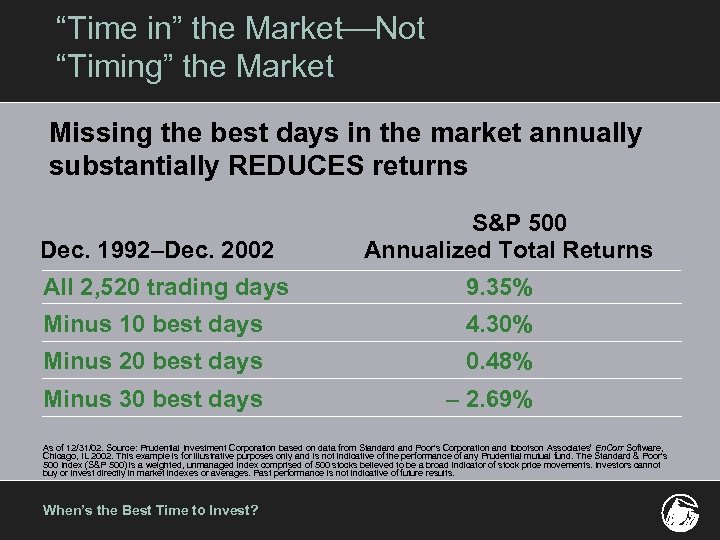
“Time in” the Market¾Not “Timing” the Market Missing the best days in the market annually substantially REDUCES returns Dec. 1992–Dec. 2002 S&P 500 Annualized Total Returns All 2, 520 trading days 9. 35% Minus 10 best days 4. 30% Minus 20 best days 0. 48% Minus 30 best days – 2. 69% As of 12/31/02. Source: Prudential Investment Corporation based on data from Standard and Poor's Corporation and Ibbotson Associates’ En. Corr Software, Chicago, IL 2002. This example is for illustrative purposes only and is not indicative of the performance of any Prudential mutual fund. The Standard & Poor's 500 Index (S&P 500) is a weighted, unmanaged index comprised of 500 stocks believed to be a broad indicator of stock price movements. Investors cannot buy or invest directly in market indexes or averages. Past performance is not indicative of future results. When’s the Best Time to Invest?
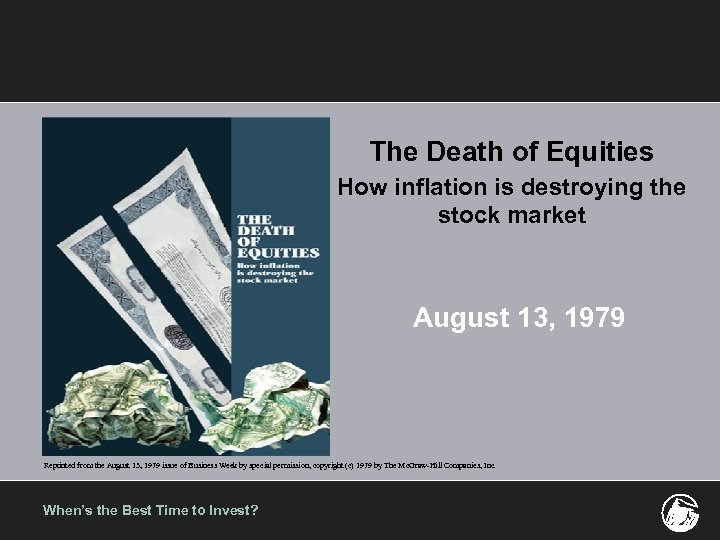
The Death of Equities How inflation is destroying the stock market August 13, 1979 Reprinted from the August 13, 1979 issue of Business Week by special permission, copyright (c) 1979 by The Mc. Graw-Hill Companies, Inc. When’s the Best Time to Invest?
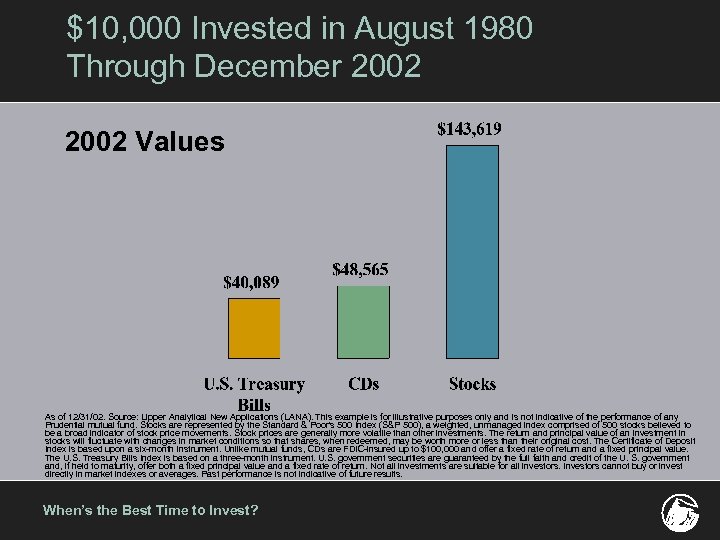
$10, 000 Invested in August 1980 Through December 2002 Values As of 12/31/02. Source: Lipper Analytical New Applications (LANA). This example is for illustrative purposes only and is not indicative of the performance of any Prudential mutual fund. Stocks are represented by the Standard & Poor's 500 Index (S&P 500), a weighted, unmanaged index comprised of 500 stocks believed to be a broad indicator of stock price movements. Stock prices are generally more volatile than other investments. The return and principal value of an investment in stocks will fluctuate with changes in market conditions so that shares, when redeemed, may be worth more or less than their original cost. The Certificate of Deposit Index is based upon a six-month instrument. Unlike mutual funds, CDs are FDIC-insured up to $100, 000 and offer a fixed rate of return and a fixed principal value. The U. S. Treasury Bills Index is based on a three-month instrument. U. S. government securities are guaranteed by the full faith and credit of the U. S. government and, if held to maturity, offer both a fixed principal value and a fixed rate of return. Not all investments are suitable for all investors. Investors cannot buy or invest directly in market indexes or averages. Past performance is not indicative of future results. When’s the Best Time to Invest?
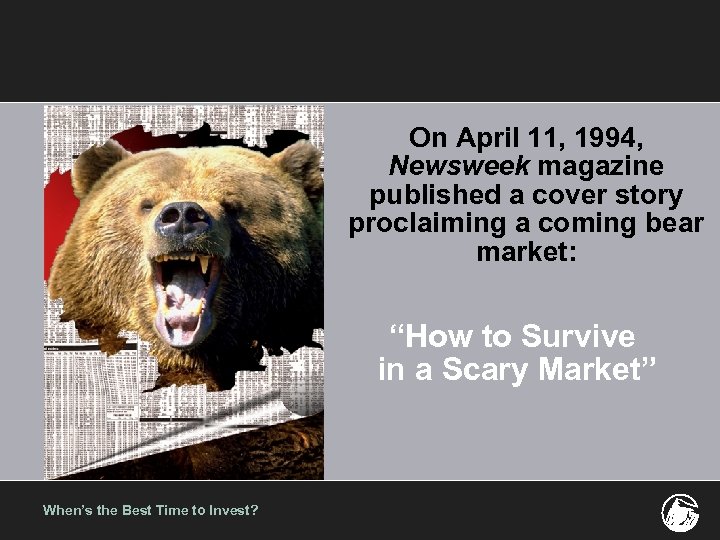
On April 11, 1994, Newsweek magazine published a cover story proclaiming a coming bear market: “How to Survive in a Scary Market” When’s the Best Time to Invest?
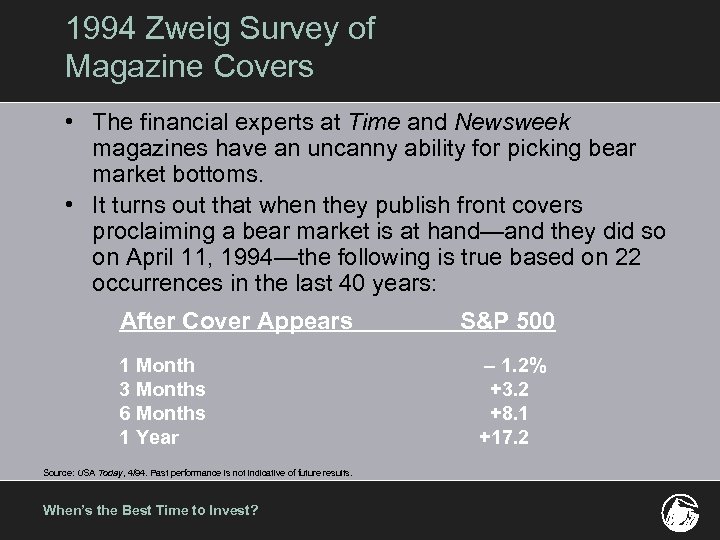
1994 Zweig Survey of Magazine Covers • The financial experts at Time and Newsweek magazines have an uncanny ability for picking bear market bottoms. • It turns out that when they publish front covers proclaiming a bear market is at hand—and they did so on April 11, 1994—the following is true based on 22 occurrences in the last 40 years: After Cover Appears 1 Month 3 Months 6 Months 1 Year Source: USA Today, 4/94. Past performance is not indicative of future results. When’s the Best Time to Invest? S&P 500 – 1. 2% +3. 2 +8. 1 +17. 2
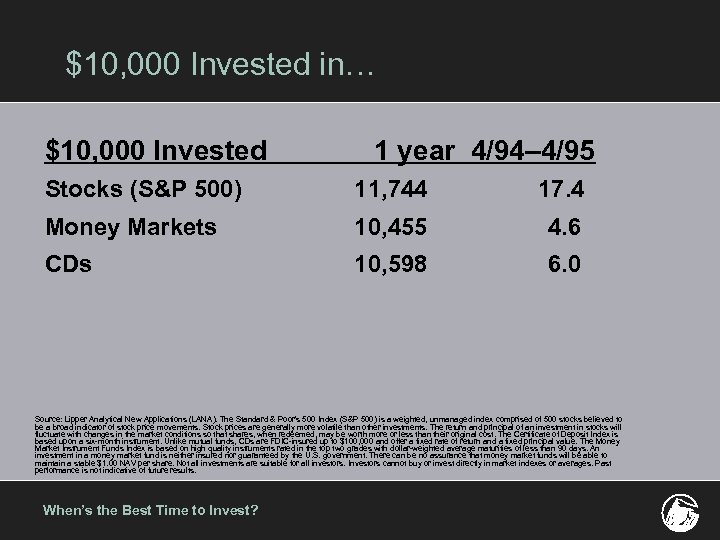
$10, 000 Invested in… $10, 000 Invested 1 year 4/94– 4/95 Stocks (S&P 500) 11, 744 17. 4 Money Markets 10, 455 4. 6 CDs 10, 598 6. 0 Source: Lipper Analytical New Applications (LANA). The Standard & Poor's 500 Index (S&P 500) is a weighted, unmanaged index comprised of 500 stocks believed to be a broad indicator of stock price movements. Stock prices are generally more volatile than other investments. The return and principal of an investment in stocks will fluctuate with changes in the market conditions so that shares, when redeemed, may be worth more or less than their original cost. The Certificate of Deposit Index is based upon a six-month instrument. Unlike mutual funds, CDs are FDIC-insured up to $100, 000 and offer a fixed rate of return and a fixed principal value. The Money Market Instrument Funds Index is based on high quality instruments rated in the top two grades with dollar-weighted average maturities of less than 90 days. An investment in a money market fund is neither insured nor guaranteed by the U. S. government. There can be no assurance that money market funds will be able to maintain a stable $1. 00 NAV per share. Not all investments are suitable for all investors. Investors cannot buy or invest directly in market indexes or averages. Past performance is not indicative of future results. When’s the Best Time to Invest?
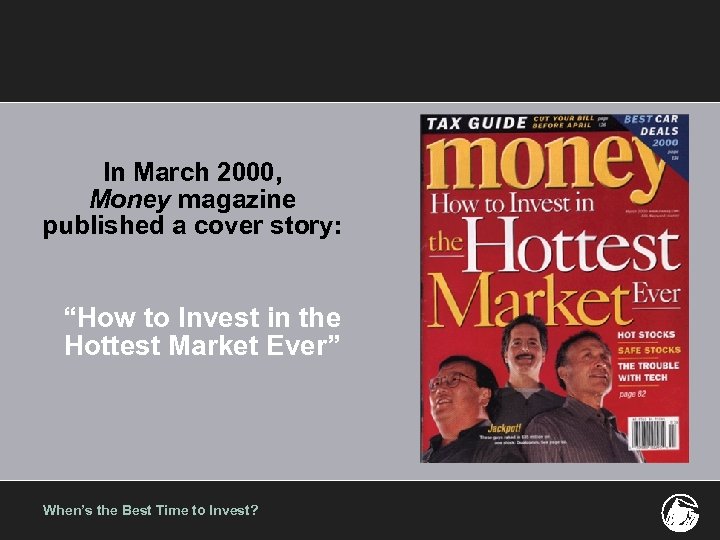
In March 2000, Money magazine published a cover story: “How to Invest in the Hottest Market Ever” When’s the Best Time to Invest?
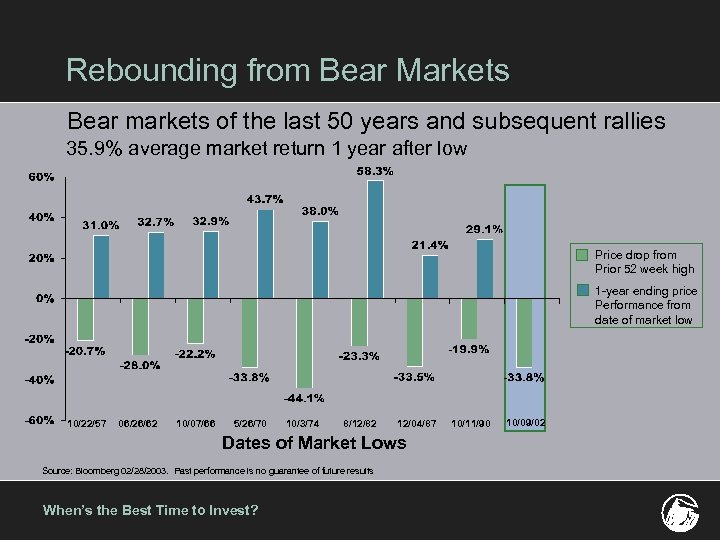
Rebounding from Bear Markets Bear markets of the last 50 years and subsequent rallies 35. 9% average market return 1 year after low Price drop from Prior 52 week high 1 -year ending price Performance from date of market low 10/22/57 06/26/62 10/07/66 5/26/70 10/3/74 8/12/82 12/04/87 Dates of Market Lows Source: Bloomberg 02/28/2003. Past performance is no guarantee of future results When’s the Best Time to Invest? 10/11/90 10/09/02
“When’s the Best Time to Invest? ” When’s the Best Time to Invest?
“Whenever You Have the Money” When’s the Best Time to Invest?

Importance of Professional Guidance Smart investing begins with a plan¾one that reflects your unique needs and goals, the time you have to achieve them, and your attitude towards risk. When’s the Best Time to Invest?
Thank You • • Neither the information contained herein nor any opinion expressed shall be construed as an offer to sell or a solicitation to buy any securities mentioned herein. Past performance is not indicative of future results. Securities products and services are offered through Pruco Securities Corporation, 751 Broad Street, Newark NJ 07102 -3777; Prudential Securities Incorporated, 199 Water Street, New York, NY 10292; and Prudential Investment Management Services LLC (PIMS), Three Gateway Center, 14 th Floor, Newark, NJ 07102 -04077. All are Prudential Financial Companies and members SIPC. Prudential Financial is a service mark of The Prudential Insurance Company of America, Newark, NJ, and its affiliates. IFS-A 052625 Ed. 02/2003
Скачать презентацию When s the Best Time to Invest Speaker s name
aa811d4c89db38b5e50b92e5b4715b06.ppt