


 Скачать презентацию When multi-university partnering works The University System of
709e42ffda09f1ae66035f2d3ecd8942.ppt
- Количество слайдов: 22
 When multi-university partnering works: The University System of Maryland experience with Two TQE grants Susan Tucker, Evaluation & Development Associates, LLC Dewayne Morgan, University System of Maryland 1
 Overview of Presentation n University System Context n n Leveraging P-20 Relationships Statewide Partnership Work: Two Case Examples LINC from 2000 -2006: Job-alike mentoring for retention n E=mc 2 from 2003 -2009: Teacher academies for recruiting n n Findings, Sustainability &Institutionalization n Gathering learnings from participants 2
 University System of Maryland n Maryland’s four-year+ public IHE system: 11 degree-granting colleges and universities n 2 research institutes n 2 regional higher education centers n 112, 000 undergraduate students; 38, 000 graduate/professional students n Offers more than 600 bachelor's, master's, doctoral, and professional degree programs n 3
 2 TQE grants managed by USM Office of Academic Affairs TQE Compliments OAA responsibilities: § § § Academic planning and accountability Academic policy, transfer and articulation Teaching/learning initiatives P-20 coordination Faculty affairs 4
 Why P-20 Partnerships? The whole is greater than the sum of its parts. Aristotle Metaphysica, 3 -1078 b 5
 Alphabet Ice breaker 1. 2. 3. 4. 5. Sing the Alphabet Song collectively or in small groups. Take a look at the magnet board that the presenter. Sing the Alphabet Song again using the letters on the board What did you notice? How does this exercise speak to partnerships and partnership work? 6
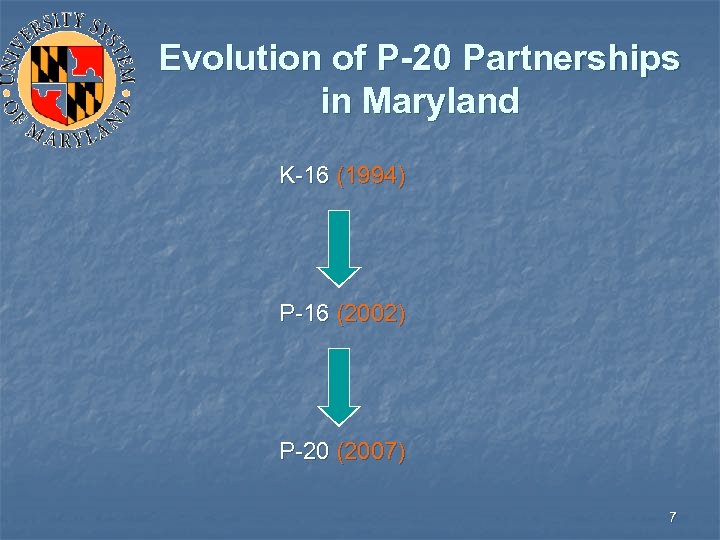 Evolution of P-20 Partnerships in Maryland K-16 (1994) P-16 (2002) P-20 (2007) 7
 P-20 Partnership Philosophy n Seamless educational alignment from prekindergarten through college n Raising standards and expectations for both students and teachers n Changing higher education behavior n Collaboration among diverse educational segments and with the larger community to improve student learning outcomes 8
 P-20 Challenges and Opportunities: How does TQE fit within this context? n Evidence-based claims: n n n If you didn’t measure it, did it really happen? Budgeting forpartners shifting over time Getting partner buy-in upfront Aligning research opportunities with faculty and graduate student interests Maximizing internal & external evaluators 9
 Testing assumptions: organizational “fit” with TQE n n n Partner approach is a vehicle for human and institutional development Facilitates knowledge creation and diffusion Moves the NCLB agenda forward Makes possible better cost-sharing Contributes to teacher education capacity development 10
 Hidden TQE Challenges n n Fluid premises about “partnership” Documenting partnering contexts, processes, outcomes n n n When logic maps do not work Improving partnership & sustainability when high turnover in leadership GPRA indicators shifting (and limiting) n PRAXIS, High school recruitment programs, etc 11
 What hidden challenges have you discovered in your project? n n n Challenges in recruitment Challenges in retention Challenges in partnering 12
 USM TQE initiatives n LINC: n n Job-Alike Mentoring Program for new teachers with Prince George’s County Public Schools E=mc 2: n Early recruitment pipeline of High School Teacher Academies in Baltimore City Public Schools 13
 LINC Findings n n Two new degree/certification programs n 2+2 Certification and RTC n increased teachers’ success in high needs schools Teachers receiving Job-Alike mentoring n returned to their schools in greater percentages than those who did not Formal three-day induction Continued professional development n graduate credit; certification&re-certification workshops 14
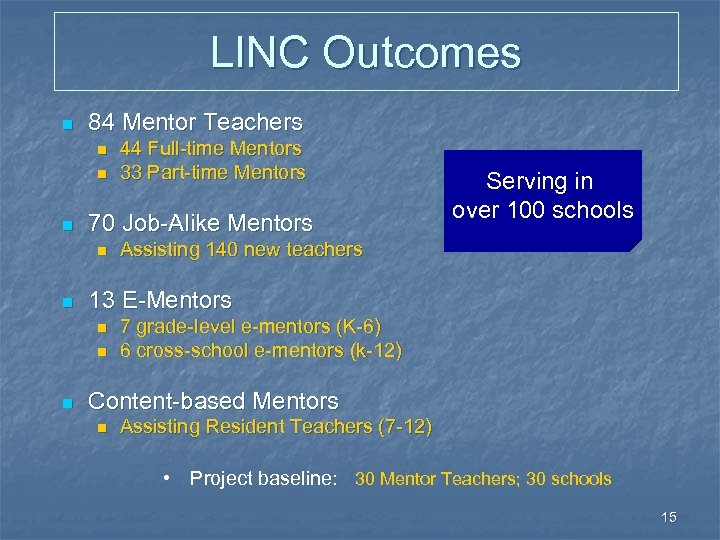 LINC Outcomes n 84 Mentor Teachers n n n 70 Job-Alike Mentors n n Serving in over 100 schools Assisting 140 new teachers 13 E-Mentors n n n 44 Full-time Mentors 33 Part-time Mentors 7 grade-level e-mentors (K-6) 6 cross-school e-mentors (k-12) Content-based Mentors n Assisting Resident Teachers (7 -12) • Project baseline: 30 Mentor Teachers; 30 schools 15
 E=mc 2 findings n n High School Teacher Academy model adopted statewide Created curriculum & support materials n n Current enrollment is over 2000 students in 13 districts Summer institute impacts n n 167 teachers over past 3 summers prepared Continue during academic year managing teacher academies and HS student support 16
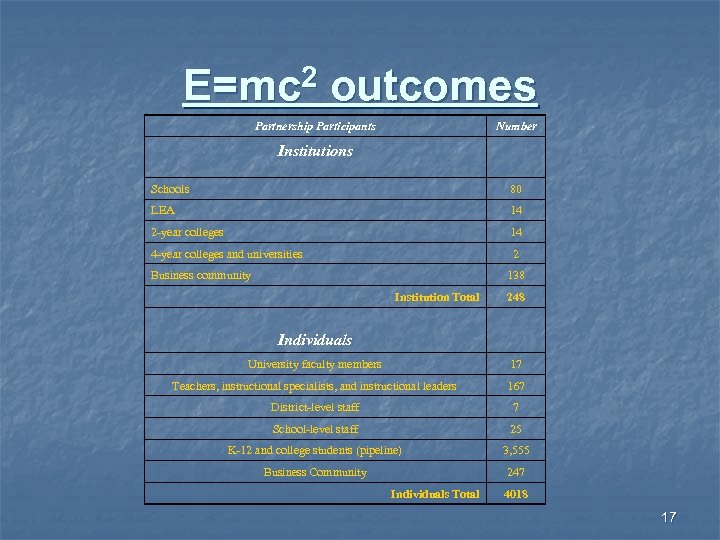 2 E=mc outcomes Partnership Participants Number Institutions Schools 80 LEA 14 2 -year colleges 14 4 -year colleges and universities 2 Business community 138 Institution Total 248 Individuals University faculty members 17 Teachers, instructional specialists, and instructional leaders 167 District-level staff 7 School-level staff 25 K-12 and college students (pipeline) 3, 555 Business Community 247 Individuals Total 4018 17
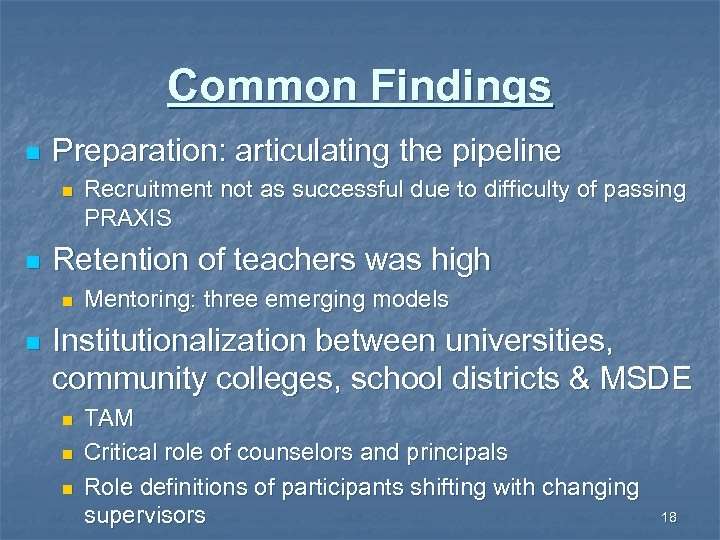 Common Findings n Preparation: articulating the pipeline n n Retention of teachers was high n n Recruitment not as successful due to difficulty of passing PRAXIS Mentoring: three emerging models Institutionalization between universities, community colleges, school districts & MSDE n n n TAM Critical role of counselors and principals Role definitions of participants shifting with changing supervisors 18
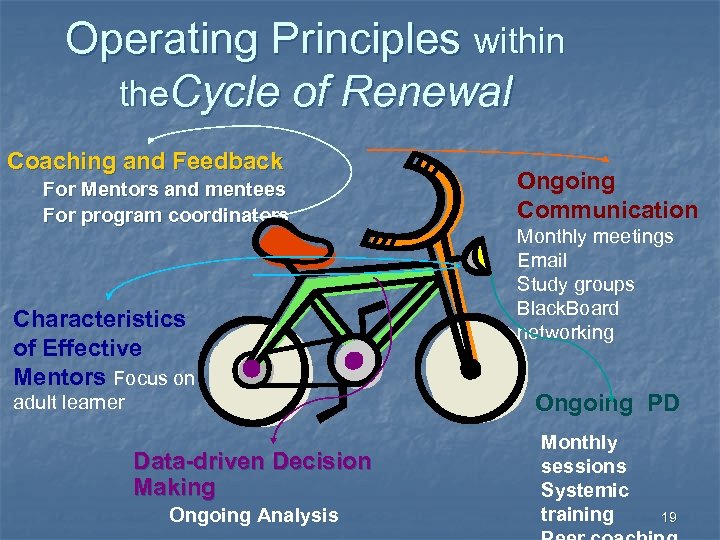 Operating Principles within the. Cycle of Renewal Coaching and Feedback For Mentors and mentees For program coordinators Characteristics of Effective Mentors Focus on adult learner Data-driven Decision Making Ongoing Analysis Ongoing Communication Monthly meetings Email Study groups Black. Board networking Ongoing PD Monthly sessions Systemic training 19
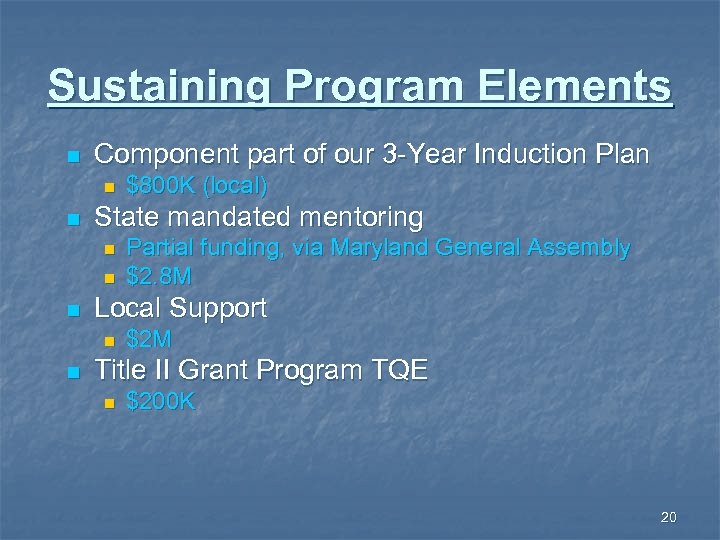 Sustaining Program Elements n Component part of our 3 -Year Induction Plan n n State mandated mentoring n n n Partial funding, via Maryland General Assembly $2. 8 M Local Support n n $800 K (local) $2 M Title II Grant Program TQE n $200 K 20
 What are your learnings about sustainable partnering strategies? n n Facilitating factors Inhibiting factors Border crossing strategies Recommended policies & practices to support partnering 21
 Where do we go from here… n n n Recruitment Retention Partnering 22