


 Скачать презентацию Whats Up with the Linear Collider P Grannis
1ce8efa7bc1993246935dee95f7f8fd6.ppt
- Количество слайдов: 36
 Whats Up with the Linear Collider? P. Grannis: Stony Brook 3/11/02 Much has happened in the Linear Collider world over the past year. From the charge at the Johns Hopkins LC Workshop March 2001: “ In the US, the HEP community has not yet articulated its support for the LC; our chief focus now should be to make the case for the LC within the physics community as fairly and as completely as possible. ” We have passed the stage of making a consensus – and now have entered the era of pushing to make the LC happen
 2 2001 Milestones: March: TESLA proposal now under consideration by the German Science Council. http: //tesla. desy. de/new_pages/TDR_CD/start. html v June: SNOWMASS 2001 : 400 page “LC Sourcebook”: http: //www. slac. stanford. edu/grp/th/LCBook (LC Physics, Case for 500 Ge. V, Scenarios, Det’s, Study Q’s) v July: Snowmass Physics Groups recommendation: “There are fundamental questions concerning electroweak symmetry breaking and physics beyond the Standard Model that cannot be answered without a physics program at a Linear Collider overlapping that of the Large Hadron Collider. We therefore strongly recommend the expeditious construction of a Linear Collider as the next major international High Energy Physics project. ” v. August: ECFA Working Group recommended: “… realization, in as timely a fashion possible, of a world-wide collaboration to construct a high-luminosity e+e- linear collider with an energy range up to at least 400 Ge. V ” v. September: ACFA statement: hep-ph/0109166 “The e+e- LC must start operation when the high luminosity run of LHC starts around with 250 -500 Ge. V , with energy upgrade to higher than 1 Te. V. ACFA strongly endorses the plan to construct such a collider in the Asian-Pacific region with Japan as the host. ”
 3 Milestones: Jan. 2002: HEPAP subpanel statement: “We recommend that the highest priority of the U. S. program be a high-energy, high-luminosity, electron-positron linear collider, wherever it is built in the world…” “We recommend that the United States prepare to bid to host the linear collider, in a facility that is international from the inception, with a broad mandate in fundamental physics research and accelerator development…” “We recommend the formation of a steering committee to oversee all linear collider activities in the U. S. … ” So, the playing field has changed – we have a strong statement of priority for the LC in all regions. Workshop Plans for near future: Regional consortium meetings: Europe : 12 – 15 April, St. Malo, France Fermilab, April 5 : Research and Development Opportunities for the Linear Collider U. S. : 27 – 29 June, UC Santa Cruz Asia : July , Tokyo World LC Workshop: 26 – 30 August, Jeju Island, Korea http: //fms. physics. uiuc. edu/conferences/ linearcollider/html_files/main. htm Cornell, April 19 : http: //www. lns. cornell. edu/public/LCCOM/
 Other physics This does not mean that all physicists in the US/elsewhere share the sense of LC as their avenue to future experimentation. Many other initiatives of merit exist and should be pursued: Ø Superbeam/long baseline n studies; m. SR Ø Underground/sea/ice labs for p decay, n astronomy Ø Studies of rare decays of K, B … and insights into flavor Ø Innovative astroparticle experiments – SNAP, GLAST, LISA, Pierre Auger, CMB … Ø Very high energy hadron collider The international collaboration required for the Linear Collider should also be invoked to enable coherent planning of other initiatives. Although those in the LC camp argue that the physics issues of EWSB are the most ripe for fundamental new understanding in the near term, we should recognize that these other projects are also of fundamental importance. 4
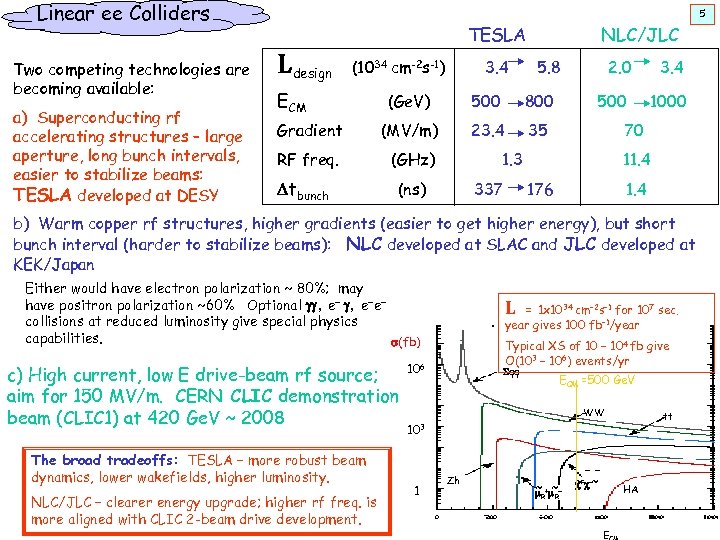 Linear ee Colliders Two competing technologies are becoming available: a) Superconducting rf accelerating structures – large aperture, long bunch intervals, easier to stabilize beams: TESLA developed at DESY 5 Ldesign TESLA (1034 cm-2 s-1) ECM 3. 4 NLC/JLC 5. 8 (Ge. V) 500 800 Gradient (MV/m) 23. 4 35 RF freq. (GHz) Dtbunch (ns) 2. 0 500 1000 70 1. 3 337 3. 4 11. 4 176 1. 4 b) Warm copper rf structures, higher gradients (easier to get higher energy), but short bunch interval (harder to stabilize beams): NLC developed at SLAC and JLC developed at KEK/Japan Either would have electron polarization ~ 80%; may have positron polarization ~60% Optional gg, e-ecollisions at reduced luminosity give special physics capabilities. s(fb) c) High current, low E drive-beam rf source; aim for 150 MV/m. CERN CLIC demonstration beam (CLIC 1) at 420 Ge. V ~ 2008 The broad tradeoffs: TESLA – more robust beam dynamics, lower wakefields, higher luminosity. NLC/JLC – clearer energy upgrade; higher rf freq. is more aligned with CLIC 2 -beam drive development. L = 1 x 1034 cm-2 s-1 for 107 sec. year gives 100 fb-1/year Typical XS of 10 – 104 fb give O(103 – 106) events/yr 106 Sqq ECM =500 Ge. V WW tt 103 1 Zh ~ +m m ~ R ~ ~ c +c - HA R E
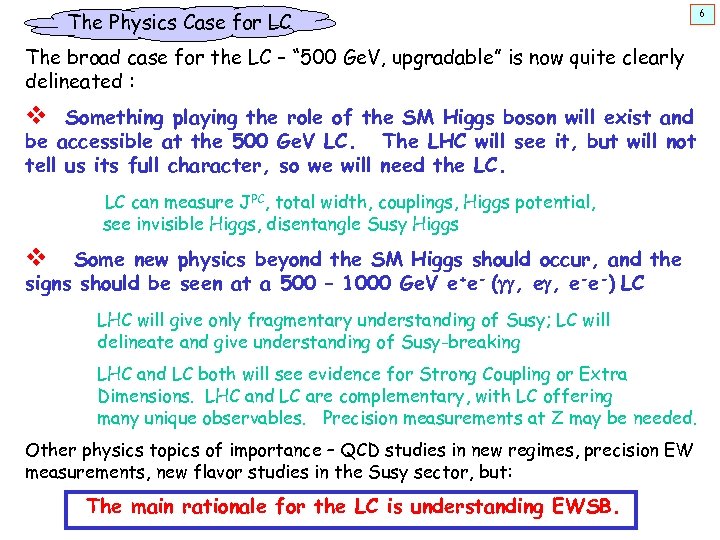 The Physics Case for LC The broad case for the LC – “ 500 Ge. V, upgradable” is now quite clearly delineated : v Something playing the role of the SM Higgs boson will exist and be accessible at the 500 Ge. V LC. The LHC will see it, but will not tell us its full character, so we will need the LC. LC can measure JPC, total width, couplings, Higgs potential, see invisible Higgs, disentangle Susy Higgs v Some new physics beyond the SM Higgs should occur, and the signs should be seen at a 500 – 1000 Ge. V e+e- (gg, e-e-) LC LHC will give only fragmentary understanding of Susy; LC will delineate and give understanding of Susy-breaking LHC and LC both will see evidence for Strong Coupling or Extra Dimensions. LHC and LC are complementary, with LC offering many unique observables. Precision measurements at Z may be needed. Other physics topics of importance – QCD studies in new regimes, precision EW measurements, new flavor studies in the Susy sector, but: The main rationale for the LC is understanding EWSB. 6
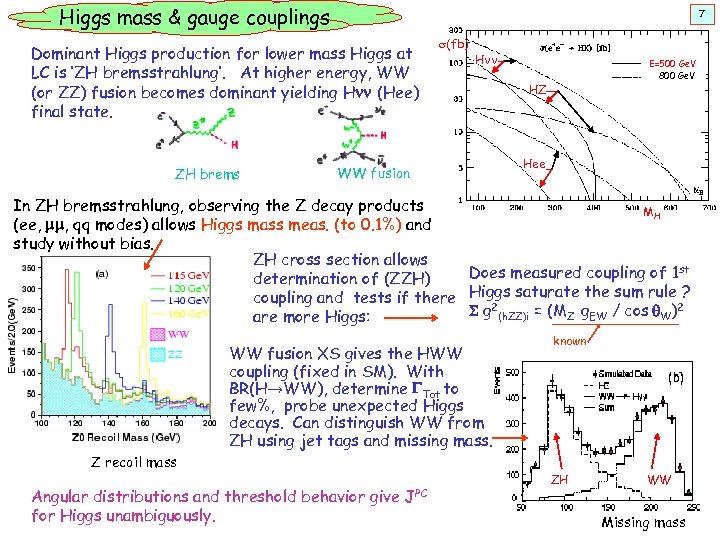 Higgs mass & gauge couplings 7 Dominant Higgs production for lower mass Higgs at LC is ‘ZH bremsstrahlung’. At higher energy, WW (or ZZ) fusion becomes dominant yielding Hnn (Hee) final state. ZH brems s(fb) Hnn WW fusion E=500 Ge. V 800 Ge. V HZ Hee In ZH bremsstrahlung, observing the Z decay products MH (ee, mm, qq modes) allows Higgs mass meas. (to 0. 1%) and study without bias. ZH cross section allows Does measured coupling of 1 st determination of (ZZH) coupling and tests if there Higgs saturate the sum rule ? S g 2(h. ZZ)i = (MZ g. EW / cos q. W)2 are more Higgs: WW fusion XS gives the HWW coupling (fixed in SM). With BR(H→WW), determine GTot to few%, probe unexpected Higgs decays. Can distinguish WW from ZH using jet tags and missing mass. Z recoil mass Angular distributions and threshold behavior give JPC for Higgs unambiguously. known ZH Missing mass WW Missing mass
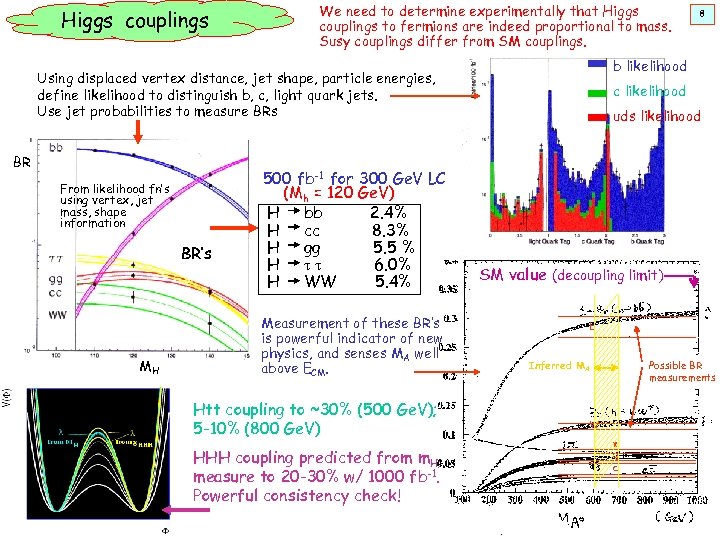 Higgs couplings We need to determine experimentally that Higgs couplings to fermions are indeed proportional to mass. Susy couplings differ from SM couplings. b likelihood Using displaced vertex distance, jet shape, particle energies, define likelihood to distinguish b, c, light quark jets. Use jet probabilities to measure BRs BR From likelihood fn’s using vertex, jet mass, shape information BR’s MH 500 fb-1 for 300 Ge. V LC (Mh = 120 Ge. V) H bb 2. 4% H cc 8. 3% H gg 5. 5 % H tt 6. 0% H WW 5. 4% Measurement of these BR’s is powerful indicator of new physics, and senses MA well above ECM. Htt coupling to ~30% (500 Ge. V); 5 -10% (800 Ge. V) HHH coupling predicted from m. H; measure to 20 -30% w/ 1000 fb-1. Powerful consistency check! 8 c likelihood uds likelihood SM value (decoupling limit) b Possible BR measurements Inferred MA W t g c
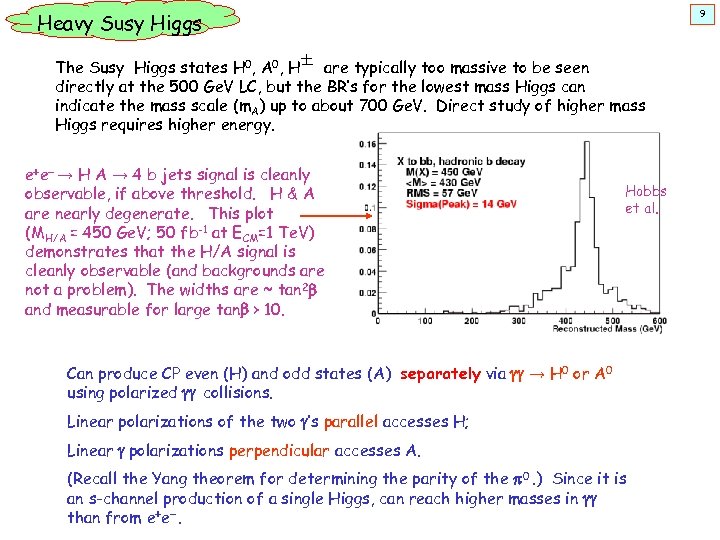 9 Heavy Susy Higgs The Susy Higgs states H 0, A 0, H are typically too massive to be seen directly at the 500 Ge. V LC, but the BR’s for the lowest mass Higgs can indicate the mass scale (m. A) up to about 700 Ge. V. Direct study of higher mass Higgs requires higher energy. e+e- → H A → 4 b jets signal is cleanly observable, if above threshold. H & A are nearly degenerate. This plot (MH/A = 450 Ge. V; 50 fb-1 at ECM=1 Te. V) demonstrates that the H/A signal is cleanly observable (and backgrounds are not a problem). The widths are ~ tan 2 b and measurable for large tanb > 10. Hobbs et al. Can produce CP even (H) and odd states (A) separately via gg → H 0 or A 0 using polarized gg collisions. Linear polarizations of the two g’s parallel accesses H; Linear g polarizations perpendicular accesses A. (Recall the Yang theorem for determining the parity of the p 0. ) Since it is an s-channel production of a single Higgs, can reach higher masses in gg than from e+e-.
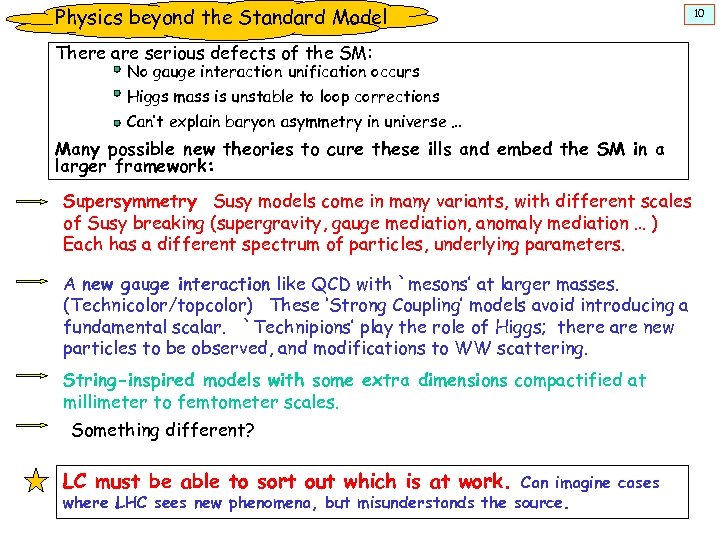 Physics beyond the Standard Model There are serious defects of the SM: No gauge interaction unification occurs Higgs mass is unstable to loop corrections Can’t explain baryon asymmetry in universe … Many possible new theories to cure these ills and embed the SM in a larger framework: Supersymmetry Susy models come in many variants, with different scales of Susy breaking (supergravity, gauge mediation, anomaly mediation … ) Each has a different spectrum of particles, underlying parameters. A new gauge interaction like QCD with `mesons’ at larger masses. (Technicolor/topcolor) These ‘Strong Coupling’ models avoid introducing a fundamental scalar. `Technipions’ play the role of Higgs; there are new particles to be observed, and modifications to WW scattering. String-inspired models with some extra dimensions compactified at millimeter to femtometer scales. Something different? LC must be able to sort out which is at work. Can imagine cases where LHC sees new phenomena, but misunderstands the source. 10
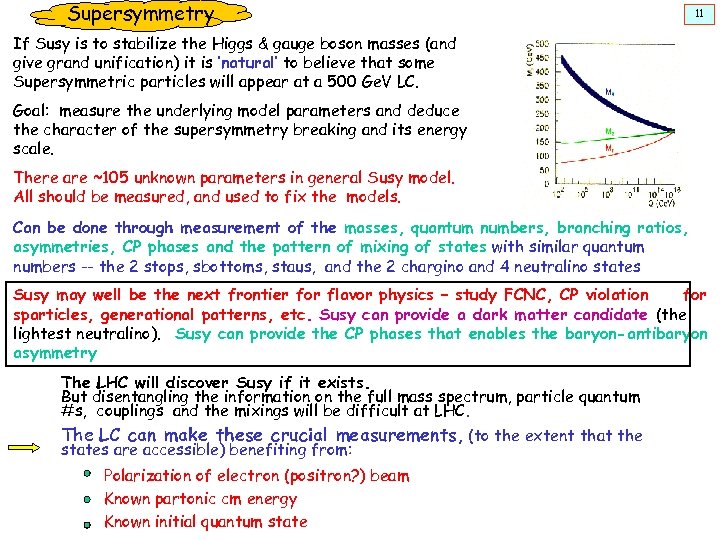 Supersymmetry 11 If Susy is to stabilize the Higgs & gauge boson masses (and give grand unification) it is ‘natural’ to believe that some Supersymmetric particles will appear at a 500 Ge. V LC. Goal: measure the underlying model parameters and deduce the character of the supersymmetry breaking and its energy scale. There are ~105 unknown parameters in general Susy model. All should be measured, and used to fix the models. Can be done through measurement of the masses, quantum numbers, branching ratios, asymmetries, CP phases and the pattern of mixing of states with similar quantum numbers -- the 2 stops, sbottoms, staus, and the 2 chargino and 4 neutralino states Susy may well be the next frontier for flavor physics – study FCNC, CP violation for sparticles, generational patterns, etc. Susy can provide a dark matter candidate (the lightest neutralino). Susy can provide the CP phases that enables the baryon-antibaryon asymmetry The LHC will discover Susy if it exists. But disentangling the information on the full mass spectrum, particle quantum #s, couplings and the mixings will be difficult at LHC. The LC can make these crucial measurements, (to the extent that the states are accessible) benefiting from: Polarization of electron (positron? ) beam Known partonic cm energy Known initial quantum state
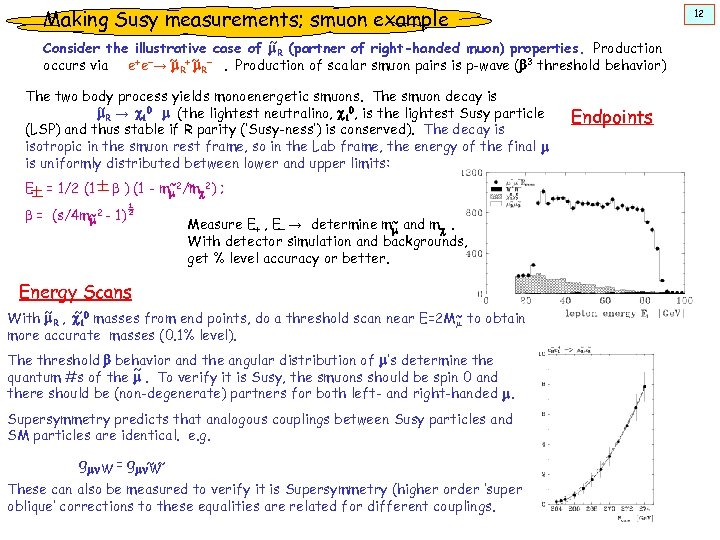 Making Susy measurements; smuon example 12 Consider the illustrative case of ~R (partner of right-handed muon) properties. Production m +e-→ ~ + ~ -. Production of scalar smuon pairs is p-wave (b 3 threshold behavior) occurs via e m. R The two body process yields monoenergetic smuons. The smuon decay is ~ → c 0 m (the lightest neutralino, c 0, is the lightest Susy particle m. R 1 1 (LSP) and thus stable if R parity (‘Susy-ness’) is conserved). The decay is isotropic in the smuon rest frame, so in the Lab frame, the energy of the final m is uniformly distributed between lower and upper limits: E = 1/2 (1 ~ b ) (1 - m~2/mc 2) ; m b = (s/4 m~2 - 1) ½ m Measure E+ , E- → determine m~ and mc. m With detector simulation and backgrounds, get % level accuracy or better. Energy Scans ~ With ~R , c 10 masses from end points, do a threshold scan near E=2 M~ to obtain m m more accurate masses (0. 1% level). ~ The threshold b behavior and the angular distribution of m’s determine the ~ quantum #s of the m. To verify it is Susy, the smuons should be spin 0 and there should be (non-degenerate) partners for both left- and right-handed m. Supersymmetry predicts that analogous couplings between Susy particles and SM particles are identical. e. g. ~ ~~ gmn. W = gmn. W ~ These can also be measured to verify it is Supersymmetry (higher order ‘super oblique’ corrections to these equalities are related for different couplings. Endpoints
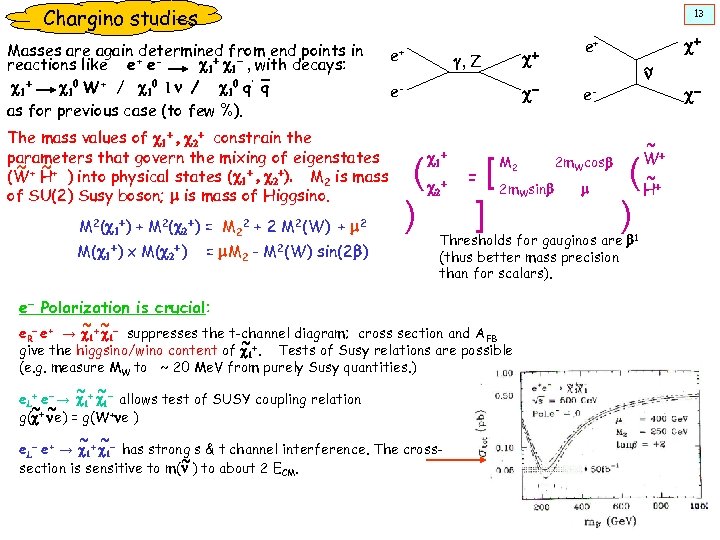 Chargino studies 13 Masses are again determined from end points in reactions like e+ ec 1+ c 1 - , with decays: c 1+ c 10 W+ / c 10 l n / c 10 q’ q as for previous case (to few %). The mass values of c 1+ , c 2+ constrain the parameters that govern the mixing of eigenstates ~ ~ (W+ H+ ) into physical states (c 1+ , c 2+). M 2 is mass of SU(2) Susy boson; m is mass of Higgsino. M 2(c 1+) + M 2(c 2+) = M 22 + 2 M 2(W) + m 2 M(c 1+) x M(c 2+) = m. M 2 - M 2(W) e+ c+ g, Z e- cc 1+ (c ) sin(2 b) + 2 [ = ] M 2 2 m. Wsinb ~ n e- 2 m. Wcosb m ( ) Thresholds for gauginos are b 1 (thus better mass precision than for scalars). e- Polarization is crucial: ~ ~ e. R- e+ → c 1+ c 1 - suppresses the t-channel diagram; cross section and A FB ~ give the higgsino/wino content of c +. Tests of Susy relations are possible 1 (e. g. measure MW to ~ 20 Me. V from purely Susy quantities. ) e. L+ e- → ~1+ c 1 - allows test of SUSY coupling relation c ~ ~ ~ g(c+ ne) = g(W+ne ) ~ ~ e+ e. L- e+ → c 1+ c 1 - has strong s & t channel interference. The cross~ section is sensitive to m(n ) to about 2 ECM. ~ W+ ~ H+ c+ c-
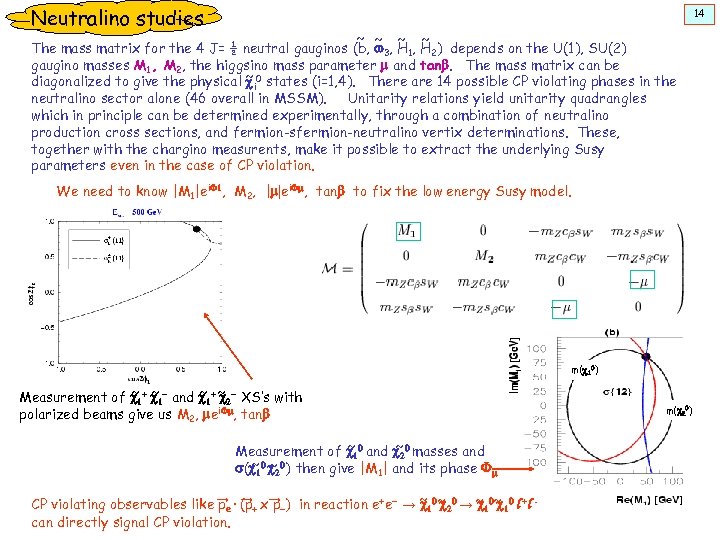 Neutralino studies 14 ~ ~ The mass matrix for the 4 J= ½ neutral gauginos (b, w 3, H 1, H 2) depends on the U(1), SU(2) gaugino masses M 1, M 2, the higgsino mass parameter m and tanb. The mass matrix can be diagonalized to give the physical ~i 0 states (i=1, 4). There are 14 possible CP violating phases in the c neutralino sector alone (46 overall in MSSM). Unitarity relations yield unitarity quadrangles which in principle can be determined experimentally, through a combination of neutralino production cross sections, and fermion-sfermion-neutralino vertix determinations. These, together with the chargino measurents, make it possible to extract the underlying Susy parameters even in the case of CP violation. We need to know |M 1|ei. F 1, M 2, |m|ei. Fm, tanb to fix the low energy Susy model. m(c 10) ~ ~ ~ c Measurement of c 1+ c 1 - and c 1+ ~ 2 - XS’s with polarized beams give us M 2, mei. Fm, tanb ~ ~ Measurement of c 10 and c 20 masses and ~ ~ s(c 10 c 20) then give |M 1| and its phase Fm CP violating observables like → ·(p+ x→-) in reaction e+e- → ~ 10~ 20 → ~ 10 l +l pe → p c c can directly signal CP violation. m(c 20)
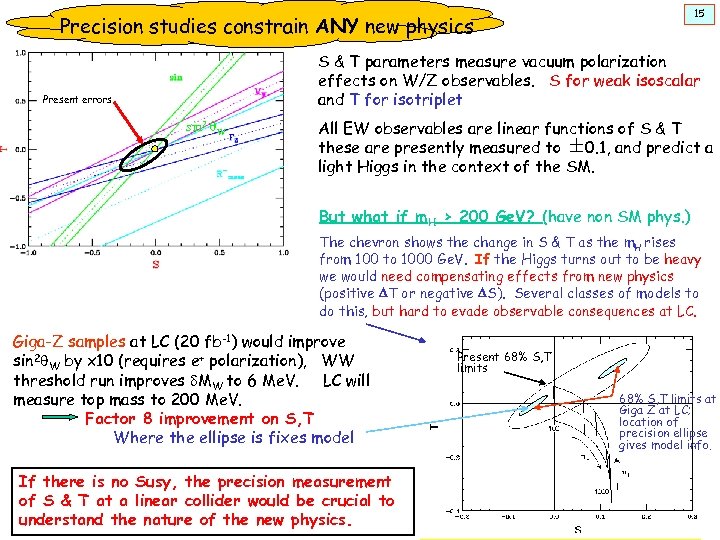 15 Precision studies constrain ANY new physics S & T parameters measure vacuum polarization effects on W/Z observables. S for weak isoscalar and T for isotriplet Present errors sin 2 q. W All EW observables are linear functions of S & T these are presently measured to 0. 1, and predict a light Higgs in the context of the SM. But what if m. H > 200 Ge. V? (have non SM phys. ) The chevron shows the change in S & T as the m. H rises from 100 to 1000 Ge. V. If the Higgs turns out to be heavy we would need compensating effects from new physics (positive DT or negative DS). Several classes of models to do this, but hard to evade observable consequences at LC. Giga-Z samples at LC (20 fb-1) would improve sin 2 q. W by x 10 (requires e+ polarization), WW threshold run improves d. MW to 6 Me. V. LC will measure top mass to 200 Me. V. Factor 8 improvement on S, T Where the ellipse is fixes model If there is no Susy, the precision measurement of S & T at a linear collider would be crucial to understand the nature of the new physics. Present 68% S, T limits at Giga Z at LC; location of precision ellipse gives model info.
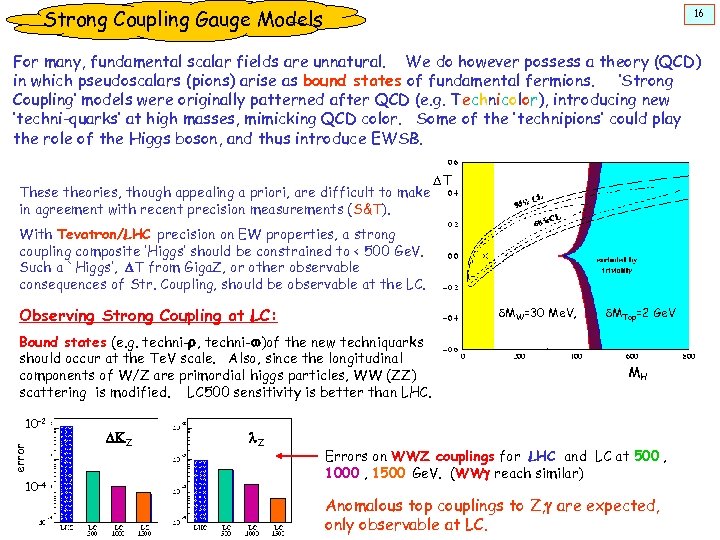 Strong Coupling Gauge Models 16 For many, fundamental scalar fields are unnatural. We do however possess a theory (QCD) in which pseudoscalars (pions) arise as bound states of fundamental fermions. ‘Strong Coupling’ models were originally patterned after QCD (e. g. Technicolor), introducing new ‘techni-quarks’ at high masses, mimicking QCD color. Some of the ‘technipions’ could play the role of the Higgs boson, and thus introduce EWSB. These theories, though appealing a priori, are difficult to make in agreement with recent precision measurements (S&T). DT With Tevatron/LHC precision on EW properties, a strong coupling composite ‘Higgs’ should be constrained to < 500 Ge. V. Such a `Higgs’, DT from Giga. Z, or other observable consequences of Str. Coupling, should be observable at the LC. Observing Strong Coupling at LC: d. MW=30 Me. V, Bound states (e. g. techni-r, techni-w)of the new techniquarks should occur at the Te. V scale. Also, since the longitudinal components of W/Z are primordial higgs particles, WW (ZZ) scattering is modified. LC 500 sensitivity is better than LHC. error 10 -2 10 -4 DKZ l. Z d. MTop=2 Ge. V MH Errors on WWZ couplings for LHC and LC at 500 , 1000 , 1500 Ge. V. (WWg reach similar) Anomalous top couplings to Z, g are expected, only observable at LC.
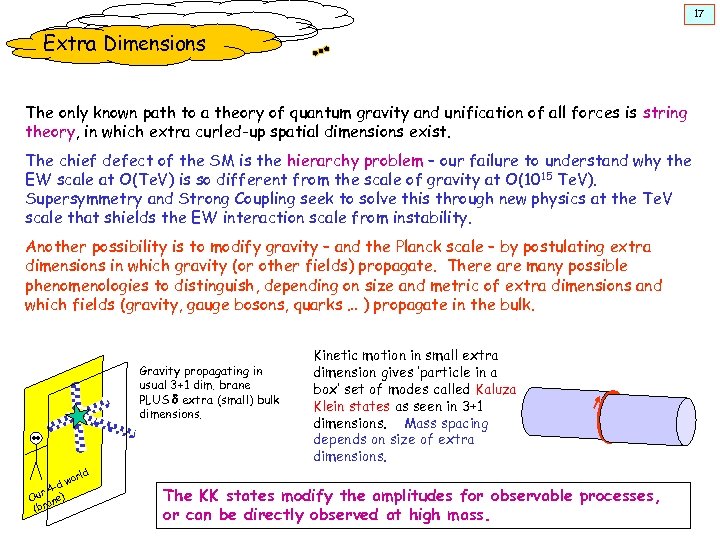 17 Extra Dimensions The only known path to a theory of quantum gravity and unification of all forces is string theory, in which extra curled-up spatial dimensions exist. The chief defect of the SM is the hierarchy problem – our failure to understand why the EW scale at O(Te. V) is so different from the scale of gravity at O(1015 Te. V). Supersymmetry and Strong Coupling seek to solve this through new physics at the Te. V scale that shields the EW interaction scale from instability. Another possibility is to modify gravity – and the Planck scale – by postulating extra dimensions in which gravity (or other fields) propagate. There are many possible phenomenologies to distinguish, depending on size and metric of extra dimensions and which fields (gravity, gauge bosons, quarks … ) propagate in the bulk. Gravity propagating in usual 3+1 dim. brane PLUS d extra (small) bulk dimensions. -d r 4 Ou ane) (br Kinetic motion in small extra dimension gives ‘particle in a box’ set of modes called Kaluza Klein states as seen in 3+1 dimensions. Mass spacing depends on size of extra dimensions. rld wo The KK states modify the amplitudes for observable processes, or can be directly observed at high mass.
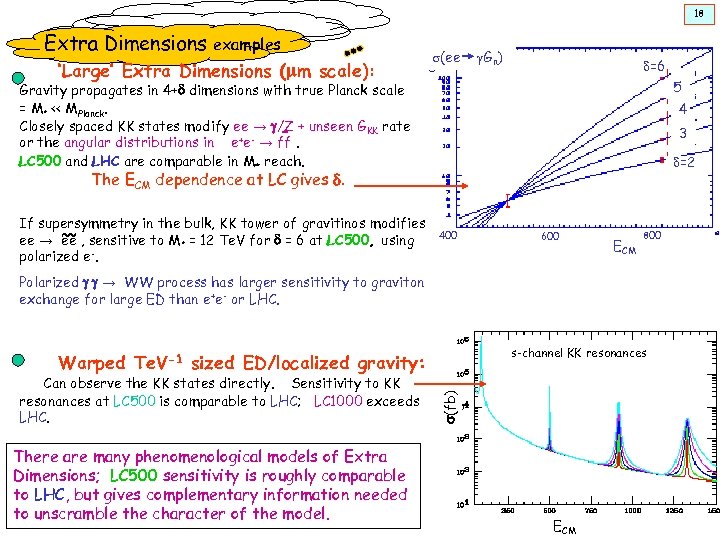 18 Extra Dimensions examples ‘Large’ Extra Dimensions (mm scale): s(ee g. Gn) d=6 5 Gravity propagates in 4+d dimensions with true Planck scale = M* << MPlanck. Closely spaced KK states modify ee → g/Z + unseen GKK rate or the angular distributions in e+e- → ff. LC 500 and LHC are comparable in M* reach. 4 3 d=2 The ECM dependence at LC gives d. If supersymmetry in the bulk, KK tower of gravitinos modifies ~ ~ ee → ee , sensitive to M* = 12 Te. V for d = 6 at LC 500, using polarized e-. 400 600 ECM 800 Polarized g g → WW process has larger sensitivity to graviton exchange for large ED than e+e- or LHC. s-channel KK resonances Can observe the KK states directly. Sensitivity to KK resonances at LC 500 is comparable to LHC; LC 1000 exceeds LHC. There are many phenomenological models of Extra Dimensions; LC 500 sensitivity is roughly comparable to LHC, but gives complementary information needed to unscramble the character of the model. s(fb) Warped Te. V-1 sized ED/localized gravity: ECM
 Scenarios Are there physics scenarios for which the LC does not add critical information beyond LHC? Have looked at many possible physics situations, including cases with no low scale supersymmetry, composite Higgs is at unexpectedly high mass, or no Higgs. v Do not see a plausible case where the LC cannot find and study the Higgs, though it is possible that one would need a bit more than 500 Ge. V in extreme strong coupling models. In the case of MH > 200 Ge. V, where H → WW predominantly (e. g. in strong coupling models), one would learn less about the Higgs sector (no observable fermionic couplings), but still significantly more than at LHC. v If there is Susy, the LC should be the instrument of choice for its study – but going to higher energy ultimately to see all the states would be very desirable. v If there is no Susy (Strong Coupling or Extra Dimensions), the LC will add information not available from the LHC. In these cases, the Giga-Z option may be crucial, as the constraints from precision measurements on the new physics will be very important. v In the most extreme (and unexpected) case of no Higgs and no new physics, the LC precision measurements will be a critical need to point the way. Ø If there is a low mass Higgs and low scale Susy, there will be a plethora of states to be studied, and the issue is whether the desired program can be made in reasonable time. 19
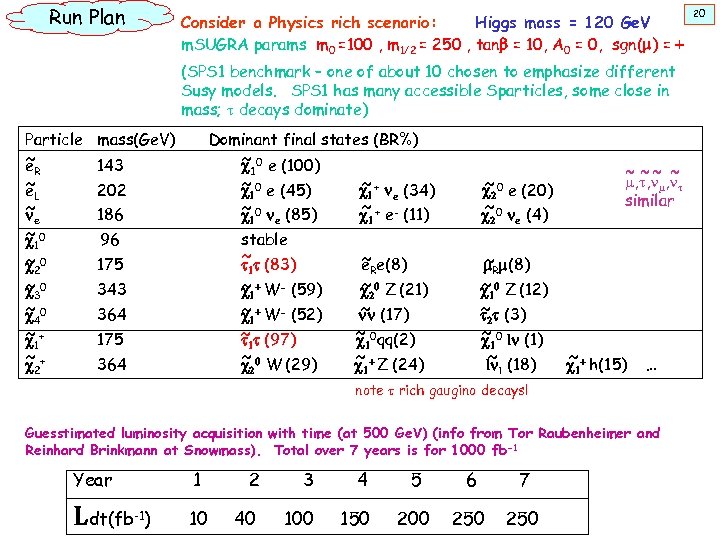 Run Plan Consider a Physics rich scenario: Higgs mass = 120 Ge. V m. SUGRA params m 0 =100 , m 1/2 = 250 , tanb = 10, A 0 = 0, sgn(m) = + (SPS 1 benchmark – one of about 10 chosen to emphasize different Susy models. SPS 1 has many accessible Sparticles, some close in mass; t decays dominate) Particle mass(Ge. V) ~ e. R ~ e. L ~ ne ~0 c 1 ~20 c ~30 c ~0 c 4 ~+ c 1 ~+ c 2 Dominant final states (BR%) 186 ~ 0 e (100) c 1 ~ 0 e (45) c 1 ~ 0 n (85) c 96 stable 143 202 1 e ~ t (83) t 175 1 ~1+ W- (59) c ~1+ W- (52) c ~ t (97) t 1 ~ 0 W (29) c 343 364 175 364 2 ~ c 1+ ne (34) ~ c + e- (11) ~ c 20 e (20) ~ c 0 n (4) ~ e. Re(8) ~ ~~ ~ m, t, nm, nt similar ~ m. Rm(8) 1 e 2 ~ c 20 Z (21) ~ c 10 Z (12) ~ nn (17) ~ t (3) t 2 ~ 0 ln (1) c 1 ~ ln (18) ~ 0 qq(2) c 1 ~ c + Z (24) 1 l ~ c 1+ h(15) … note t rich gaugino decays! Guesstimated luminosity acquisition with time (at 500 Ge. V) (info from Tor Raubenheimer and Reinhard Brinkmann at Snowmass). Total over 7 years is for 1000 fb-1 Year 1 Ldt(fb-1) 10 2 3 4 40 100 150 5 6 7 200 250 20
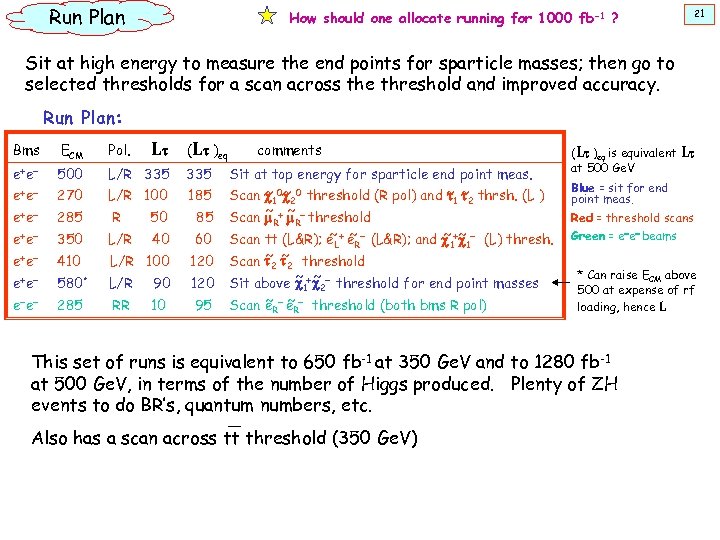 Run Plan How should one allocate running for 1000 fb-1 ? 21 Sit at high energy to measure the end points for sparticle masses; then go to selected thresholds for a scan across the threshold and improved accuracy. Run Plan: Lt (Lt )eq Bms ECM Pol. e+ e- 500 L/R 335 e+ e- 270 L/R 100 185 e+ e- 285 R 50 85 e+ e- 350 L/R 40 60 e+ e- 410 L/R 100 120 e+ e- 580* L/R 90 120 e- e- 285 RR 10 95 comments Sit at top energy for sparticle end point meas. ~ ~ Scan c 10 c 20 threshold (R pol) and ~1 ~2 thrsh. (L ) t t ~ + m - threshold ~ Scan m R R ~ ~ ~ c Scan tt (L&R); e. L+ e. R- (L&R); and c 1+~1 - (L) thresh. ~ ~ Scan t t threshold 2 2 ~ ~ Sit above c 1+c 2 - threshold for end point masses ~ ~ Scan e - threshold (both bms R pol) R R (Lt )eq is equivalent at 500 Ge. V Blue = sit for end point meas. Red = threshold scans Green = e-e- beams * Can raise ECM above 500 at expense of rf loading, hence L This set of runs is equivalent to 650 fb-1 at 350 Ge. V and to 1280 fb-1 at 500 Ge. V, in terms of the number of Higgs produced. Plenty of ZH events to do BR’s, quantum numbers, etc. Also has a scan across tt threshold (350 Ge. V) Lt
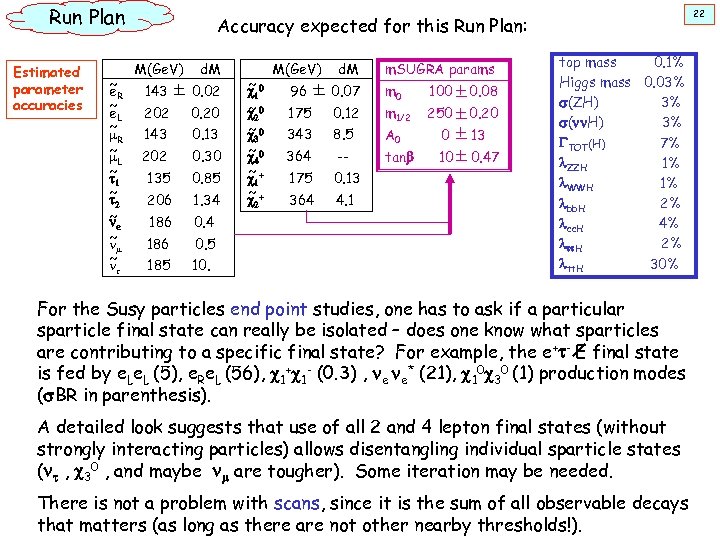 Run Plan Estimated parameter accuracies ~ e. R ~ e. L ~ m. R ~ m. L ~ t 1 ~ t 2 ~ ne ~ n m ~ nt 22 Accuracy expected for this Run Plan: M(Ge. V) d. M 143 0. 02 202 0. 20 143 0. 13 202 0. 30 135 0. 85 206 1. 34 186 0. 5 185 10. ~ c 10 ~ c 20 ~ c 0 3 ~ c 40 ~ c 1+ ~ c 2+ M(Ge. V) d. M 96 0. 07 175 0. 12 343 8. 5 364 -- 175 0. 13 364 4. 1 m. SUGRA params m 0 100 0. 08 m 1/2 250 0. 20 A 0 0 13 tanb 10 0. 47 top mass 0. 1% Higgs mass 0. 03% s(ZH) 3% s(nn. H) 3% GTOT(H) 7% l. ZZH 1% l. WWH 1% lbb. H 2% lcc. H 4% ltt. H 2% ltt. H 30% For the Susy particles end point studies, one has to ask if a particular sparticle final state can really be isolated – does one know what sparticles are contributing to a specific final state? For example, the e +t- E final state is fed by e. L (5), e. Re. L (56), c 1+c 1 - (0. 3) , ne ne* (21), c 10 c 30 (1) production modes (s. BR in parenthesis). A detailed look suggests that use of all 2 and 4 lepton final states (without strongly interacting particles) allows disentangling individual sparticle states (nt , c 30 , and maybe nm are tougher). Some iteration may be needed. There is not a problem with scans, since it is the sum of all observable decays that matters (as long as there are not other nearby thresholds!).
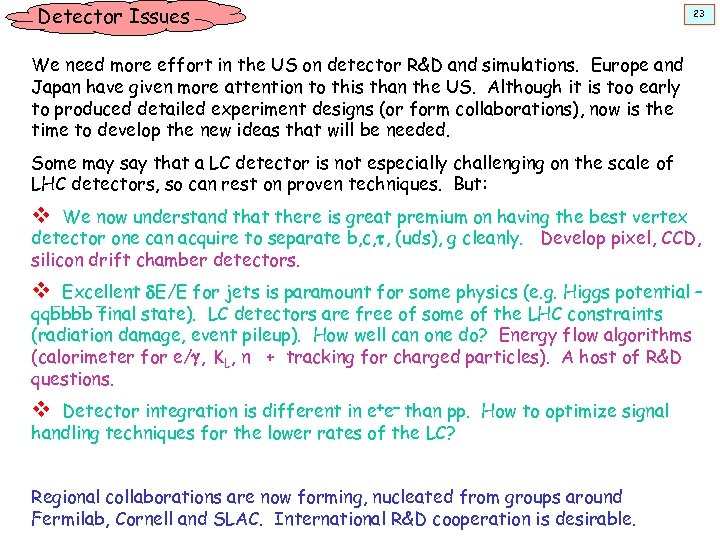 Detector Issues 23 We need more effort in the US on detector R&D and simulations. Europe and Japan have given more attention to this than the US. Although it is too early to produced detailed experiment designs (or form collaborations), now is the time to develop the new ideas that will be needed. Some may say that a LC detector is not especially challenging on the scale of LHC detectors, so can rest on proven techniques. But: v We now understand that there is great premium on having the best vertex detector one can acquire to separate b, c, t, (uds), g cleanly. Develop pixel, CCD, silicon drift chamber detectors. v Excellent d. E/E for jets is paramount for some physics (e. g. Higgs potential – qqbbbb final state). LC detectors are free of some of the LHC constraints (radiation damage, event pileup). How well can one do? Energy flow algorithms (calorimeter for e/g, KL, n + tracking for charged particles). A host of R&D questions. v Detector integration is different in e+e- than pp. How to optimize signal handling techniques for the lower rates of the LC? Regional collaborations are now forming, nucleated from groups around Fermilab, Cornell and SLAC. International R&D cooperation is desirable.
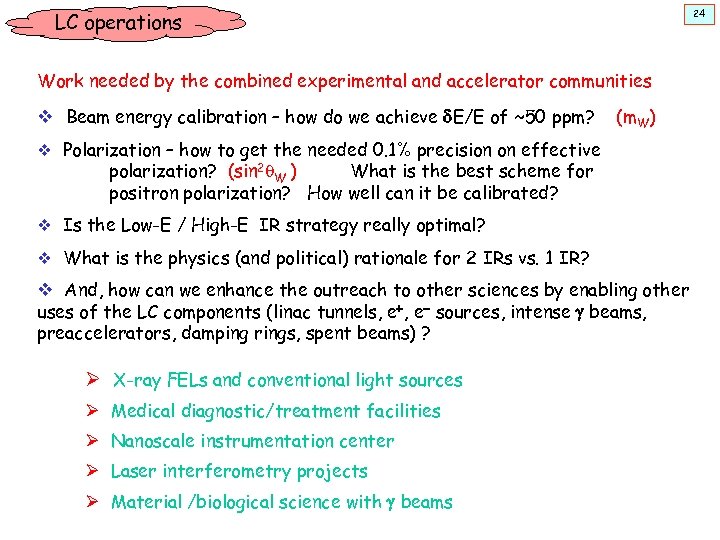 24 LC operations Work needed by the combined experimental and accelerator communities v Beam energy calibration – how do we achieve d. E/E of ~50 ppm? (m. W) v Polarization – how to get the needed 0. 1% precision on effective polarization? (sin 2 q. W ) What is the best scheme for positron polarization? How well can it be calibrated? v Is the Low-E / High-E IR strategy really optimal? v What is the physics (and political) rationale for 2 IRs vs. 1 IR? v And, how can we enhance the outreach to other sciences by enabling other uses of the LC components (linac tunnels, e+, e- sources, intense g beams, preaccelerators, damping rings, spent beams) ? Ø X-ray FELs and conventional light sources Ø Medical diagnostic/treatment facilities Ø Nanoscale instrumentation center Ø Laser interferometry projects Ø Material /biological science with g beams
 Realizing a Linear Collider 25 Recent statements of highest priority for LC in all regions is a major step, and a big argument for making the LC happen. Ø Expect technical proposals and proposals to site a LC from each of the three regions. The TESLA proposal is now before the German Science Ministry, with a recommendation expected in late 2002. Ø Ø The cost of the LC will be high – multi B$. Will be no more than one LC in the world ! There is an international committee (Greg Loew chair) charged by ICFA evaluating the technical merits, comparative costs, and R&D issues – report in late 2002? (but is not a decision making body!) Ø Setting the organizational structure will be critical. ‘LHC’ model = a host country with major control & funding and contributing partners vs. ‘CERN’ model = collaboration of more equal partners ? Ø The choice of site will be difficult; it will likely be driven by the region that is willing to put up the majority of the funding ( 2/3 ? ). Need international discussion to start now; ICFA seems the appropriate body to charge this. HEP has pioneered such collaboration on the smaller scale of collider detectors in the past. We can help establish the paradigm for future international scientific cooperation.
 Realizing a Linear Collider We should never underestimate the difficulty in getting the Linear Collider approved. v The LC project has many extremely challenging technical aspects and much remaining R&D. The experimental community needs to participate in solving these. v Cost is well beyond the single project cost for basic science in the past. We say it must be fundamentally international to afford it, but do not yet have a blueprint for this. v Preoccupation of governments on other issues Terrorism and security needs Economic recession threats worldwide Preference for bio-medical research Costs of unification of Germany … v Competition with other science and technology projects (bureaucrats don’t distinguish laser fusion, space experiments, and accelerators), and HEP is not in strong favor with US government now. Our colleagues in other areas of science must be convinced that HEP in general, and the LC in particular, makes scientific sense in broad terms, and is worth large expenditures. 26
 Realizing a Linear Collider The big steps: 1. Get realistic costs – for R&D, LC project, infrastructure (political process, environment, outreach) 2. Choose the accelerator technology: TESLA vs. NLC/JLC. The Loew panel will help define the tradeoffs. We need to start now on a process to make this decision since it will be hard to sell the project to governments until made. If there is clear preference from the ICFA evaluation process, make the decision! If not, it does not matter so much! Some will have to swallow their pride, but better sooner than later so we can move on a united front. 1. 3. Establish the process for reaching political international decisions on: Ø funding arrangements – the shares for host and participant nations. Ø the way to reach the site decision. Ø organizational structure (just for LC, or a structure for future projects? ) Ø how to retain the health of accel. /particle physics in all regions with a LC in only one. 2. 4. Articulate the rationale for the LC to governments – it will not be the last project we request! It has to be sold on the basis of understanding fundamental makeup of universe (“structure of space, time, energy and matter”) and not on spin -offs. 27
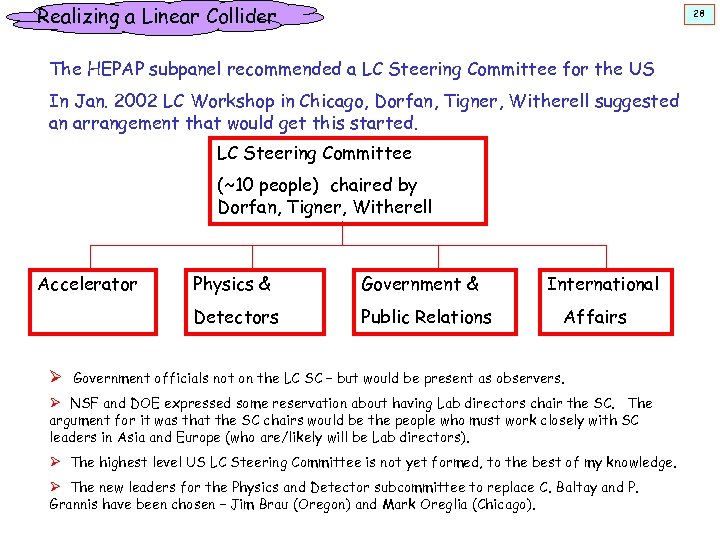 Realizing a Linear Collider 28 The HEPAP subpanel recommended a LC Steering Committee for the US In Jan. 2002 LC Workshop in Chicago, Dorfan, Tigner, Witherell suggested an arrangement that would get this started. LC Steering Committee (~10 people) chaired by Dorfan, Tigner, Witherell Accelerator Physics & Government & Detectors Public Relations International Affairs Ø Government officials not on the LC SC – but would be present as observers. Ø NSF and DOE expressed some reservation about having Lab directors chair the SC. The argument for it was that the SC chairs would be the people who must work closely with SC leaders in Asia and Europe (who are/likely will be Lab directors). Ø The highest level US LC Steering Committee is not yet formed, to the best of my knowledge. Ø The new leaders for the Physics and Detector subcommittee to replace C. Baltay and P. Grannis have been chosen – Jim Brau (Oregon) and Mark Oreglia (Chicago).
 Realizing a Linear Collider Ø January HEPAP meeting amended this structure to remove the “Government/Public” committee from the LC-specific line, and instead to form a standing subcommittee of HEPAP charged with Communications and Outreach for HEP more generally. J. Bagger and B. Barish to be the initial chairs, with membership to include (I hear) P. Drell, M. Shochet, P. Grannis, Judy Jackson, Neil Calder, … Charge is not yet clear, but it should include preparation of informational booklet/materials for use in discussing with US government, and to develop the scientific case for a Linear Collider to be brought to the wider scientific community. The National Academy is also contemplating preparation of such a booklet. The Int’l LC Working Group, in place since 1998, (chairs C. Baltay, D. Miller, S. Komamiya) has also advocated a world-wide book outlining the scientific case for the LC in lay terms. ILCWG is discussing the possibility of a new physics (and detector) book produced in cooperation by physicists from across all regions – a sort of CERN Yellow Book for LC physics. Part of the rationale is to bring the regions into closer cooperation, and to emphasize to governments that the project is supported jointly by all regions. 29
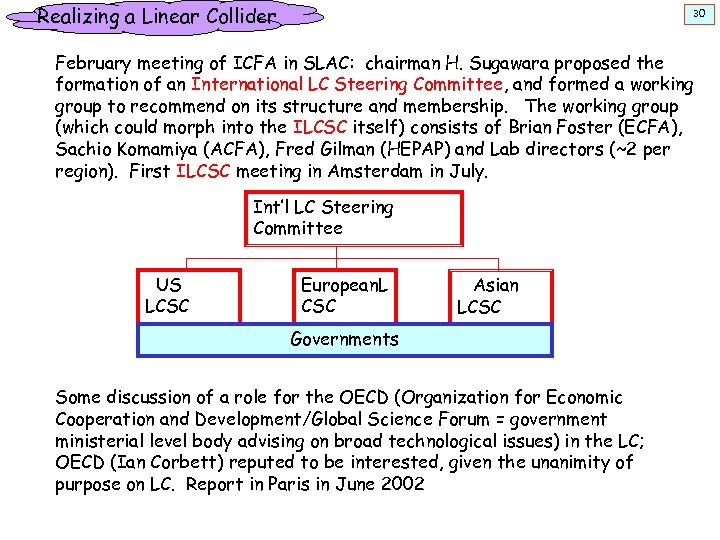 Realizing a Linear Collider 30 February meeting of ICFA in SLAC: chairman H. Sugawara proposed the formation of an International LC Steering Committee, and formed a working group to recommend on its structure and membership. The working group (which could morph into the ILCSC itself) consists of Brian Foster (ECFA), Sachio Komamiya (ACFA), Fred Gilman (HEPAP) and Lab directors (~2 per region). First ILCSC meeting in Amsterdam in July. Int’l LC Steering Committee US LCSC European. L CSC Asian LCSC Governments Some discussion of a role for the OECD (Organization for Economic Cooperation and Development/Global Science Forum = government ministerial level body advising on broad technological issues) in the LC; OECD (Ian Corbett) reputed to be interested, given the unanimity of purpose on LC. Report in Paris in June 2002
 Conclusion We have done the easier part by coming to consensus that a Linear Collider is what HEP should aim for. Now comes the much harder part in making it occur !
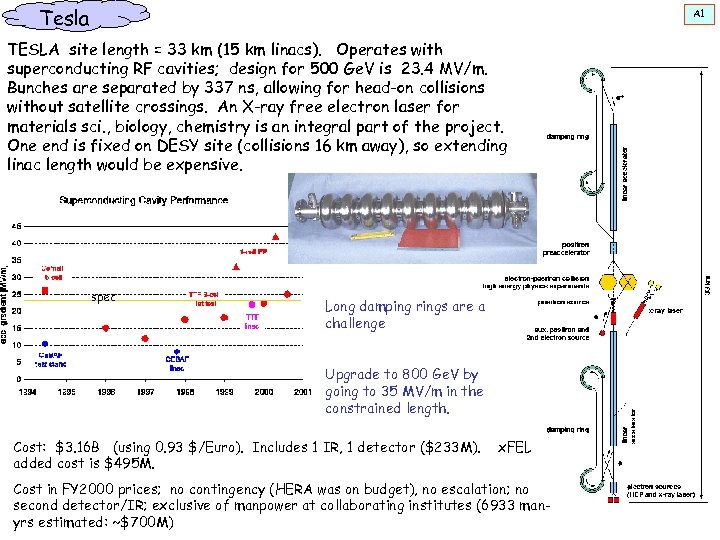 Tesla A 1 TESLA site length = 33 km (15 km linacs). Operates with superconducting RF cavities; design for 500 Ge. V is 23. 4 MV/m. Bunches are separated by 337 ns, allowing for head-on collisions without satellite crossings. An X-ray free electron laser for materials sci. , biology, chemistry is an integral part of the project. One end is fixed on DESY site (collisions 16 km away), so extending linac length would be expensive. spec Long damping rings are a challenge Upgrade to 800 Ge. V by going to 35 MV/m in the constrained length. Cost: $3. 16 B (using 0. 93 $/Euro). Includes 1 IR, 1 detector ($233 M). added cost is $495 M. x. FEL Cost in FY 2000 prices; no contingency (HERA was on budget), no escalation; no second detector/IR; exclusive of manpower at collaborating institutes (6933 manyrs estimated: ~$700 M)
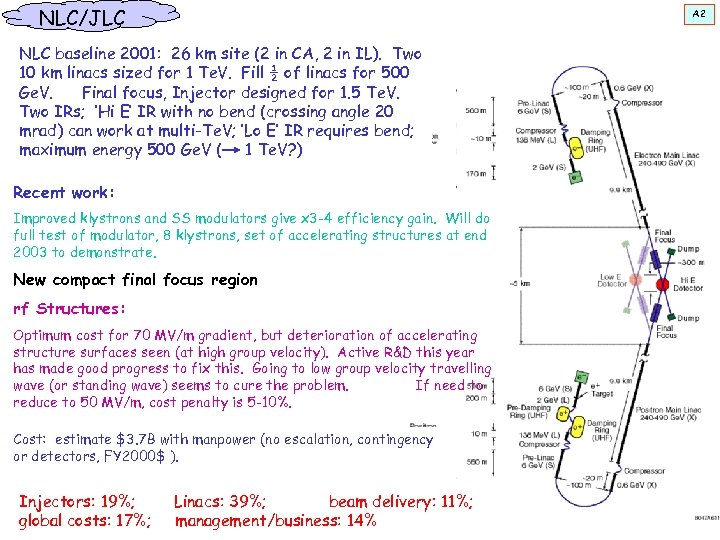 NLC/JLC A 2 NLC baseline 2001: 26 km site (2 in CA, 2 in IL). Two 10 km linacs sized for 1 Te. V. Fill ½ of linacs for 500 Ge. V. Final focus, Injector designed for 1. 5 Te. V. Two IRs; ‘Hi E’ IR with no bend (crossing angle 20 mrad) can work at multi-Te. V; ‘Lo E’ IR requires bend; maximum energy 500 Ge. V ( 1 Te. V? ) Recent work: Improved klystrons and SS modulators give x 3 -4 efficiency gain. Will do full test of modulator, 8 klystrons, set of accelerating structures at end 2003 to demonstrate. New compact final focus region rf Structures: Optimum cost for 70 MV/m gradient, but deterioration of accelerating structure surfaces seen (at high group velocity). Active R&D this year has made good progress to fix this. Going to low group velocity travelling wave (or standing wave) seems to cure the problem. If need to reduce to 50 MV/m, cost penalty is 5 -10%. Cost: estimate $3. 7 B with manpower (no escalation, contingency or detectors, FY 2000$ ). Injectors: 19%; global costs: 17%; Linacs: 39%; beam delivery: 11%; management/business: 14%
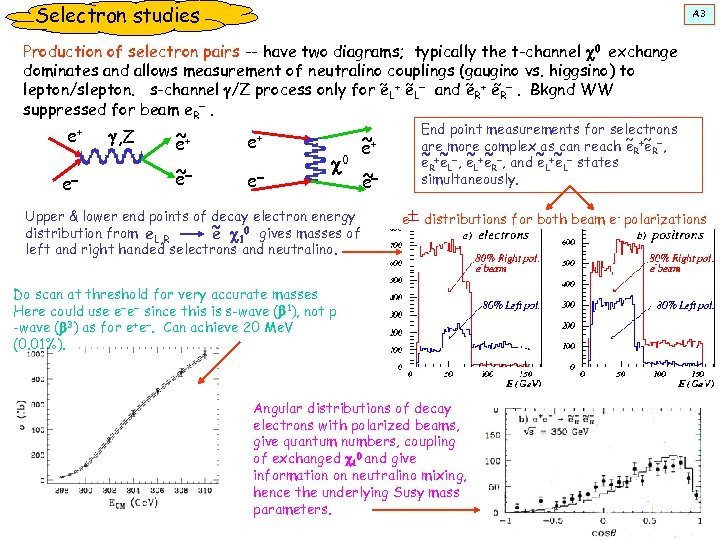 Selectron studies A 3 Production of selectron pairs -- have two diagrams; typically the t-channel c 0 exchange dominates and allows measurement of neutralino couplings (gaugino vs. higgsino) to lepton/slepton. s-channel g/Z process only for ~ L+ e. L- and ~ R+ e. R-. Bkgnd WW e ~ suppressed for beam e. R-. e+ e- g, Z ~ e+ e+ ~ e- e- c 0 Upper & lower end points of decay electron energy ~ c 0 gives masses of distribution from e. L, R e 1 left and right handed selectrons and neutralino. ~ e+ ~e End point measurements for selectrons are more complex as can reach ~R+~R-, e e ~ +~ -, e +e -, and ~ +~ - states ~ ~ e. R e. L L R e. L simultaneously. e distributions for both beam e- polarizations Do scan at threshold for very accurate masses Here could use e-e- since this is s-wave (b 1), not p -wave (b 3) as for e+e-. Can achieve 20 Me. V (0. 01%). Angular distributions of decay electrons with polarized beams, give quantum numbers, coupling of exchanged c 10 and give information on neutralino mixing, hence the underlying Susy mass parameters.
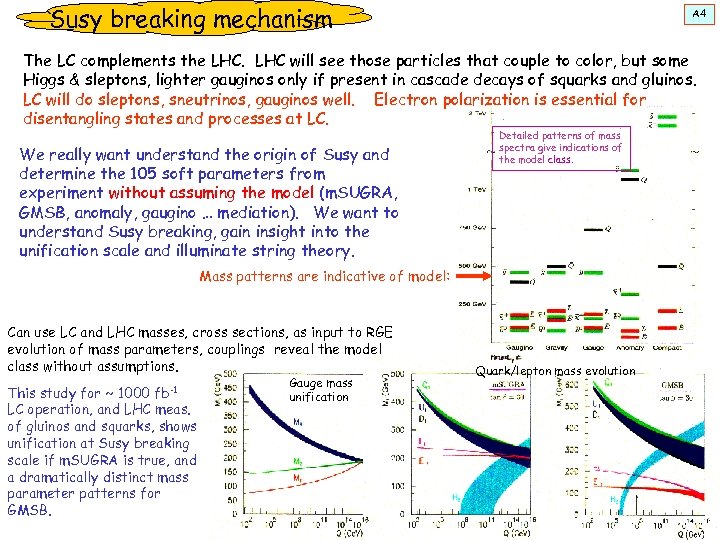 Susy breaking mechanism A 4 The LC complements the LHC will see those particles that couple to color, but some Higgs & sleptons, lighter gauginos only if present in cascade decays of squarks and gluinos. LC will do sleptons, sneutrinos, gauginos well. Electron polarization is essential for disentangling states and processes at LC. We really want understand the origin of Susy and determine the 105 soft parameters from experiment without assuming the model (m. SUGRA, GMSB, anomaly, gaugino … mediation). We want to understand Susy breaking, gain insight into the unification scale and illuminate string theory. Detailed patterns of mass spectra give indications of the model class. Mass patterns are indicative of model: Can use LC and LHC masses, cross sections, as input to RGE evolution of mass parameters, couplings reveal the model class without assumptions. This study for ~ 1000 fb-1 LC operation, and LHC meas. of gluinos and squarks, shows unification at Susy breaking scale if m. SUGRA is true, and a dramatically distinct mass parameter patterns for GMSB. Gauge mass unification Quark/lepton mass evolution
 Precision measurements In the case that the LHC/LC does not see supersymmetry, precision EW measurements will have added importance as signposts to the new physics. NLC design has special lower energy collision point – at present alternate HI to LO energy operation, but it may be possible to design concurrent usage with same HI energy IP rep rate. Tesla design would simply lower ECM at the single IP with consequent loss of luminosity. Giga Z: Modest luminosity (20 fb-1 – equivalent in time to ~100 fb-1 at full energy) needed for 109 Z’s. To get the improved Z-pole precisions, need very accurate control of polarization (e. g. for ALR). This could be achieved by using both electron and positron polarization, but the positron polarization schemes are not yet mature. R&D on polarimetry and positron polarization is needed. Even larger Z samples (1010) would become very interesting for precision studies of b-quark couplings, asymmetries, rare decays and would extend b-physics into new regimes. W mass: Scan the cross-section at WW threshold; with 100 fb-1 can get precision ~5 Me. V. Knowing the beam energy and luminosity to the required precision is a challenge (50 ppm on Ebeam). The scan would also give GW to ~ 4 Me. V. Top quark: Scan at tt threshold is sensitive to mt, a. S, Gt and the top Yukawa coupling lt. (lt is also accessible from s(tt. H) at higher energy LC operation. ) With 300 fb-1 at the tt threshold, estimate precisions of: dmt = 18 Me. V; da. S=0. 0015; d. Gt=32 Me. V. Determination of top Yukawa coupling from threshold scan seems limited to about 30%. A 5