


 Скачать презентацию What You Need to Know Health Reform for
00881902ac78a535a49e817f6f75caf4.ppt
- Количество слайдов: 80
 What You Need to Know: Health Reform for Alaska Lessons Learned from Other States A Briefing for Alaska Legislators and Staff Juneau, AK January 28, 2009 Enrique Martinez-Vidal Vice President, Academy. Health Director, State Coverage Initiatives
 State Coverage Initiatives (SCI) l An Initiative of the Robert Wood Johnson Foundation Community of State Officials Ø Convening state officials Resources and Information Ø Web site: www. statecoverage. org Ø State Profiles Ø Publications/State of the States Direct technical assistance to states Ø State-specific help, research on state policymakers’ questions Ø Grant funding/Coverage Institute
 Overview of Presentation • • • Background What is driving state reform? State Reform Strategies States & the Health Workforce State Quality Reporting Activities State Health Policy Commissions and Authorities • Lessons Learned from State Reforms • Concluding Thoughts
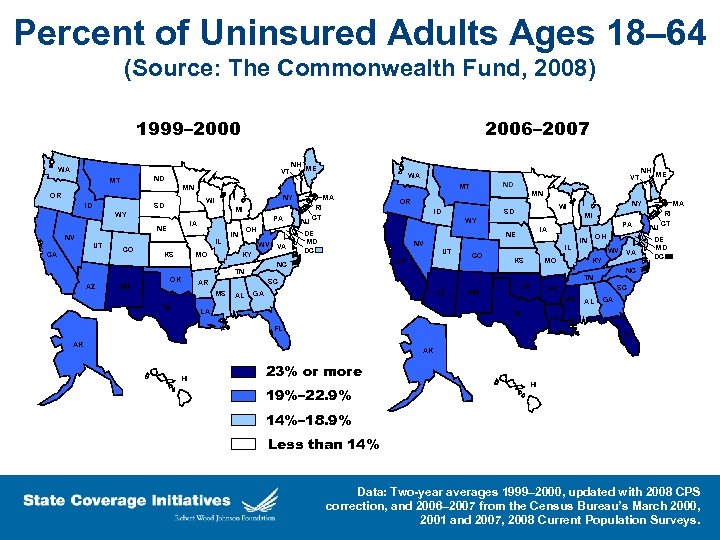 Percent of Uninsured Adults Ages 18– 64 (Source: The Commonwealth Fund, 2008) 1999– 2000 2006– 2007 WA VT ND MT ID MI WY PA IA NE NV IL CO KS MO OH IN WV NM OK NJ RI CT IL CO KS MO OH IN WV AZ GA LA NM OK NJ RI CT DE MD DC NC SC AR MS TX VA KY TN SC AL PA IA NV CA MA MI NE UT NY WI SD WY DE MD DC NH ME MN OR ID NC AR MS TX VA KY TN AZ MA VT ND MT NY WI SD CA WA MN OR UT NH ME AL GA LA FL FL AK AK HI 23% or more 19%– 22. 9% HI 14%– 18. 9% Less than 14% Data: Two-year averages 1999– 2000, updated with 2008 CPS correction, and 2006– 2007 from the Census Bureau’s March 2000, 2001 and 2007, 2008 Current Population Surveys.
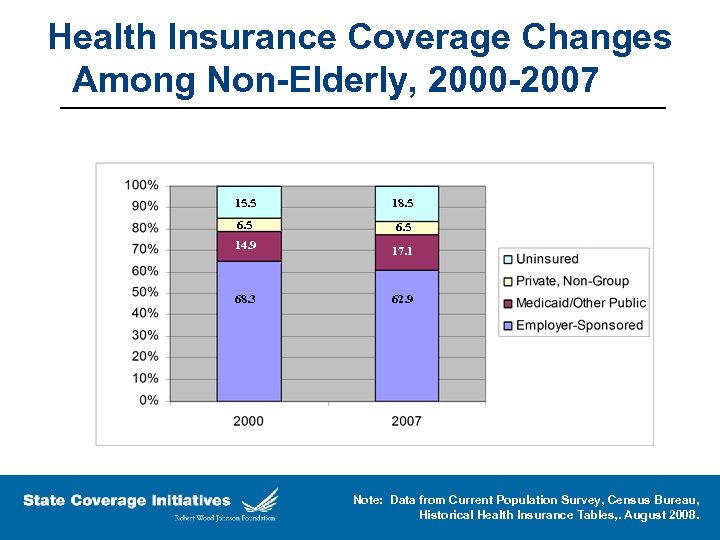 Health Insurance Coverage Changes Among Non-Elderly, 2000 -2007 15. 5 18. 5 6. 5 14. 9 17. 1 68. 3 62. 9 Note: Data from Current Population Survey, Census Bureau, Historical Health Insurance Tables, . August 2008.
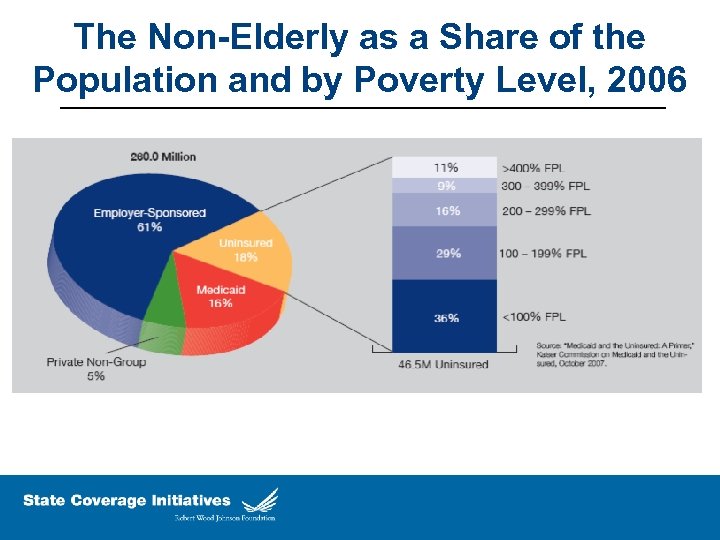 The Non-Elderly as a Share of the Population and by Poverty Level, 2006 11% 14. 9 29% 17. 7
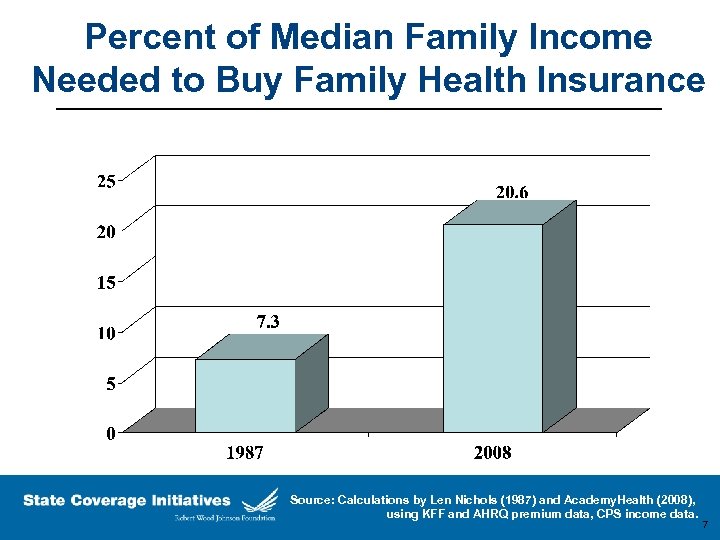 Percent of Median Family Income Needed to Buy Family Health Insurance Source: Calculations by Len Nichols (1987) and Academy. Health (2008), using KFF and AHRQ premium data, CPS income data. 7
 Drivers of State Health Reform Efforts Uninsured still high l Employer-sponsored insurance down l Costs/premiums increasingly unaffordable – Indiv; Families; Govt l Coverage needed for effective and efficient health care system l Lack of national consensus – future? l Greater political will at state level l
 Key Policy and Design Issues l l l l Different Populations Require Different Solutions Subsidies and Financing: Who will pay? Who will benefit? Should Health Insurance Coverage Be Required? What is Affordable Coverage? What is the Most Appropriate Benefit Design? Do Insurance Markets Need to be Reformed/Reorganized? Best Mechanisms for Cost Containment/Systems Improvement
 “One size fits all” approach won’t work • Those with few resources to bring to private insurance market Ø Ø Ø • Those with some resources but cannot bear the full cost of insurance premiums Ø • Ceiling = eligibility for public programs Children: 100 -300% FPL SCHIP Parents/Childless Adults: Vary from 12 -275% FPL Subsidies and other methods to reduce premiums Those who have sufficient incomes to participate in market on their own Ø Encourage voluntary participation or mandate coverage
 No Free Solutions: Who Will Pay? Who Will Benefit? l Shared responsibility – Who will help cover the costs? Ø l Individuals; Employers; Federal government; State government; Health plans/insurers; Providers Enough money in current system? Ø Ø If yes, then – Redistribution (Who will pay? Who will get paid? ) If not, then need new forms of revenue: Sin taxes; Provider taxes; Payroll taxes; Lease the lottery; Slots revenues; Gross Receipts Tax
 Should Health Insurance Coverage Be Required? l l Unenforceable? Impingement on individual freedom? Does your state have money for subsidies to help lower-income uninsured (or an exemption process)?
 What is Affordable Coverage? l l Related to overall benefit design Related to subsidies being considered Could be related to individual mandate General agreement that levels of both premium and out-of-pocket costs should somehow be related to income and ability to pay
 Benefit Design • Services included/excluded; cost-sharing; structure of access to providers • Not just cost of coverage but value of the benefit plan – what set of services are purchased for specific amount of money • Before – limit benefits; raise cost-sharing; limit networks (value issue) • Levers within benefit design: Ø reduce premiums Ø encourage efficient/appropriate consumer behavior Ø change carrier and provider behavior • Evidence-based benefit design? MN • Consumer-driven health plans? IN • First-dollar benefits? TN • Direct consumer behavior change? RI 1
 Don’t Forget the Delivery System • • • Prevention/primary care/wellness Chronic care management and coordination Public health initiatives Value-based purchasing/payment reforms Medical error reduction Health-acquired infection reduction/patient safety Price and quality transparency Heath information technology and exchange Administrative and regulatory efficiencies
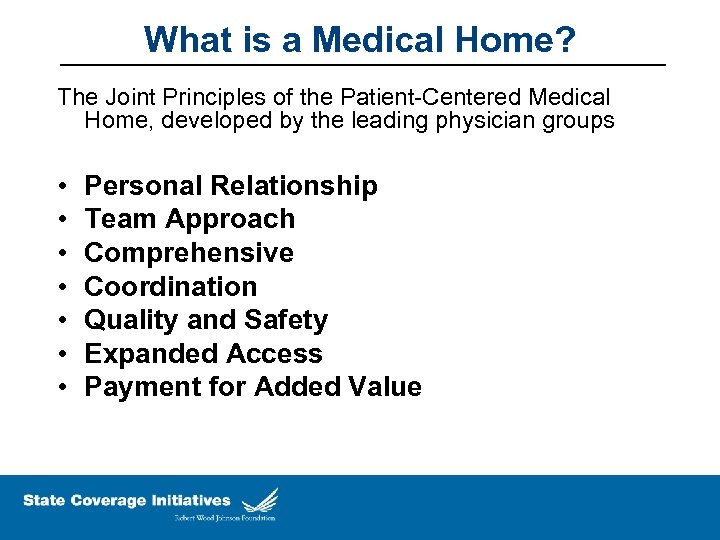 What is a Medical Home? The Joint Principles of the Patient-Centered Medical Home, developed by the leading physician groups • • Personal Relationship Team Approach Comprehensive Coordination Quality and Safety Expanded Access Payment for Added Value
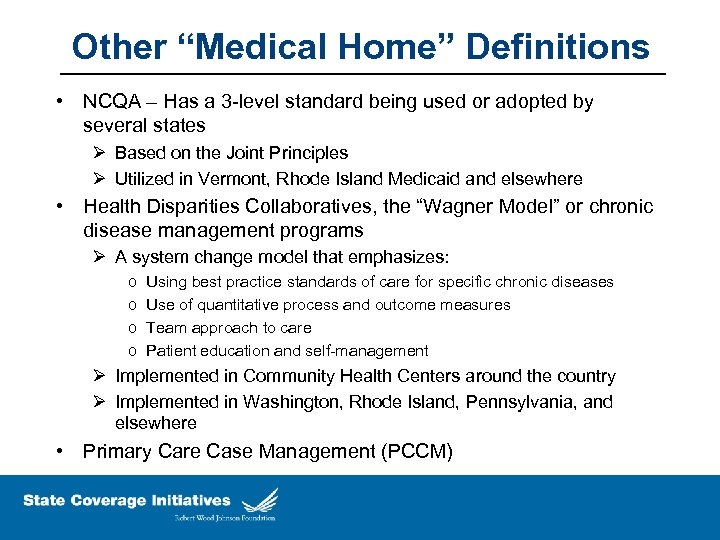 Other “Medical Home” Definitions • NCQA – Has a 3 -level standard being used or adopted by several states Ø Based on the Joint Principles Ø Utilized in Vermont, Rhode Island Medicaid and elsewhere • Health Disparities Collaboratives, the “Wagner Model” or chronic disease management programs Ø A system change model that emphasizes: o o Using best practice standards of care for specific chronic diseases Use of quantitative process and outcome measures Team approach to care Patient education and self-management Ø Implemented in Community Health Centers around the country Ø Implemented in Washington, Rhode Island, Pennsylvania, and elsewhere • Primary Care Case Management (PCCM)
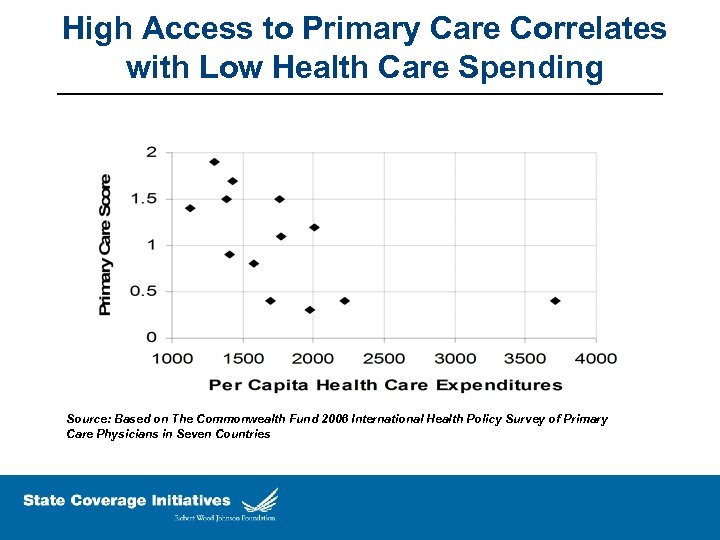 High Access to Primary Care Correlates with Low Health Care Spending Source: Based on The Commonwealth Fund 2006 International Health Policy Survey of Primary Care Physicians in Seven Countries
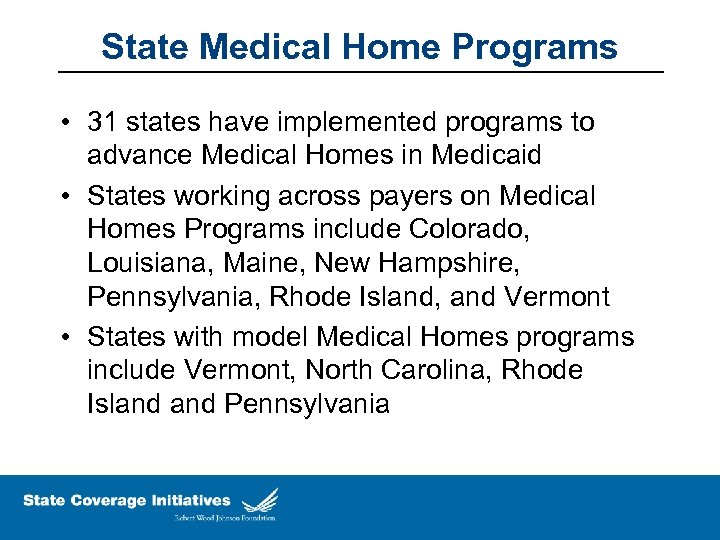 State Medical Home Programs • 31 states have implemented programs to advance Medical Homes in Medicaid • States working across payers on Medical Homes Programs include Colorado, Louisiana, Maine, New Hampshire, Pennsylvania, Rhode Island, and Vermont • States with model Medical Homes programs include Vermont, North Carolina, Rhode Island Pennsylvania
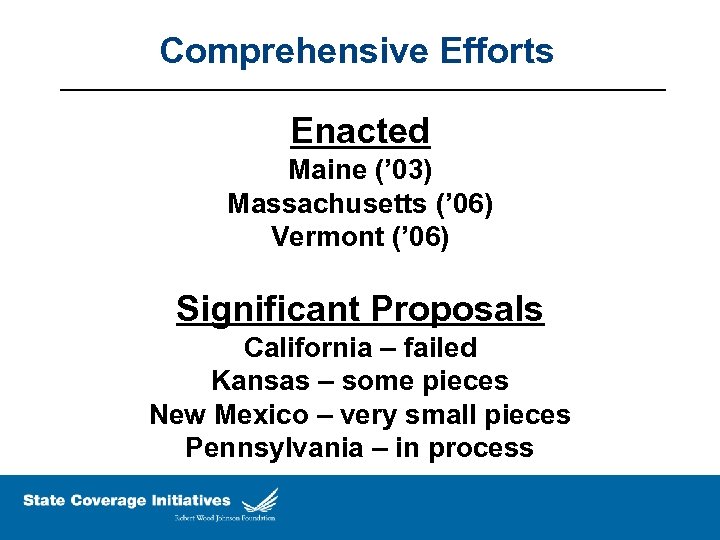 Comprehensive Efforts Enacted Maine (’ 03) Massachusetts (’ 06) Vermont (’ 06) Significant Proposals California – failed Kansas – some pieces New Mexico – very small pieces Pennsylvania – in process
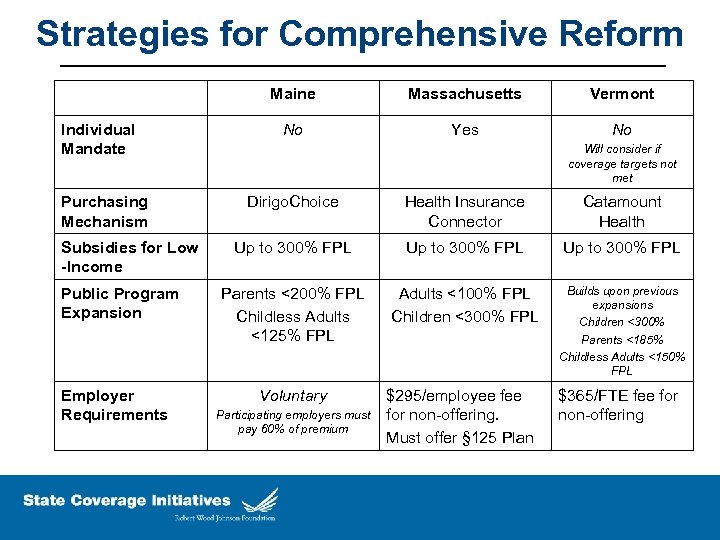 Strategies for Comprehensive Reform Maine Individual Mandate Purchasing Mechanism Subsidies for Low -Income Public Program Expansion Employer Requirements Massachusetts Vermont No Yes No Will consider if coverage targets not met Dirigo. Choice Health Insurance Connector Catamount Health Up to 300% FPL Parents <200% FPL Childless Adults <125% FPL Adults <100% FPL Children <300% FPL Builds upon previous expansions Children <300% Parents <185% Childless Adults <150% FPL Voluntary Participating employers must pay 60% of premium $295/employee for non-offering. Must offer § 125 Plan $365/FTE fee for non-offering
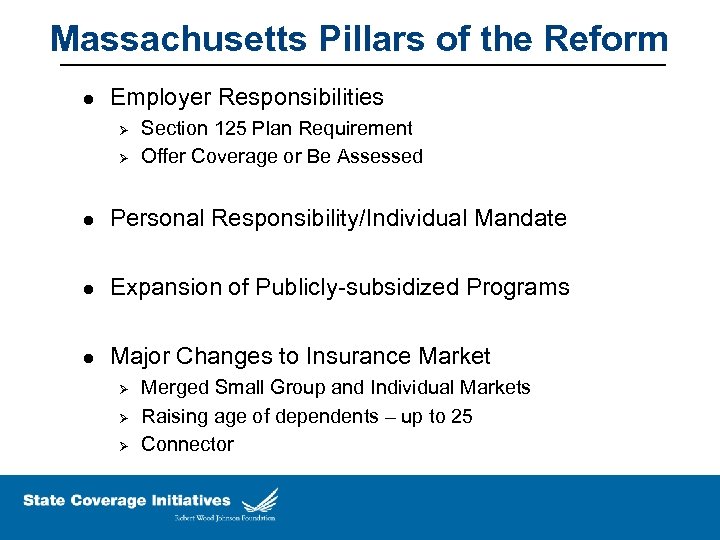 Massachusetts Pillars of the Reform l Employer Responsibilities Ø Ø Section 125 Plan Requirement Offer Coverage or Be Assessed l Personal Responsibility/Individual Mandate l Expansion of Publicly-subsidized Programs l Major Changes to Insurance Market Ø Ø Ø Merged Small Group and Individual Markets Raising age of dependents – up to 25 Connector
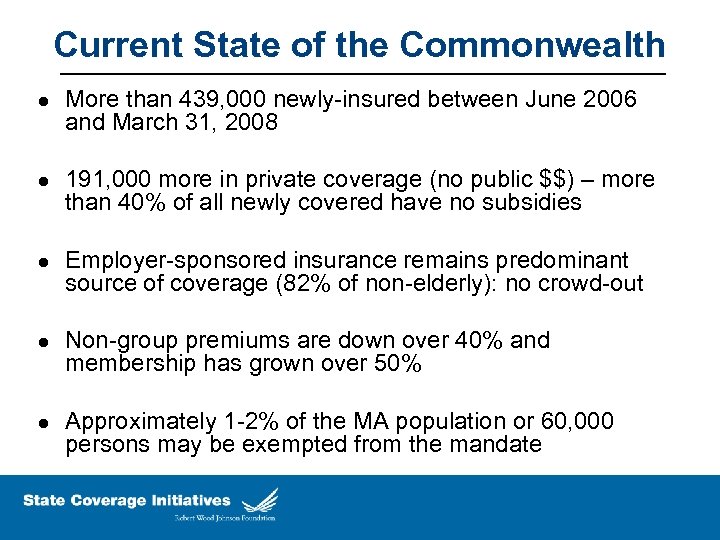 Current State of the Commonwealth l l l More than 439, 000 newly-insured between June 2006 and March 31, 2008 191, 000 more in private coverage (no public $$) – more than 40% of all newly covered have no subsidies Employer-sponsored insurance remains predominant source of coverage (82% of non-elderly): no crowd-out Non-group premiums are down over 40% and membership has grown over 50% Approximately 1 -2% of the MA population or 60, 000 persons may be exempted from the mandate
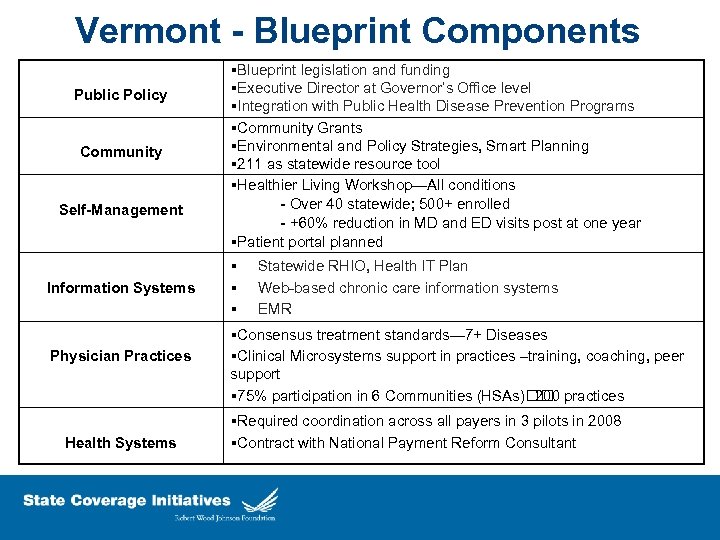 Vermont - Blueprint Components Public Policy Community Self-Management Information Systems Physician Practices Health Systems §Blueprint legislation and funding §Executive Director at Governor’s Office level §Integration with Public Health Disease Prevention Programs §Community Grants §Environmental and Policy Strategies, Smart Planning § 211 as statewide resource tool §Healthier Living Workshop—All conditions - Over 40 statewide; 500+ enrolled - +60% reduction in MD and ED visits post at one year §Patient portal planned § Statewide RHIO, Health IT Plan § Web-based chronic care information systems § EMR §Consensus treatment standards— 7+ Diseases §Clinical Microsystems support in practices –training, coaching, peer support § 75% participation in 6 Communities (HSAs) 200 practices §Required coordination across all payers in 3 pilots in 2008 §Contract with National Payment Reform Consultant
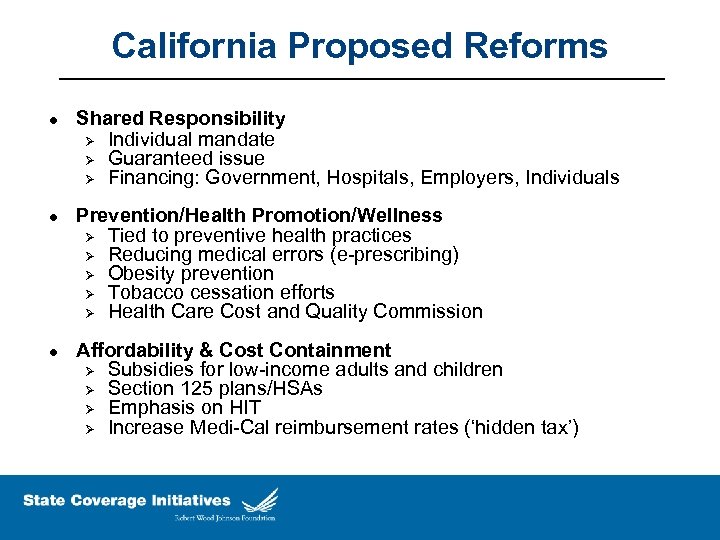 California Proposed Reforms l l l Shared Responsibility Ø Individual mandate Ø Guaranteed issue Ø Financing: Government, Hospitals, Employers, Individuals Prevention/Health Promotion/Wellness Ø Tied to preventive health practices Ø Reducing medical errors (e-prescribing) Ø Obesity prevention Ø Tobacco cessation efforts Ø Health Care Cost and Quality Commission Affordability & Cost Containment Ø Subsidies for low-income adults and children Ø Section 125 plans/HSAs Ø Emphasis on HIT Ø Increase Medi-Cal reimbursement rates (‘hidden tax’)
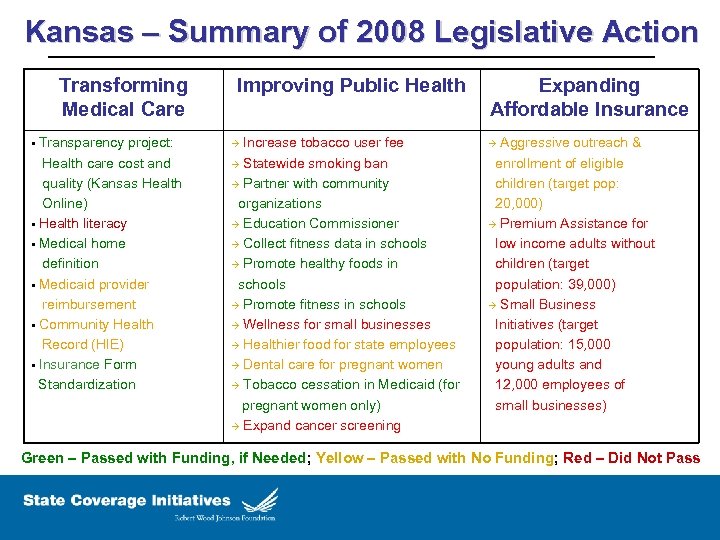 Kansas – Summary of 2008 Legislative Action Transforming Medical Care § Transparency project: Improving Public Health Increase tobacco user fee Health care cost and Statewide smoking ban quality (Kansas Health Partner with community Online) organizations § Health literacy Education Commissioner § Medical home Collect fitness data in schools definition Promote healthy foods in § Medicaid provider schools reimbursement Promote fitness in schools § Community Health Wellness for small businesses Record (HIE) Healthier food for state employees § Insurance Form Dental care for pregnant women Standardization Tobacco cessation in Medicaid (for pregnant women only) Expand cancer screening Expanding Affordable Insurance Aggressive outreach & enrollment of eligible children (target pop: 20, 000) Premium Assistance for low income adults without children (target population: 39, 000) Small Business Initiatives (target population: 15, 000 young adults and 12, 000 employees of small businesses) Green – Passed with Funding, if Needed; Yellow – Passed with No Funding; Red – Did Not Pass
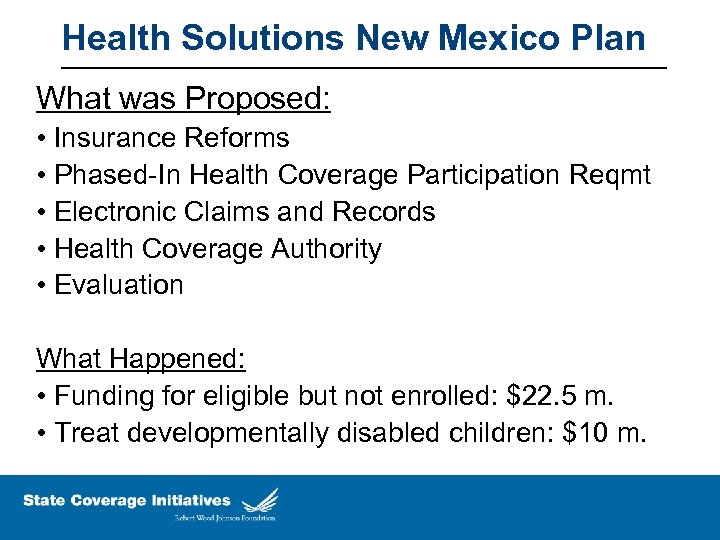 Health Solutions New Mexico Plan What was Proposed: • Insurance Reforms • Phased-In Health Coverage Participation Reqmt • Electronic Claims and Records • Health Coverage Authority • Evaluation What Happened: • Funding for eligible but not enrolled: $22. 5 m. • Treat developmentally disabled children: $10 m.
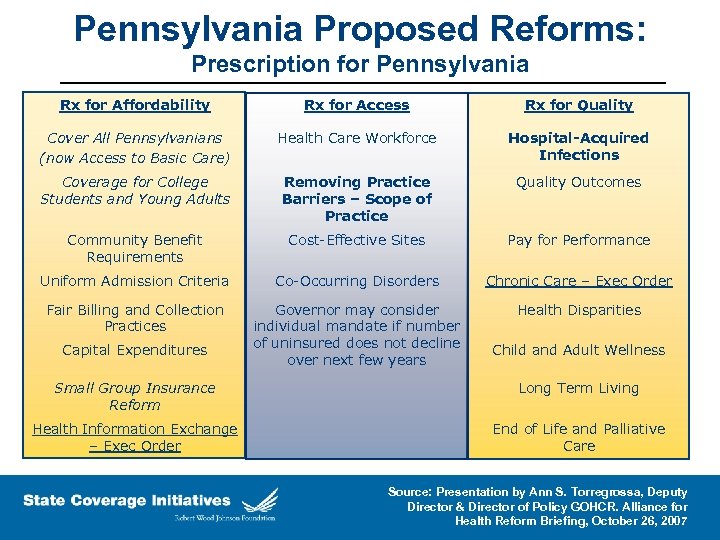 Pennsylvania Proposed Reforms: Prescription for Pennsylvania Rx for Affordability Rx for Access Rx for Quality Cover All Pennsylvanians (now Access to Basic Care) Health Care Workforce Hospital-Acquired Infections Coverage for College Students and Young Adults Removing Practice Barriers – Scope of Practice Quality Outcomes Community Benefit Requirements Cost-Effective Sites Pay for Performance Uniform Admission Criteria Co-Occurring Disorders Chronic Care – Exec Order Fair Billing and Collection Practices Governor may consider individual mandate if number of uninsured does not decline over next few years Health Disparities Capital Expenditures Child and Adult Wellness Small Group Insurance Reform Long Term Living Health Information Exchange – Exec Order End of Life and Palliative Care Source: Presentation by Ann S. Torregrossa, Deputy Director & Director of Policy GOHCR. Alliance for Health Reform Briefing, October 26, 2007
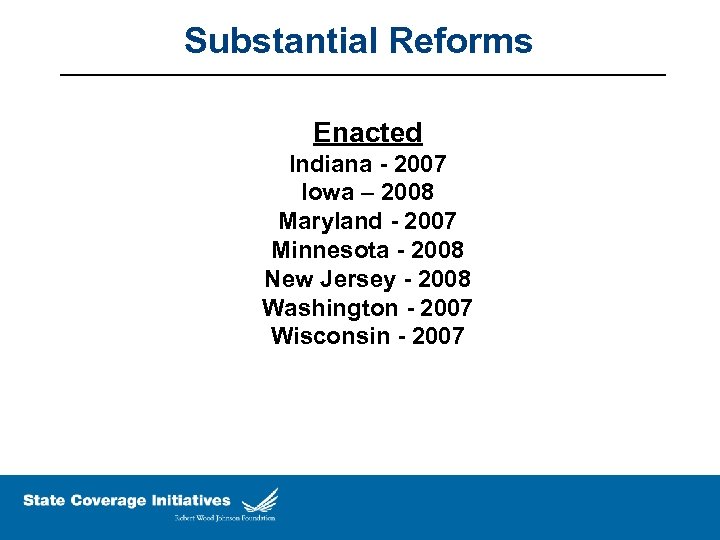 Substantial Reforms Enacted Indiana - 2007 Iowa – 2008 Maryland - 2007 Minnesota - 2008 New Jersey - 2008 Washington - 2007 Wisconsin - 2007
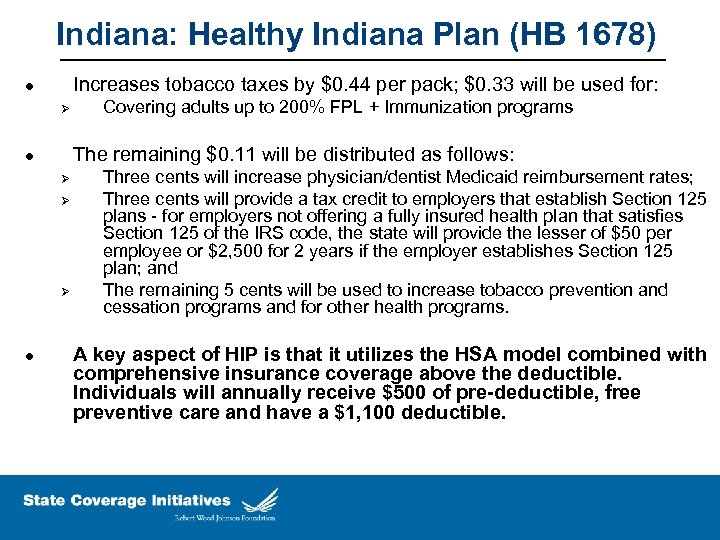 Indiana: Healthy Indiana Plan (HB 1678) Increases tobacco taxes by $0. 44 per pack; $0. 33 will be used for: l Ø The remaining $0. 11 will be distributed as follows: l Ø Ø Ø l Covering adults up to 200% FPL + Immunization programs Three cents will increase physician/dentist Medicaid reimbursement rates; Three cents will provide a tax credit to employers that establish Section 125 plans - for employers not offering a fully insured health plan that satisfies Section 125 of the IRS code, the state will provide the lesser of $50 per employee or $2, 500 for 2 years if the employer establishes Section 125 plan; and The remaining 5 cents will be used to increase tobacco prevention and cessation programs and for other health programs. A key aspect of HIP is that it utilizes the HSA model combined with comprehensive insurance coverage above the deductible. Individuals will annually receive $500 of pre-deductible, free preventive care and have a $1, 100 deductible.
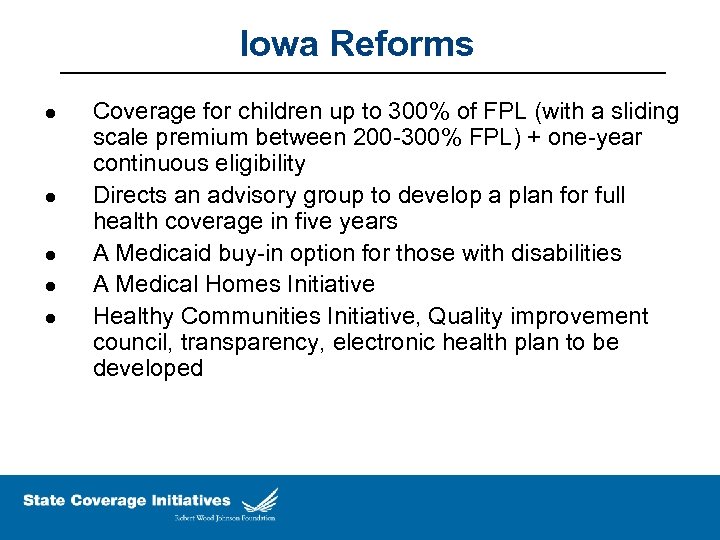 Iowa Reforms l l l Coverage for children up to 300% of FPL (with a sliding scale premium between 200 -300% FPL) + one-year continuous eligibility Directs an advisory group to develop a plan for full health coverage in five years A Medicaid buy-in option for those with disabilities A Medical Homes Initiative Healthy Communities Initiative, Quality improvement council, transparency, electronic health plan to be developed
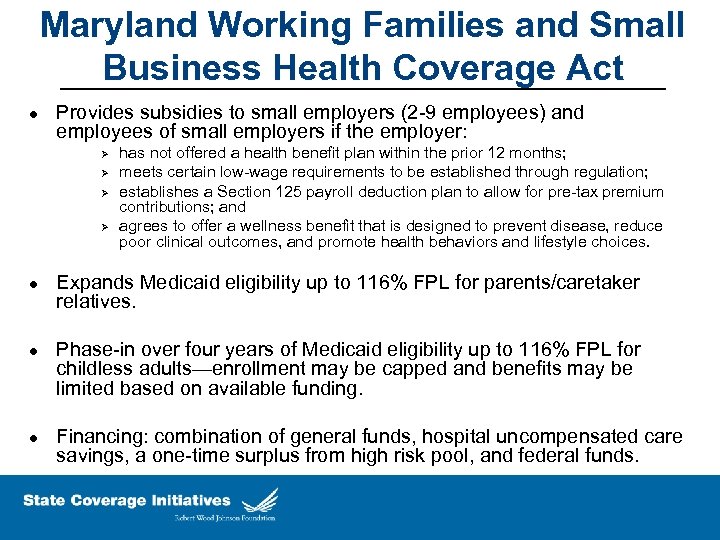 Maryland Working Families and Small Business Health Coverage Act l Provides subsidies to small employers (2 -9 employees) and employees of small employers if the employer: Ø Ø l l l has not offered a health benefit plan within the prior 12 months; meets certain low-wage requirements to be established through regulation; establishes a Section 125 payroll deduction plan to allow for pre-tax premium contributions; and agrees to offer a wellness benefit that is designed to prevent disease, reduce poor clinical outcomes, and promote health behaviors and lifestyle choices. Expands Medicaid eligibility up to 116% FPL for parents/caretaker relatives. Phase-in over four years of Medicaid eligibility up to 116% FPL for childless adults—enrollment may be capped and benefits may be limited based on available funding. Financing: combination of general funds, hospital uncompensated care savings, a one-time surplus from high risk pool, and federal funds.
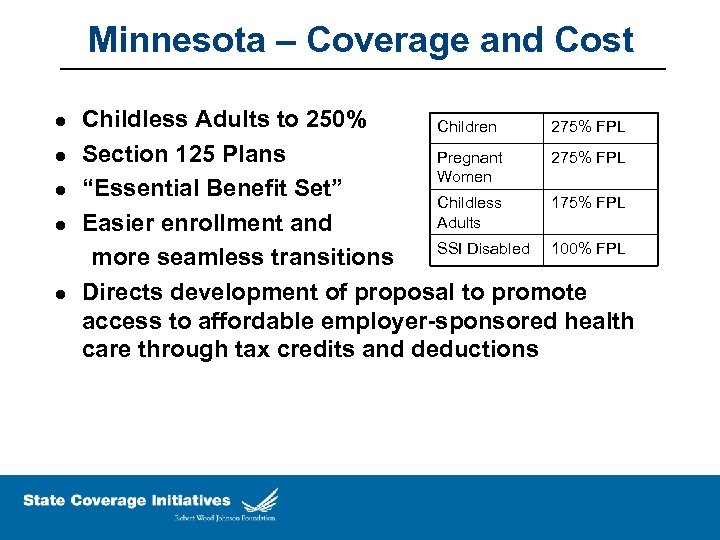 Minnesota – Coverage and Cost l l l Childless Adults to 250% Children 275% FPL Section 125 Plans Pregnant 275% FPL Women “Essential Benefit Set” Childless 175% FPL Adults Easier enrollment and SSI Disabled 100% FPL more seamless transitions Directs development of proposal to promote access to affordable employer-sponsored health care through tax credits and deductions
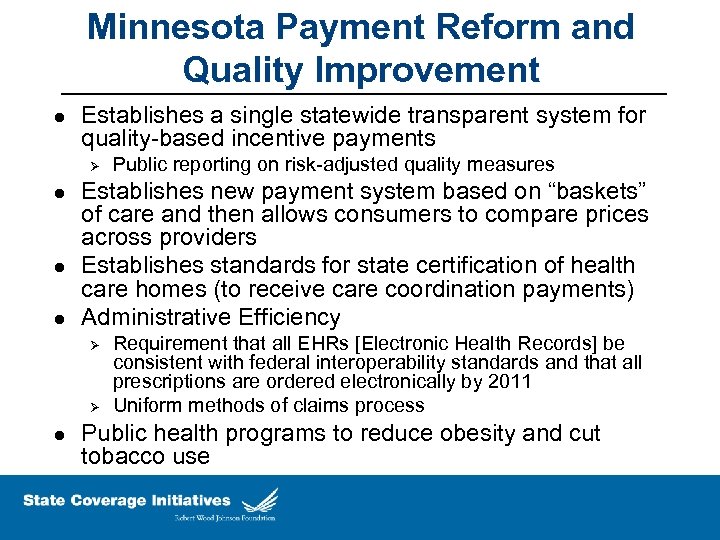 Minnesota Payment Reform and Quality Improvement l Establishes a single statewide transparent system for quality-based incentive payments Ø l l l Establishes new payment system based on “baskets” of care and then allows consumers to compare prices across providers Establishes standards for state certification of health care homes (to receive care coordination payments) Administrative Efficiency Ø Ø l Public reporting on risk-adjusted quality measures Requirement that all EHRs [Electronic Health Records] be consistent with federal interoperability standards and that all prescriptions are ordered electronically by 2011 Uniform methods of claims process Public health programs to reduce obesity and cut tobacco use
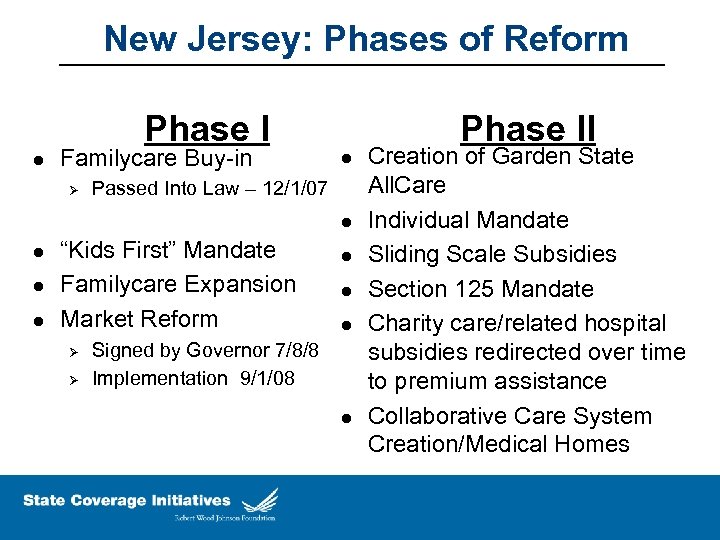 New Jersey: Phases of Reform Phase I l Familycare Buy-in Ø Phase II l Passed Into Law – 12/1/07 l l “Kids First” Mandate Familycare Expansion Market Reform Ø Ø l l l Signed by Governor 7/8/8 Implementation 9/1/08 l Creation of Garden State All. Care Individual Mandate Sliding Scale Subsidies Section 125 Mandate Charity care/related hospital subsidies redirected over time to premium assistance Collaborative Care System Creation/Medical Homes
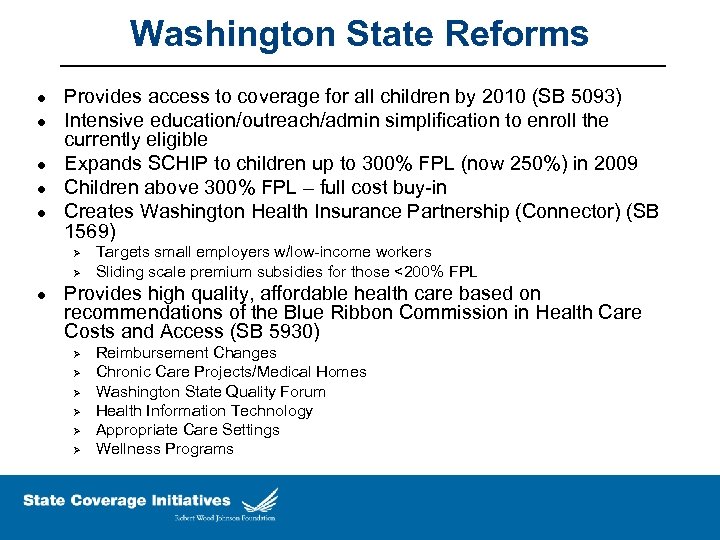 Washington State Reforms l l l Provides access to coverage for all children by 2010 (SB 5093) Intensive education/outreach/admin simplification to enroll the currently eligible Expands SCHIP to children up to 300% FPL (now 250%) in 2009 Children above 300% FPL – full cost buy-in Creates Washington Health Insurance Partnership (Connector) (SB 1569) Ø Ø l Targets small employers w/low-income workers Sliding scale premium subsidies for those <200% FPL Provides high quality, affordable health care based on recommendations of the Blue Ribbon Commission in Health Care Costs and Access (SB 5930) Ø Ø Ø Reimbursement Changes Chronic Care Projects/Medical Homes Washington State Quality Forum Health Information Technology Appropriate Care Settings Wellness Programs
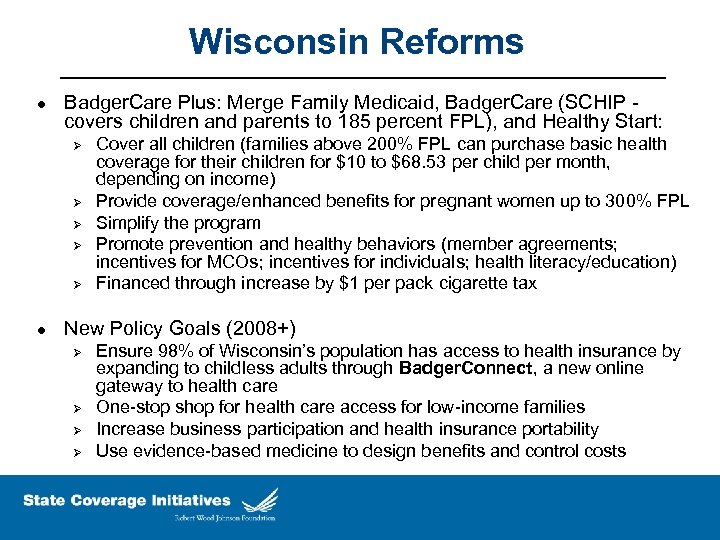 Wisconsin Reforms l Badger. Care Plus: Merge Family Medicaid, Badger. Care (SCHIP - covers children and parents to 185 percent FPL), and Healthy Start: Ø Ø Ø l Cover all children (families above 200% FPL can purchase basic health coverage for their children for $10 to $68. 53 per child per month, depending on income) Provide coverage/enhanced benefits for pregnant women up to 300% FPL Simplify the program Promote prevention and healthy behaviors (member agreements; incentives for MCOs; incentives for individuals; health literacy/education) Financed through increase by $1 per pack cigarette tax New Policy Goals (2008+) Ø Ø Ensure 98% of Wisconsin’s population has access to health insurance by expanding to childless adults through Badger. Connect, a new online gateway to health care One-stop shop for health care access for low-income families Increase business participation and health insurance portability Use evidence-based medicine to design benefits and control costs
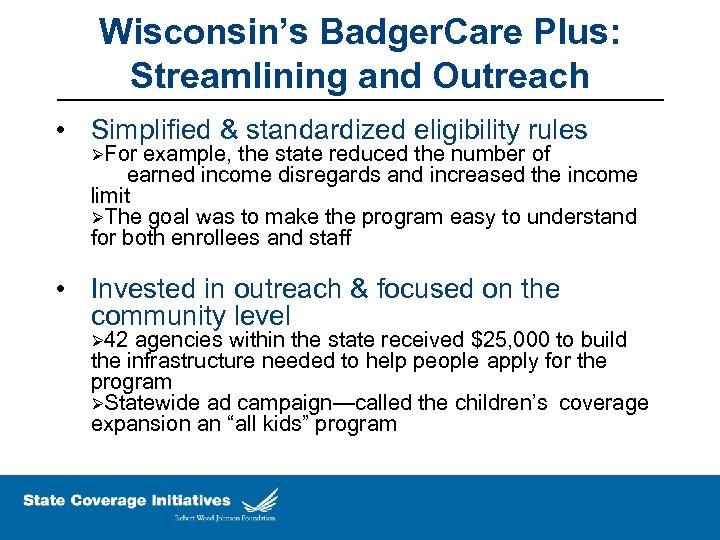 Wisconsin’s Badger. Care Plus: Streamlining and Outreach • Simplified & standardized eligibility rules ØFor example, the state reduced the number of earned income disregards and increased the income limit ØThe goal was to make the program easy to understand for both enrollees and staff • Invested in outreach & focused on the community level Ø 42 agencies within the state received $25, 000 to build the infrastructure needed to help people apply for the program ØStatewide ad campaign—called the children’s coverage expansion an “all kids” program
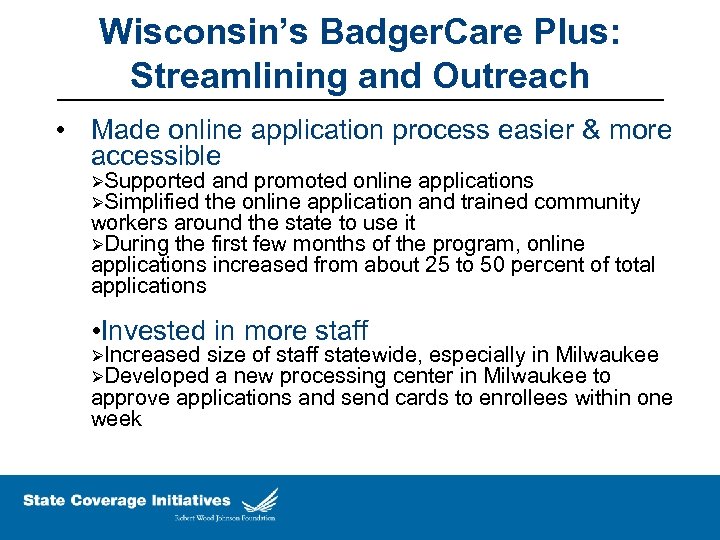 Wisconsin’s Badger. Care Plus: Streamlining and Outreach • Made online application process easier & more accessible ØSupported and promoted online applications ØSimplified the online application and trained community workers around the state to use it ØDuring the first few months of the program, online applications increased from about 25 to 50 percent of total applications • Invested in more staff ØIncreased size of staff statewide, especially in Milwaukee ØDeveloped a new processing center in Milwaukee to approve applications and send cards to enrollees within one week
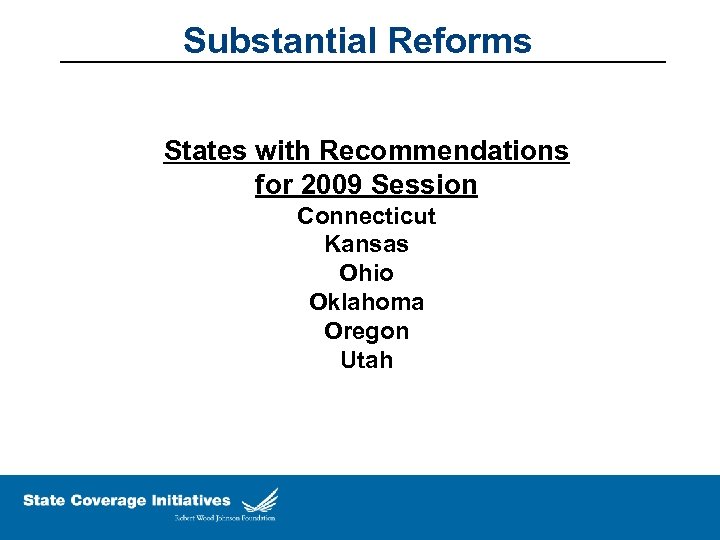 Substantial Reforms States with Recommendations for 2009 Session Connecticut Kansas Ohio Oklahoma Oregon Utah
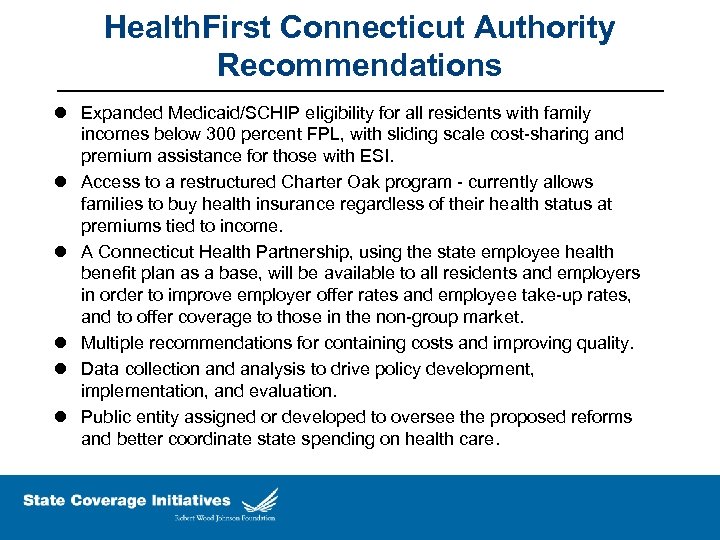 Health. First Connecticut Authority Recommendations l Expanded Medicaid/SCHIP eligibility for all residents with family incomes below 300 percent FPL, with sliding scale cost-sharing and premium assistance for those with ESI. l Access to a restructured Charter Oak program - currently allows families to buy health insurance regardless of their health status at premiums tied to income. l A Connecticut Health Partnership, using the state employee health benefit plan as a base, will be available to all residents and employers in order to improve employer offer rates and employee take-up rates, and to offer coverage to those in the non-group market. l Multiple recommendations for containing costs and improving quality. l Data collection and analysis to drive policy development, implementation, and evaluation. l Public entity assigned or developed to oversee the proposed reforms and better coordinate state spending on health care.
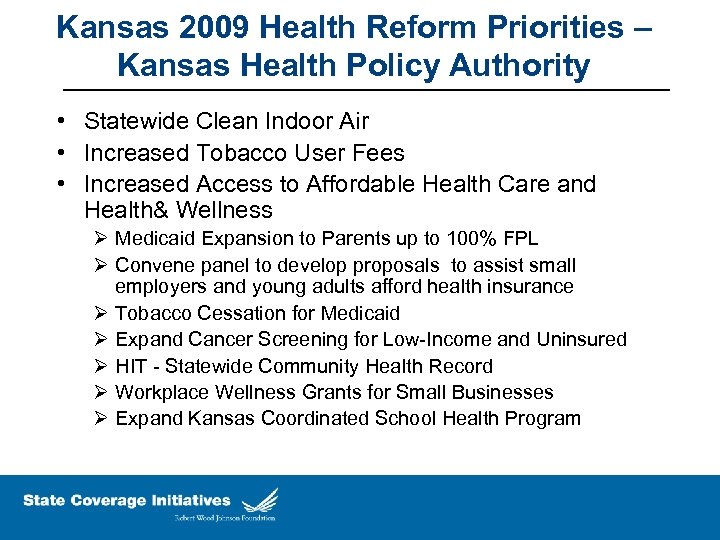 Kansas 2009 Health Reform Priorities – Kansas Health Policy Authority • Statewide Clean Indoor Air • Increased Tobacco User Fees • Increased Access to Affordable Health Care and Health& Wellness Ø Medicaid Expansion to Parents up to 100% FPL Ø Convene panel to develop proposals to assist small employers and young adults afford health insurance Ø Tobacco Cessation for Medicaid Ø Expand Cancer Screening for Low-Income and Uninsured Ø HIT - Statewide Community Health Record Ø Workplace Wellness Grants for Small Businesses Ø Expand Kansas Coordinated School Health Program
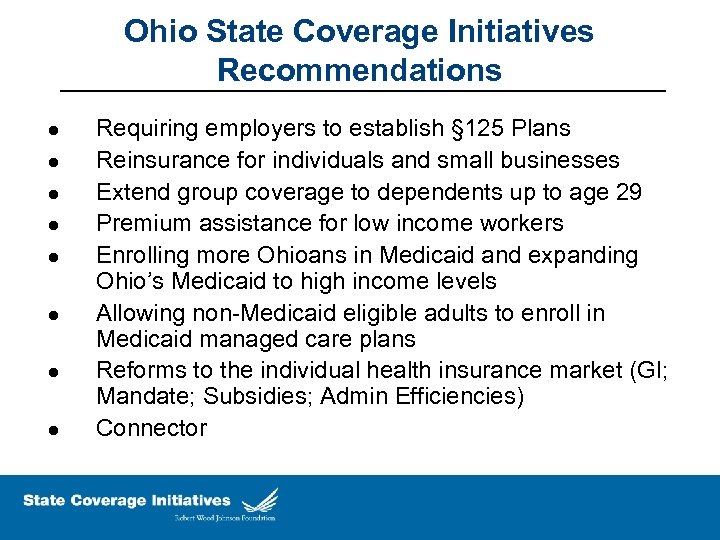 Ohio State Coverage Initiatives Recommendations l l l l Requiring employers to establish § 125 Plans Reinsurance for individuals and small businesses Extend group coverage to dependents up to age 29 Premium assistance for low income workers Enrolling more Ohioans in Medicaid and expanding Ohio’s Medicaid to high income levels Allowing non-Medicaid eligible adults to enroll in Medicaid managed care plans Reforms to the individual health insurance market (GI; Mandate; Subsidies; Admin Efficiencies) Connector
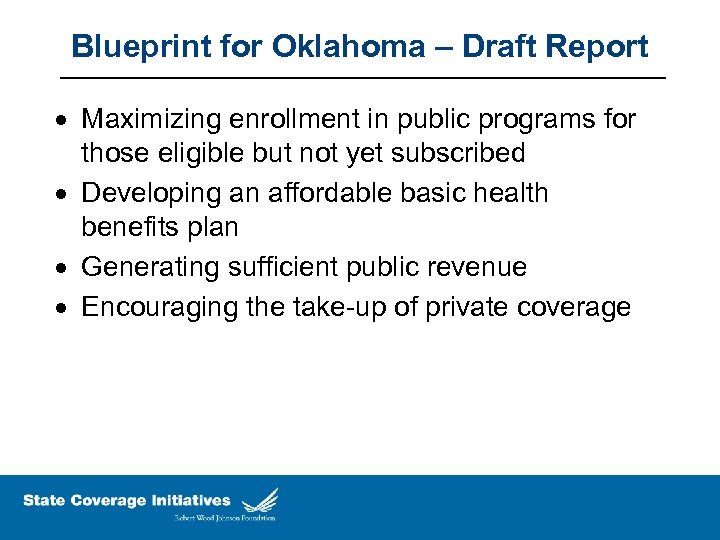 Blueprint for Oklahoma – Draft Report Maximizing enrollment in public programs for those eligible but not yet subscribed Developing an affordable basic health benefits plan Generating sufficient public revenue Encouraging the take-up of private coverage
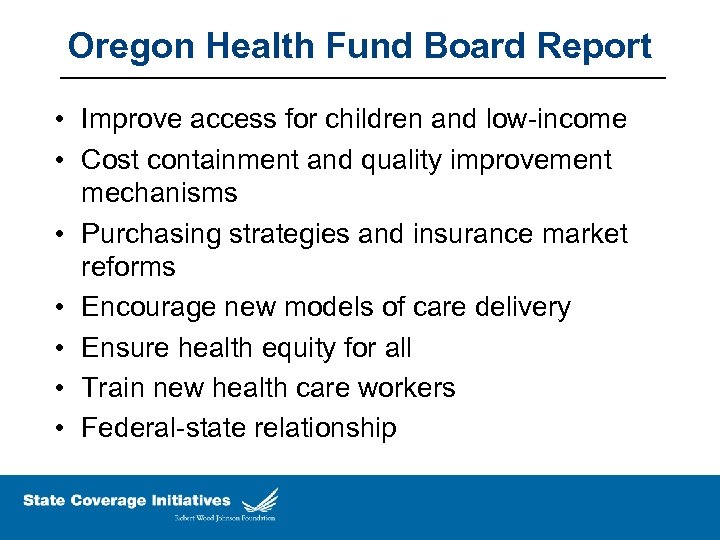 Oregon Health Fund Board Report • Improve access for children and low-income • Cost containment and quality improvement mechanisms • Purchasing strategies and insurance market reforms • Encourage new models of care delivery • Ensure health equity for all • Train new health care workers • Federal-state relationship
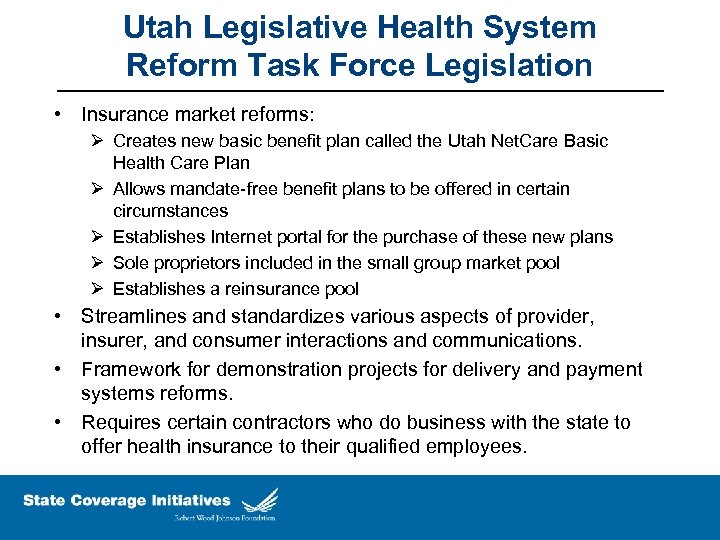 Utah Legislative Health System Reform Task Force Legislation • Insurance market reforms: Ø Creates new basic benefit plan called the Utah Net. Care Basic Health Care Plan Ø Allows mandate-free benefit plans to be offered in certain circumstances Ø Establishes Internet portal for the purchase of these new plans Ø Sole proprietors included in the small group market pool Ø Establishes a reinsurance pool • Streamlines and standardizes various aspects of provider, insurer, and consumer interactions and communications. • Framework for demonstration projects for delivery and payment systems reforms. • Requires certain contractors who do business with the state to offer health insurance to their qualified employees.
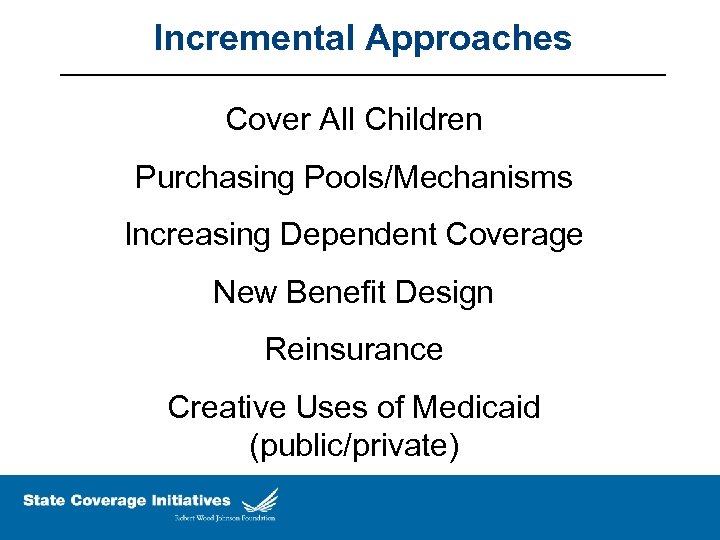 Incremental Approaches Cover All Children Purchasing Pools/Mechanisms Increasing Dependent Coverage New Benefit Design Reinsurance Creative Uses of Medicaid (public/private)
 Rhode Island (‘ 07): Health. Pact l l Includes coverage for physician visits, hospitalization, preventive services, and prescription drugs Design is intended to give incentives to enrollees to be more actively engaged in managing their own health care Proposes to achieve significant cost savings though financial incentives for enrollees who improve and maintain their health through five key wellness initiatives For enrollees who choose to participate in the wellness programs, it is proposed that deductibles, co-pays and coinsurance will be reduced to amounts normally seen in plans with much higher premiums
 Cover Tennessee (‘ 07) l Affordable healthcare coverage Ø Ø Ø l Portable – Individual Product Ø Ø Ø l Premiums shared equally by employer, individual and state Individual’s monthly premium share ranges between $37 and $109 Premiums vary depending on age, tobacco use, and obesity No deductibles; reasonable co-pays Maximum Benefit amount: $25, 000 Owned by the individual Individual can keep coverage even if they leave an employer Provides continued coverage during brief periods of unemployment Basic – Provides most services most people need
 States & the Health Workforce
 States & the Health Workforce • States have strong influence over the development and practice of the health workforce. Ø Education, financing and regulation • State action is critical for current shortages & for the future. • States are faced with current or imminent health workforce shortages due to multiple factors: Ø Aging population Ø Changing educational & practice environments Ø Limited pipeline of people entering health professions
 State Action on Workforce Issues • Data collection and analysis: State nursing centers, centers for health workforce studies, university centers • Pipeline development: Health career websites, K-12 outreach programs, scholarships/loan repayment programs • Retention (geared towards nurses): Career ladder programs, abolish mandatory overtime, pass minimum staffing ratios • Licensure and Credentialing: Scope of practice changes, Nurse Licensure Compact (currently 23 states) • Educational capacity building: Faculty scholarships and loan repayments, increasing educational capacity, innovation in educational delivery
 Massachusetts (Enacted 8/08) • Passed comprehensive plan to strengthen primary care infrastructure Ø Creates new Health Care Workforce Center within the Department of Public Health Ø State authority to establish a medical home demonstration project Ø Directs Mass. Health Payment Policy Advisory Board to study methods to improve payments or bonuses for primary care providers • For health care professionals who practice in underserved areas: Ø Loan forgiveness program Ø Affordable housing pilot • Requires health insurers to recognize and reimburse nurse practitioners as primary care providers
 Oregon (11/08 Recommendations) • Released blueprint for comprehensive health care system reform - one key “building block” is to train a new health care workforce. • Action steps include: Ø Collecting data through the licensure process to provide an on-going database about current workforce and analyze future workforce needs Ø Implementing strategies to train, attract and retain an appropriate supply of primary care providers in all areas of Oregon Ø Develop direct reimbursement and a certification system for Community Health Workers
 Pennsylvania (Enacted 2008) • Passed a series of measures over the last few years to expand the scope of practice for physician assistants, nurse practitioners, clinical nurse specialists, nurse midwives and dental hygienists • Generally, the laws allow fewer doctors to oversee these health care providers and expand the types of settings where they can provide health care services
 Iowa (Enacted 5/08) • Requires that the Department of Public Health expand efforts to guarantee a stable & well-qualified workforce • Creates a Direct Care Worker Advisory Council to continue work on education and certification issues • Instructs the Department of Human Services (DHS) to maintain an ongoing report that measures direct care worker turnover in nursing facilities • Directs DHS to design a premium assistance demonstration project to provide health coverage for up to 150 direct care workers and their dependents
 Vermont (Enacted 2006) Workforce measures to increase provider availability: • Loan repayment program for health care providers & educators Ø Available to primary care doctors, nurses, dentists, and nurse educators/faculty Ø Must agree to serve patients enrolled in Medicare, Medicaid, or other state health benefit plans • Loan forgiveness program for nurses and dental hygienists • Tele-psychiatry pilot to fill the state’s gap in available child psychiatrists • Provider reimbursement surveys Ø Examine the adequacy of reimbursement rates and understand impact of rates on recruitment and retention of health care professionals • Conduct Nurse Authority Study Ø Establish a work group to study and make recommendations on whether an advanced practice nurse need not be required to work in a collaborative practice with a physician
 State Quality Reporting Activities
 Using Performance Measurement to Improve Quality l Public Reporting Ø Ø l Purchasing to Improve Quality Ø Ø Ø l Health Plans Hospitals Nursing Homes Ambulatory Settings Value-based purchasing/payment reform Tiered networks To drive delivery system reform To Drive Consumer Choice and Internal Quality Improvement
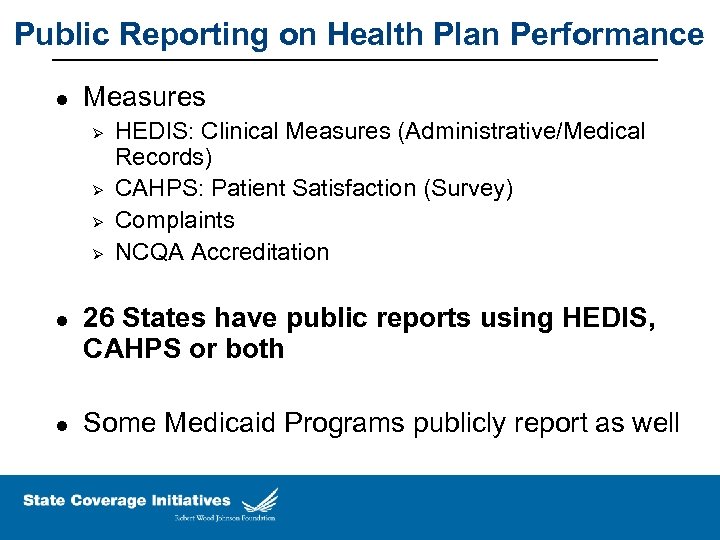 Public Reporting on Health Plan Performance l Measures Ø Ø l l HEDIS: Clinical Measures (Administrative/Medical Records) CAHPS: Patient Satisfaction (Survey) Complaints NCQA Accreditation 26 States have public reports using HEDIS, CAHPS or both Some Medicaid Programs publicly report as well
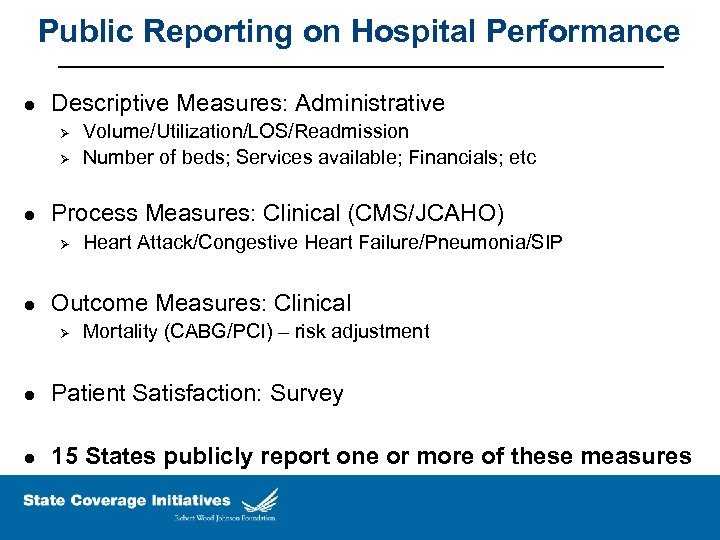 Public Reporting on Hospital Performance l Descriptive Measures: Administrative Ø Ø l Process Measures: Clinical (CMS/JCAHO) Ø l Volume/Utilization/LOS/Readmission Number of beds; Services available; Financials; etc Heart Attack/Congestive Heart Failure/Pneumonia/SIP Outcome Measures: Clinical Ø Mortality (CABG/PCI) – risk adjustment l Patient Satisfaction: Survey l 15 States publicly report one or more of these measures
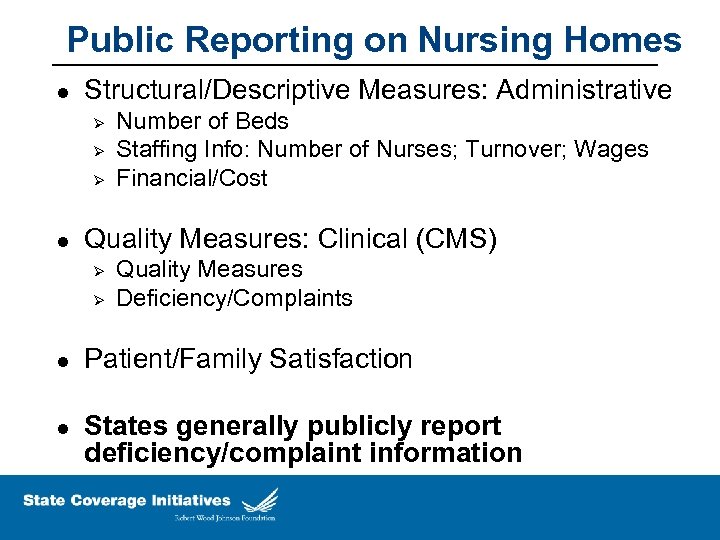 Public Reporting on Nursing Homes l Structural/Descriptive Measures: Administrative Ø Ø Ø l Quality Measures: Clinical (CMS) Ø Ø l l Number of Beds Staffing Info: Number of Nurses; Turnover; Wages Financial/Cost Quality Measures Deficiency/Complaints Patient/Family Satisfaction States generally publicly report deficiency/complaint information
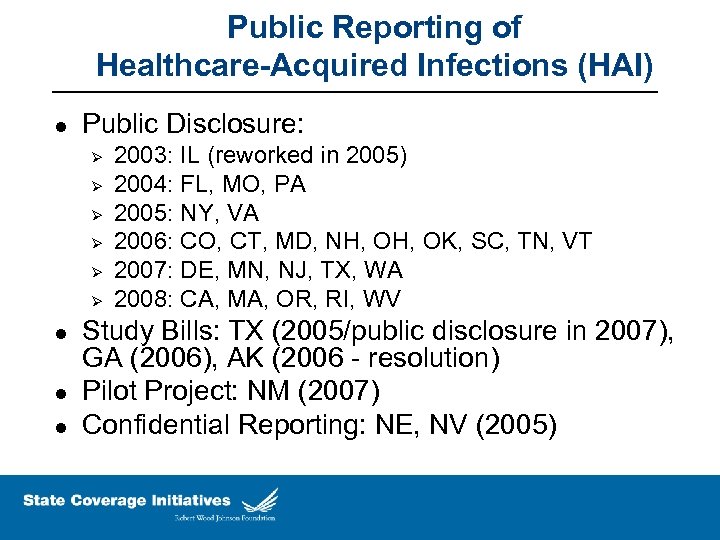 Public Reporting of Healthcare-Acquired Infections (HAI) l Public Disclosure: Ø Ø Ø l l l 2003: IL (reworked in 2005) 2004: FL, MO, PA 2005: NY, VA 2006: CO, CT, MD, NH, OK, SC, TN, VT 2007: DE, MN, NJ, TX, WA 2008: CA, MA, OR, RI, WV Study Bills: TX (2005/public disclosure in 2007), GA (2006), AK (2006 - resolution) Pilot Project: NM (2007) Confidential Reporting: NE, NV (2005)
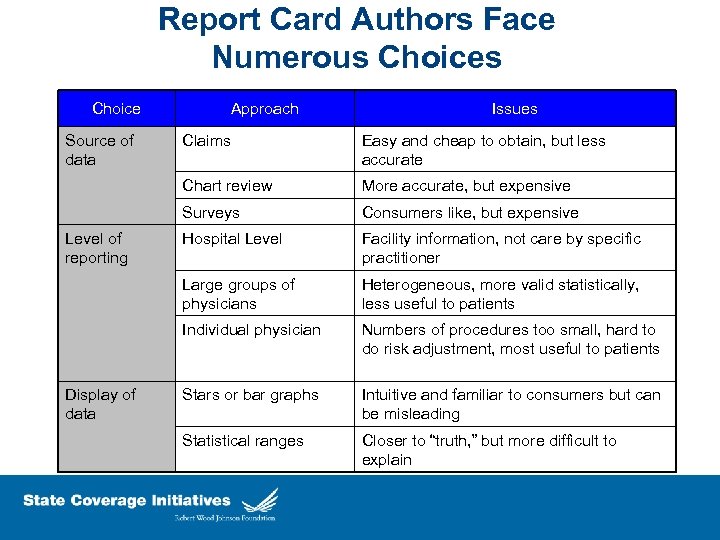 Report Card Authors Face Numerous Choice Source of data Approach Issues More accurate, but expensive Surveys Consumers like, but expensive Hospital Level Facility information, not care by specific practitioner Large groups of physicians Heterogeneous, more valid statistically, less useful to patients Individual physician Display of data Easy and cheap to obtain, but less accurate Chart review Level of reporting Claims Numbers of procedures too small, hard to do risk adjustment, most useful to patients Stars or bar graphs Intuitive and familiar to consumers but can be misleading Statistical ranges Closer to “truth, ” but more difficult to explain
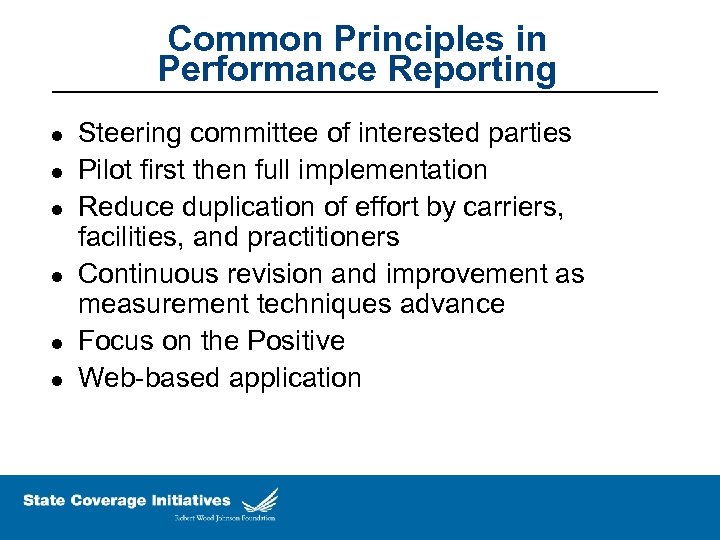 Common Principles in Performance Reporting l l l Steering committee of interested parties Pilot first then full implementation Reduce duplication of effort by carriers, facilities, and practitioners Continuous revision and improvement as measurement techniques advance Focus on the Positive Web-based application
 State Health Policy Commissions and Authorities
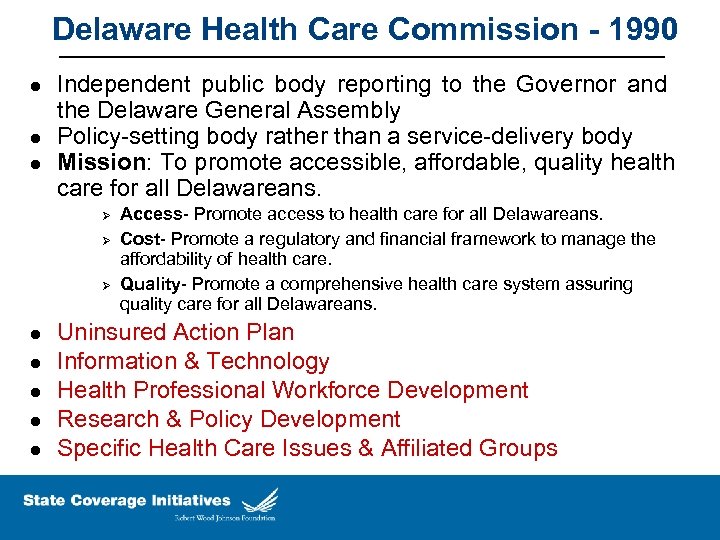 Delaware Health Care Commission - 1990 l l l Independent public body reporting to the Governor and the Delaware General Assembly Policy-setting body rather than a service-delivery body Mission: To promote accessible, affordable, quality health care for all Delawareans. Ø Ø Ø l l l Access- Promote access to health care for all Delawareans. Cost- Promote a regulatory and financial framework to manage the affordability of health care. Quality- Promote a comprehensive health care system assuring quality care for all Delawareans. Uninsured Action Plan Information & Technology Health Professional Workforce Development Research & Policy Development Specific Health Care Issues & Affiliated Groups
 Delaware Health Care Commission l l Chair is Lt Gov Four government officials (ex officio) Ø Ø l Secretary of Finance Secretary of Health & Social Services Secretary of Children, Youth & Their Families Insurance Commissioner Six private citizens appointed either by the Governor, the Speaker of the House or the President Pro Tempore of the Senate Ø Ø Ø Dean, College of Health and Public Policy, Delaware State Univ. Senior VP for Government Relations, DE Chamber of Commerce Chair, Dept of Family & Comm Med, Christiana Care Health Services President, Maritime Exchange for the Delaware River and Bay Two others
 Maryland Health Care Commission l l l l l Develop State Health Plan/administer Certificate of Need program Oversee certain aspects of small group market reforms Develop and publish consumer guides for health plans, hospitals, nursing homes and ambulatory surgical centers Establish and develop a medical care data base on health care services rendered by health care practitioners Establish standards for the operation and licensing of medical care electronic claims clearinghouses Determine the cost of mandated health insurance services Promote the availability of information to consumers on charges by practitioners and reimbursements from payors Oversee and administer the Maryland Trauma Physician Services Fund Other policy studies as requested: patient safety, affordability, etc
 Maryland Health Care Commission l 15 members appointed by Gov with advise/consent of Senate Ø Ø Nine must be individuals with no connection to the management or policy of a health care provider or payor Remaining six members: o o l l Two physicians Two payors One nursing home administrator One non-physician health care practitioner Also geographic representation requirements To the extent practicable, assure geographic balance and promote racial, ethnic, and gender diversity in the Commission's membership
 Kansas Health Policy Authority - 2005 l l Responsible for coordinating a statewide health policy agenda that incorporates effective purchasing and administration with health promotion strategies. All health insurance purchasing by the State is now combined under KPHA, including publicly funded programs (Medicaid, State Children’s Health Insurance Program, and Medikan) and the State Employee Health Benefits Plan. Responsible for compiling and distributing uniform health care data in order to provide health care consumers, payers, providers and policy makers with information regarding trends in the use and cost of health care for improved decision making. 2007 Legislation: Directed KHPA to develop health reform options in collaboration with Kansas stakeholders.
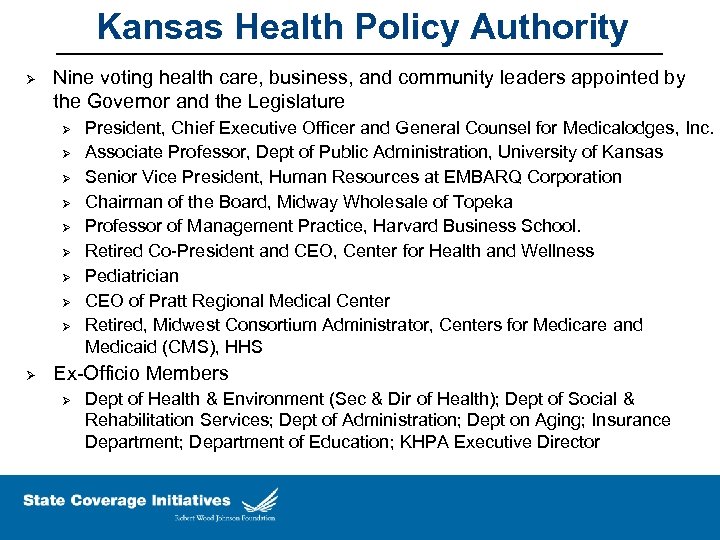 Kansas Health Policy Authority Ø Nine voting health care, business, and community leaders appointed by the Governor and the Legislature Ø Ø Ø Ø Ø President, Chief Executive Officer and General Counsel for Medicalodges, Inc. Associate Professor, Dept of Public Administration, University of Kansas Senior Vice President, Human Resources at EMBARQ Corporation Chairman of the Board, Midway Wholesale of Topeka Professor of Management Practice, Harvard Business School. Retired Co-President and CEO, Center for Health and Wellness Pediatrician CEO of Pratt Regional Medical Center Retired, Midwest Consortium Administrator, Centers for Medicare and Medicaid (CMS), HHS Ex-Officio Members Ø Dept of Health & Environment (Sec & Dir of Health); Dept of Social & Rehabilitation Services; Dept of Administration; Dept on Aging; Insurance Department; Department of Education; KHPA Executive Director
 Connecticut Office of Health Care Access l l Headed by a Commissioner who is appointed by the Governor Mission: To ensure that the citizens of Connecticut have access to a quality health care delivery system: Ø Ø Ø By advising policy makers of health care issues By informing the public and the industry of statewide and national trends By designing and directing health care system development l Certificate of Need & Compliance Unit: l Research & Planning Unit:
 Oregon Health Policy Commission - 2003 l Mission: To develop and promote policy recommendations to the Governor, the Legislature, and the Oregon Health Policy and Research (OHPR) that improve the health of all Oregonians by ensuring access to essential health care and support services, increasing quality and improving outcomes for individuals and society, controlling costs, and encouraging healthy lifestyles.
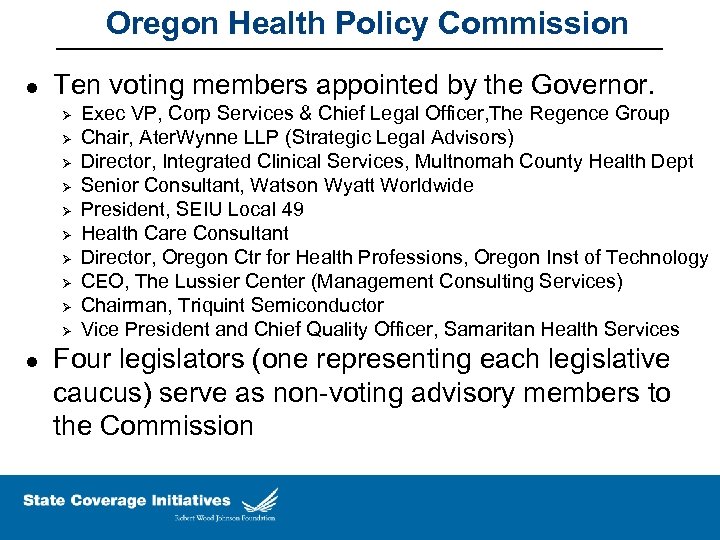 Oregon Health Policy Commission l Ten voting members appointed by the Governor. Ø Ø Ø Ø Ø l Exec VP, Corp Services & Chief Legal Officer, The Regence Group Chair, Ater. Wynne LLP (Strategic Legal Advisors) Director, Integrated Clinical Services, Multnomah County Health Dept Senior Consultant, Watson Wyatt Worldwide President, SEIU Local 49 Health Care Consultant Director, Oregon Ctr for Health Professions, Oregon Inst of Technology CEO, The Lussier Center (Management Consulting Services) Chairman, Triquint Semiconductor Vice President and Chief Quality Officer, Samaritan Health Services Four legislators (one representing each legislative caucus) serve as non-voting advisory members to the Commission
 Lessons Learned in State Reform Efforts
 Lessons Learned in State Reform Efforts #1 l l l Successful comprehensive reforms are built on previous efforts, financing mechanisms Need ingredients: leadership, opportunity, readiness to act, persistence No free solutions Successful efforts to enact reforms often need shared financial responsibility State expansions in coverage often rely on private insurers to deliver care Voluntary strategies will not result in universal coverage - some states are beginning to recognize the need for mandatory participation
 Lessons Learned in State Reform Efforts #2 Hard to get agreement on what is covered (benefit design/affordability) Little success so far in addressing underlying cost of health care but a new focus on chronic care management/preventive care holds potential Address access, systems improvement, cost containment simultaneously—concern about longterm sustainability of coverage programs and improved population health New state reforms can be fairly judged only after several years, allowing a realistic length of time to work through implementation challenges. Comprehensive reforms need sequencing l l l Ø Sequential = incremental with a vision
 States Can Advance Reform Initiatives But Need Federal Support l States face growing pressures for reform Ø Uninsurance continues to rise as employer sponsored coverage declines Ø Cost increases threaten state budgets and capacity to sustain Medicaid/SCHIP l States play critical role in moving the conversations about coverage expansions Ø Testing new ideas (politically and practically) Ø Creating momentum for national policy solution l States cannot achieve universal coverage without a federal framework and funding Ø Significant variation across states in resources, capacity, and landscape—including uninsured rates, available state funds to invest in coverage, insurance market structures, and other important factors 80