 Скачать презентацию What we know about men who buy sex
7bf78589a84d5700510fb1d582fcb7f7.ppt
- Количество слайдов: 19




What we know about men who buy sex. Dr Teela Sanders University of Leeds t. l. m. sanders@leeds. ac. uk UKNSWP Annual Conference 6 th October 2006 Britannia Hotel, Manchester
Aims of the presentation • Brief over-view of the literature on men who buy sex from female sex workers • Evaluation of rehabilitation programmes • Why the re-focus on ‘kerbcrawlers’ in policy? • The impact of criminalisation?
Prevalence of Men buying sex • • National Survey of Sexual Attitudes and Lifestyles 1990 – 2000 from 2% to 4. 2% (Johnson et al 2001) 8. 9% in Greater London Ward et al (2005) survey of 6, 000 men in 1990 & 2000 in UK. 1990, 5. 6 % had purchased sex 2000, increased to 8. 8% 10% (n=267) of population in sexual health clinic survey in Glasgow had purchased sex (Groom and Nandwani, 2006) All statistics are under-representation
Global view of prevalence • • Sweden: 13% (Ekberg, 2004) Australia: 15. 6% (Rissel et al, 2003) Spain: 39% (Leridon, et al 1998) Thailand: 73% (Anderson & O’Connell Davidson, 2003)
Why the increase? • • • Increase in divorce / decline in marriage Growth in adult entertainment industry Availability & visibility Growth of Internet and global communications Increase in travel Increase in amount of adult time spent alone Increased cultural acceptance / less stigma Change in sexual morality attitudes? Scott (1998) still high condemnation for extramarital affairs
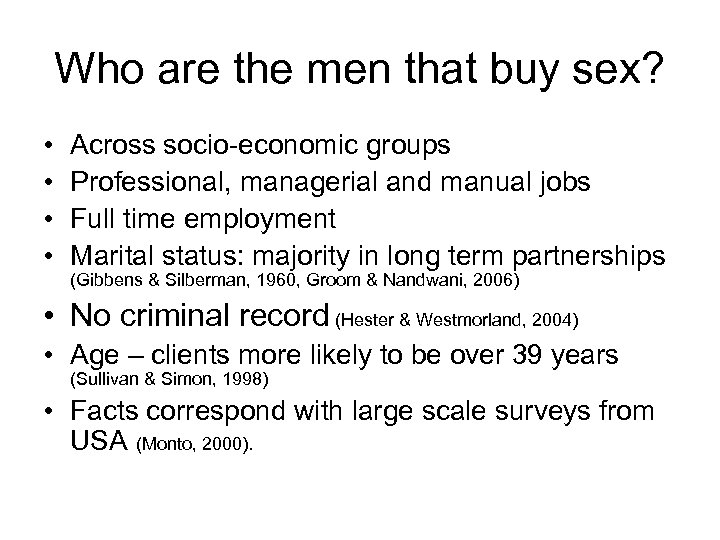
Who are the men that buy sex? • • Across socio-economic groups Professional, managerial and manual jobs Full time employment Marital status: majority in long term partnerships (Gibbens & Silberman, 1960, Groom & Nandwani, 2006) • No criminal record (Hester & Westmorland, 2004) • Age – clients more likely to be over 39 years (Sullivan & Simon, 1998) • Facts correspond with large scale surveys from USA (Monto, 2000).
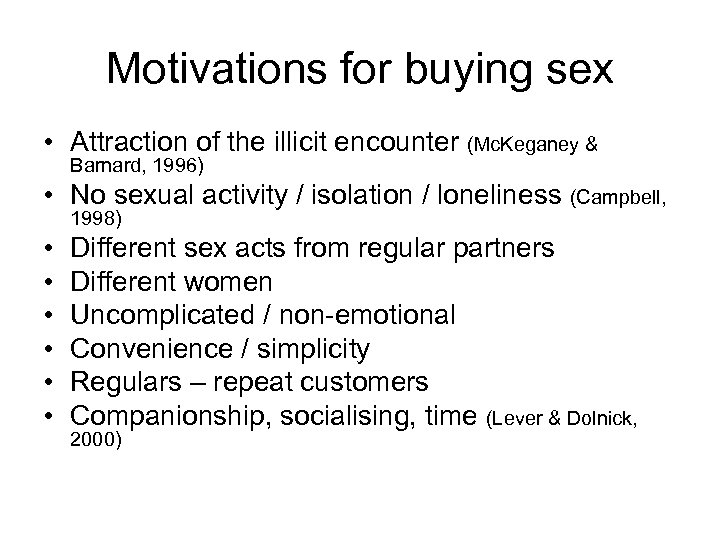
Motivations for buying sex • Attraction of the illicit encounter (Mc. Keganey & Barnard, 1996) • No sexual activity / isolation / loneliness (Campbell, 1998) • • • Different sex acts from regular partners Different women Uncomplicated / non-emotional Convenience / simplicity Regulars – repeat customers Companionship, socialising, time (Lever & Dolnick, 2000)
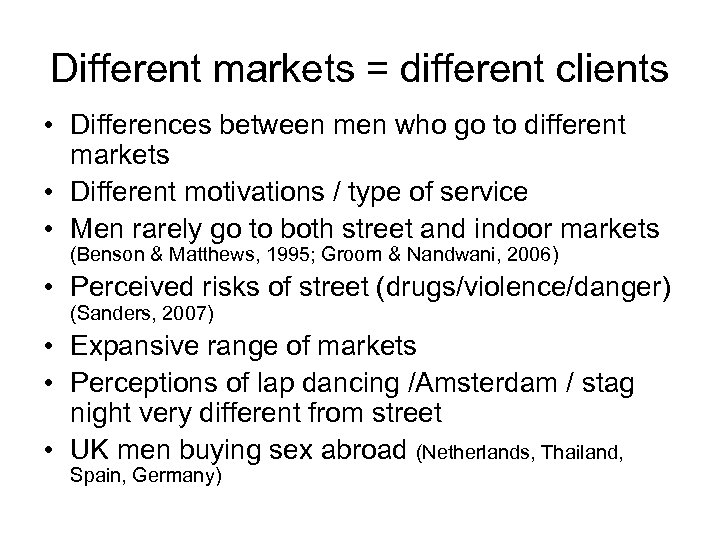
Different markets = different clients • Differences between men who go to different markets • Different motivations / type of service • Men rarely go to both street and indoor markets (Benson & Matthews, 1995; Groom & Nandwani, 2006) • Perceived risks of street (drugs/violence/danger) (Sanders, 2007) • Expansive range of markets • Perceptions of lap dancing /Amsterdam / stag night very different from street • UK men buying sex abroad (Netherlands, Thailand, Spain, Germany)
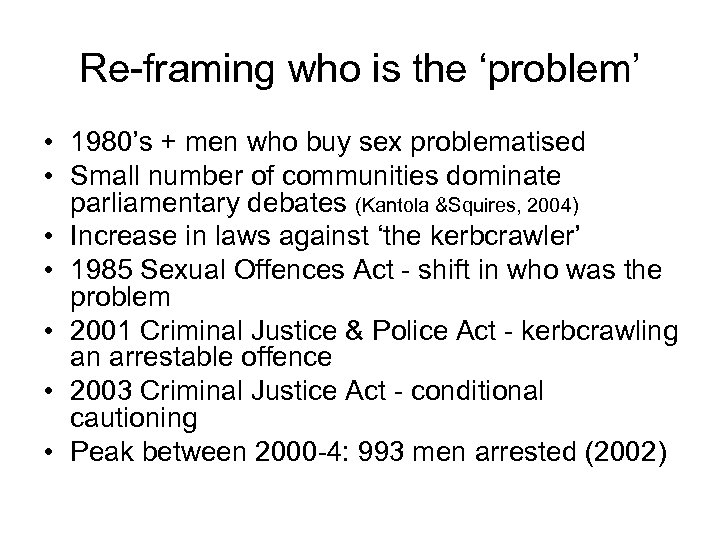
Re-framing who is the ‘problem’ • 1980’s + men who buy sex problematised • Small number of communities dominate parliamentary debates (Kantola &Squires, 2004) • Increase in laws against ‘the kerbcrawler’ • 1985 Sexual Offences Act - shift in who was the problem • 2001 Criminal Justice & Police Act - kerbcrawling an arrestable offence • 2003 Criminal Justice Act - conditional cautioning • Peak between 2000 -4: 993 men arrested (2002)
Coordinated Prostitution Strategy: Tackling Demand • Enforcement of existing laws for kerbcrawling • Addressing concerns from communities • Informal warning / court diversion / prosecution • Crackdowns, zero tolerance decoys, supporting naming and shaming, media coverage, driving licenses revoked, fines, rehabilitation programmes
Rehabilitation programmes: A coherent approach? • Court diversion schemes • Success of UK programmes based on low re-offending rates • Strategy ignored evaluations / evidence • No evidence that programmes in North America have lasted more than 2 years • Range of reasons for ineffectiveness
Evaluation of Effectiveness • Re-offending cannot be used as an effectiveness measuring tool (Monto & Garcia, 2000) • Recidivism not due to programme – other factors lead to behavioural change • Some evidence of attitude changes but not behaviour (Wortley, et al 2002; Kennedy et al, 2004) • Resource intensive – Clubs & Vice: 12 crackdowns a year yields 25 -35 arrests each time. 20 officers needed for each week long crackdown.
Criticisms of the programmes • Bias programme content – 1995 radical feminist campaign in San Francisco (Campbell & Storr, 1998) • Not balanced view of law or prostitution (Van Brunschot, 2003) • Against legal theory & due process (Brooks Gordon, 2006) • Damage of shaming schools – confrontational shaming ritual (Sawyer et al, 1998) • Need for wider educational awareness programme with all men
Impact of tackling demand? • Still legal to buy sex: confusion • Mixed messages: condoning or enabling commercial sex? • No awareness of impact of crackdowns / zero tolerance on sex workers or industry • Temporal, spatial and tactical displacement • Impact of naming & shaming on families

So……. ? Will the Strategy reduce demand? Up against multi-million £ and $ industry and an embedded commodification culture
• Anderson, B and O’Connell Davidson, J (2003) Is trafficking in human beings demand driven? A multi-country pilot study. International Organisation for Migration, • Benson, C. , & Matthews, R. (1995). Street Prostitution: Ten Facts in Search of a Policy. International Journal of the Sociology of Law, 23, 395 -415. • Brooks-Gordon, B. (2005). Clients and Commercial Sex: Reflections on Paying the Price: A Consultation Paper on Prostitution. Criminal Law Review, 425 -443. • — (2006). The Price of Sex: Prostitution, Policy and Society: Willan Publishing. • Campbell, R. (1998). Invisible Men: Making Visible Male Clients of Female Prostitutes in Merseyside. In J. Elias, V. Bullough, V. Elias & G. Brewer (Eds. ), Prostitution. On Whores, Hustlers and Johns (pp. 155 -171). New York: Prometheus Books

• • Campbell, R. , & Storr, M. (2001). Challenging the Kerb Crawler Rehabilitation Programme. Feminist Review, 67, 94 -108. Ekberg, G. (2004). The Swedish Law that Prohibits the Purchase of Sexual Services: Best Practices for Prevention of Prostitution and Trafficking in Human Beings. Violence Against Women, 10, 1187 -1218. Fischer, H. , Webster, C. , & Wortley, S. (2002). Vice lessons: A survey of prostitution offenders enrolled in the Toronto John School Diversion Program. Canadian Journal of Criminology, 44, 369 -402. Gibbens, T. , & Silberman, M. (1970). The Clients of Prostitutes. The British Journal of Venereal Diseases, 36, 113 -117. Groom, TM and Nandwani, R (2006) Characteristics of men who pay for sex: A UK sexual health clinic survey, Sexually Transmitted Infections, 82, 5, pp 364 -367 Hester, M. , & Westmarland, N. (2004). Tackling Street Prostitution: Towards a Holistic Approach. London: Home Office. Johnson, AM. , Mercer, CH, Erens, B etal (2001) Sexual Behaviour in Britain: partnerships, practices and HIV risk behaviours. Lancet, 358, pp 1835 -42
• • Kantola, J. , & Squires, J. (2004). Discourses Surrounding Prostitution Policies in the UK. European Journal of Women's Studies, 11, 77 -101. Kennedy, M. A. , Klein, C. , Gorzalka, B. B. , & Yuille, J. C. (2004). Attitude Change Following a Diversion Program for Men Who Solicit Sex. Journal of Offender rehabilitation, 40, 41 -60. Leridon, H van Zessen, G. , Hubert, m (1998) The Europeans and their Sexual Partners in Hubert, M, Bajos, N and Sandfort, T (eds) Sexual behaviour and HIV/AIDS in Europe, London UCL Press Lever, J. , & Dolnick, D. (2000). Clients and Call Girls: Seeking Sex and Intimacy. In R. Weitzer (Ed. ), Sex for Sale (pp. 85 -100). London: Routledge. Mc. Keganey, N. , & Barnard, M. (1996). Sex Work on the Streets. Buckingham: Open University Press. Monto, M. (2000). Why Men Seek Out Prostitutes. In R. Weitzer (Ed. ), Sex for Sale (pp. 67 -83). Routledge: London. Monto, M. A. , & Garcia, S. (2001). Recidivism Among the Customers of Female Street Prostitutes: Do Intervention Programs Help? Western Criminology Review, 3. Rissel, C. E. , Richters, J. , Grulich AE. , et al Sex in Australia: Experiences of Commercial Sex in a Representative Sample of Adults Australian and New Zealand Journal of Public Health 27: 191 -7
• • • Sanders, T (2007) Paying for Pleasure: Men who Buy Sex Cullompton, Willan Sawyer, S. , Rosser, B. R. S. , & Schroeder, A. (1998). A Brief Psychoeducational Program for Men Who Patronize Prostitutes. Journal of Offender Rehabilitation, 26, 111 -125. Scott, J (1998) Changing Attitudes to Sexual Morality: A Cross-National Comparison, Sociology, 32, 4 pp 815 -845 Sullivan, E. , & Simon, W. (1998). The Client: A Social, Psychological and Behavioural Look at the Unseen Patron of Prostitution. In J. E. Elias, V. L. Bullough, V. Elias & G. Brewer (Eds. ), Prostitution: On Whores, Hustlers and Johns (pp. 134 -154). Amsherst, NY: Prometheus. Van Brunschot, E. G. (2003). Community Policing and "John Schools". Canadian Review of Sociology and Anthroplogy, 40, 215 -232. Ward, H. , Mercer, CH. , Wellings K et al (2005) Who pays for sex? An analysis of the increasing prevalence of female commercial sex contacts among men in Britain. Sexually Transmitted Infections, 81: 467 -71
Скачать презентацию What we know about men who buy sex
7bf78589a84d5700510fb1d582fcb7f7.ppt