


 Скачать презентацию What to Do When Export Controls Apply NCURA
333ce5076b8b7ba68d48e5692395c3fa.ppt
- Количество слайдов: 51
 What to Do When Export Controls Apply NCURA Annual Conference Senior Seminar Washington, DC November 4, 2007
 Jilda Garton Associate Vice Provost for Research Georgia Institute of Technology (404) 894 -4819 jilda. garton@gtrc. gatech. edu Steve Eisner Export Control Officer Stanford University (650) 734 -7270 steve. eisner@stanford. edu
 What to Do When Export Controls Apply Tab 1 Review of Export Controls Basics
 Why Do We Have Export Control Regulations? n Objective: To protect U. S. national security and foreign policy interests by n Denying our adversaries the means to advance their military potential n Implementing foreign policy objectives n Preventing terrorism n Inhibiting the proliferation of Weapons of Mass Destruction (nuclear, biological, chemical) n Fulfilling Multilateral Obligations (i. e. UN Sanctions, Trade Agreements)
 What Are Export Control Regulations? n Export Control Regulations prohibit the unauthorized “export” of certain controlled ITEMS, INFORMATION OR SOFTWARE to foreign persons or entities in the U. S. and abroad n n n ITEMS= Tangible things, equipment or hardware INFORMATION = “Technical Data” such as models, formulae, engineering designs or “Technical Assistance” such as training or instruction SOFTWARE = Computer programs or microprograms in either “Source Code” (programming statements) or “Object Code” (machine-readable instructions)
 What is an “Export”? • • Shipment of controlled item or good outside of the US Transmission (electronic or digital) of controlled item or information related to controlled item outside of the US Use or application of controlled technology on behalf of, or for the benefit of, any foreign person or entity, either in U. S. or abroad Release or disclosure (including verbal or visual) of any controlled technology, software or technical data, either in U. S. (“deemed export”) or abroad
 Deemed Exports • • The transfer of technology to a foreign person in the U. S. is “deemed” to be an export to that individual’s country The information can take the form of data or technical assistance Release of certain controlled software source code and technology within the U. S. may be a “deemed export” Licensing issues may arise when controlled technology is disclosed to foreign students, foreign national staff, symposium attendees from other countries, visiting scholars, those touring laboratories, etc.
 Who is a “Foreign Person”? n A “foreign person” is anyone who is not a “U. S. person” n A “U. S. person” is either: n A U. S. citizen, lawful permanent resident alien (“Green Card Holder”), refugee, protected political asylee or someone granted temporary residency under amnesty or Special Agricultural Worker provisions; or n Any juridical person (i. e. organizations under the laws of the United States or any jurisdiction within the U. S. , including foreign branches)
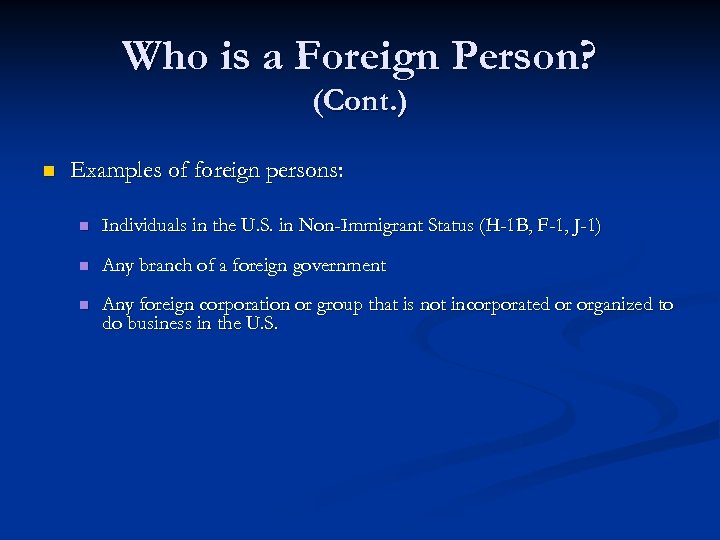 Who is a Foreign Person? (Cont. ) n Examples of foreign persons: n Individuals in the U. S. in Non-Immigrant Status (H-1 B, F-1, J-1) n Any branch of a foreign government n Any foreign corporation or group that is not incorporated or organized to do business in the U. S.
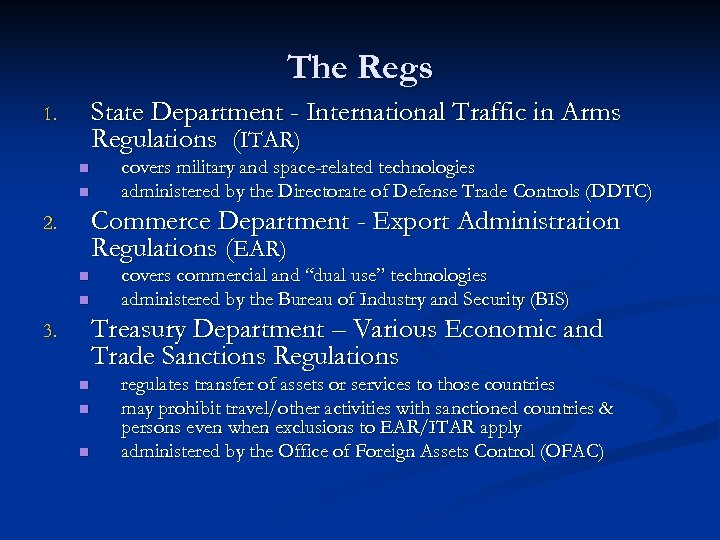 The Regs State Department - International Traffic in Arms Regulations (ITAR) 1. n n covers military and space-related technologies administered by the Directorate of Defense Trade Controls (DDTC) Commerce Department - Export Administration Regulations (EAR) 2. n n covers commercial and “dual use” technologies administered by the Bureau of Industry and Security (BIS) Treasury Department – Various Economic and Trade Sanctions Regulations 3. n n n regulates transfer of assets or services to those countries may prohibit travel/other activities with sanctioned countries & persons even when exclusions to EAR/ITAR apply administered by the Office of Foreign Assets Control (OFAC)
 What to Do When Export Controls Apply Tab 2 Review of Exclusions and Exemptions
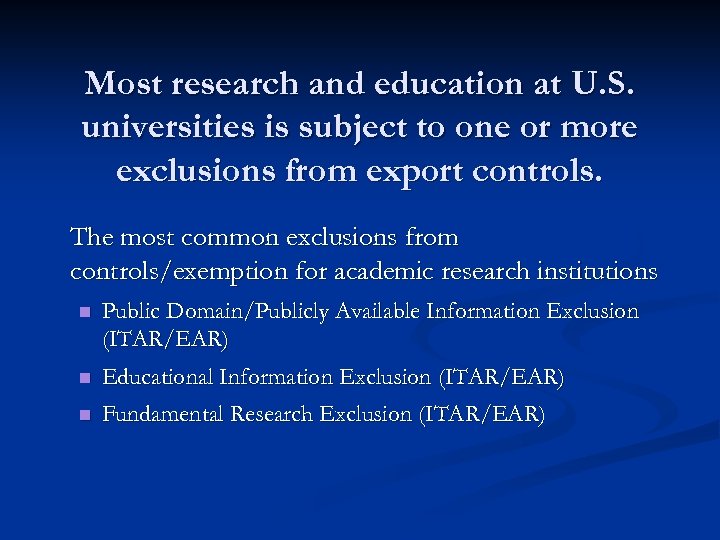 Most research and education at U. S. universities is subject to one or more exclusions from export controls. The most common exclusions from controls/exemption for academic research institutions n Public Domain/Publicly Available Information Exclusion (ITAR/EAR) n Educational Information Exclusion (ITAR/EAR) n Fundamental Research Exclusion (ITAR/EAR)
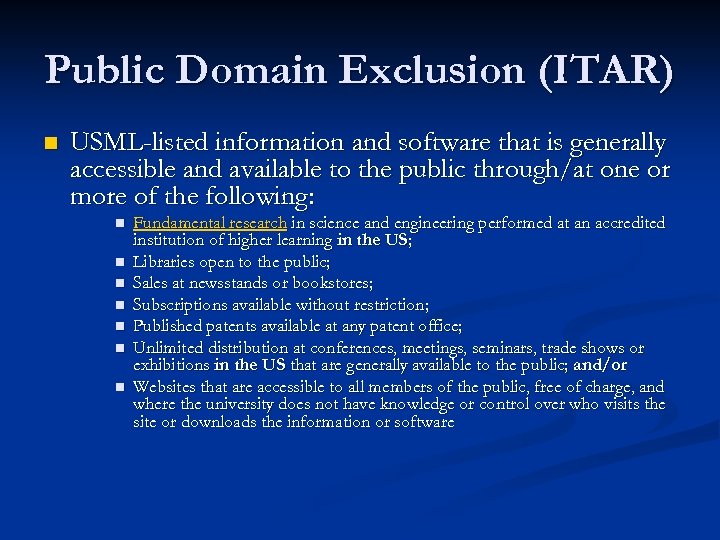 Public Domain Exclusion (ITAR) n USML-listed information and software that is generally accessible and available to the public through/at one or more of the following: n n n n Fundamental research in science and engineering performed at an accredited institution of higher learning in the US; Libraries open to the public; Sales at newsstands or bookstores; Subscriptions available without restriction; Published patents available at any patent office; Unlimited distribution at conferences, meetings, seminars, trade shows or exhibitions in the US that are generally available to the public; and/or Websites that are accessible to all members of the public, free of charge, and where the university does not have knowledge or control over who visits the site or downloads the information or software
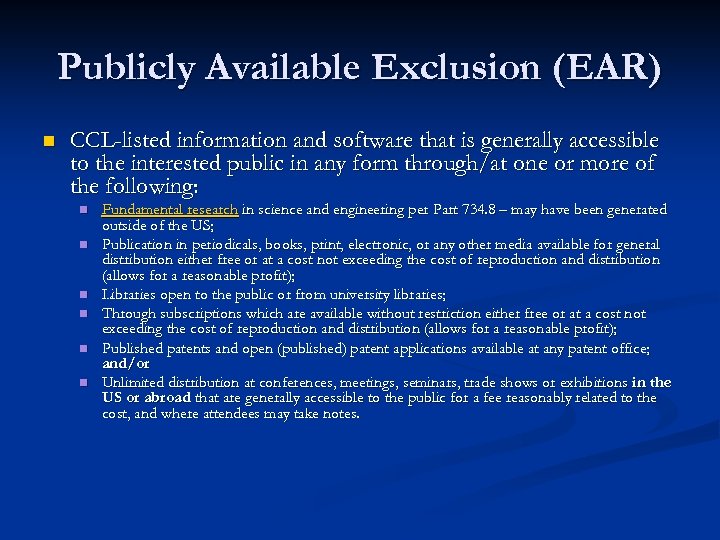 Publicly Available Exclusion (EAR) n CCL-listed information and software that is generally accessible to the interested public in any form through/at one or more of the following: n n n Fundamental research in science and engineering per Part 734. 8 – may have been generated outside of the US; Publication in periodicals, books, print, electronic, or any other media available for general distribution either free or at a cost not exceeding the cost of reproduction and distribution (allows for a reasonable profit); Libraries open to the public or from university libraries; Through subscriptions which are available without restriction either free or at a cost not exceeding the cost of reproduction and distribution (allows for a reasonable profit); Published patents and open (published) patent applications available at any patent office; and/or Unlimited distribution at conferences, meetings, seminars, trade shows or exhibitions in the US or abroad that are generally accessible to the public for a fee reasonably related to the cost, and where attendees may take notes.
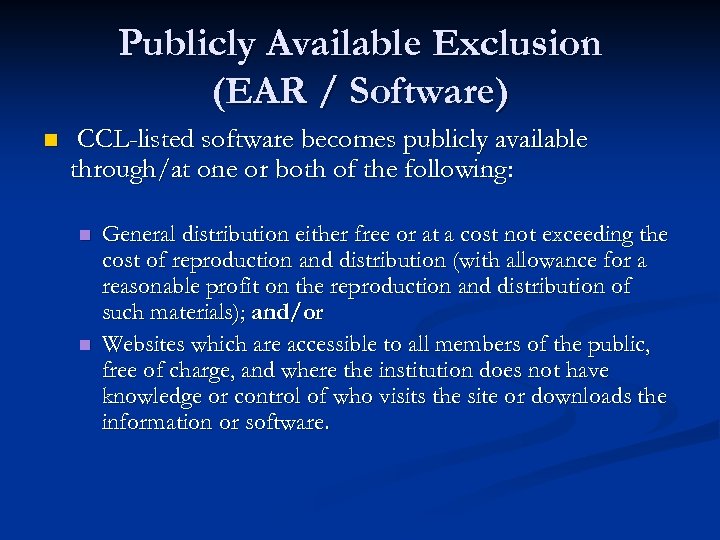 Publicly Available Exclusion (EAR / Software) n CCL-listed software becomes publicly available through/at one or both of the following: n n General distribution either free or at a cost not exceeding the cost of reproduction and distribution (with allowance for a reasonable profit on the reproduction and distribution of such materials); and/or Websites which are accessible to all members of the public, free of charge, and where the institution does not have knowledge or control of who visits the site or downloads the information or software.
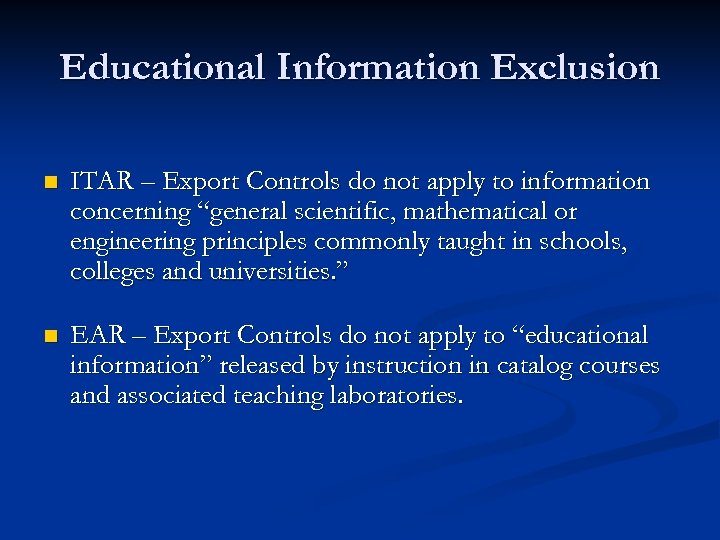 Educational Information Exclusion n ITAR – Export Controls do not apply to information concerning “general scientific, mathematical or engineering principles commonly taught in schools, colleges and universities. ” n EAR – Export Controls do not apply to “educational information” released by instruction in catalog courses and associated teaching laboratories.
 Fundamental Research Exclusion n Covers most basic research at colleges and universities Stated US government policy via NSDD 189 ITAR Part 120. 11: n “Public Domain means information which is published and which is generally accessible to the public…through fundamental research in science and engineering at accredited institutions of higher learning in the US where the resulting information is ordinarily published and shared broadly in the scientific community. ”
 Fundamental Research Exclusion (Cont. ) The fundamental research exemption will not apply if the university accepts any restrictions on the publication of resulting information, other than a brief (~ 90 day) advance review by sponsors to: § Prevent divulging propriety information provided to the investigator by the sponsor § Insure that publication will not compromise patent rights of the sponsor
 Fundamental Research Exclusion (Cont. ) Fundamental Research Exclusion is destroyed by any clause that: Gives the sponsor the right to approve publications q Restricts participation of foreign nationals in conduct of research by precluding access to research results q q Restriction also raises “Openness in Research” policy issues for colleges and universities The Fundamental Research Exclusion is destroyed by such clauses regardless of sponsorship (federal, private or non-profit)
 What to Do When Export Controls Apply Tab 3 Export Control Determinations
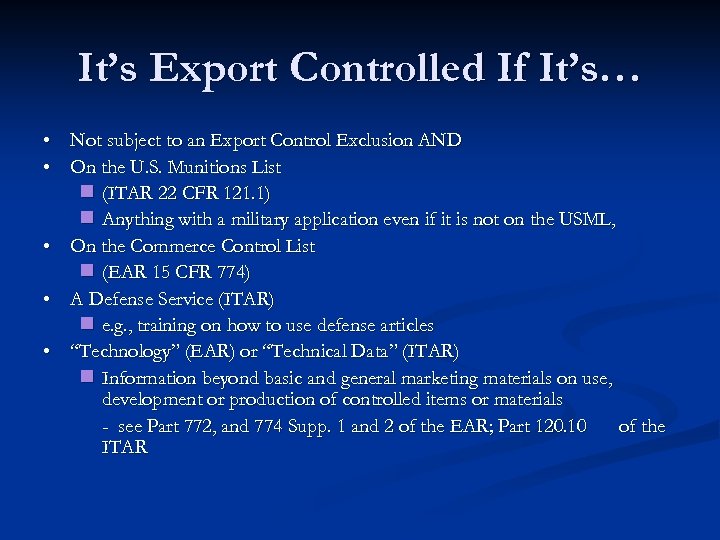 It’s Export Controlled If It’s… • Not subject to an Export Control Exclusion AND • On the U. S. Munitions List n (ITAR 22 CFR 121. 1) n Anything with a military application even if it is not on the USML, • On the Commerce Control List n (EAR 15 CFR 774) • A Defense Service (ITAR) n e. g. , training on how to use defense articles • “Technology” (EAR) or “Technical Data” (ITAR) n Information beyond basic and general marketing materials on use, development or production of controlled items or materials - see Part 772, and 774 Supp. 1 and 2 of the EAR; Part 120. 10 ITAR of the
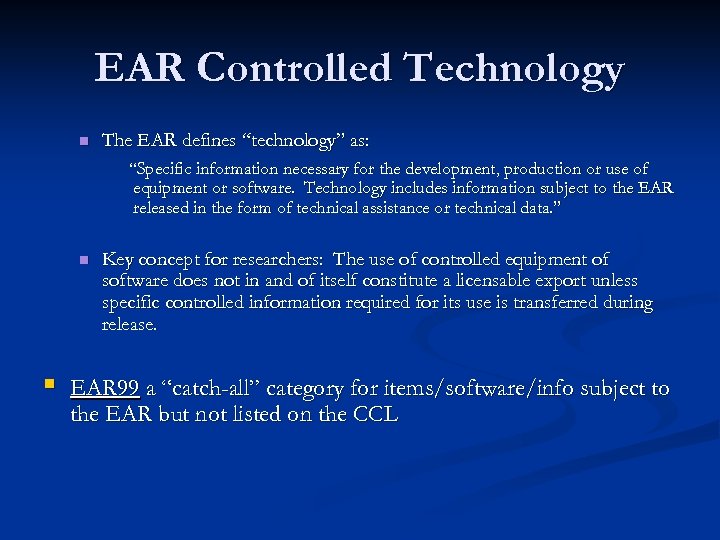 EAR Controlled Technology n The EAR defines “technology” as: “Specific information necessary for the development, production or use of equipment or software. Technology includes information subject to the EAR released in the form of technical assistance or technical data. ” n § Key concept for researchers: The use of controlled equipment of software does not in and of itself constitute a licensable export unless specific controlled information required for its use is transferred during release. EAR 99 a “catch-all” category for items/software/info subject to the EAR but not listed on the CCL
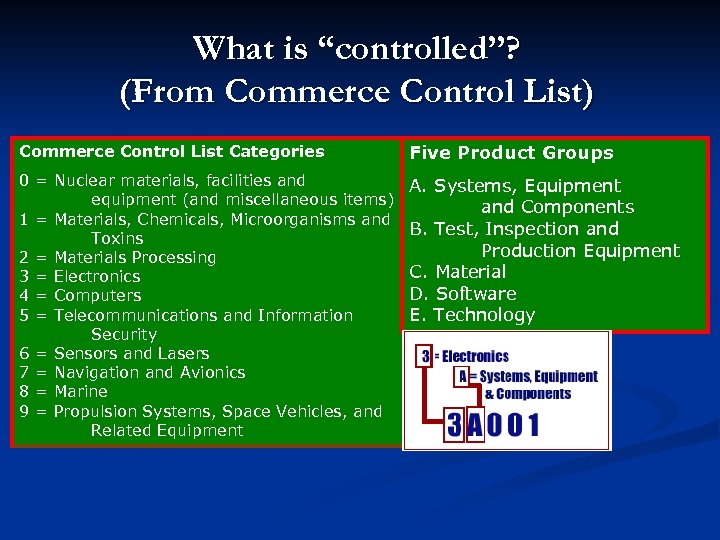 What is “controlled”? (From Commerce Control List) Commerce Control List Categories Five Product Groups 0 = Nuclear materials, facilities and equipment (and miscellaneous items) 1 = Materials, Chemicals, Microorganisms and Toxins 2 = Materials Processing 3 = Electronics 4 = Computers 5 = Telecommunications and Information Security 6 = Sensors and Lasers 7 = Navigation and Avionics 8 = Marine 9 = Propulsion Systems, Space Vehicles, and Related Equipment A. Systems, Equipment and Components B. Test, Inspection and Production Equipment C. Material D. Software E. Technology
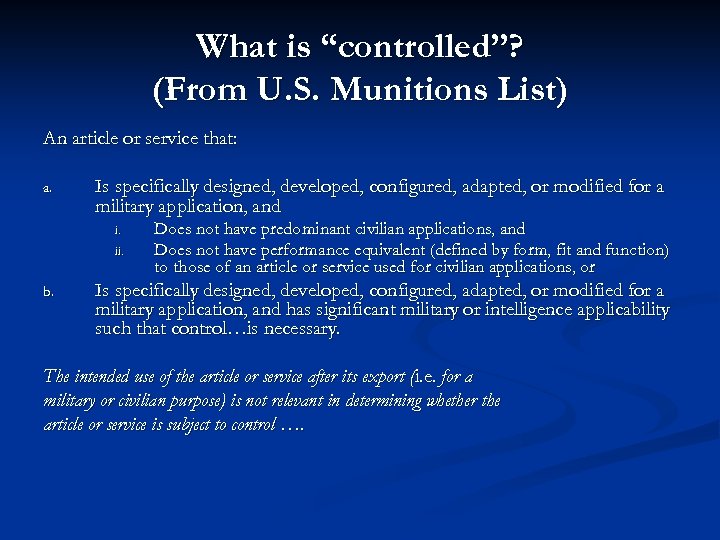 What is “controlled”? (From U. S. Munitions List) An article or service that: a. Is specifically designed, developed, configured, adapted, or modified for a military application, and i. ii. b. Does not have predominant civilian applications, and Does not have performance equivalent (defined by form, fit and function) to those of an article or service used for civilian applications, or Is specifically designed, developed, configured, adapted, or modified for a military application, and has significant military or intelligence applicability such that control…is necessary. The intended use of the article or service after its export (i. e. for a military or civilian purpose) is not relevant in determining whether the article or service is subject to control ….
 What is “controlled”? (by Office of Foreign Assets Control) OFAC Sanctions and Controls n Regulates the transfer of items/services of value to sanctioned nations n Imposes Trade Sanctions, and Trade and Travel Embargoes Aimed at Controlling Terrorism, Drug Trafficking and Other Illicit Activities n Prohibit Payments/Providing Value to Nationals of Sanctioned Countries and Some Specified Entities/Individuals n May Prohibit Travel and Other Activities with Sanctioned Countries and Individuals Even When Exclusions to EAR/ITAR Apply
 What Formal Determination Processes are Available? n Commodity Classification Request (BIS) n n Request for Advisory Opinion (BIS) n n ITAR 120. 4 USML Advisory Opinion (DDTC) n n EAR Part 748. 3 Commodity Jurisdiction Request (DDTC) n n EAR Part 748. 3 ITAR 126. 9 Use of Outside Counsel for Determination
 When are export licenses required? n Under (ITAR) State Department jurisdiction a license is always required unless an exemption is in place n Under (EAR) Commerce Department a license is required only when specified for a particular item and a particular country and if an exception is not available n Under OFAC (Treasury) jurisdiction, a license is always required with only a couple of exceptions, such as informational materials
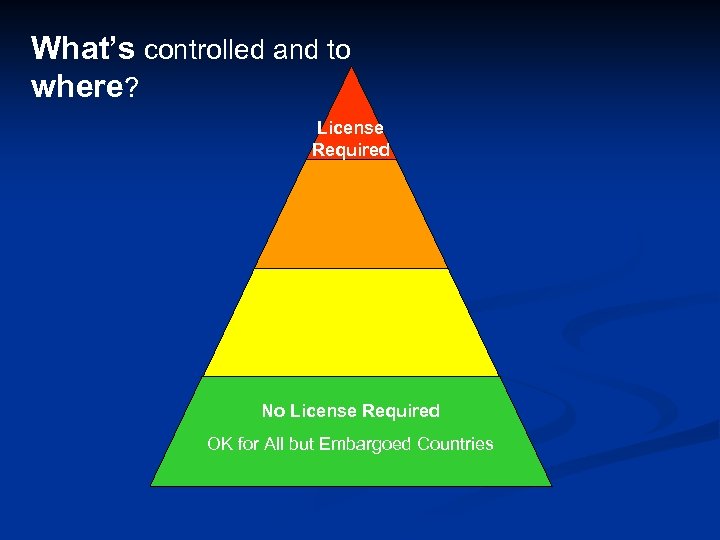 What’s controlled and to where? License Required No License Required OK for All but Embargoed Countries
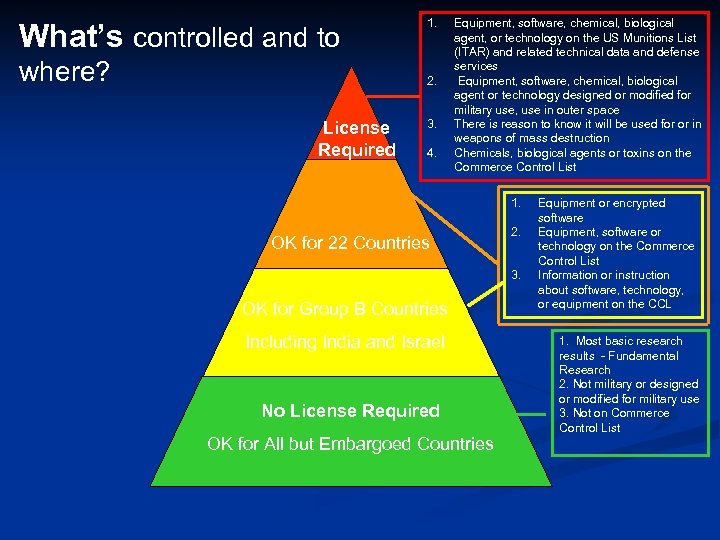 What’s controlled and to where? 1. 2. License Required 3. 4. Equipment, software, chemical, biological agent, or technology on the US Munitions List (ITAR) and related technical data and defense services Equipment, software, chemical, biological agent or technology designed or modified for military use, use in outer space There is reason to know it will be used for or in weapons of mass destruction Chemicals, biological agents or toxins on the Commerce Control List 1. OK for 22 Countries 2. 3. OK for Group B Countries Including India and Israel No License Required OK for All but Embargoed Countries Equipment or encrypted software Equipment, software or technology on the Commerce Control List Information or instruction about software, technology, or equipment on the CCL 1. Most basic research results Fundamental Research 2. Not military or designed or modified for military use 3. Not on Commerce Control List
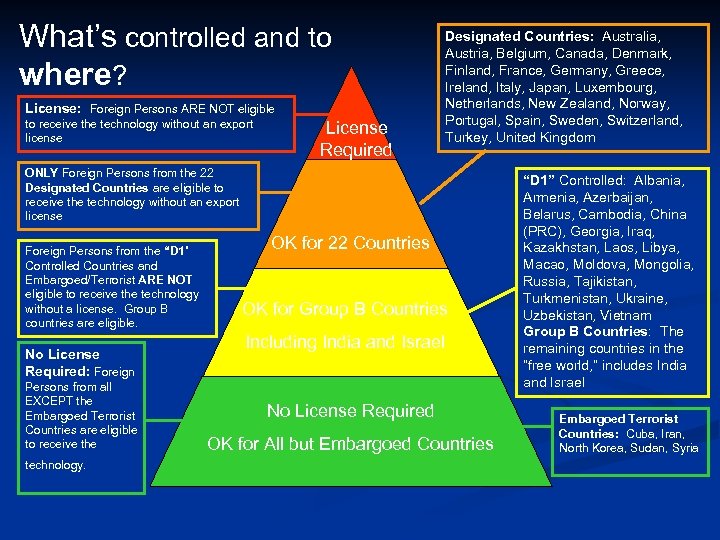 What’s controlled and to where? License: Foreign Persons ARE NOT eligible to receive the technology without an export license License Required Designated Countries: Australia, Austria, Belgium, Canada, Denmark, Finland, France, Germany, Greece, Ireland, Italy, Japan, Luxembourg, Netherlands, New Zealand, Norway, Portugal, Spain, Sweden, Switzerland, Turkey, United Kingdom ONLY Foreign Persons from the 22 Designated Countries are eligible to receive the technology without an export license Foreign Persons from the “D 1” Controlled Countries and Embargoed/Terrorist ARE NOT eligible to receive the technology without a license. Group B countries are eligible. No License Required: Foreign Persons from all EXCEPT the Embargoed Terrorist Countries are eligible to receive the technology. OK for 22 Countries OK for Group B Countries Including India and Israel No License Required OK for All but Embargoed Countries “D 1” Controlled: Albania, Armenia, Azerbaijan, Belarus, Cambodia, China (PRC), Georgia, Iraq, Kazakhstan, Laos, Libya, Macao, Moldova, Mongolia, Russia, Tajikistan, Turkmenistan, Ukraine, Uzbekistan, Vietnam Group B Countries: The remaining countries in the “free world, ” includes India and Israel Embargoed Terrorist Countries: Cuba, Iran, North Korea, Sudan, Syria
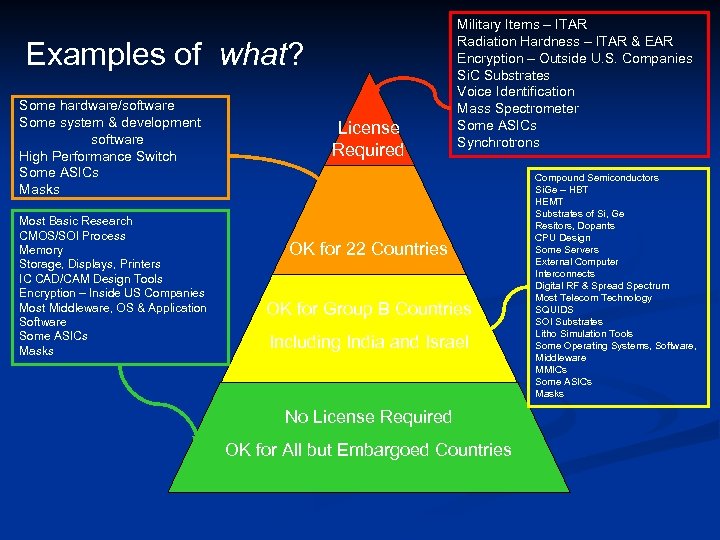 Examples of what? Some hardware/software Some system & development software High Performance Switch Some ASICs Masks Most Basic Research CMOS/SOI Process Memory Storage, Displays, Printers IC CAD/CAM Design Tools Encryption – Inside US Companies Most Middleware, OS & Application Software Some ASICs Masks License Required Military Items – ITAR Radiation Hardness – ITAR & EAR Encryption – Outside U. S. Companies Si. C Substrates Voice Identification Mass Spectrometer Some ASICs Synchrotrons OK for 22 Countries OK for Group B Countries Including India and Israel No License Required OK for All but Embargoed Countries Compound Semiconductors Si. Ge – HBT HEMT Substrates of Si, Ge Resitors, Dopants CPU Design Some Servers External Computer Interconnects Digital RF & Spread Spectrum Most Telecom Technology SQUIDS SOI Substrates Litho Simulation Tools Some Operating Systems, Software, Middleware MMICs Some ASICs Masks
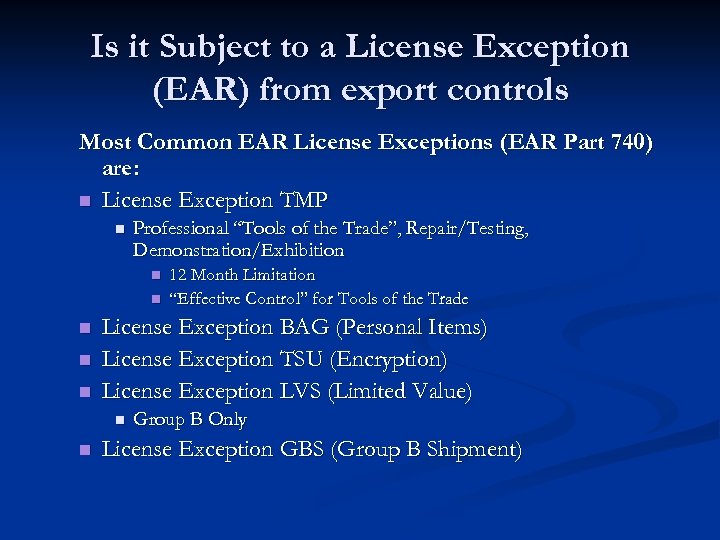 Is it Subject to a License Exception (EAR) from export controls Most Common EAR License Exceptions (EAR Part 740) are: n License Exception TMP n Professional “Tools of the Trade”, Repair/Testing, Demonstration/Exhibition n n License Exception BAG (Personal Items) License Exception TSU (Encryption) License Exception LVS (Limited Value) n n 12 Month Limitation “Effective Control” for Tools of the Trade Group B Only License Exception GBS (Group B Shipment)
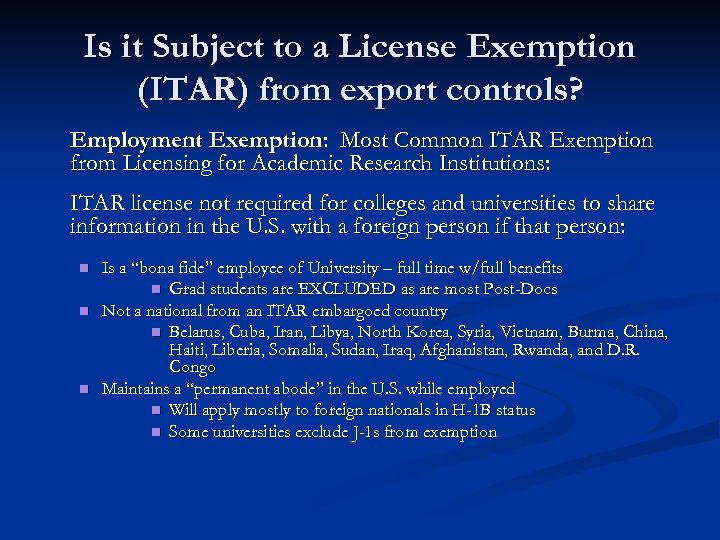 Is it Subject to a License Exemption (ITAR) from export controls? Employment Exemption: Most Common ITAR Exemption from Licensing for Academic Research Institutions: ITAR license not required for colleges and universities to share information in the U. S. with a foreign person if that person: n n n Is a “bona fide” employee of University – full time w/full benefits n Grad students are EXCLUDED as are most Post-Docs Not a national from an ITAR embargoed country n Belarus, Cuba, Iran, Libya, North Korea, Syria, Vietnam, Burma, China, Haiti, Liberia, Somalia, Sudan, Iraq, Afghanistan, Rwanda, and D. R. Congo Maintains a “permanent abode” in the U. S. while employed n Will apply mostly to foreign nationals in H-1 B status n Some universities exclude J-1 s from exemption
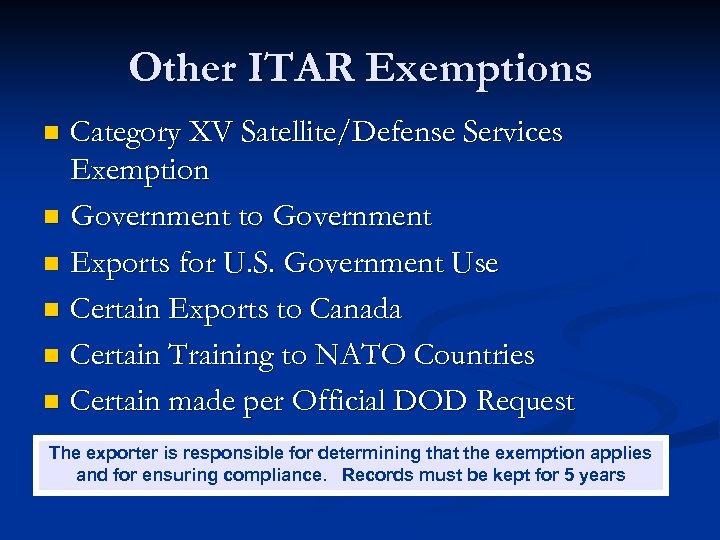 Other ITAR Exemptions Category XV Satellite/Defense Services Exemption n Government to Government n Exports for U. S. Government Use n Certain Exports to Canada n Certain Training to NATO Countries n Certain made per Official DOD Request n The exporter is responsible for determining that the exemption applies and for ensuring compliance. Records must be kept for 5 years
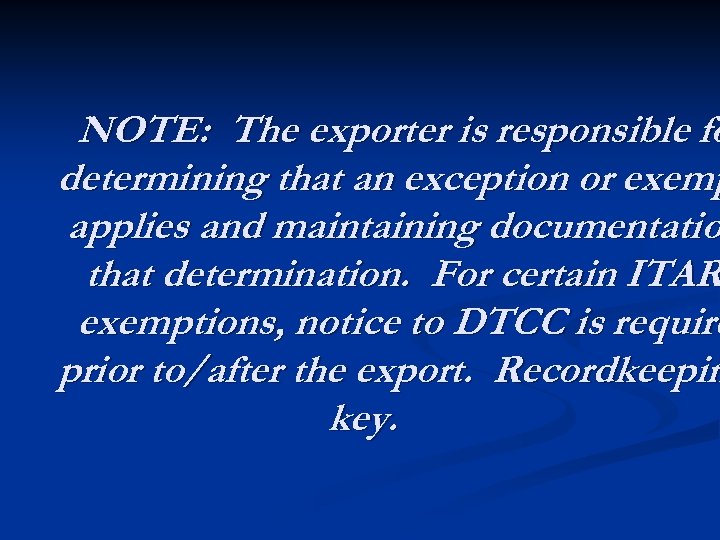 NOTE: The exporter is responsible fo determining that an exception or exemp applies and maintaining documentatio that determination. For certain ITAR exemptions, notice to DTCC is require prior to/after the export. Recordkeepin key.
 What to Do When Export Controls Apply Tab 4 Export Licensing Processes
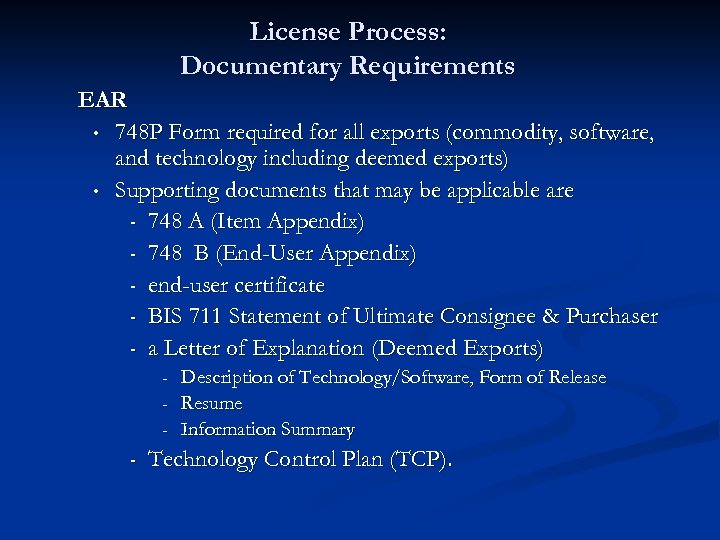 License Process: Documentary Requirements EAR • 748 P Form required for all exports (commodity, software, and technology including deemed exports) • Supporting documents that may be applicable are 748 A (Item Appendix) 748 B (End-User Appendix) end-user certificate BIS 711 Statement of Ultimate Consignee & Purchaser a Letter of Explanation (Deemed Exports) Description of Technology/Software, Form of Release Resume Information Summary Technology Control Plan (TCP).
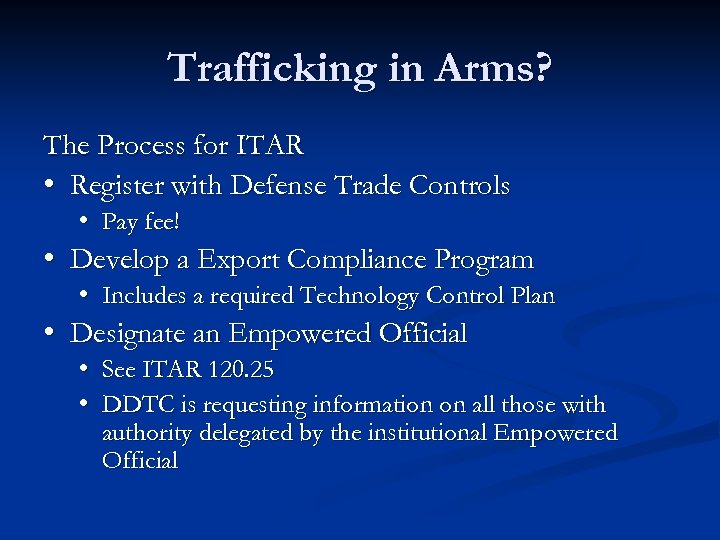 Trafficking in Arms? The Process for ITAR • Register with Defense Trade Controls • Pay fee! • Develop a Export Compliance Program • Includes a required Technology Control Plan • Designate an Empowered Official • See ITAR 120. 25 • DDTC is requesting information on all those with authority delegated by the institutional Empowered Official
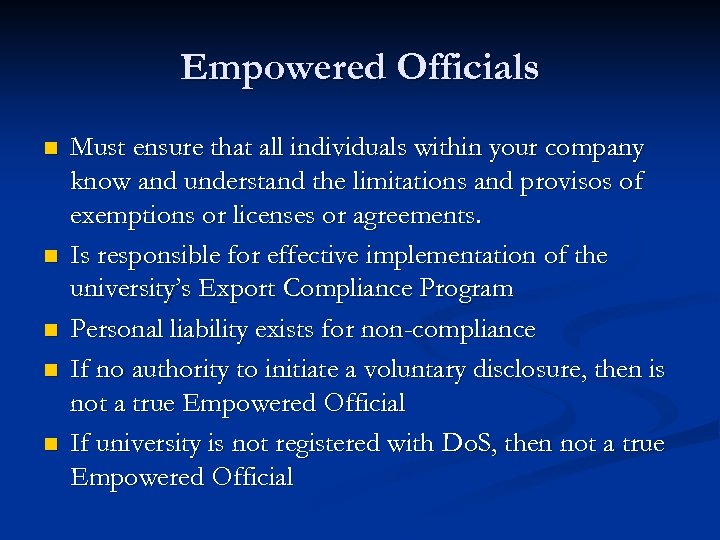 Empowered Officials n n n Must ensure that all individuals within your company know and understand the limitations and provisos of exemptions or licenses or agreements. Is responsible for effective implementation of the university’s Export Compliance Program Personal liability exists for non-compliance If no authority to initiate a voluntary disclosure, then is not a true Empowered Official If university is not registered with Do. S, then not a true Empowered Official
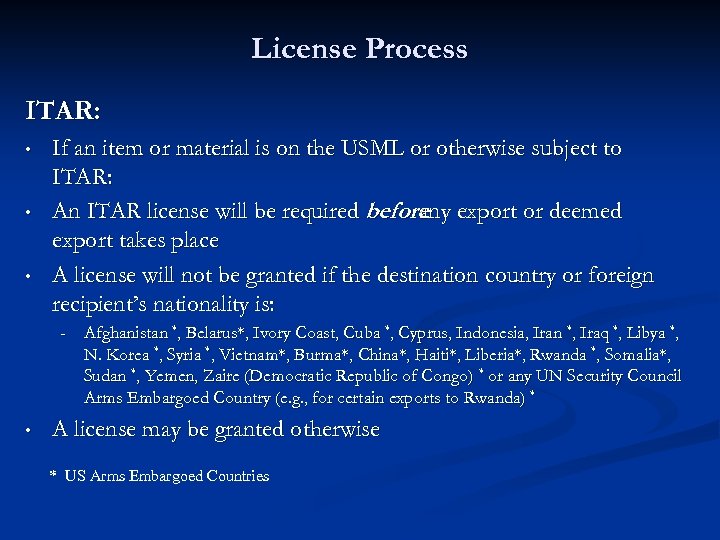 License Process ITAR: • • • If an item or material is on the USML or otherwise subject to ITAR: An ITAR license will be required before export or deemed any export takes place A license will not be granted if the destination country or foreign recipient’s nationality is: • Afghanistan *, Belarus*, Ivory Coast, Cuba *, Cyprus, Indonesia, Iran *, Iraq *, Libya *, N. Korea *, Syria *, Vietnam*, Burma*, China*, Haiti*, Liberia*, Rwanda *, Somalia*, Sudan *, Yemen, Zaire (Democratic Republic of Congo) * or any UN Security Council Arms Embargoed Country (e. g. , for certain exports to Rwanda) * A license may be granted otherwise * US Arms Embargoed Countries
 License Process: Documentary Requirements ITAR • ITAR requires that persons who manufacture or export defense articles or provide defense services must register & pay fees • License forms used: DSP-5 (Permanent Export), DSP-73 (Temporary Export), DSP-61 (Temporary Import), DSP-85 Classified Articles (Exports and Imports)
 State Department ITAR Process • ITAR: Arrangements that require DDTC authorization but not export licenses are: Technical Assistance Agreements (TAA), Manufacturing License Agreements (MLA), Distribution Agreements, Distribution Arrangements, and Offshore Procurements.
 State Department ITAR Process • Defense Articles: n File a DSP 85 n State Department grants an export license • Technical Assistance and Manufacturing Licenses: n Negotiate a Technical Assistance Agreement n State Department reviews & approves it
 State Department ITAR Process: Technical Assistance Agreement • Must be negotiated but NOT SIGNED with a foreign government prior to submission of the proposal. • Export counsel should assist in the preparation and ensure that required clauses are included. • It is part of the proposal and the Sponsored Programs file.
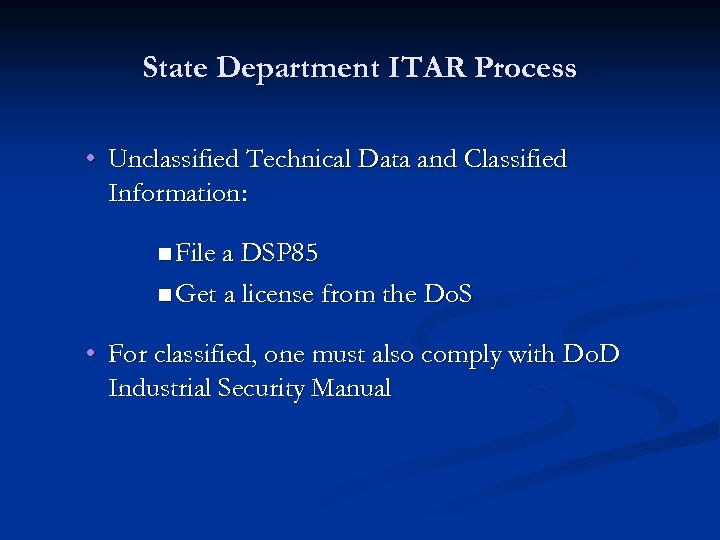 State Department ITAR Process • Unclassified Technical Data and Classified Information: n File a DSP 85 n Get a license from the Do. S • For classified, one must also comply with Do. D Industrial Security Manual
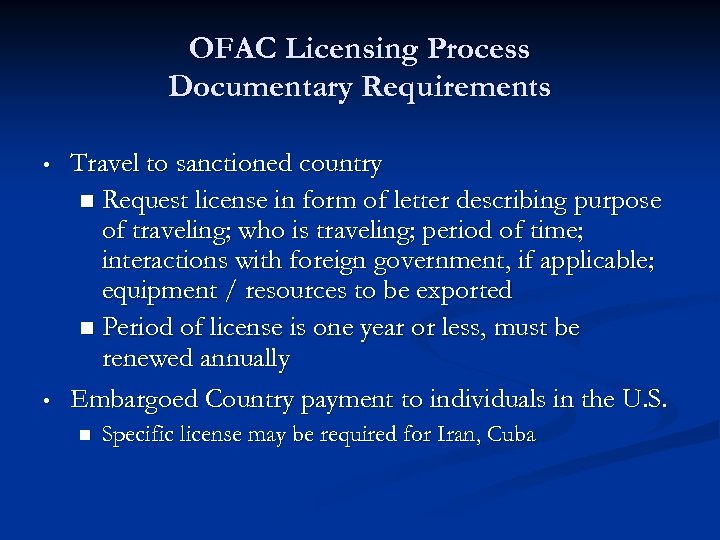 OFAC Licensing Process Documentary Requirements • • Travel to sanctioned country n Request license in form of letter describing purpose of traveling; who is traveling; period of time; interactions with foreign government, if applicable; equipment / resources to be exported n Period of license is one year or less, must be renewed annually Embargoed Country payment to individuals in the U. S. n Specific license may be required for Iran, Cuba
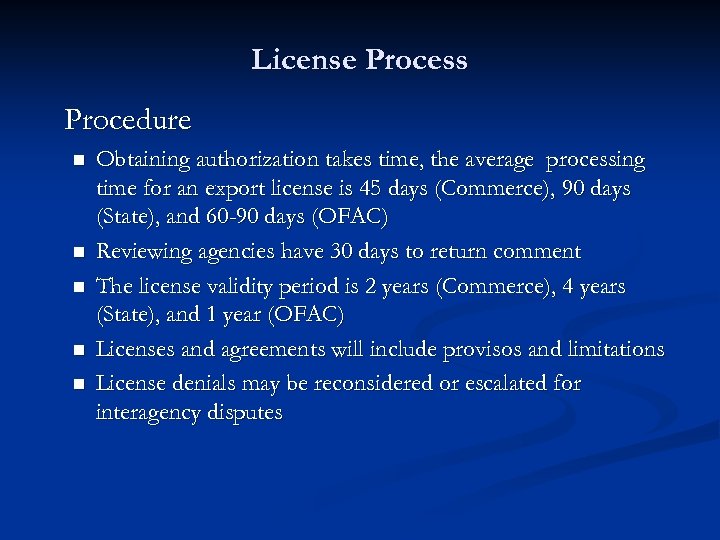 License Process Procedure n n n Obtaining authorization takes time, the average processing time for an export license is 45 days (Commerce), 90 days (State), and 60 -90 days (OFAC) Reviewing agencies have 30 days to return comment The license validity period is 2 years (Commerce), 4 years (State), and 1 year (OFAC) Licenses and agreements will include provisos and limitations License denials may be reconsidered or escalated for interagency disputes
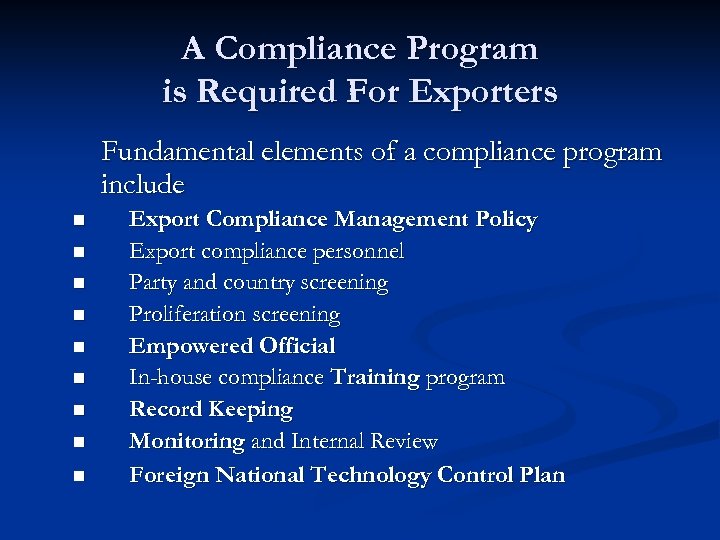 A Compliance Program is Required For Exporters Fundamental elements of a compliance program include n n n n n Export Compliance Management Policy Export compliance personnel Party and country screening Proliferation screening Empowered Official In-house compliance Training program Record Keeping Monitoring and Internal Review Foreign National Technology Control Plan
 Export Compliance Program Five basic tenants are included in the Export Compliance Program. For properly implementing agreements, a plan must: 1. 2. 3. 4. 5. Be written and documented Include training of essential personnel Integrate export activity logs Track compliance to provisos & limitations Contain user acknowledgments of provisos & limitations
 Export Compliance Program n The Export Compliance Program n n n Provides a written, documented process for communicating the terms & conditions of an approved agreement Provides a process for authorized exemption acceptance Provides a process for obtaining a license and approval of the terms and conditions by requisite business unit personnel involved in the export transaction n n Limitations and Provisos Provides a process for management of license agreements, managing technology control plans, and monitoring for compliance
 Export Compliance Program When You Don’t Expect to Export Fundamental elements of a compliance program include n n n n Export Compliance Management Policy Definition of export compliance roles and responsibilities definitions Party and country screening In-house compliance Training program Documentation of Exemptions Record Keeping Monitoring and Internal Review