 Скачать презентацию What should you know about American Government
b85bfc6908b79adef8c9b7a53e526cfd.ppt
- Количество слайдов: 17



What should you know about American Government?
Principles of U. S. Government n n n n Popular Sovereignty Separation of Powers Checks and Balances Limited Government Flexibility Federalism Inalienable Rights Due Process
Branches of the U. S. Government n. Executive Branch n. Legislative Branch n. Judicial Branch
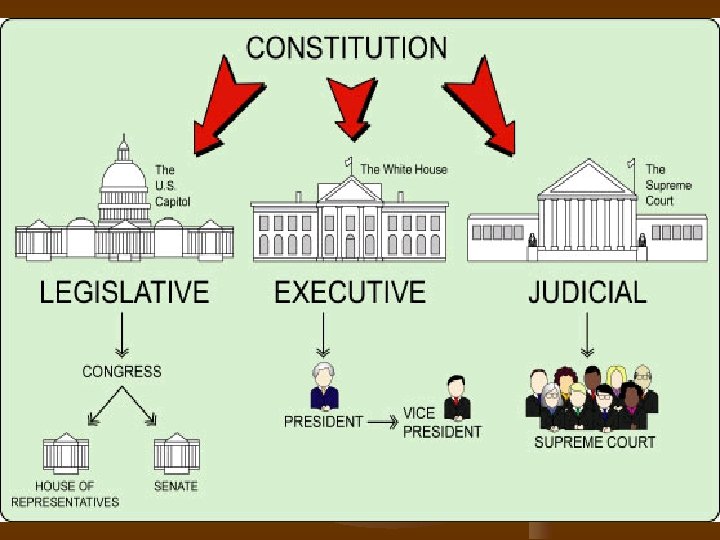
Executive Branch n President: leader of country & commander in chief of military n n Vice President: President of Senate, 2 nd in line Cabinet members: advise President on issues & help carry out policies n Independent Agencies: help carry out policy & provide special services
Presidential Powers n n n n Chief Executive Chief Diplomat Chief Legislator Veto Commander in Chief of Armed Forces Chief of State Grant pardons Grant amnesty
Legislative Branch Bi-cameral Congress n Senate n House of Representatives n Law-making branch of government
Main Roles of Congress n n n To pass legislation (laws) Declare war Regulate trade Regulate money Impeach federal officials Override presidential vetoes (2/3 vote in each house)
Senate n n Upper House 2 senators per state 100 total 6 -year terms n n n Approve presidential nominations to the federal courts Approve presidential appointments to federal positions Approve treaties Serve as jury in impeachment trials Select VP if Electoral College fails to do so
HOUSE of REPRESENTATIVES Lower House n Based on state population n 435 total n 2 -year terms n n Originate all spending ($$) bills Serve as prosecution in impeachment trial Select President if Electoral College fails to do so
Judicial Branch n n n The Court System Supreme Court is highest in nation Interpret the law Exercise the power of judicial review Chief Justice presides over trials of presidential impeachment
Power of Judicial Review n n Determine if laws passed by Congress are allowable by the Constitution Determine if treaties negotiated by the President and approved by the Senate are allowable by the Constitution Determine if actions by the President in enforcing the law are allowable by the Constitution Determine if laws passed by states are allowable by the Constitution
Important Documents n n n n n Magna Carta English Bill of Rights Declaration of Independence Articles of Confederation U. S. Constitution Bill of Rights Monroe Doctrine Emancipation Proclamation Gulf of Tonkin Resolution
Constitutional Amendments n 1 st n 4 th, 5 th, 6 th, 7 th, 8 th n 13 th, 14 th, 15 th n 15 th, 19 th, 26 th protects freedom of expression protect rights of due process Civil War amendments; protects slaves rights protects voting rights
Supreme Court Cases n Marbury vs. Madison (1803) n Dred Scott (1857) n Plessy vs. Ferguson (1896) n Brown vs. Board of Education (1954) n Miranda vs. Arizona (1966)
Economic Terminology n n n n Inflation Deflation Profit Monopoly Laissez-faire Capitalism Socialism Communism
Supply & Demand n n n Interact to determine prices in a market economy Demand = how much consumers are willing and able to buy at different prices As prices INCREASE, demand DECREASES Supply = how much producers are willing and able to sell at different prices As prices INCREASE, supply INCREASES
Скачать презентацию What should you know about American Government
b85bfc6908b79adef8c9b7a53e526cfd.ppt