


 Скачать презентацию What s the Harm Prop 8 and the Need
5d336c4f144b6dba72dda0596a661a1c.ppt
- Количество слайдов: 40
 What’s the Harm? Prop 8 and the Need for Constitutional Protection For Marriage By Lynn D. Wardle Bruce C. Hafen Professor of Law J. Reuben Clark Law School, Brigham Young University* Presented at Mc. George Law School to the Federalist Society Debate Same-Sex Marriage and the Constitution Tuesday, October 10, 2008. * Professional opinions are of the author himself not any institution
 Lest We Take Ourselves Too Seriously
 Audience Survey How many believe that SSM should be legalized? Y____ No_____ Un______ How many believe that marr-equiv SSCU should be legalized? Y____ No_____ Un______ How many believe that the state constitution should be amended to prohib SSM (support Prop 8)? Y__ N__ Un__
 Six Preliminary Points 1) The issue is about Marriage! Don’t get distracted; it’s not about gays or same-sex etiology etc. , its about marriage! 2) Advocates of same-sex marriage seek to change marriage, not marriage 3) Calling a same-sex union a marriage does not make it so. 4) Protection of Marriage is a Civil Rights Cause. 5) The claim for Same-Sex Marriage is Not a Claim for Tolerance 6) We didn’t choose, but cannot avoid, this battle.
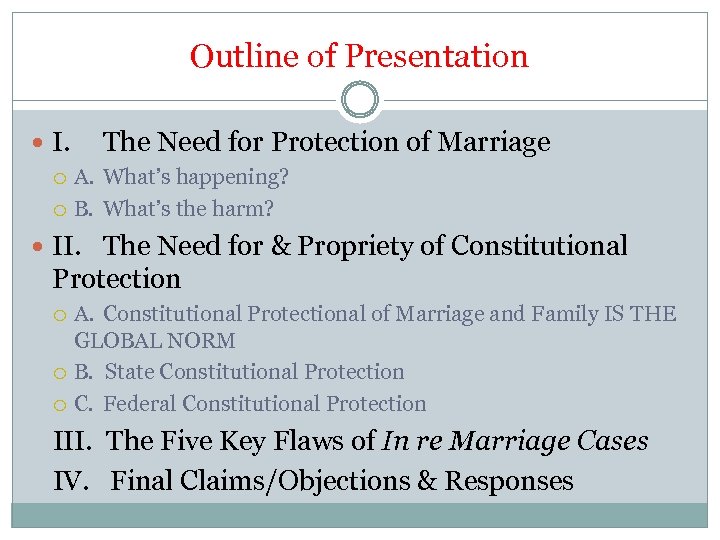 Outline of Presentation I. The Need for Protection of Marriage A. What’s happening? B. What’s the harm? II. The Need for & Propriety of Constitutional Protection A. Constitutional Protectional of Marriage and Family IS THE GLOBAL NORM B. State Constitutional Protection C. Federal Constitutional Protection III. The Five Key Flaws of In re Marriage Cases IV. Final Claims/Objections & Responses
 I. The Need for Protection of Marriage A. What’s happening?
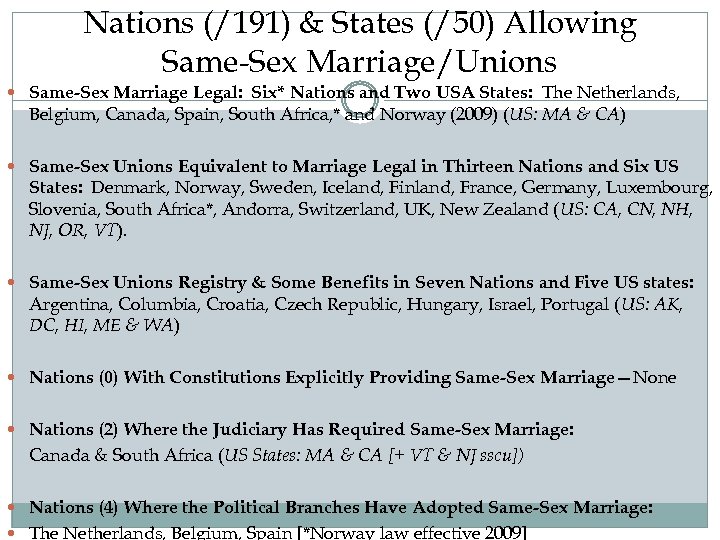 Nations (/191) & States (/50) Allowing Same-Sex Marriage/Unions Same-Sex Marriage Legal: Six* Nations and Two USA States: The Netherlands, Belgium, Canada, Spain, South Africa, * and Norway (2009) (US: MA & CA) Same-Sex Unions Equivalent to Marriage Legal in Thirteen Nations and Six US States: Denmark, Norway, Sweden, Iceland, Finland, France, Germany, Luxembourg, Slovenia, South Africa*, Andorra, Switzerland, UK, New Zealand (US: CA, CN, NH, NJ, OR, VT). Same-Sex Unions Registry & Some Benefits in Seven Nations and Five US states: Argentina, Columbia, Croatia, Czech Republic, Hungary, Israel, Portugal (US: AK, DC, HI, ME & WA) Nations (0) With Constitutions Explicitly Providing Same-Sex Marriage—None Nations (2) Where the Judiciary Has Required Same-Sex Marriage: Canada & South Africa (US States: MA & CA [+ VT & NJ sscu]) Nations (4) Where the Political Branches Have Adopted Same-Sex Marriage: The Netherlands, Belgium, Spain [*Norway law effective 2009]
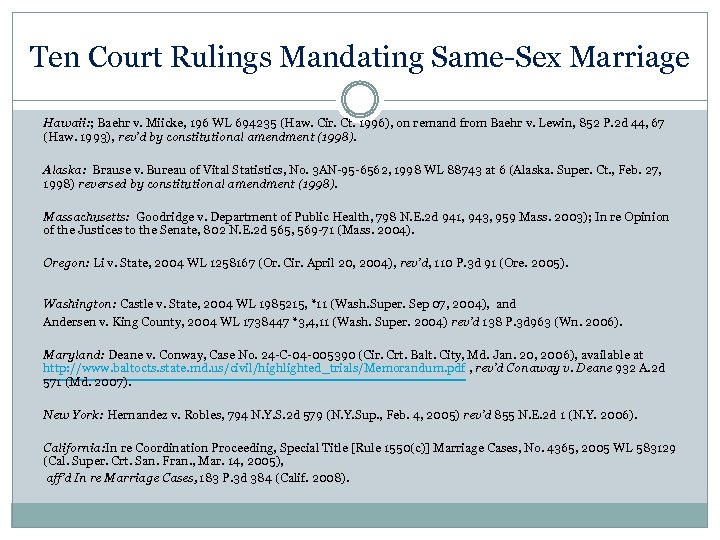 Ten Court Rulings Mandating Same-Sex Marriage Hawaii: ; Baehr v. Miicke, 196 WL 694235 (Haw. Cir. Ct. 1996), on remand from Baehr v. Lewin, 852 P. 2 d 44, 67 (Haw. 1993), rev’d by constitutional amendment (1998). Alaska: Brause v. Bureau of Vital Statistics, No. 3 AN-95 -6562, 1998 WL 88743 at 6 (Alaska. Super. Ct. , Feb. 27, 1998) reversed by constitutional amendment (1998). Massachusetts: Goodridge v. Department of Public Health, 798 N. E. 2 d 941, 943, 959 Mass. 2003); In re Opinion of the Justices to the Senate, 802 N. E. 2 d 565, 569 -71 (Mass. 2004). Oregon: Li v. State, 2004 WL 1258167 (Or. Cir. April 20, 2004), rev’d, 110 P. 3 d 91 (Ore. 2005). Washington: Castle v. State, 2004 WL 1985215, *11 (Wash. Super. Sep 07, 2004), and Andersen v. King County, 2004 WL 1738447 *3, 4, 11 (Wash. Super. 2004) rev’d 138 P. 3 d 963 (Wn. 2006). Maryland: Deane v. Conway, Case No. 24 -C-04 -005390 (Cir. Crt. Balt. City, Md. Jan. 20, 2006), available at http: //www. baltocts. state. md. us/civil/highlighted_trials/Memorandum. pdf , rev’d Conaway v. Deane 932 A. 2 d 571 (Md. 2007). New York: Hernandez v. Robles, 794 N. Y. S. 2 d 579 (N. Y. Sup. , Feb. 4, 2005) rev’d 855 N. E. 2 d 1 (N. Y. 2006). California: In re Coordination Proceeding, Special Title [Rule 1550(c)] Marriage Cases, No. 4365, 2005 WL 583129 (Cal. Super. Crt. San. Fran. , Mar. 14, 2005), aff’d In re Marriage Cases, 183 P. 3 d 384 (Calif. 2008).
 Two Court Rulings Mandating Legalization of Same-Sex Unions Equal to Marriage Vermont: Baker v. State, 744 A. 2 d 864 (Vt. 1999) (marr-equiv SSUs). New Jersey: Lewis v. Harris, 908 A. wd 196 (N. J. 2006) (marr-equiv SSUs).
 Eleven Constitutional Doctrines Invoked to Mandate Same-Sex Marriage, Strike SMAs and DOMAs, etc. -Equal Protection -Substantive Due Process Privacy -Substantive Due Process Right to Marry -Substantive Due Process Right of Association -Substantive Due Process Right to Expression -Privileges & Immunities -Full Faith & Credit -Bill of Attainder -Establishment of Religion -Freedom of Religion -Arbitrary and Irrational
 II. B. What’s the Harm of Legalizing Same-Sex Marriage? SHORT ANS: Compare to other radical redifinition of marriage: -polygamy or marriage with 13 -year-olds or Fa-Dau marriage? Five flaws in “sky didn’t fall” arguments: 1) Switch Burden of Proof (is on those proposing radical alteration of global norm) 2) Assumes immediate, visible harm (comparable to divorce children or smoking) 3) Diverts attention from the “transformative power of inclusion” – the transformative effect on marriage of inclusion of gay-lesbian lifestyles as ‘marriage. ’ 4) Marriage is used in 1, 138 federal laws, unnumbered (even more) federal regulations, and hundreds of state laws in each state. 5) Already there are evident harms, ‘wake effects’ of SSM -Adoption agencies, -practice medicine/religion, -education, -free speech
 In California: Abortion cases CA SCT decision : Catholic doctor legally liable (if facts) because declined ART services to a lesbian; no religious exemption Elsewhere: -Georgetown University United States, the Boy Scouts denied privileges and public facilities. -Canada, Knights of Columbus was held liable -Hospital (abortion already, so same-sex marriage, also) -Educators and schools are vulnerable. - Massachusetts numerous school controversies - British Columbia, Trinity Western University denied accreditation Free speech rights have already been abused: effort to “silence” oppons -Sweden Pentacostal Pastor Ake Green -Similar cases have been reported in Canada and England & PA & OH (African-American administrator at college in OH). Suit involving CDC counselor for referral (‘homophobic’) - Ireland, ICCL warned that Catholic Bishops and clergy of hate speech
 What’s the Harm of Transforming the Meaning of Marriage? Distinguish Public from Private Interests in marriage. When marriages fail or fail to form, society must pick up the pieces and the public incurs huge fiscal and social costs. How marriage is defined sends signals to and reflects common understandings about the expectations of the relationship. Men and women are different, and the union of a man and woman still creates a different kind of union that the union of 2 men or 2 women. RB Ginsburg “-“ Marriage establishes the moral core of the family and the moral baseline and standards for society in many ways. “Marriage is a society's cultural infrastructure. . ” David Blankenhorn, The Future of Marriage. One clear effort to change marriage and marital family: Bolshevik Russia marriage and family law reforms, 1917 -1927.
 Men and Women Differ; Equality Does Not Require SSM Justice Ruth Bader Ginsburg wrote: “Physical differences between men and women. . . are enduring: ‘The two sexes are not fungible; a community made up exclusively of one [sex] is different from a community composed of both. ’” United States v. Virginia, 116 S. Ct. 2264, 2276 (1996)
 Same-sex relationships differ in profound ways form conjugal marriage For example, a study by Dutch AIDs researchers, published in 2003 in the journal AIDS, reported on the number of partners among Amsterdam’s homosexual population. They found: - 86% of new HIV/AIDS infections in gay men were in men who had steady partners. - Gay men with steady partners engage in more risky sexual behaviors than gays without steady partners. - Gay men with steady partners had 8 other sex partners (“casual partners”) per year, on average. - The average duration of committed relationships among gay steady partners was 1. 5 years. Kirk and Madsen reported in their that “the cheating ratio of ‘married’ gay males, given enough time, approaches 100%. . ” A 2006 Norwegian study found divorce-risk levels were about 50% higher for registered gay men partnerships than for comparable heterosexual couples, and controlling for variables, the risk of divorce was twice as high for lesbian couples as it was for gay men couples.
 II. The Need for & Propriety of Constitutional Protection A. Constitutional Protectional of Marriage and Family IS THE GLOBAL NORM B. State Constitutional Protection
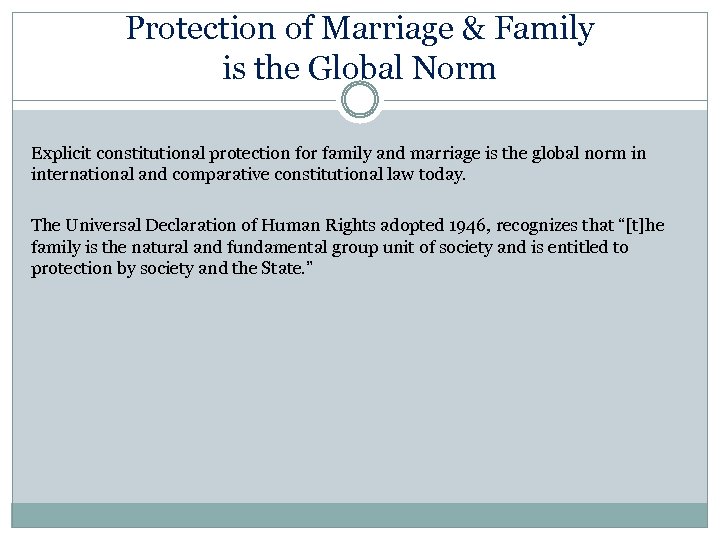 Protection of Marriage & Family is the Global Norm Explicit constitutional protection for family and marriage is the global norm in international and comparative constitutional law today. The Universal Declaration of Human Rights adopted 1946, recognizes that “[t]he family is the natural and fundamental group unit of society and is entitled to protection by society and the State. ”
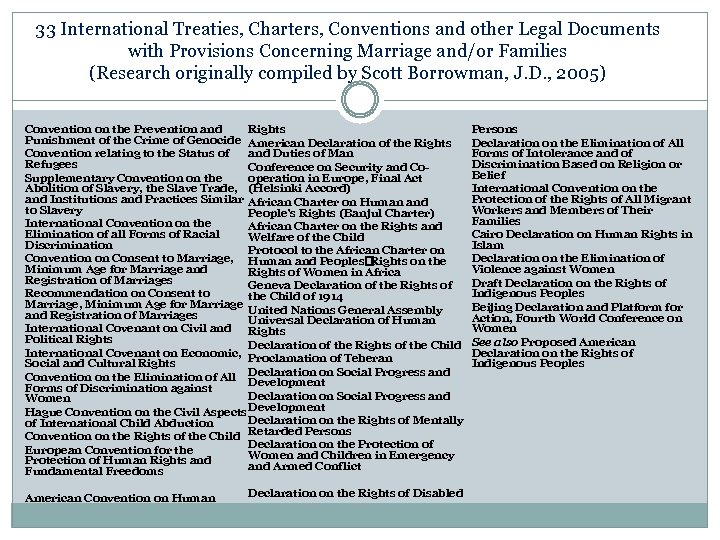 33 International Treaties, Charters, Conventions and other Legal Documents with Provisions Concerning Marriage and/or Families (Research originally compiled by Scott Borrowman, J. D. , 2005) Rights Convention on the Prevention and Punishment of the Crime of Genocide American Declaration of the Rights Convention relating to the Status of and Duties of Man Refugees Conference on Security and Co. Supplementary Convention on the operation in Europe, Final Act Abolition of Slavery, the Slave Trade, (Helsinki Accord) and Institutions and Practices Similar African Charter on Human and to Slavery People’s Rights (Banjul Charter) International Convention on the African Charter on the Rights and Elimination of all Forms of Racial Welfare of the Child Discrimination Protocol to the African Charter on Convention on Consent to Marriage, Human and Peoples Rights on the Minimum Age for Marriage and Rights of Women in Africa Registration of Marriages Geneva Declaration of the Rights of Recommendation on Consent to the Child of 1914 Marriage, Minimum Age for Marriage United Nations General Assembly and Registration of Marriages Universal Declaration of Human International Covenant on Civil and Rights Political Rights Declaration of the Rights of the Child International Covenant on Economic, Proclamation of Teheran Social and Cultural Rights Convention on the Elimination of All Declaration on Social Progress and Development Forms of Discrimination against Declaration on Social Progress and Women Hague Convention on the Civil Aspects Development Declaration on the Rights of Mentally of International Child Abduction Convention on the Rights of the Child Retarded Persons Declaration on the Protection of European Convention for the Women and Children in Emergency Protection of Human Rights and Armed Conflict Fundamental Freedoms American Convention on Human Declaration on the Rights of Disabled Persons Declaration on the Elimination of All Forms of Intolerance and of Discrimination Based on Religion or Belief International Convention on the Protection of the Rights of All Migrant Workers and Members of Their Families Cairo Declaration on Human Rights in Islam Declaration on the Elimination of Violence against Women Draft Declaration on the Rights of Indigenous Peoples Beijing Declaration and Platform for Action, Fourth World Conference on Women See also Proposed American Declaration on the Rights of Indigenous Peoples
 Most national constitutions adopted in the past 60 years also have included express constitutional protection for marriage and/or family.
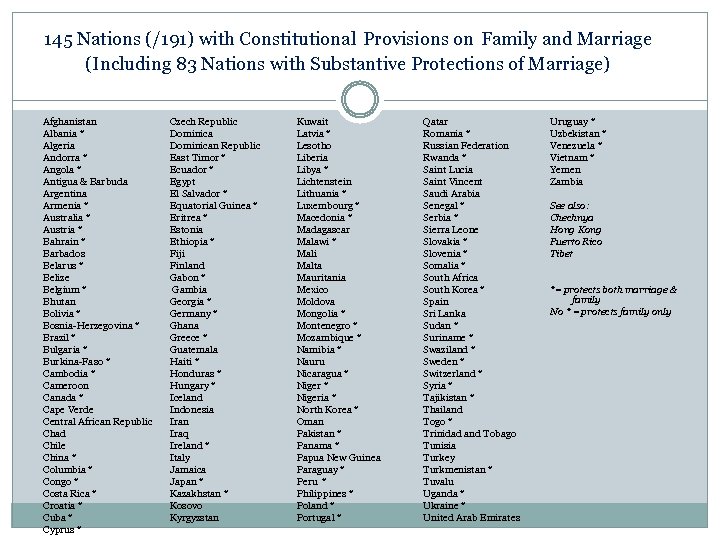 145 Nations (/191) with Constitutional Provisions on Family and Marriage (Including 83 Nations with Substantive Protections of Marriage) Afghanistan Albania * Algeria Andorra * Angola * Antigua & Barbuda Argentina Armenia * Australia * Austria * Bahrain * Barbados Belarus * Belize Belgium * Bhutan Bolivia * Bosnia-Herzegovina * Brazil * Bulgaria * Burkina-Faso * Cambodia * Cameroon Canada * Cape Verde Central African Republic Chad Chile China * Columbia * Congo * Costa Rica * Croatia * Cuba * Cyprus * Czech Republic Dominican Republic East Timor * Ecuador * Egypt El Salvador * Equatorial Guinea * Eritrea * Estonia Ethiopia * Fiji Finland Gabon * Gambia Georgia * Germany * Ghana Greece * Guatemala Haiti * Honduras * Hungary * Iceland Indonesia Iran Iraq Ireland * Italy Jamaica Japan * Kazakhstan * Kosovo Kyrgyzstan Kuwait Latvia * Lesotho Liberia Libya * Lichtenstein Lithuania * Luxembourg * Macedonia * Madagascar Malawi * Mali Malta Mauritania Mexico Moldova Mongolia * Montenegro * Mozambique * Namibia * Nauru Nicaragua * Nigeria * North Korea * Oman Pakistan * Panama * Papua New Guinea Paraguay * Peru * Philippines * Poland * Portugal * Qatar Romania * Russian Federation Rwanda * Saint Lucia Saint Vincent Saudi Arabia Senegal * Serbia * Sierra Leone Slovakia * Slovenia * Somalia * South Africa South Korea * Spain Sri Lanka Sudan * Suriname * Swaziland * Sweden * Switzerland * Syria * Tajikistan * Thailand Togo * Trinidad and Tobago Tunisia Turkey Turkmenistan * Tuvalu Uganda * Ukraine * United Arab Emirates Uruguay * Uzbekistan * Venezuela * Vietnam * Yemen Zambia See also: Chechnya Hong Kong Puerto Rico Tibet *= protects both marriage & family No * = protects family only
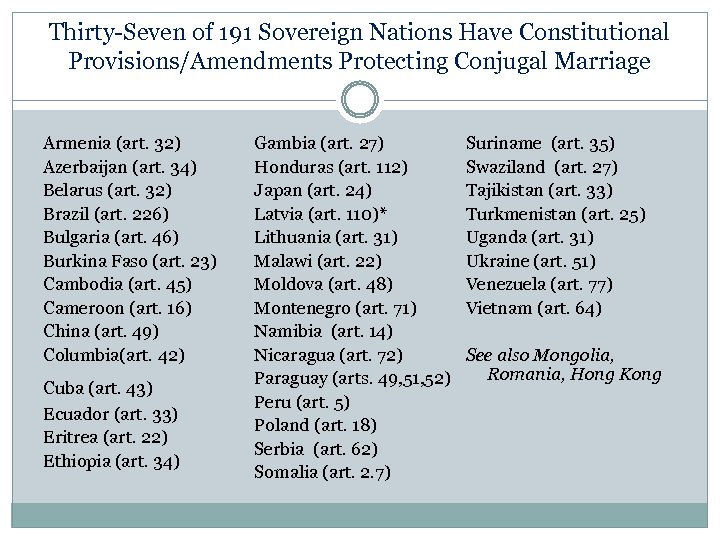 Thirty-Seven of 191 Sovereign Nations Have Constitutional Provisions/Amendments Protecting Conjugal Marriage Armenia (art. 32) Azerbaijan (art. 34) Belarus (art. 32) Brazil (art. 226) Bulgaria (art. 46) Burkina Faso (art. 23) Cambodia (art. 45) Cameroon (art. 16) China (art. 49) Columbia(art. 42) Cuba (art. 43) Ecuador (art. 33) Eritrea (art. 22) Ethiopia (art. 34) Gambia (art. 27) Honduras (art. 112) Japan (art. 24) Latvia (art. 110)* Lithuania (art. 31) Malawi (art. 22) Moldova (art. 48) Montenegro (art. 71) Namibia (art. 14) Nicaragua (art. 72) Paraguay (arts. 49, 51, 52) Peru (art. 5) Poland (art. 18) Serbia (art. 62) Somalia (art. 2. 7) Suriname (art. 35) Swaziland (art. 27) Tajikistan (art. 33) Turkmenistan (art. 25) Uganda (art. 31) Ukraine (art. 51) Venezuela (art. 77) Vietnam (art. 64) See also Mongolia, Romania, Hong Kong
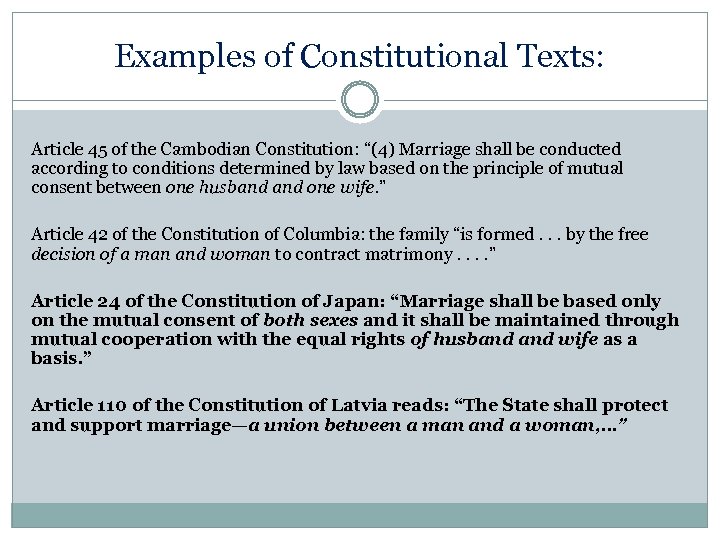 Examples of Constitutional Texts: Article 45 of the Cambodian Constitution: “(4) Marriage shall be conducted according to conditions determined by law based on the principle of mutual consent between one husband one wife. ” Article 42 of the Constitution of Columbia: the family “is formed. . . by the free decision of a man and woman to contract matrimony. . ” Article 24 of the Constitution of Japan: “Marriage shall be based only on the mutual consent of both sexes and it shall be maintained through mutual cooperation with the equal rights of husband wife as a basis. ” Article 110 of the Constitution of Latvia reads: “The State shall protect and support marriage—a union between a man and a woman, …”
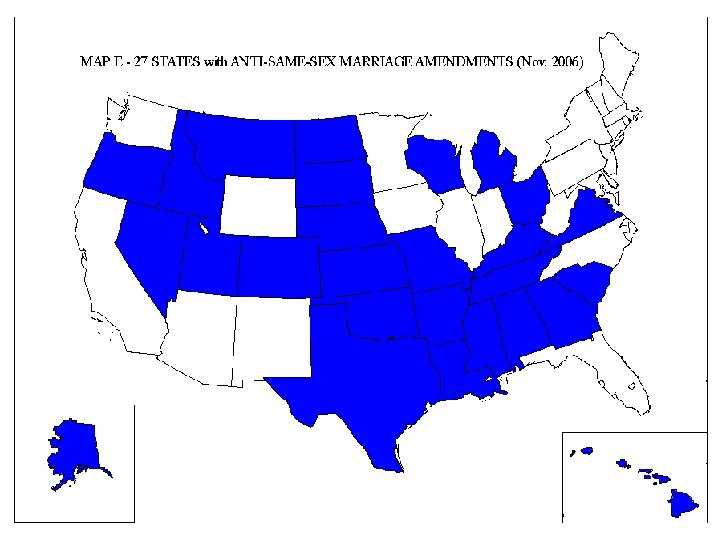
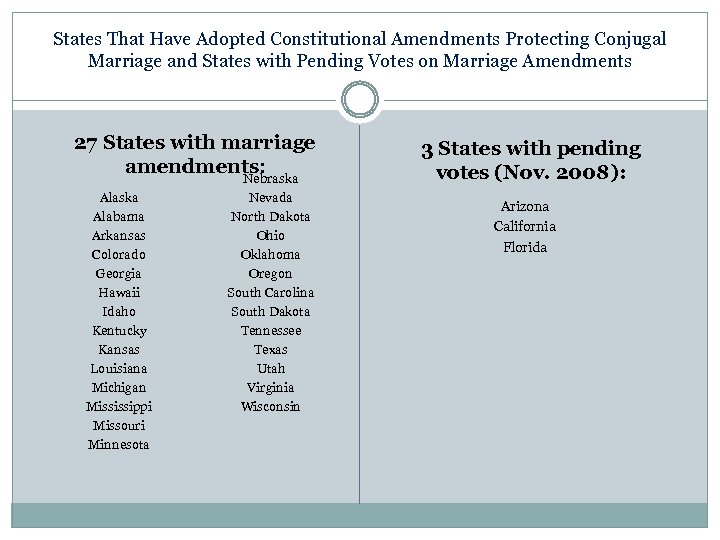 States That Have Adopted Constitutional Amendments Protecting Conjugal Marriage and States with Pending Votes on Marriage Amendments 27 States with marriage amendments: Alaska Alabama Arkansas Colorado Georgia Hawaii Idaho Kentucky Kansas Louisiana Michigan Mississippi Missouri Minnesota Nebraska Nevada North Dakota Ohio Oklahoma Oregon South Carolina South Dakota Tennessee Texas Utah Virginia Wisconsin 3 States with pending votes (Nov. 2008): Arizona California Florida
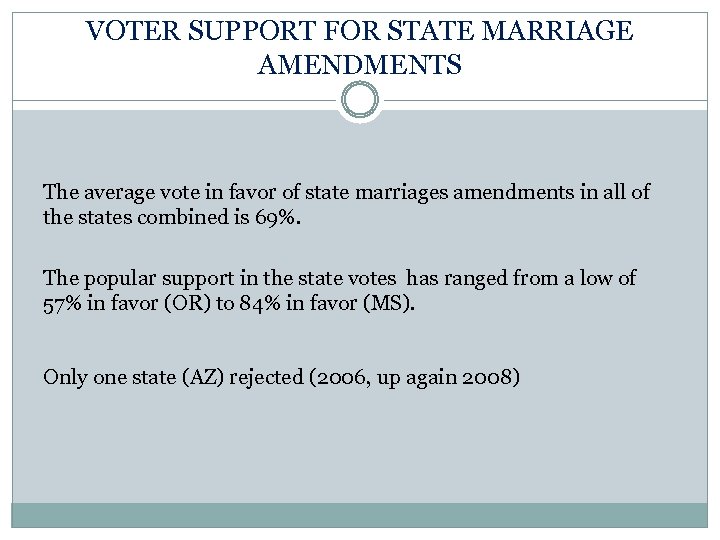 VOTER SUPPORT FOR STATE MARRIAGE AMENDMENTS The average vote in favor of state marriages amendments in all of the states combined is 69%. The popular support in the state votes has ranged from a low of 57% in favor (OR) to 84% in favor (MS). Only one state (AZ) rejected (2006, up again 2008)
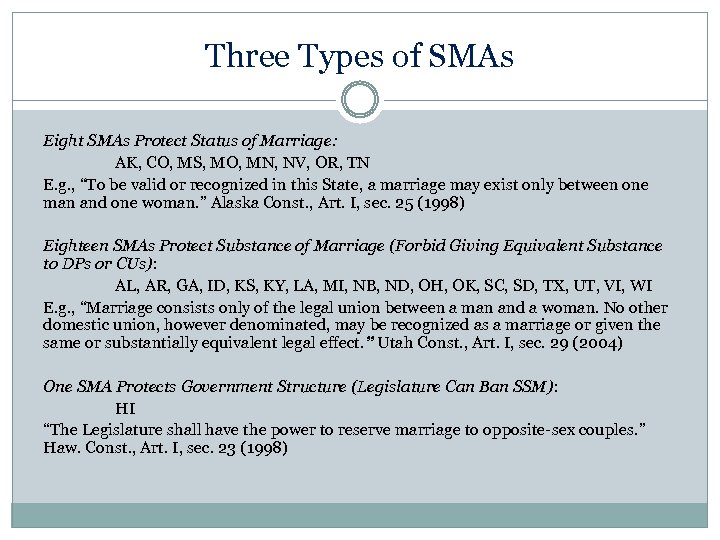 Three Types of SMAs Eight SMAs Protect Status of Marriage: AK, CO, MS, MO, MN, NV, OR, TN E. g. , “To be valid or recognized in this State, a marriage may exist only between one man and one woman. ” Alaska Const. , Art. I, sec. 25 (1998) Eighteen SMAs Protect Substance of Marriage (Forbid Giving Equivalent Substance to DPs or CUs): AL, AR, GA, ID, KS, KY, LA, MI, NB, ND, OH, OK, SC, SD, TX, UT, VI, WI E. g. , “Marriage consists only of the legal union between a man and a woman. No other domestic union, however denominated, may be recognized as a marriage or given the same or substantially equivalent legal effect. ” Utah Const. , Art. I, sec. 29 (2004) One SMA Protects Government Structure (Legislature Can Ban SSM): HI “The Legislature shall have the power to reserve marriage to opposite-sex couples. ” Haw. Const. , Art. I, sec. 23 (1998)
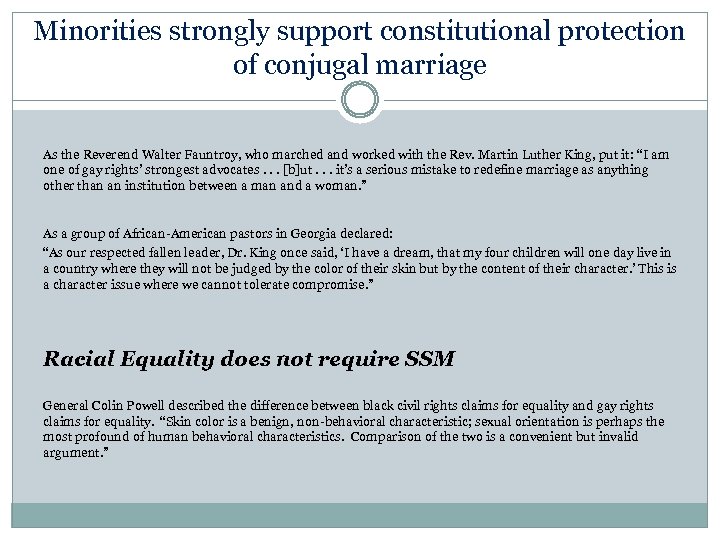 Minorities strongly support constitutional protection of conjugal marriage As the Reverend Walter Fauntroy, who marched and worked with the Rev. Martin Luther King, put it: “I am one of gay rights’ strongest advocates. . . [b]ut. . . it’s a serious mistake to redefine marriage as anything other than an institution between a man and a woman. ” As a group of African-American pastors in Georgia declared: “As our respected fallen leader, Dr. King once said, ‘I have a dream, that my four children will one day live in a country where they will not be judged by the color of their skin but by the content of their character. ’ This is a character issue where we cannot tolerate compromise. ” Racial Equality does not require SSM General Colin Powell described the difference between black civil rights claims for equality and gay rights claims for equality. “Skin color is a benign, non-behavioral characteristic; sexual orientation is perhaps the most profound of human behavioral characteristics. Comparison of the two is a convenient but invalid argument. ”
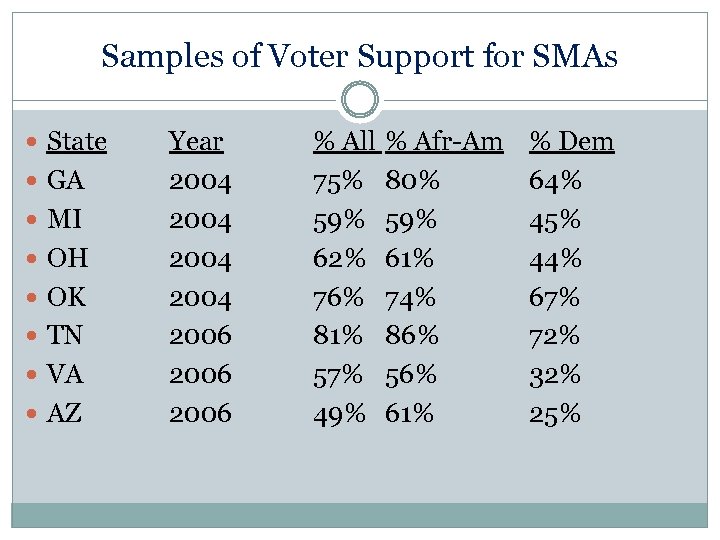 Samples of Voter Support for SMAs State GA MI OH OK TN VA AZ Year 2004 2006 % All % Afr-Am 75% 80% 59% 62% 61% 76% 74% 81% 86% 57% 56% 49% 61% % Dem 64% 45% 44% 67% 72% 32% 25%
 Five Key Flaws: Why the In re Marriage Cases Decision Should be Overturned The California Supreme Court made five types of very serious mistakes: 1) Structural – judicial legislation 2) Substantive – endanger the basic unit of society 3) Analytical - policy rhetoric and bald assumptions, not constitutional analysis 4) Political – manipulation endangering integrity and independence of judiciary 5) Pandering – embraced rather than rejected the “capture of marriage” tactic like that used by the racial anti-miscegenation movement
 Common Objections and Responses: Déjà vu from 1787 -91 and opposition to the Bill of Rights 1) Not needed, ample protection (In re Marriage Cases shows need) 2) Eliminate the right to marry (that was judicially invented and forced upon the people of California by judicial decree of the California Supreme Court that overturned protection for marriage adopted by vote of 61% of California voters in 2000) 3) Distort constitutional government (purpose of constitutional government) 4) Diverts attention from more important business (Pork barrel politics? Gerrymandering? ) 5) Futile (not unless we have lost the rule of law; government of laws not men)
 Proposition 8 adds fourteen words to the Constitution of California: “Only marriage between a man and a woman is valid or recognized in California. ” The language is identical to the language of statue enacted by over 60% of the popular vote as Proposition 22 in 2000 (& codified at Family Code § 308. 5).
 We must speak up and stand up One of our responsibilities as parents, citizens, and especially scholars is to warn of dangers - Elie Wiesel, Night: “Moishe the Beadle” Elie Wiesel, Nobel Acceptance Speech: “I swore never to be silent. . We must take sides. Neutrality helps the oppressor, never the victim. Silence encourages the tormentor. . ” We too must speak up and get involved. ” “There is so much to be done, there is so much that can be done. One person – a Raoul Wallenberg, an Albert Schweitzer, a Martin Luther King, Jr. – one person of integrity can make a difference, a different of life and death. ”
 Protecting An Inalienable Right “In the context of California’s Proposition 8, the question is whether marriage is merely a creature of governmental creation and therefore subject to modification by judicial or legislative whim and preference, or an “inalienable” feature of life that. . . the Declaration of Independence and Constitution were intended to protect. . [T]he definition of marriage is not an item subject to definition or redefinition by the government, even by the judiciary. It predated our or any other government and created the children to whom natural law granted their “unalienable” rights. ” (A. Scott Loveless, Ph. D. , Acting Managing Director, World Family Policy Forum, 081008)
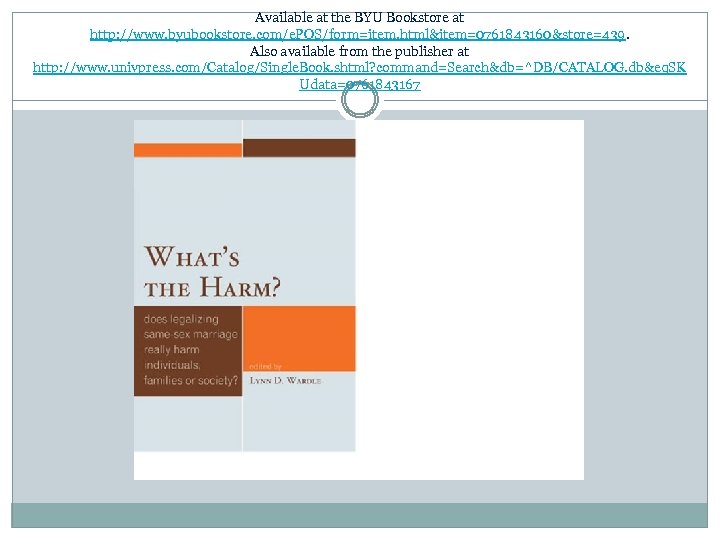 Available at the BYU Bookstore at http: //www. byubookstore. com/e. POS/form=item. html&item=0761843160&store=439. Also available from the publisher at http: //www. univpress. com/Catalog/Single. Book. shtml? command=Search&db=^DB/CATALOG. db&eq. SK Udata=0761843167

 Standing for Something -President Gordon B, Hinckley wrote: “We cannot effect a turnaround in a day or a month or a year. But with enough effort, we can begin a turnaround within a generation, and accomplish wonders within two generations – a period of time that is not very long in the history of humanity.
 Selected Partial Bibliography (A few of many excellent resources that may be helpful in defending the fundamental institutions of conjugal marriage and the marital family) The Divine Institution of Marriage (Salt Lake City, Aug. 13, 2008), at www. newsroom. lds. org/ldsnewsroom/eng/commentary/the-divine-institution-ofmarriage WHAT’S THE HARM (Lynn D. Wardle, ed. , University Press of America 2008) THE FUTURE OF MARRIAGE by David Blankenhorn (Encounter Books 2007) SETTING THE RECORD STRAIGHT: MORMONS & HOMOSEXUALITY by A. Dean Byrd, Ph. D. , M. P. H. (Millenial Press Inc. 2008) THE NATURAL FAMILY, A MANIFESTO by Allan C. Carlson & Paul T. Mero (Spence Publishing 2007) THE MEANING OF MARRIAGE (Robert P. George & Jean Bethke Elshtain eds. , Spence Publishing 2006) POWER OVER THE BODY, EQUALITY IN THE FAMILY by Charles J. Reid Jr. , (Wm. B. Eerdmans Publishing 2004) MARRIAGE AND SAME-SEX UNIONS, A DEBATE (Lynn D. Wardle, Mark Strasser, William C. Duncan & David Orgon Coolidge, eds. Praeger 2003) HOMOSEXUALITY AND THE CHURCH OF JESUS CHRIST OF LATTER-DAY SAINTS by A. Dean Byrd, Ph. D. (Cedar Fort 2001) THE CASE FOR MARRIAGE by Linda J. Waite and Maggie Gallagher (Doubleday 2000)

 Standing for Something - President Gordon B. Hinckley, Standing for Something: “We go to great lengths to preserve historical buildings and sites in our cities. We need to apply the same fervor to preserving the most ancient and sacred of institutions – the family. What we desperately need today on all fronts. . . are leaders, men and women who are willing to stand for something. We need people. . . who are willing to stand up for decency, truth, integrity, morality, and law and order. . . even when it is unpopular to do so – perhaps especially when it is unpopular to do so.
 Same-sex Marriage in the US Same-Sex Marriage is explicitly prohibited by written law in 45 states (all states except Connecticut, Massachusetts, New Jersey, New Mexico, and Rhode Island*).