 Скачать презентацию What s New in DICOM Robert Horn Agfa Healthcare
2a1347595b16200eeb89af5d31798fd9.ppt
- Количество слайдов: 17



What’s New in DICOM Robert Horn Agfa Healthcare 3/15/2018
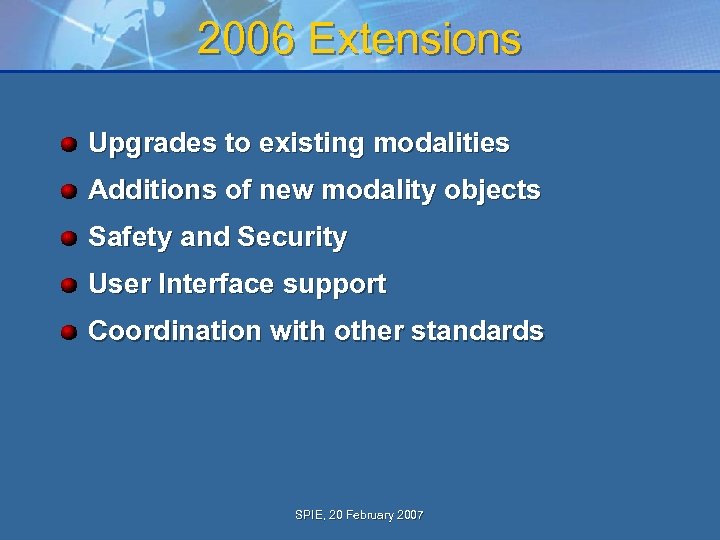
2006 Extensions Upgrades to existing modalities Additions of new modality objects Safety and Security User Interface support Coordination with other standards SPIE, 20 February 2007
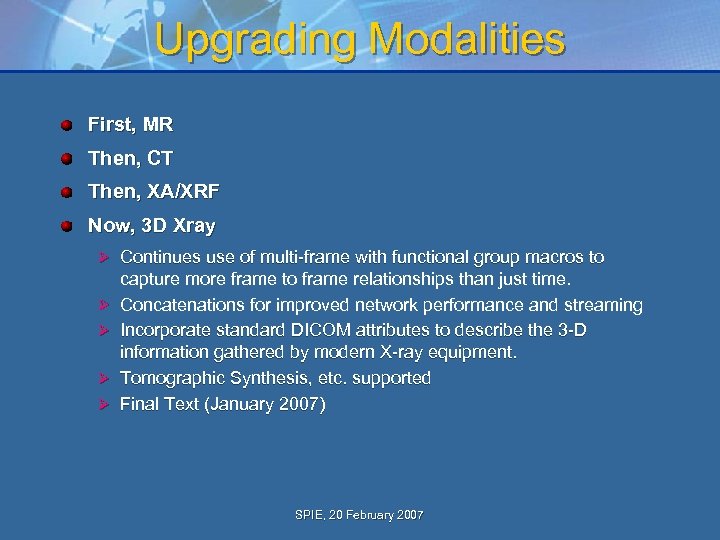
Upgrading Modalities First, MR Then, CT Then, XA/XRF Now, 3 D Xray Ø Continues use of multi-frame with functional group macros to Ø Ø capture more frame to frame relationships than just time. Concatenations for improved network performance and streaming Incorporate standard DICOM attributes to describe the 3 -D information gathered by modern X-ray equipment. Tomographic Synthesis, etc. supported Final Text (January 2007) SPIE, 20 February 2007
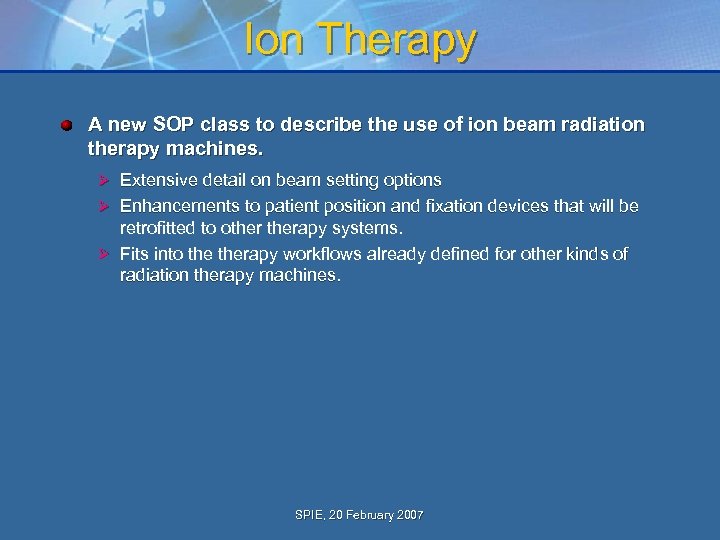
Ion Therapy A new SOP class to describe the use of ion beam radiation therapy machines. Ø Extensive detail on beam setting options Ø Enhancements to patient position and fixation devices that will be retrofitted to otherapy systems. Ø Fits into therapy workflows already defined for other kinds of radiation therapy machines. SPIE, 20 February 2007
CT/MR Cardiovascular Report An evidence document that captures measurement data derived from either CT or MR observations of the cardiovascular system. The report incorporates; Ø Patient characteristics Ø Relevant images references Ø Procedure summaries Ø Automatically as well as manually detected findings Ø Information about the progress of finding properties over time (by comparison with predecessor preceding reports) Ø Observational Conclusions SPIE, 20 February 2007
JPIP A transfer syntax is defined for supporting the JPEG Progressive Interactive Protocol. This syntax is intended for supporting interactive access to large images or over slower links, and is not well suited to transfer of complete images with full fidelity. SPIE, 20 February 2007
Segmentation This supplement defines voxel oriented tissue segmentations. Segmentation allows fractional voxel assignment: e. g, 60% blood, 30% bone, 20% tissue. IOD defines algorithm names and source data used. It does not include algorithm specifications. IOD does not define presentation or visualization parameters. A surface based segmentation IOD is in preparation. SPIE, 20 February 2007
Deformable Spatial Registration This is an extension to the already define rigid spatial registration An array of deformation mapping vectors is provided. Deformable registrations are not expected to be reversible in general. If the registration is to be used reversibly, two registration IODs are needed. SPIE, 20 February 2007
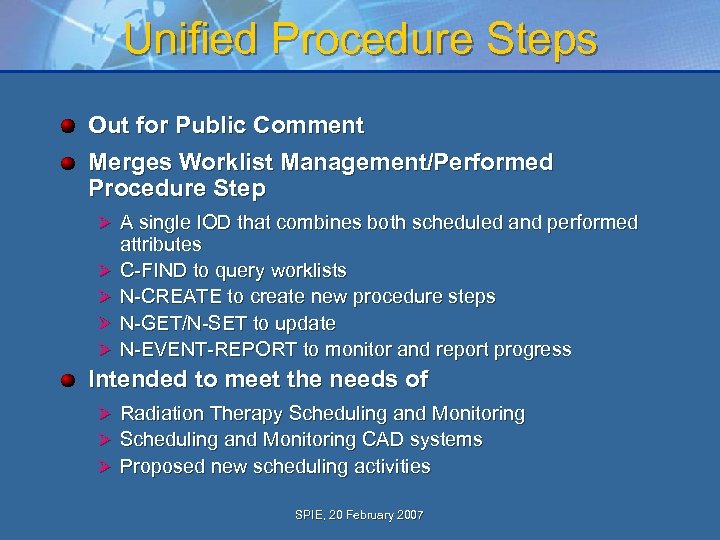
Unified Procedure Steps Out for Public Comment Merges Worklist Management/Performed Procedure Step Ø A single IOD that combines both scheduled and performed Ø Ø attributes C-FIND to query worklists N-CREATE to create new procedure steps N-GET/N-SET to update N-EVENT-REPORT to monitor and report progress Intended to meet the needs of Ø Ø Ø Radiation Therapy Scheduling and Monitoring CAD systems Proposed new scheduling activities SPIE, 20 February 2007
RT Worklist First usage of Unified Procedure Step Out for public comment Provides automated worklist management for the integration of multi-site and multisystem radiation therapy. SPIE, 20 February 2007
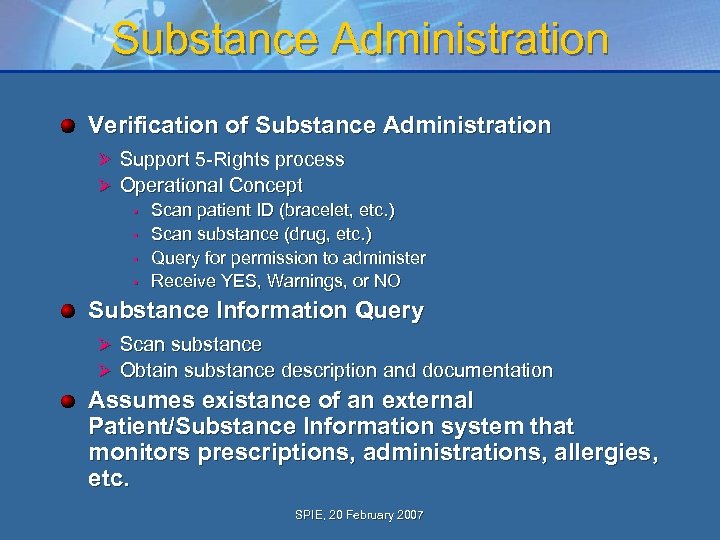
Substance Administration Verification of Substance Administration Ø Support 5 -Rights process Ø Operational Concept • Scan patient ID (bracelet, etc. ) • Scan substance (drug, etc. ) • Query for permission to administer • Receive YES, Warnings, or NO Substance Information Query Ø Scan substance Ø Obtain substance description and documentation Assumes existance of an external Patient/Substance Information system that monitors prescriptions, administrations, allergies, etc. SPIE, 20 February 2007
Encapsulation of CDA Similar to encapsulated PDF Encapsulates HL 7 CDA documents, providing a few crucial extracts (e. g. Patient ID, Document Title) so that a DICOM PACS archive can be used to storage and retrieve HL 7 CDA documents. SPIE, 20 February 2007
Veterinary Extensions These extensions rephrase the definition of some existing terms, like “patient name” to accommodate typical veterinary usages. These extensions add attributes for “breed”, “digital identifier”, etc. SPIE, 20 February 2007
Tracking IT Improvements IPv 6 support Small network configuration management Email Transport Ø ZIP file format to hold DICOMDIR and DICOM files Ø Email transport Ø Can be either automated or manual. In summary, “create DICOM CD image, ZIP it, attach to an email” Ø In use by Dentistry and IHE SPIE, 20 February 2007
New efforts Enhancements to Query and Retrieve especially intended to manage retrieval of subsets from large multi-frame objects Graphic Displays Ø Ø Ø Structured Display Calibration communication Enhanced Presentation state Colon CAD Breast Tomosynthesis Application Hosting (draft for trial use this year) SPIE, 20 February 2007
New Efforts (contd) Ophthalmology Ø Ophthalmic Tomography (OCT and other technologies) Ø Refractive Reports Pathology Ø revisions and clarifications to the specimen model Ø Whole slide imaging (uncompressed raw slide images are 350 gibagyte to 3. 5 Terabytes) Cardiac Ø Cardiac Stress Report Ø Electrophysiology Report SPIE, 20 February 2007
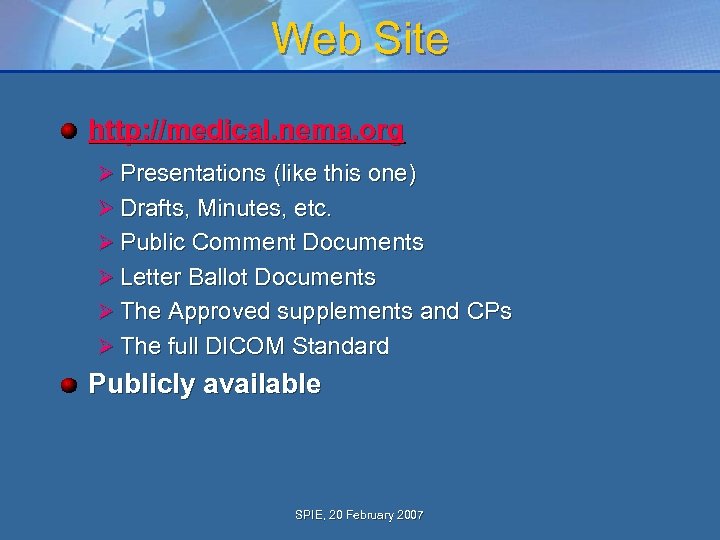
Web Site http: //medical. nema. org Ø Presentations (like this one) Ø Drafts, Minutes, etc. Ø Public Comment Documents Ø Letter Ballot Documents Ø The Approved supplements and CPs Ø The full DICOM Standard Publicly available SPIE, 20 February 2007
Скачать презентацию What s New in DICOM Robert Horn Agfa Healthcare
2a1347595b16200eeb89af5d31798fd9.ppt