


 Скачать презентацию What s new Alessandro D Elia 1 Ohmic dissipation
69c23dcd9db7d6a1ce981c04b7383563.ppt
- Количество слайдов: 16
 What’s new Alessandro D’Elia 1
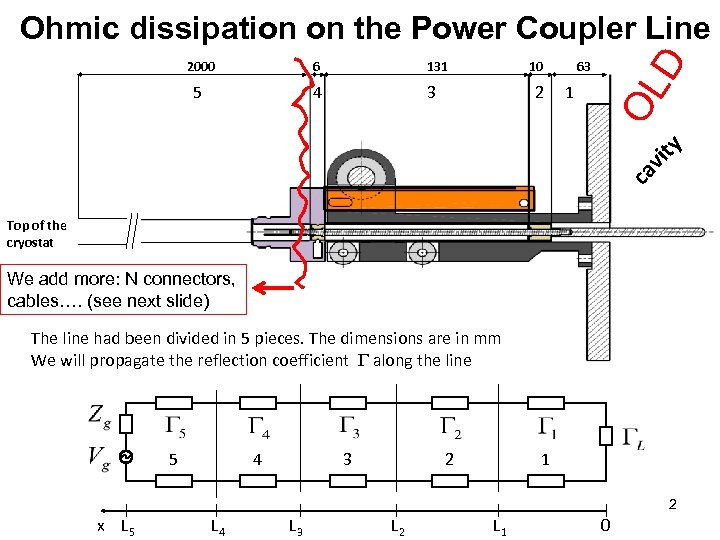 Ohmic dissipation on the Power Coupler Line 131 5 4 10 3 1 ca vit y 2 63 D 6 OL 2000 Top of the cryostat We add more: N connectors, cables…. (see next slide) The line had been divided in 5 pieces. The dimensions are in mm We will propagate the reflection coefficient along the line 5 4 3 2 1 2 x L 5 L 4 L 3 L 2 L 1 0
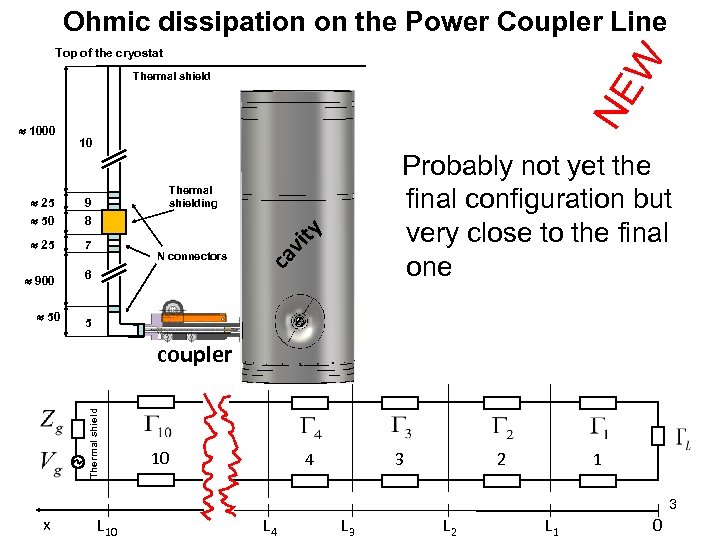 Ohmic dissipation on the Power Coupler Line NE W Top of the cryostat Thermal shield 10 7 900 6 50 y 25 Thermal shielding 9 8 N connectors vit 25 50 Probably not yet the final configuration but very close to the final one ca 1000 5 Thermal shield coupler 10 4 3 2 1 3 x L 10 L 4 L 3 L 2 L 1 0
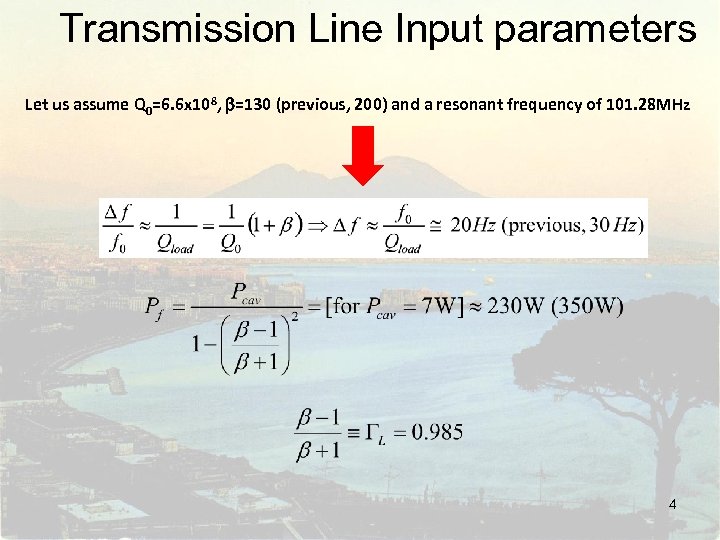 Transmission Line Input parameters Let us assume Q 0=6. 6 x 10⁸, =130 (previous, 200) and a resonant frequency of 101. 28 MHz 4
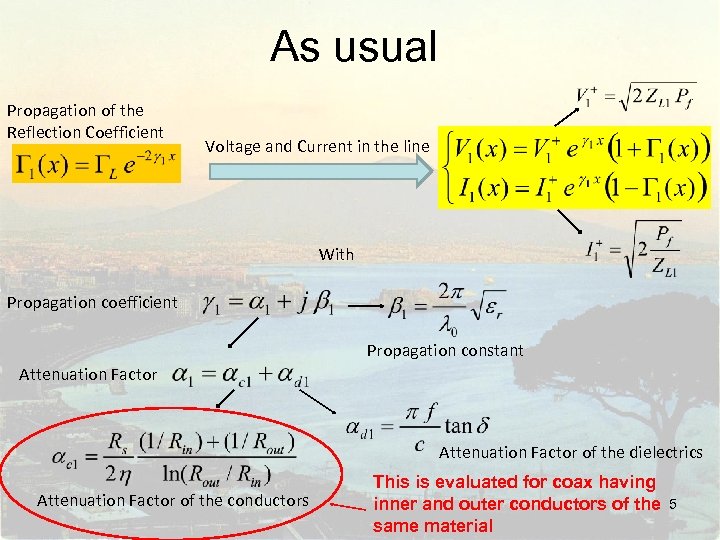 As usual Propagation of the Reflection Coefficient Voltage and Current in the line With Propagation coefficient Propagation constant Attenuation Factor of the dielectrics Attenuation Factor of the conductors This is evaluated for coax having inner and outer conductors of the same material 5
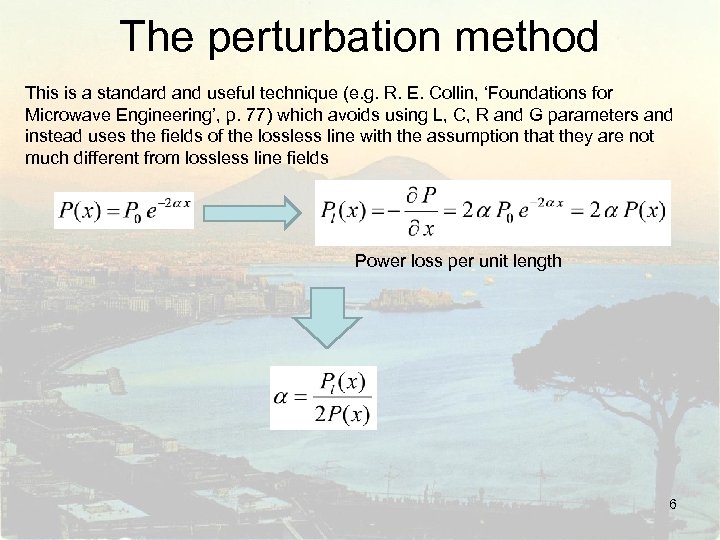 The perturbation method This is a standard and useful technique (e. g. R. E. Collin, ‘Foundations for Microwave Engineering’, p. 77) which avoids using L, C, R and G parameters and instead uses the fields of the lossless line with the assumption that they are not much different from lossless line fields Power loss per unit length 6
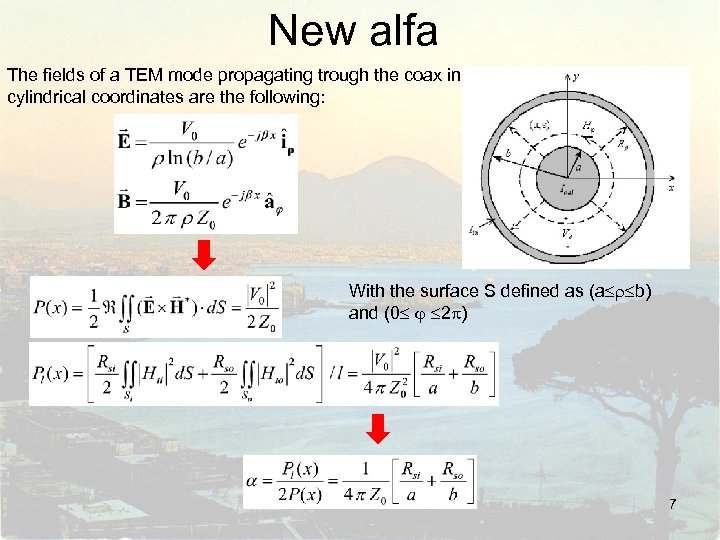 New alfa The fields of a TEM mode propagating trough the coax in cylindrical coordinates are the following: With the surface S defined as (a b) and (0 2 ) 7
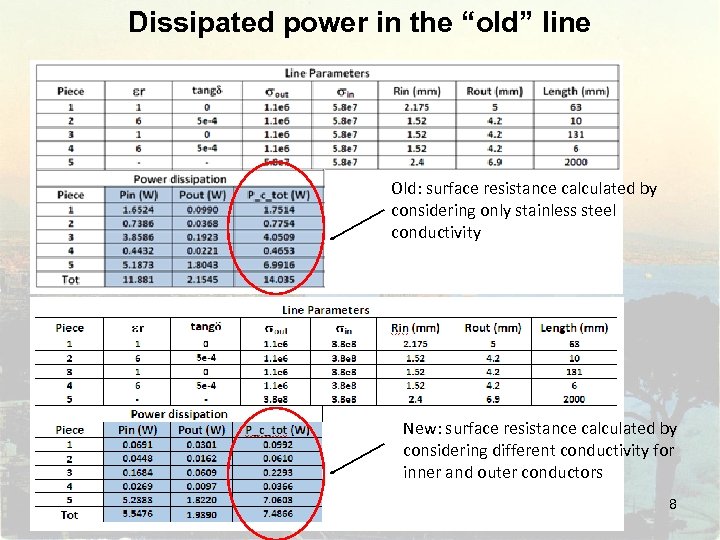 Dissipated power in the “old” line Old: surface resistance calculated by considering only stainless steel conductivity New: surface resistance calculated by considering different conductivity for inner and outer conductors 8
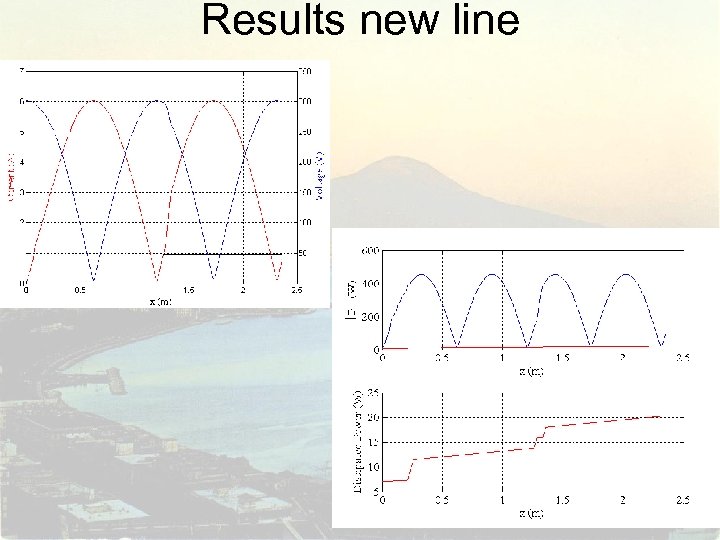 Results new line 9
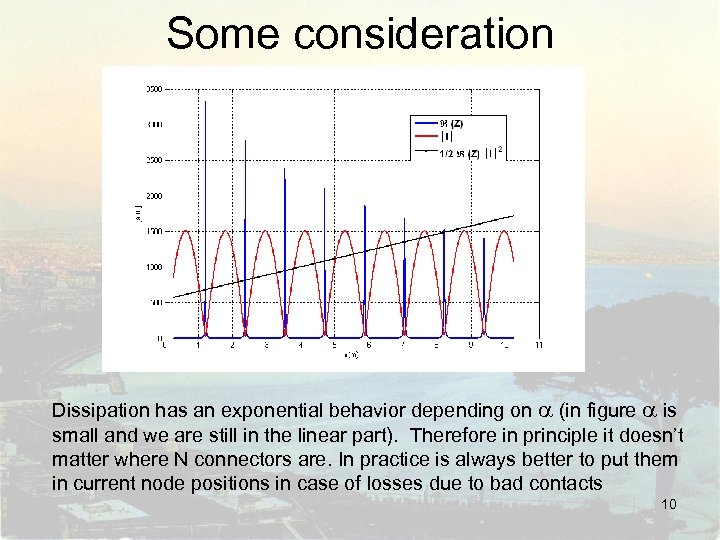 Some consideration Dissipation has an exponential behavior depending on (in figure is small and we are still in the linear part). Therefore in principle it doesn’t matter where N connectors are. In practice is always better to put them in current node positions in case of losses due to bad contacts 10
 Comments • Total power dissipation is compatible with the one in TRIUMF • Final values for each part of the line may change after thermal analysis • We know values of the dissipation factor of the cables and connectors only at room temperature • Possible cryogenic tests of cables and N connectors (in Liquid Nitrogen) to measure the behaviour of the attenuation at low temperatures. . . If really needed 11
 Radiation Pressure • We don’t care about microphonic excitation as we work in CW • We don’t care about Lorentz detuning as the symmetry of our structure and the thickness of the copper layer exhibit a quite safety margin • We care about additional forces on tuner plate (more expensive moving engine to buy!!) 12
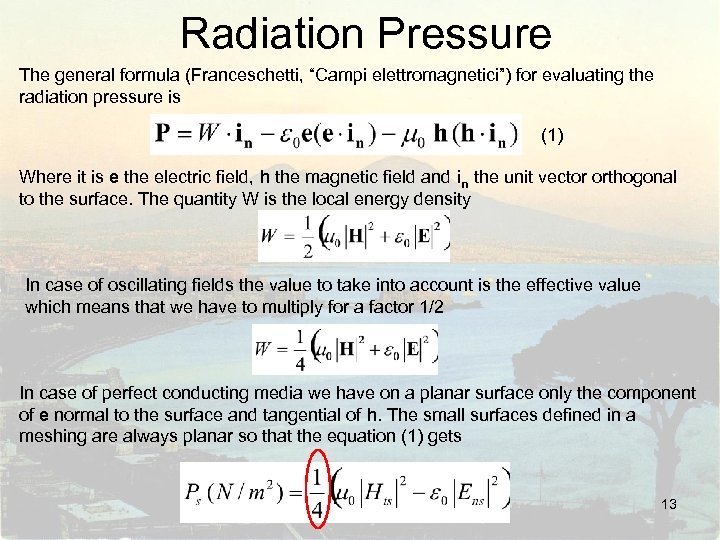 Radiation Pressure The general formula (Franceschetti, “Campi elettromagnetici”) for evaluating the radiation pressure is (1) Where it is e the electric field, h the magnetic field and in the unit vector orthogonal to the surface. The quantity W is the local energy density In case of oscillating fields the value to take into account is the effective value which means that we have to multiply for a factor 1/2 In case of perfect conducting media we have on a planar surface only the component of e normal to the surface and tangential of h. The small surfaces defined in a meshing are always planar so that the equation (1) gets 13
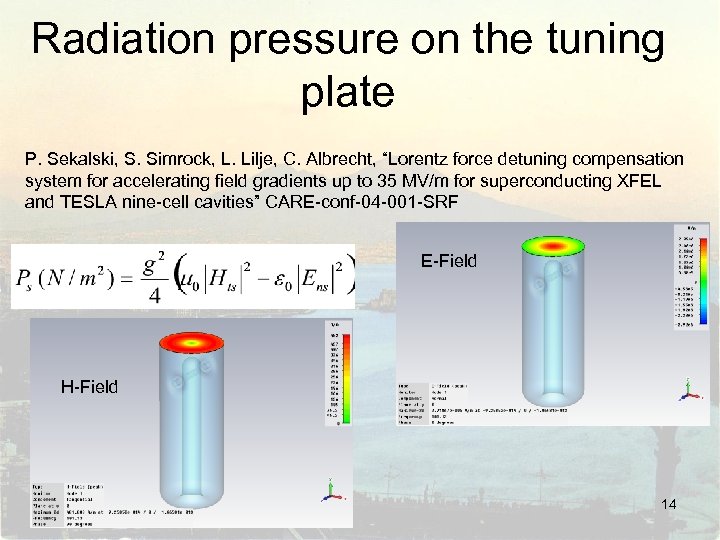 Radiation pressure on the tuning plate P. Sekalski, S. Simrock, L. Lilje, C. Albrecht, “Lorentz force detuning compensation system for accelerating field gradients up to 35 MV/m for superconducting XFEL and TESLA nine-cell cavities” CARE-conf-04 -001 -SRF E-Field H-Field 14
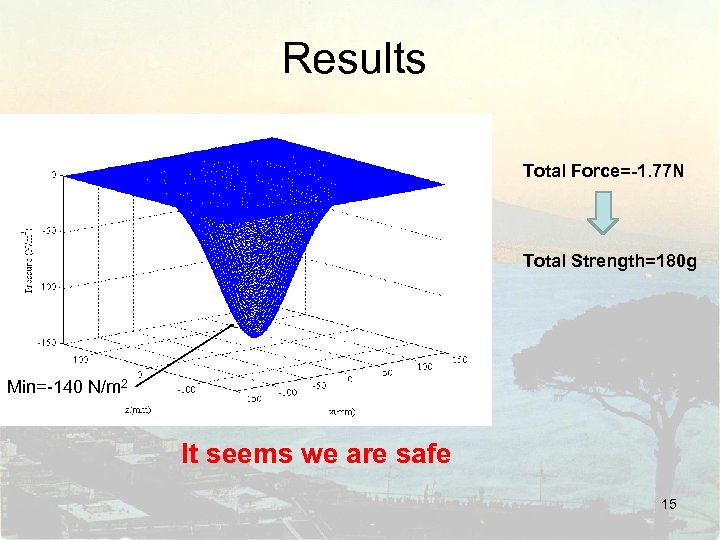 Results Total Force=-1. 77 N Total Strength=180 g Min=-140 N/m 2 It seems we are safe 15
 CLIC • Walter Wuensch would like to have from me as soon as possible (less then 1 month) a document containing what we intend to realize by pointing out the first practical steps. • He also agrees on the possibility of having someone (namely Vasim. . . ) here at CERN for a while in order to make easier the exchange of information, but this is a future step at the moment. • I’ve spoken with Vasim on Tuesday asking for some info and especially for any kind of material in order to have a more detailed overview of the structure • I discussed also with Riccardo Zennaro and he would like to have the matrix of circuit model and also all the possible HFSS or whatever files of the structure 16