


 Скачать презентацию What s Ahead for EU Mortgage Markets ELRA
89df9c1e0fd2fa70371df727937964b6.ppt
- Количество слайдов: 22
 What’s Ahead for EU Mortgage Markets? ELRA General Assembly Brussels, Belgium 27 April 2009 Kerstin FISCHER European Mortgage Federation 1
 Structure of Presentation 1. Introduction to the European Mortgage Federation (EMF) 2. Definitions 3. Market Trends 4. State of Play 5. Next Steps 6. Conclusions 2
 The Voice of the EU Mortgage Industry 1 § EMF: a product federation - all categories of mortgage lenders § Membership: EU MS & Accession Countries § Representing mortgage industry at EU level => retail & funding sides § European Covered Bond Council (ECBC) since 2004 § Important sector in the general EU economy: Ø € 6. 1 trillion outstanding (end 2007) Ø = 50. 1% of aggregate EU GDP Ø Access to housing for 70. 4% of EU population 3
 Defining Home loans 2 § Two categories of mortgage credit, based on the borrower: residential and commercial § Residential mortgage credit/Home Loans = credit to consumers as per EU definition of consumer: Ø “a natural person who is acting for purposes which can be regarded as outside his trade or profession” § 3 categories of Home Loans: Ø “classic” mortgage loans: secured by real estate property and granted for housing purposes; Ø ERS: Mortgage loans secured on real estate property but granted for consumption purposes; Ø Housing loans, i. e. granted for housing purposes but non-real estate secured or unsecured loans. 4
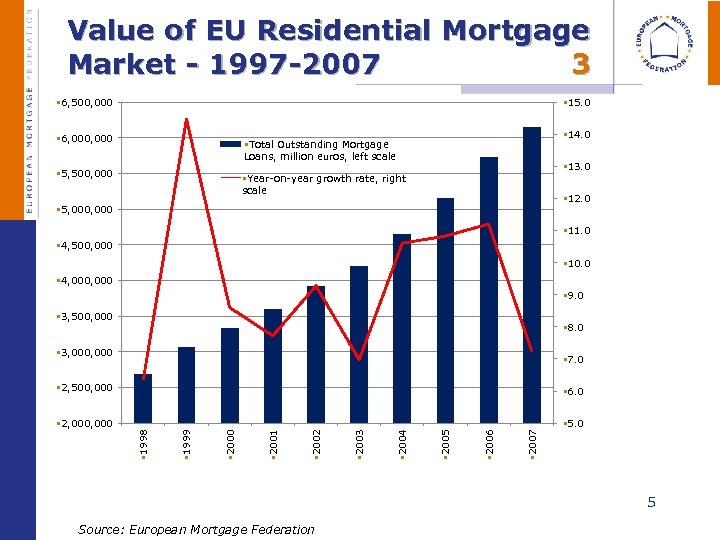 Value of EU Residential Mortgage Market - 1997 -2007 3 § 6, 500, 000 § 15. 0 § 6, 000 § 14. 0 §Total Outstanding Mortgage Loans, million euros, left scale § 5, 500, 000 § 13. 0 §Year-on-year growth rate, right scale § 12. 0 § 5, 000 § 11. 0 § 4, 500, 000 § 10. 0 § 4, 000 § 9. 0 § 3, 500, 000 § 3, 000 § 7. 0 § 2007 § 2006 § 2005 § 2004 § 2003 § 2002 § 5. 0 § 2001 § 2, 000 § 2000 § 6. 0 § 1999 § 2, 500, 000 § 1998 § 8. 0 5 Source: European Mortgage Federation
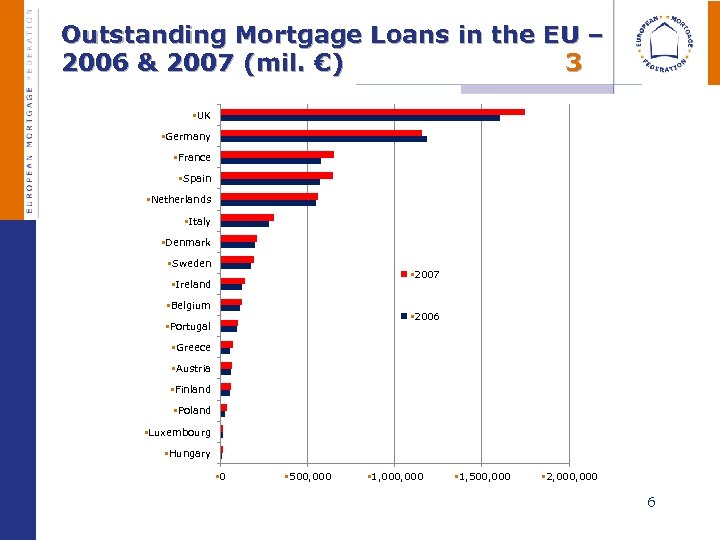 Outstanding Mortgage Loans in the EU – 2006 & 2007 (mil. €) 3 §UK §Germany §France §Spain §Netherlands §Italy §Denmark §Sweden § 2007 §Ireland §Belgium § 2006 §Portugal §Greece §Austria §Finland §Poland §Luxembourg §Hungary § 0 § 500, 000 § 1, 500, 000 § 2, 000 6
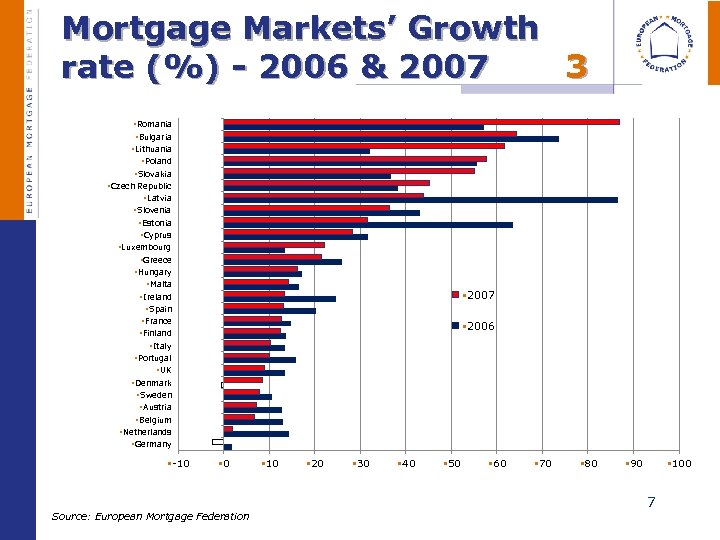 Mortgage Markets’ Growth rate (%) - 2006 & 2007 3 §Romania §Bulgaria §Lithuania §Poland §Slovakia §Czech Republic §Latvia §Slovenia §Estonia §Cyprus §Luxembourg §Greece §Hungary §Malta §Ireland §Spain §France §Finland §Italy §Portugal §UK §Denmark §Sweden §Austria §Belgium §Netherlands §Germany §-10 § 2007 § 2006 § 0 § 10 § 20 § 30 § 40 § 50 § 60 § 70 § 80 § 90 § 100 7 Source: European Mortgage Federation
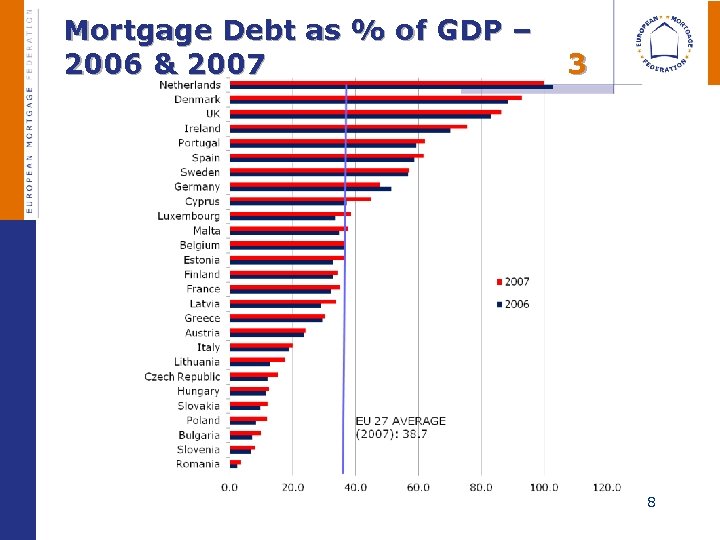 Mortgage Debt as % of GDP – 2006 & 2007 3 8
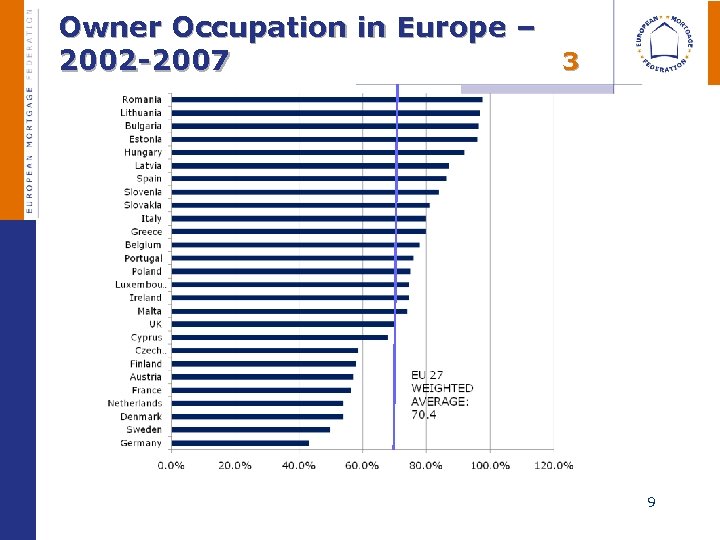 Owner Occupation in Europe – 2002 -2007 3 9
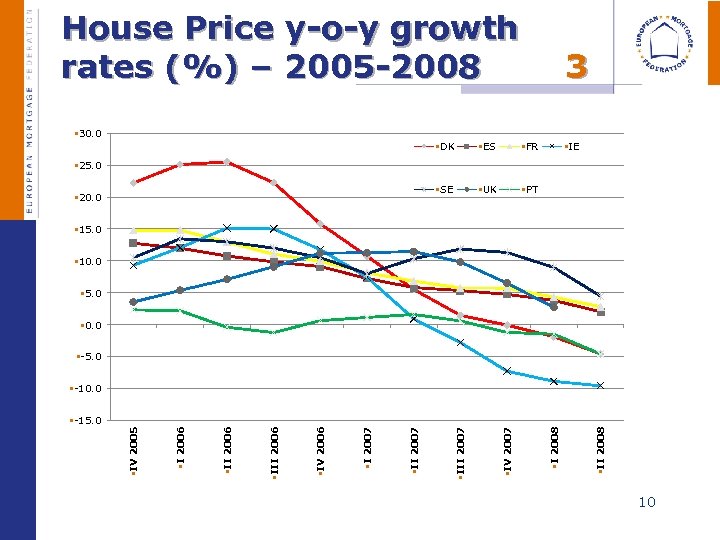 House Price y-o-y growth rates (%) – 2005 -2008 3 § 30. 0 §DK §ES §FR §SE §UK §IE §PT § 25. 0 § 20. 0 § 15. 0 § 10. 0 § 5. 0 § 0. 0 §-10. 0 §II 2008 §IV 2007 §III 2007 §IV 2006 §III 2006 §I 2006 §-15. 0 §IV 2005 §-5. 0 10
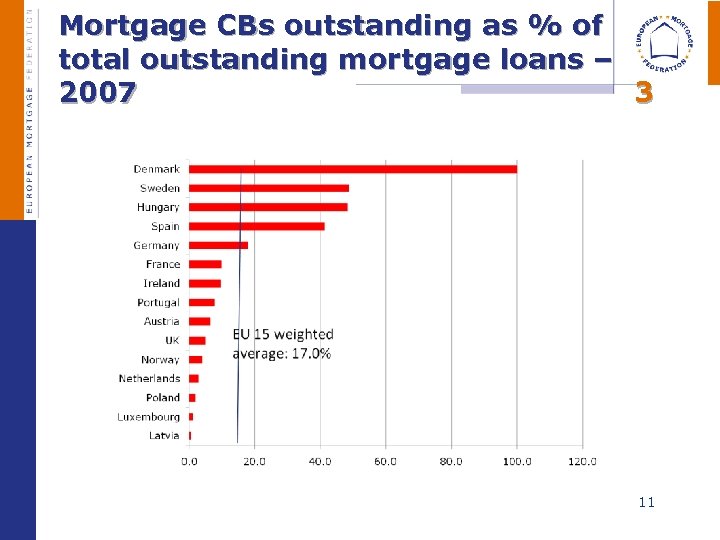 Mortgage CBs outstanding as % of total outstanding mortgage loans – 2007 3 11
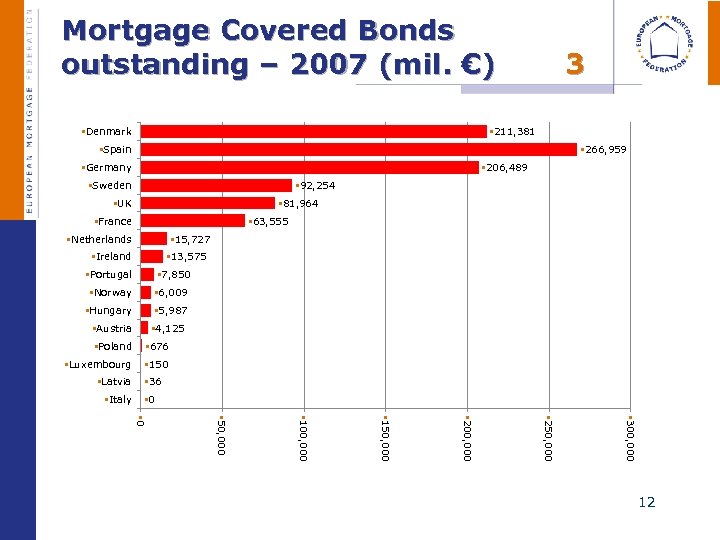 Mortgage Covered Bonds outstanding – 2007 (mil. €) §Denmark 3 § 211, 381 §Spain § 266, 959 §Germany § 206, 489 §Sweden § 92, 254 §UK § 81, 964 §France § 63, 555 §Netherlands § 15, 727 §Ireland § 13, 575 §Portugal § 7, 850 §Norway § 6, 009 §Hungary § 5, 987 §Austria § 4, 125 §Poland § 676 §Luxembourg § 150 §Latvia §Italy § 36 § 0 § 300, 000 § 250, 000 § 200, 000 § 150, 000 § 100, 000 § 50, 000 § 0 12
 Booming Mortgage & Housing Markets until mid-2007 3 § Interest rates at a historic low thanks to favourable economic context § Significant decrease in mortgage loan prices due to: Ø Increasingly strong competition within the Industry Ø Banks’ increased efficiency: consolidation, outsourcing Ø Abundance of liquidity: cheap funding on capital mkts § Very high consumer demand as a result of: Ø Increased affordability: low interest rates; decrease in prices; general increase in households incomes & strong product innovation (LTVs/maturities/flexib) Ø Change in demographic organisation of households Ø Expectation of continued increase in house prices 13
 2007 : A Turning Point 4 § US Sub-Prime Crisis: Ø Result of abundant liquidity & continued house price growth Ø Relaxing of credit underwriting conditions Ø Funding through securitisation: loans/risk do not remain on lenders’ balance sheets Ø Securitisation process has developed, becoming much more complex and less transparent § Global Financial Crisis: Impacts on EU Ø Majority of EU lenders do not grant sub-prime loans & primarily fund through savings deposits & covered bonds Ø But EU banks invest in US securitisation portfolios containing sub-prime loans – primarily relying on CRA ratings Ø In 2007, EU banks discover existence of risky loans in their portfolios => Result: Very strong loss of confidence, drastic drying up of liquidity on EU markets and, finally, a credit crunch 14
 State of Play in the EU by November 2008 4 § EU Industry acknowledges a slow-down in the mortgage market in a general context where: Ø Property markets in a number of MS are witnessing a decline in their price growth rate (DK, ES, UK) and even some price falls (IE) Ø Consumer demand is easing due to general increase in prices and decline in economic perspectives § As a result, either due to lack of liquidity or out of caution, EU lenders have: Ø Strengthened their credit underwriting conditions Ø Increased the price/cost for riskier loans 15
 Stakeholders’ Reactions: EU Commission (1) 5 § EU regulation of mortgage industry today: Ø Institutional regulation aiming at banks’ economic soundness & general financial stability: CRD/Basel II Ø Product regulation: consumer credit, time share Ø Horizontal consumer protection: UCP Directive § 2007 Commission White Paper: further integration of EU mortgage markets: Ø MC = access to housing for 67% of EU citizens Ø Financial sector outstanding= 49. 6% of EU GDP 2007 Ø Linked to construction sector = major driver of economy § COM: further integration would benefit consumers/ lenders => lower costs & increased product diversity. (“integration”: not defined) 16
 Stakeholders’ Reactions: EU Commission (2) 5 § To achieve further integration, DG MARKT considers four types of measures: Ø Comparative studies on desirability of regulation / harmonisation: equity release loans; credit intermediaries; tying/ UCP; non-banks Ø Removal of legal obstacles to cross-border activities: registration, enforcement & valuation Ø Facilitation of cross-border funding in the EU Ø Further consumer protection measures (PCI, ESIS) § However, a number of these proposals have been superseded by the crisis, and today the Industry has other, more urgent priorities 17
 Stakeholders’ Reactions: EU Industry (1) 5 Integration = EU cross-border activities Ø Lenders do go cross-border through subsidiaries & M&A § Integration = EU price convergence Ø Range of adjusted prices in the EU is <1% and continuously converging, thanks to: Ø Increased competition, lender efficiency, and greater price transparency § § Integration = EU market completeness Ø Markets are broadly complete and the product range is continuously broadening, but there are gaps (DE; IT; P) Ø Missing products: ERL; fixed-rate & sub-prime products Ø In principle, there is room for improvement 18
 Stakeholders’ Reactions: EU Industry (2) 5 § Pre-Crisis EU mc markets: broadly integrated Ø Level of cross-border activity depends on individual lender’s appetite / objectives (economic context) Ø Margins left little room for further price reductions Ø Market completeness level: could be improved in principle § However, the crisis has changed the landscape: Ø Lenders tend to avoid new risky undertakings, to fall back on markets they know best; Ø Prices are increasing (re-evaluation of risk, increased interest rates); and Ø Product diversity is narrowing rather than widening. 19
 Lessons learnt: Where do we go from here? (1) 6 Here & Now - Industry’s priorities: overcome current crisis + restart a dynamic & sustainable business, in a context where: § MS’ sensitivities to global crisis vary widely, depending on: Ø Choice as to major funding technique: deposits, CBs, MBS Ø Level of exposure to US securitisation Ø Range of products: attitude to more risky products Ø State of housing market & consumer demand § § Causes of the crisis in the EU mainly result from: Ø EU markets’ sensitivity to US ‘ups & downs’: global distribution of risk through securitisation proved to lead to “contagion” rather than to mitigation Ø Loss of confidence resulting in drying up of liquidity Ø Lack of transparency of securitisation process: investors relying on CRAs/not aware of real risk level Ø Some relaxing of credit underwriting conditions 20
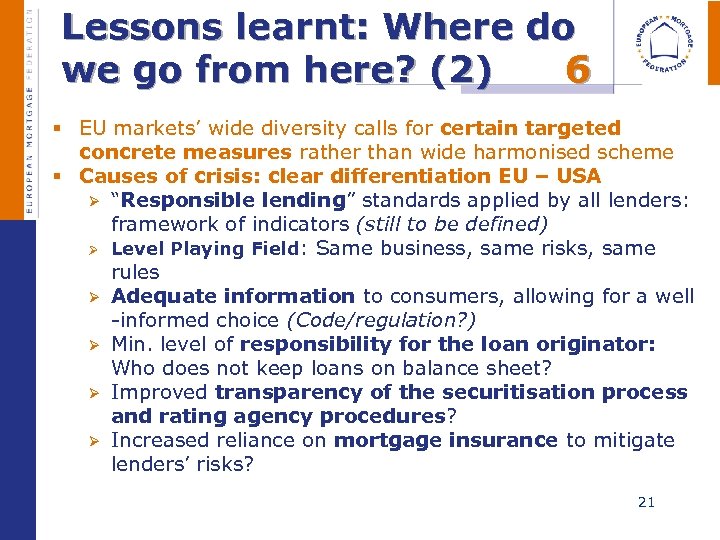 Lessons learnt: Where do we go from here? (2) 6 § EU markets’ wide diversity calls for certain targeted concrete measures rather than wide harmonised scheme § Causes of crisis: clear differentiation EU – USA Ø “Responsible lending” standards applied by all lenders: framework of indicators (still to be defined) Ø Level Playing Field: Same business, same risks, same rules Ø Adequate information to consumers, allowing for a well -informed choice (Code/regulation? ) Ø Min. level of responsibility for the loan originator: Who does not keep loans on balance sheet? Ø Improved transparency of the securitisation process and rating agency procedures? Ø Increased reliance on mortgage insurance to mitigate lenders’ risks? 21
 European Mortgage Federation THANK YOU FOR YOUR ATTENTION! emfinfo@hypo. org - www. hypo. org +32 2 285 40 30 NEW ADDRESS! Avenue de Cortenbergh 71 B-1000 Brussels Belgium