


 Скачать презентацию What s After Nanotechnology Developing the Army s Future Materials
4d443321858e1d27cca66368016cf86f.ppt
- Количество слайдов: 25
 What’s After Nanotechnology? Developing the Army’s Future Materials Dr. David M. Stepp U. S. Army Research Office Materials Science Division david. m. stepp@us. army. mil (919) 549 -4329, DSN 832 -4329, FAX (919) 549 -4399 http: //www. aro. army. mil 2 March 2005
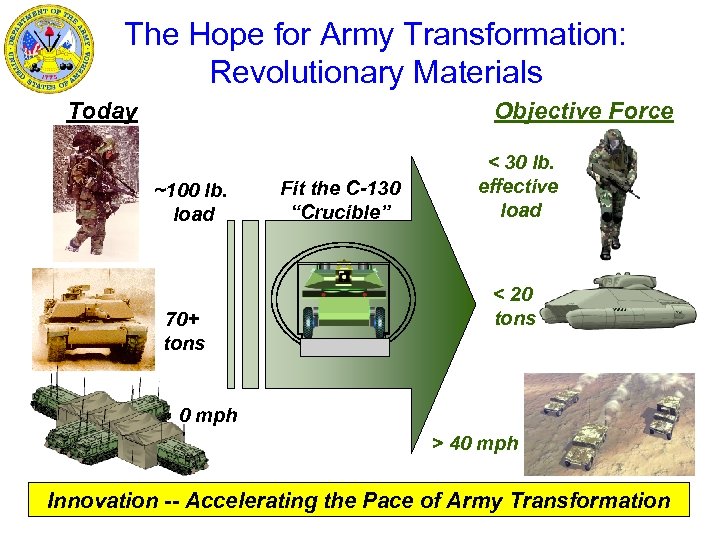 The Hope for Army Transformation: Revolutionary Materials Today Objective Force ~100 lb. load 70+ tons Fit the C-130 “Crucible” < 30 lb. effective load < 20 tons 0 mph > 40 mph Innovation -- Accelerating the Pace of Army Transformation
 Outline • Basic Research Definition • U. S. Army Research Office Overview – Types of Basic Research Awards – Major Focus Areas • Do. D Nanotechnology Definition • Nanotechnology and Lightweight Materials • What’s After Nanotechnology? – Optimized Materials Design – Bio-hybrids – Improved Technology Transfer
 Basic Research Defined (Do. D 7000. 14 -R) Basic research is systematic study directed toward greater knowledge or understanding of the fundamental aspects of phenomena and of observable facts without specific applications towards processes or products in mind. It includes all scientific study and experimentation directed toward increasing fundamental knowledge and understanding in those fields of the physical, engineering, environmental and life sciences related to long-term national security needs. It is farsighted high payoff research that provides the basis for technological progress. Basic research may lead to: (a) subsequent applied research and advanced technology developments in Defense-related technologies, and (b) new and improved military functional capabilities in areas such as…
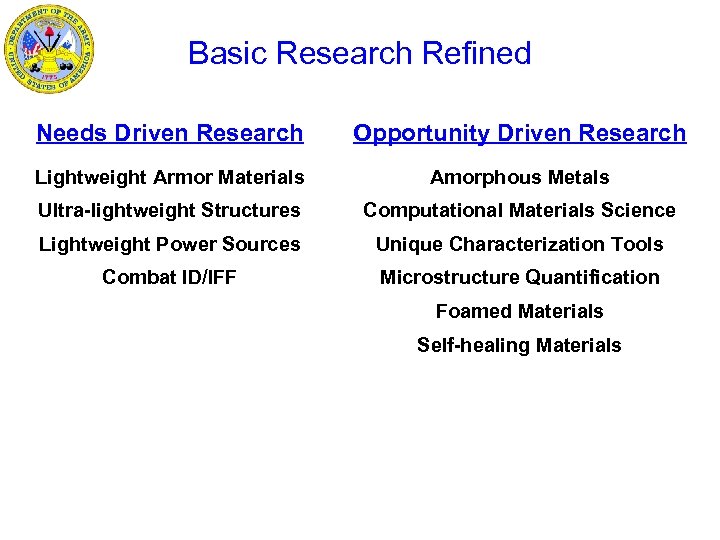 Basic Research Refined Needs Driven Research Opportunity Driven Research Lightweight Armor Materials Amorphous Metals Ultra-lightweight Structures Computational Materials Science Lightweight Power Sources Unique Characterization Tools Combat ID/IFF Microstructure Quantification Foamed Materials Self-healing Materials
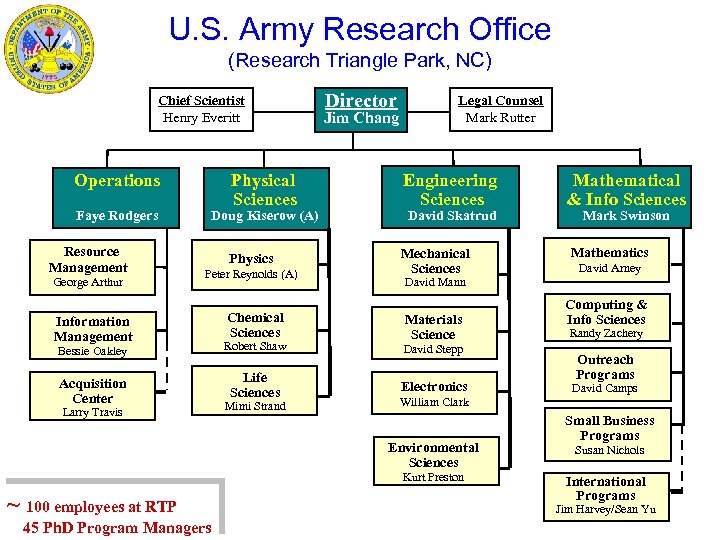 U. S. Army Research Office (Research Triangle Park, NC) Chief Scientist Henry Everitt Operations George Arthur Jim Chang Legal Counsel Mark Rutter Physical Sciences Engineering Sciences Physics Faye Rodgers Resource Management Director Mechanical Sciences Doug Kiserow (A) Peter Reynolds (A) Information Management Chemical Sciences David Skatrud Materials Science Bessie Oakley David Stepp Acquisition Center Life Sciences Electronics Mimi Strand Kurt Preston 45 Ph. D Program Managers Mathematics David Arney Computing & Info Sciences Randy Zachery Outreach Programs David Camps William Clark Environmental Sciences ~ 100 employees at RTP Mark Swinson David Mann Robert Shaw Larry Travis Mathematical & Info Sciences Small Business Programs Susan Nichols International Programs Jim Harvey/Sean Yu
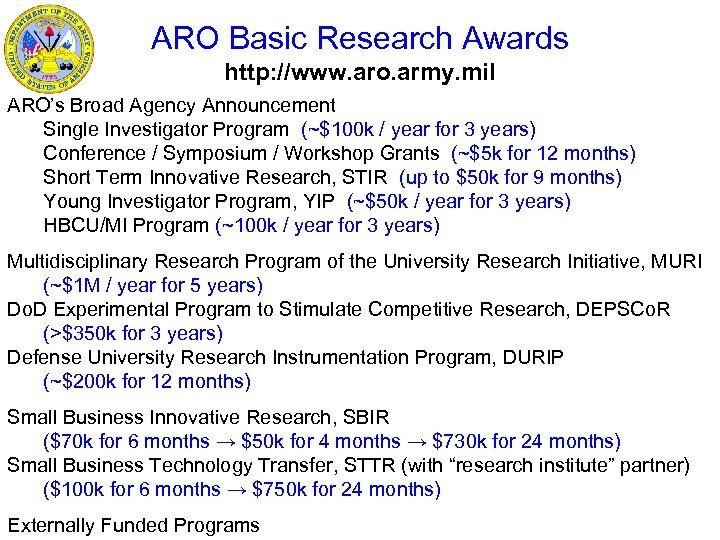 ARO Basic Research Awards http: //www. aro. army. mil ARO’s Broad Agency Announcement Single Investigator Program (~$100 k / year for 3 years) Conference / Symposium / Workshop Grants (~$5 k for 12 months) Short Term Innovative Research, STIR (up to $50 k for 9 months) Young Investigator Program, YIP (~$50 k / year for 3 years) HBCU/MI Program (~100 k / year for 3 years) Multidisciplinary Research Program of the University Research Initiative, MURI (~$1 M / year for 5 years) Do. D Experimental Program to Stimulate Competitive Research, DEPSCo. R (>$350 k for 3 years) Defense University Research Instrumentation Program, DURIP (~$200 k for 12 months) Small Business Innovative Research, SBIR ($70 k for 6 months → $50 k for 4 months → $730 k for 24 months) Small Business Technology Transfer, STTR (with “research institute” partner) ($100 k for 6 months → $750 k for 24 months) Externally Funded Programs
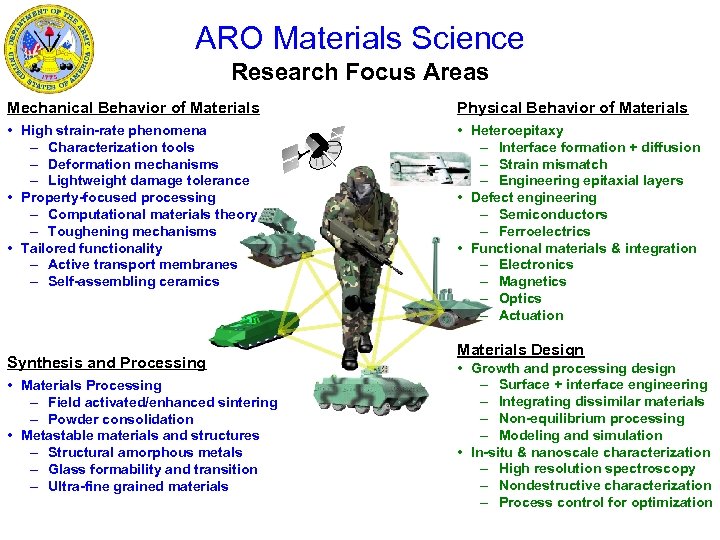 ARO Materials Science Research Focus Areas Mechanical Behavior of Materials Physical Behavior of Materials • High strain-rate phenomena – Characterization tools – Deformation mechanisms – Lightweight damage tolerance • Property-focused processing – Computational materials theory – Toughening mechanisms • Tailored functionality – Active transport membranes – Self-assembling ceramics • Heteroepitaxy – Interface formation + diffusion – Strain mismatch – Engineering epitaxial layers • Defect engineering – Semiconductors – Ferroelectrics • Functional materials & integration – Electronics – Magnetics – Optics – Actuation Synthesis and Processing • Materials Processing – Field activated/enhanced sintering – Powder consolidation • Metastable materials and structures – Structural amorphous metals – Glass formability and transition – Ultra-fine grained materials Materials Design • Growth and processing design – Surface + interface engineering – Integrating dissimilar materials – Non-equilibrium processing – Modeling and simulation • In-situ & nanoscale characterization – High resolution spectroscopy – Nondestructive characterization – Process control for optimization
 Do. D Nanotechnology Defined Do. D nanotechnology programs are distinguished from those of other federal agencies in that the program activities are simultaneously focused on scientific and technical merit and on potential relevance to Do. D. The overall technical objective of these programs is to develop understanding and control of matter at dimensions of approximately 1 to 100 nanometers, where the physical, chemical, and biological properties may differ in fundamental and valuable ways from those of individual atoms, molecules, or bulk matter. The overall objective for Do. D relevance is to discover and exploit unique phenomena at these dimensions to enable novel applications enhancing war fighter and battle systems capabilities.
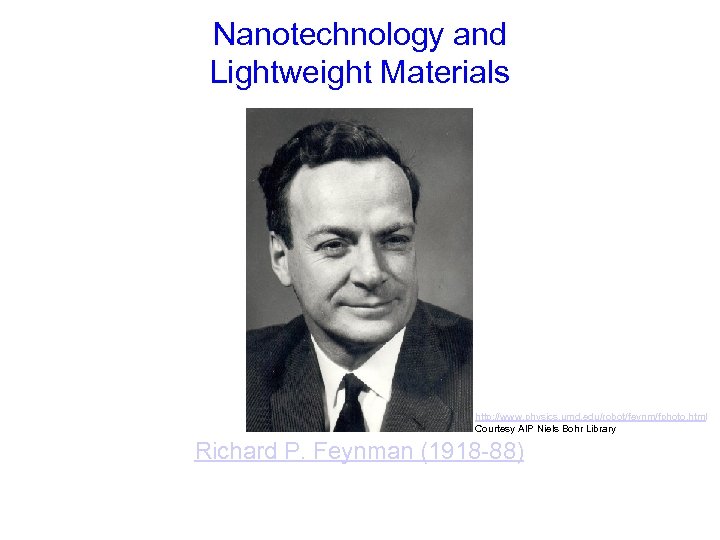 Nanotechnology and Lightweight Materials http: //www. physics. umd. edu/robot/feynm/fphoto. html Courtesy AIP Niels Bohr Library Richard P. Feynman (1918 -88)
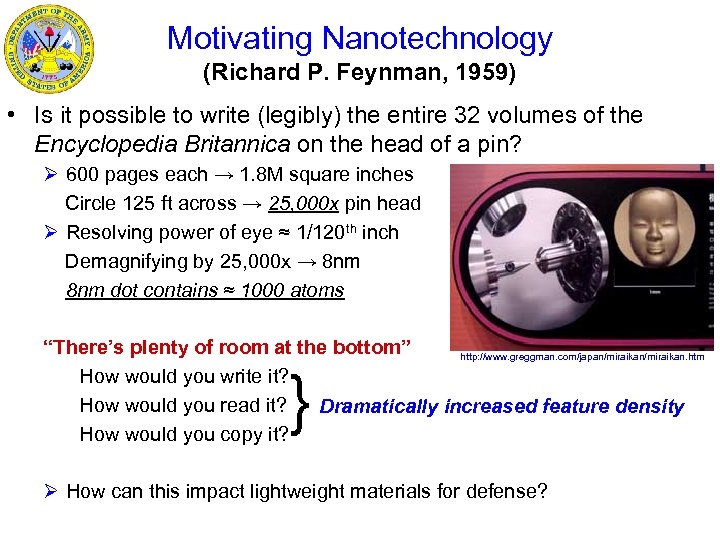 Motivating Nanotechnology (Richard P. Feynman, 1959) • Is it possible to write (legibly) the entire 32 volumes of the Encyclopedia Britannica on the head of a pin? Ø 600 pages each → 1. 8 M square inches Circle 125 ft across → 25, 000 x pin head Ø Resolving power of eye ≈ 1/120 th inch Demagnifying by 25, 000 x → 8 nm dot contains ≈ 1000 atoms “There’s plenty of room at the bottom” http: //www. greggman. com/japan/miraikan. htm How would you write it? How would you read it? Dramatically increased feature density How would you copy it? } Ø How can this impact lightweight materials for defense?
 Nanotechnology and Lightweight Materials? Strengths Ø Unprecedented functional materials and functional structures Feature densities (and surface areas) Weight savings from reduced size of components Ø “Inserting” function into proven structural materials Degradation resistance, surface-area-based enhancements Features can be engineered below critical defect size Multifunctional materials Ø Some enhancement from atomic-scale optimization, simulation Most likely for highest-end applications (incremental)
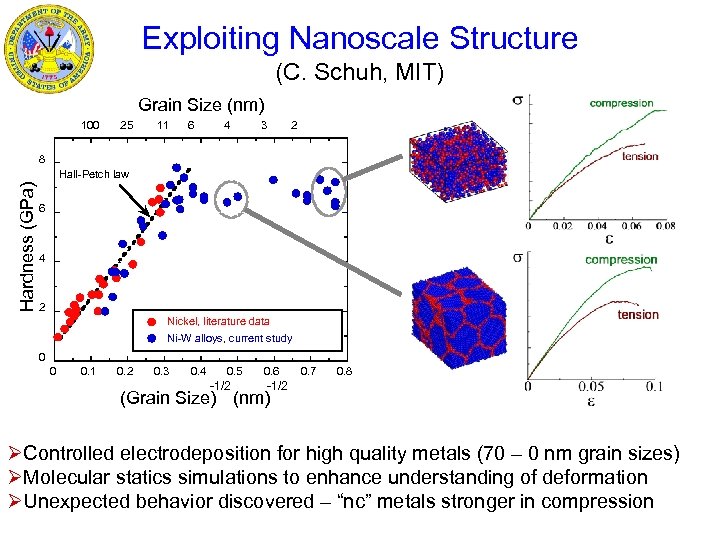 Exploiting Nanoscale Structure (C. Schuh, MIT) Grain Size (nm) 100 25 11 6 4 3 2 8 Hardness (GPa) Hall-Petch law 6 4 2 Nickel, literature data Ni-W alloys, current study 0 0 0. 1 0. 2 0. 3 0. 4 0. 5 -1/2 0. 6 0. 7 0. 8 -1/2 (Grain Size) (nm) ØControlled electrodeposition for high quality metals (70 – 0 nm grain sizes) ØMolecular statics simulations to enhance understanding of deformation ØUnexpected behavior discovered – “nc” metals stronger in compression
 "This isn't right. This isn't even wrong. " http: //www. geocities. com/ilian 73/pauli. html Wolfgang Pauli (1900 -1958)
 Nanotechnology and Lightweight Materials? Weaknesses Ø Excessive funding Prolific “forced” nanotechnology focus in research proposals Over-hyped and misleading results (esp. athletic equipment) Relative improvements to substandard materials Ø Non-falsifiable hypotheses Ø Mechanical properties and extrapolating to design values Micro/nano -scale testing does not correlate with bulk Reliability and repeatability problematic Material scale-up highly problematic Ø Processing control, variations, and durability Ø Nanotubes
 Example: Actual Military Requests Ø “Injectable” training Localized fluency in all languages; seamlessly blend into any cultural environment Example: “Tactical neural nano-implant” Ø Integrated self-protection capabilities Indestructibility; appear to be standard regional dress Example: “Carbon nanotube armor” Ø Sensors and communications Extend all senses; be able to detect stress or unusual behavior Example: “Sensory enhancing nanobots” Ø Shape shift materials Ability to blend with any environment Example: “Nano-fabrics that self heal, self clean, and adopt color and texture of surroundings”
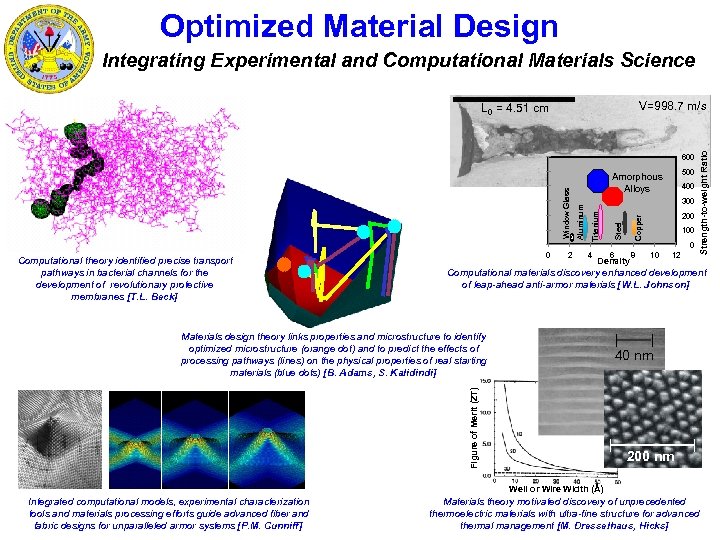 Optimized Material Design Integrating Experimental and Computational Materials Science Computational theory identified precise transport pathways in bacterial channels for the development of revolutionary protective membranes [T. L. Beck] 0 2 500 Amorphous Alloys 400 300 4 6 200 Copper Steel Titanium Aluminum Window Glass 600 Density 8 100 0 10 12 Strength-to-weight Ratio V=998. 7 m/s L 0 = 4. 51 cm Computational materials discovery enhanced development of leap-ahead anti-armor materials [W. L. Johnson] Materials design theory links properties and microstructure to identify optimized microstructure (orange dot) and to predict the effects of processing pathways (lines) on the physical properties of real starting materials (blue dots) [B. Adams, S. Kalidindi] Figure of Merit (ZT) 40 nm 200 nm Well or Wire Width (Ǻ) Integrated computational models, experimental characterization tools and materials processing efforts guide advanced fiber and fabric designs for unparalleled armor systems [P. M. Cunniff] Materials theory motivated discovery of unprecedented thermoelectric materials with ultra-fine structure for advanced thermal management [M. Dresselhaus, Hicks]
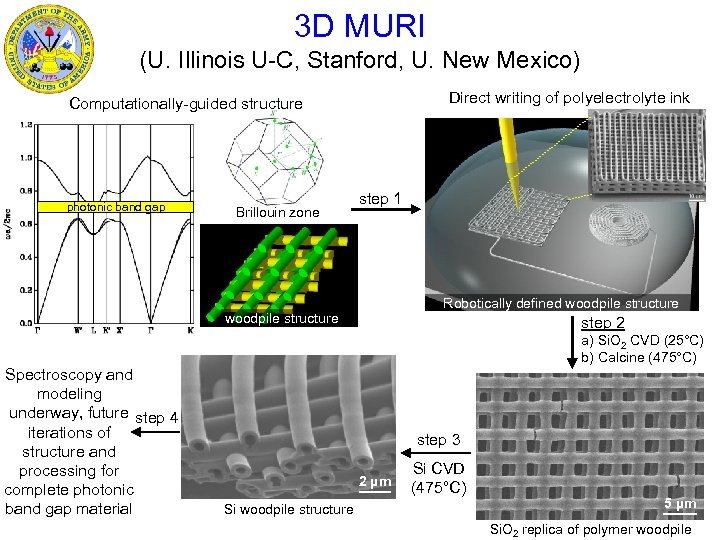 3 D MURI (U. Illinois U-C, Stanford, U. New Mexico) Direct writing of polyelectrolyte ink Computationally-guided structure photonic band gap Brillouin zone step 1 Robotically defined woodpile structure step 2 a) Si. O 2 CVD (25°C) b) Calcine (475°C) Spectroscopy and modeling underway, future step 4 iterations of structure and processing for complete photonic band gap material step 3 2 µm Si woodpile structure Si CVD (475°C) 5 µm Si. O 2 replica of polymer woodpile
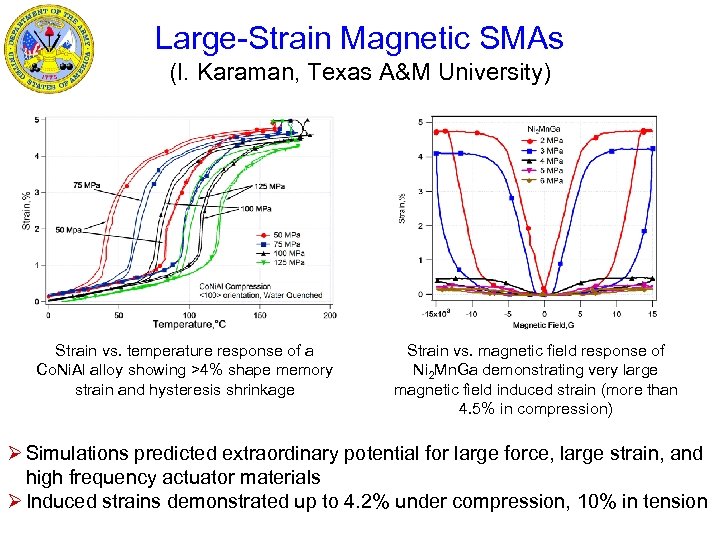 Large-Strain Magnetic SMAs (I. Karaman, Texas A&M University) Strain vs. temperature response of a Co. Ni. Al alloy showing >4% shape memory strain and hysteresis shrinkage Strain vs. magnetic field response of Ni 2 Mn. Ga demonstrating very large magnetic field induced strain (more than 4. 5% in compression) Ø Simulations predicted extraordinary potential for large force, large strain, and high frequency actuator materials Ø Induced strains demonstrated up to 4. 2% under compression, 10% in tension
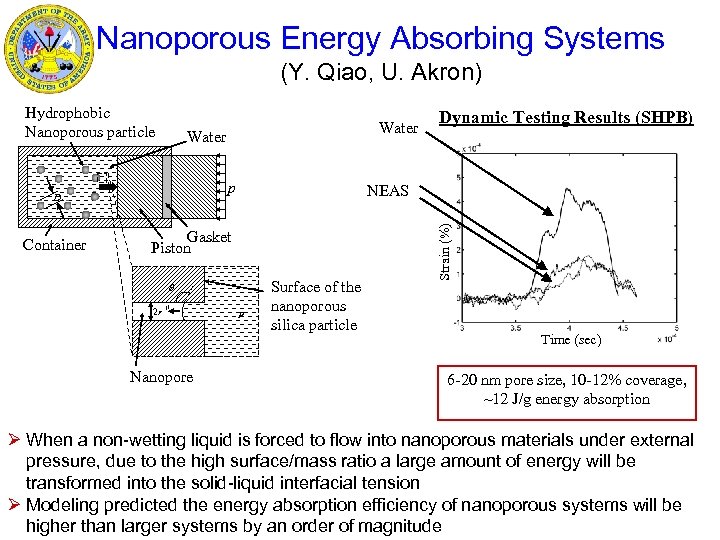 Nanoporous Energy Absorbing Systems (Y. Qiao, U. Akron) Water p D Container Water NEAS Gasket Piston 2 r v Nanopore Dynamic Testing Results (SHPB) p Surface of the nanoporous silica particle Strain (%) Hydrophobic Nanoporous particle Time (sec) 6 -20 nm pore size, 10 -12% coverage, ~12 J/g energy absorption Ø When a non-wetting liquid is forced to flow into nanoporous materials under external pressure, due to the high surface/mass ratio a large amount of energy will be transformed into the solid-liquid interfacial tension Ø Modeling predicted the energy absorption efficiency of nanoporous systems will be higher than larger systems by an order of magnitude
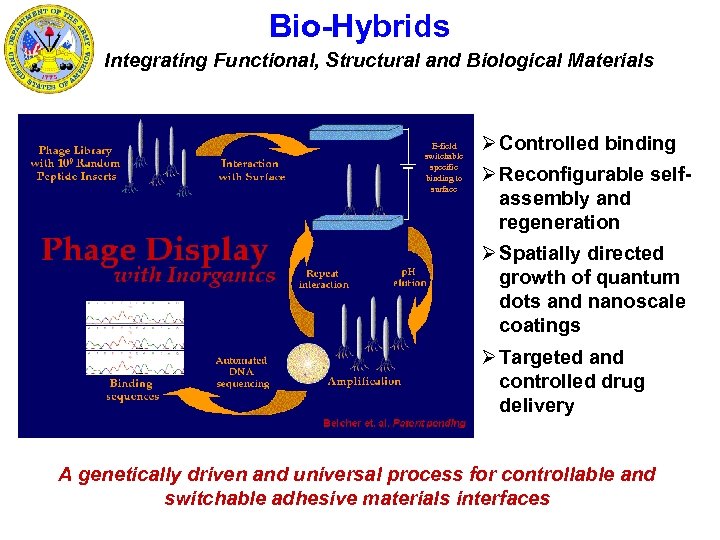 Bio-Hybrids Integrating Functional, Structural and Biological Materials E-field switchable specific binding to surface Ø Controlled binding Ø Reconfigurable selfassembly and regeneration Ø Spatially directed growth of quantum dots and nanoscale coatings Ø Targeted and controlled drug delivery A genetically driven and universal process for controllable and switchable adhesive materials interfaces
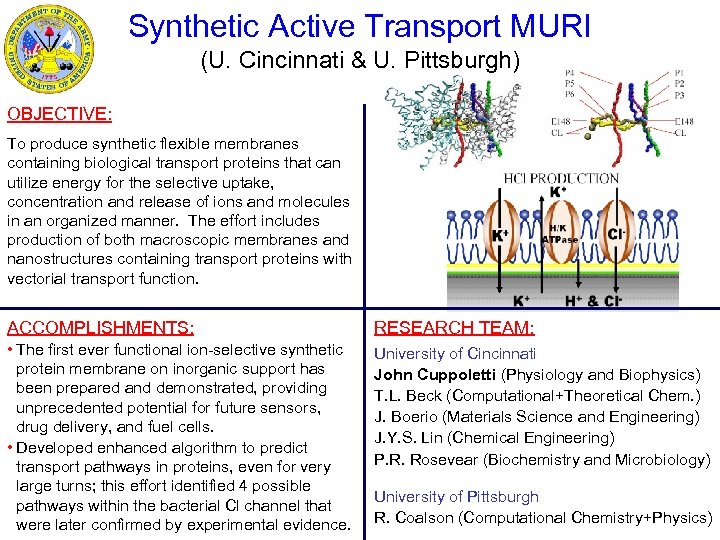 Synthetic Active Transport MURI (U. Cincinnati & U. Pittsburgh) OBJECTIVE: To produce synthetic flexible membranes containing biological transport proteins that can utilize energy for the selective uptake, concentration and release of ions and molecules in an organized manner. The effort includes production of both macroscopic membranes and nanostructures containing transport proteins with vectorial transport function. ACCOMPLISHMENTS: RESEARCH TEAM: • The first ever functional ion-selective synthetic protein membrane on inorganic support has been prepared and demonstrated, providing unprecedented potential for future sensors, drug delivery, and fuel cells. • Developed enhanced algorithm to predict transport pathways in proteins, even for very large turns; this effort identified 4 possible pathways within the bacterial Cl channel that were later confirmed by experimental evidence. University of Cincinnati John Cuppoletti (Physiology and Biophysics) T. L. Beck (Computational+Theoretical Chem. ) J. Boerio (Materials Science and Engineering) J. Y. S. Lin (Chemical Engineering) P. R. Rosevear (Biochemistry and Microbiology) University of Pittsburgh R. Coalson (Computational Chemistry+Physics)
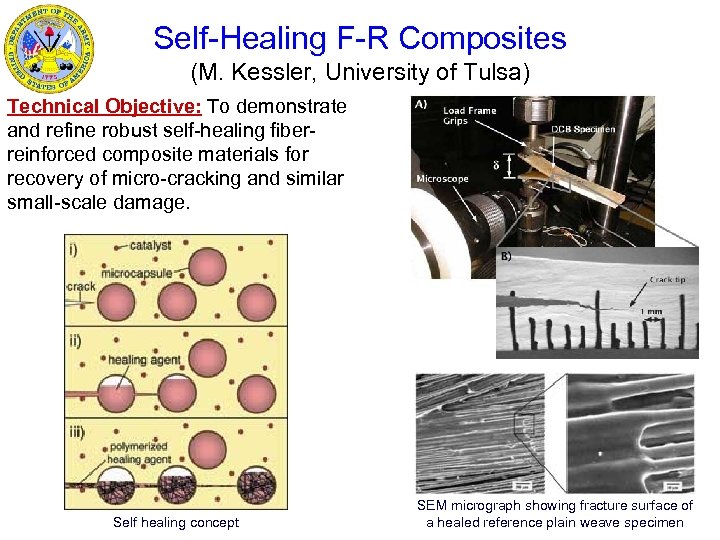 Self-Healing F-R Composites (M. Kessler, University of Tulsa) Technical Objective: To demonstrate and refine robust self-healing fiberreinforced composite materials for recovery of micro-cracking and similar small-scale damage. Self healing concept SEM micrograph showing fracture surface of a healed reference plain weave specimen
 Improving Technology Transfer Ø Nanomanufacturing to enable scaled-up, reliable, cost effective manufacturing of nanoscale materials, structures, devices, and systems; the development and integration of ultra-miniaturized top-down processes and increasingly complex bottom-up or self-assembly processes. Ø Small Business Innovative Research (SBIR) Ø Small Business Technology Transfer (STTR) Ø Manufacturing Technology (MANTECH) program Ø Industry partnerships? Ø Spiral development? Ø “Preliminary” field testing?
 david. m. stepp@us. army. mil http: //www. aro. army. mil • Basic Research and the U. S. Army Research Office – Farsighted high-payoff research – Needs driven and opportunity driven basic research efforts • Nanotechnology and Lightweight Materials – Tremendous potential for enhancing functionality – Beware non-falsifiable hypotheses, esp. for mechanical/structural apps. • What’s After Nanotechnology – Optimized Materials Design? – Bio-hybrids? – Improved Technology Transfer