 Скачать презентацию What renewables are These are resources found
renewablespresentation-1229884774071197-1 (2).ppt
- Количество слайдов: 10



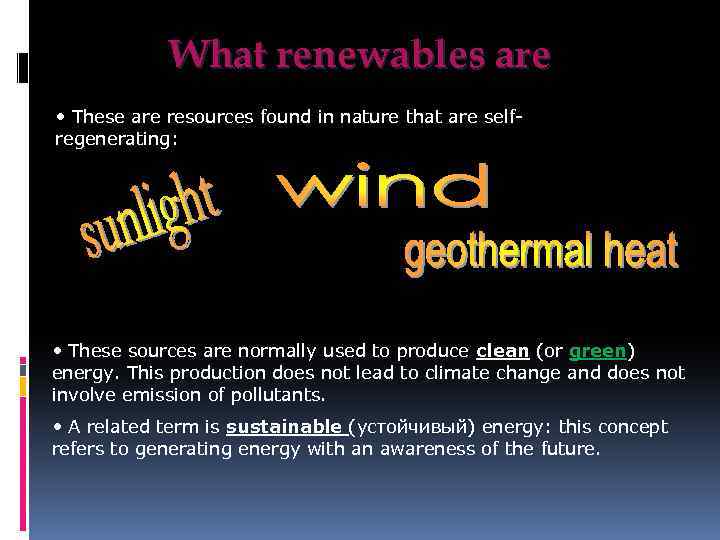
What renewables are • These are resources found in nature that are selfregenerating: • These sources are normally used to produce clean (or green) energy. This production does not lead to climate change and does not involve emission of pollutants. • A related term is sustainable (устойчивый) energy: this concept refers to generating energy with an awareness of the future.
Renewable energy is growing in importance and popularity: • because of the desire and necessity to avert irreversible climate damage; • because of increasing oil prices; • because of the unreliability of non-renewable resources (e. g. the depletion of oil wells). ü In view of all these and other factors, governments worldwide support renewables with various incentives. ü This, in turn, encourages entrepreneurs to make largescale investments in renewable energy.
Main types of renewable energy • Solar energy • Wind energy • Hydropower (water power) • Geothermal energy There are many sources of renewable energy, but all of them, except geothermal energy, are more or less directly related to the sun: the main source of clean and sustainable energy for the earth.
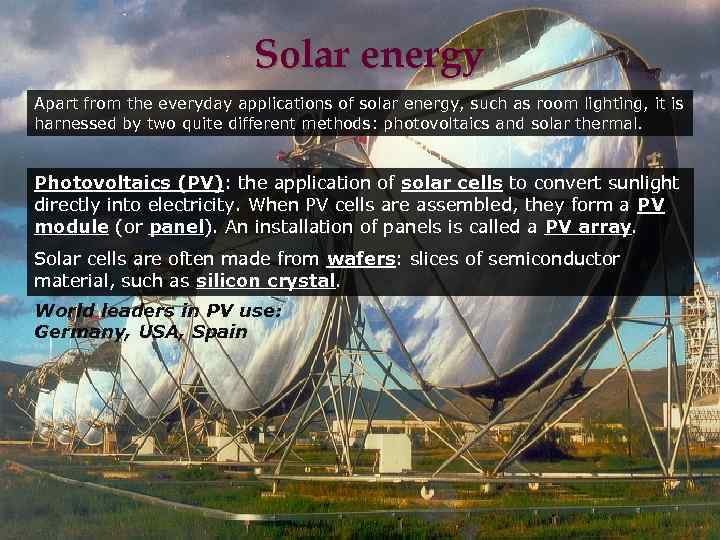
Solar energy Apart from the everyday applications of solar energy, such as room lighting, it is harnessed by two quite different methods: photovoltaics and solar thermal. Photovoltaics (PV): the application of solar cells to convert sunlight directly into electricity. When PV cells are assembled, they form a PV module (or panel). An installation of panels is called a PV array. Solar cells are often made from wafers: slices of semiconductor material, such as silicon crystal. World leaders in PV use: Germany, USA, Spain
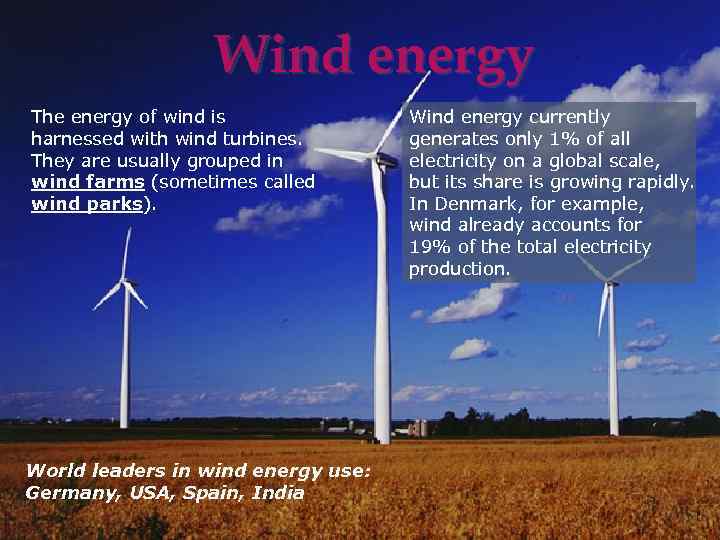
Wind energy The energy of wind is harnessed with wind turbines. They are usually grouped in wind farms (sometimes called wind parks). World leaders in wind energy use: Germany, USA, Spain, India Wind energy currently generates only 1% of all electricity on a global scale, but its share is growing rapidly. In Denmark, for example, wind already accounts for 19% of the total electricity production.
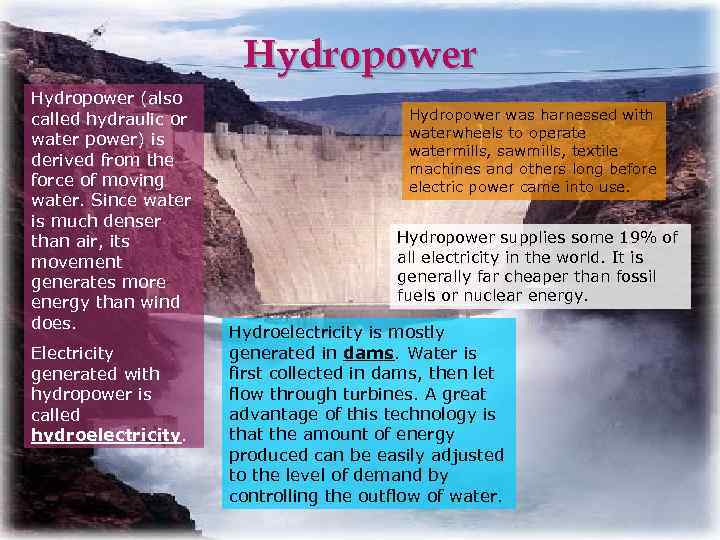
Hydropower (also called hydraulic or water power) is derived from the force of moving water. Since water is much denser than air, its movement generates more energy than wind does. Electricity generated with hydropower is called hydroelectricity. Hydropower was harnessed with waterwheels to operate watermills, sawmills, textile machines and others long before electric power came into use. Hydropower supplies some 19% of all electricity in the world. It is generally far cheaper than fossil fuels or nuclear energy. Hydroelectricity is mostly generated in dams. Water is first collected in dams, then let flow through turbines. A great advantage of this technology is that the amount of energy produced can be easily adjusted to the level of demand by controlling the outflow of water.
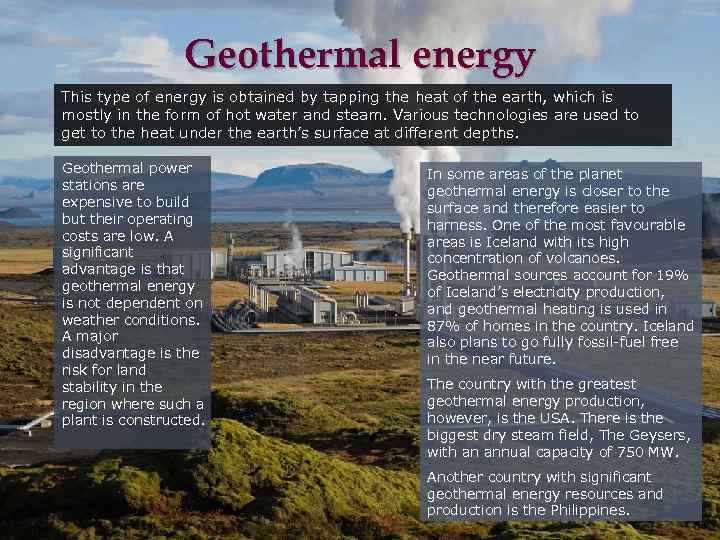
Geothermal energy This type of energy is obtained by tapping the heat of the earth, which is mostly in the form of hot water and steam. Various technologies are used to get to the heat under the earth’s surface at different depths. Geothermal power stations are expensive to build but their operating costs are low. A significant advantage is that geothermal energy is not dependent on weather conditions. A major disadvantage is the risk for land stability in the region where such a plant is constructed. In some areas of the planet geothermal energy is closer to the surface and therefore easier to harness. One of the most favourable areas is Iceland with its high concentration of volcanoes. Geothermal sources account for 19% of Iceland’s electricity production, and geothermal heating is used in 87% of homes in the country. Iceland also plans to go fully fossil-fuel free in the near future. The country with the greatest geothermal energy production, however, is the USA. There is the biggest dry steam field, The Geysers, with an annual capacity of 750 MW. Another country with significant geothermal energy resources and production is the Philippines.
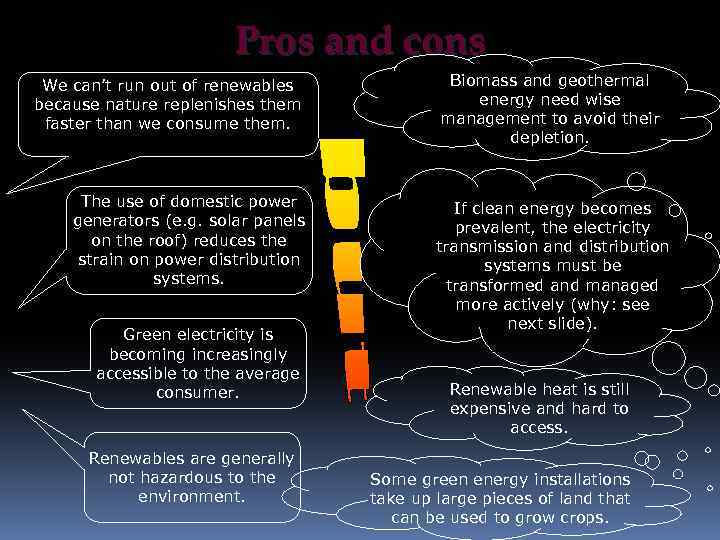
Pros and cons We can’t run out of renewables because nature replenishes them faster than we consume them. The use of domestic power generators (e. g. solar panels on the roof) reduces the strain on power distribution systems. Green electricity is becoming increasingly accessible to the average consumer. Renewables are generally not hazardous to the environment. Biomass and geothermal energy need wise management to avoid their depletion. If clean energy becomes prevalent, the electricity transmission and distribution systems must be transformed and managed more actively (why: see next slide). Renewable heat is still expensive and hard to access. Some green energy installations take up large pieces of land that can be used to grow crops.
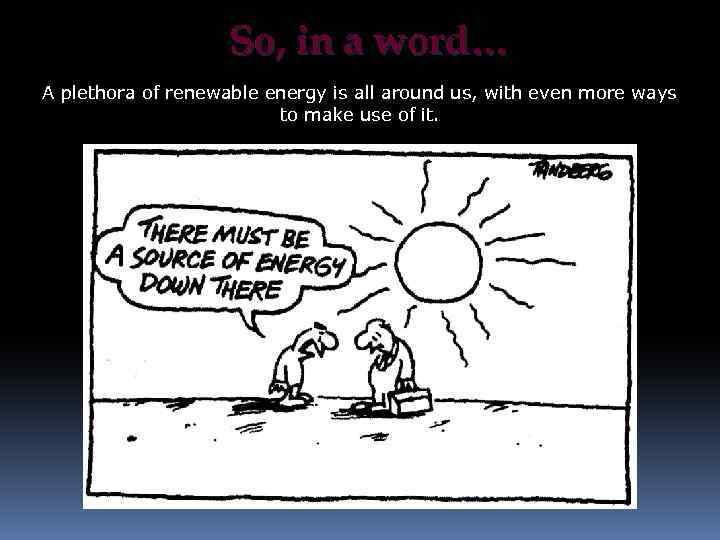
So, in a word… A plethora of renewable energy is all around us, with even more ways to make use of it.
Скачать презентацию What renewables are These are resources found
renewablespresentation-1229884774071197-1 (2).ppt