 Скачать презентацию What not to do about the financial crisis
38784dff557eb3f1569bd5bcf5ea5041.ppt
- Количество слайдов: 21




What (not) to do about the financial crisis? Dr Alfred Kleinknecht, Emeritus Professor of Economics (TU Delft) & Senior Fellow of WSI (Hans-Böckler-Stiftung) alfred-kleinknecht@boeckler. de
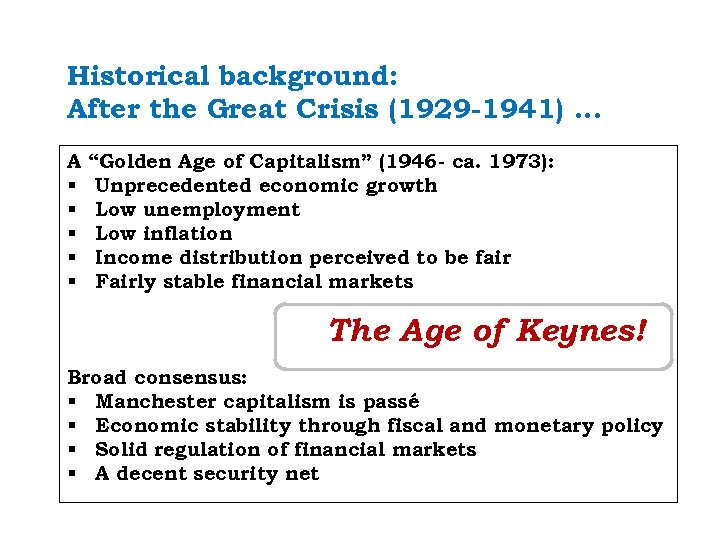
Historical background: After the Great Crisis (1929 -1941) … A § § § “Golden Age of Capitalism” (1946 - ca. 1973): Unprecedented economic growth Low unemployment Low inflation Income distribution perceived to be fair Fairly stable financial markets The Age of Keynes! Broad consensus: § Manchester capitalism is passé § Economic stability through fiscal and monetary policy § Solid regulation of financial markets § A decent security net
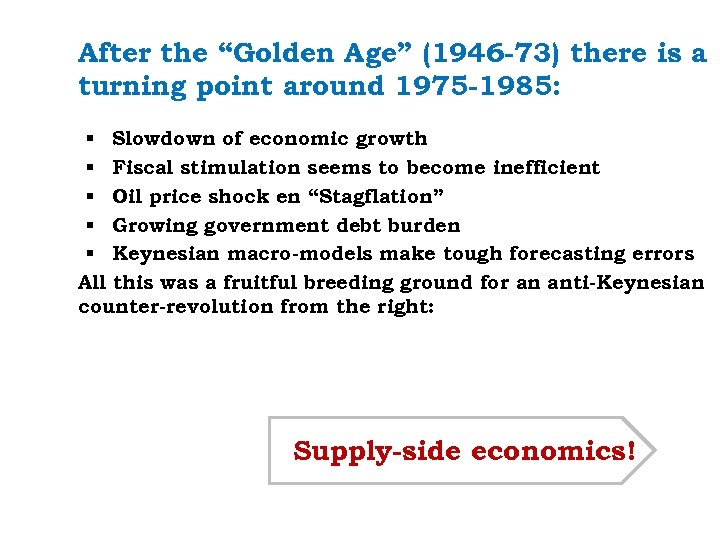
After the “Golden Age” (1946 -73) there is a turning point around 1975 -1985: § Slowdown of economic growth § Fiscal stimulation seems to become inefficient § Oil price shock en “Stagflation” § Growing government debt burden § Keynesian macro-models make tough forecasting errors All this was a fruitful breeding ground for an anti-Keynesian counter-revolution from the right: Supply-side economics!
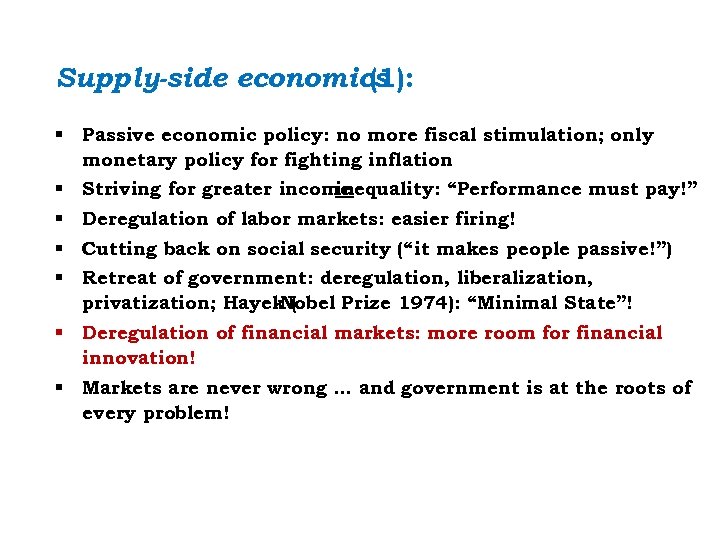
Supply-side economics (1): § Passive economic policy: no more fiscal stimulation; only monetary policy for fighting inflation § Striving for greater income inequality: “Performance must pay!” § Deregulation of labor markets: easier firing! § Cutting back on social security (“it makes people passive!”) § Retreat of government: deregulation, liberalization, privatization; Hayek ( Nobel Prize 1974): “Minimal State”! § Deregulation of financial markets: more room for financial innovation! § Markets are never wrong … and government is at the roots of every problem!
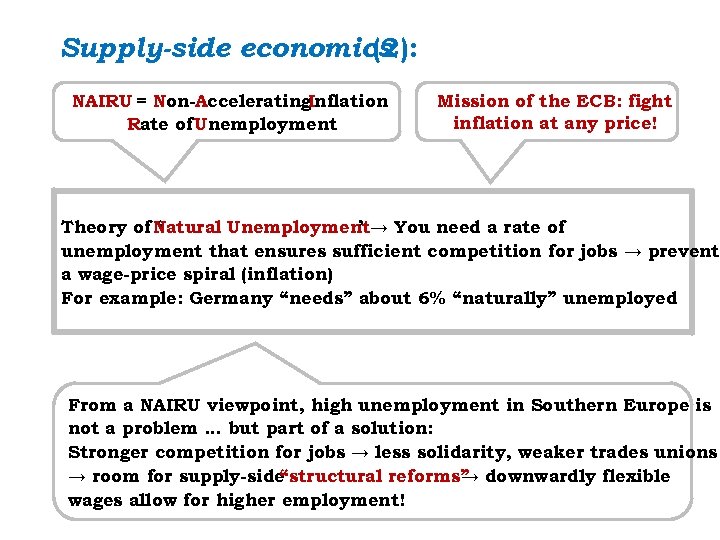
Supply-side economics (2): . NAIRU = Non-Accelerating. Inflation Rate of Unemployment Mission of the ECB: fight inflation at any price! Theory of Natural Unemployment→ You need a rate of ‘ ’ unemployment that ensures sufficient competition for jobs → prevent a wage-price spiral (inflation) For example: Germany “needs” about 6% “naturally” unemployed From a NAIRU viewpoint, high unemployment in Southern Europe is not a problem … but part of a solution: Stronger competition for jobs → less solidarity, weaker trades unions → room for supply-side “structural reforms” downwardly flexible → wages allow for higher employment!
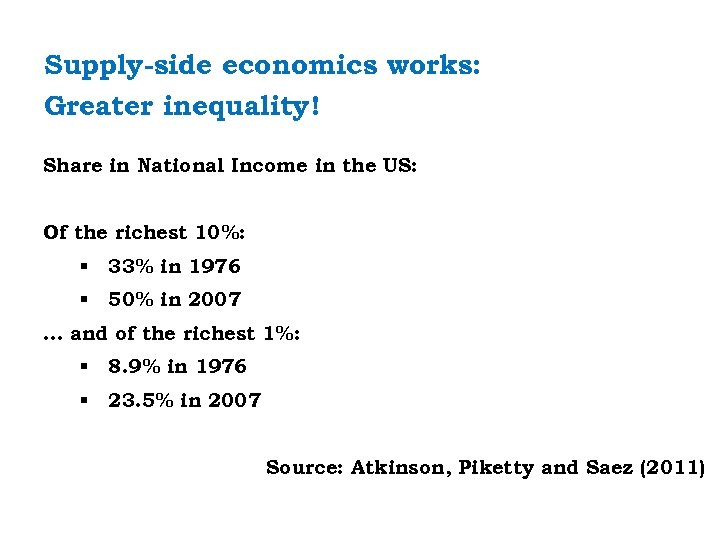
Supply-side economics works: Greater inequality! Share in National Income in the US: Of the richest 10%: § 33% in 1976 § 50% in 2007 … and of the richest 1%: § 8. 9% in 1976 § 23. 5% in 2007 Source: Atkinson, Piketty and Saez (2011)
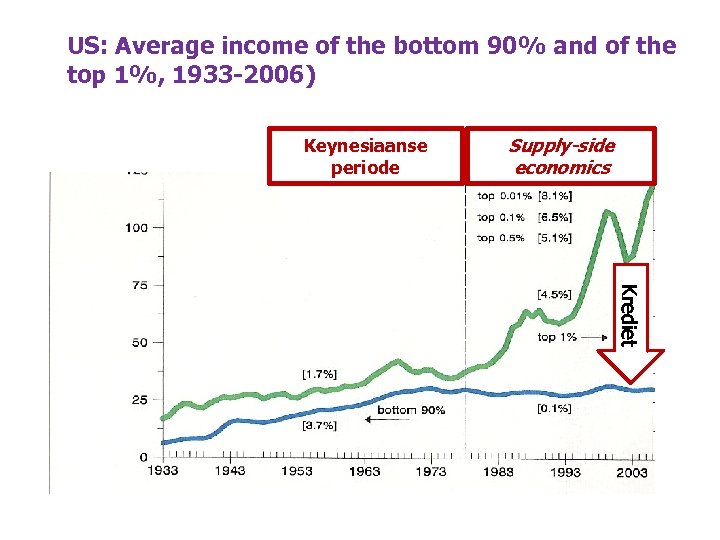
US: Average income of the bottom 90% and of the top 1%, 1933 -2006) Keynesiaanse periode Supply-side economics Krediet
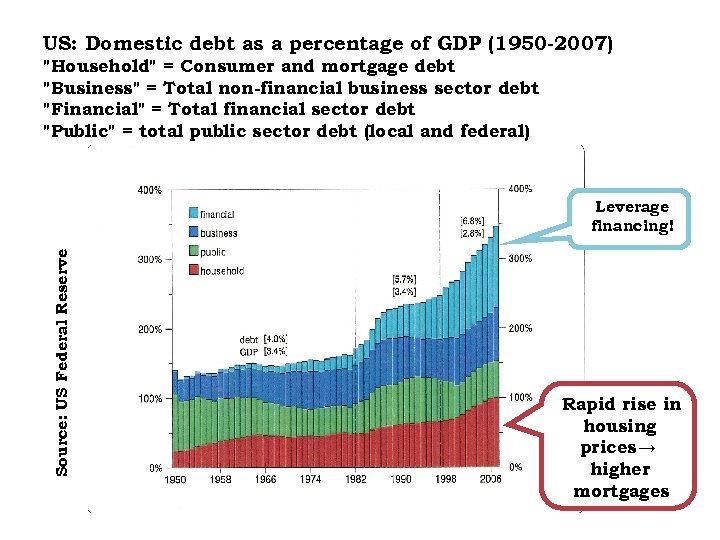
US: Domestic debt as a percentage of GDP (1950 -2007) "Household" = Consumer and mortgage debt "Business" = Total non-financial business sector debt "Financial" = Total financial sector debt "Public" = total public sector debt (local and federal) Source: US Federal Reserve Leverage financing! Rapid rise in housing prices → higher mortgages
The drama of the Mediterranean countries … § After their accession to the EU, they had higher growth rates than the Northern countries! § But this was only possible as they could devaluate their currencies from time to time … § … devaluation makes your export cheaper, and your import more expensive § … and that helps avoiding excessive import deficits
The key problem: Since the introduction of the Euro, devaluation is no more possible! → Mediterranean countries build up ever higher import surpluses … … and these surpluses were/are financed mainly through credit!
What market fundamentalist don’t tell you … Failing financial markets: ‘our’ financial sector gave easily credit, being blind for risks … while the debt burden grew dramatically They failed asking risk premiums which could have discouraged borrowing … so borrowing went on, at low interest rates, until the bubble exploded … and Rating Agencies were sleeping: Mediterranean countries had solid A-ratings until short before the crisis!
“Framing” of the political discussion: • Lots of concern about governments with high debts, but little is said about banks lending too much • Emphasis on governments as easy spenders: How can we enforce budget discipline? • … but there are just two countries that have a problematic government debt (Greece and Italy); in other countries, privatedebt is the problem • Many countries reduced their government debt after accession to the Eurozone… • … but debt (as a percentage of National Product) rose again after the Lehman Crash in 2008
An alternative diagnosis: § Germany and the Netherlands brought Mediterranean countries into difficulties through an aggressive export policy § Their export surpluses created lots of extra jobs in Germany and the Netherlands … § … but destroyed jobs in the Mediterranean countries: the rich steel jobs from the poor! § … and our financial sector provided cheap and abundant credit which allowed them paying for their import surpluses You could see long ago that this to end in a credit crisis! had (see e. g. early warnings by Heiner Flassbeck!)
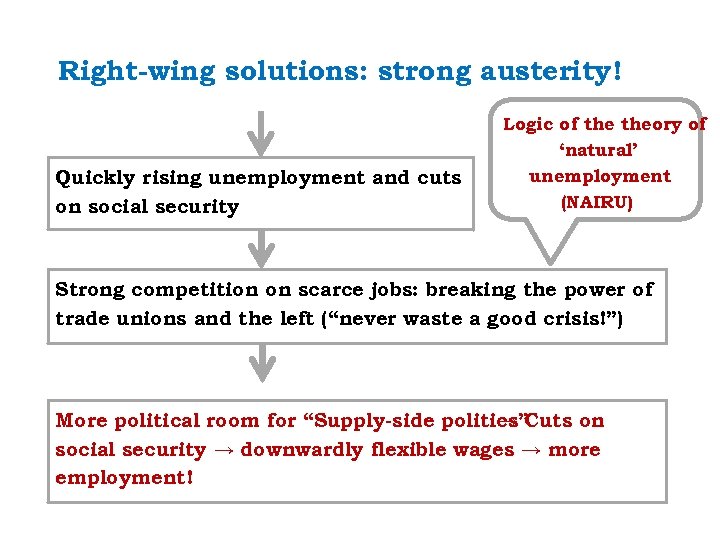
Right-wing solutions: strong austerity! Quickly rising unemployment and cuts on social security Logic of theory of ‘natural’ unemployment (NAIRU) Strong competition on scarce jobs: breaking the power of trade unions and the left (“never waste a good crisis!”) More political room for “Supply-side politics” → Cuts on social security → downwardly flexible wages → more employment!
Right-wing solutions: Deflationary policy! • In Mediterranean countries, the general price level has to go down in order to make them competitive again • … this requires downwardly flexible wages, defeating the trade unions and easier hiring and firing … • … but when prices decline, consumers postpone their spending, waiting for lower prices … • … which brings the economy even deeper into crisis – and this diminishes possibilities for debt-repayment … • … and unpaid debt has, in the end, to be born by European tax payers Food for right-wing populists: “Our tax money is wasted by lazy people in Southern Europe!”
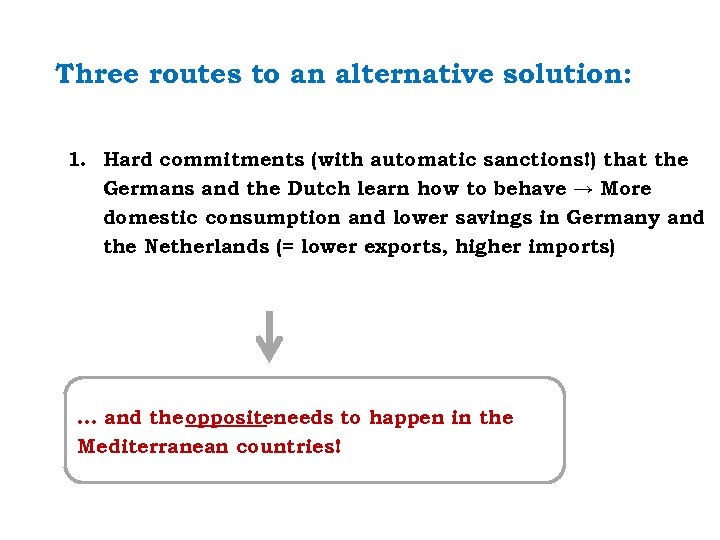
Three routes to an alternative solution: 1. Hard commitments (with automatic sanctions!) that the Germans and the Dutch learn how to behave → More domestic consumption and lower savings in Germany and the Netherlands (= lower exports, higher imports) … and the oppositeneeds to happen in the Mediterranean countries!
Three routes to an alternative solution 2. Trade unions should coordinate their wage claims: strong wage increases in export surplus countries; low wage claims in countries that have import surpluses! 3. More European solidarity: every currency union in the World has a public budget for “backing-up losers”: The rich have to support the poor!
And if all this turns out impossible … if nationalism prevails? Then split the Eurozone into a Euro-North and a Euro-South with a (Bretton-Woods-type) exchange rate between them. … or, if that is not feasible: let individual countries exit the Euro (in a well-managed way) This is still better than the current practicethere is a risk → that anti-European populists gain momentum!
A remaining risk: Governments backing up speculators … Many banks are still“too big to fail” they have am implicit → bail-out guarantee by governments If you accept more risks, you make higher profits … and hence the implicit bail-out guarantee gives an incentive for ruthless speculation: Profits are private Losses are for tax payers
Solution: Better banking regulation … realize that government budgets cannot be charged by a second round of bank rescues Regulators should be given the power to force banks rescuing themselves: Selling new shares and bonds + force a bank’s bond and shareholders to buy them Three major advantages: 1. Share and bond holders get stronger incentives monitoring their managers 2. Banks immediately have larger capital reserves 3. No more perverse incentives (privatizing profits; socializing losses)
In the meanwhile … As the crisis goes on: § High unemployment weakens the trade unions and the leftwing political spectrum → room for supply-side “structural reforms” → lots of lowproductive, precarious jobs § Depression and austerity weaken the innovation and knowledge potential in Mediterranean countries Possible consequences: Growing divergence of standards of living and unemployment rates between North and South in the Eurozone Risk: Growing anti. EU populism can damage the European project!
Скачать презентацию What not to do about the financial crisis
38784dff557eb3f1569bd5bcf5ea5041.ppt