


 Скачать презентацию WHAT ME TOO The risk to carers
5518740e22d872559a99ecace2134ce3.ppt
- Количество слайдов: 24
 “WHAT – ME TOO? The risk to carers of ANXIETY or DEPRESSION A resource pack developed by: Andree, Barbara, Cally (carer worker), Chris, Colin, Dawn, Debra, Ian, Jacqui (Worcester MHN), Janet, Jill, John (Facilitator), June, Lee (Hereford), Martin (On-side Advocacy), Ray (psychotherapist), Rosemary, Sheila, Sylvia, © 2009, Carers in Partnership CIC
 THE BRIEF Carers are a group recognised to be at risk of facing anxiety or depression. Ci. P was asked to identify key issues and develop recommendations: 1. How should carers be informed about IAPT services? 2. What are the most appropriate referral routes into the service for carers? 3. Are there factors that may act as barriers to carers accessing services? 4. If so, how might these factors be addressed? 5. Can any further issues or themes be identified? Consultation was conducted through four facilitated focus groups.
 “IF I WERE NOT A CARER, I COULD BE HAVING A BALL” The brief is concerned with risk to mental health carers arising from the stresses involved in their caring role. It is not about those they care for, nor day-to-day support.
 INFORMING GENERIC CARERS ABOUT IAPT The team identified the following general routes: – General publicity as part of the public health agenda – Publicity within and from GP surgeries by Primary Care Trusts – Full and consistent use of the GPs ‘yellow card’ system – Such media publicity as is initiated/encouraged/supported by DH – Encouragement to be aware of risk as part of all carer assessments – Traditional media, including leaflets, posters, radio, TV/soaps etc – New/on-line media, including internet sources, video-screens etc – Route options include libraries, leisure/sports centres etc – Other authorities such as benefits offices, jobcentres, CAB , advocacy – Finally, the information routes used by generic carers’ support groups
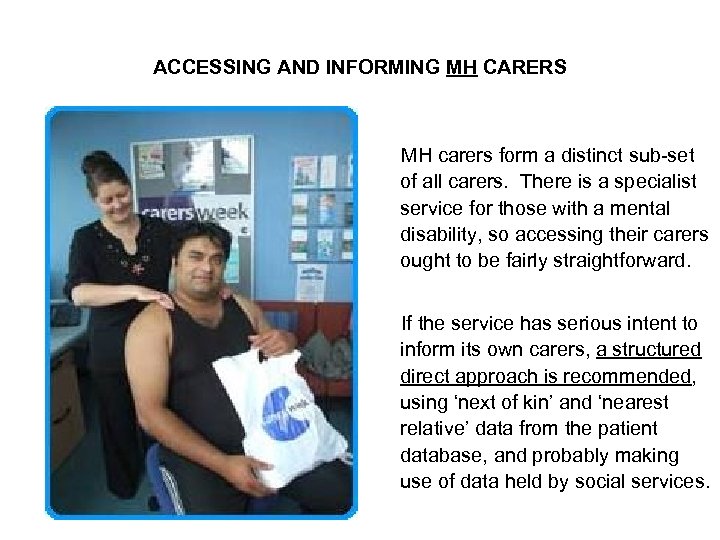 ACCESSING AND INFORMING MH CARERS MH carers form a distinct sub-set of all carers. There is a specialist service for those with a mental disability, so accessing their carers ought to be fairly straightforward. If the service has serious intent to inform its own carers, a structured direct approach is recommended, using ‘next of kin’ and ‘nearest relative’ data from the patient database, and probably making use of data held by social services.
 CARER COMMENTS “If all carers are to be found, all other contacts in the service should know of the IAPT service and be a position to refer them. ” “Could not it be arranged that the MH service call us for an annual assessment by our GP, to cover anxiety and depression etc? ” “Off-loading by talking to a friend with a ‘listening ear’ helps to get a clearer perspective and contributes to not feeling so alone. ” “Carers recognise themselves as mothers etc, not as carers. The service should ‘charge with vigour’ what it is doing for carers”
 SUGGESTIONS BY CARERS • A pamphlet (written by carers) describing the risk to carers etc • An education programme to help carers self-diagnose for risk • The carer to attend when the service user visits his/her GP surgery • Trained carers and carer workers to brief all carer group members • Adaptation of the yellow card to identify a MH v. a ‘physical’ carer
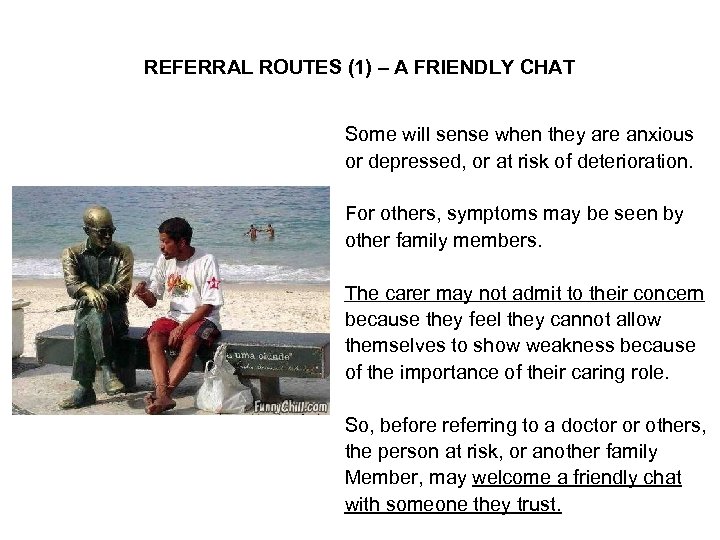 REFERRAL ROUTES (1) – A FRIENDLY CHAT Some will sense when they are anxious or depressed, or at risk of deterioration. For others, symptoms may be seen by other family members. The carer may not admit to their concern because they feel they cannot allow themselves to show weakness because of the importance of their caring role. So, before referring to a doctor or others, the person at risk, or another family Member, may welcome a friendly chat with someone they trust.
 CARER OBSERVATIONS (1) Carers must be in a position to identify risk to themselves or other family To do so, they need information or education about identifying symptoms They need to know in what circumstances they should refer to specialists Some are content to make use of a well structured directory of information Some will be content to refer to Sane, Rethink. Mind, Alzheimers etc Some will make use of carer workers, carer support groups or other carers Some will be inclined to find an informed acquaintance for a friendly chat >>>>>
 CARER OBSERVATIONS (2) >>>>>> But others may reach a state when they cannot initiate for themselves By this stage, it is hoped that MH staff may have identified a risk situation It seems unlikely that an annual assessment could predict impending risk Assuming not, care co-ordinators or named nurses may have a useful role GPs could be encouraged to exercise ‘watchful waiting’ for known carers SO All concerned need to recognise when a person is ‘on the edge’ and act
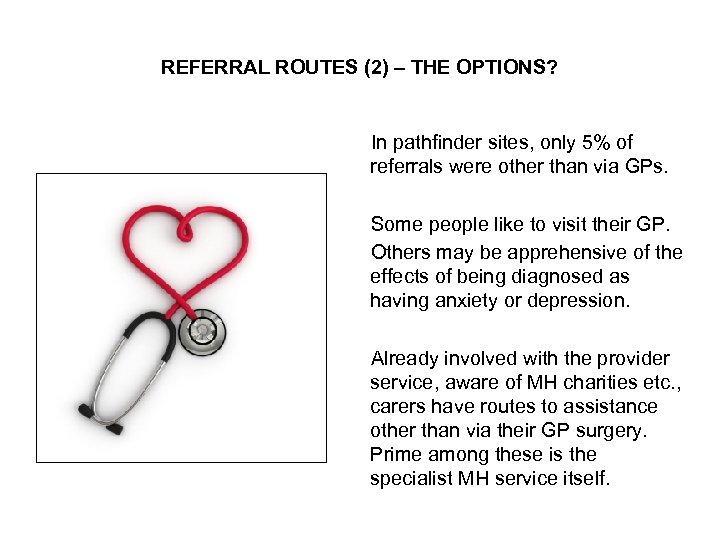 REFERRAL ROUTES (2) – THE OPTIONS? In pathfinder sites, only 5% of referrals were other than via GPs. Some people like to visit their GP. Others may be apprehensive of the effects of being diagnosed as having anxiety or depression. Already involved with the provider service, aware of MH charities etc. , carers have routes to assistance other than via their GP surgery. Prime among these is the specialist MH service itself.
 REFERRAL OPTIONS • For many, the GP will remain the obvious and a comfortable route. • It would be wasteful if staff of the MH service already in contact with family carers were not be trained to refer them direct • Pathfinders report just 5% ‘self-referral’. For MH carers self-referral has the potential to become a major and the most desirable route • Many carers use pharmacists for informal advice on medication – pharmacists could be trained to facilitate self-referral • Various other bodies might facilitate self-referral: – churches, Mind, Rethink, SOBS, Cruse, PJSD, Salvation Army, Syrenians, family workers/Meriden, advocacy services, housing associations, law centres, carer centres/support bodies • Self-referral requires some form of briefing, such as a decision tree, offering a logical approach, thereby maximising confidence.
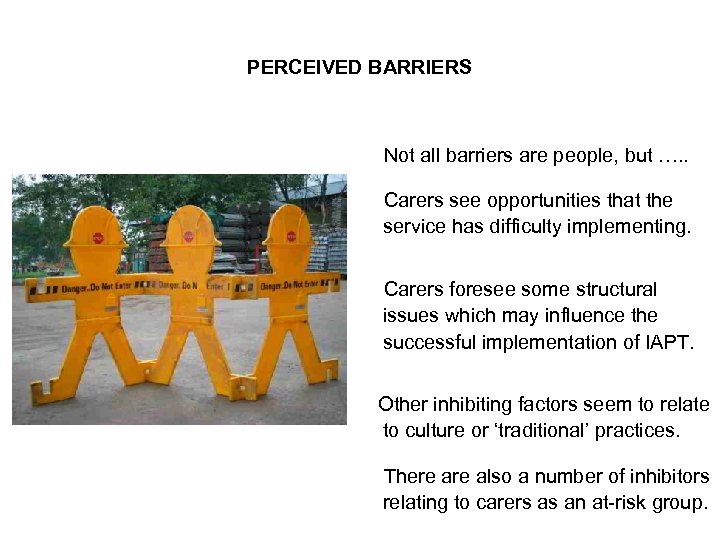 PERCEIVED BARRIERS Not all barriers are people, but …. . Carers see opportunities that the service has difficulty implementing. Carers foresee some structural issues which may influence the successful implementation of IAPT. Other inhibiting factors seem to relate to culture or ‘traditional’ practices. There also a number of inhibitors relating to carers as an at-risk group.
 STRUCTURAL BARRIERS (1) IAPT is a service aiming at preventing deterioration of a condition. Carers may be unclear whether it is part of the primary care service, or part of the secondary MH service, but delivered through GPs. In general, active carers perceive a lack of joined-up-ness between the GP service and the specialist MH service. Carers foresee co-ordination of that interface as offering challenges for both managers and commissioners, but also opportunities. >>>>>
 STRUCTURAL BARRIERS (2) >>>>> If the MH service is to be used to access carers because they are at risk possibly to refer them as well - there is perceived to be risk of access being delayed, or other problems, due to issues about who pays. Many older carers who are at risk may be supporting a relative who is under the care of the OPMH service. Anomalies are recognised to exist in the adult to OPMH transition zone, a further challenge for managers and commissioners. Carer attitudes to being at risk and to what might be done will differ individually. There may be reactions general to carers from within particular cultures.
 BARRIERS – INHIBITORS – POSSIBLE SOLUTIONS (1) Carers acknowledge that they tend not to consider themselves – so they may need an external catalyst - “We spend most of our time dealing with crisis, so may overlook or not even consider our own risk” - “Family dynamics can be a big problem” Conditions of anxiety or depression seem likely to be aggravated within a fractured family – the fracture itself may be caused by mental ill-health – so there may be merit in linking IAPT with family work. >>>>>
 BARRIERS – INHIBITORS – POSSIBLE SOLUTIONS (2) >>>>> “There is a widespread reluctance in the service to communicate with carers” - Carers experienced in working with the service may be of help. Use of confidentiality as a protective measure remains a concern of carers, although this may be less prevalent in the largely primary care environment. The RC Psychiatrists guidelines about Confidentiality should be promoted for adoption by GPs. Policies, procedures and protocols need to be user-friendly - in this case ‘carer-friendly’ – written for carers and compiled with carers - “It is not the caring that really impacts adversely, but dealing with the MH process” >>>>>
 BARRIERS – INHIBITORS – POSSIBLE SOLUTIONS (3) >>>>> In OPMH user and carer assessments are integrated – this may be an option in adult MH, possibly alongside work towards effective implementation of ‘new’ CPA - “Carers assessments here are pretty much a joke – lack of holistic assessment is a major cultural hurdle” “There is need to deal with cultural barriers from the Asian sub-continent and the Far East, and for interpreters even for Portuguese and Poles here (Worcs)” – scope for joint-working with the BME workers Widespread education & communication is needed - “People will be resistant to accepting their need for IAPT – it makes me look as if I am not coping”
 IDEAS • Work with Compact & Health. Watch • Subdivide yellow card MH v physical • Think prevention – not correction • Work on GPs apparent unawareness of identifying impending MH ill-health • As with other expertise, there is need for cross-training of professionals • “This is not just ‘adult‘ MH - many carers are older persons with a spouse with dementia - others are younger persons, even children”
 FURTHER OBSERVATIONS (1) “It should be remembered that dementia sufferers do not get well – their carers know that only too well – that realisation does not really help” “Workshops about how to get our family member to ‘sort’ problematical ‘stuff’, such as benefits, would reduce our anxiety quite a bit” “Not a few social workers appear to need training in communications and customer care” “There is need to explore needs with GPs and commissioners” >>>>>
 FURTHER OBSERVATIONS (2) >>>> “I think there is need for clinical supervision of GPs dealing with patients with potentially severe depressive conditions” “Failing to plan (IAPT) would be little better than planning to fail” “I ask only that they concentrate on quality rather than on targets” “I am glad there is the wish to involve carers in the recruitment of IAPT practitioners – if treated as equals, we should have much to offer”
 IAPT & MH CARERS THE 10 COMMENDMENTS 1. Decide if you are serious about identifying/briefing MH carers 2. Plan and set out to contact them all - with GPs, and sharing LA data 3. Involve a core of carers in preparing suitable briefing material 4. Create a plan for communication, involving all carer-facing staff 5. Identify all training needs, cross-training and CPD, and implement 6. Discuss the plan with GPs and gain their positive engagement 7. Provide a variety of sources from which carers may gain information 8. Arrange support, inside and outside the service, for carers who need it 9. Provide a variety of user-friendly referral routes - including self-referral 10. Ensure the service extends to young carers and of those in OPMH © 2009, Carers in Partnership CIC
 SO, WHERE FROM HERE ? - LET’S NOT LET JIM FIX IT ! LET’S “MAKE IT HAPPEN” – TOGETHER Carers would like the service to: • “ensure a robust roll-out – needs genuine /widespread buy-in” • “provide guided opportunity for a carer to self assess his/her anxiety/depression (GAD-7 or PHQ-9) before seeing their GP” • “arrange an assessment of the carer’s risk of anxiety/depression each time their relative/friend is subject to a MHA assessment • “prioritize MH carers for IAPT (alongside servicemen/new mothers)” • “report to the carer’s GP immediately s/he is identified as a carer”
 SO, WHOSE MOVE NEXT? “If you always do what you have always done, you will always get what you have always got” Ci. P would appreciate feedback how this resource pack comes across: copping. jl@gmail. com 01926 403966