


 Скачать презентацию What Keeps Insurance CEOs Awake at Night An
22aec6b09557b759ca2b0444d4290dc1.ppt
- Количество слайдов: 105
 What Keeps Insurance CEOs Awake at Night? An Overview and Outlook for the P/C Insurance Industry May 2002 Robert P. Hartwig, Ph. D. , Senior Vice President & Chief Economist Insurance Information Institute 110 William Street New York, NY 10038 Tel: (212) 346 -5520 Fax: (212) 732 -1916 bobh@iii. org www. iii. org
 Presentation Outline Tough Mission for CEOs but Not Mission Impossible • Restore Profitability >Restore & Rebuild Capacity • Rationalize Pricing >Focus on the Fundamentals • Improve Investment Returns • Accelerate Consolidation • Add Value through Technology—Insurance Scoring • Restore Order in the Courts • Keep Wall Street Happy • The Challenge of Corporate Governance • The Challenge of Terrorism
 RESTORE PROFITABILITY
 P/C Net Income After Taxes 1993 -2001 ($ Millions) 2001 was the first year ever with a full year net loss Sources: A. M. Best, ISO, Insurance Information Institute.
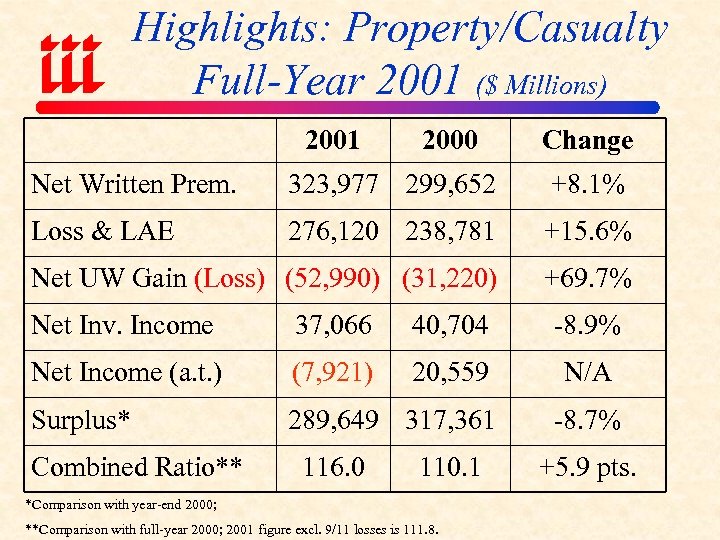 Highlights: Property/Casualty Full-Year 2001 ($ Millions) 2001 2000 Change Net Written Prem. 323, 977 299, 652 +8. 1% Loss & LAE 276, 120 238, 781 +15. 6% Net UW Gain (Loss) (52, 990) (31, 220) +69. 7% Net Inv. Income 37, 066 40, 704 -8. 9% Net Income (a. t. ) (7, 921) 20, 559 N/A Surplus* 289, 649 317, 361 Combined Ratio** 116. 0 110. 1 *Comparison with year-end 2000; **Comparison with full-year 2000; 2001 figure excl. 9/11 losses is 111. 8. -8. 7% +5. 9 pts.
 ROE: Financial Services Industry Segments, 1987– 2001 Source: Insurance Information Institute; Fortune
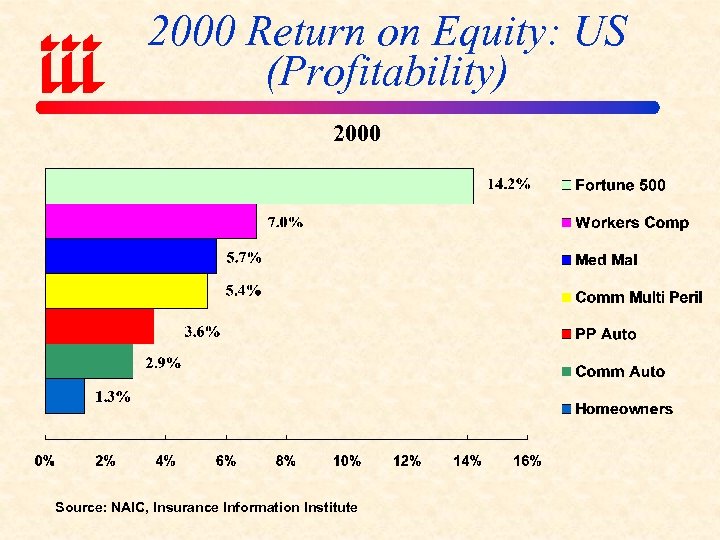 2000 Return on Equity: US (Profitability) 2000 Source: NAIC, Insurance Information Institute
 2000 Return on Equity: Mid-Atlantic States PP Auto 2000 Source: NAIC, Insurance Information Institute
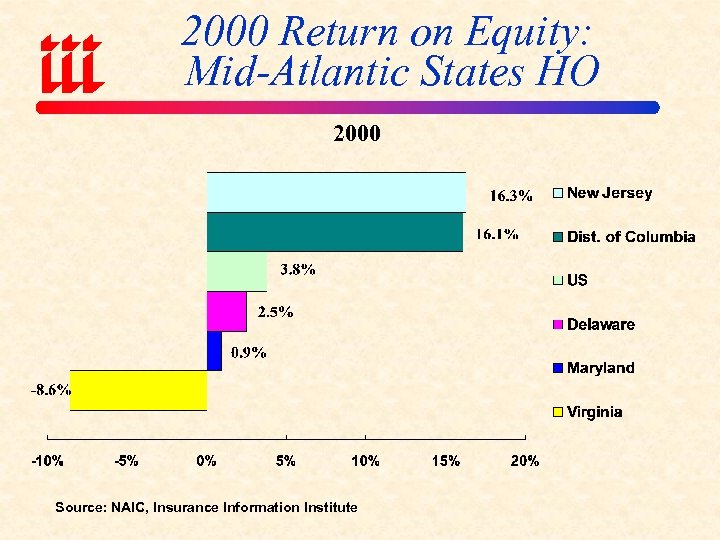 2000 Return on Equity: Mid-Atlantic States HO 2000 Source: NAIC, Insurance Information Institute
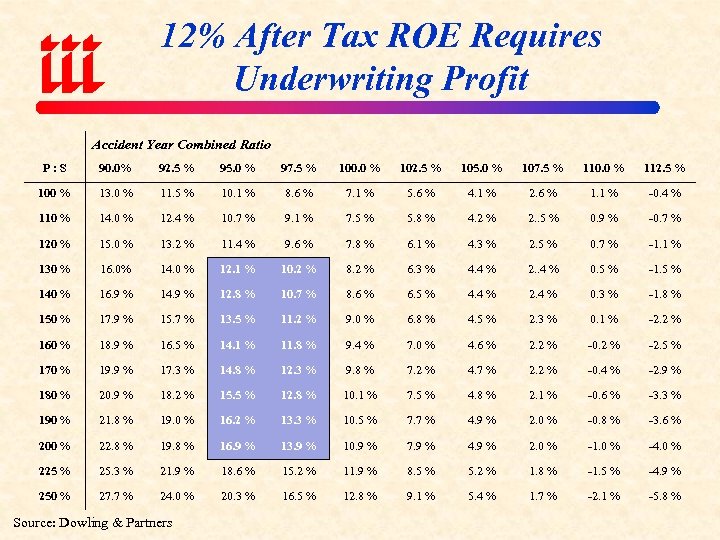 12% After Tax ROE Requires Underwriting Profit Accident Year Combined Ratio P: S 90. 0% 92. 5 % 95. 0 % 97. 5 % 100. 0 % 102. 5 % 105. 0 % 107. 5 % 110. 0 % 112. 5 % 100 % 13. 0 % 11. 5 % 10. 1 % 8. 6 % 7. 1 % 5. 6 % 4. 1 % 2. 6 % 1. 1 % -0. 4 % 110 % 14. 0 % 12. 4 % 10. 7 % 9. 1 % 7. 5 % 5. 8 % 4. 2 % 2. . 5 % 0. 9 % -0. 7 % 120 % 15. 0 % 13. 2 % 11. 4 % 9. 6 % 7. 8 % 6. 1 % 4. 3 % 2. 5 % 0. 7 % -1. 1 % 130 % 16. 0% 14. 0 % 12. 1 % 10. 2 % 8. 2 % 6. 3 % 4. 4 % 2. . 4 % 0. 5 % -1. 5 % 140 % 16. 9 % 14. 9 % 12. 8 % 10. 7 % 8. 6 % 6. 5 % 4. 4 % 2. 4 % 0. 3 % -1. 8 % 150 % 17. 9 % 15. 7 % 13. 5 % 11. 2 % 9. 0 % 6. 8 % 4. 5 % 2. 3 % 0. 1 % -2. 2 % 160 % 18. 9 % 16. 5 % 14. 1 % 11. 8 % 9. 4 % 7. 0 % 4. 6 % 2. 2 % -0. 2 % -2. 5 % 170 % 19. 9 % 17. 3 % 14. 8 % 12. 3 % 9. 8 % 7. 2 % 4. 7 % 2. 2 % -0. 4 % -2. 9 % 180 % 20. 9 % 18. 2 % 15. 5 % 12. 8 % 10. 1 % 7. 5 % 4. 8 % 2. 1 % -0. 6 % -3. 3 % 190 % 21. 8 % 19. 0 % 16. 2 % 13. 3 % 10. 5 % 7. 7 % 4. 9 % 2. 0 % -0. 8 % -3. 6 % 200 % 22. 8 % 19. 8 % 16. 9 % 13. 9 % 10. 9 % 7. 9 % 4. 9 % 2. 0 % -1. 0 % -4. 0 % 225 % 25. 3 % 21. 9 % 18. 6 % 15. 2 % 11. 9 % 8. 5 % 5. 2 % 1. 8 % -1. 5 % -4. 9 % 250 % 27. 7 % 24. 0 % 20. 3 % 16. 5 % 12. 8 % 9. 1 % 5. 4 % 1. 7 % -2. 1 % -5. 8 % Source: Dowling & Partners
 RESTORE & REBUILD DESTROYED CAPACITY
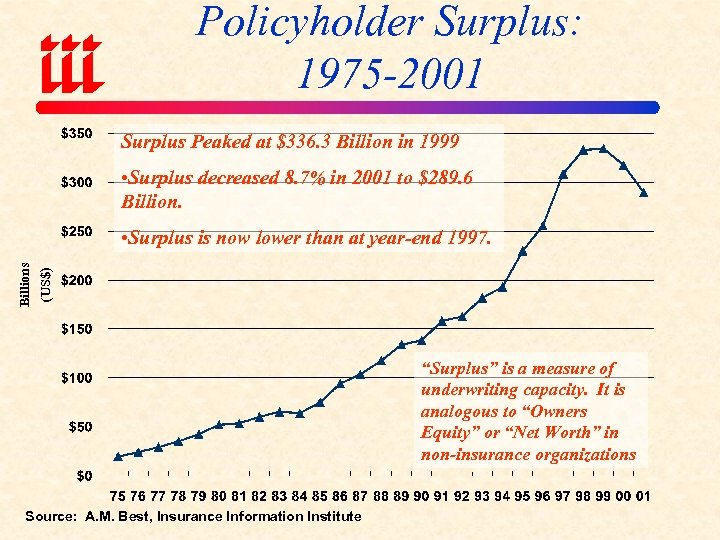 Policyholder Surplus: 1975 -2001 Surplus Peaked at $336. 3 Billion in 1999 • Surplus decreased 8. 7% in 2001 to $289. 6 Billion. (US$) Billions • Surplus is now lower than at year-end 1997. “Surplus” is a measure of underwriting capacity. It is analogous to “Owners Equity” or “Net Worth” in non-insurance organizations Source: A. M. Best, Insurance Information Institute
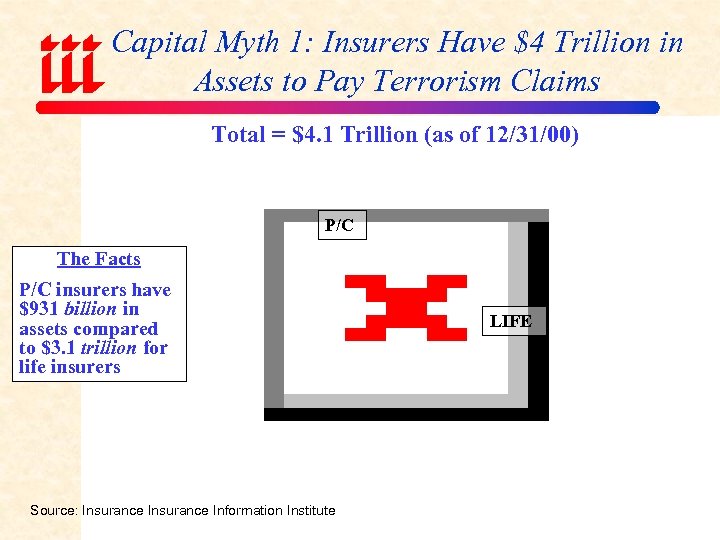 Capital Myth 1: Insurers Have $4 Trillion in Assets to Pay Terrorism Claims Total = $4. 1 Trillion (as of 12/31/00) P/C The Facts P/C insurers have $931 billion in assets compared to $3. 1 trillion for life insurers Source: Insurance Information Institute LIFE
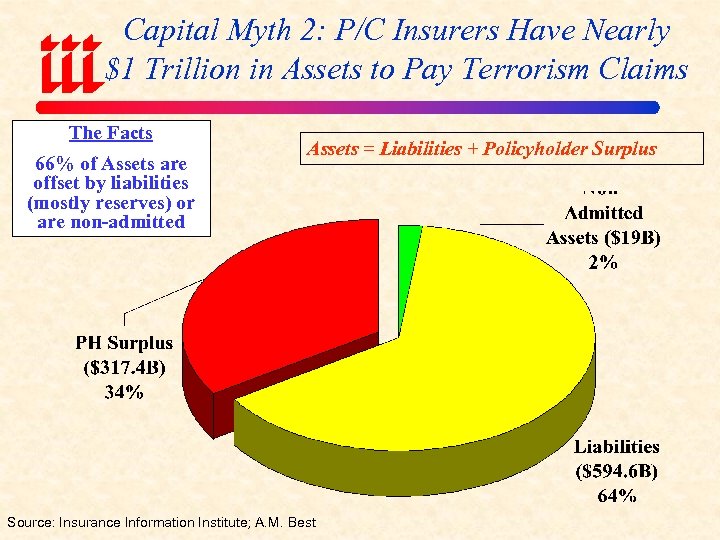 Capital Myth 2: P/C Insurers Have Nearly $1 Trillion in Assets to Pay Terrorism Claims The Facts 66% of Assets are offset by liabilities (mostly reserves) or are non-admitted Assets = Liabilities + Policyholder Surplus Source: Insurance Information Institute; A. M. Best
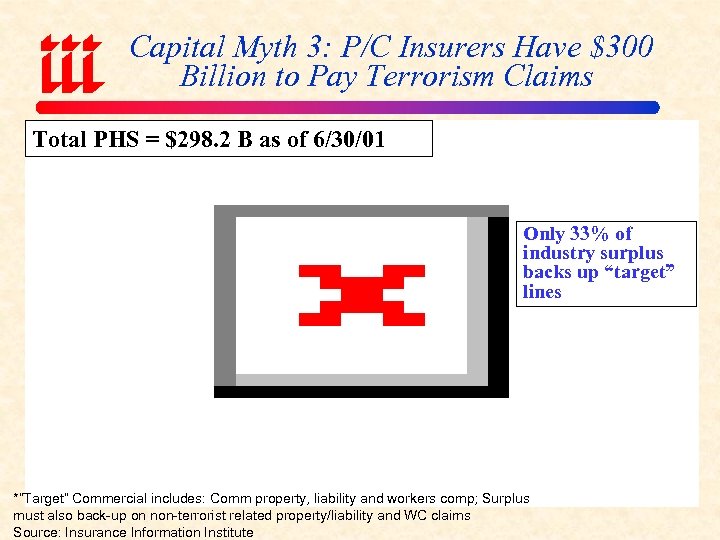 Capital Myth 3: P/C Insurers Have $300 Billion to Pay Terrorism Claims Total PHS = $298. 2 B as of 6/30/01 Only 33% of industry surplus backs up “target” lines *”Target” Commercial includes: Comm property, liability and workers comp; Surplus must also back-up on non-terrorist related property/liability and WC claims Source: Insurance Information Institute
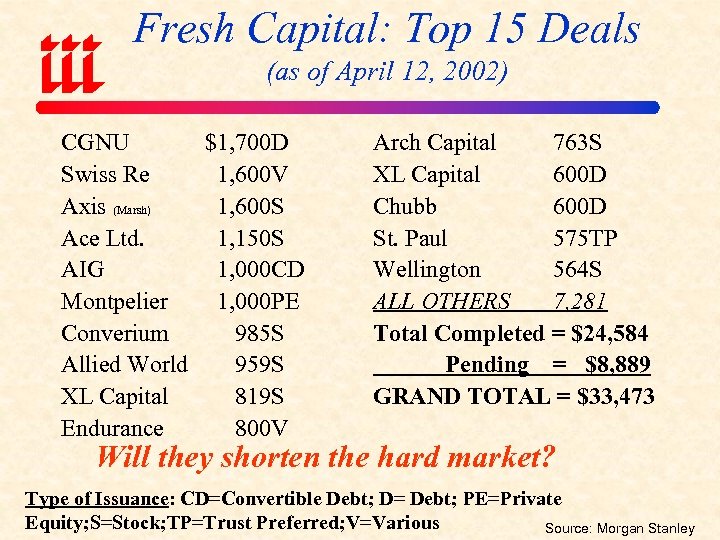 Fresh Capital: Top 15 Deals (as of April 12, 2002) CGNU $1, 700 D Swiss Re 1, 600 V Axis (Marsh) 1, 600 S Ace Ltd. 1, 150 S AIG 1, 000 CD Montpelier 1, 000 PE Converium 985 S Allied World 959 S XL Capital 819 S Endurance 800 V Arch Capital 763 S XL Capital 600 D Chubb 600 D St. Paul 575 TP Wellington 564 S ALL OTHERS 7, 281 Total Completed = $24, 584 Pending = $8, 889 GRAND TOTAL = $33, 473 Will they shorten the hard market? Type of Issuance: CD=Convertible Debt; D= Debt; PE=Private Equity; S=Stock; TP=Trust Preferred; V=Various Source: Morgan Stanley
 RATIONALIZE PRICING
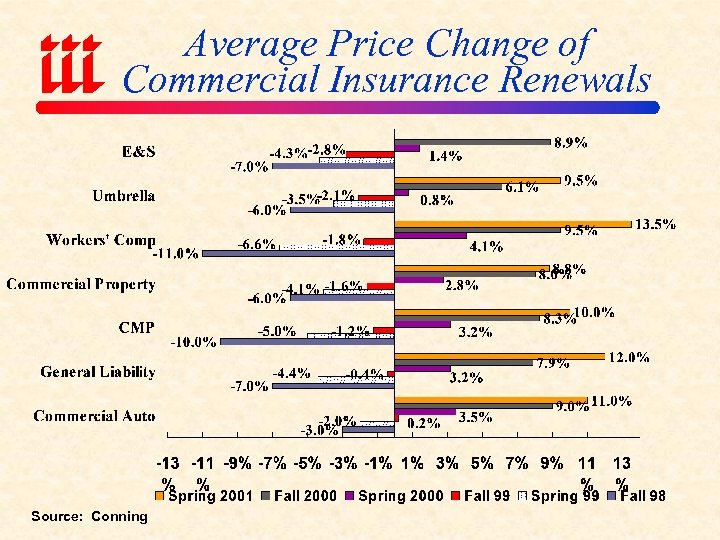 Average Price Change of Commercial Insurance Renewals Source: Conning
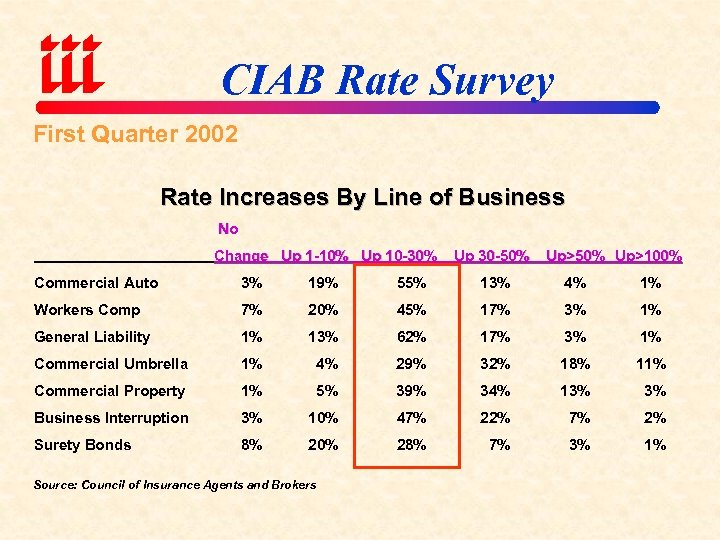 CIAB Rate Survey First Quarter 2002 Rate Increases By Line of Business No Change Up 1 -10% Up 10 -30% Up 30 -50% Up>100% Commercial Auto 3% 19% 55% 13% 4% 1% Workers Comp 7% 20% 45% 17% 3% 1% General Liability 1% 13% 62% 17% 3% 1% Commercial Umbrella 1% 4% 29% 32% 18% 11% Commercial Property 1% 5% 39% 34% 13% 3% Business Interruption 3% 10% 47% 22% 7% 2% Surety Bonds 8% 20% 28% 7% 3% 1% Source: Council of Insurance Agents and Brokers
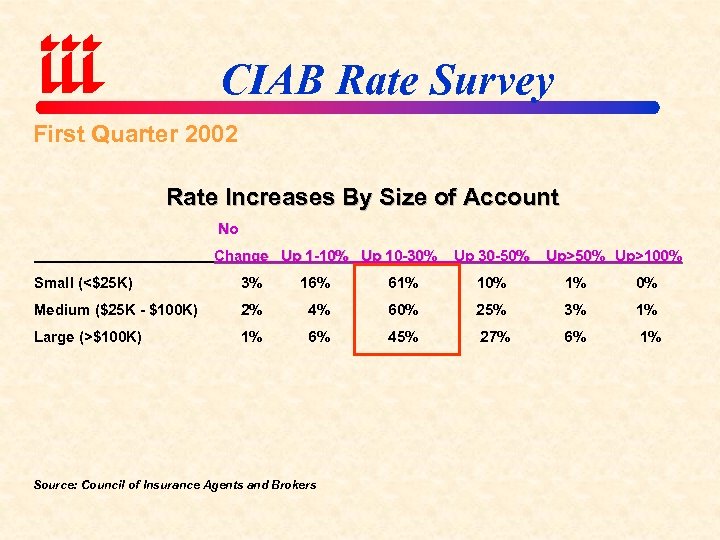 CIAB Rate Survey First Quarter 2002 Rate Increases By Size of Account No Change Up 1 -10% Up 10 -30% Up 30 -50% Up>100% Small (<$25 K) 3% 16% 61% 10% 1% 0% Medium ($25 K - $100 K) 2% 4% 60% 25% 3% 1% Large (>$100 K) 1% 6% 45% 27% 6% 1% Source: Council of Insurance Agents and Brokers
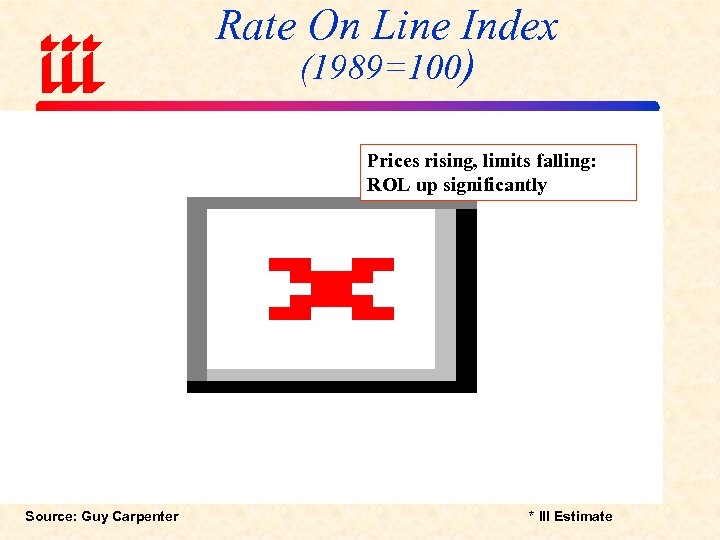 Rate On Line Index (1989=100) Prices rising, limits falling: ROL up significantly Source: Guy Carpenter * III Estimate
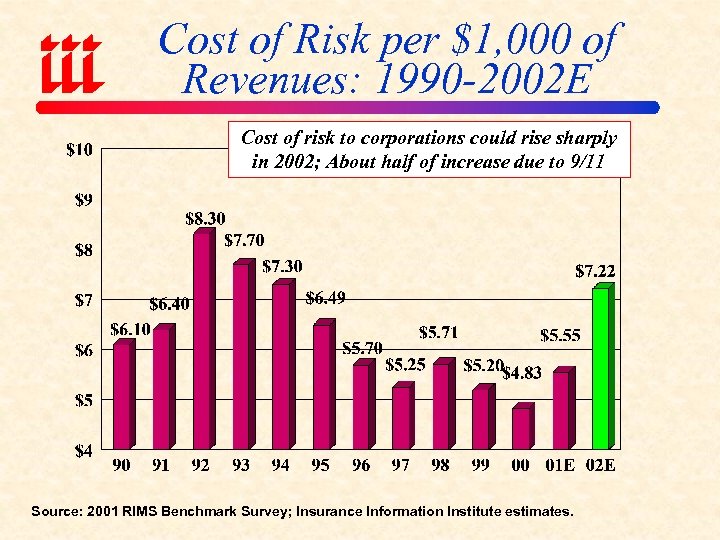 Cost of Risk per $1, 000 of Revenues: 1990 -2002 E Cost of risk to corporations could rise sharply in 2002; About half of increase due to 9/11 Source: 2001 RIMS Benchmark Survey; Insurance Information Institute estimates.
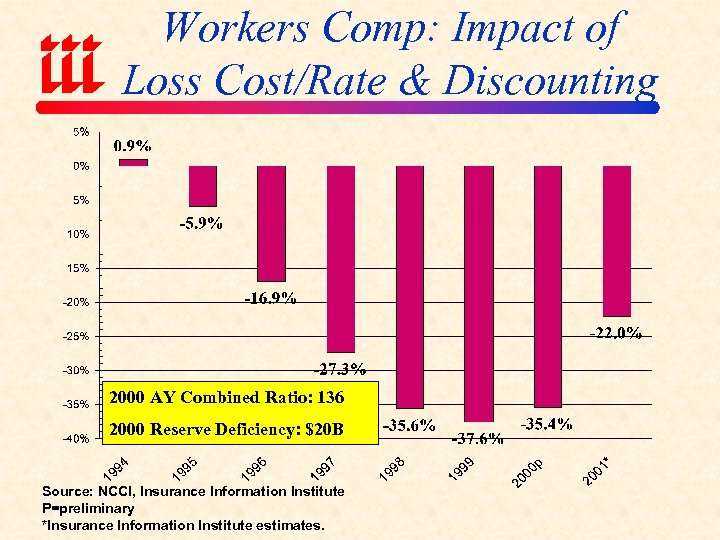 Workers Comp: Impact of Loss Cost/Rate & Discounting 2000 AY Combined Ratio: 136 2000 Reserve Deficiency: $20 B Source: NCCI, Insurance Information Institute P=preliminary *Insurance Information Institute estimates.
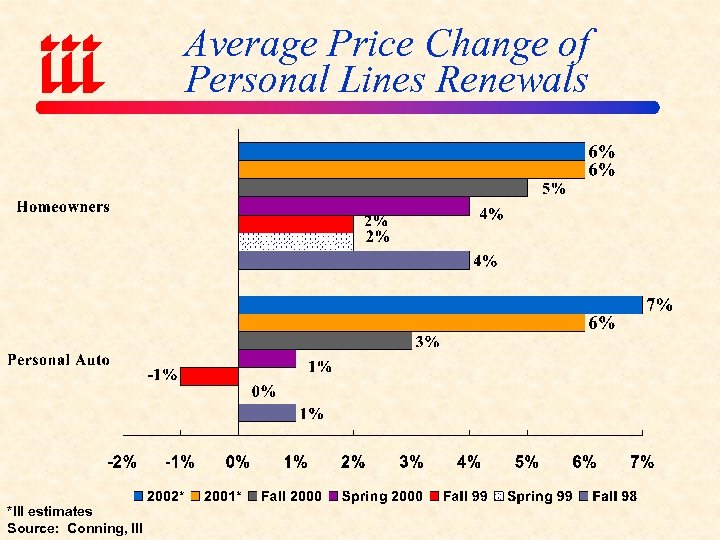 Average Price Change of Personal Lines Renewals *III estimates Source: Conning, III
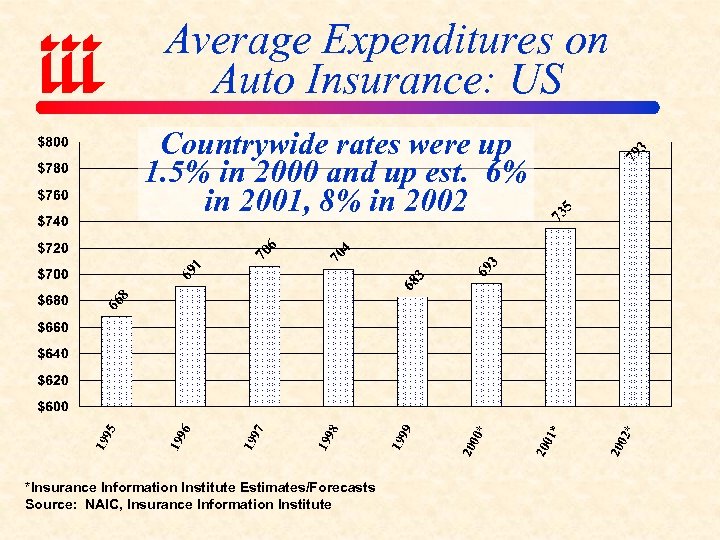 Average Expenditures on Auto Insurance: US Countrywide rates were up 1. 5% in 2000 and up est. 6% in 2001, 8% in 2002 *Insurance Information Institute Estimates/Forecasts Source: NAIC, Insurance Information Institute
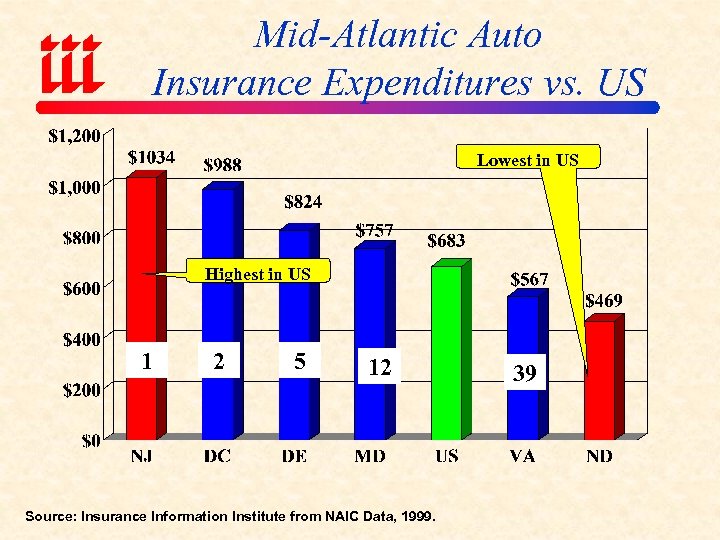 Mid-Atlantic Auto Insurance Expenditures vs. US Lowest in US Highest in US 1 2 5 12 Source: Insurance Information Institute from NAIC Data, 1999. 39
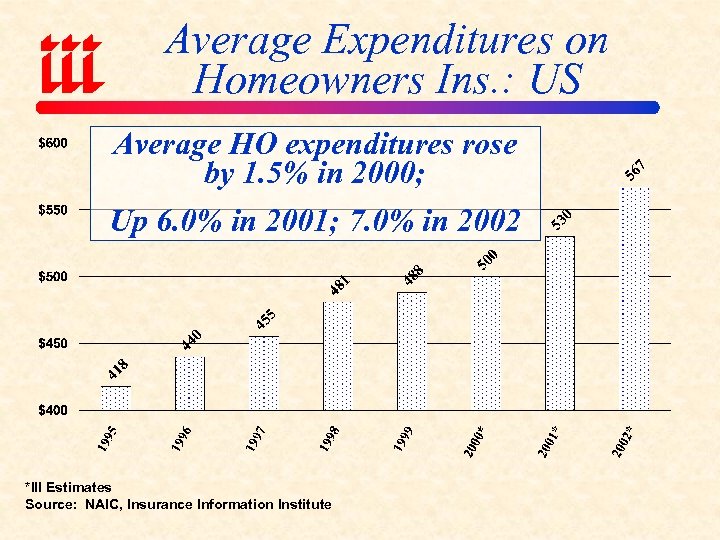 Average Expenditures on Homeowners Ins. : US Average HO expenditures rose by 1. 5% in 2000; Up 6. 0% in 2001; 7. 0% in 2002 *III Estimates Source: NAIC, Insurance Information Institute
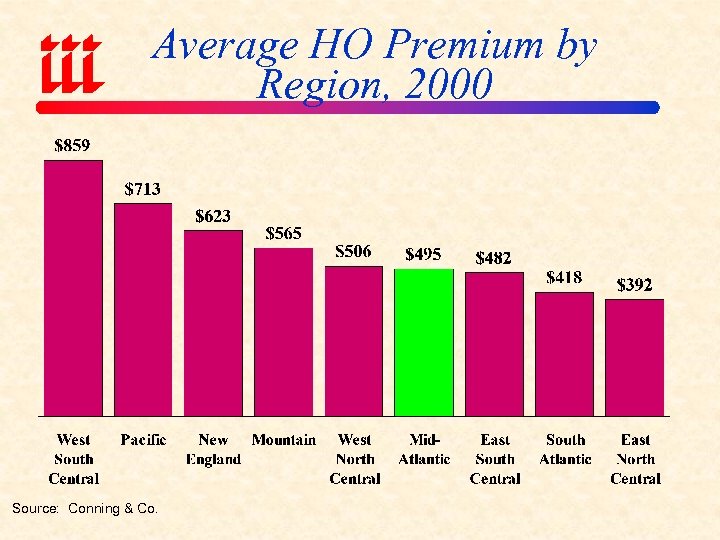 Average HO Premium by Region, 2000 Source: Conning & Co.
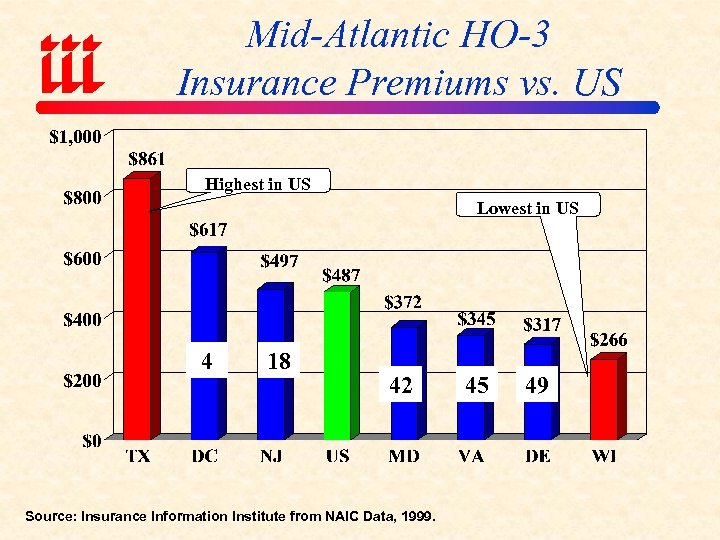 Mid-Atlantic HO-3 Insurance Premiums vs. US Highest in US Lowest in US 4 18 42 Source: Insurance Information Institute from NAIC Data, 1999. 45 49
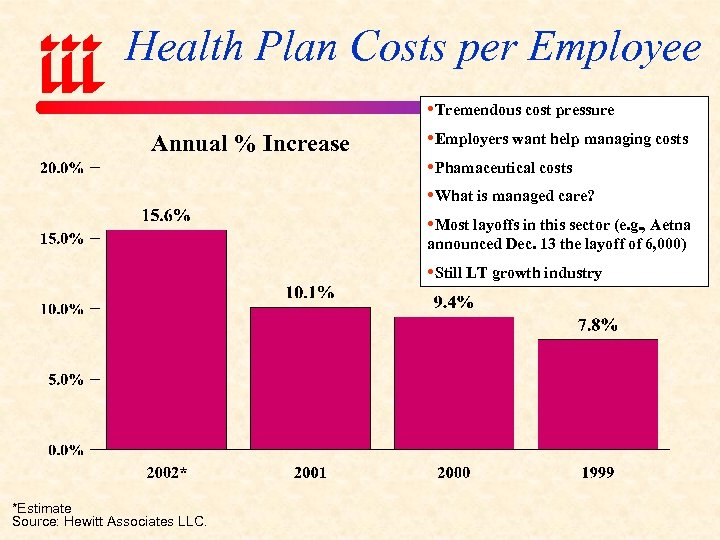 Health Plan Costs per Employee Tremendous cost pressure Annual % Increase Employers want help managing costs Phamaceutical costs What is managed care? Most layoffs in this sector (e. g. , Aetna announced Dec. 13 the layoff of 6, 000) Still LT growth industry *Estimate Source: Hewitt Associates LLC.
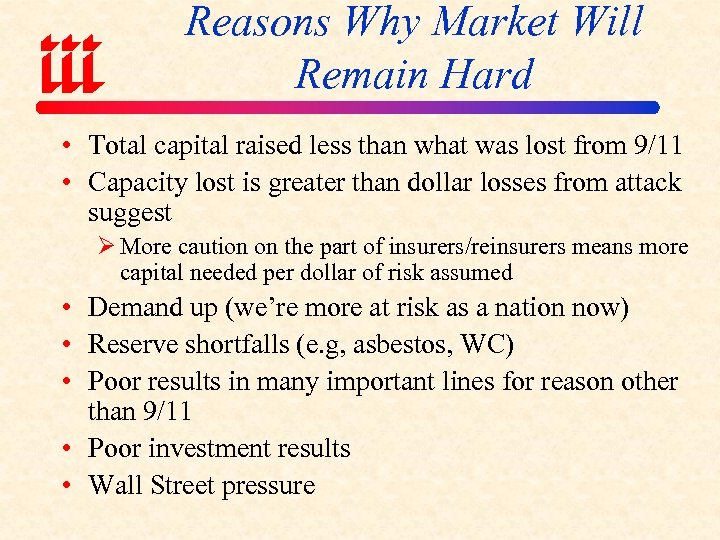 Reasons Why Market Will Remain Hard • Total capital raised less than what was lost from 9/11 • Capacity lost is greater than dollar losses from attack suggest Ø More caution on the part of insurers/reinsurers means more capital needed per dollar of risk assumed • Demand up (we’re more at risk as a nation now) • Reserve shortfalls (e. g, asbestos, WC) • Poor results in many important lines for reason other than 9/11 • Poor investment results • Wall Street pressure
 FOCUS ON FUNDAMENTALS
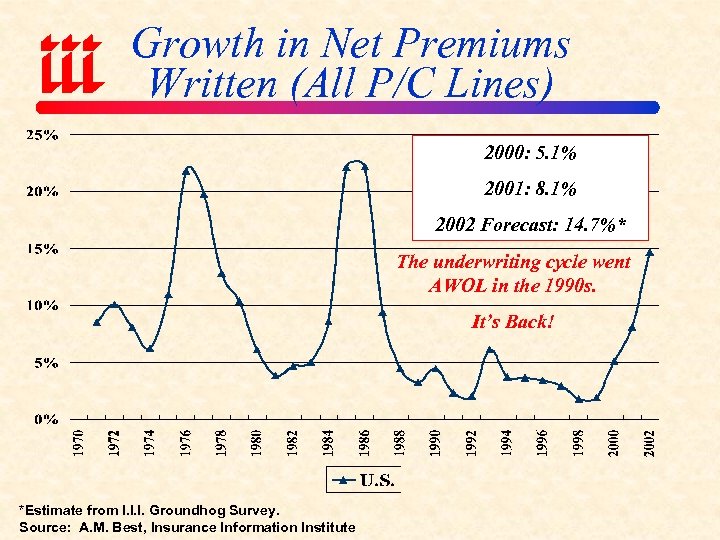 Growth in Net Premiums Written (All P/C Lines) 2000: 5. 1% 2001: 8. 1% 2002 Forecast: 14. 7%* The underwriting cycle went AWOL in the 1990 s. It’s Back! *Estimate from I. I. I. Groundhog Survey. Source: A. M. Best, Insurance Information Institute
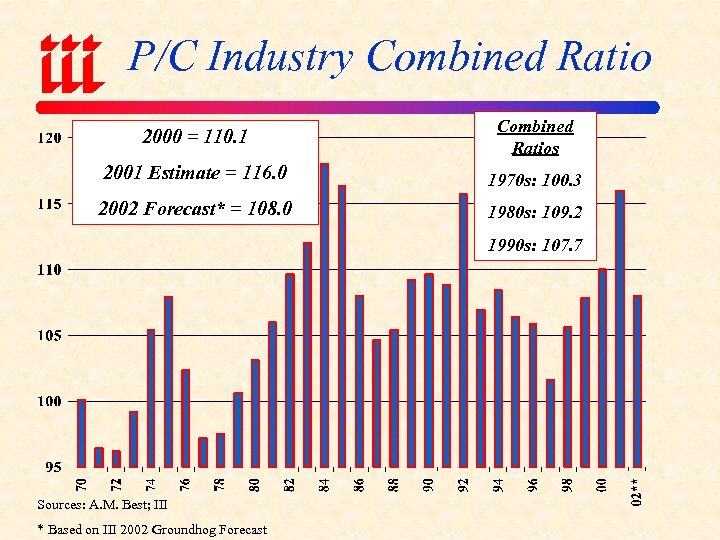 P/C Industry Combined Ratio 2000 = 110. 1 Combined Ratios 2001 Estimate = 116. 0 1970 s: 100. 3 2002 Forecast* = 108. 0 1980 s: 109. 2 1990 s: 107. 7 Sources: A. M. Best; III * Based on III 2002 Groundhog Forecast
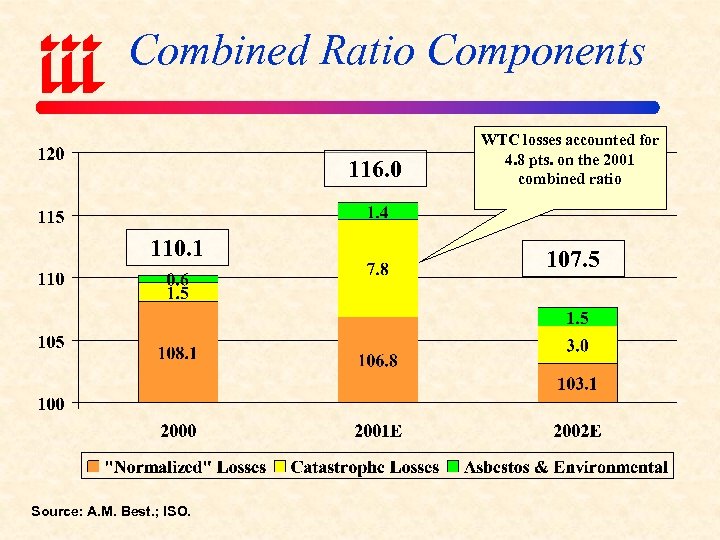 Combined Ratio Components 116. 0 110. 1 Source: A. M. Best. ; ISO. WTC losses accounted for 4. 8 pts. on the 2001 combined ratio 107. 5
 Kitchen Sink Quarter: 2001: Q 4 P/C insurers took $5 billion in miscellaneous charges against their 2001: Q 4 results Source: Morgan Stanley as of February 8, 2002.
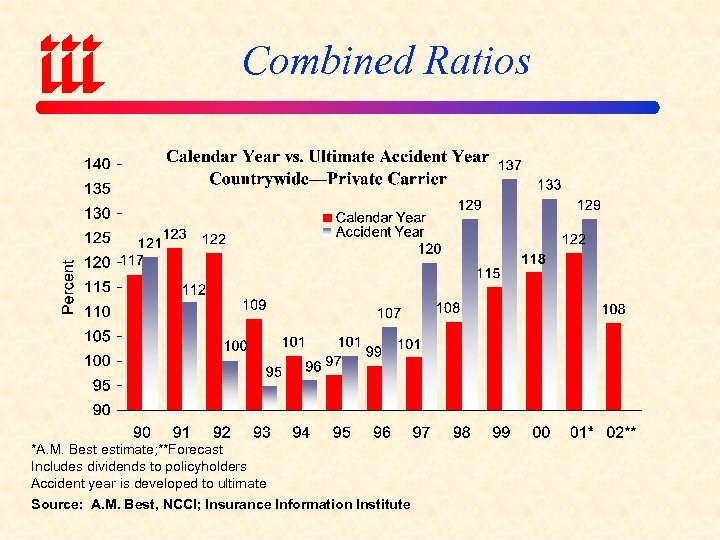 Combined Ratios *A. M. Best estimate; **Forecast Includes dividends to policyholders Accident year is developed to ultimate Source: A. M. Best, NCCI; Insurance Information Institute
 Combined Ratio: Reinsurance vs. P/C Industry 2001’s combined ratio was the worst-ever for reinsurers & the 3 rd worst ever for p/c insurers in aggregate. Source: A. M. Best, ISO, Reinsurance Association of America, Insurance Information Institute
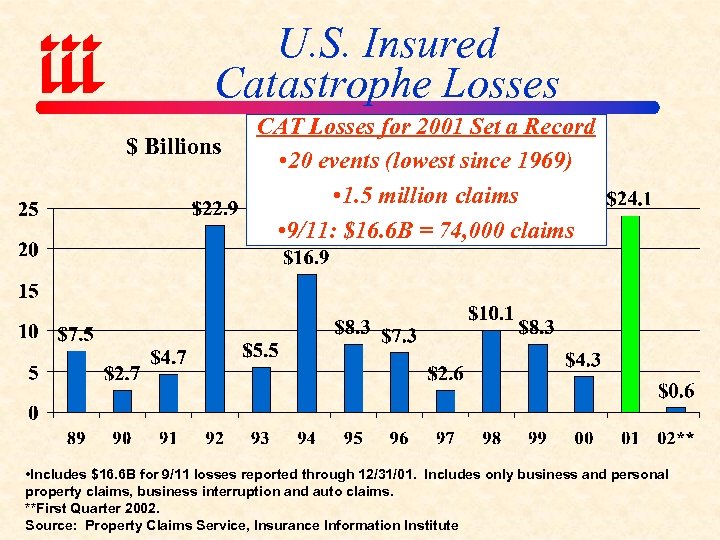 U. S. Insured Catastrophe Losses $ Billions CAT Losses for 2001 Set a Record • 20 events (lowest since 1969) • 1. 5 million claims • 9/11: $16. 6 B = 74, 000 claims • Includes $16. 6 B for 9/11 losses reported through 12/31/01. Includes only business and personal property claims, business interruption and auto claims. **First Quarter 2002. Source: Property Claims Service, Insurance Information Institute
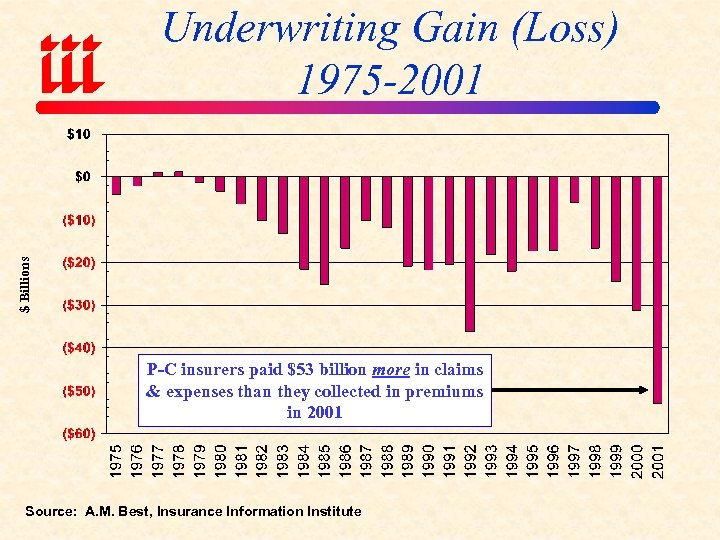 $ Billions Underwriting Gain (Loss) 1975 -2001 P-C insurers paid $53 billion more in claims & expenses than they collected in premiums in 2001 Source: A. M. Best, Insurance Information Institute
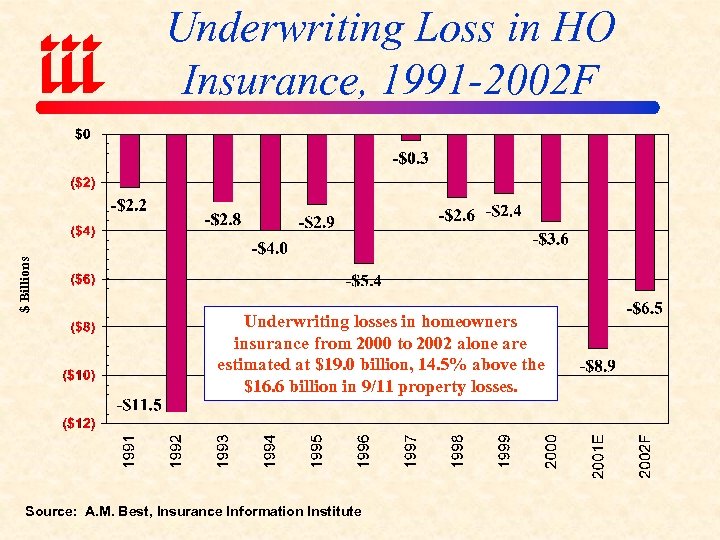 $ Billions Underwriting Loss in HO Insurance, 1991 -2002 F Underwriting losses in homeowners insurance from 2000 to 2002 alone are estimated at $19. 0 billion, 14. 5% above the $16. 6 billion in 9/11 property losses. Source: A. M. Best, Insurance Information Institute
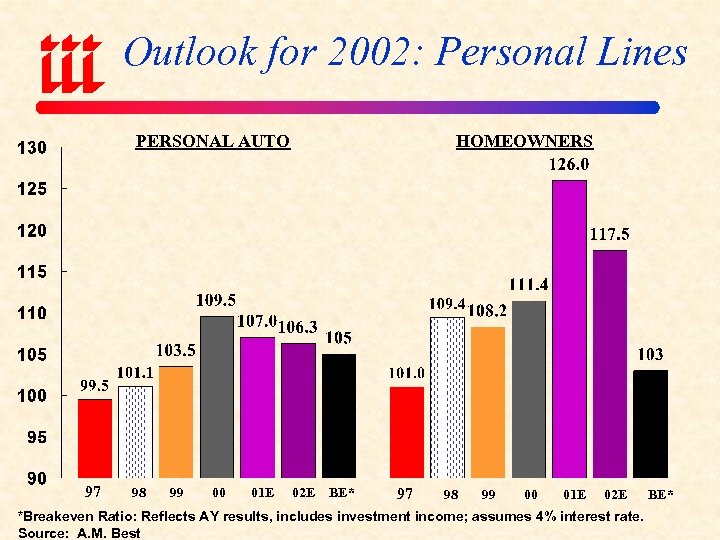 Outlook for 2002: Personal Lines PERSONAL AUTO 97 98 99 00 01 E HOMEOWNERS 02 E BE* 97 98 99 00 01 E 02 E *Breakeven Ratio: Reflects AY results, includes investment income; assumes 4% interest rate. Source: A. M. Best BE*
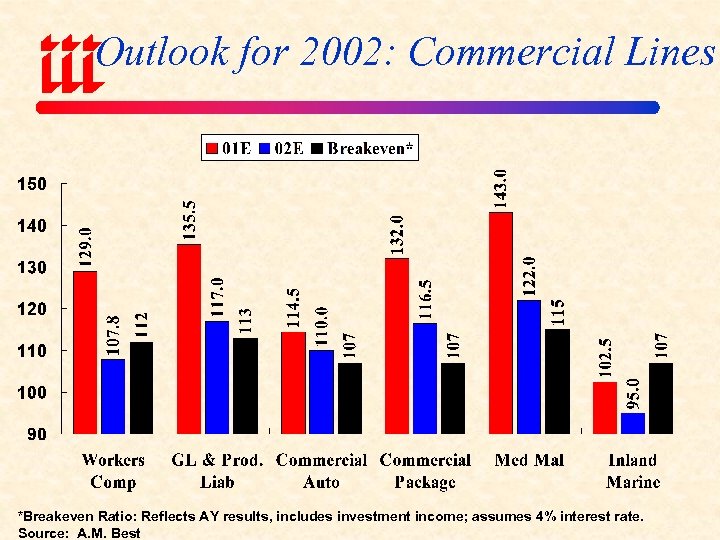 Outlook for 2002: Commercial Lines *Breakeven Ratio: Reflects AY results, includes investment income; assumes 4% interest rate. Source: A. M. Best
 IMPROVE INVESTMENT RETURNS
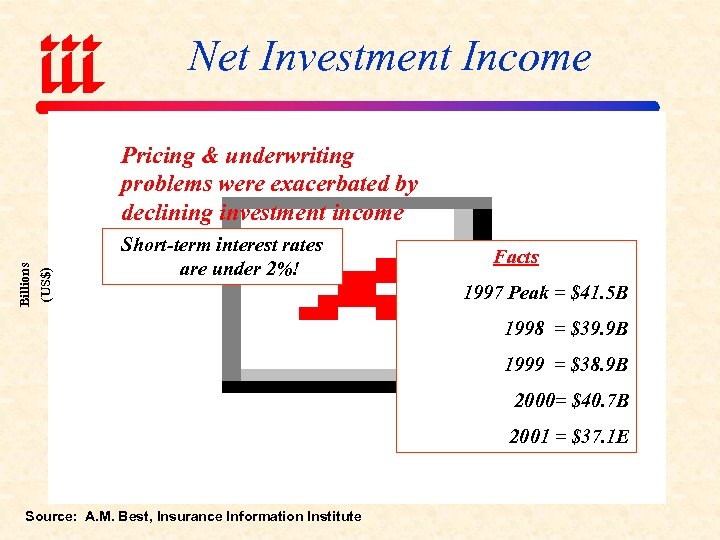 Net Investment Income (US$) Billions Pricing & underwriting problems were exacerbated by declining investment income Short-term interest rates are under 2%! Facts 1997 Peak = $41. 5 B 1998 = $39. 9 B 1999 = $38. 9 B 2000= $40. 7 B 2001 = $37. 1 E Source: A. M. Best, Insurance Information Institute
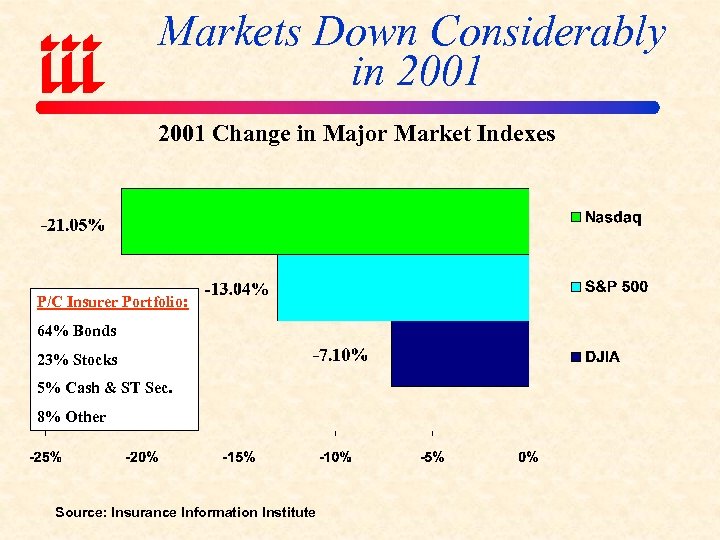 Markets Down Considerably in 2001 Change in Major Market Indexes P/C Insurer Portfolio: 64% Bonds 23% Stocks 5% Cash & ST Sec. 8% Other Source: Insurance Information Institute
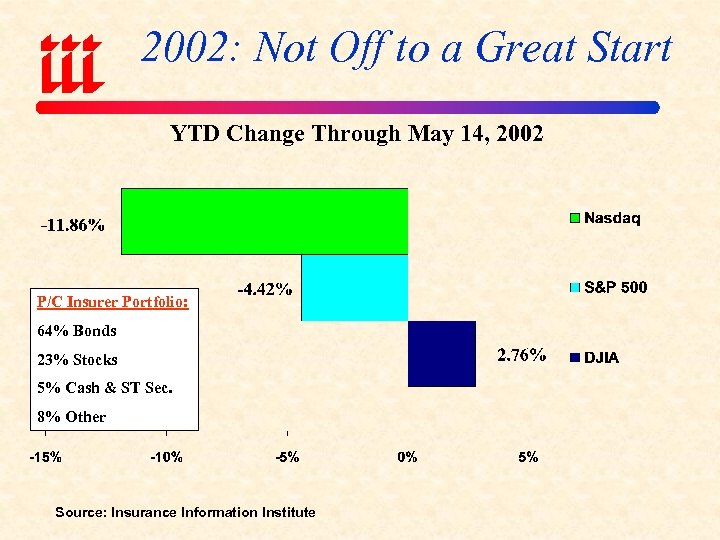 2002: Not Off to a Great Start YTD Change Through May 14, 2002 P/C Insurer Portfolio: 64% Bonds 23% Stocks 5% Cash & ST Sec. 8% Other Source: Insurance Information Institute
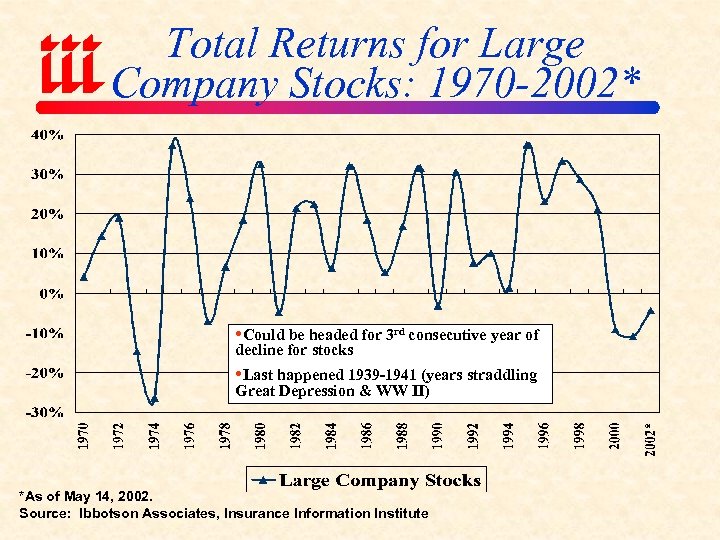 Total Returns for Large Company Stocks: 1970 -2002* Could be headed for 3 rd consecutive year of decline for stocks Last happened 1939 -1941 (years straddling Great Depression & WW II) *As of May 14, 2002. Source: Ibbotson Associates, Insurance Information Institute
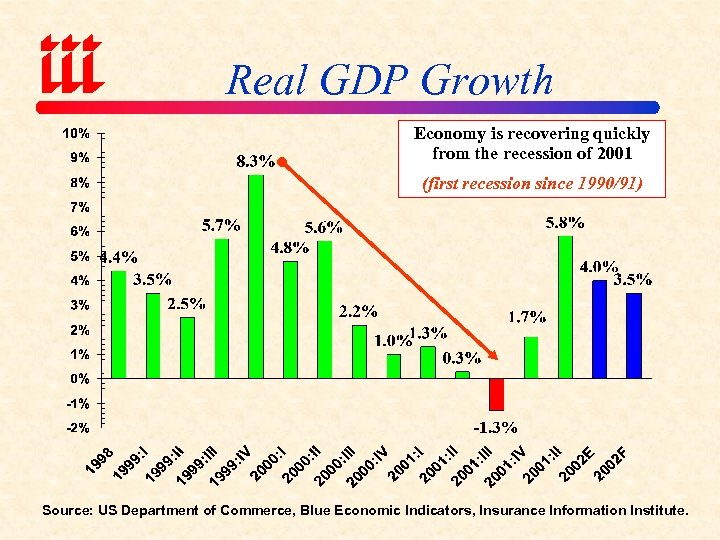 Real GDP Growth Economy is recovering quickly from the recession of 2001 (first recession since 1990/91) Source: US Department of Commerce, Blue Economic Indicators, Insurance Information Institute.
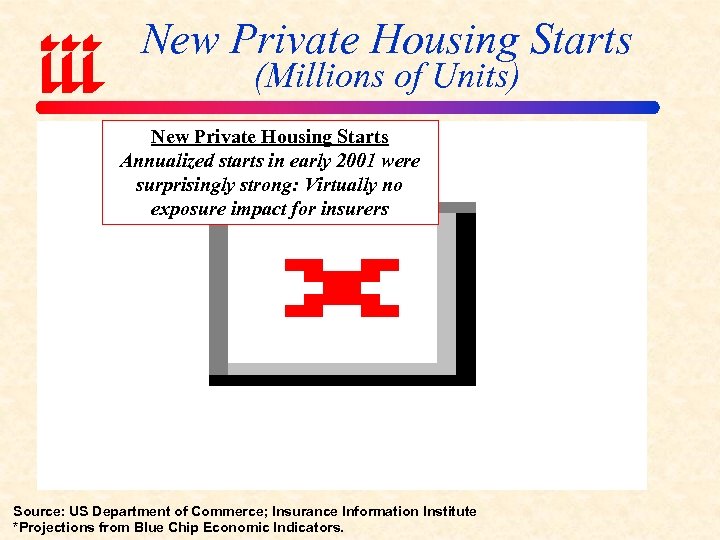 New Private Housing Starts (Millions of Units) New Private Housing Starts Annualized starts in early 2001 were surprisingly strong: Virtually no exposure impact for insurers Source: US Department of Commerce; Insurance Information Institute *Projections from Blue Chip Economic Indicators.
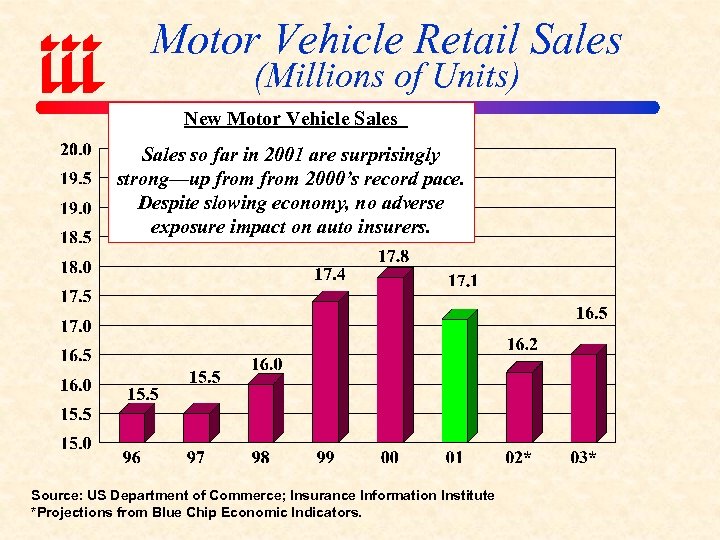 Motor Vehicle Retail Sales (Millions of Units) New Motor Vehicle Sales so far in 2001 are surprisingly strong—up from 2000’s record pace. Despite slowing economy, no adverse exposure impact on auto insurers. Source: US Department of Commerce; Insurance Information Institute *Projections from Blue Chip Economic Indicators.
 ACCELERATE CONSOLIDATION
 Insurance Mergers and Acquisitions 1998: 565 deals valued at $165. 4 B 8 of the 10 top deals in 2001 were in the Life sector; 2 were Health/Mgd. Care None of the top 10 deals were in the P/C sector Source: Compiled from Conning & Company reports.
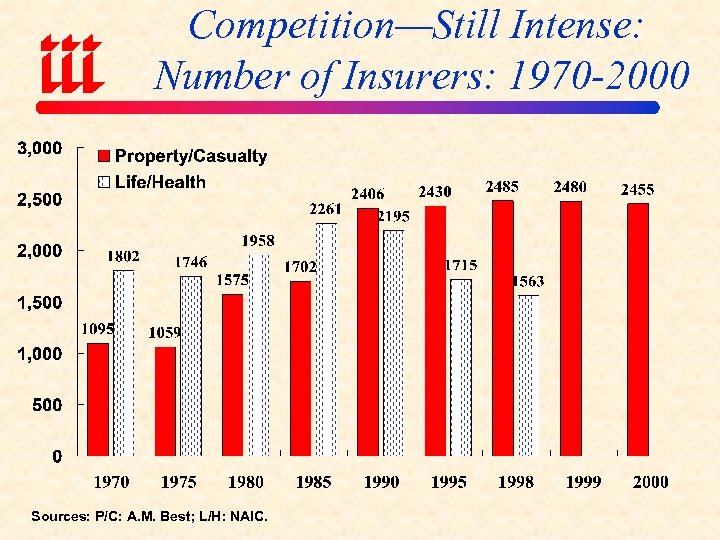 Competition—Still Intense: Number of Insurers: 1970 -2000 Sources: P/C: A. M. Best; L/H: NAIC.
 ADD VALUE THROUGH TECHNOLOGY
 Application of Technology in Underwriting: Insurance Scoring
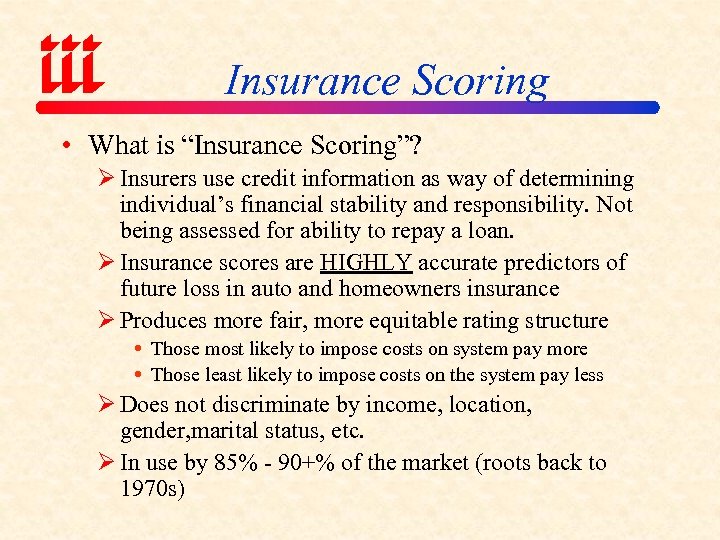 Insurance Scoring • What is “Insurance Scoring”? Ø Insurers use credit information as way of determining individual’s financial stability and responsibility. Not being assessed for ability to repay a loan. Ø Insurance scores are HIGHLY accurate predictors of future loss in auto and homeowners insurance Ø Produces more fair, more equitable rating structure Those most likely to impose costs on system pay more Those least likely to impose costs on the system pay less Ø Does not discriminate by income, location, gender, marital status, etc. Ø In use by 85% - 90+% of the market (roots back to 1970 s)
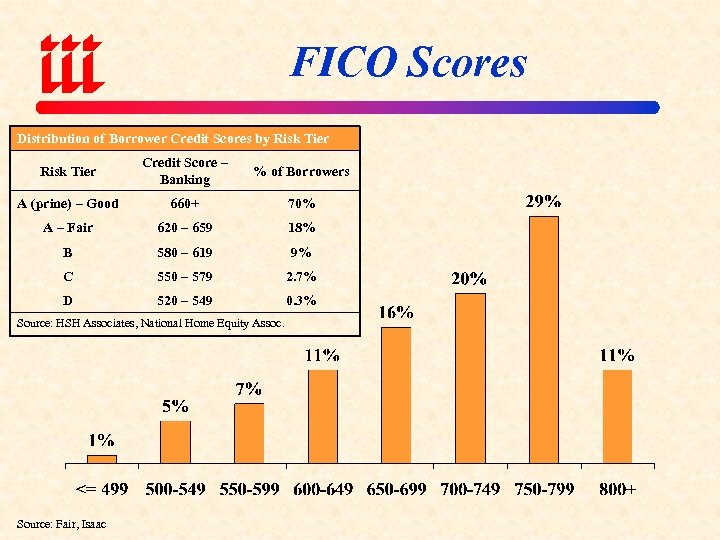 FICO Scores Distribution of Borrower Credit Scores by Risk Tier Credit Score – Banking % of Borrowers A (prine) – Good 660+ 70% A – Fair 620 – 659 18% B 580 – 619 9% C 550 – 579 2. 7% D 520 – 549 0. 3% Source: HSH Associates, National Home Equity Assoc. Source: Fair, Isaac
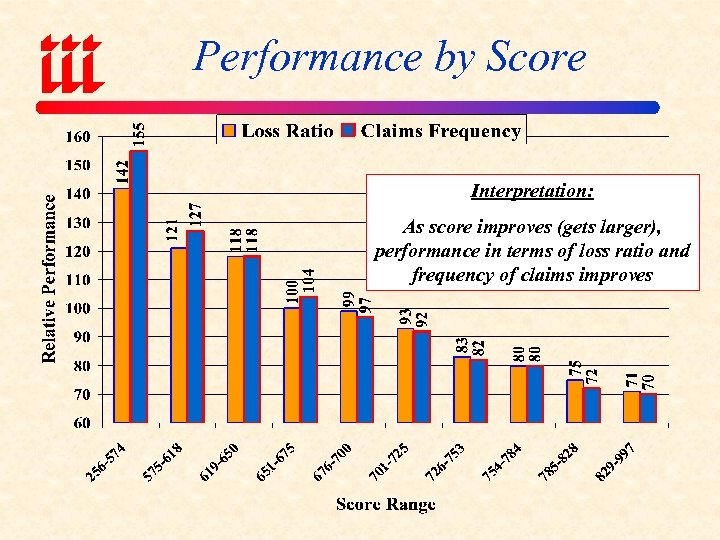 Performance by Score Interpretation: As score improves (gets larger), performance in terms of loss ratio and frequency of claims improves
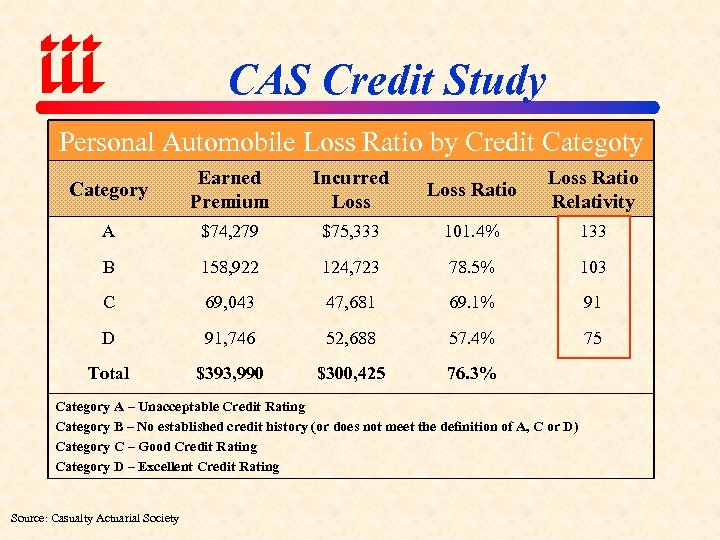 CAS Credit Study Personal Automobile Loss Ratio by Credit Categoty Category Earned Premium Incurred Loss Ratio Relativity A $74, 279 $75, 333 101. 4% 133 B 158, 922 124, 723 78. 5% 103 C 69, 043 47, 681 69. 1% 91 D 91, 746 52, 688 57. 4% 75 Total $393, 990 $300, 425 76. 3% Category A – Unacceptable Credit Rating Category B – No established credit history (or does not meet the definition of A, C or D) Category C – Good Credit Rating Category D – Excellent Credit Rating Source: Casualty Actuarial Society
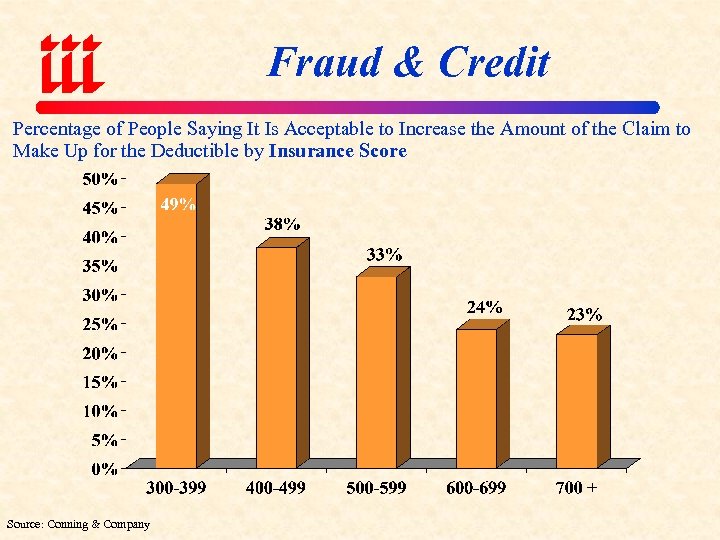 Fraud & Credit Percentage of People Saying It Is Acceptable to Increase the Amount of the Claim to Make Up for the Deductible by Insurance Score Source: Conning & Company
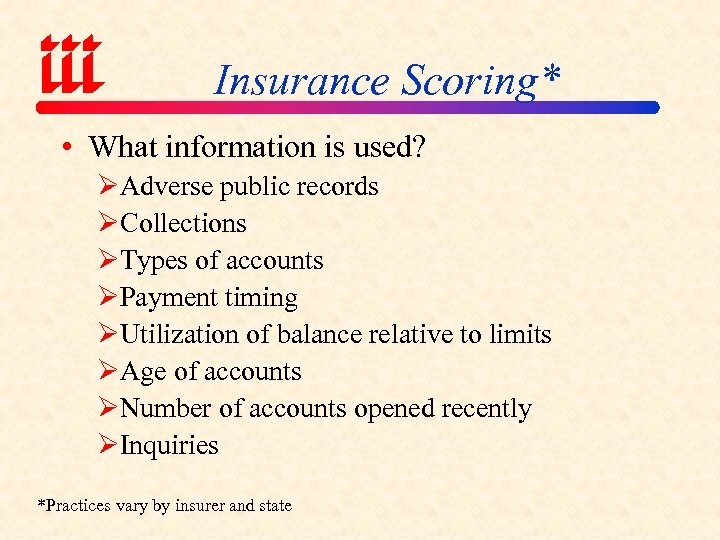 Insurance Scoring* • What information is used? ØAdverse public records ØCollections ØTypes of accounts ØPayment timing ØUtilization of balance relative to limits ØAge of accounts ØNumber of accounts opened recently ØInquiries *Practices vary by insurer and state
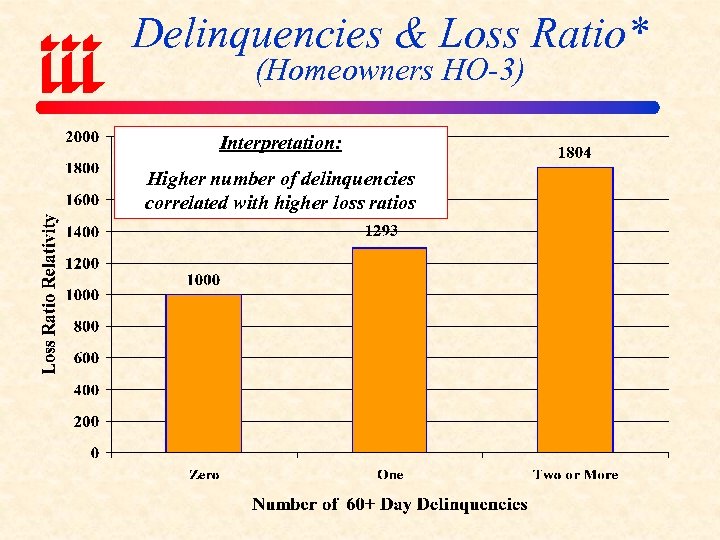 Delinquencies & Loss Ratio* (Homeowners HO-3) Interpretation: Higher number of delinquencies correlated with higher loss ratios
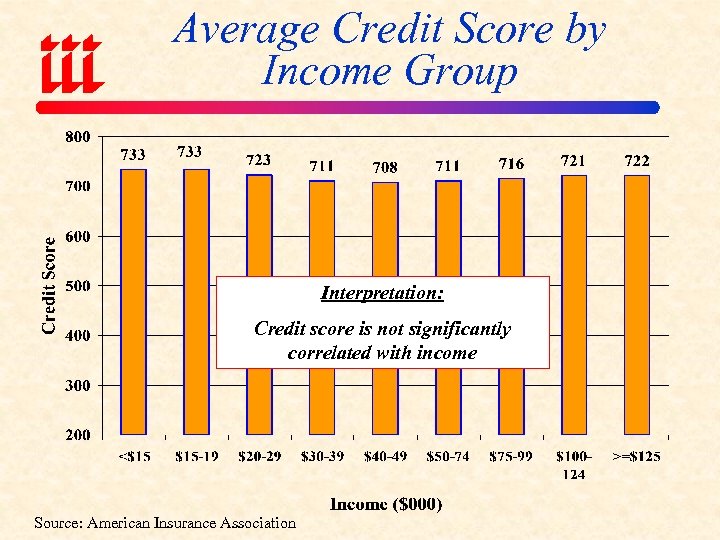 Average Credit Score by Income Group Interpretation: Credit score is not significantly correlated with income Source: American Insurance Association
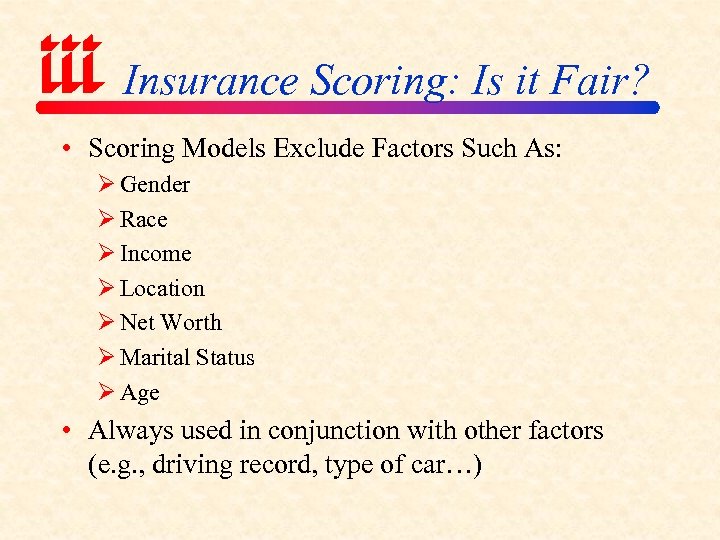 Insurance Scoring: Is it Fair? • Scoring Models Exclude Factors Such As: Ø Gender Ø Race Ø Income Ø Location Ø Net Worth Ø Marital Status Ø Age • Always used in conjunction with other factors (e. g. , driving record, type of car…)
 Insurance Scoring: Is it Fair? • Insurers comply with Fair Credit Reporting Act of 1970 (& subsequent amendments) ØFirms must have permissable purpose to access (underwriting of insurance is explicitly listed as a permissable purpose) ØConsumer must notified of adverse action ØConsumer may obtain free copy of report ØConsumer may request full reinvestigation ØConsumer may dispute reinvestigation results
 RESTORE ORDER TO THE COURTS
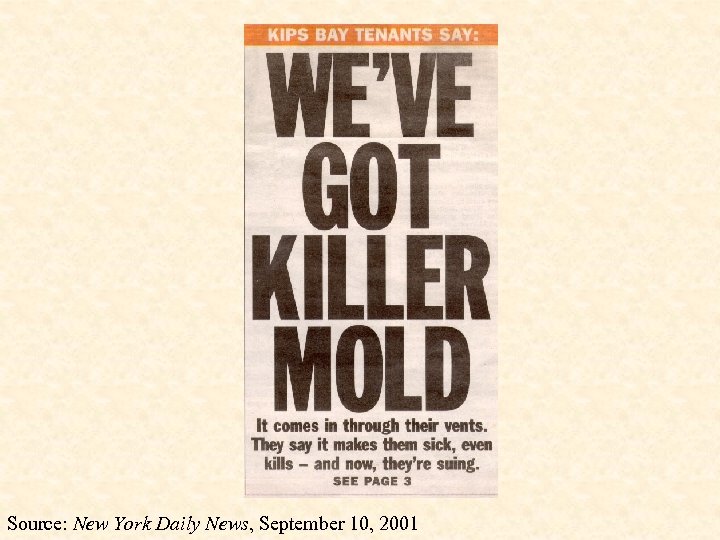
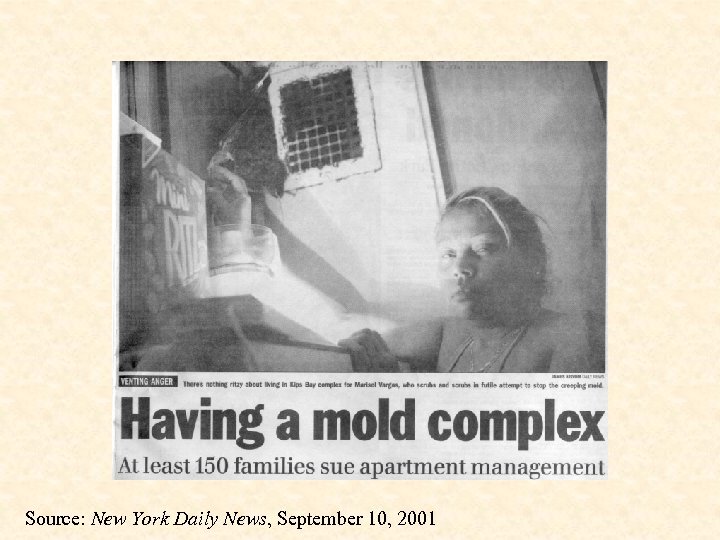
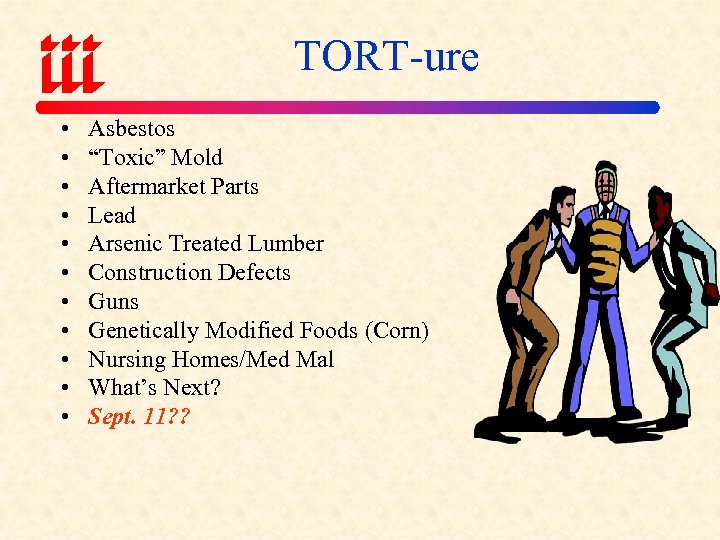 TORT-ure • • • Asbestos “Toxic” Mold Aftermarket Parts Lead Arsenic Treated Lumber Construction Defects Guns Genetically Modified Foods (Corn) Nursing Homes/Med Mal What’s Next? Sept. 11? ?
 Average Jury Awards 1994 vs. 2000 Source: Jury Verdict Research; Insurance Information Institute.
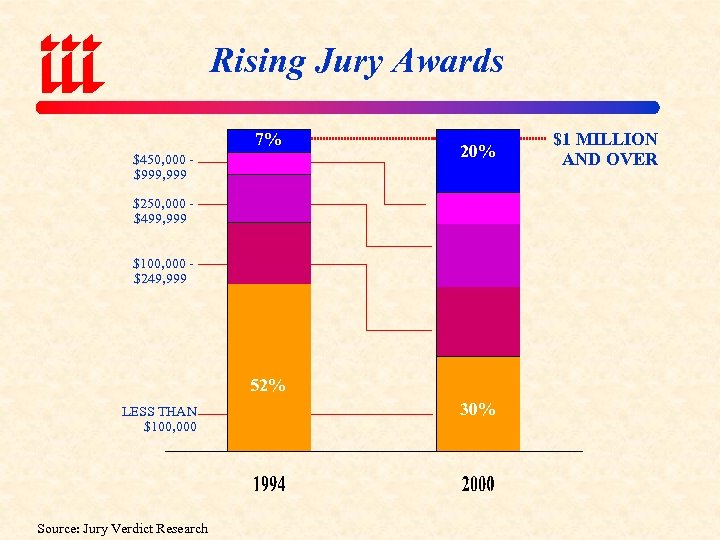 Rising Jury Awards 7% $450, 000 $999, 999 20% $250, 000 $499, 999 $100, 000 $249, 999 52% LESS THAN $100, 000 Source: Jury Verdict Research 30% $1 MILLION AND OVER
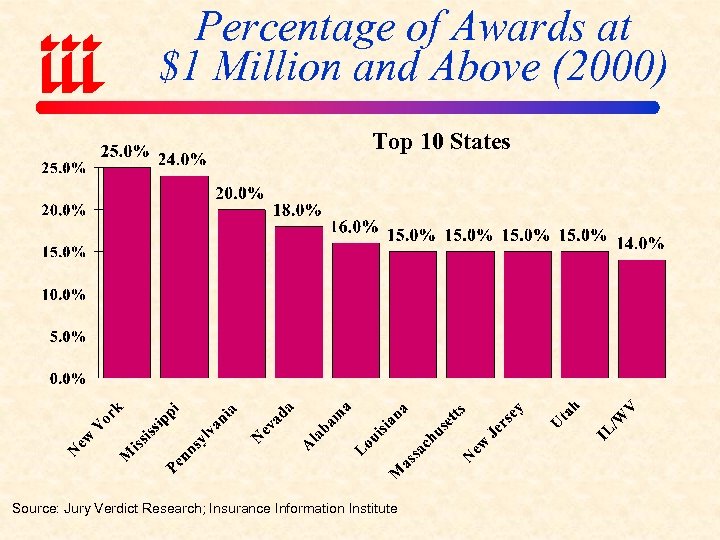 Percentage of Awards at $1 Million and Above (2000) Top 10 States Source: Jury Verdict Research; Insurance Information Institute
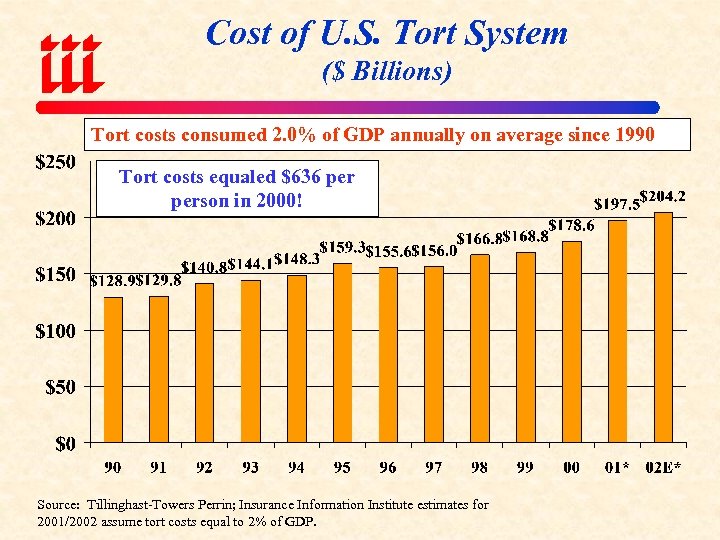 Cost of U. S. Tort System ($ Billions) Tort costs consumed 2. 0% of GDP annually on average since 1990 Tort costs equaled $636 person in 2000! Source: Tillinghast-Towers Perrin; Insurance Information Institute estimates for 2001/2002 assume tort costs equal to 2% of GDP.
 Source: New York Daily News, September 10, 2001
 Source: New York Times Magazine, August 12, 2001
 Source: New York Daily News, September 10, 2001
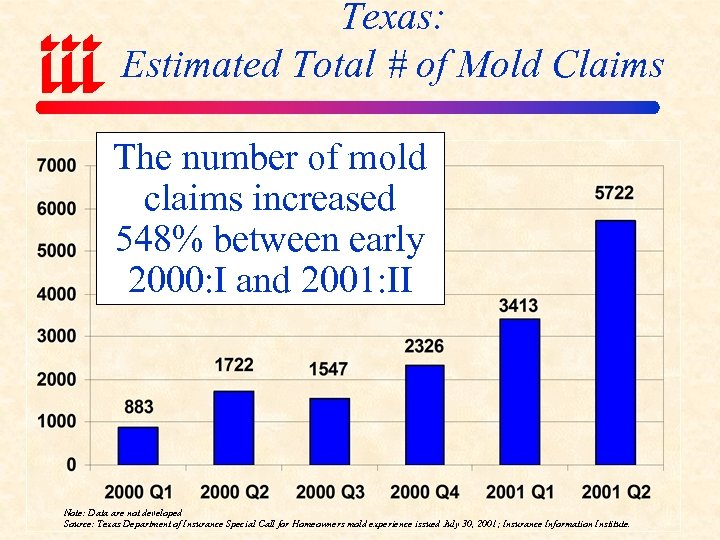 Texas: Estimated Total # of Mold Claims The number of mold claims increased 548% between early 2000: I and 2001: II Note: Data are not developed Source: Texas Department of Insurance Special Call for Homeowners mold experience issued July 30, 2001; Insurance Information Institute.
 Asbestos: Reserve Deficiency and Ultimate Costs Growing Reserve Deficiency = $33. 1 Billion Source: A. M. Best.
 KEEP WALL STREET HAPPY
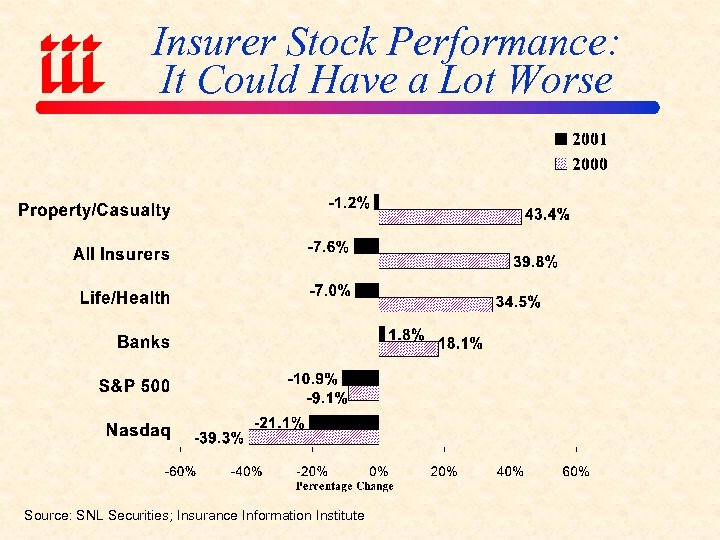 Insurer Stock Performance: It Could Have a Lot Worse Source: SNL Securities; Insurance Information Institute
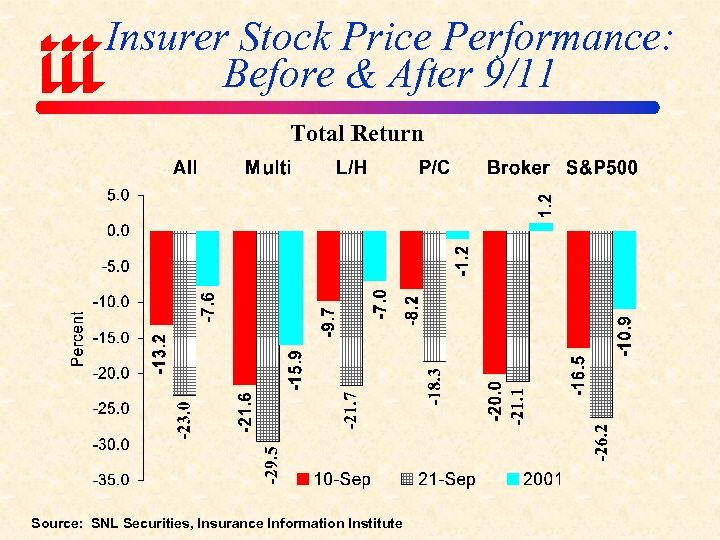 Insurer Stock Price Performance: Before & After 9/11 Total Return Source: SNL Securities, Insurance Information Institute
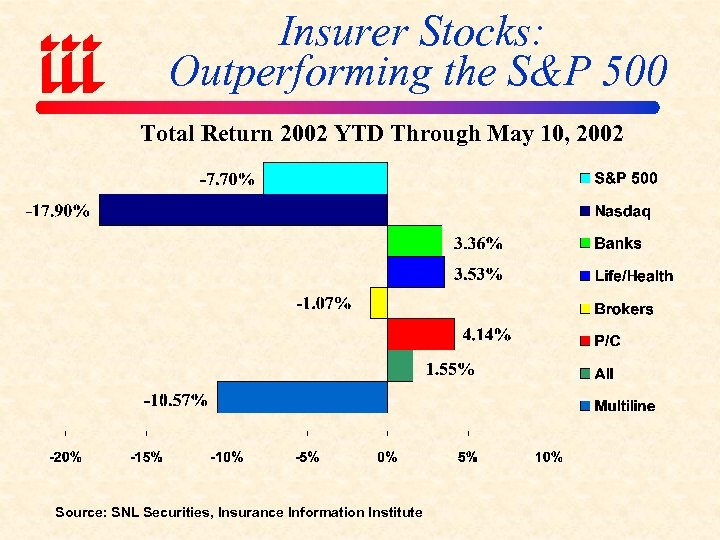 Insurer Stocks: Outperforming the S&P 500 Total Return 2002 YTD Through May 10, 2002 Source: SNL Securities, Insurance Information Institute
 THE CHALLENGE OF CORPORATE GOVERNANCE
 CORPORATE GOVERNANCE: New & Difficult Risk for Financial Institutions
 Accounting Problems are Getting Many Companies into Trouble • Enron fallout much worse than anticipated • Many companies restating earnings
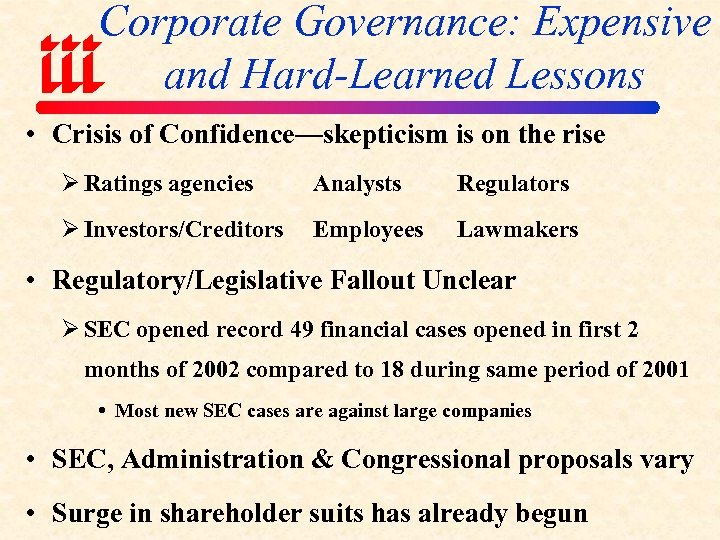 Corporate Governance: Expensive and Hard-Learned Lessons • Crisis of Confidence—skepticism is on the rise Ø Ratings agencies Analysts Regulators Ø Investors/Creditors Employees Lawmakers • Regulatory/Legislative Fallout Unclear Ø SEC opened record 49 financial cases opened in first 2 months of 2002 compared to 18 during same period of 2001 Most new SEC cases are against large companies • SEC, Administration & Congressional proposals vary • Surge in shareholder suits has already begun
 Breach of Faith Cover of Business. Week, May 13, 2002
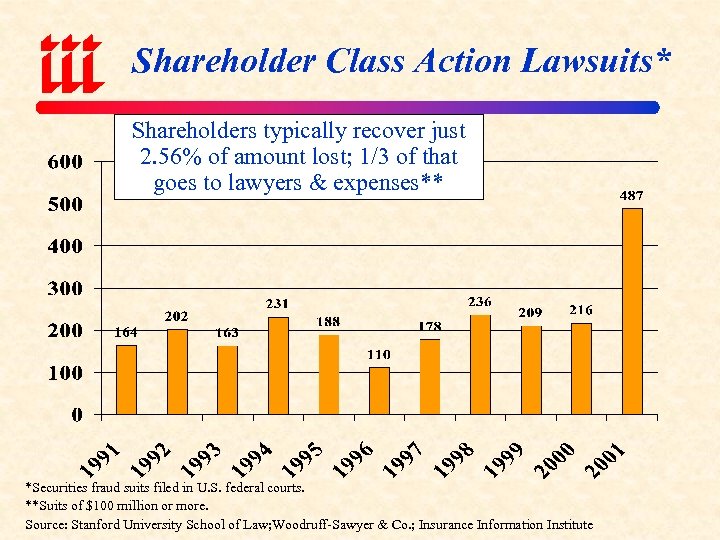 Shareholder Class Action Lawsuits* Shareholders typically recover just 2. 56% of amount lost; 1/3 of that goes to lawyers & expenses** *Securities fraud suits filed in U. S. federal courts. **Suits of $100 million or more. Source: Stanford University School of Law; Woodruff-Sawyer & Co. ; Insurance Information Institute
 Serious Implications for Financial Institutions • FIs exposed to wide variety of risks: Ø Investment risk (as institutional investors) Ø Insurance risk (surety, credit guarantees, D&O) Ø Professional liability (investment banks advisory role) Ø Reputation risk • FIs will be targets of regulatory/legal action Ø Most large FIs are organizationally complex Ø GLB necessarily increases complexity (BHC tent is big) Ø As principals go bankrupt, shareholders go in search of deep pockets (Read: Wall Street)
 Houston… We Have a Problem Total Exposure (Life & Non-Life): $3. 796 Billion Enron is the biggest bankruptcy in US history ($31 B+) Equity/debt widely -held as S&P 500 company Biggest impact in institutional investors/creditors 11 Congressional investigations 56 suits against officers & directors Will spark similar suits Source: Loss estimates from Morgan Stanley as Feb. 8, 2002; Insurance Information Institute.
 THE CHALLENGE OF TERRORISM
 TERRORIST ATTACKS OF SEPTEMBER 11, 2001
 What’s this Going to Cost & Who’s Going to Pay for It?
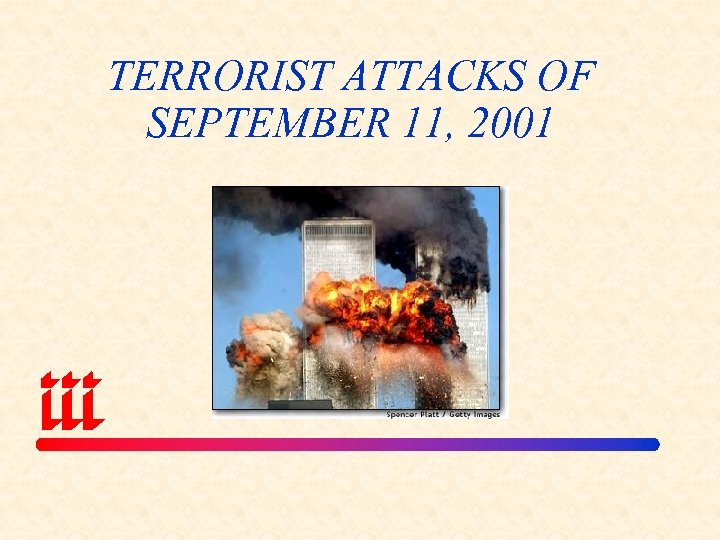
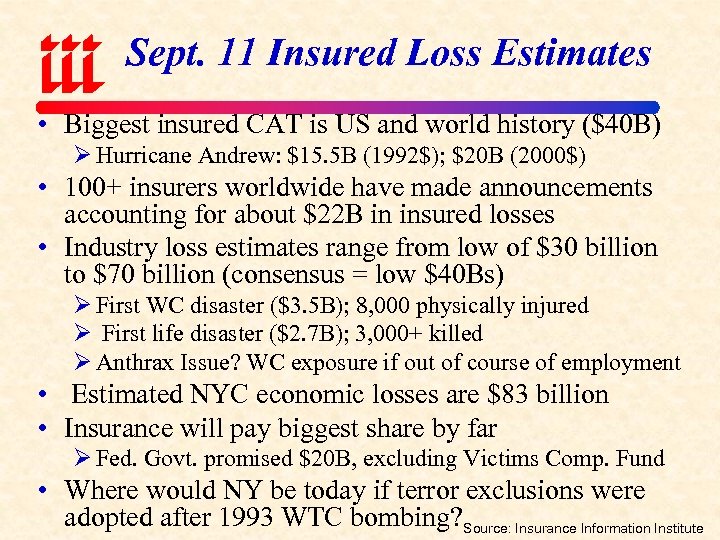 Sept. 11 Insured Loss Estimates • Biggest insured CAT is US and world history ($40 B) Ø Hurricane Andrew: $15. 5 B (1992$); $20 B (2000$) • 100+ insurers worldwide have made announcements accounting for about $22 B in insured losses • Industry loss estimates range from low of $30 billion to $70 billion (consensus = low $40 Bs) Ø First WC disaster ($3. 5 B); 8, 000 physically injured Ø First life disaster ($2. 7 B); 3, 000+ killed Ø Anthrax Issue? WC exposure if out of course of employment • Estimated NYC economic losses are $83 billion • Insurance will pay biggest share by far Ø Fed. Govt. promised $20 B, excluding Victims Comp. Fund • Where would NY be today if terror exclusions were adopted after 1993 WTC bombing? Source: Insurance Information Institute
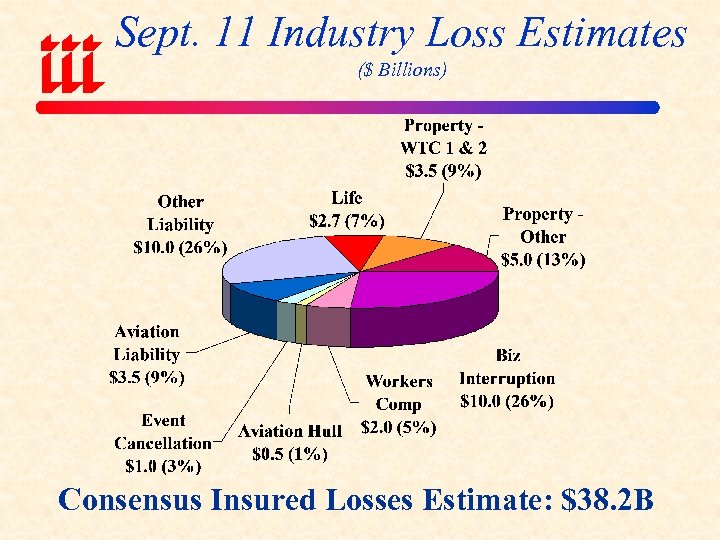 Sept. 11 Industry Loss Estimates ($ Billions) Consensus Insured Losses Estimate: $38. 2 B
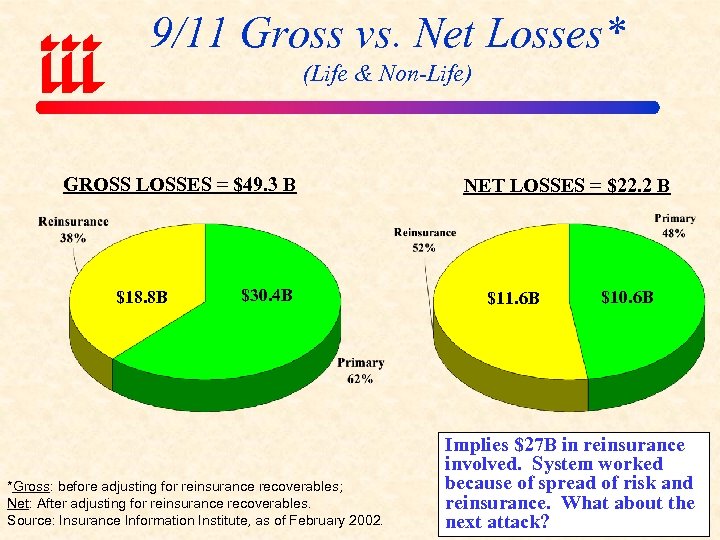 9/11 Gross vs. Net Losses* (Life & Non-Life) GROSS LOSSES = $49. 3 B $18. 8 B $30. 4 B *Gross: before adjusting for reinsurance recoverables; Net: After adjusting for reinsurance recoverables. Source: Insurance Information Institute, as of February 2002. NET LOSSES = $22. 2 B $11. 6 B $10. 6 B Implies $27 B in reinsurance involved. System worked because of spread of risk and reinsurance. What about the next attack?
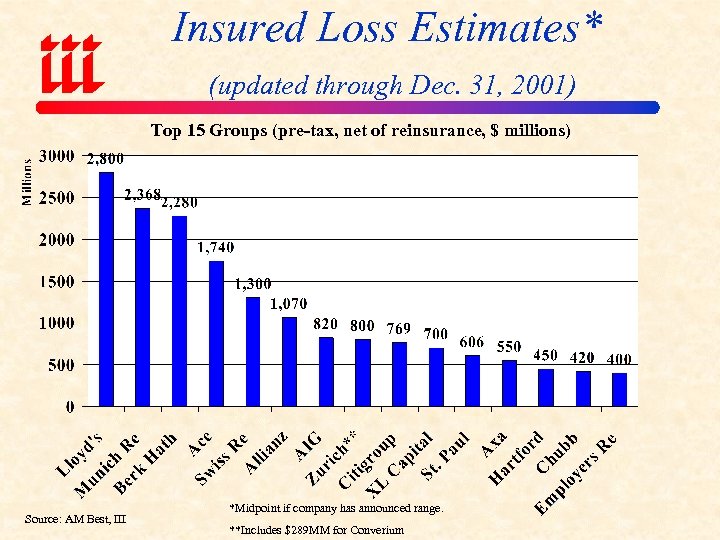 Insured Loss Estimates* (updated through Dec. 31, 2001) Top 15 Groups (pre-tax, net of reinsurance, $ millions) Source: AM Best, III *Midpoint if company has announced range. **Includes $289 MM for Converium
 World: Top 10 Biggest Catastrophes (by insured loss) $ Billions, in 2000 $ *III Estimate; Includes life, liability and workers compensation losses. Source: Swiss Re, Insurance Information Institute.
 What About the Next Attack?
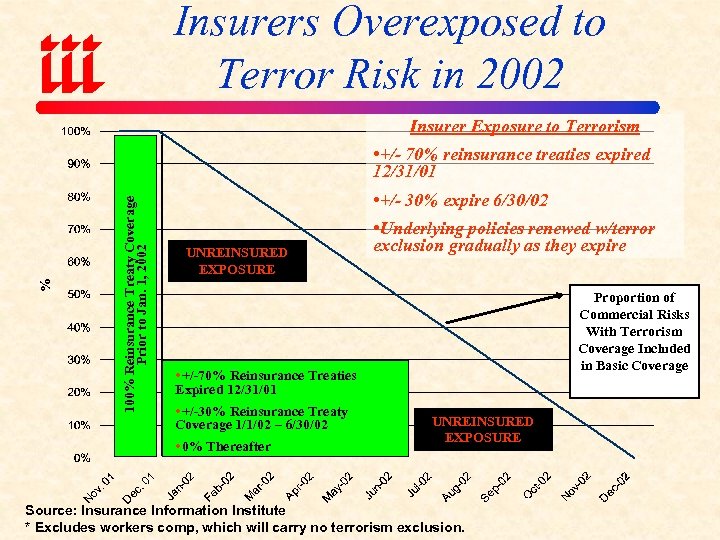 Insurers Overexposed to Terror Risk in 2002 Insurer Exposure to Terrorism 100% Reinsurance Treaty Coverage Prior to Jan. 1, 2002 % • +/- 70% reinsurance treaties expired 12/31/01 • +/- 30% expire 6/30/02 UNREINSURED EXPOSURE • Underlying policies renewed w/terror exclusion gradually as they expire Proportion of Commercial Risks With Terrorism Coverage Included in Basic Coverage +/-70% Reinsurance Treaties Expired 12/31/01 +/-30% Reinsurance Treaty Coverage 1/1/02 – 6/30/02 0% Thereafter UNREINSURED EXPOSURE Source: Insurance Information Institute * Excludes workers comp, which will carry no terrorism exclusion.
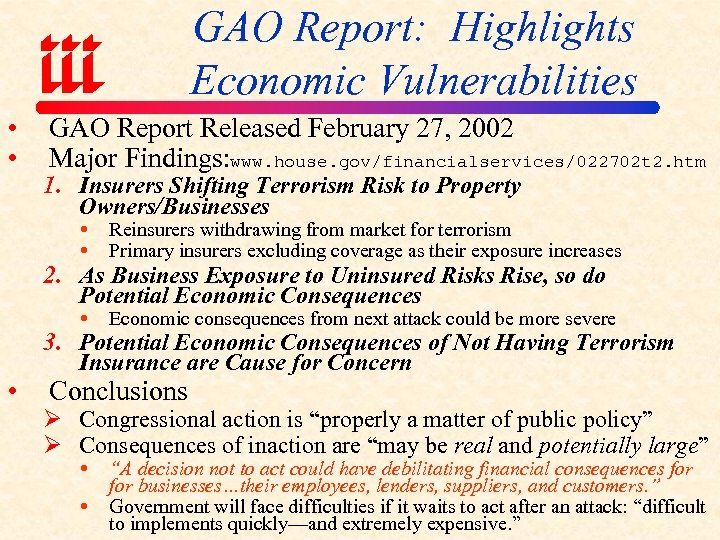 GAO Report: Highlights Economic Vulnerabilities • • GAO Report Released February 27, 2002 Major Findings: www. house. gov/financialservices/022702 t 2. htm 1. Insurers Shifting Terrorism Risk to Property Owners/Businesses Reinsurers withdrawing from market for terrorism Primary insurers excluding coverage as their exposure increases Economic consequences from next attack could be more severe 2. As Business Exposure to Uninsured Risks Rise, so do Potential Economic Consequences • 3. Potential Economic Consequences of Not Having Terrorism Insurance are Cause for Concern Conclusions Ø Congressional action is “properly a matter of public policy” Ø Consequences of inaction are “may be real and potentially large” “A decision not to act could have debilitating financial consequences for businesses…their employees, lenders, suppliers, and customers. ” Government will face difficulties if it waits to act after an attack: “difficult to implements quickly—and extremely expensive. ”
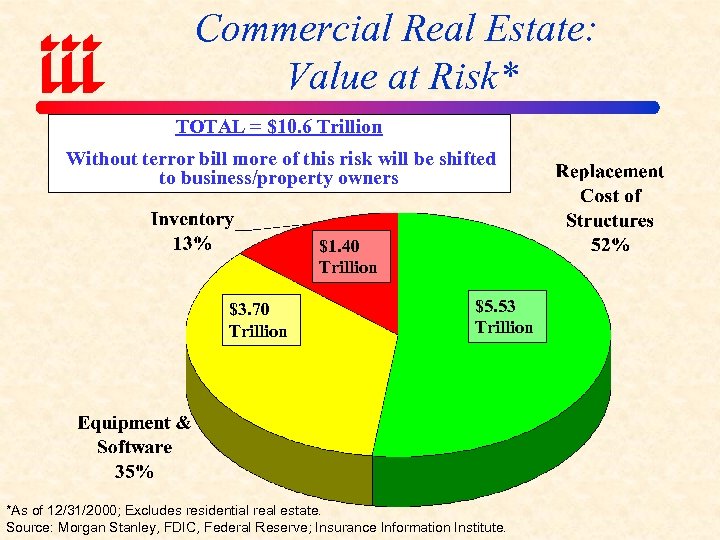 Commercial Real Estate: Value at Risk* TOTAL = $10. 6 Trillion Without terror bill more of this risk will be shifted to business/property owners $1. 40 Trillion $3. 70 Trillion $5. 53 Trillion *As of 12/31/2000; Excludes residential real estate. Source: Morgan Stanley, FDIC, Federal Reserve; Insurance Information Institute.
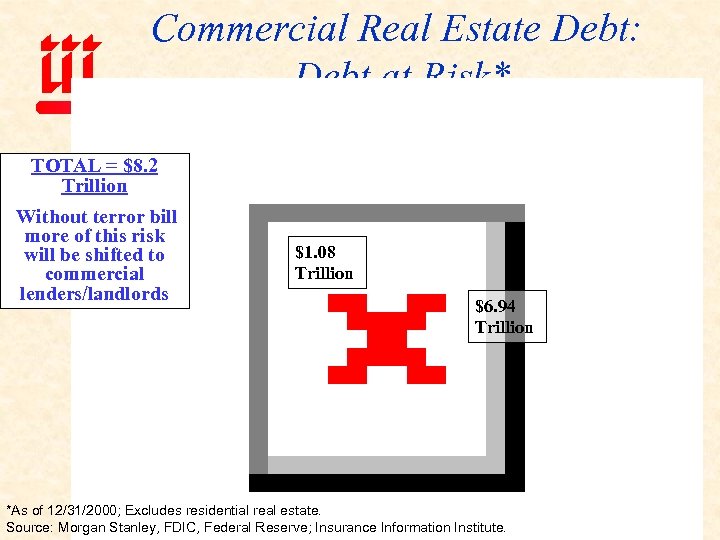 Commercial Real Estate Debt: Debt at Risk* TOTAL = $8. 2 Trillion Without terror bill more of this risk will be shifted to commercial lenders/landlords $1. 08 Trillion $6. 94 Trillion *As of 12/31/2000; Excludes residential real estate. Source: Morgan Stanley, FDIC, Federal Reserve; Insurance Information Institute.
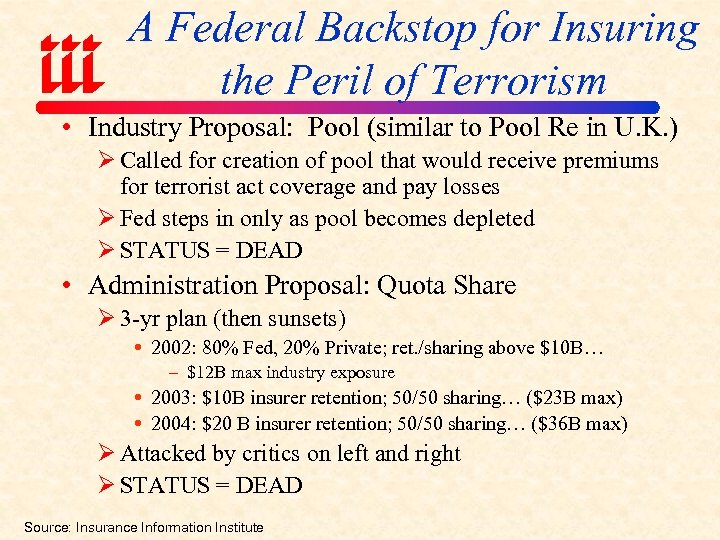 A Federal Backstop for Insuring the Peril of Terrorism • Industry Proposal: Pool (similar to Pool Re in U. K. ) Ø Called for creation of pool that would receive premiums for terrorist act coverage and pay losses Ø Fed steps in only as pool becomes depleted Ø STATUS = DEAD • Administration Proposal: Quota Share Ø 3 -yr plan (then sunsets) 2002: 80% Fed, 20% Private; ret. /sharing above $10 B… – $12 B max industry exposure 2003: $10 B insurer retention; 50/50 sharing… ($23 B max) 2004: $20 B insurer retention; 50/50 sharing… ($36 B max) Ø Attacked by critics on left and right Ø STATUS = DEAD Source: Insurance Information Institute
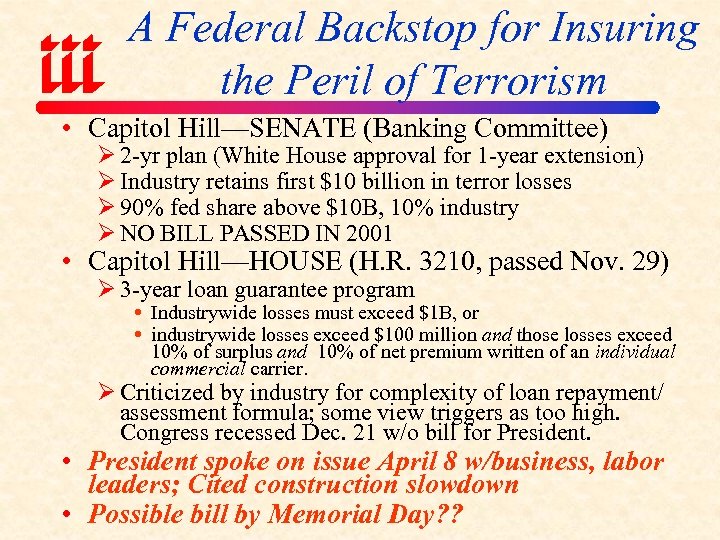 A Federal Backstop for Insuring the Peril of Terrorism • Capitol Hill—SENATE (Banking Committee) Ø 2 -yr plan (White House approval for 1 -year extension) Ø Industry retains first $10 billion in terror losses Ø 90% fed share above $10 B, 10% industry Ø NO BILL PASSED IN 2001 • Capitol Hill—HOUSE (H. R. 3210, passed Nov. 29) Ø 3 -year loan guarantee program Industrywide losses must exceed $1 B, or industrywide losses exceed $100 million and those losses exceed 10% of surplus and 10% of net premium written of an individual commercial carrier. Ø Criticized by industry for complexity of loan repayment/ assessment formula; some view triggers as too high. Congress recessed Dec. 21 w/o bill for President. • President spoke on issue April 8 w/business, labor leaders; Cited construction slowdown • Possible bill by Memorial Day? ?
 Insurance Information Institute On-Line If you would like a copy of this presentation, please give me your business card with e-mail address