


 Скачать презентацию What is your choice Organic 2000 LL kg 2500
beb6970f5b384eca7a12c1099051690b.ppt
- Количество слайдов: 32
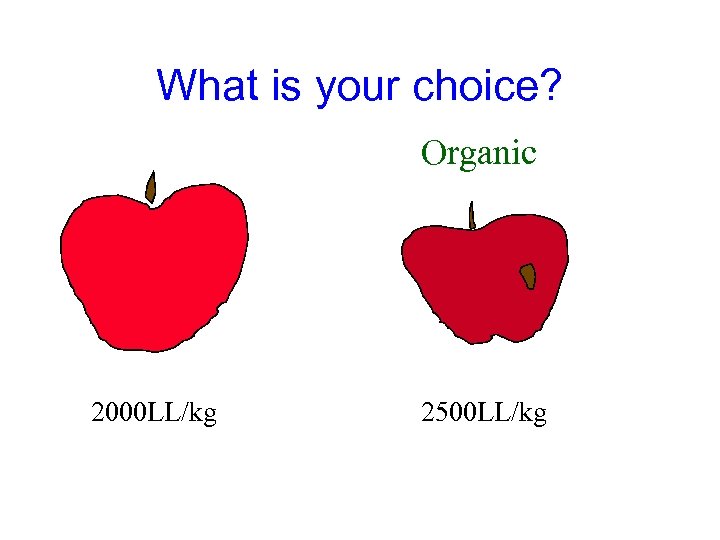 What is your choice? Organic 2000 LL/kg 2500 LL/kg
 AGSC 231 Principles of Agronomy Organic farming By S. K. Yau, revised May 2010
 Content u Brief background u What is organic farming (OF) – Definition & Principles ? u Major misconceptions u Why practice OF? u Can organic crops be grown successfully? u Is no-till possible in OF?
 Background u u u organic movement developed fast in the 1980 s consumer interest developed even faster - because of health and environment concern International Federation of Organic Agric. Movement (IFOAM), conference in 1989 (www. ifoam. org) Some European countries introduced schemes to support farmers financially in the critical conversion period. Research taking place at universities and elsewhere, particularly in Europe and North America
 What is OF? _ besides misconceptions, nomenclature varies in different parts of the world _ the term ‘biological’ more favored in mainland Europe, whereas Britain and USA stick to ‘organic’ _ a short, sharp, and clear definition for OF not available
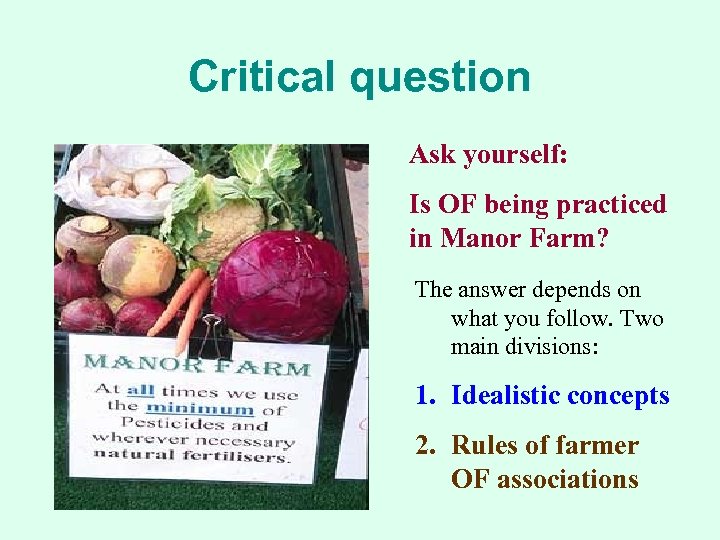 Critical question Ask yourself: Is OF being practiced in Manor Farm? The answer depends on what you follow. Two main divisions: 1. Idealistic concepts 2. Rules of farmer OF associations
 Definition of O. F. by USDA a production system which avoids or largely excludes the use of synthetically compounded fertilizers, pesticides, growth regulators, and feed additives. * to the maximum extent feasible, it relies on crop rotations, crop residues, animal manure, legumes, green manure, and off-farm organic wastes to supply plant nutrients, and biological pest control to maintain soil productivity, and to control insects, weeds, and other pests. * the concept of the soil as a living system. . . that develops. . . the activities of beneficial organisms. . . is central to this definition. (i. e. , farmers should seek harmony with nature) *
 Important principles of O. F. (by IFOAM) /to produce good-quality nutritious food sufficiently /to work with natural systems rather than dominate /to enhance the biological cycles involving microorganisms, soil flora and fauna, plants, and animals /to use as far as possible renewable resources /to work as much as possible within a closed system with regard to organic matter and nutrient elements /to maintain and increase the long-term fertility of soils /to maintain the genetic diversity of the agricultural system and its surroundings, including the protection of plant and wildlife habitats /to avoid all forms of pollution
 Common misconceptions on OF? OF commonly known to be ‘farming without chemicals’ u Is this true? u Case 1 - If we apply manure to the field or plow under a green manure crop before sowing, does it mean that we are not supplying chemicals to our crop? u Case 2 – If we use an extract from a certain plant and spray it to control a bug feeding on our crop, does it mean that we are not applying chemicals? u
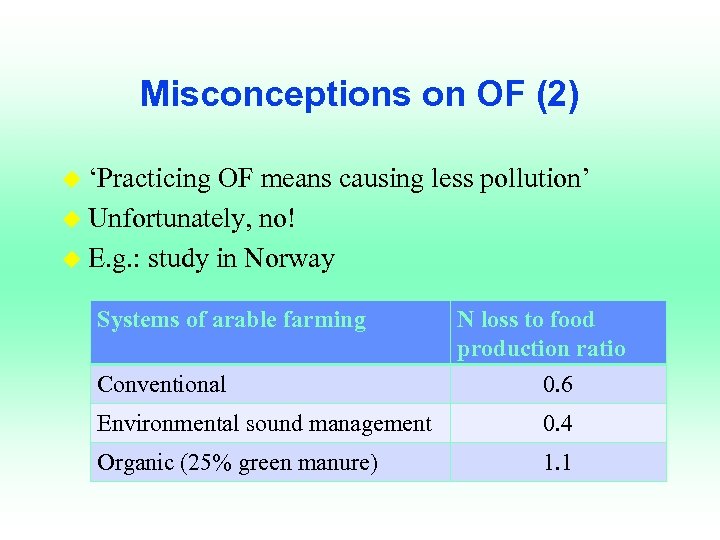 Misconceptions on OF (2) u ‘Practicing OF means causing less pollution’ u Unfortunately, no! u E. g. : study in Norway Systems of arable farming N loss to food production ratio Conventional 0. 6 Environmental sound management 0. 4 Organic (25% green manure) 1. 1
 Why practice O. F. ? u widespread concern over the countryside and environment, e. g. , loss of natural habitat and species, and water pollution, with special reference to human health. u growing realization that finite natural resources need to be more carefully managed u subsidized over-production in Europe causes unendurable financial strain and political problem, e. g. , export subsidies u people want to buy organic food to the extent of paying a price premium of 15 % or more
 Can organic crops be grown successfully?
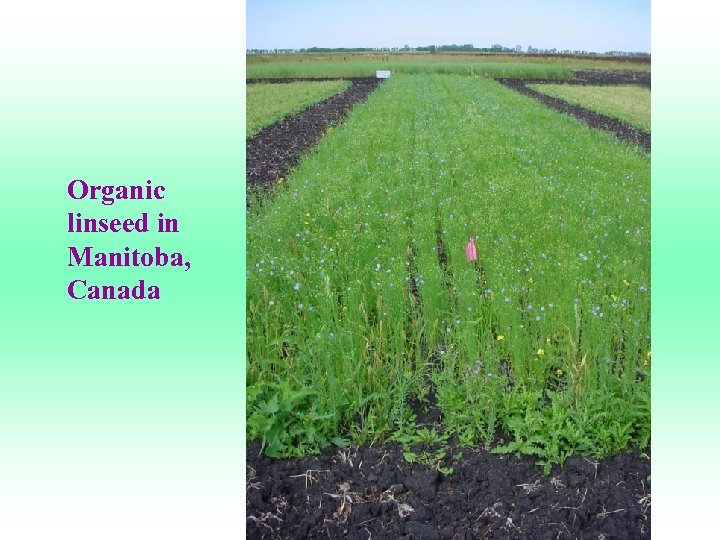 Organic linseed in Manitoba, Canada
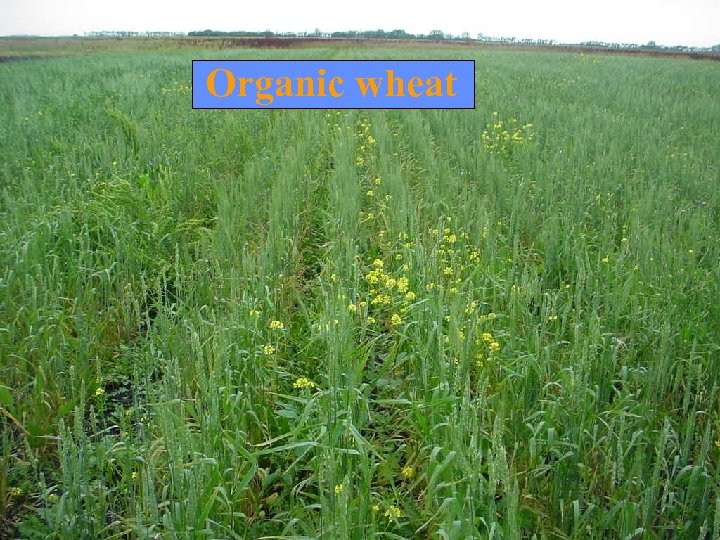 Organic wheat
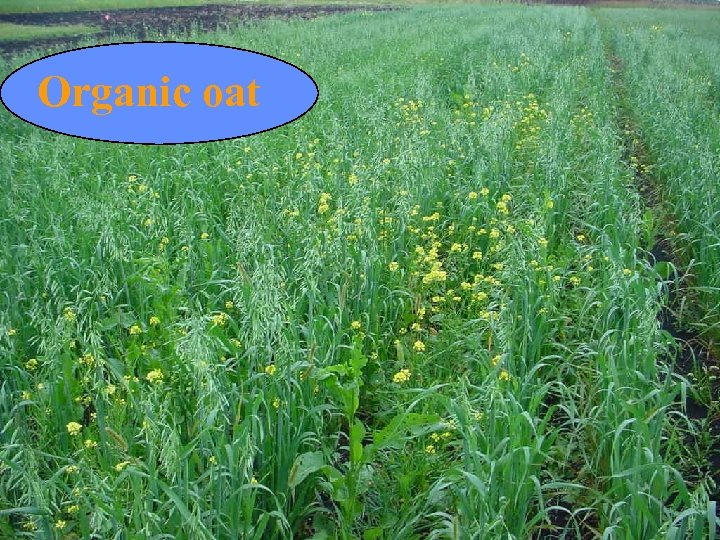 Organic oat
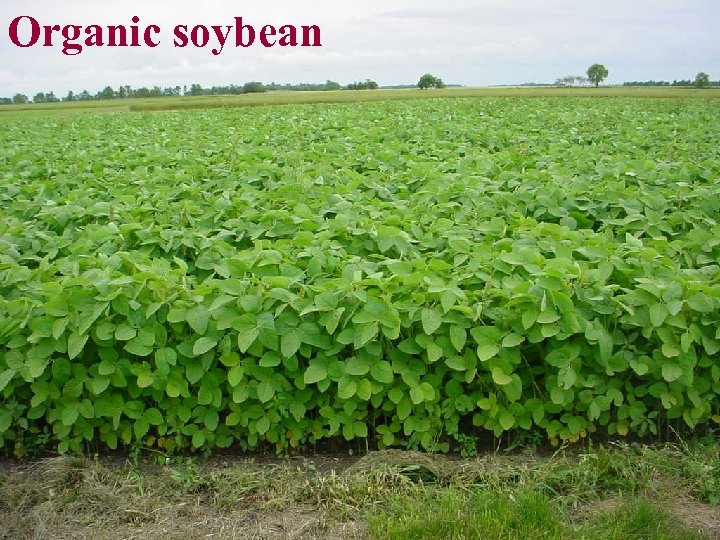 Organic soybean
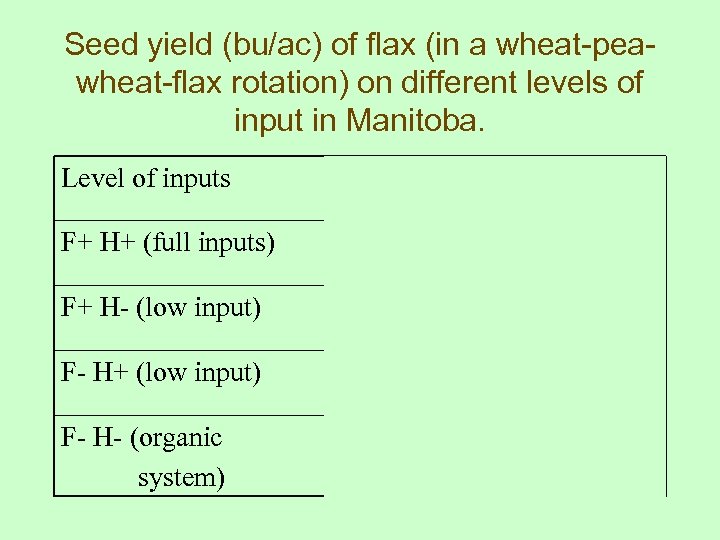 Seed yield (bu/ac) of flax (in a wheat-peawheat-flax rotation) on different levels of input in Manitoba. Level of inputs 1995 1999 2003 F+ H+ (full inputs) 30 22 27 F+ H- (low input) 16 10 2 F- H+ (low input) 21 17 15 F- H- (organic system) 15 10 4
 Why farmers choose to grow organically?
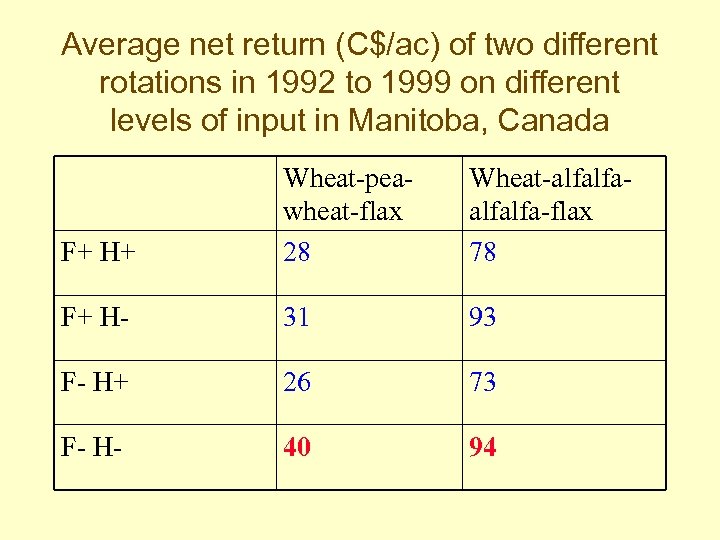 Average net return (C$/ac) of two different rotations in 1992 to 1999 on different levels of input in Manitoba, Canada F+ H+ Wheat-peawheat-flax 28 Wheat-alfalfa-flax 78 F+ H- 31 93 F- H+ 26 73 F- H- 40 94
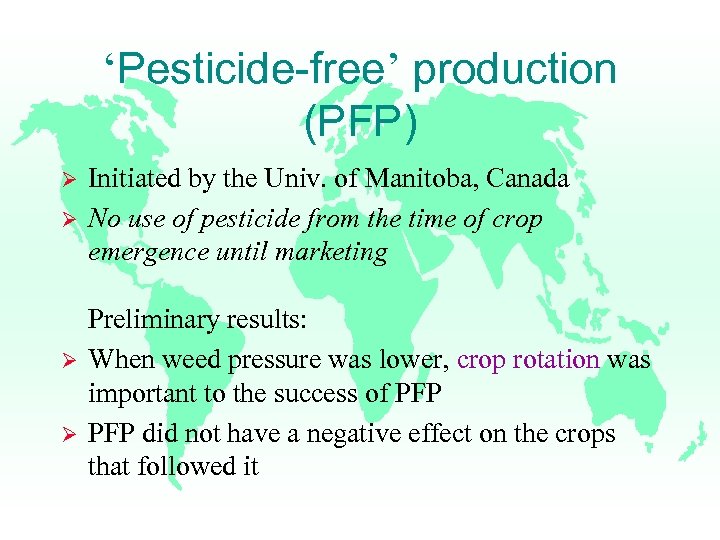 ‘Pesticide-free’ production (PFP) Ø Ø Initiated by the Univ. of Manitoba, Canada No use of pesticide from the time of crop emergence until marketing Preliminary results: When weed pressure was lower, crop rotation was important to the success of PFP did not have a negative effect on the crops that followed it
 Possible to practice no-till in organic farming?
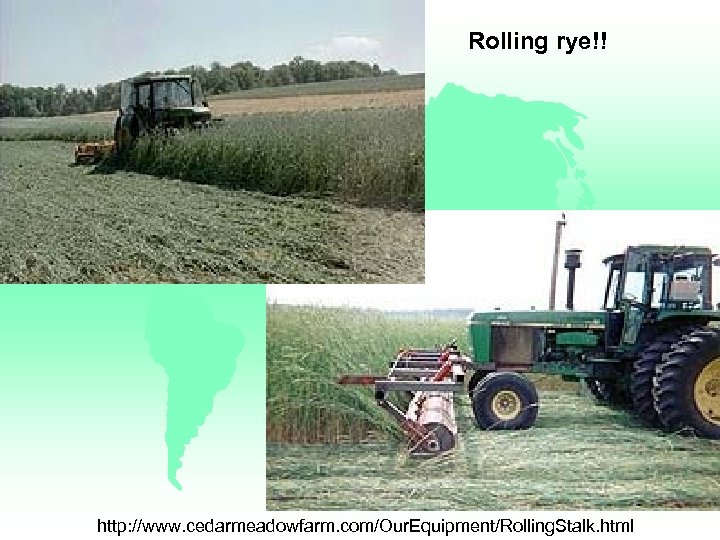 Rolling rye!! http: //www. cedarmeadowfarm. com/Our. Equipment/Rolling. Stalk. html
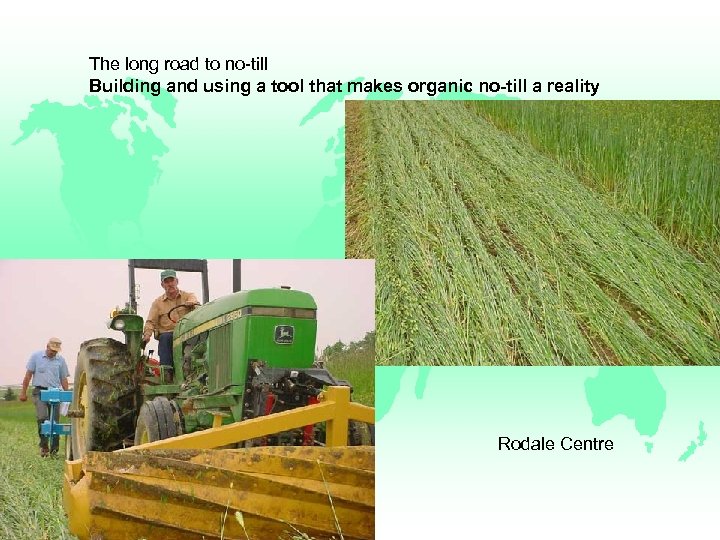 The long road to no-till Building and using a tool that makes organic no-till a reality Rodale Centre
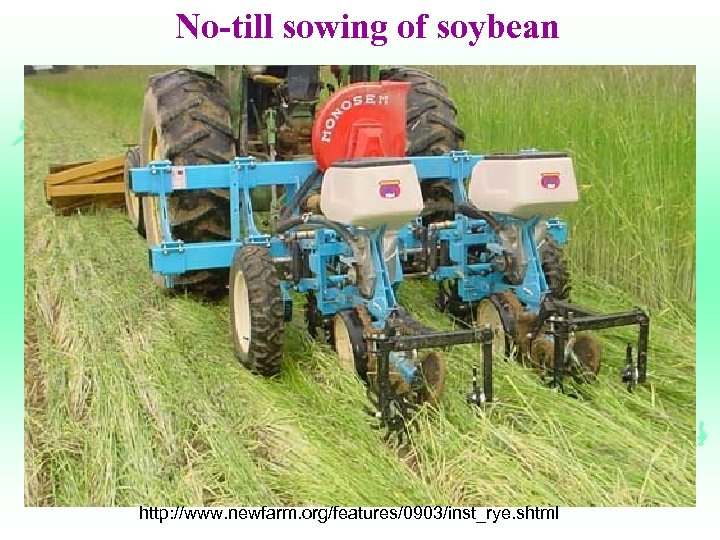 No-till sowing of soybean http: //www. newfarm. org/features/0903/inst_rye. shtml
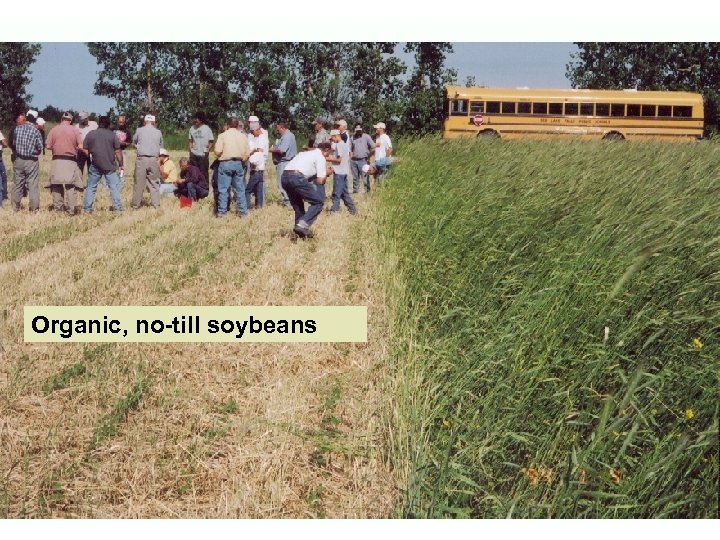 Organic, no-till soybeans
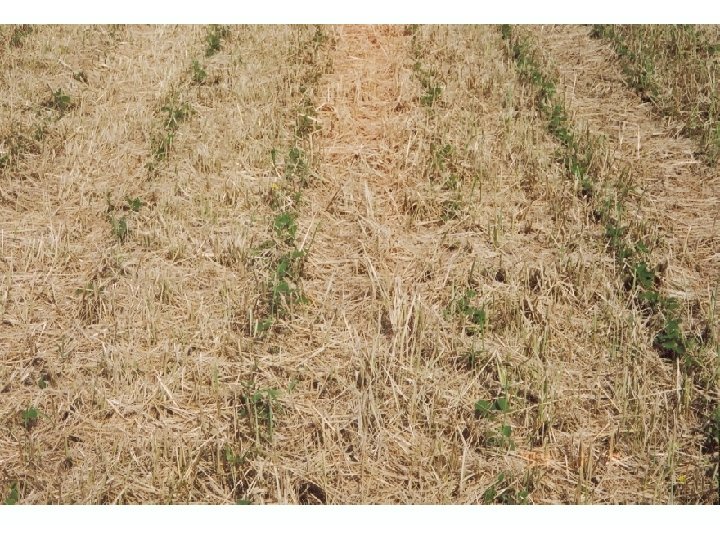
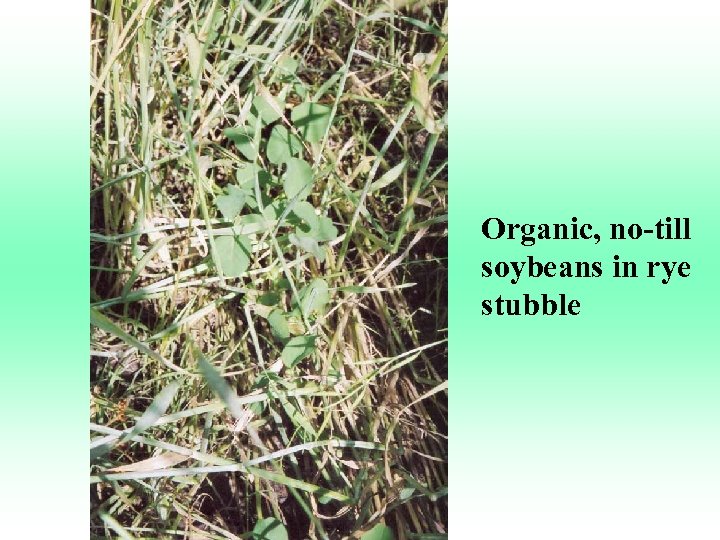 Organic, no-till soybeans in rye stubble
 Discussion u. Is OF the agriculture for the future in developed countries? u. Is OF suitable for developing countries where there are food shortages?
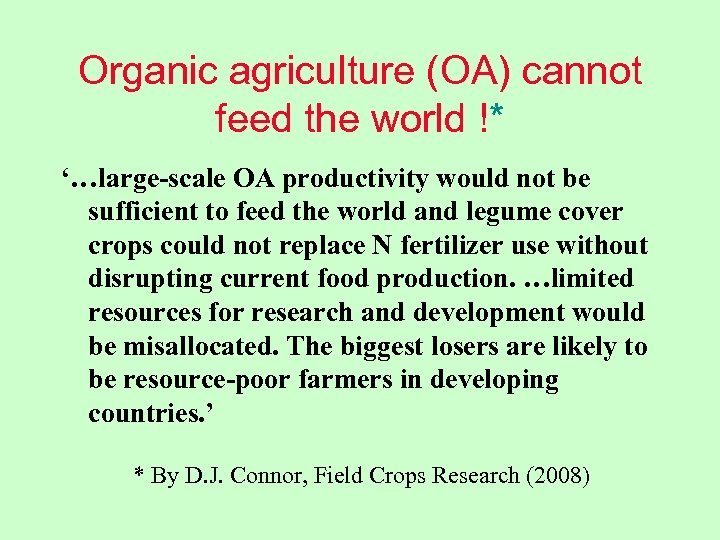 Organic agriculture (OA) cannot feed the world !* ‘…large-scale OA productivity would not be sufficient to feed the world and legume cover crops could not replace N fertilizer use without disrupting current food production. …limited resources for research and development would be misallocated. The biggest losers are likely to be resource-poor farmers in developing countries. ’ * By D. J. Connor, Field Crops Research (2008)
 Thank you + best wishes!