


 Скачать презентацию What is Vo IP Telephone Service as we
6ddd4c0d040e9b0a97b4b81af7d5e529.ppt
- Количество слайдов: 34
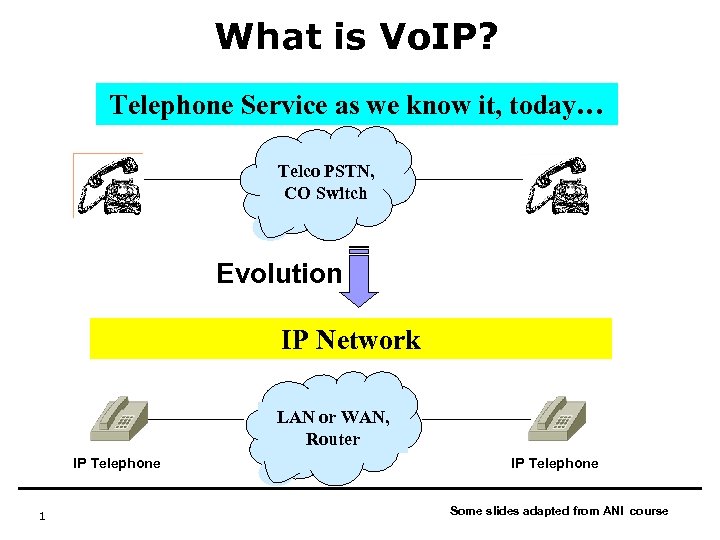 What is Vo. IP? Telephone Service as we know it, today… Telco PSTN, CO Switch Evolution IP Network LAN or WAN, Router IP Telephone 1 IP Telephone Some slides adapted from ANI course
 What is IP? Internet Protocol (IP) characteristics: · IP is a Protocol – A Method of Communication · · Designed for the Department of Defense (DOD) · Provides for Logical Addressing of Devices · 2 Industry Standard (De Facto) Creates a robust non-centralized Network Some slides adapted from ANI course
 Analog and Digital Voice Circuits · Analog Circuit – Referred to as a line • Unit by which capacity is typically measured • A residential line or a 1 FB (Feature Group - Business) – Bandwidth is typically between 300 Hz and 3 KHz – Voice traffic is carried as a waveform · Digital Circuit – Analog voice traffic that has been “digitized” (converted to bits) for ease of transport – Bandwidth is typically 1. 544 Mbps – Voice traffic is carried as a stream of bits 3 Some slides adapted from ANI course
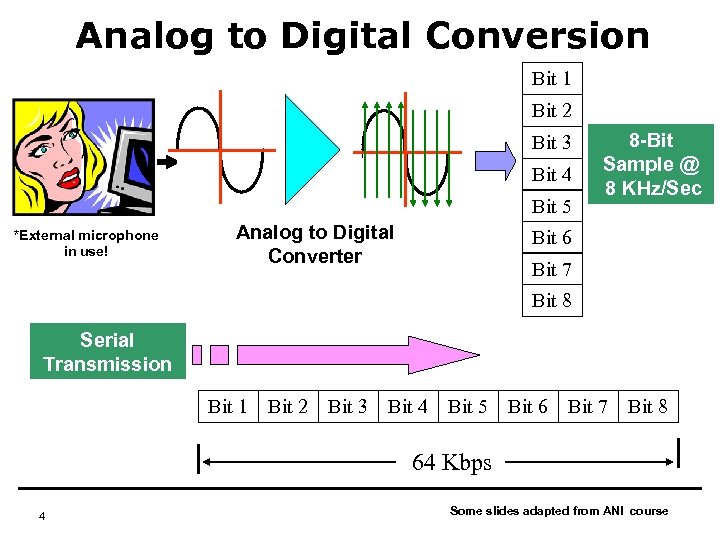 Analog to Digital Conversion Bit 1 Bit 2 Bit 3 Bit 4 Bit 5 *External microphone in use! Analog to Digital Converter 8 -Bit Sample @ 8 KHz/Sec Bit 6 Bit 7 Bit 8 Serial Transmission Bit 1 Bit 2 Bit 3 Bit 4 Bit 5 Bit 6 Bit 7 Bit 8 64 Kbps 4 Some slides adapted from ANI course
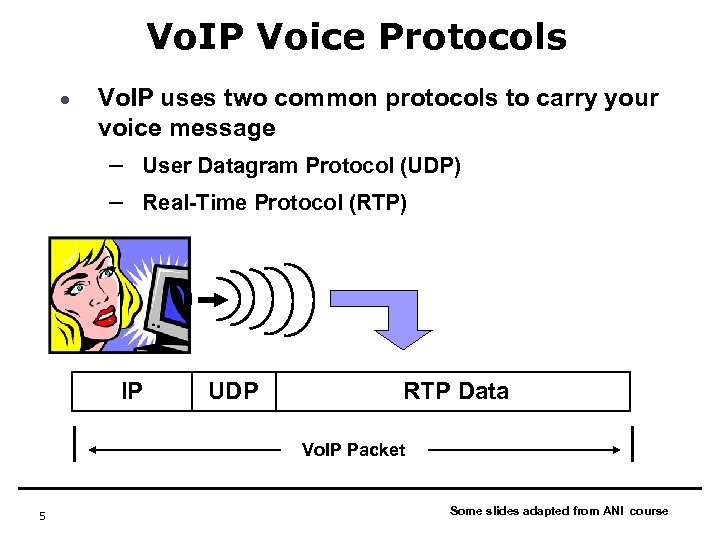 Vo. IP Voice Protocols · Vo. IP uses two common protocols to carry your voice message – User Datagram Protocol (UDP) – Real-Time Protocol (RTP) IP UDP RTP Data Vo. IP Packet 5 Some slides adapted from ANI course
 Vo. IP Business Case 6 Some slides adapted from ANI course
 The Promise of Vo. IP · Single Converged Network of Voice and Data Benefit: Lower Cost · Integrating Voice into the Desktop Benefit: User Productivity 7 Some slides adapted from ANI course
 The State of Vo. IP · Are People Planning to use Vo. IP? YES! They’re doing it! · What is the State of the Industry? Late Prototype to Early Production · How is the Sound Quality? The Sound Quality is Excellent now 8 Some slides adapted from ANI course
 Benefits of Vo. IP · Easy Deployment and Reconfiguration Management · Cost Savings: Hardware, Maintenance, Toll Charges · Improved Mobility, Changing of Offices, Phone Numbers · Convergence of Services, such as Conferencing · Compared to TDM Phones, Vo. IP Phones offer – More Flexibility – More Features This Equates to Corporate Productivity Enhancement 9 Some slides adapted from ANI course
 Vo. IP Basics · PBX Functionality in an IP-based System · PBX Switch operation in a LAN · Enterprise to Enterprise communication · IP Services (ie. Unified Messaging) – Sends voicemail messages via Email · Toll Bypass – Removes connection charges paid to Carrier 10 Some slides adapted from ANI course
 Telco Policy Law and Precedents What we have now with the Telco: · · Public Safety · Law Enforcement · National Security · Universal (affordable) Service · 11 Carrier Grade Reliability Disabled Access Some slides adapted from ANI course
 What is “Carrier Grade” in a Telco Network? “Carrier Grade” operation is a global Telco standard · Dialtone is provided even when local electricity is unavailable (ie. East Coast blackout of 2003) · Carrier Grade means a high level of total availability – Referred to as “Five Nines” (99. 999%) – Equates to 5 minutes per year of network downtime 12 Some slides adapted from ANI course
 Vo. IP Dependencies · Vo. IP does not automatically imply Voice over the Internet – Voice over IP can, and is, in private IP-based networks · Complete deployment of Vo. IP is totally dependent on Broadband adoption – Requires acceptable bandwidth at the SOHO location 13 Some slides adapted from ANI course
 Consumer Acceptance of Vo. IP · The End User requirements and Feature Assessment must be Accurate · Train the End Users, Demonstrate the Advanced Features · Benchmark the Before / After performance – Currently Cable Modem and DSL can provide excellent SOHO service for Internet access · 14 The Consumer must be comfortable with the Vo. IP environment – Vo. IP operation must be transparent to user Some slides adapted from ANI course
 Success Stories for Vo. IP Services · Free World Dialup – Peer to peer (closed network) over Broadband 200, 000 Users, Worldwide · Vonage – 200, 000 subscribers · Shoreline – 30, 000+ subscribers 15 Some slides adapted from ANI course
 Interoperability Challenges · In a manner similar to the networking industry, the early deployment vendors are creating proprietary implementations – Some hardware/software combinations will not scale to support large enterprises – Difficult to test interoperation with all possible vendor solutions – Testing under heavy load is not always available for newer technologies · 16 Legacy support is critical as newer products and protocols are developed Some slides adapted from ANI course
 Need for Standards Bodies A Standards Body provides the following benefits: · · Provides a forum for Improvement and Technology research · Helps to select the Best Overall Solution for Market Applications · 17 Helps to insure interoperability between vendors Acts as a Standards Body, not as a Regulatory Agency Some slides adapted from ANI course
 Existing Standards Bodies for Vo. IP and Networking · · International Telecommunication Union (ITU) · Institute for Electrical and Electronics Engineers (IEEE) · International Standards Organization (ISO) · 3 G Partnership Project (3 GPP/3 GPP 2) · 18 Internet Engineering Task Force (IETF) Cable. Labs Some slides adapted from ANI course
 Vo. IP History · · 1996 International Telecommunication Union - Version 1 Draft of H. 323 · 1999 Dial. Pad begins Service · 2001 Microsoft XP with SIP support · 2001 Qwest in Boise, ID starts Vo. IP trials for Customers · 19 1995 Vocal. Tec 2002 Vonage initiates Service Elad Sion Some slides adapted from ANI course
 Vo. IP Vendor Devices A sample of Vo. IP devices available today: · · SIP Phones · Software Phones (Net. Meeting, Skype) · USB Phones · Wireless Phones (Future Cellular) · PDA’s · 20 H. 323 Phones Routers/Gateways Some slides adapted from ANI course
 The Future of Vo. IP? Vo. IP deployments face some challenges: · · 9 -1 -1 / E 9 -1 -1 Issues · Requirement for Integrated Networks · 21 Residential/Small Business Vo. IP Providers Consistent Network Infrastructure Some slides adapted from ANI course
 SOHO Vo. IP Providers Vendors active in the SOHO market space · · Packet 8 · Vonage · Iconnect · Nikotel (SIP Network) · Net 2 phone · 22 Voiceglo Level 3 Communications Some slides adapted from ANI course
 9 -1 -1/E 9 -1 -1 Issues · · Routing to the correct PSAP serving the geo/political jurisdiction where the 911 caller is physically located · Sending Proper Re-contact (call back) Information to PSAP · IP PBX must get Location / Endpoint information to PSAP · 23 All Devices Should be treated as Movable Cannot Rely on E. 164 Numbering Plan for physical location information Some slides adapted from ANI course
 Vo. IP Conclusions · Vo. IP is a Viable Technology, Ready to Deploy NOW! · Vo. IP allows for Convergence of Services at the Phone or Desktop · Vo. IP is Easy to Manage, Deploy and Reconfigure · Vo. IP will provide Cost Savings: Lower Toll Call Costs, Lower Equipment Cost and Lower Maintenance Costs · Vo. IP provides Improved Mobility · Vo. IP Phones have More Features than TDM Phones 24 Some slides adapted from ANI course
 NENA-VON Coalition Agreement · Established to set minimum levels of coordination with Public Safety and NENA · Does not recommend call delivery to 10 digit numbers, but rather as minimum method · Recommends active contact with PSAPs or PSAP Coordinator prior to service initiation, to establish what method is to be used to deliver 9 -1 -1 dialed calls, and the details (See Agreement in separate document, or at the NENA website (www. nena. org) – may be updated at the website) 25 Some slides adapted from ANI course
 Some Ways to Receive Vo. I 9 -1 -1 Calls · · 10 digit emergency number delivery should be used only for those cases where better methods can’t apply. · 26 NENA’s view is that Voice over Internet service providers should use the best available method for 9 -1 -1 calling, prior to the availability of the NENA I 2 standard interface. See descriptions. Since many Vo. I subscribers are in replacement of previous wireline service that had E 9 -1 -1, Vo. I subscribers should have E 9 -1 -1 service where possible. Vo. I provider costs for E 9 -1 -1 access should not be a primary issue. E 9 -1 -1 is fundamental service, not optional. Some slides adapted from ANI course
 Some Methods to Receive Voice over Internet 9 -1 -1 Calls Best choice is for as many Voice over Internet providers as possible to use initial methods to interface to the E 9 -1 -1 systems, via a CLEC or cable provider (or ILEC? !) for subscribers using home NPA at fixed location. With the proper procedures, nomadic subscribers could voluntarily update location. Examples: Packet 8 / Level 3, Vox. Path, Cox. Cable, Time. Warner, MCI and AT&T Call. Advantage may be adding this method. 10 Digit numbers are a lesser alternative, and are the only known method for handling the subset of non-home NPA subscribers. 27 Some slides adapted from ANI course
 A. Establish or identify a 24 x 7 10 digit emergency number with the Caller. ID feature, and set it as a priority answer equivalent to 9 -1 -1 trunk calls, in the ACD, on the telephone console itself, or in some other way that fits the PSAP systems. Provides callback number in most cases, for those Voice over Internet providers using Caller. ID. 28 Some slides adapted from ANI course
 B. Establish a 10 digit emergency number in a central office that call forwards, with ANI of that CO number, to the central office’s 9 -1 -1 trunk group into the Selective Router. For both routing control to the target PSAP, and for ALI purposes, establish a fixed ALI record against that call forward ANI, that identifies the call as a Voice over Internet call from a given area. Note that this technique could be applied by Vo. I service provider, using different numbers for each, or across all Vo. I type providers in common. Does not provide ANI of the caller. 29 Some slides adapted from ANI course
 C. Establish a new SR to PSAP trunk group, with its own Routing TN at the SR, for call delivery through the new PSAP trunk group. This technique allows call delivery within the 9 -1 -1 trunking to the 9 -1 -1 CPE, provides equivalent priority of answer capability, and E 9 -1 -1 transfer capabilities, but does not provide ANI or Caller. ID. Call appears as an Anonymous call, but is identifiable as a Vo. I call due to the dedicated trunk group. 30 Some slides adapted from ANI course
 NENA and Internet communications providers have agreed upon the following action items: 1. For service to customers using phones that have the functionality and appearance of conventional telephones, provide 9 -1 -1 emergency services access (at least routing to a PSAP 10 -digit number) within a reasonable time (three to six months) and prior to that time inform customers of the lack of such access. 2. When a communications provider begins selling in a particular area, it should discuss with the local PSAPs or their coordinator (as identified on the NENA website) the approach to providing access. (For example, if routing to 10 -digit number, confirm the correct number with the PSAP. ) This obligation does not apply to any “roaming” by customers. 31 Some slides adapted from ANI course
 3. Support for current NENA and industry work towards an interim solution that includes (a) delivery of 9 -1 -1 call through the existing 9 -1 -1 network, (b) providing callback number to PSAP, and (c) possibly in some cases, initial location information. The current timeline for the NENA Vo. IP/Packet Committee to develop its interim recommended solution is May 2004. 4. Support for current NENA and industry work towards long-term solutions that include (a) delivery of 9 -1 -1 call to the proper PSAP, (b) providing callback number/recontact information to the PSAP, (c) providing location of caller; and (d) PSAPs having direct IP connectivity. The initial standards development work of the NENA Vo. IP/Packet Committee should be completed by the end of 2004. 32 Some slides adapted from ANI course
 5. Support for an administrative approach to maintaining funding of 9 -1 -1 resources at a level equivalent to those generated by current or evolving funding processes. 6. Consumer education. This could include projects involving various industry participants and NENA public education committee members to create suggested materials explaining any 9 -1 -1 differences to customers. 33 Some slides adapted from ANI course
 Roger Hixson Technical Issues Director NENA - The Voice of 9 -1 -1 614 -442 -9110 or 800 -332 -3911 rhixson@nena. org 34 Some slides adapted from ANI course