


 Скачать презентацию What is This Grief Thing How Families Grieve
d80a098ee2408fd21f62f5d33b286352.ppt
- Количество слайдов: 52
 What is This Grief “Thing”? How Families Grieve The Loss of Someone Close Michelle Post, MA, LMFT Clinical Aftercare Specialist One. Legacy Family Care
 Outline • • • What to do/not do for a grieving person Describe J. William Worden’s Grief and Loss Model (4 Tasks of Mourning). Identify normal grief reactions and warning signs of Depression. Michelle A. Post, MA, LMFT , 213 -229 -5687 Email: mpost@onelegacy. org
 Quick Survey by show of hands • How many of you have had experienced the death of a patient? • How many of you have had a friend who has experienced the death of someone close? • How many of you knew exactly what to say to help the patient’s family or your friend with their grief?
 Quick Survey • How many of you have ever had first hand experience dealing with the death of someone close to you? • During your grief, how many of you had someone tell you something (maybe in an effort to try to help you) that was NOT helpful, or even hurtful?
 The Platitudes/Clichés • Time heals all wounds. • Think about the good times. • God needed another (angel, plumber, teacher, coach, etc. ) in heaven. • It was God’s will / Everything happens for a reason. • Something good will come of this. • She/he led a full life.
 Is Death a Universal Truth? Elizabeth Kubler -Ross - 1969 Hearses white vans vs Underused hospice
 Is Death a Universal Truth? Who Do We Turn to? MDs (some see death as failure) Clergy good & bad Funeral Homes Crisis Response Teams Police & Firefighters
 Is Death a Universal Truth? Who Do We Turn to? Professional Counselors: Training? DSM Code for Bereavement gives timeframe? 2 months (numbness wearing off) kids (23 years old and under): 6 -12 mo
 Grief Statistics: • 1 in 5 kids will experience the death of someone close by age 18 (Kenneth Doka, Editor of OMEGA Journal of death and dying) • 1 in 20 kids will experience the death of one or both parents by age 15 (Steen, 1998)
 Grief Statistics: Close to 2 million children receive death benefits from a deceased worker (Social Security Administration, 2007) …And that is just the KIDS! We serve 2200 to 2500 new families each year just in One. Legacy
 If Death is a Universal Truth, Grief is the Great Equalizer… Everyone is Affected!
 Possible Pitfalls for Those Who Do Not Reconcile Their Grief: • Avoid love as a way to avoid pain • Inability to acknowledge the pain of others • Avoid risks
 Possible Pitfalls for Those Who Do Not Reconcile Their Grief: • Inability to express love for their own children • Experience a sense of ‘searching’ for that which was lost • Resisting school or work projects which demand long-term commitment
 What can we do to help with grief? ‘Normal’ Grief can last years AOPO: Aftercare ~ 2 yrs min.
 What can we do to help with grief? What does your hospital do to support a grieving family?
 What can I do to for personal/professional grief? Explore Your Own Grief Attitudes J. William Worden, Ph. D. : Personal Death Awareness; or G Counseling & Grief Therapy: A Handbook for the M Health Practitioner
 What Else Can I Do? ~Learn a Model of Grief and Loss
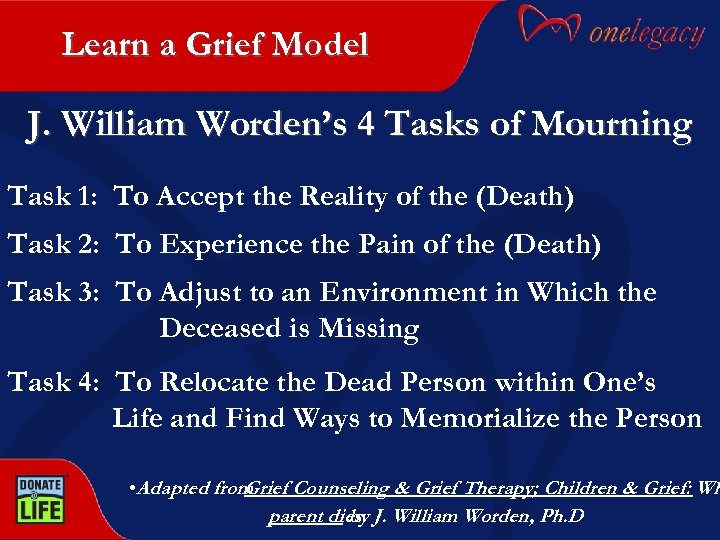 Learn a Grief Model J. William Worden’s 4 Tasks of Mourning Task 1: To Accept the Reality of the (Death) Task 2: To Experience the Pain of the (Death) Task 3: To Adjust to an Environment in Which the Deceased is Missing Task 4: To Relocate the Dead Person within One’s Life and Find Ways to Memorialize the Person • Adapted from Grief Counseling & Grief Therapy; Children & Grief: Wh parent dies J. William Worden, Ph. D by
 J. William Worden’s 4 Tasks of Mourning Task 1: To Accept the Reality of the (Death) • Adapted from Grief Counseling & Grief Therapy; Children & Grief: Wh parent dies J. William Worden, Ph. D by
 Task 1: To Accept the Reality of the (Death) • The griever begins to grasp that the person has actually died. • Even when the death was expected, there is still often a sense that it hasn’t really happened. • Intellectual vs. emotional acceptance of the death. Intellectual acceptance may come long before emotional acceptance.
 Task 1: To Accept the Reality of the (Death) Traditional rituals (funerals/memorials) assist the bereaved in moving toward acceptance of the death as real. ** Include children!
 Task 1: To Accept the Reality of the (Death) Belief and disbelief come and go over time. Examples: Misidentify another person as the one who has died or think they see or hear them. – "I still hear his keys in the door". – "I expect to see her cooking in the kitchen".
 Task 1: To Accept the Reality of the (Death) • Families will need to repeat their stories many times. • Ask questions that ask for details surrounding the death
 Task 1: To Accept the Reality of the (Death) • The death becomes more of a reality as each "first" occurs without the deceased - 1 st birthdays, death markers/dates, etc. - 1 st holiday season. Ask about the last holiday and what they think they will do for the next one.
 Best thing you can say? Actually best thing is to just listen…
 If you HAVE to say something… DON’T SAY: • • I understand how you feel. Death was a blessing. You’re still young/ have whole life ahead of you. You can have other children/Find another. Call me when I can help. It’s time to put it behind you. Be strong!
 If you HAVE to say something… Try… I’m sorry/ I’m sorry you are going through this. How are you doing with all this? What can I do for you? I’m here and I want to listen. What’s the hardest part for you? I’ll call tomorrow/Friday/in an hour. I can imagine how much this hurts. It isn’t fair, is it? Take all the time you need.
 J. William Worden’s 4 Tasks of Mourning Task 2: To Experience The Pain Of The (Death) • Adapted from Grief Counseling & Grief Therapy; Children & Grief: Wh parent dies J. William Worden, Ph. D by
 What is the pain of “Normal” Grief? If ‘Normal’ Grief can last years, w are the symptoms? See “Potential Symptoms of Gr Handouts
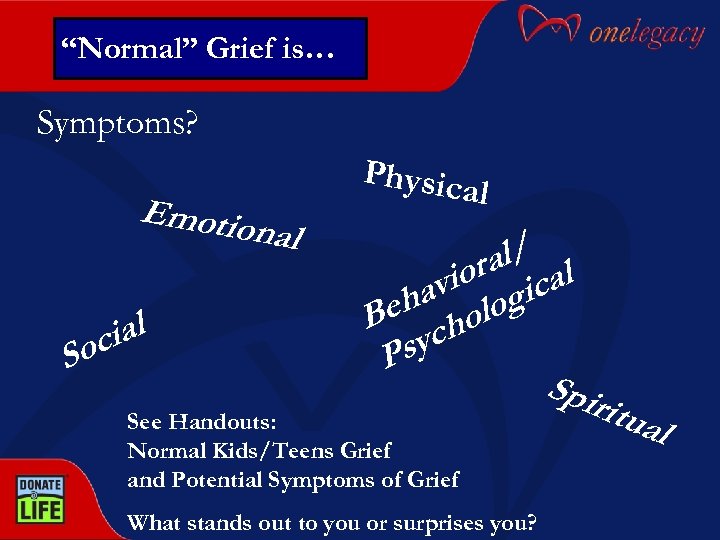 “Normal” Grief is… Symptoms? Physica Emotio na l l S ial oc al/ al ior ic av log eh o B ch sy P Spir i See Handouts: Normal Kids/Teens Grief and Potential Symptoms of Grief What stands out to you or surprises you? tual
 Task 2: To Experience The Pain Of The (Death) • Pain will vary in intensity from person to person and may come and go. • Friends, culture, and society may interfere with the successful completion of this task by not allowing the griever to grieve. -“Think about the good times” -“Be strong”
 Task 2: To Experience The Pain Of The (Death) • Avoidance = drugs, alcohol, travel, relocation, constant work, or quickly entering into a new relationship. • Avoidance hinder one’s ability to heal. The pain will eventually reappear.
 Task 2: To Experience The Pain Of The (Death) WHAT IS ABNORMAL GRIEF? • Active Suicidal/Homicidal Ideation, Plan, Intention, Means • I don’t know how I will go on! – Normal • I wish I could be reunited/wish my pain was over/wouldn’t care if I died – Normal • I’m going to kill myself! - Abnormal
 Task 2: To Experience The Pain Of The (Death) WHAT IS ABNORMAL GRIEF? =Command hallucinations • I thought I saw him walking down the street. – Normal • I felt her presence in the room – Normal • I heard him tell me to trash my mother’s house/join her in heaven – Abnormal!
 J. William Worden’s 4 Tasks of Mourning Task 3: To Adjust to an Environment in Which the Deceased is Missing • Adapted from Grief Counseling & Grief Therapy; Children & Grief: Wh parent dies J. William Worden, Ph. D by
 J. William Worden’s Task 3: To Adjust to an Environment in Which the Deceased is Missing • The grieving person may need to learn new skills, and perform functions that the person who died had previously taken care of. This happens just at a time when they are burdened with acute grief and the least capable of doing so. • The bereaved tries to gain a sense of control over his or her life. • Help them to brainstorm who can help with daily activities for themselves/family (baby sitting, picking up kids, cooking, etc. )
 J. William Worden’s Task 3: To Adjust to an Environment in Which the Deceased is Missing Not only is the relationship gone, but also that part of the grieving person’s identity. “Who am I if I am no longer John’s wife? ” “Am I still a parent if my only child has died? ” “What do I say when people ask me how many children do I have? ” -Give them permission to answer these questions differently or the same as they did before the death.
 J. William Worden’s 4 Tasks of Mourning Task 4: To Relocate the Dead Person within One’s Life and Find Ways to Memorialize the Person • Adapted from Children & Grief: When a parent by J. William Worden, Ph. D dies Michelle A. Post, MA, LMFT , (310) 927 -5611 , Email: michpost@ca. rr. com
 J. William Worden’s 4 Tasks of Mourning Task 4: To Relocate the Dead Person within One’s Life and Find Ways to Memorialize the Person • Assist grievers in finding a new place, internally, for their relationship with the person who died. • Grievers find ways to create a new "normal". • The griever re-invests in their current life, while maintaining continuing bonds with the person who died. • Adapted from Children & Grief: When a parent by J. William Worden, Ph. D dies Michelle A. Post, MA, LMFT , (310) 927 -5611 , Email: mpost@onelegacy. org
 J. William Worden’s 4 Tasks of Mourning Task 4: To Relocate the Dead Person within One’s Life and Find Ways to Memorialize the Person Grievers create or continue traditions and rituals which allow them to honor the memory of the person Some make a pact with themselves never to love again Many go on to form new attachments and relationships • Adapted from Children & Grief: When a parent by J. William Worden, Ph. D dies Michelle A. Post, MA, LMFT , (310) 927 -5611 , Email: mpost@onelegacy. org
 J. William Worden’s 4 Tasks of Mourning Task 4: To Relocate the Dead Person within One’s Life and Find Ways to Memorialize the Person Help with Remembering Help the family start thinking about the “legacy” their loved one will leave • Encourage story telling – Opportunity to share a part of their life with you and to introduce you to the person they loved through memories – Help facilitate the process • strengthens rapport and trust • comforting and reassuring • Memory Boxes • Hand Molds, Scrapbooks, Web-pages
 What Else Can We Do to Help? ~ Watch Your *#$%&* Language
 What else can we do to help? See Do’s and Don’ts Handout & Child Speak Handout
 ~DO - Simplify Language for Grievers!
 ~Why is it important to simplify language? It’s okay to say dead… died… death… Let’s practice! Helps with Worden’s First task of mourning – to accept the reality of the death
 What to Encourage for Grievers DO: Encourage choices (leads to feeling in control) DO: Encourage routine activities. DO NOT: Encourage Change in 1 st 12 months, Instead: keep home, school, work, relationships the same. Adapted from Children & Grief: When a parent by J. William Worden, Ph. D dies
 To Include or Not to Include Kids in the Hosp/Funeral? Seeing/Touching the Body?
 DO Include them!!!! The Harvard Study Research: The picture in their head is often worse than what is real. - Not being involved is a risk factor for later complicated grief Prepare children & teens & adults for what they will see, hear, feel and/or smell. Let them get involved. Testing in front of them can help them accept the reality of the death. Adapted from Children & Grief: When a parent by J. William Worden, Ph. D dies
 Include them!!!! Include children in all aspects of information sharing, hospital visits, and family mourning rituals. In ICU or at a Funeral: Provide a buddy for them (1 adult per child) Debrief with them. Adapted from Children & Grief: When a parent by J. William Worden, Ph. D dies
 Q&A Any questions? Case examples with concerns? Something you did to assist a family in their grief that worked well?
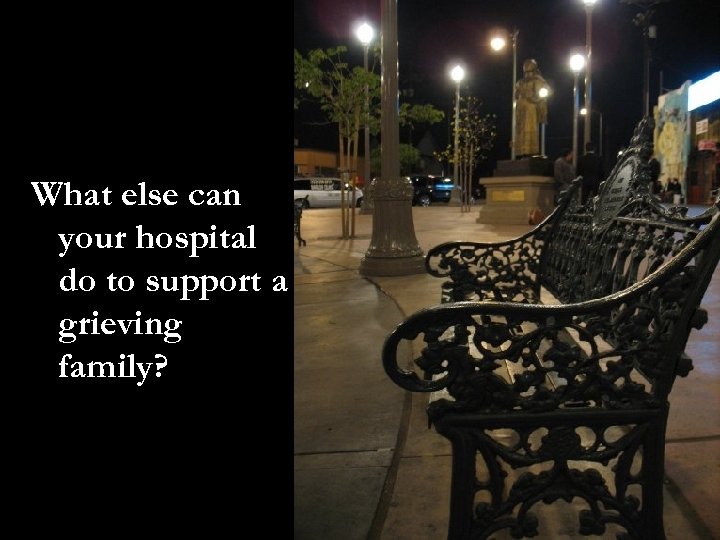 What else can your hospital do to support a grieving family?
 What is This Grief “Thing”? How Families Grieve The Loss of Someone Close Michelle Post, MA, LMFT Clinical Aftercare Specialist One. Legacy Family Care