


 Скачать презентацию What is the Stock Market Stocks are
fdf9fe83a7a3431042812a43f7eaf682.ppt
- Количество слайдов: 28
 What is the Stock Market? • Stocks are units of ownership in a company. • The Stock Market is where stocks are traded
 Goal of buying stock • The goal is to buy the stock, hold on to it for a time, and then sell it for more than you paid for it. • Stocks are long-term investments. Investors who hold on to stock for more than 15 years usually profit. • There are no guarantees!
 Limits of the Stock Market Game • The game only lasts 10 weeks – too short to reflect real life • Because of the time limit, the game rewards risk taking • In real life, investing conservatively and dollar-cost averaging are better strategies
 Other avenues for investing • Savings accounts – low rates, very safe, liquid; compound interest; FDIC insured; interest rate not fixed
 Certificates of Deposit • Higher interest than savings • very safe (FDIC insured) • not liquid (must invest for specified period) • compound interest; • the longer the period the higher the interest rate; the larger the investment, the higher the interest rate
 Money Market Accounts • • Requires a certain level of investment FDIC insured May withdraw money at any time Interest rates change; not fixed
 Bonds • Two kinds: – EE bonds – sold at a discount (half the face value); continues to earn interest up to 30 years (even after face value reached) – I bonds – sold at face value; interest fluctuates; tax free – Safe but your money is tied up for years – Lower risk but also lower interest rates
 Mutual Funds • Combine the money of many investors to buy many kinds of investments (diversified) • Noone insures your investment • Safer than other stocks because of diversification • You can sell at any time • Professionally managed but return is not guaranteed • Fees charged for management expenses
 Stocks • No guarantee of safety • Can sell at any time – but you get the current price, which is changeable • Dividends – payments (usually quarterly) of a portion of the profits in money or more shares • Shares can be split (when the prices rise to the point that the company fears people will not buy shares) – you then have more shares but they are worth less individually (total doesn’t change)
 Collectibles • Baseball cards, Barbies, etc. • You hold on to them because they are rare • No guarantee that they will increase in value • Can only get money by finding a buyer • Long-term investment The Pyramid of Risk and Reward
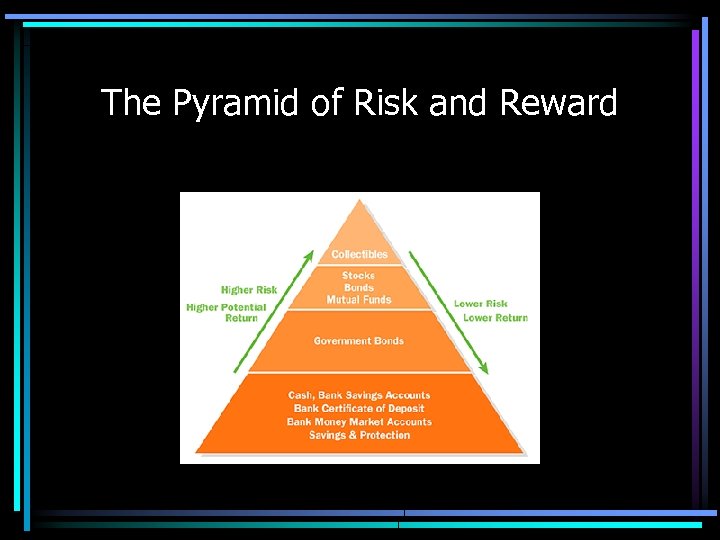 The Pyramid of Risk and Reward
 Examples • http: //www. themint. org/kids/compound ing-calculator. html • http: //www. themint. org/kids/power-of 72. html • http: //www. themint. org/kids/when-willyou-be-a-millionaire. html • http: //www. ingnz. com/WEB/webm. nsf/ Compound. Interest? Open. Form
 Benefits of the Stock Market Game • It teaches how to read stock tables • Students become familiar with researching companies • Students learn that there is a fee to trade stocks • It teaches critical thinking and decision making, as well as cooperation
 Why do companies sell stock? • The main reason companies sell stock is to acquire money. This money can be used to • Do research on products and methods of production • Create new products or improve products • Hire more employees • Enlarge or modernize buildings
 Do all companies sell stock? • There are three types of companies: • Sole proprietorships • Partnerships • Corporations Of these three, only corporations sell stock. Companies that sell stock are publicly held. Companies that do not sell stock are privately held. You will only be able to invest in publicly held companies. When you research, if you can’t find the company on the Stock Market, it may be privately held.
 Where should I research my stocks? • Online sites – yahoo finance, google finance, etc. • Morningstar. com • Nyse. com • The company’s website • Newspapers (WSJ)
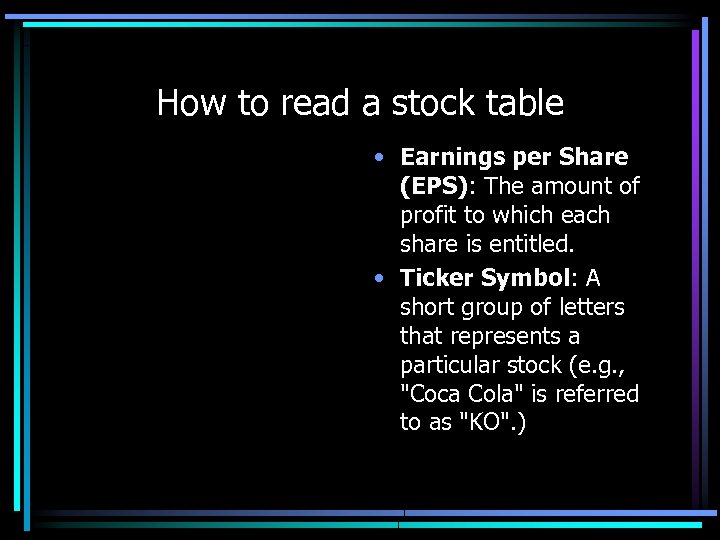 How to read a stock table • Earnings per Share (EPS): The amount of profit to which each share is entitled. • Ticker Symbol: A short group of letters that represents a particular stock (e. g. , "Coca Cola" is referred to as "KO". )
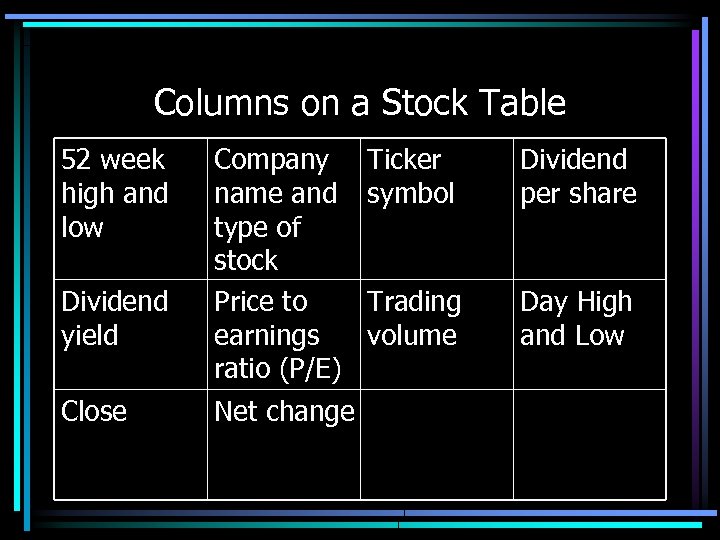 Columns on a Stock Table 52 week high and low Dividend yield Close Company name and type of stock Price to earnings ratio (P/E) Net change Ticker symbol Dividend per share Trading volume Day High and Low
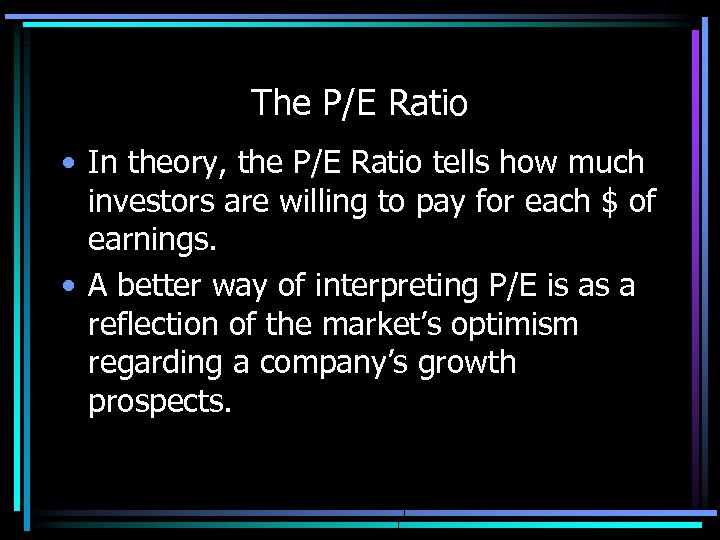 The P/E Ratio • In theory, the P/E Ratio tells how much investors are willing to pay for each $ of earnings. • A better way of interpreting P/E is as a reflection of the market’s optimism regarding a company’s growth prospects.
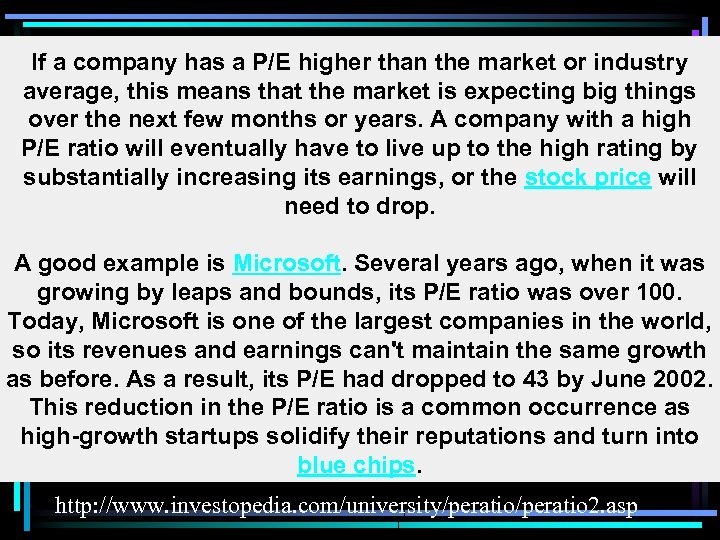 If a company has a P/E higher than the market or industry average, this means that the market is expecting big things over the next few months or years. A company with a high P/E ratio will eventually have to live up to the high rating by substantially increasing its earnings, or the stock price will need to drop. A good example is Microsoft. Several years ago, when it was growing by leaps and bounds, its P/E ratio was over 100. Today, Microsoft is one of the largest companies in the world, so its revenues and earnings can't maintain the same growth as before. As a result, its P/E had dropped to 43 by June 2002. This reduction in the P/E ratio is a common occurrence as high-growth startups solidify their reputations and turn into blue chips. http: //www. investopedia. com/university/peratio 2. asp
 P/E as an indicator of stock value • P/E is a better indicator of value than the stock price alone • You need to take into account two factors: – How fast has the company been growing, and is it expected to continue growing at the same rate? – Compare the company growth rate to the industry average
 Short Selling • In short selling, you sell a stock that you do not actually own – you are just borrowing it. • While with regular stocks (long selling) you hope prices will go up, with short selling you hope the price will go down. • If the price goes down, you do a “short cover” and pocket the difference between the amount you borrowed it at and the amount at which you returned it.
 Rules of the Stock Market Game • Each team begins with $100, 000 • 2% interest on positive cash balances • 7% interest charged on negative cash balances (you can borrow against equity) • Interest is compounded daily but posted weekly
 Rules cont. • You may only trade stocks on the AMEX, NASDAQ, and NYSE that have traded in the last 7 days • Transactions will be made at the end of day price (4: 00 p. m. ) for stocks • Mutual funds are treated as real-time transactions and priced at previous day’s closing price
 Rules, cont. • If you enter a transaction with a limit price, it will only be held for that day • All buy orders or short sell orders must be for a minimum of 100 shares. • Orders are finalized at 4: 00. Up to that point, you cancel an order. • You may not trade penny stocks (stocks trading for less than $5 per share) • Trades will be rejected if you do not have the money to pay for the entire trade
 Rules, cont. • A 2% broker’s fee is charged for all transactions; sell or shortsell transactions will also be charged an SEC (Securities and Exchange Commission) fee • The game runs Monday through Friday but transactions may be entered at any time. You may play the game from home as well as at school. Just be sure your partners agree with your decisions.
 Rules, cont. • Any stock and cash dividends and stock splits will be automatically added to your portfolio • You must maintain a total equity position equal to or greater than 30% of the current value of your holdings, or you will receive a margin call.
 Rules, cont. • For your team to count in the rankings, you must invest in at least three stocks. • I would also like you to invest in at least one mutual fund. • You must keep a daily and weekly journal of your stocks – buying, selling, changes in price, dividends or stock splits, etc.