 Скачать презентацию What is the computational cost of automating brilliance
c7c45b1081615f0f7e125a58aa5dd1d2.ppt
- Количество слайдов: 24



What is the computational cost of automating brilliance or serendipity? (Computational complexity & P vs NP) COS 116, Spring 2010 Adam Finkelstein
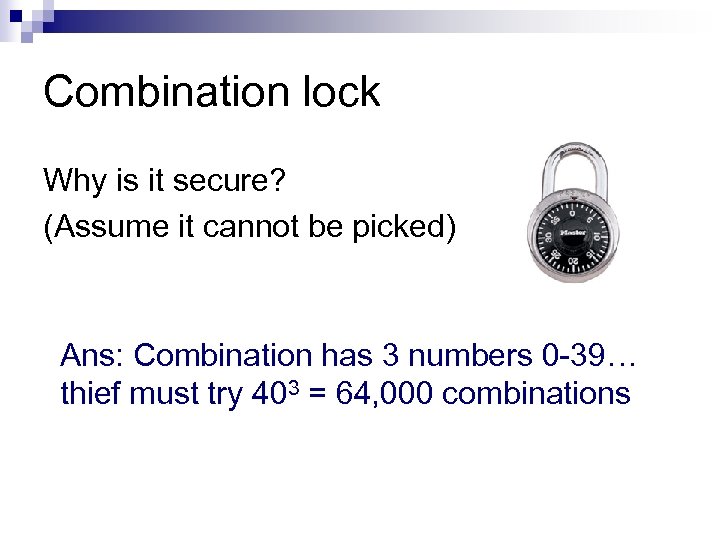
Combination lock Why is it secure? (Assume it cannot be picked) Ans: Combination has 3 numbers 0 -39… thief must try 403 = 64, 000 combinations
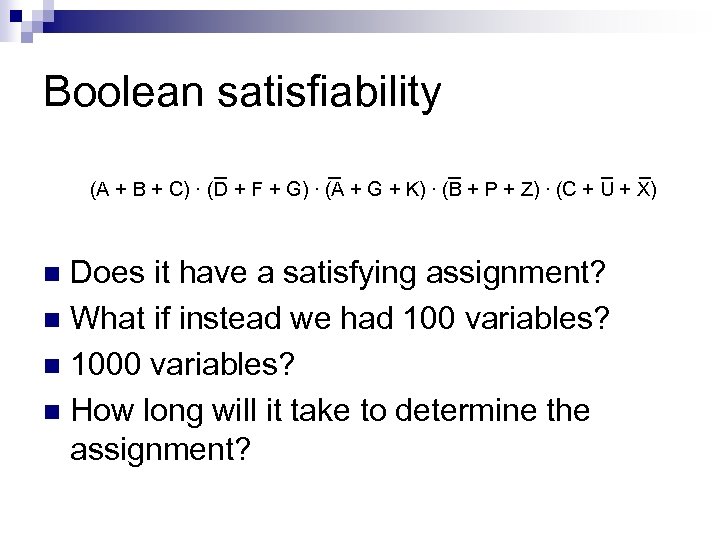
Boolean satisfiability (A + B + C) · (D + F + G) · (A + G + K) · (B + P + Z) · (C + U + X) Does it have a satisfying assignment? n What if instead we had 100 variables? n 1000 variables? n How long will it take to determine the assignment? n
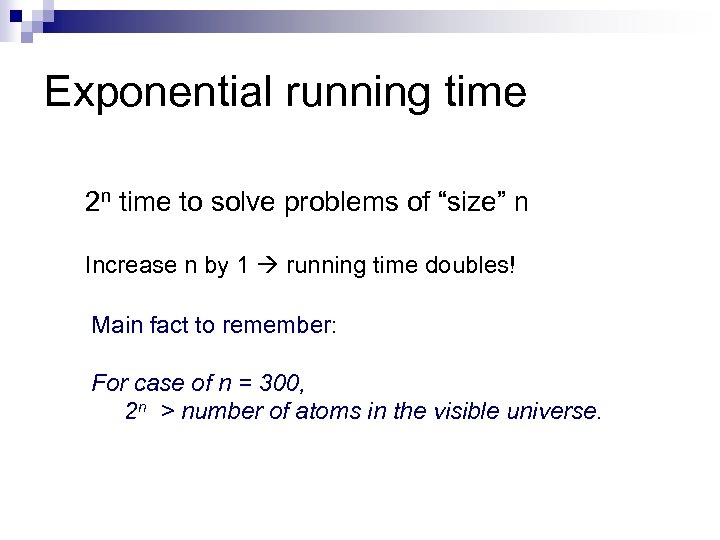
Exponential running time 2 n time to solve problems of “size” n Increase n by 1 running time doubles! Main fact to remember: For case of n = 300, 2 n > number of atoms in the visible universe.
Discussion Is there an inherent difference between being creative / brilliant and being able to appreciate creativity / brilliance? What is a computational analogue of this phenomenon?
A Proposal Brilliance = Ability to find “needle in a haystack” Beethoven found “satisfying assignments” to our neural circuits for music appreciation Comments? ?
There are many computational problems where finding a solution is equivalent to “finding a needle in a haystack”….
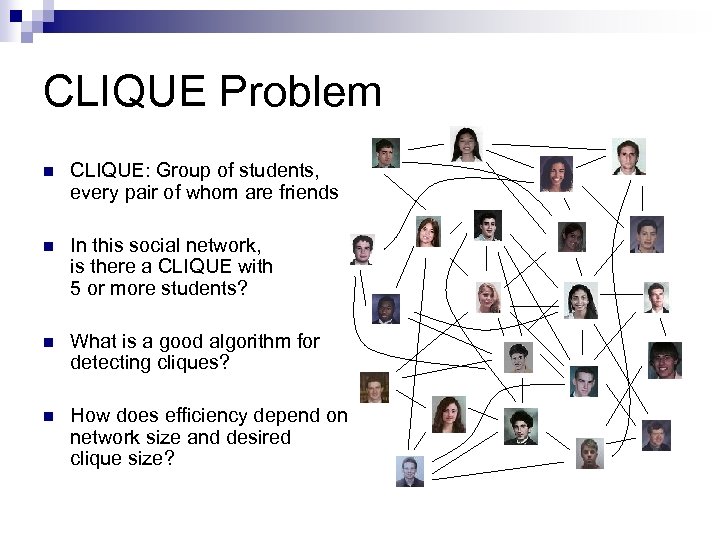
CLIQUE Problem n CLIQUE: Group of students, every pair of whom are friends n In this social network, is there a CLIQUE with 5 or more students? n What is a good algorithm for detecting cliques? n How does efficiency depend on network size and desired clique size?
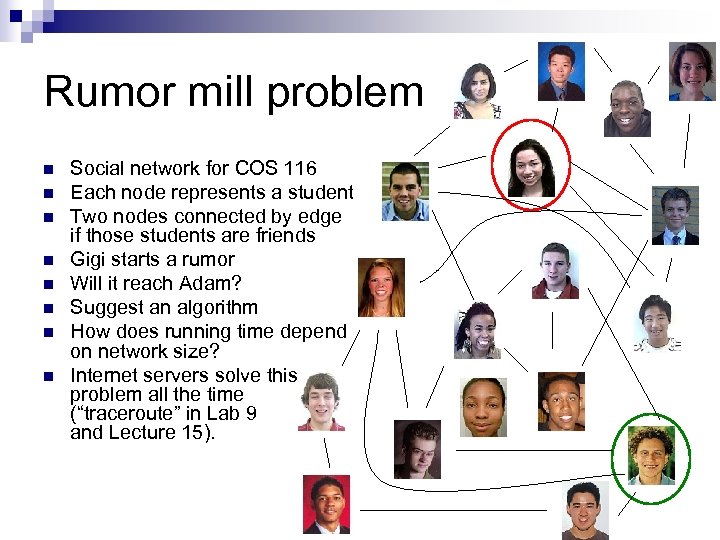
Rumor mill problem n n n n Social network for COS 116 Each node represents a student Two nodes connected by edge if those students are friends Gigi starts a rumor Will it reach Adam? Suggest an algorithm How does running time depend on network size? Internet servers solve this problem all the time (“traceroute” in Lab 9 and Lecture 15).
Exhaustive Search / Combinatorial Explosion Naïve algorithms for many “needle in a haystack” tasks involve checking all possible answers exponential running time. n n Ubiquitous in the computational universe Can we design smarter algorithms (as for “Rumor Mill”)? Say, n 2 running time.
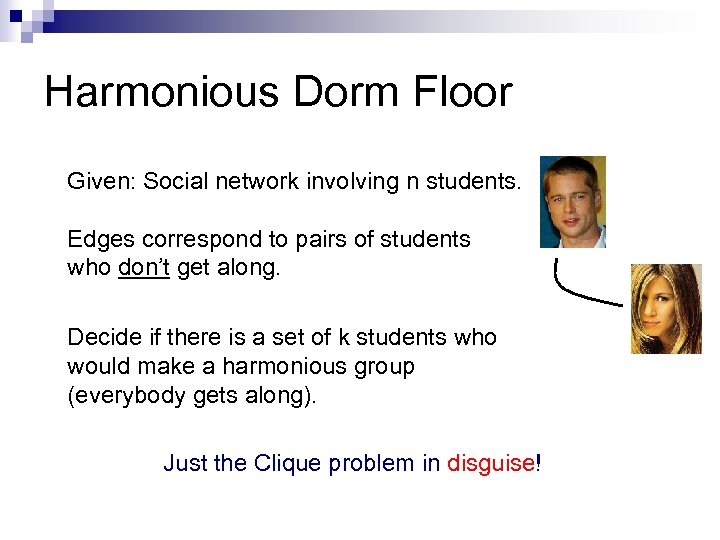
Harmonious Dorm Floor Given: Social network involving n students. Edges correspond to pairs of students who don’t get along. Decide if there is a set of k students who would make a harmonious group (everybody gets along). Just the Clique problem in disguise!
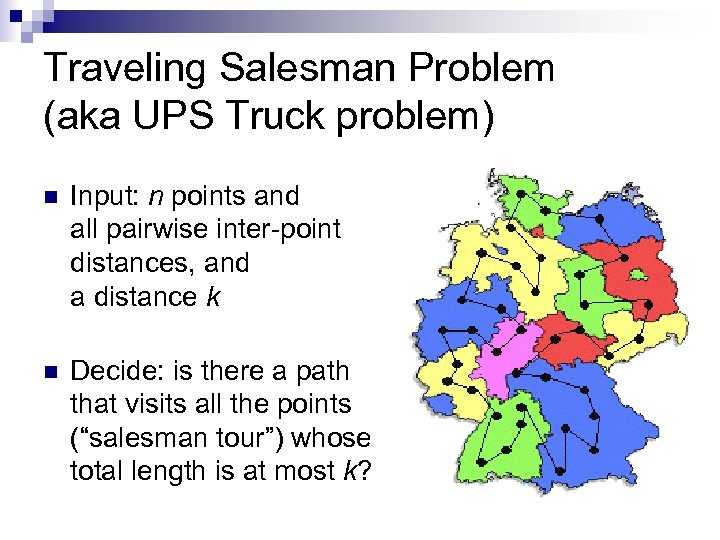
Traveling Salesman Problem (aka UPS Truck problem) n Input: n points and all pairwise inter-point distances, and a distance k n Decide: is there a path that visits all the points (“salesman tour”) whose total length is at most k?
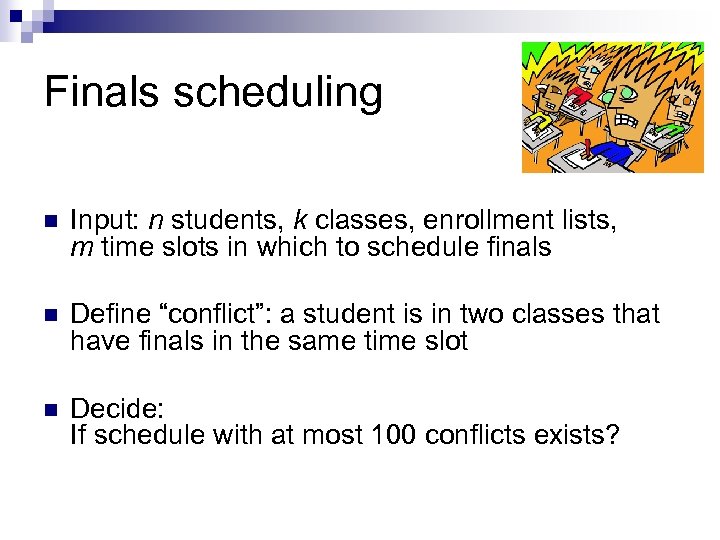
Finals scheduling n Input: n students, k classes, enrollment lists, m time slots in which to schedule finals n Define “conflict”: a student is in two classes that have finals in the same time slot n Decide: If schedule with at most 100 conflicts exists?
The P vs NP Question n P: problems for which solutions can be found in polynomial time (nc where c is a fixed integer and n is “input size”). Example: Rumor Mill n NP: problems where a good solution can be checked in nc time. Examples: Boolean Satisfiability, Traveling Salesman, Clique, Finals Scheduling n Question: Is P = NP? “Can we automate brilliance? ” (Note: Choice of computational model --Turing-Post, pseudocode, C++ etc. --- irrelevant. )
NP-complete Problems in NP that are “the hardest” ¨ If they are in P then so is every NP problem. Examples: Boolean Satisfiability, Traveling Salesman, Clique, Finals Scheduling, 1000 s of others How could we possibly prove these problems are “the hardest”?
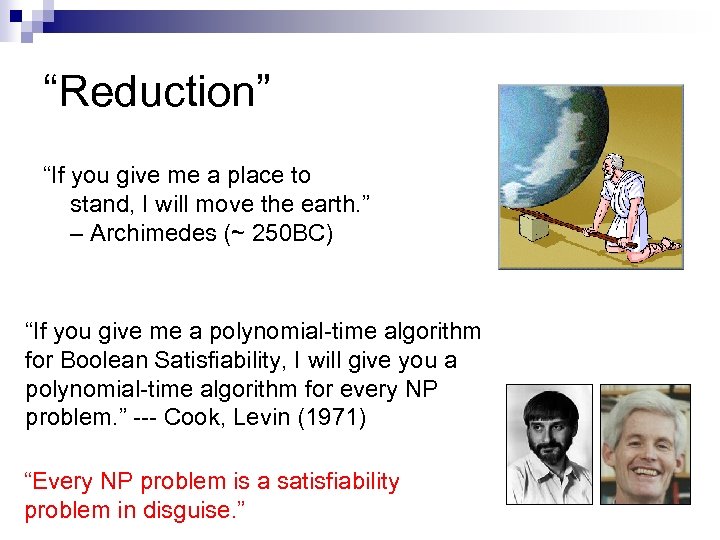
“Reduction” “If you give me a place to stand, I will move the earth. ” – Archimedes (~ 250 BC) “If you give me a polynomial-time algorithm for Boolean Satisfiability, I will give you a polynomial-time algorithm for every NP problem. ” --- Cook, Levin (1971) “Every NP problem is a satisfiability problem in disguise. ”
Dealing with NP-complete problems 1. Heuristics (algorithms that produce reasonable solutions in practice) 2. Approximation algorithms (compute provably near-optimal solutions)
Computational Complexity Theory: Study of Computationally Difficult problems. A new lens on the world? n Study matter look at mass, charge, etc. n Study processes look at computational difficulty
Example 1: Economics General equilibrium theory: n Input: n agents, each has some initial endowment (goods, money, etc. ) and preference function n General equilibrium: system of prices such that for every good, demand = supply. n Equilibrium exists [Arrow-Debreu, 1954]. Economists assume markets find it (“invisible hand”) n But, no known efficient algorithm to compute it. How does the market compute it?
Example 2: Factoring problem Given a number n, find two numbers p, q (neither of which is 1) such that n = p x q. Any suggestions how to solve it? Fact: This problem is believed to be hard. It is the basis of much of cryptography. (More next time. )
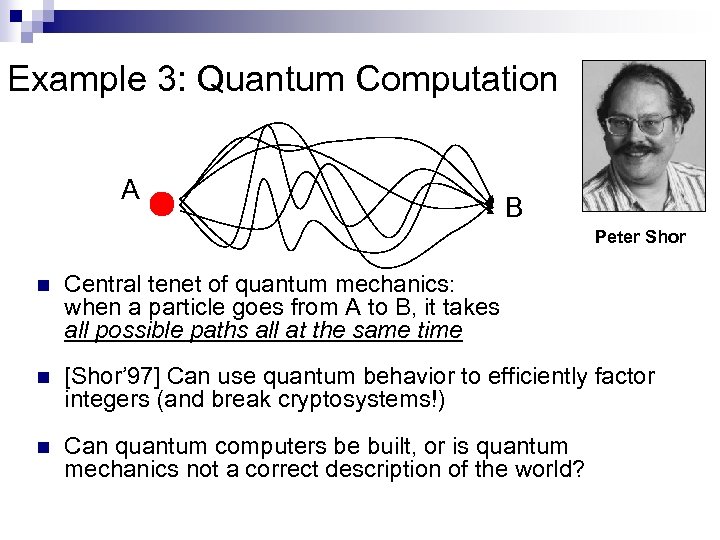
Example 3: Quantum Computation A B Peter Shor n Central tenet of quantum mechanics: when a particle goes from A to B, it takes all possible paths all at the same time n [Shor’ 97] Can use quantum behavior to efficiently factor integers (and break cryptosystems!) n Can quantum computers be built, or is quantum mechanics not a correct description of the world?
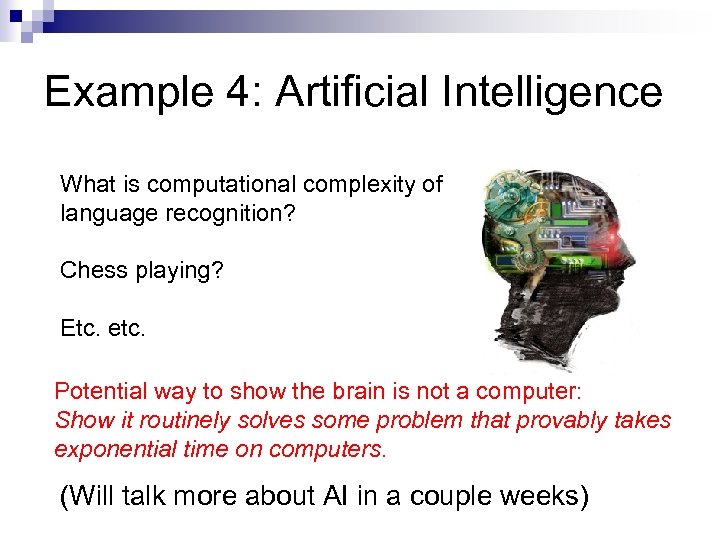
Example 4: Artificial Intelligence What is computational complexity of language recognition? Chess playing? Etc. etc. Potential way to show the brain is not a computer: Show it routinely solves some problem that provably takes exponential time on computers. (Will talk more about AI in a couple weeks)
Why is P vs NP a Million-dollar open problem? n If P = NP then Brilliance becomes routine (best schedule, best route, best design, best math proof, etc…) n If P NP then we know something new and fundamental not just about computers but about the world (akin to “Nothing travels faster than light”).
Next time: Cryptography (practical use of computational complexity)
Скачать презентацию What is the computational cost of automating brilliance
c7c45b1081615f0f7e125a58aa5dd1d2.ppt