


 Скачать презентацию What is that PHED 2017 — INQUIRY
0aa7438535dbf52ce28b663ce9243463.ppt
- Количество слайдов: 14
 What is that? PHED 2017 - INQUIRY
 INQUIRY? ? ? ? This course examines constructivist approaches to teaching and learning. Challenging traditional methods of curriculum delivery, this course assists students in developing skills to facilitate, manage and structure the learning environment to enhance learning ACTIVE vs. PASSIVE. . . CHALLENGE vs. ACCEPTANCE
 ME OR NOT ME? ? I have at least two siblings I have a partner I was born in Northern Ontario I have travelled beyond North America I have one or more pets My favourite sport is a TEAM sport I am as fit as I have ever been I am a teacher I am a PE teacher I feel comfortable teaching sexual health education
 SO, YOU WOULD LIKE TO TEACH P. E. ? ? Anatomy of a PE teacher Are there stereotypes? Do stereotypes still exist? How do you fit in?
 HOW THE FIELD EVOLVED. . . 1807 – first time games/play recognized as part of the school program in Upper Canada 1841 – Universal Education including “salvation through sports” (English belief) 1846 – Eggerton Ryerson – physical training and hygiene part of total education 1909 – North Bay “Normal” School to train teachers in the new system (drill & gymnastics)
 1909 – Strathcona Trust ($500, 000) Military preparation (Sweden) Persisted until late 1960’s 1920 -1945 – Fitness a primary concern 1943 National Physical Fitness Act (repealed in 1954) 1946 -1970 – increased emphasis on SPORT 1961 – Bill C-131 – Fitness & Amateur Sport
 DEVELOPMENT OF PROVINCIAL CURRICULA 1966 – HPE Curriculum – drill & conditioning for boys; dance/gymnastics and fundamental movements for girls (Laban) 1978 – HPE Curriculum – inculcate a love of “vigorous exercise” 1981 – Canada Fitness Survey 1998 – HPE Curriculum – updated versions include 20 minutes of “sustained moderate to vigorous physical activity” 2009 – HPE Curriculum – new directions
 SPORT TIMELINE. . . 5000 B. C. – the first watercraft are developed in various indigenous cultures (e. g. Kayaks) 1834 - The first modern Lacrosse games are played. The original game was played by North American Indians. 1837 - Donald Walker's book, Exercise for Ladies, warns women against horseback riding, because it deforms the lower part of the body. 1846 – first game of baseball is played.
 1855 - The first modern game of hockey is played in Kingston, Ontario, using rules similar to today's. 1865 - Matthew Vassar opens Vassar College with a special School of Physical Training with classes in riding, gardening, swimming, boating, skating and "other physical accomplishments suitable for ladies to acquire. . . bodily strength and grace. “ 1891 – James Naismith creates the game of basketball 1895 - Volleyball is invented in Holyoke, MA.
 1896 - At the first modern Olympics in Athens, a woman, Melpomene, barred from the official race, runs the same course as the men, finishing in 4 hours 30 minutes. Baron Pierre de Coubertin, founder of the modern Olympics, says, "It is indecent that the spectators should be exposed to the risk of seeing the body of a woman being smashed before their very eyes. Besides, no matter how toughened a sportswoman may be, her organizm is not cut out to sustain certain shocks”. 1914 - The American Olympic Committee formally opposes women's athletic competition in the Olympics. The only exception is the floor exercise, where women are allowed to only wear long skirts.
 1900 -1920 - Physical Education instructors strongly oppose competition among women, fearing it will make them less feminine. 1928 – Amsterdam Olympics first to offer a significant number of events for women. 1968 - The Olympic Committee conducts gender tests for the first time in international sports at the Winter Games in Grenoble, France. 1972 – Title IX is enacted in the US – “No person in the United States shall, on the basis of sex, be excluded from participation in, be denied the benefits of, or be subjected to discrimination under any education program or activity receiving Federal financial assistance. "[
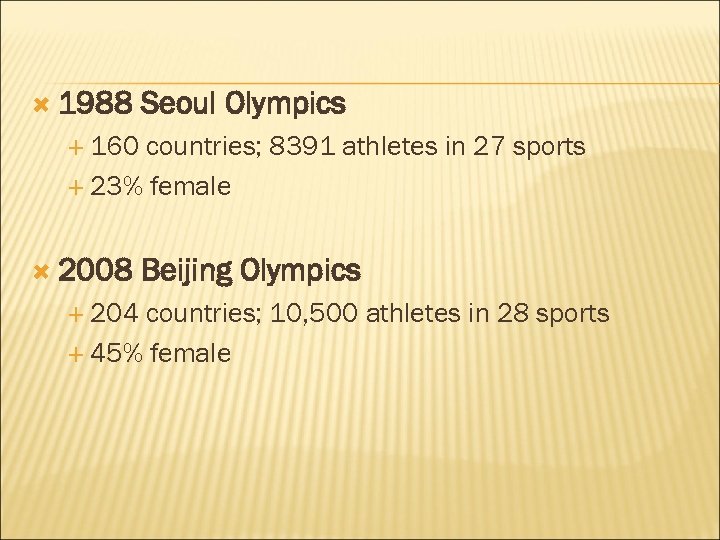 1988 Seoul Olympics 160 countries; 8391 athletes in 27 sports 23% female 2008 204 Beijing Olympics countries; 10, 500 athletes in 28 sports 45% female
 COURSE OUTLINE
 WHY DOES PHE MATTER? Write a one-page (maximum) belief statement that captures YOUR OWN values, attitudes and beliefs regarding the teaching of Physical & Health Education Double-spaced, typed, hard copy only. Due next class NOTE: start an electronic folder for all of your Inquiry documents!