


 Скачать презентацию What is Poetry Poetry Expresses
f1885a6670f6826399bb53df32d4c66d.ppt
- Количество слайдов: 70
 What is Poetry ?
 Poetry • Expresses the music and lyricism of language. • Teaches us the richness of language and its capabilities • Defines and frames deep feelings • Is personal and can be about anything and everything. • Should give pleasure to the listener and the reader.
 • Is intended to be read aloud. • Is a way of seeing, translating and reading. • Is intense and captures distilled perceptions. • Communicates on all levels of emotion and intellect. • Explores the meaning and mysteries of life. • Must be age and interest appropriate if it is to be appreciated.
 Acrostic Poems • In an acrostic poetry the letters of the subject are written down (vertically) to form the word of choice. Next to each letter the poetic statement is written horizontally to express the subject in an innovative way.
 Example of Acrostic poetry ME My heart beats inside of me Every day and night. Hamburger Heavenly food All Canada loves you Most especially me! Bring me your tired and your hungry Up to your favourite fast food place Rush to the place an order with the Gang behind the counter Eat with muster, ketchup, relish and a pickle Revive your strength once again!
 Alliteration • When the beginning of words start with the same consonant and vowel sounds in stressed syllable—and the words are close together, the effect is called Alliteration. • It takes a bit of listening to hear the repetition of a unit of sound, almost like an echo. • Alliteration is a device used to have dramatic effect upon the listener. • The sounds may sound similar though the letters are not similar, such as city and seal, fish and philosophy, quick and cat.
 Examples of Alliteration • Toby teaches tiny tots in Toledo. • Crazy cat climbed up the crooked cable. • Strong Sally slipped on Stanley’s icy surface. • Mad Maxie maneuvered a mean motorcycle.
 Alphabet Poetry • This form of poetry was invented by the poet, Paul West. • There are many varieties of alphabet poetry but they all begin with the selection of a topic. • The length of the lines are your choice. • Try to listen for rhythm and effect.
 Examples of alphabet poetry. Fashion accessories, buttons, caps denims, epaulets feathers, grunge, hemlines inseams, jeans, knickers, Levis mittens, nightgown, overalls, pajamas quilted, raglan, scarf, topcoat, underwear, vest windbreaker Xtraordinary yokes zipper.
 Catalogue Poetry • A catalogue is a list of items that deal with articles in a particular group. • A poetic list may define the qualities of a person, a place, and adventure that captures the vivid description of the reader. • Catalogue poems may be found in ancient writings such as Homer’s Iliad. • This pattern in its most elegant form ( as in praise found on a tombstone) may also be called “lapidary” • Catalogue poetry is also found in more modern romantic and down-to-earth subject.
 Example of a Catalogue Poem I am Not By Kathryn Mayer I am not my skin and hair and nails. I am not my weight. I am not my parents and I am not my generation. I am not my report card. I am not my friends or who I’m dating or what I used to be or my clothes or my horoscope. I am not a gender or a diagnosis. I am not a market or a category or a photograph, a file or an ability or disability or a possibility or a kind. But how would you know that?
 Cento • Cento is a word that in Latin means “patchwork”. The form goes back to the second century! • The objective in patchwork is to put together lines of poetry, each of which are borrowed from the work of a different poet. • This is not easy because the entire poem must make sense! • If you want to make it harder, you do so by using the rhyme scheme aa, bb, cc. • However, no matter what your choice, the syntax, the tense and the person must be consistent!
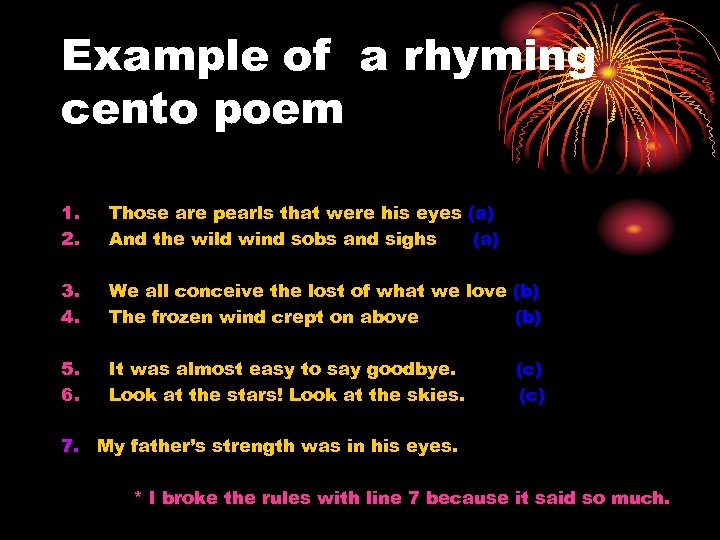 Example of a rhyming cento poem 1. 2. Those are pearls that were his eyes (a) And the wild wind sobs and sighs (a) 3. 4. We all conceive the lost of what we love (b) The frozen wind crept on above (b) 5. 6. It was almost easy to say goodbye. Look at the stars! Look at the skies. (c) 7. My father’s strength was in his eyes. * I broke the rules with line 7 because it said so much.
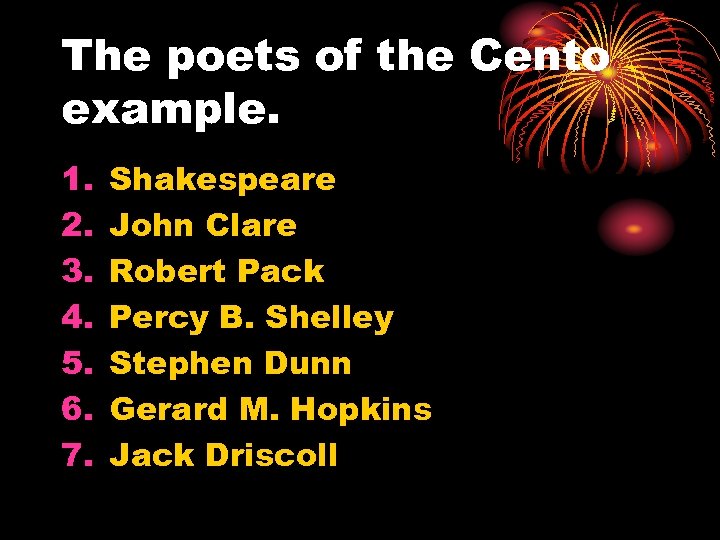 The poets of the Cento example. 1. 2. 3. 4. 5. 6. 7. Shakespeare John Clare Robert Pack Percy B. Shelley Stephen Dunn Gerard M. Hopkins Jack Driscoll
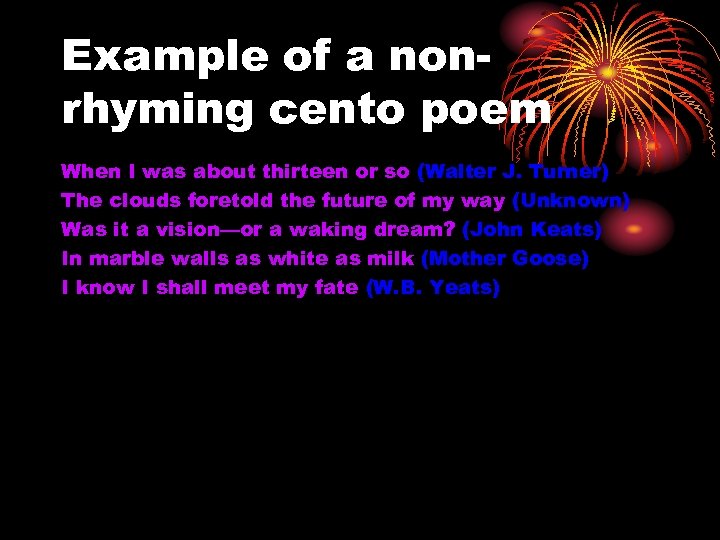 Example of a nonrhyming cento poem When I was about thirteen or so (Walter J. Turner) The clouds foretold the future of my way (Unknown) Was it a vision—or a waking dream? (John Keats) In marble walls as white as milk (Mother Goose) I know I shall meet my fate (W. B. Yeats)
 Cinquain (Sin-Cain) • An unrhymed form of poetry invented by Adelaid Crapsey whose topics were delicate and sad! • The original cinquain had a set number of five lines and a syllabic pattern of two, four, six, eight, two on respective lines.
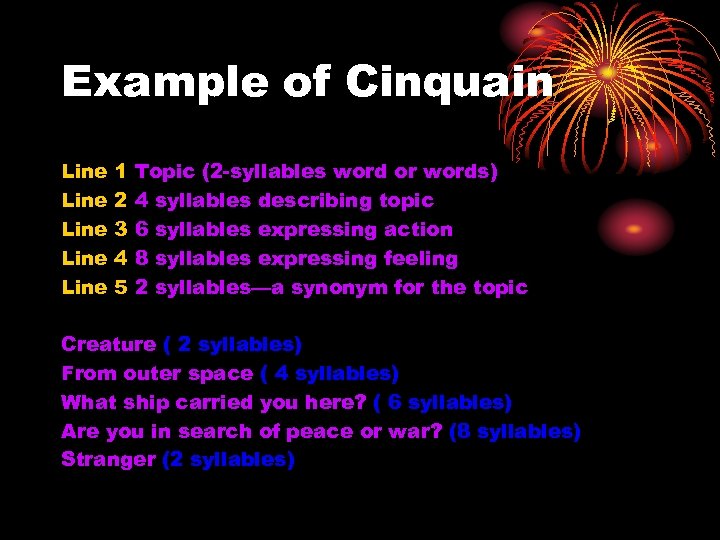 Example of Cinquain Line Line 1 2 3 4 5 Topic (2 -syllables word or words) 4 syllables describing topic 6 syllables expressing action 8 syllables expressing feeling 2 syllables—a synonym for the topic Creature ( 2 syllables) From outer space ( 4 syllables) What ship carried you here? ( 6 syllables) Are you in search of peace or war? (8 syllables) Stranger (2 syllables)
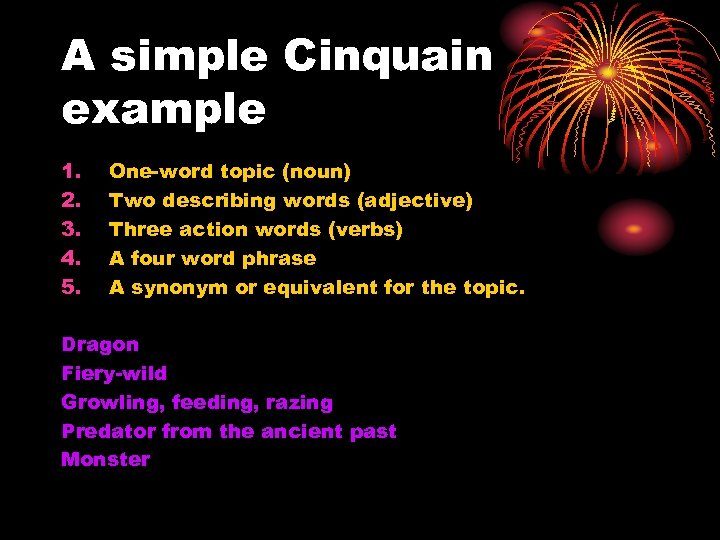 A simple Cinquain example 1. 2. 3. 4. 5. One-word topic (noun) Two describing words (adjective) Three action words (verbs) A four word phrase A synonym or equivalent for the topic. Dragon Fiery-wild Growling, feeding, razing Predator from the ancient past Monster
 Clerihew • This humorous biographic form was named after its creator, Edmund Clerihew Bentley, who wrote the first clerihew about himself. • A clerihew is a quatrain ( four lines) based upon someone’s name and is designed to give a clue about the personality of the person in the poem. • The rhyme scheme is aa, bb. • Finding rhyme words for names can be a problem, therefore the writer may use the first or last name in order to compose a rhyme.
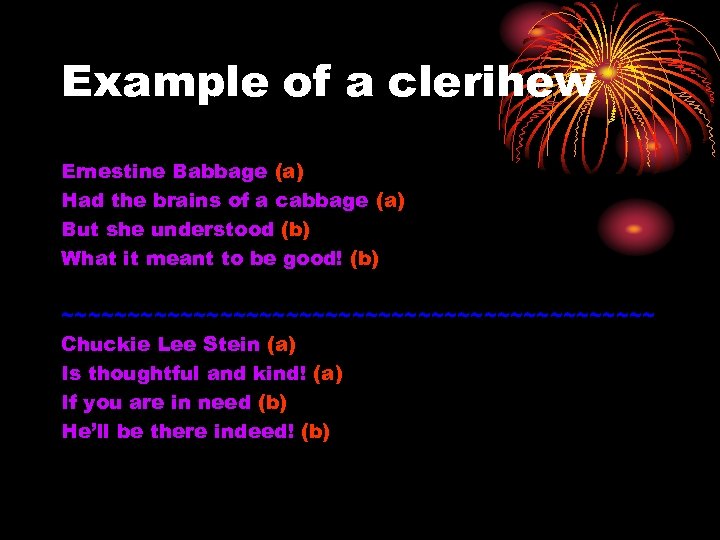 Example of a clerihew Ernestine Babbage (a) Had the brains of a cabbage (a) But she understood (b) What it meant to be good! (b) ~~~~~~~~~~~~~~~~~~~~~~~ Chuckie Lee Stein (a) Is thoughtful and kind! (a) If you are in need (b) He’ll be there indeed! (b)
 Concrete Poetry • Concrete poetry is a form of visual poetry where the type-face is laid out to present a pictorial representation of the subject of the poem. • Concrete Poetry is visual word expression. • It captures the essence of very specific words and works them through in very observable, physical ways. • Shapes are formed by the letters, words, or symbols that make up the poem rather than by the conventional arrangement of words.
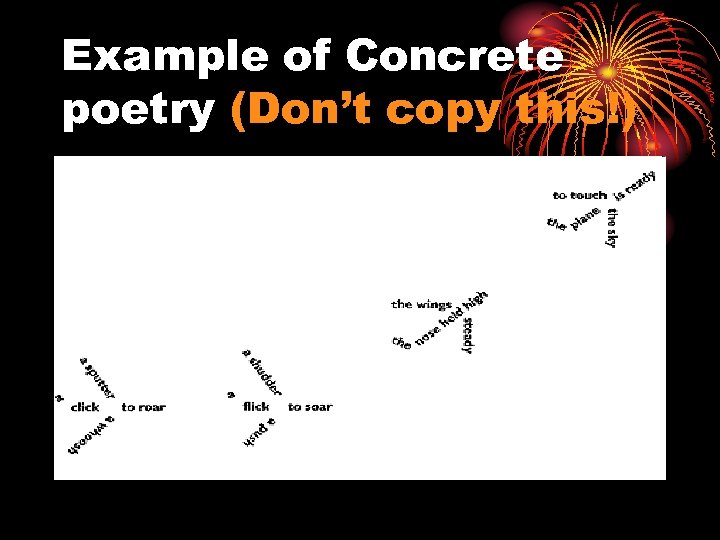 Example of Concrete poetry (Don’t copy this!)
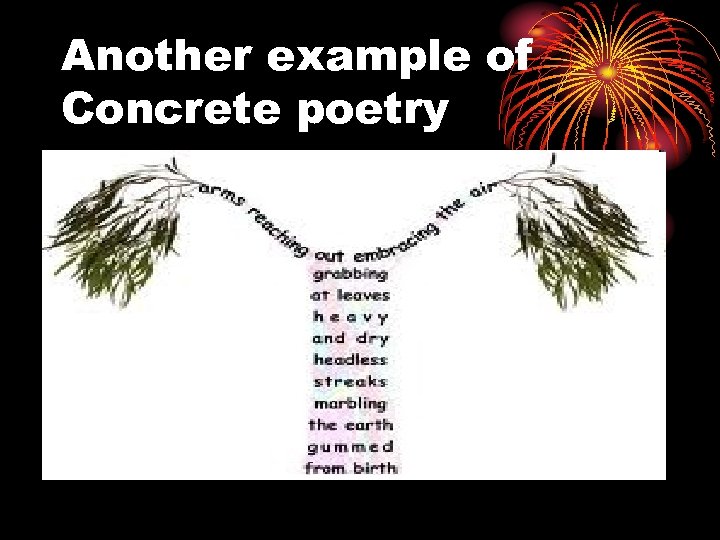 Another example of Concrete poetry
 Couplet • A couple is made up of two people, two things and two of everything. • So, in verse, a couplet is two lines that rhyme, usually in iambic pentameter. • A complete idea may be expressed in one couplet or a long poem may be made up of many couplets. • These poems can be humorous or sad.
 Example of couplets “But if a while I think of thee, dear friend, All losses are restored and sorrows end. ” (Shakespeare) “Twinkle, twinkle, little star, How I wonder what you are Up above the world so high, Like a diamond in the sky Then the traveler in the dark Thanks you for your tiny spark; How could he see where to go, If you did not twinkle so? ” (Mother Goose)
 Diamante • Diamante is the Italian word for “diamond” • The poetic form was created by Iris Tiedt and takes the form of a diamond when it is completed. • There are two forms to choose from, both must be viewed visually if they are to be appreciated. • Here you will see “Pattern 1” and “Pattern 2”.
 Diamante Pattern 1 • For pattern 1 you should construct the lines as follows: Line One: Choose the topic (noun) Line Two: Use two describing words (adjectives) Line Three: Use three action words ( Verbs or any “-ing” ending words) Line Four: Use a four-word phrase capturing some feeling about the topic. Line Five: Use three action words ( Verbs or any “-ing” ending words) Line Six: Use two describing words (adjectives) Line Seven: Use a synonym for an ending word ( noun, strong word)
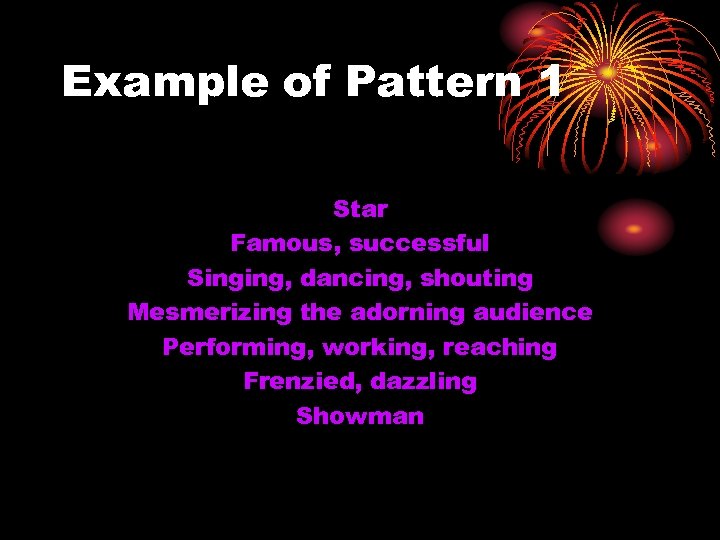 Example of Pattern 1 Star Famous, successful Singing, dancing, shouting Mesmerizing the adorning audience Performing, working, reaching Frenzied, dazzling Showman
 Diamante Pattern 2 • For pattern 2 you should construct the lines as follows: Line One: Choose a noun as your title and an opposite word (antonym) for the ending word of your poem. Line Two: Use two describing words (adjectives) for the title word Line Three: Use three action words ( Verbs or any “-ing” ending words) for the title word Line Four: Use two words to express the title noun—then two words to express the opposite ending noun. The theme changes in this line. Line Five: Choose three action words ( Verbs or any “-ing” ending words) for the ending noun Line Six: Use two describing words (adjectives) for the end word Line Seven: Use the antonym you decided upon in line one.
 Example of pattern 2 Loser Careless, wimpy Whining, complaining, stumbling Shy timid—confident, courageous Stretching, achieving, succeeding Hardworking, determined Winner (G. B. Lipson)
 Haiku • The haiku is a Japanese verse in three lines. • Line one has 5 syllables, line two has 7 syllables and line 3 has 5 syllables. • The 17 syllables are a compressed form which is a composition in praise of nature. • Many original books of haiku are illustrated gracefully in pen and ink sketches which capture the essence of a simple moment in nature. • Haiku is a mood piece in which there is no rhyme and there are no metaphors or similes!
 Example of Haiku Old crow in command (5) Always foraging for food (7) On his daily route (5) ~~~~~~~~~~~~~~ A colour riot Lilac bush burst into bloom A splash of flowers
 Hexaduad • This poetic form, invented by Gee Kay, is made up of six couplets. • Remember, a couplet is comprised of six succeeding lines of verse, usually rhyming, with the same meter. • There is a complete story contained in these 12 entertaining lines.
 Example of Hexaduad That’s My Hair My hair is high and curly It’s wavy and it’s swirly I wash it and I squeeze it I mousse it and I tease it It’s long and short and fluffy-poo It’s thick and rich and bleached so true If I have a bad hair day I glue it down with clouds of spray It takes a lot of loving care To tease and train humongous hair! Brains and soul may tell a story But gorgeous hair is a crowning glory! (G. B. Lipson)
 Lai Verse • The lai poem has a highly restricted pattern which makes it enormously difficult to compose. • The rules are very confining but some people are willing to persevere and keep trying to work at the composition and finally produce a lai verse. • The poem has three stanzas with a total of nine lines • The syllable count in each stanza is 5, 5 and 2. • The rhyme scheme is: aab, aab. It is based on a five and two-syllable rhythm.
 Example of Lai verse Apparition Are you really there? (5 syllables) So kind and so fair (5 syllables) I dream (2 syllables) Your vision is near (5 syllables) So strong and so clear (5 syllables) It seems (2 syllables) You stand by me here (5 syllables) And banish my fear (5 syllables) Serene (2 syllables)
 Lune • First came Haiku. Then in the Sixties came the an altered form by poet Jack Dollom. • Jack Dollom ignored syllables and counted words instead. • Dollom’s invented form called for three lines, the first line has three words, the second line has five words and the third line has three words. • Some startling ideas can be packed into a theme of 11 words.
 Example of Lune It rained pizzas (3 words) Everybody ran out to eat (5 words) It’s crazy man! (3 words) ~~~~~~~~~~~~~~~~~~~ The spaghetti boiled over the yellow flame What a mess!
 Lyrics • The word lyric is derived from the ancient Greek instrument, the lyre, which was like a small harp. • Originally a lyric poem was composed for song and musical accompaniment. • For hundreds of years, however, lyrics have been written without the anticipation of music. • But still—these poems always express the deep emotions of the poet which have an intrinsic, lilting musical quality.
 Metaphor • A metaphor is a figure of speech. • The word describes language that is used to compare dissimilar objects that are alike in some way. • A metaphor deals with two items in a way that makes the statement vivid and strong. • The comparison gives the metaphorical statement more meaning and helps make a mind picture. • The words like, as, than, similar to, resembles are not used. (These terms are used in similes)
 Examples of Metaphors Metaphor: “Juliet is the sun. ” (Shakespeare) In Plain Language: Juliet is pretty. ~~~~~~~~~~~~~~~~~~~ Metaphor: I cannot wrestle with this monster problem In Plain Language: The problem is too big for me ~~~~~~~~~~~~~~~~~~ Metaphor: Strength and dignity are her clothing. In Plain Language: She is strong and dignified
 Simile • A simile is a figure of speech that resembles a metaphor but uses the comparative words: like, as, than, similar to. • When a simile is used the linking to something else is clear. • Like a metaphor, the comparison if two things is designed to create a word picture that has a relationship which heightens meaning.
 Examples of similes Simile: The lie formed like a blister on his lips. In Plain Language: He lied and it was ugly. ~~~~~~~~~~~~~~~~~~~ Simile: Too much beauty is like a fatal gift. In Plain Language: Beautiful people have their problems.
 Occasional Poetry • This poem is just what it sounds like. • When there is a special event or a precious moment such as a birthday, wedding, graduation etc. This is the time the poets in the group are inspired to sit down and write personal poems for the events. • The poems may or may not rhyme.
 Onomatopoeia • Onomatopoeia is when a word is used which demonstrates a sound. • Probably one of the best examples of this form can be found throughout comic books where the sound is captured in colourful “sound words”, such as: crash, bang, boom, crunch, kerplunk, zap, buzz.
 Example of Onomatopoeia • • The water gurgled down the drain. The noisy chicken clucked her head off. I cracked that dangerous whip. The little kid slurped his soup.
 Pantoum • This form of Malayan poetry was invented in the fifteenth century. • Before that time it existed only in the oral tradition ( which is extremely difficult). • Composing a pantoum is one of the most fascinating experiences in poetry. • It unfolds like a puzzle as if someone else was helping you to write the poem. • Every line in the seven-stanza poem is used twice, except for one line in the last stanza. • Some courageous poets use quatrains. However, your poem does not have to rhyme.
 Example of Pantoum *The form below is 28 lines long. It does not rhyme and you will have to listen with an internal ear for pleasing rhythm. 1 2 3 4 Paladin Hail to the Jock! Hero of the year Elegant and strong We hear you cannot read 5 -2 Hero of the year 6 Incredible form
 7 -4 We hear you cannot read 8 Be honest with yourself 9 -6 Incredible form 10 It’s time to ask for help 11 -8 Be honest with yourself 12 Show courage off the field 13 -10 It’s time to ask for help 14 Insure your future life 15 -12 Show courage off the field 16 Look past the shouting crowd
 17 -14 Insure your future life 18 School spirit hides the truth 19 -16 Look past the shouting crowds 20 The cheers will die away 21 -18 School spirit hides the truth 22 Beyond the pride and glory 23 -20 The cheers will die away 24 When you face the real world 25 -22 Beyond the pride the glory 26 Be as fine as you can be 27 -24 When you face the real world 28 -1 Hail to the jock!
 Personification • Personification is a figure of speech. • The strategy is used to give objects, things and animals human characteristics that we recognize in ourselves. • This technique is used to animate things by giving them qualities we very well know belong to humans. • Personification heightens and emphasizes any description in terms we can relate to.
 Example of personification In Plain Language: Isn’t that a nice small car? Personification: Isn’t that the sweetest little gal you ever saw. ~~~~~~~~~~~~~~~~~~~ In Plain Language: My air conditioner sounds broken. Personification: My air conditioner is wheezing in pain.
 Poetic Cryptograms • A cryptogram is something written in code. • A poetic cryptogram is a lyrical saying written in strange ways unfamiliar to the eye. • The words and letters are in their proper order, but we are tricked because we are forced to work to guess and work out each word. • Because we are allowed artistic freedom with the design and layout of our poems—it is our personal choice to arrange a poem on paper in any way we please.
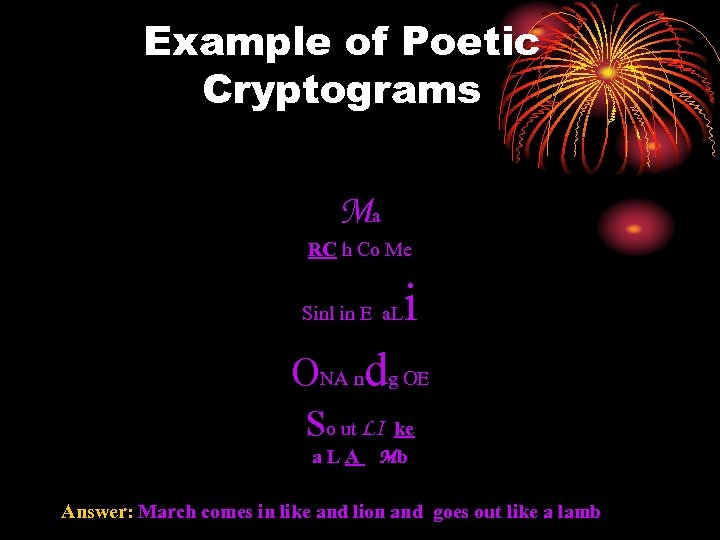 Example of Poetic Cryptograms Ma RC h Co Me Sinl in E a. L i ONA ndg OE So ut LI ke a. LA Mb Answer: March comes in like and lion and goes out like a lamb
 Quatrain • The clue to this poetic form is in the title. • A quarter of something is a fourth of it, so a quatrain is written in four verses with different rhyme schemes. • It may be written as: 1) a, a, b, b 2) a, a, a, a 3) a, b, c, d 4) a, b, a, b • It is a nice arrangement which allows a compact statement.
 Examples of Quatrains Evening red and morning grey (a) Are the signs of a sunny day. (a) An evening grey and a morning red (b) Bring rain on the farmer’s head. (b) ~~~~~~~~~~~~~~~~~~~ There was a man name Finnegan (a) A long beard grew out of his chin again- (a) Along came a wind and blew it in again- (a) Poor old man name Finnegan (a) (Mother Goose)
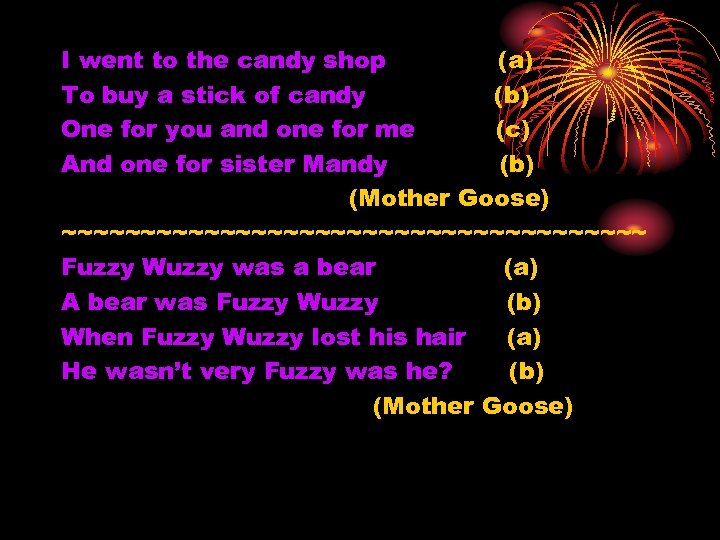 I went to the candy shop (a) To buy a stick of candy (b) One for you and one for me (c) And one for sister Mandy (b) (Mother Goose) ~~~~~~~~~~~~~~~~~~~ Fuzzy Wuzzy was a bear (a) A bear was Fuzzy Wuzzy (b) When Fuzzy Wuzzy lost his hair (a) He wasn’t very Fuzzy was he? (b) (Mother Goose)
 Sestina • The word sestina in Latin means “sixth”. • The sixth-stanza form (unrhymed) is a wonderful exercise much like a mystery that unravels itself. • The writer decides on a theme with six key words which appears six times at the end of all sentences. • Each stanza is constructed according to a given pattern. • The poem is finished with a last stanza called a tercet (three lines of verse) which also includes the key words, this time in a different place.
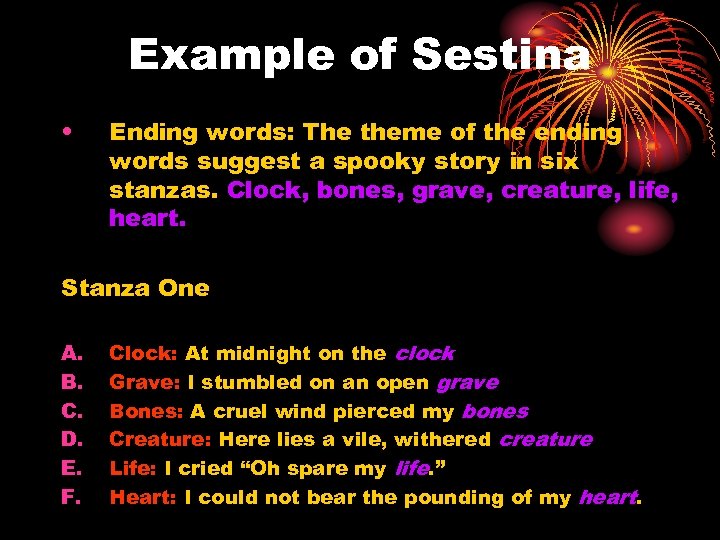 Example of Sestina • Ending words: The theme of the ending words suggest a spooky story in six stanzas. Clock, bones, grave, creature, life, heart. Stanza One A. B. C. D. E. F. Clock: At midnight on the clock Grave: I stumbled on an open grave Bones: A cruel wind pierced my bones Creature: Here lies a vile, withered creature Life: I cried “Oh spare my life. ” Heart: I could not bear the pounding of my heart.
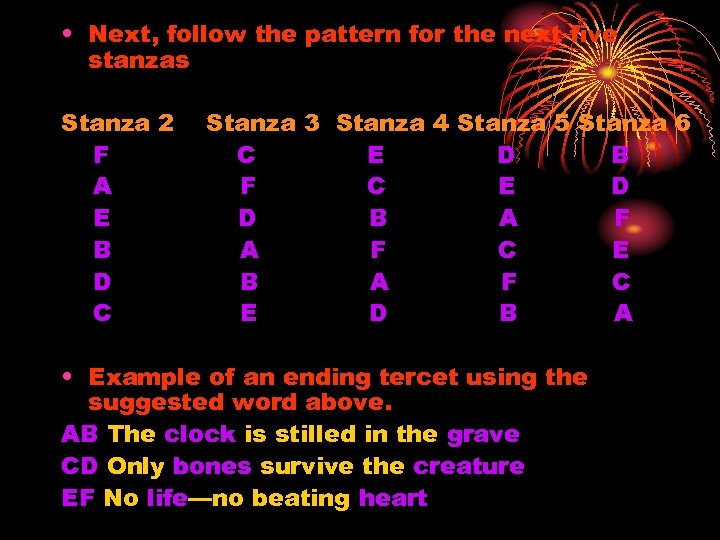 • Next, follow the pattern for the next five stanzas Stanza 2 F A E B D C Stanza 3 Stanza 4 Stanza 5 Stanza 6 C E D B F C E D D B A F C E D B A • Example of an ending tercet using the suggested word above. AB The clock is stilled in the grave CD Only bones survive the creature EF No life—no beating heart
 • A. B. C. D. E. F. Another choice for ending words: Family Time House Warmth Food Senses Stanza one A. We join the family B. At holiday time C. Tumble into the house D. Feel the warmth E. The aroma of food F. Tantalizes the senses
 Stanza Two F. A call to the senses A. Excites the family E. Into the kitchen—the source of food B. We wait for meal time D. Giddy with holiday warmth C. Thrilled to be together in our old house Stanza Three C. What sets the mood in this house F. Not just the appeal to our senses D. But the generated warmth A. That flows from the family B. Never diminished by time E. Sweet humour and old country food
 Stanza four E. Bring a dish to pass the food C. Carried to the house B. And tested over time F. The variety teases the senses A. And nurtures this lusty family D. Igniting it’s warmth Stanza five D. I need the warmth E. More than food A. The wisdom of family C. Fills this old house F. Memory sharpens my senses B. Through passing time
 Stanza six B. D. F. E. C. A. This is the time. Of quiet warmth And saturated senses Dimmed thoughts of food A quiet tribal house We leave our tired family Tercet AB Family time CD In this house of warmth EF Is food for thought and senses
 Guidelines for Sestina • Choose six key words related to a unifying theme such as cars, sports, outer space, friends, computers, the mall, art, music. • Assign a letter to each of the six words from A to F which hold throughout the poem. • Follow the designated changing pattern A to F for the seven stanzas with each line ending in the assigned word. • The last stanza, the tercet (three lines of poetry), changes the pattern but includes all six words in three lines.
 Sonnet • The sonnet has a fixed form of 14 lines of 10 syllables each. • It is usually written in iambic-pentameter—much like the rhythm of natural speech. • There are two parts to a sonnet, consisting of three quatrains and an ending couplet. • The sonnet explores a subject of particular interest to the poet. • The rhyme scheme is abab, cdcd, efef, gg. • The summing up of theme is expressed in the last couplet (two lines)
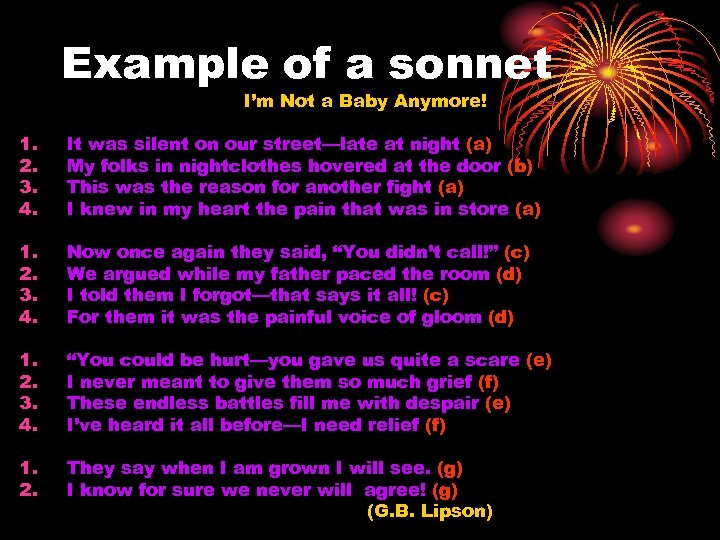 Example of a sonnet I’m Not a Baby Anymore! 1. 2. 3. 4. It was silent on our street—late at night (a) My folks in nightclothes hovered at the door (b) This was the reason for another fight (a) I knew in my heart the pain that was in store (a) 1. 2. 3. 4. Now once again they said, “You didn’t call!” (c) We argued while my father paced the room (d) I told them I forgot—that says it all! (c) For them it was the painful voice of gloom (d) 1. 2. 3. 4. “You could be hurt—you gave us quite a scare (e) I never meant to give them so much grief (f) These endless battles fill me with despair (e) I’ve heard it all before—I need relief (f) 1. 2. They say when I am grown I will see. (g) I know for sure we never will agree! (g) (G. B. Lipson)
 Iambic Pentameter • Iambic pentameter is a meter in poetry. • It refers to a line consisting of five iambic feet. The word "pentameter" simply means that there are five feet in the line; iambic pentameter is a line comprising five iambs. • An iamb refers to an unstressed syllable followed by a stressed syllable. • Iambic rhythms come relatively naturally in English. • Iambic pentameter is among the most common metrical forms in English poetry: it is used in many of the major English poetic forms, including blank verse, the heroic couplet, and many of the traditional rhymed stanza
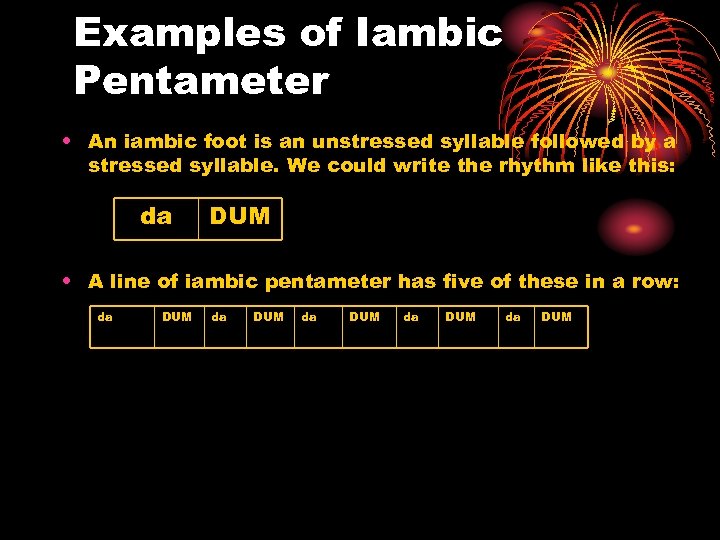 Examples of Iambic Pentameter • An iambic foot is an unstressed syllable followed by a stressed syllable. We could write the rhythm like this: da DUM • A line of iambic pentameter has five of these in a row: da DUM da DUM
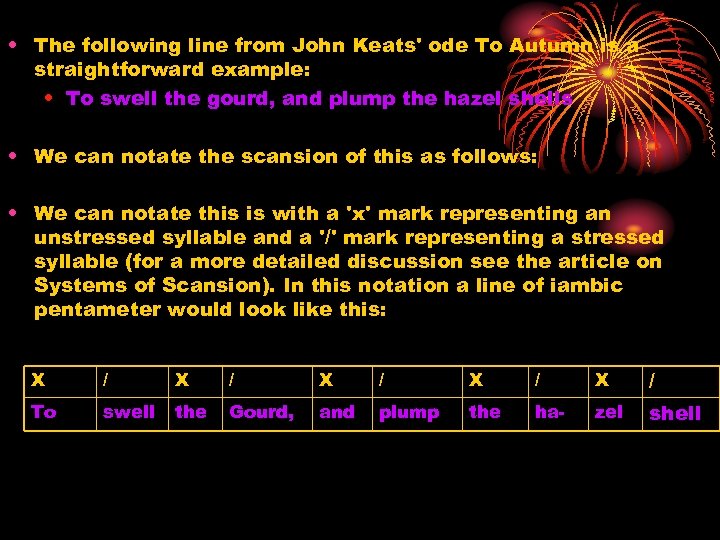 • The following line from John Keats' ode To Autumn is a straightforward example: • To swell the gourd, and plump the hazel shells • We can notate the scansion of this as follows: • We can notate this is with a 'x' mark representing an unstressed syllable and a '/' mark representing a stressed syllable (for a more detailed discussion see the article on Systems of Scansion). In this notation a line of iambic pentameter would look like this: X / X / X / To swell the Gourd, and plump the ha- zel shell