Скачать презентацию WHAT IS PARALLEL COMPUTING PARALLEL COMPUTING IS
Parallel computing.pptx
- Количество слайдов: 8
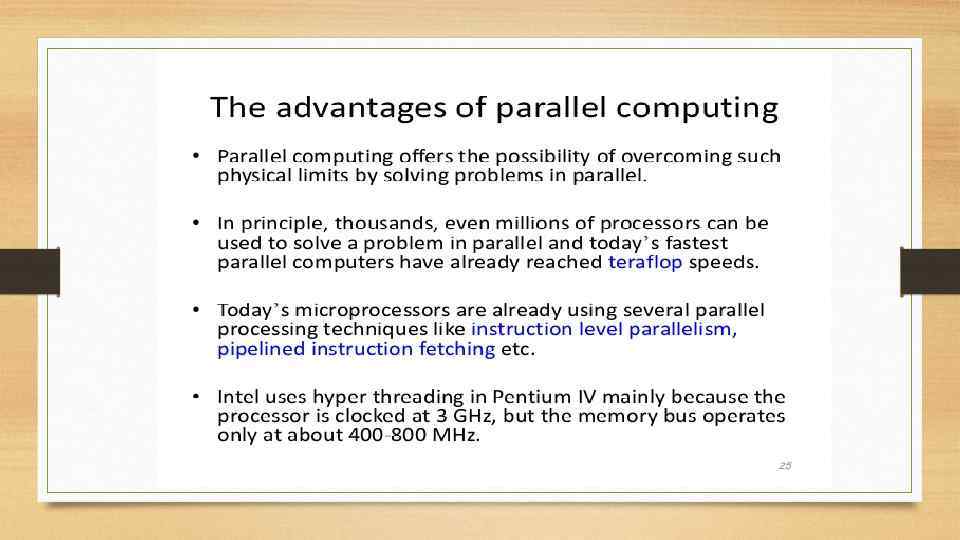
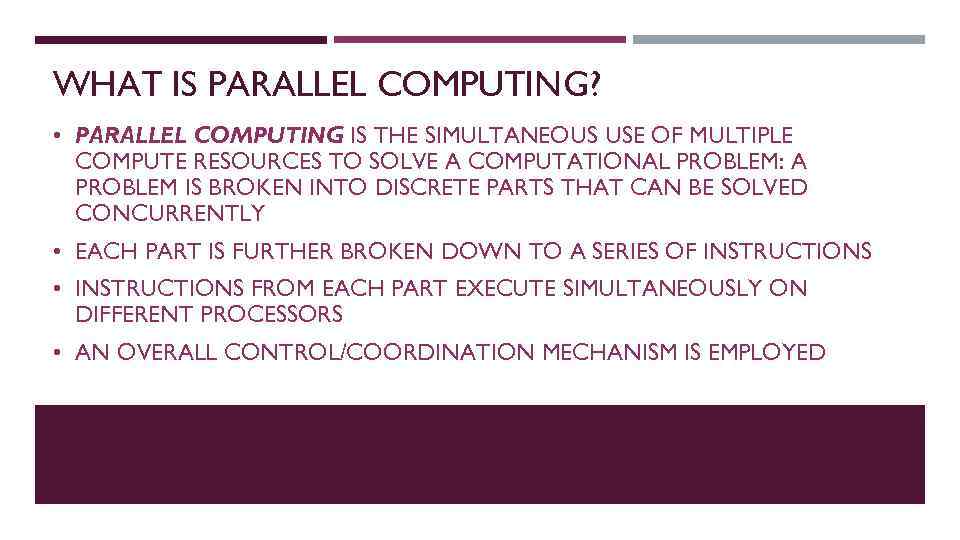 WHAT IS PARALLEL COMPUTING? • PARALLEL COMPUTING IS THE SIMULTANEOUS USE OF MULTIPLE COMPUTE RESOURCES TO SOLVE A COMPUTATIONAL PROBLEM: A PROBLEM IS BROKEN INTO DISCRETE PARTS THAT CAN BE SOLVED CONCURRENTLY • EACH PART IS FURTHER BROKEN DOWN TO A SERIES OF INSTRUCTIONS • INSTRUCTIONS FROM EACH PART EXECUTE SIMULTANEOUSLY ON DIFFERENT PROCESSORS • AN OVERALL CONTROL/COORDINATION MECHANISM IS EMPLOYED
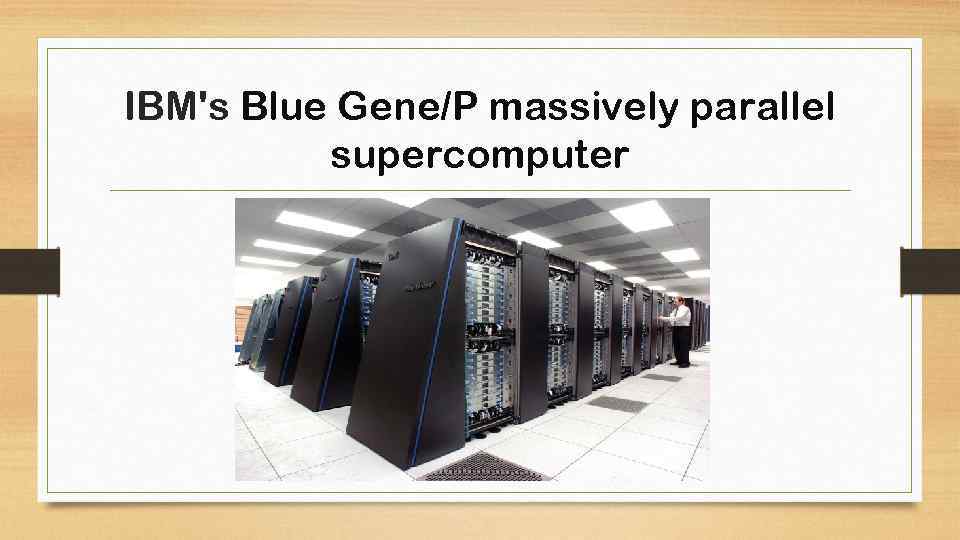 IBM's Blue Gene/P massively parallel supercomputer
 Types of Parallel Computing: There are several Types of Parallel Computing which are used World wide. 1) Bit-level Parallelism. 2) Instruction level Parallelism. 3) Task Parallelism.
 Bit Level Parallelism: It is a form of parallelism which is based on increasing processors word size. It shortens the no. of instructions that the system must run in order to perform a task on variables which are greater in size.
 Instruction Level Parallelism: It is a form of parallel computing in which we can calculate the amount of operation carried out by an operating system at same time. For example 1. Instruction pipelining. 2. Out of order execution. 3. Register renaming. 4. Speculative execution. 5. Branch prediction.
 Task Parallelism: Task Parallelism is a form of parallelization in which different processors run the program among different codes of distribution. It is also called as Function Parallelism.