


 Скачать презентацию What Is Operations Management Production is the creation
cf885234dc30351f8a5a9e0bdc577fdb.ppt
- Количество слайдов: 24
 What Is Operations Management? Production is the creation of goods and services Operations management is the set of activities that creates value in the form of goods and services by transforming inputs into outputs Transparency Masters to accompany Heizer/Render – Principles of Operations Management, 5 e, and Operations Management, 7 e 1 © 2004 by Prentice Hall, Inc. , Upper Saddle River, N. J. 07458
 Organizing to Produce Goods and Services ¨ Essential functions: ¨ Marketing – generates demand ¨ Operations –creates the product ¨ Finance/accounting – tracks organizational performance, pays bills, collects money Transparency Masters to accompany Heizer/Render – Principles of Operations Management, 5 e, and Operations Management, 7 e 2 © 2004 by Prentice Hall, Inc. , Upper Saddle River, N. J. 07458
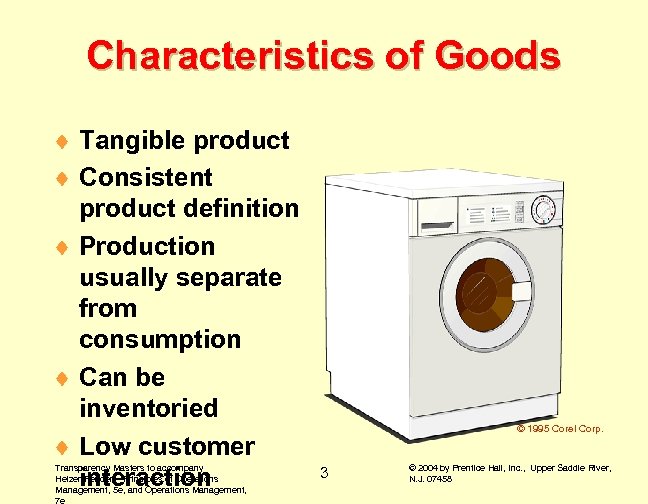 Characteristics of Goods ¨ Tangible product ¨ Consistent product definition ¨ Production usually separate from consumption ¨ Can be inventoried ¨ Low customer interaction Transparency Masters to accompany Heizer/Render – Principles of Operations Management, 5 e, and Operations Management, 7 e © 1995 Corel Corp. 3 © 2004 by Prentice Hall, Inc. , Upper Saddle River, N. J. 07458
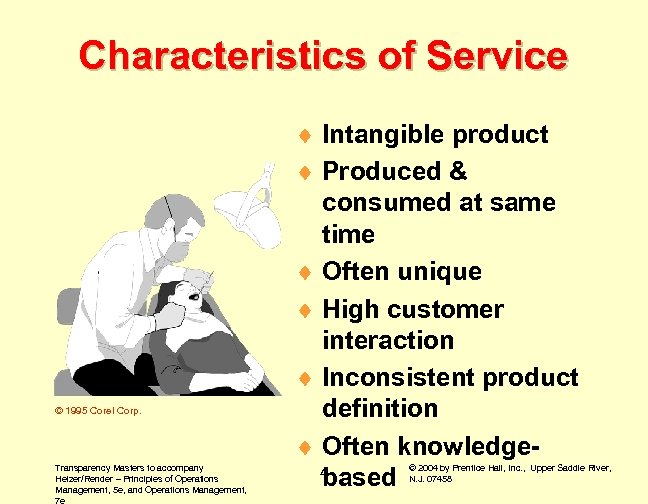 Characteristics of Service © 1995 Corel Corp. Transparency Masters to accompany Heizer/Render – Principles of Operations Management, 5 e, and Operations Management, 7 e ¨ Intangible product ¨ Produced & consumed at same time ¨ Often unique ¨ High customer interaction ¨ Inconsistent product definition ¨ Often knowledge 4 based © 2004 by Prentice Hall, Inc. , Upper Saddle River, N. J. 07458
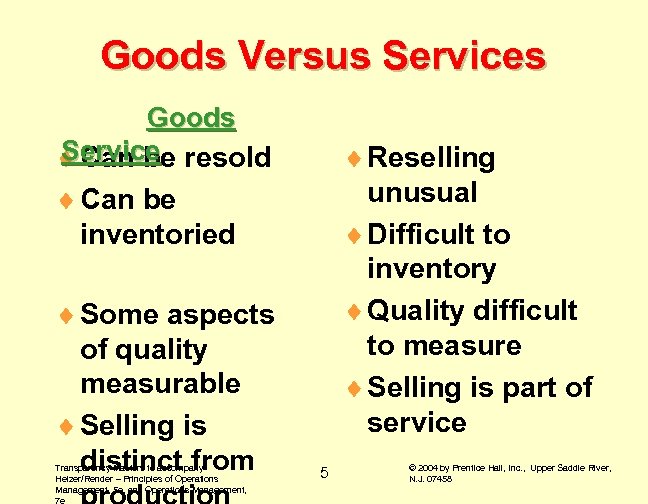 Goods Versus Services Goods Service ¨ Can be resold ¨ Can be inventoried ¨ Some aspects of quality measurable ¨ Selling is distinct from Transparency Masters to accompany Heizer/Render – Principles of Operations Management, 5 e, and Operations Management, 7 e ¨ Reselling unusual ¨ Difficult to inventory ¨ Quality difficult to measure ¨ Selling is part of service 5 © 2004 by Prentice Hall, Inc. , Upper Saddle River, N. J. 07458
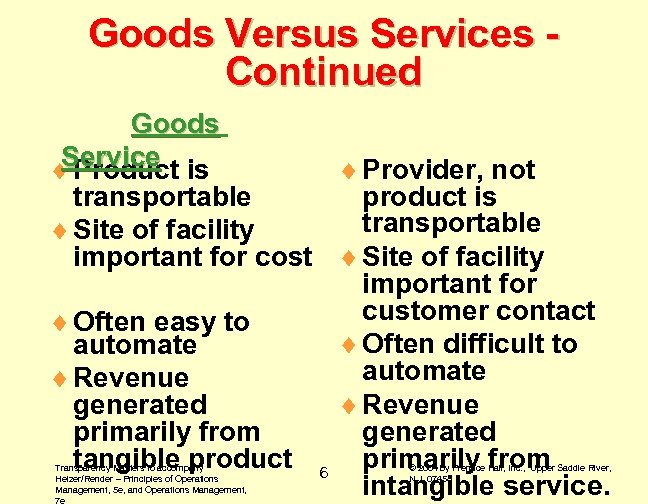 Goods Versus Services Continued Goods Service ¨ Product is ¨ Provider, not transportable product is transportable ¨ Site of facility important for cost ¨ Site of facility important for customer contact ¨ Often easy to ¨ Often difficult to automate ¨ Revenue generated ¨ Revenue primarily from generated tangible product 6 primarily from intangible service. Transparency Masters to accompany Heizer/Render – Principles of Operations Management, 5 e, and Operations Management, 7 e © 2004 by Prentice Hall, Inc. , Upper Saddle River, N. J. 07458
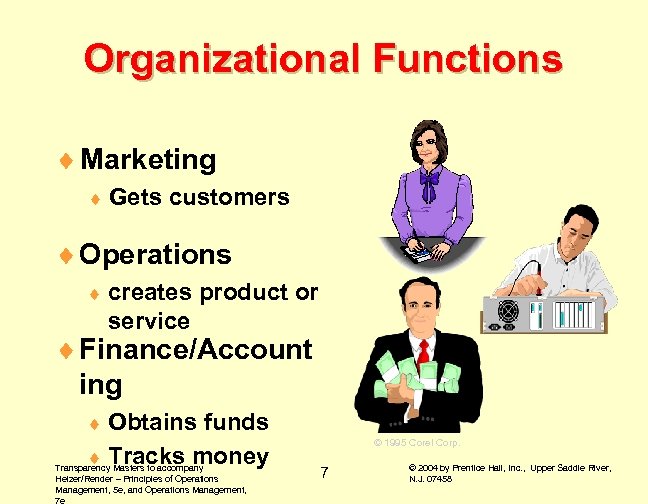 Organizational Functions ¨ Marketing ¨ Gets customers ¨ Operations ¨ creates product or service ¨ Finance/Account ing ¨ Obtains funds ¨ Tracks money Transparency Masters to accompany Heizer/Render – Principles of Operations Management, 5 e, and Operations Management, 7 e © 1995 Corel Corp. 7 © 2004 by Prentice Hall, Inc. , Upper Saddle River, N. J. 07458
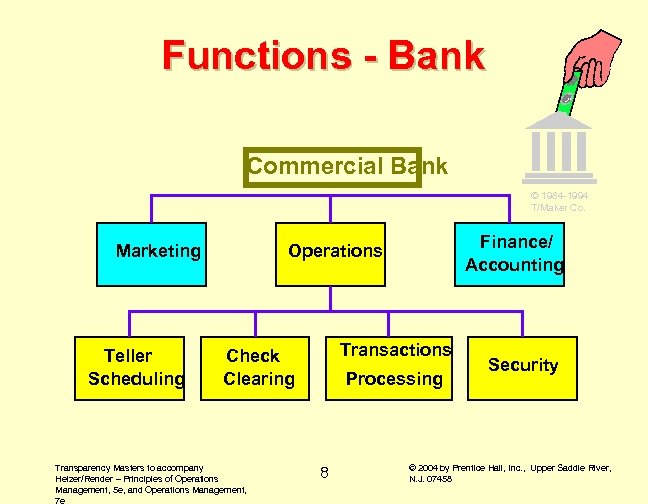 Functions - Bank Commercial Bank © 1984 -1994 T/Maker Co. Marketing Teller Scheduling Finance/ Accounting Operations Transactions Check Clearing Transparency Masters to accompany Heizer/Render – Principles of Operations Management, 5 e, and Operations Management, 7 e Processing 8 Security © 2004 by Prentice Hall, Inc. , Upper Saddle River, N. J. 07458
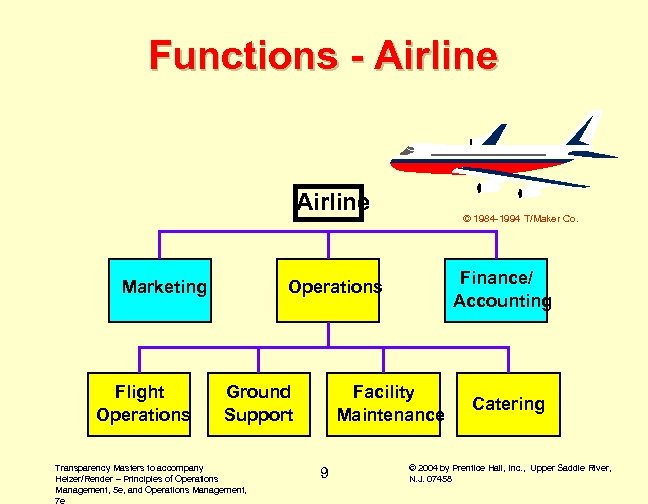 Functions - Airline Marketing Flight Operations © 1984 -1994 T/Maker Co. Finance/ Accounting Operations Ground Support Transparency Masters to accompany Heizer/Render – Principles of Operations Management, 5 e, and Operations Management, 7 e Facility Maintenance 9 Catering © 2004 by Prentice Hall, Inc. , Upper Saddle River, N. J. 07458
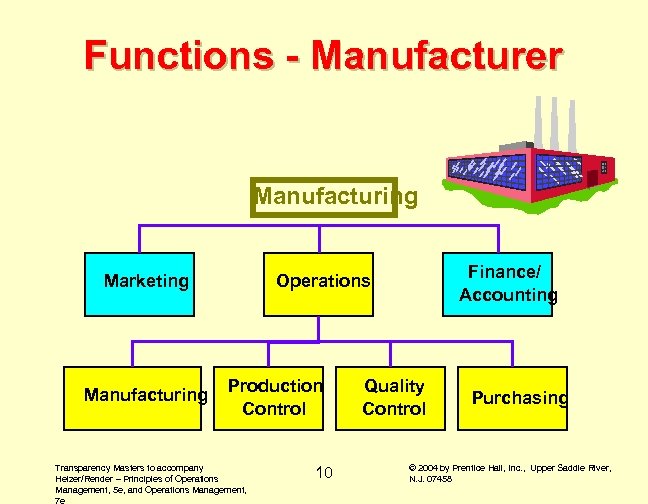 Functions - Manufacturer Manufacturing Marketing Manufacturing Finance/ Accounting Operations Production Control Transparency Masters to accompany Heizer/Render – Principles of Operations Management, 5 e, and Operations Management, 7 e 10 Quality Control Purchasing © 2004 by Prentice Hall, Inc. , Upper Saddle River, N. J. 07458
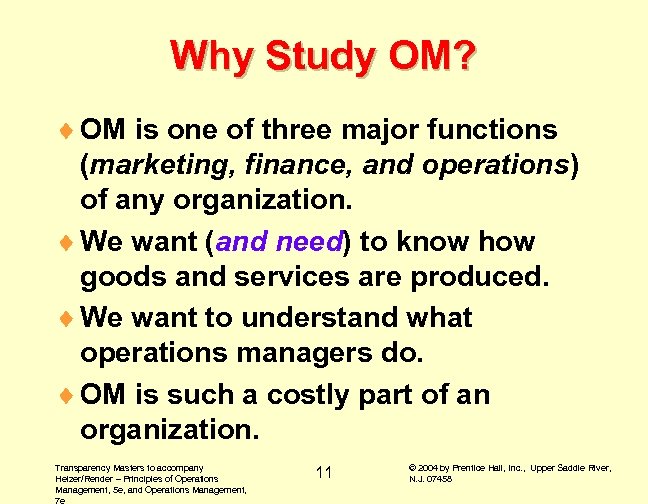 Why Study OM? ¨ OM is one of three major functions (marketing, finance, and operations) of any organization. ¨ We want (and need) to know how goods and services are produced. ¨ We want to understand what operations managers do. ¨ OM is such a costly part of an organization. Transparency Masters to accompany Heizer/Render – Principles of Operations Management, 5 e, and Operations Management, 7 e 11 © 2004 by Prentice Hall, Inc. , Upper Saddle River, N. J. 07458
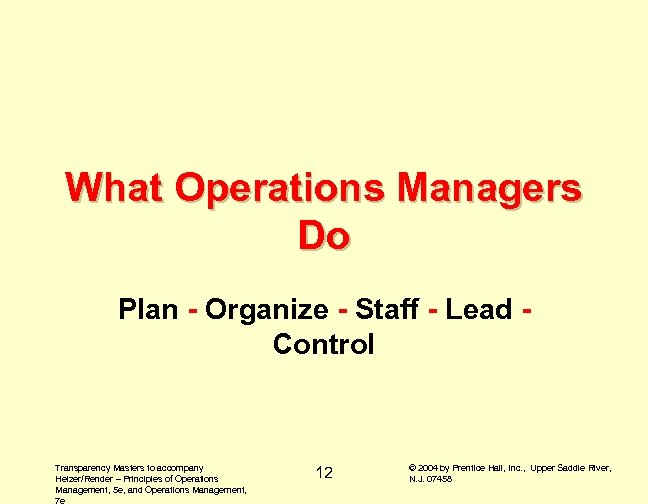 What Operations Managers Do Plan - Organize - Staff - Lead Control Transparency Masters to accompany Heizer/Render – Principles of Operations Management, 5 e, and Operations Management, 7 e 12 © 2004 by Prentice Hall, Inc. , Upper Saddle River, N. J. 07458
 Ten Critical Decisions ¨ Service, product design……………. . ¨ Quality management………………… ¨ Process, capacity design…………. . ¨ Location ………………… ¨ Layout design ……………. . ¨ Human resources, job design……. . 13 ¨ Supply-chain Transparency Masters to accompany Heizer/Render – Principles of Operations Management, 5 e, and Operations Management, 7 e © 2004 by Prentice Hall, Inc. , Upper Saddle River, N. J. 07458
 The Critical Decisions ¨ Quality management ¨ Who is responsible for quality? ¨ How do we define quality? ¨ Service and product design ¨ What product or service should we offer? ¨ How should we design these products and services? Transparency Masters to accompany Heizer/Render – Principles of Operations Management, 5 e, and Operations Management, 7 e 14 © 2004 by Prentice Hall, Inc. , Upper Saddle River, N. J. 07458
 The Critical Decisions Continued ¨ Process and capacity design ¨ What processes will these products require and in what order? ¨ What equipment and technology is necessary for these processes? ¨ Location ¨ Where should we put the facility ¨ On what criteria should we base this location decision? Transparency Masters to accompany Heizer/Render – Principles of Operations Management, 5 e, and Operations Management, 7 e 15 © 2004 by Prentice Hall, Inc. , Upper Saddle River, N. J. 07458
 The Critical Decisions Continued ¨ Layout design ¨ How should we arrange the facility? ¨ How large a facility is required? ¨ Human resources and job design ¨ How do we provide a reasonable work environment? ¨ How much can we expect our employees to produce? Transparency Masters to accompany Heizer/Render – Principles of Operations Management, 5 e, and Operations Management, 7 e 16 © 2004 by Prentice Hall, Inc. , Upper Saddle River, N. J. 07458
 The Critical Decisions Continued ¨ Supply chain management ¨ Should we make or buy this item? ¨ Who are our good suppliers and how many should we have? ¨ Inventory, material requirements planning, ¨ How much inventory of each item should we have? ¨ When do we re-order? Transparency Masters to accompany Heizer/Render – Principles of Operations Management, 5 e, and Operations Management, 7 e 17 © 2004 by Prentice Hall, Inc. , Upper Saddle River, N. J. 07458
 The Critical Decisions Continued ¨ Intermediate, short term, and project scheduling ¨ Is subcontracting production a good idea? ¨ Are we better off keeping people on the payroll during slowdowns? ¨ Maintenance ¨ Who is responsible for maintenance? ¨ When do we do maintenance? Transparency Masters to accompany Heizer/Render – Principles of Operations Management, 5 e, and Operations Management, 7 e 18 © 2004 by Prentice Hall, Inc. , Upper Saddle River, N. J. 07458
 Where Are the OM Jobs? ¨ Technology/methods ¨ Facilities/space utilization ¨ Strategic issues ¨ Response time ¨ People/team development ¨ Customer service ¨ Quality ¨ Cost reduction ¨ Inventory reduction ¨ Productivity improvement Transparency Masters to accompany Heizer/Render – Principles of Operations Management, 5 e, and Operations Management, 7 e 19 © 2004 by Prentice Hall, Inc. , Upper Saddle River, N. J. 07458
 New Challenges in OM From ¨ Local or national focus ¨ Batch shipments ¨ Low bid purchasing To ¨ Global focus ¨ Just-in-time ¨ Supply chain partnering ¨ Lengthy product development ¨ Standard products ¨ Job specialization Transparency Masters to accompany Heizer/Render – Principles of Operations Management, 5 e, and Operations Management, 7 e 20 ¨ Rapid product development, alliances ¨ Mass customization ¨ Empowered employees, © 2004 by Prentice Hall, Inc. , Upper Saddle River, N. J. 07458
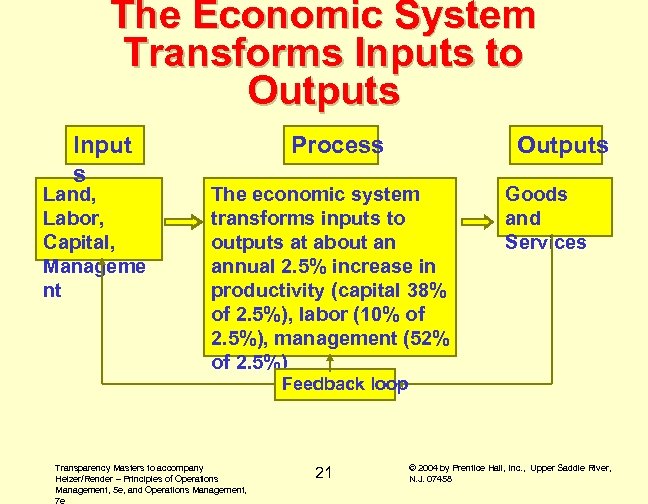 The Economic System Transforms Inputs to Outputs Input s Land, Labor, Capital, Manageme nt Process Outputs The economic system transforms inputs to outputs at about an annual 2. 5% increase in productivity (capital 38% of 2. 5%), labor (10% of 2. 5%), management (52% of 2. 5%) Goods and Services Feedback loop Transparency Masters to accompany Heizer/Render – Principles of Operations Management, 5 e, and Operations Management, 7 e 21 © 2004 by Prentice Hall, Inc. , Upper Saddle River, N. J. 07458
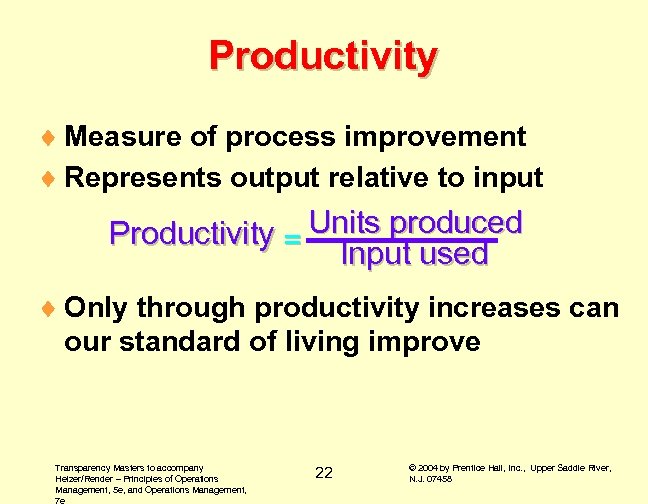 Productivity ¨ Measure of process improvement ¨ Represents output relative to input Productivity = Units produced Input used ¨ Only through productivity increases can our standard of living improve Transparency Masters to accompany Heizer/Render – Principles of Operations Management, 5 e, and Operations Management, 7 e 22 © 2004 by Prentice Hall, Inc. , Upper Saddle River, N. J. 07458
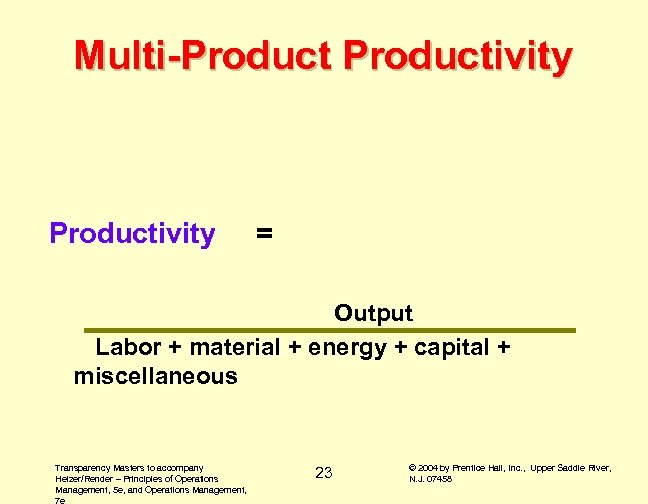 Multi-Productivity = Output Labor + material + energy + capital + miscellaneous Transparency Masters to accompany Heizer/Render – Principles of Operations Management, 5 e, and Operations Management, 7 e 23 © 2004 by Prentice Hall, Inc. , Upper Saddle River, N. J. 07458
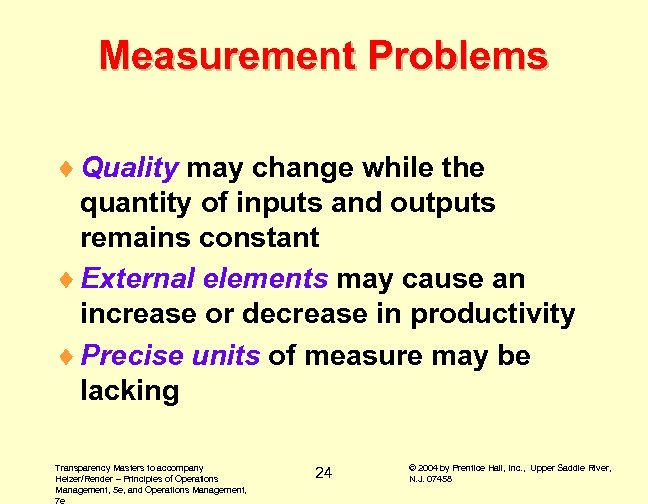 Measurement Problems ¨ Quality may change while the quantity of inputs and outputs remains constant ¨ External elements may cause an increase or decrease in productivity ¨ Precise units of measure may be lacking Transparency Masters to accompany Heizer/Render – Principles of Operations Management, 5 e, and Operations Management, 7 e 24 © 2004 by Prentice Hall, Inc. , Upper Saddle River, N. J. 07458