


 Скачать презентацию What is Macroeconomics Macroeconomics is the study of
073c981d9b4315949a0367e6dce8971f.ppt
- Количество слайдов: 33
 What is Macroeconomics? Macroeconomics is the study of the structure and performance of national economies and of the policies that governments use to try to affect economic performance 1. 2. 3. 4. 5. What determines a nation’s long run economic growth? What causes a nation's economic activity to fluctuate? What causes unemployment? What causes prices to rise? Can government policies be used to improve a nation’s economic performance?
 7 Introduction to Economic Growth and Instability
 Chapter Objectives • The Business Cycle and its Primary Phases • How Economic Growth is Measured and Why is it Important • How Unemployment and Inflation are Measured • The Types of Unemployment and Inflation and their Various Economic Impacts
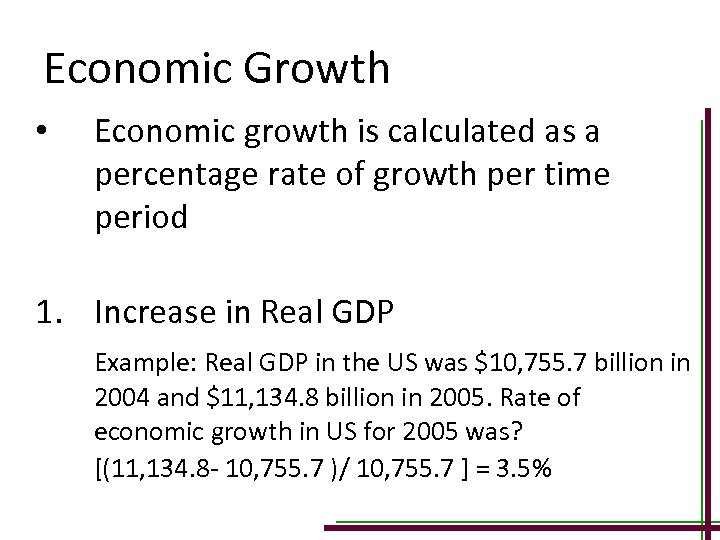 Economic Growth • Economic growth is calculated as a percentage rate of growth per time period 1. Increase in Real GDP Example: Real GDP in the US was $10, 755. 7 billion in 2004 and $11, 134. 8 billion in 2005. Rate of economic growth in US for 2005 was? [(11, 134. 8 - 10, 755. 7 )/ 10, 755. 7 ] = 3. 5%
 Economic Growth 2. Increase in Real GDP Per Capita • Takes into consideration the size of the population. • Found by dividing real GDP by the size of the population Example: • Real GDP in the US was $10, 755. 7 billion in 2004 and population was 293. 9 million • GDP per capita = $36, 596 • In 2005 GDP per capita rose to $37, 536. Rate of growth of GDP per capita? • 2. 6%
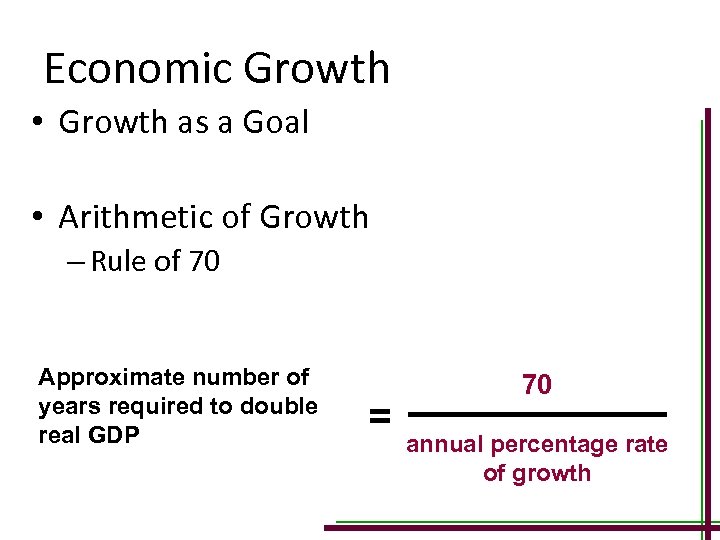 Economic Growth • Growth as a Goal • Arithmetic of Growth – Rule of 70 Approximate number of years required to double real GDP = 70 annual percentage rate of growth
 Main Sources of Growth 1. Increases in Inputs 2. Increases in Resource Productivity • Productivity: measured as real output per unit of input • Productivity in the United States – Improved Products and Services – Understating the actual growth of economic well being – Added Leisure – Increases achieved despite increases in leisure – Other Impacts – Environment and quality of life
 The Business Cycle • Business cycles are alternating rises and declines in the level of economic activity • Phases: – Peak: business activity reaches a temporary maximum – Recession: period of decline in total output, income and employment – Trough: output and employment at the lowest levels
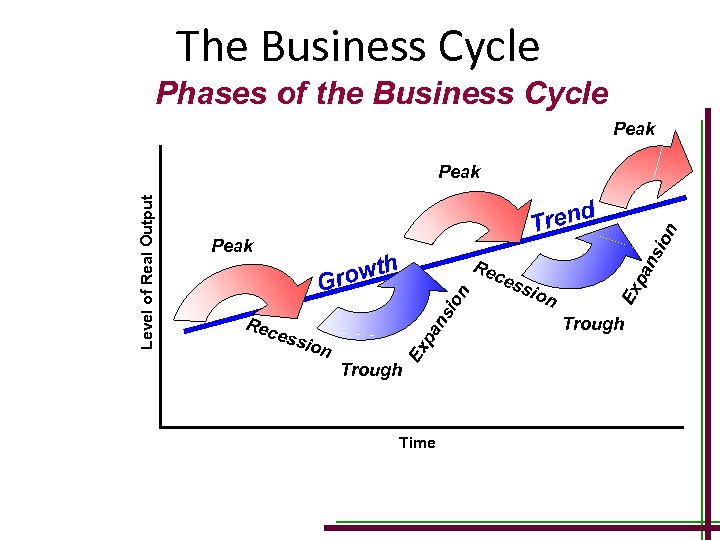 The Business Cycle Phases of the Business Cycle Peak h rowt G Rec ess io n pa ns io n Re Trough Time ces sio n Ex pa ns ion Peak rend T Ex Level of Real Output Peak Trough
 Cyclical Impact • The business cycle is felt everywhere but affects differs across sectors of the economy: 1. Durables: • Industries producing capital goods (eg. Heavy equipment etc) and consumer durables (eg. Household electronics) 1. Nondurables: • Service industries such as medical and legal services and nondurable consumer goods such as bread, milk etc • Relatively insulated from the most severe effects of recession
 • Twin Problems of the Business Cycle – Unemployment – Inflation
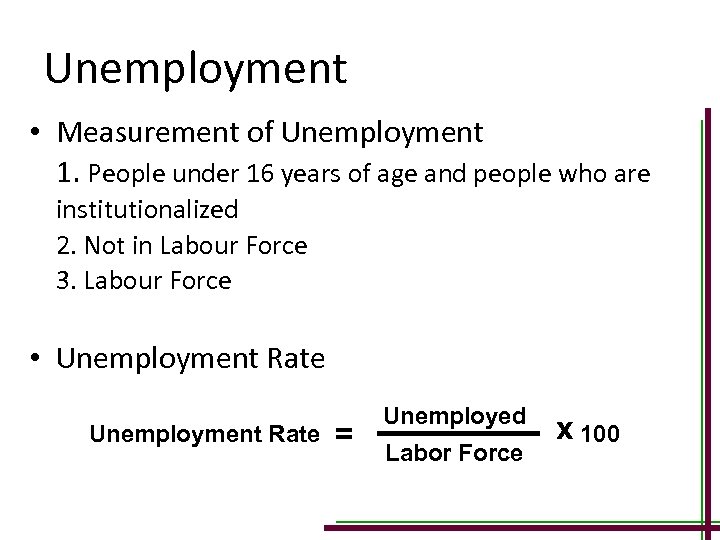 Unemployment • Measurement of Unemployment 1. People under 16 years of age and people who are institutionalized 2. Not in Labour Force 3. Labour Force • Unemployment Rate = Unemployed Labor Force x 100
 Unemployment Rate Criticisms: – Part-Time Employment • Want to work full time or are working fewer hours than they want – Discouraged Workers • After unsuccessfully seeking employment for a time, become discouraged and drop out of the labour force
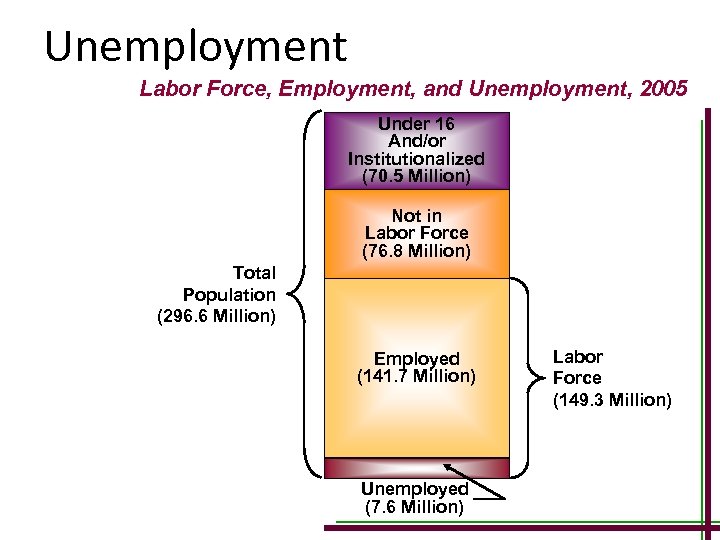 Unemployment Labor Force, Employment, and Unemployment, 2005 Under 16 And/or Institutionalized (70. 5 Million) Not in Labor Force (76. 8 Million) Total Population (296. 6 Million) Employed (141. 7 Million) Unemployed (7. 6 Million) Labor Force (149. 3 Million)
 Types of Unemployment 1. Frictional Unemployment – ‘Frictional’ implies that the labour market does not operate perfectly and instantaneously in matching workers and jobs 1. Search unemployment 2. Wait unemployment
 Types of Unemployment 2. Structural Unemployment - Changes over time in consumer demand in technology alter the ‘structure’ of the total demand - Composition of the labour force does not respond immediately or complete to the new structure of ob opportunities - Geographically
 Types of Unemployment • Distinction between frictional and structural is hazy - Frictional is short term because the unemployed have salable skills - Structural is longer term and unemployed workers find it hard to obtain new jobs without retraining, gaining additional education or relocating
 Types of Unemployment 3. Cyclical Unemployment • Caused by decline in total spending • Typically in the recession phase • Insufficient demand for goods and services
 Full Employment • Because frictional and structural unemployment is largely unavoidable, ‘full employment’ is something less than 100% employment of labour force • Full-Employment Rate of Unemployment or the Natural Rate of Unemployment (NRU) • At NRU, economy is producing its potential output • The economy will not always operate at this rate – due to cyclical unemplpyment
 Economic Cost of Unemployment • Basic cost is forgone output resulting in a GDP GAP GDP gap = Actual GDP – Potential GDP • Okun’s Law - quantify the relationship between unemployment rate and the GDP gap • For every 1 percentage point by which the actual unemployment rate exceeds the natural rate, a negative GDP gap of about 2 % occurs • Eg: if unemployment rate was 7. 4% and natural rate of unemployment 6%, what will be the GDP gap? • 2. 8% of potential GDP
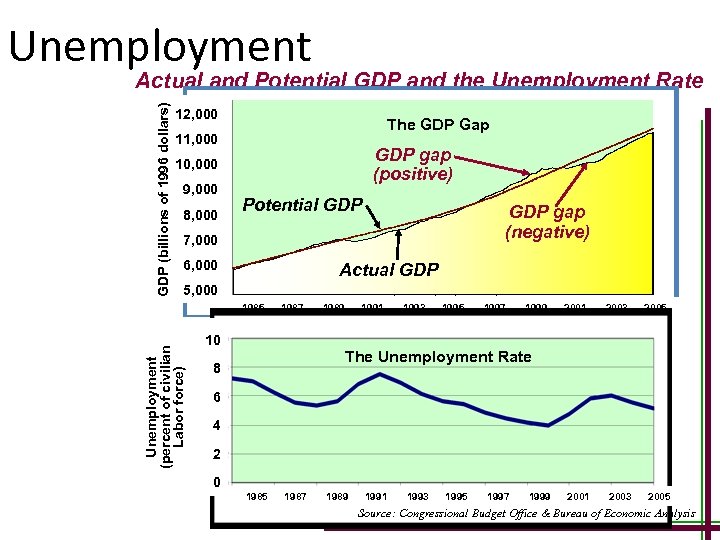 Unemployment GDP (billions of 1996 dollars) Actual and Potential GDP and the Unemployment Rate 12, 000 The GDP Gap 11, 000 GDP gap (positive) 10, 000 9, 000 8, 000 Potential GDP gap (negative) 7, 000 6, 000 Actual GDP 5, 000 Unemployment (percent of civilian Labor force) 1985 1987 10 1989 1991 1993 1995 1997 1999 2001 2003 2005 The Unemployment Rate 8 6 4 2 0 1985 1987 1989 1991 1993 1995 1997 1999 2001 2003 2005 Source: Congressional Budget Office & Bureau of Economic Analysis
 Economic Cost of Unemployment • Unequal Burdens – Occupation – Age – Race and Ethnicity – Gender – Education – Duration • Noneconomic Costs - Depression
 Inflation • Inflation is a rise in the general level of prices • Reduces the purchasing power of money
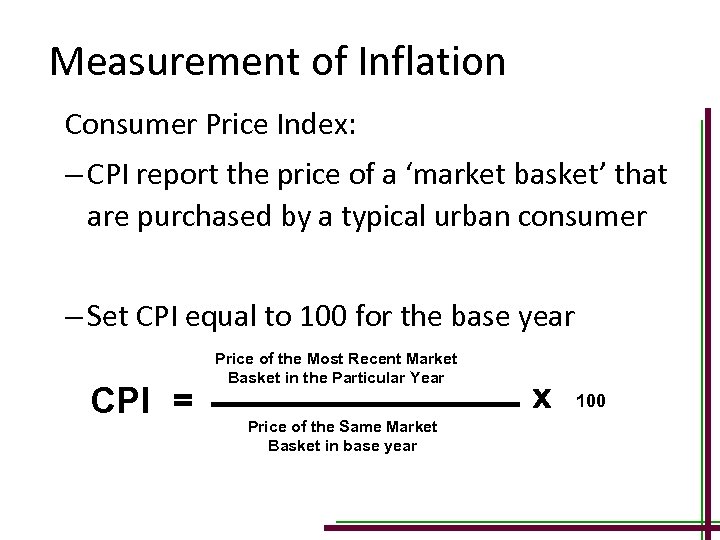 Measurement of Inflation Consumer Price Index: – CPI report the price of a ‘market basket’ that are purchased by a typical urban consumer – Set CPI equal to 100 for the base year CPI = Price of the Most Recent Market Basket in the Particular Year Price of the Same Market Basket in base year x 100
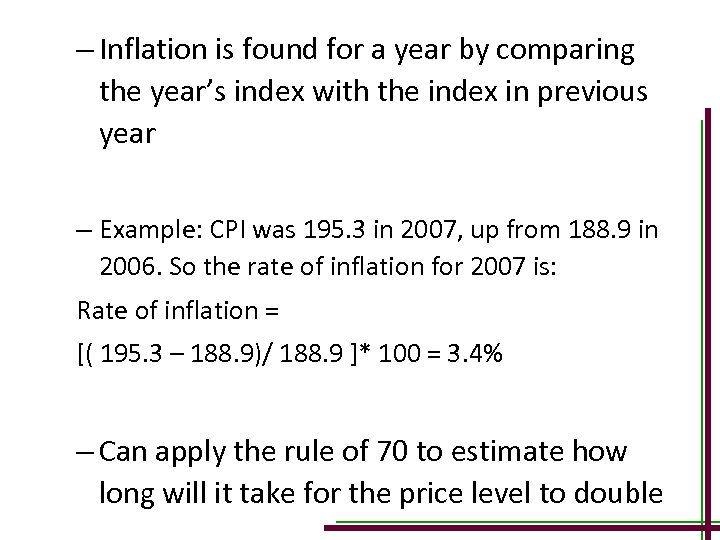 – Inflation is found for a year by comparing the year’s index with the index in previous year – Example: CPI was 195. 3 in 2007, up from 188. 9 in 2006. So the rate of inflation for 2007 is: Rate of inflation = [( 195. 3 – 188. 9)/ 188. 9 ]* 100 = 3. 4% – Can apply the rule of 70 to estimate how long will it take for the price level to double
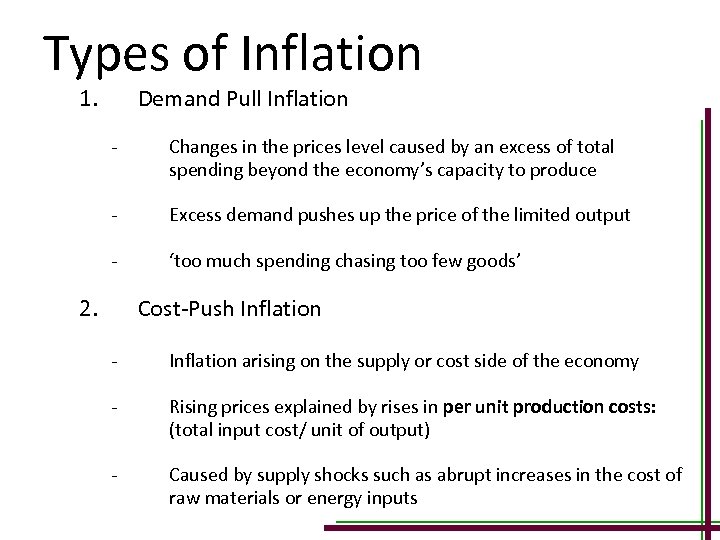 Types of Inflation 1. Demand Pull Inflation - Changes in the prices level caused by an excess of total spending beyond the economy’s capacity to produce - Excess demand pushes up the price of the limited output - ‘too much spending chasing too few goods’ 2. Cost-Push Inflation - Inflation arising on the supply or cost side of the economy - Rising prices explained by rises in per unit production costs: (total input cost/ unit of output) - Caused by supply shocks such as abrupt increases in the cost of raw materials or energy inputs
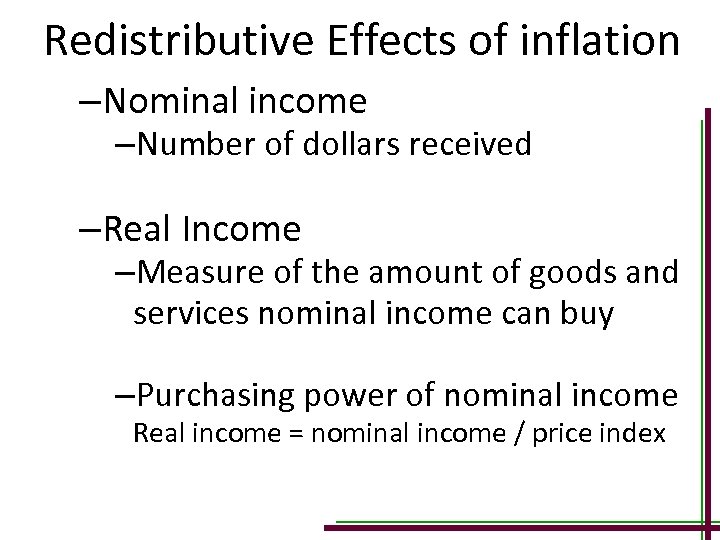 Redistributive Effects of inflation –Nominal income –Number of dollars received –Real Income –Measure of the amount of goods and services nominal income can buy –Purchasing power of nominal income Real income = nominal income / price index
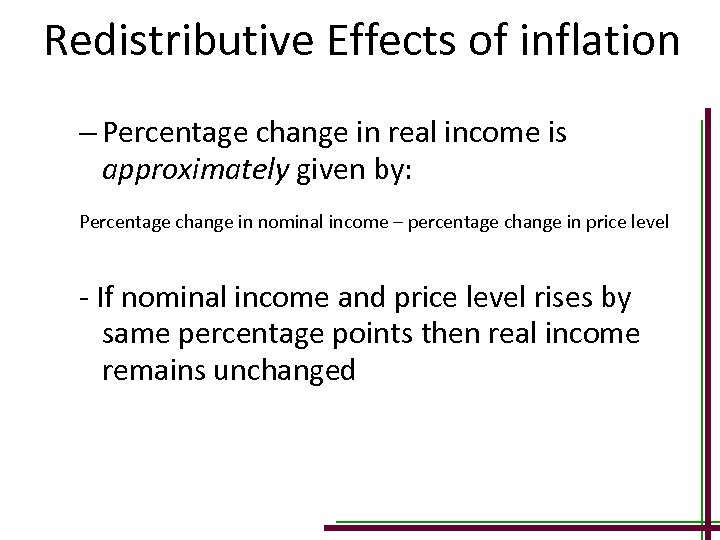 Redistributive Effects of inflation – Percentage change in real income is approximately given by: Percentage change in nominal income – percentage change in price level - If nominal income and price level rises by same percentage points then real income remains unchanged
 Who is Hurt by Inflation? • Fixed-Income Receivers • Savers - Real value of accumulated value decreases • Creditors (lenders)
 Who is unaffected or helped by Inflation? – Flexible-Income Receivers • Indexed to the CPI • Cost-of-Living Adjustments • Businesses whose resource costs rise less than rise in product price – Debtors (borrowers) • When borrowed was worth more, will now return the principal and interest with dollars whose purchasing power has decreased
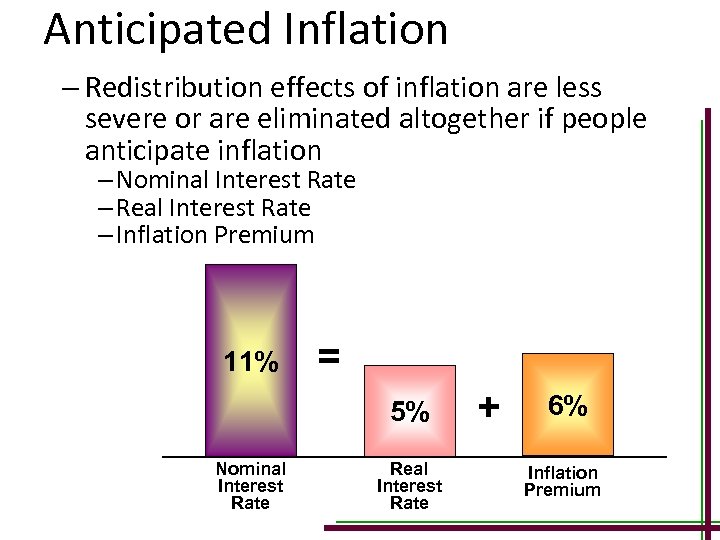 Anticipated Inflation – Redistribution effects of inflation are less severe or are eliminated altogether if people anticipate inflation – Nominal Interest Rate – Real Interest Rate – Inflation Premium 11% = 5% Nominal Interest Rate Real Interest Rate + 6% Inflation Premium
 Does inflation affect output? • Cost-Push Inflation and Real Output - As prices rise, the quantity of goods and services demanded falls so firms respond by producing less • Demand-Pull Inflation and Real Output - Even low levels of inflation diverts time and effort towards activities such as cost of changing prices on shelves
 Hyperinflation • Extraordinarily rapid inflation • As prices shoot up sharply and unevenly during hyperinflation, people begin to anticipate even more rapid inflation