 Скачать презентацию What Is It About The Walls A Report
ab29033011152fb12d947d70a20611e3.ppt
- Количество слайдов: 34



“What Is It About The Walls” A Report of African American Women’s Experiences of Domestic Violence in the Lincoln, Nebraska Area Project Coordinator of Grant Study Venita Kelley, Ph. D Additional Authors Myesha Albert, M. A. S. Lateefah Coleman Debbie Gaspard, M. B. A. Cindy Grandberry Tekla Ali Johnson, ABD Wendy Smooth, Ph. D Renita. Tyrance, M. Ed. Franchell Watson, B. A.
Report Commissioned By: Ø The Family Violence Council/Lincoln Medical Education Foundation Ø African American Women and Domestic Violence Services Steering Committee Ø Friendship Home Ø Rape Spouse Abuse Crisis Center
Report Funded By: Ø Woods Charitable Fund Ø Community Health Endowment Ø Friends of the Lincoln Lancaster Women’s Commission Ø The Lozier Foundation Ø Nebraska Department of Correctional Services
Why This Study: “Called Matriarch, Emasculator and hot Momma. Sometimes Sister, Pretty Baby, Auntie, Mammy and Girl. Called Unwed Mother, Welfare Recipient and Inner City Consumer. The Black American Woman has had to admit that while nobody knew the trouble she saw, everybody, his brother and his dog, felt qualified to explain her, even to herself. ” --Trudier Harris, 1982
Methods Recruitment of Facilitators Ø 8 facilitators Ø Facilitators received RSACC training and focus group/personal interview training Recruitment of Participants Ø 20 targeted with 46 participants Ø Age range from 12 to 64 years of age Ø 26 women from NCCW and LCC
Methods Focus Groups and Interviews Ø 90 minute target focus groups. Ø Group sizes from 3 -7 ØThe facilitators accommodated personal interviews as well.
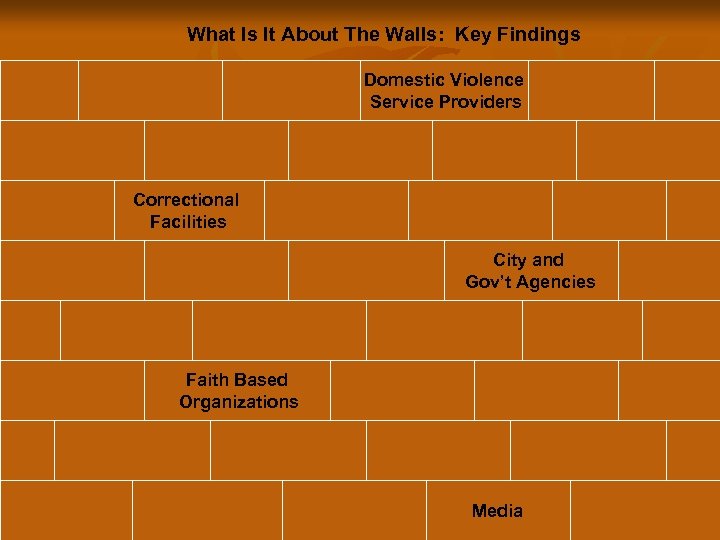
What Is It About The Walls: Key Findings Domestic Violence Service Providers Correctional Facilities City and Gov’t Agencies Faith Based Organizations Media
Key Findings: Domestic Violence Service Providers Outreach Ø Not targeted to African American women. Ø Information about shelters is difficult to access Ø Thirty days is not enough time to get reestablished
Domestic Service Providers-cont’d In Shelter Treatment ØProviders needed to be sensitive to cultural nuances Ø Overt censure and suspicion was felt. ØThere were some positive interactions with service providers.
Key Findings: City and Gov’t Agencies Social Services Law Enforcement State Policy and Laws Legal System Educational Facilities Medical
Key Findings: Social Services Ø High level of distrust related to social and human services workers Ø Fear of losing their children “Once your children are gone into that system, it’s like hell to get them back. They look at you as the unstable one, even though you were not the Perpetrator. ”—Focus Group Participant
Key Findings: State Policy and Laws Ø Participants referenced a Nebraska law (LB 184) that places children who have witnessed domestic violence in foster care Ø These laws were a major hindrance to reporting domestic violence in the African American community, and may serve to further empower abusers
Key Findings: Educational Facilities Ø Not giving warnings to girls Ø School officials insensitive to children’s feelings Ø Shame and humiliation a part of lives
Key Findings: Law Enforcement ØAfrican American women are more likely to have to rely on local police in a domestic violence crisis Ø Most participants who had experienced domestic violence found officers to be of little help Ø A few women reported officers had been helpful: “He was my rock!”—Focus Group Participant
Key Findings: Correctional Facilities Ø Imprisonment is part of the domestic violence cycle Ø Programs for support had not been in place for at least two years at NCCW and do not exist at LCC Ø No African American counseling (or staff) personnel or other women of color in place in the correctional facilities Ø Power and control dynamics were evident
Key Findings: Faith Based Organizations Ø Ambivalence and outright discouragement about the Black Church and Muslim Mosque response to their situations of domestic violence Ø Yet, participants did find aid in the faith community ******* Ø Participants discovered an incomplete application of the scriptures
Key Findings: Media Ø Women stated that O. J. Simpson opened the world to the problem Ø African American women are strong, unfeminine, ugly, not worthy of respect, loud, masculine, as domestics, and literal and emotional servants “Black women’s assertiveness and their use of every expression of racism to launch multiple assaults against the entire fabric of inequality have been a consistent, multifaceted threat to the status quo. As punishment, Black women have been assaulted with a variety of negative images. ” —Cheryl Gilkes, 1982
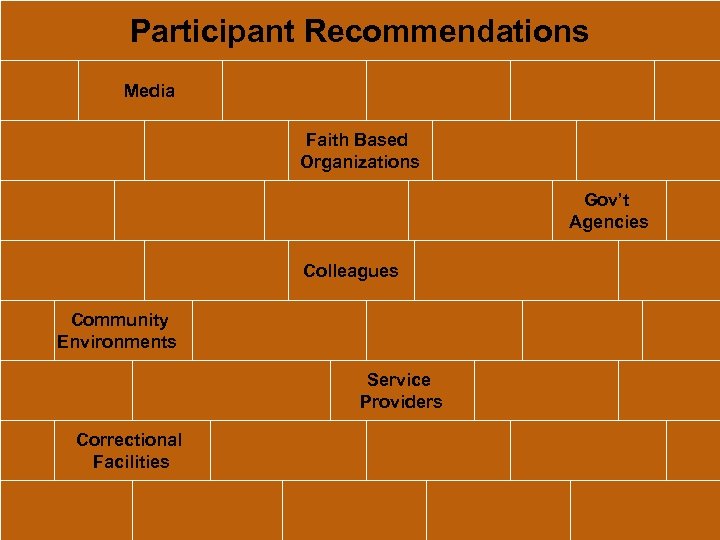
Participant Recommendations Media Faith Based Organizations Gov’t Agencies Colleagues Community Environments Service Providers Correctional Facilities
Participant’s Recommendations: Media Ø Eliminate stereotypical images Ø Teach our daughters Ø Include African American women in the mainstream social images of domestic violence work
Participant’s Recommendations: Faith Based Organizations ØUse sermons to address domestic violence ØMake churches and mosques safe places for women ØEngage leaders in training and education related to domestic violence
Participant’s Recommendations: City and Governmental Agencies Law enforcement ØOffer monetary rewards for information on abusers ØOfficers must be aware of statistics associated with African American women exiting abusive relationships Education ØMust respect the children’s right to privacy ØEstablish a domestic violence curriculum
Participant’s Recommendations: City and Governmental Agencies--continued Medical ØWomen suggest both medication and counseling “…come to think of it, I DID begin abusing prescription Medicine first…(they gave me) what I describe as ‘the Black people’s domestic violence counseling. ” --Focus Group Participant Legal System ØWomen suggested the establishment of a defense law ØRefine dual arrest laws ØRepeal law that puts children witnessing DV in foster care
Participant's Recommendations: Colleagues As Colleagues Ø Facilitate professional networking Ø Train and educate providers about female relationship dynamics Ø Incorporate suggestions and practices that differ from existing shelter structures
Participant's Recommendations: Community Environments ØPost business sized cards at the grocery store ØPost information in hair salons ØInvolve religious communities ØRecruit ministers
Participant’s Recommendations: Service Providers Ø A shelter run by Women of Color would enhance the services Ø Essence and Jet Magazines Ø Implement a “Detox” Program Ø Establish culturally specific support groups Ø Conduct a media program
Participant's Recommendations: Correctional Facilities Ø Establish and maintain grief, family, and domestic violence support groups Ø Establish a half-way house staffed by Women of Color to assist transition back into public society Ø Include former correctional residents on a advisory board
Research Team's Objectives and Recommendations Ø Remove the “ For White Women Only” stigma Ø Reach out to significant institutions in the Black community Ø Build relationships with African American Organizations Ø Seek the help of the Black Church/religious institutions to combat domestic violence Ø Implement holistic programs
Research Team's Objectives and Recommendations Ø An examination of cultural and societal maintenance assumptions will reveal that African American women’s (and all women’s) roles and lives are defined within a context of self-sacrifice and altruism for others’ sake
Conclusions ØDV services in Lincoln, NE were viewed as for "white women" only ØMulti-angle/level phenomena ØReligious institutions erroneously communicated that violence is sanctioned by the Bible and Koran ØCommunity involvement is imperative
Conclusions cont. Ø “Strong Black Woman” stereotype Ø Commitment to the family “Human ties can be freeing and empowering, as is the case with Black women’s heterosexual love relationships or in the power of motherhood in African-American families and communities. Human ties can also be confining and oppressive. Situations of domestic violence and abuse or cases in which controlling images foster Black women’s internalized oppression represent domination on the personal level. The same situation can look quite different depending on the consciousness one brings to interpret it. ” --Patricia Hills Collins, 1990 Ø Abandon “one size fits all” approach Ø Holistic approach imperative
Challenges in the Process: Ø Name of the Report Ø The Author’s Perspectives Ø Transitory Nature of Committee Ø Name of the Committee Ø Cultural Nuances
Outcomes from Report: Ø Program Coordinator Position (FVC) Ø Good Neighbor Award Ø Advocate Positions at RSACC and Friendship Home Ø Creation of the Nebraska African American Domestic Violence Advisory Committee(NAADVAC) Ø Community Forum-Malone Community Center Ø Additional Grant Funds Ø African American Women and Domestic Violence Conference
Outcomes from Report-cont’d: Ø Special Session: Nebraska Violence Symposium Ø Collaborations: - UNL-VAWOC - Lincoln Area NAACP - Safe Quarters - National Counsel of Negro Women Ø Local and National exposure -CALCASA Presentation -Lincoln Juneteenth Celebration
Walls? “Domination operates by seducing, pressuring, or forcing African-American women and members of subordinated groups to replace individual and cultural ways of knowing with the dominant group’s specialized thought. ” –Patricia Hill Collins, 1990 www. rtyrance@peoplescitymission. org
Скачать презентацию What Is It About The Walls A Report
ab29033011152fb12d947d70a20611e3.ppt