


 Скачать презентацию What is Human Nature A question for every
e17e6d4794f868ffc1837b599a6770bd.ppt
- Количество слайдов: 32
 What is Human Nature? A question for every academic discipline Linguistic answer: a mental object How do Mind and Brain differ? They are the same: the brain can only be explained by the mind. Purpose: the brain is designed to carry out the intentions of the mind. Intentions: defined in mental and mathematical terms
 What Mathematical Principles: Recursion = an Operation that contains itself Recursion => different in Vision and Language Russian Dolls Analogy: stereoscopy in vision and hearing => Separately represented in neurology
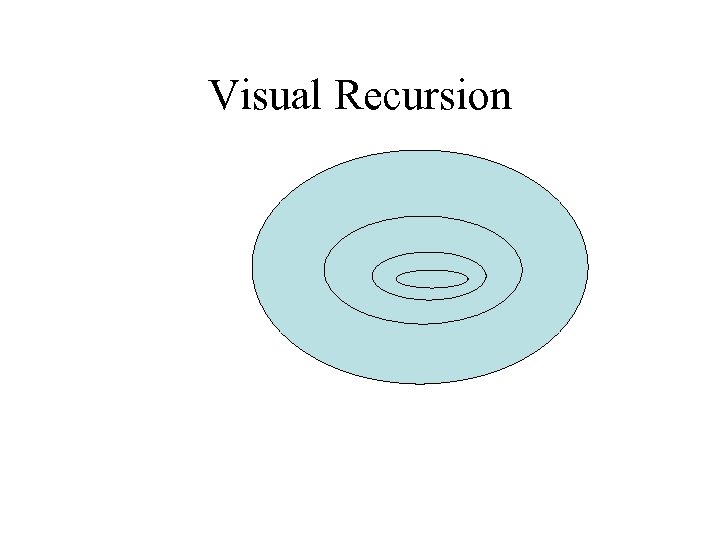 Visual Recursion
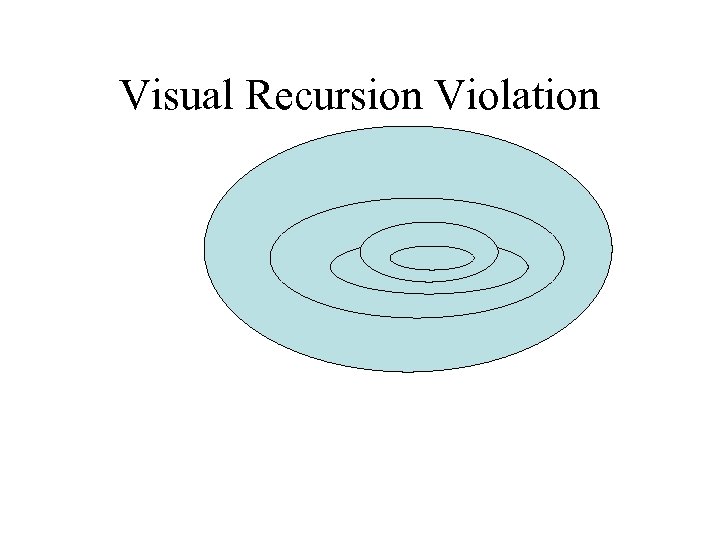 Visual Recursion Violation
 Hauser, Chomsky, and Fitch (2002): Recursion is what distinguishes human language from the communication systems of nonhuman animals. "FLN [narrow faculty of language] only includes recursion and is the only uniquely human component of the faculty of language, … [it] appears to lack any analog in animal communication … allowing us to communicate an endless variety of thoughts. . "
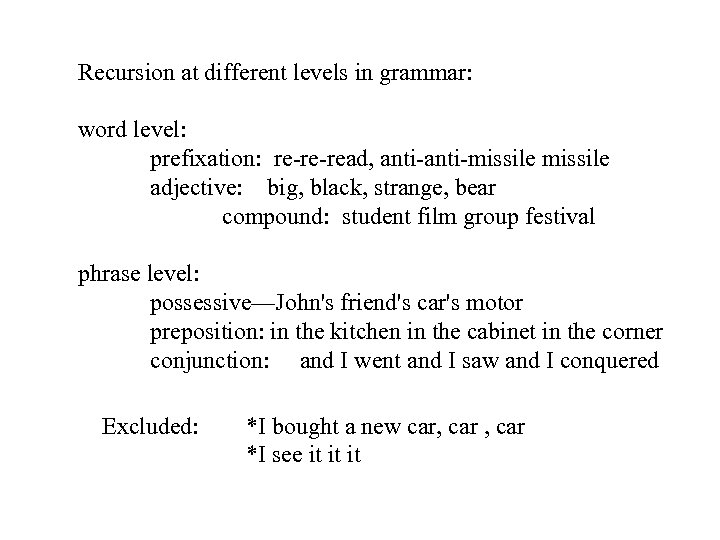 Recursion at different levels in grammar: word level: prefixation: re-re-read, anti-missile adjective: big, black, strange, bear compound: student film group festival phrase level: possessive—John's friend's car's motor preposition: in the kitchen in the cabinet in the corner conjunction: and I went and I saw and I conquered Excluded: *I bought a new car, car *I see it it it
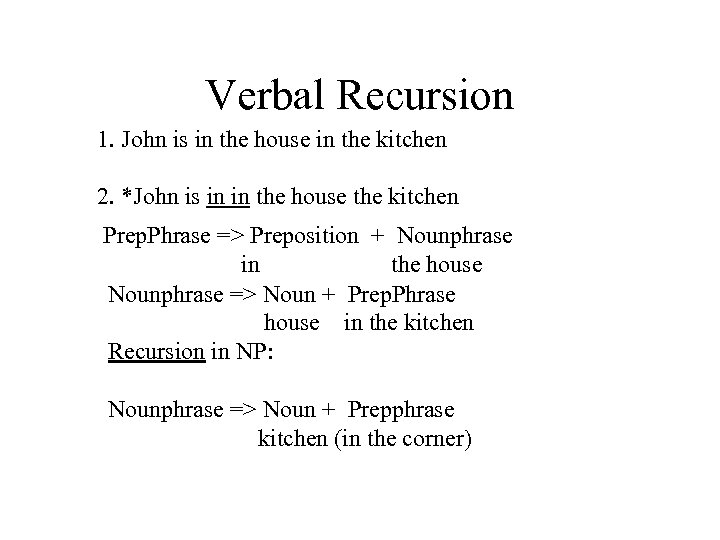 Verbal Recursion 1. John is in the house in the kitchen 2. *John is in in the house the kitchen Prep. Phrase => Preposition + Nounphrase in the house Nounphrase => Noun + Prep. Phrase house in the kitchen Recursion in NP: Nounphrase => Noun + Prepphrase kitchen (in the corner)
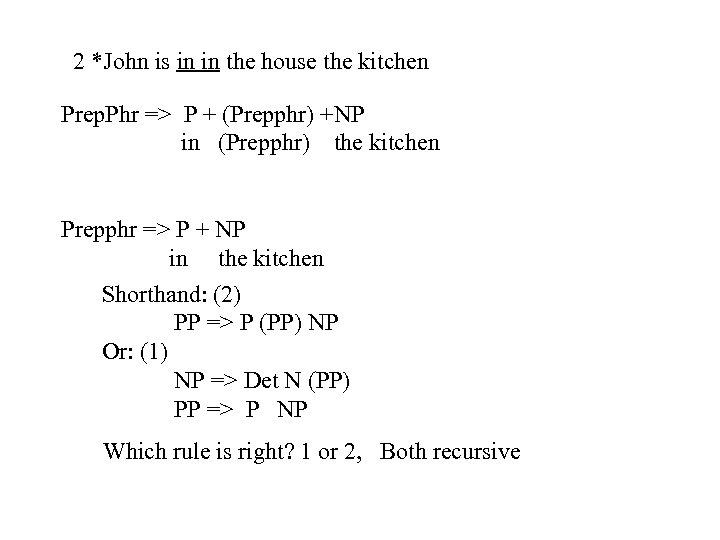 2 *John is in in the house the kitchen Prep. Phr => P + (Prepphr) +NP in (Prepphr) the kitchen Prepphr => P + NP in the kitchen Shorthand: (2) PP => P (PP) NP Or: (1) NP => Det N (PP) PP => P NP Which rule is right? 1 or 2, Both recursive
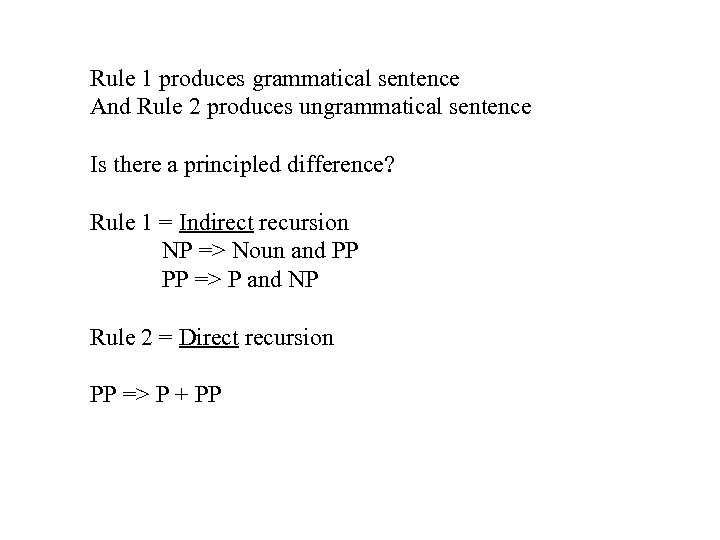 Rule 1 produces grammatical sentence And Rule 2 produces ungrammatical sentence Is there a principled difference? Rule 1 = Indirect recursion NP => Noun and PP PP => P and NP Rule 2 = Direct recursion PP => P + PP
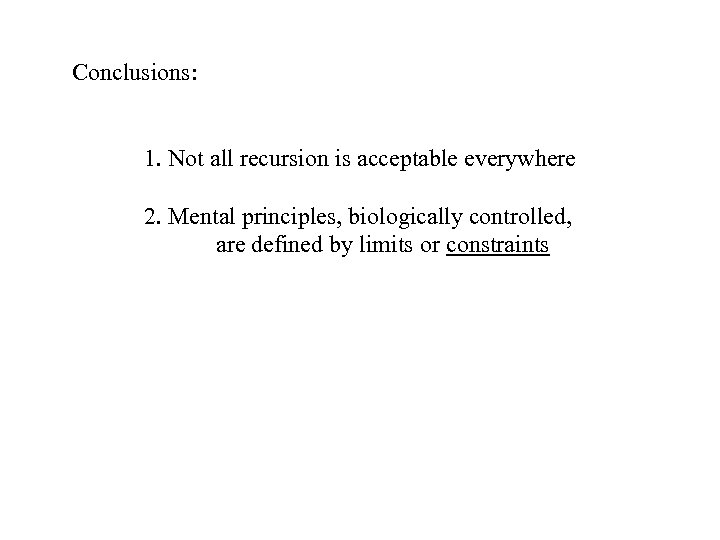 Conclusions: 1. Not all recursion is acceptable everywhere 2. Mental principles, biologically controlled, are defined by limits or constraints
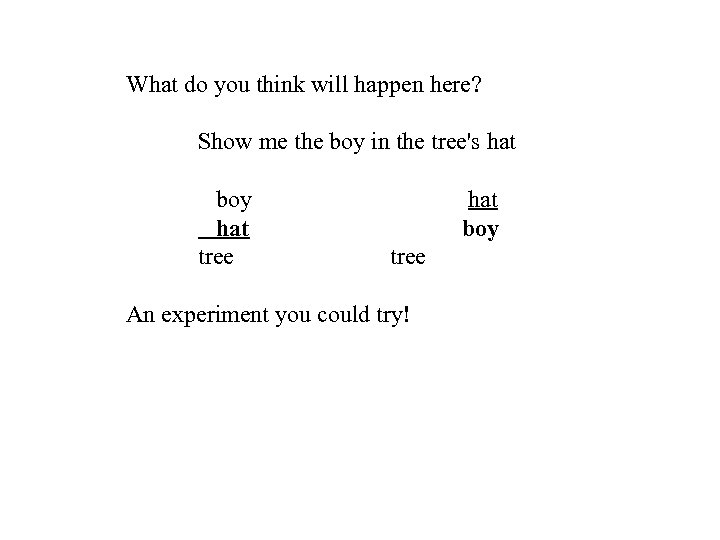
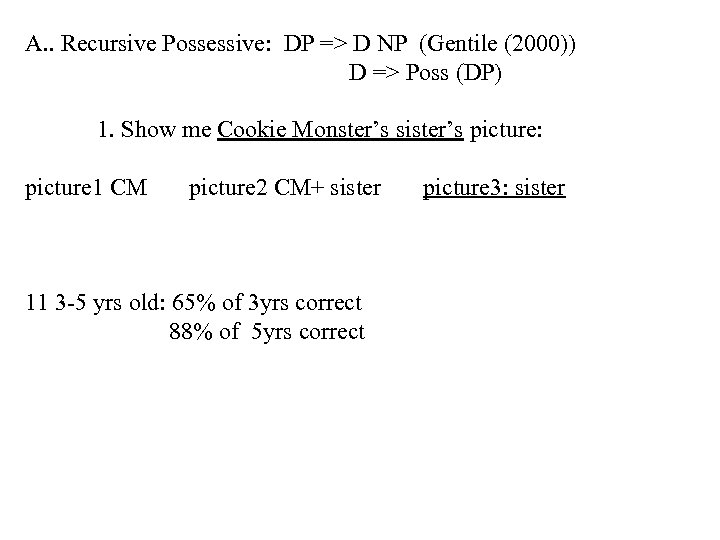 A. . Recursive Possessive: DP => D NP (Gentile (2000)) D => Poss (DP) 1. Show me Cookie Monster’s sister’s picture: picture 1 CM picture 2 CM+ sister 11 3 -5 yrs old: 65% of 3 yrs correct 88% of 5 yrs correct picture 3: sister
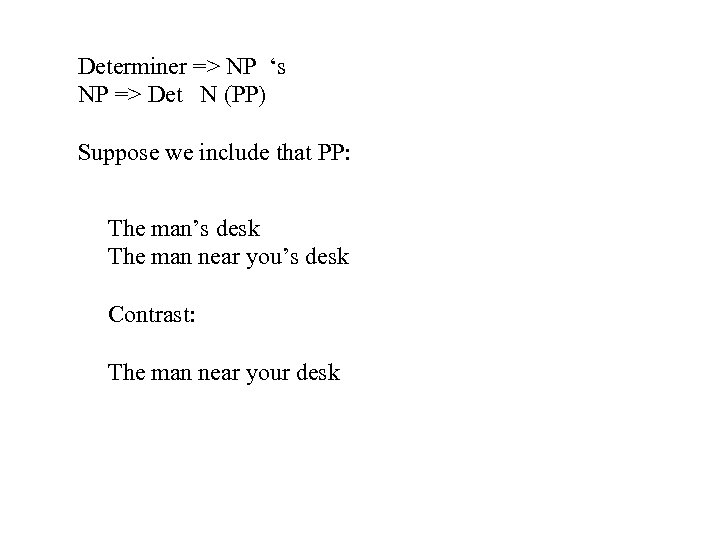
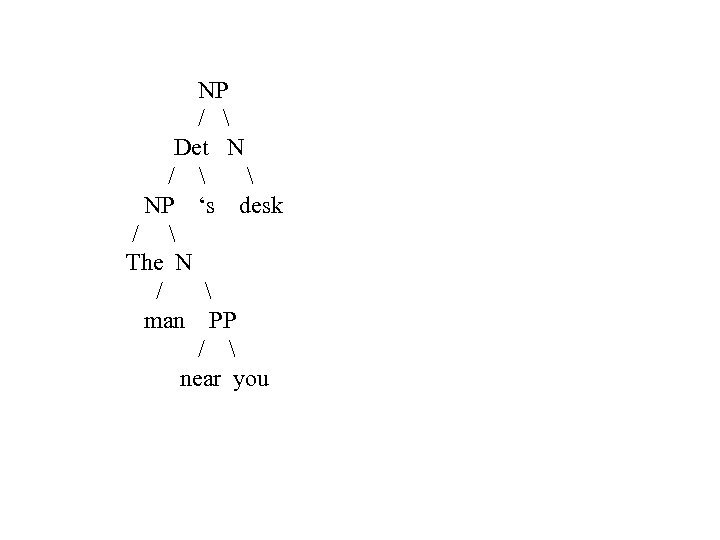
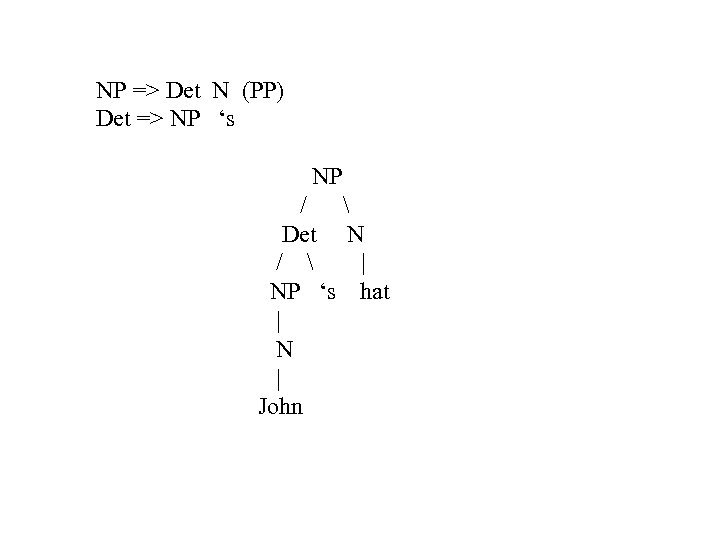 NP => Det N (PP) Det => NP ‘s NP / Det N / | NP ‘s hat | N | John
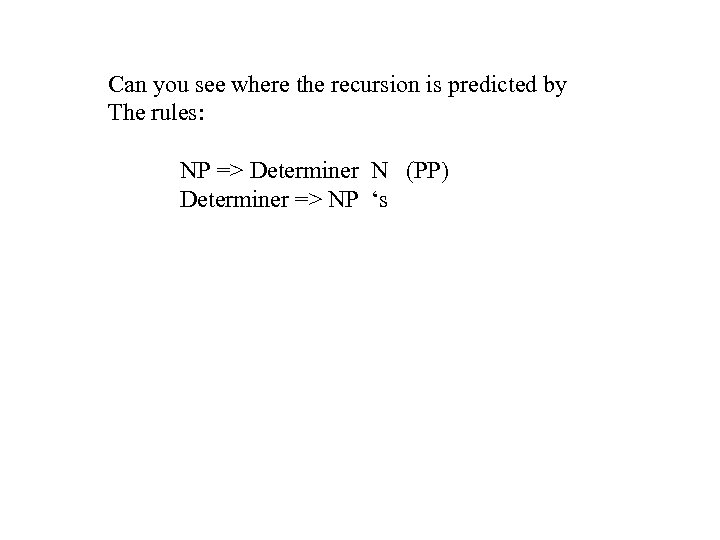 Can you see where the recursion is predicted by The rules: NP => Determiner N (PP) Determiner => NP ‘s
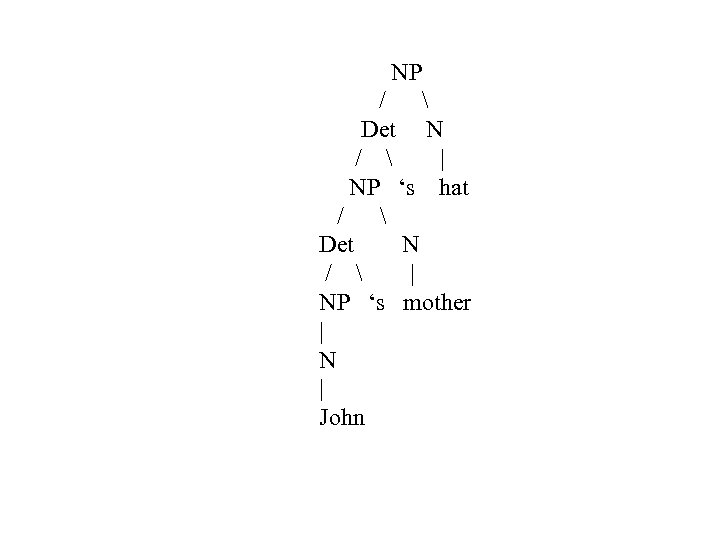 NP / Det N / | NP ‘s hat / Det N / | NP ‘s mother | N | John
 NP
NP
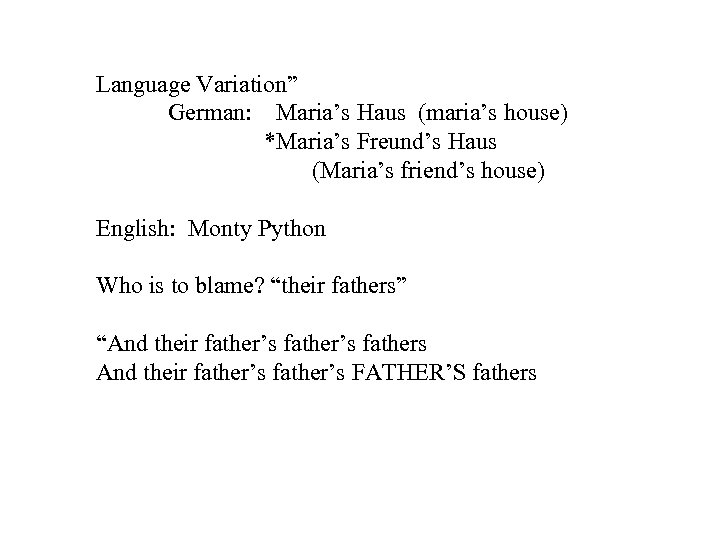 Language Variation” German: Maria’s Haus (maria’s house) *Maria’s Freund’s Haus (Maria’s friend’s house) English: Monty Python Who is to blame? “their fathers” “And their father’s fathers And their father’s FATHER’S fathers
 Challenge to the child who does not know if he is Learning English or German: Recognize where recursion occurs!
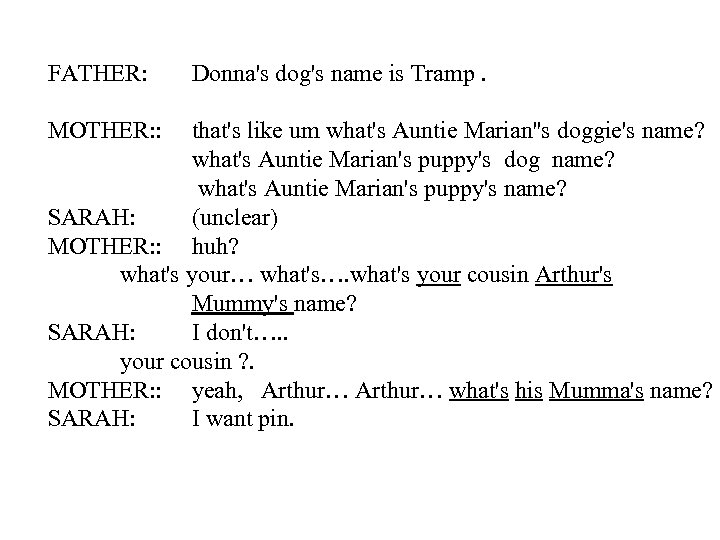 FATHER: MOTHER: : Donna's dog's name is Tramp. that's like um what's Auntie Marian''s doggie's name? what's Auntie Marian's puppy's dog name? what's Auntie Marian's puppy's name? SARAH: (unclear) MOTHER: : huh? what's your… what's…. what's your cousin Arthur's Mummy's name? SARAH: I don't…. . your cousin ? . MOTHER: : yeah, Arthur… what's his Mumma's name? SARAH: I want pin.
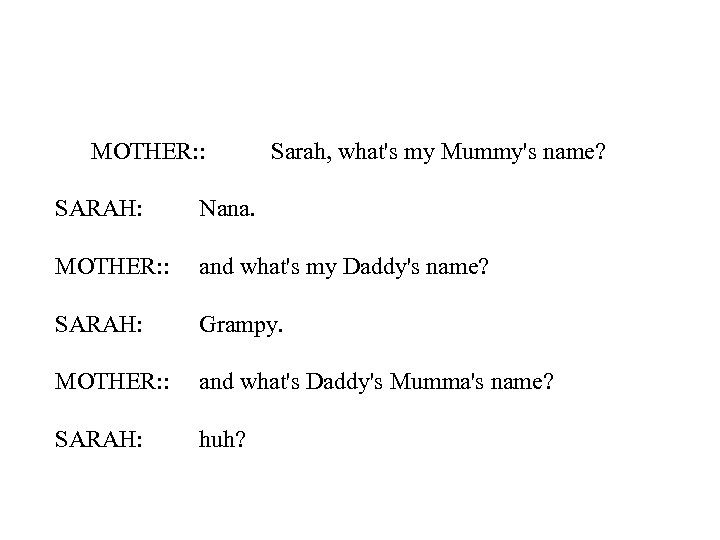 MOTHER: : Sarah, what's my Mummy's name? SARAH: Nana. MOTHER: : and what's my Daddy's name? SARAH: Grampy. MOTHER: : and what's Daddy's Mumma's name? SARAH: huh?

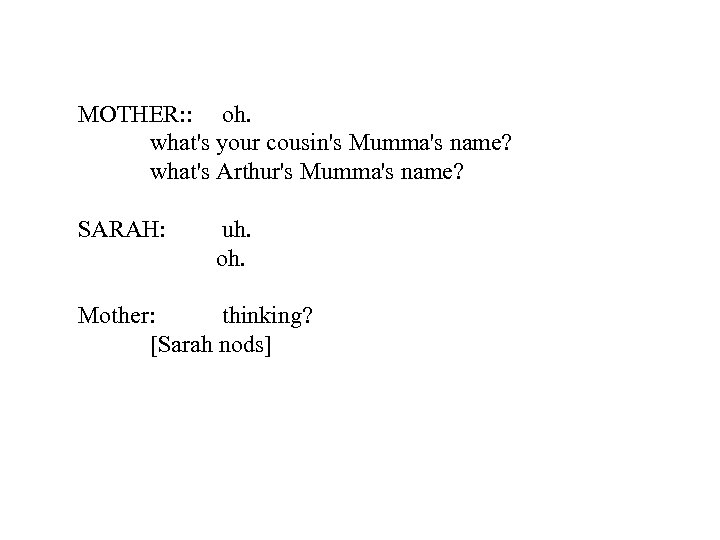 MOTHER: : oh. what's your cousin's Mumma's name? what's Arthur's Mumma's name? SARAH: uh. oh. Mother: thinking? [Sarah nods]
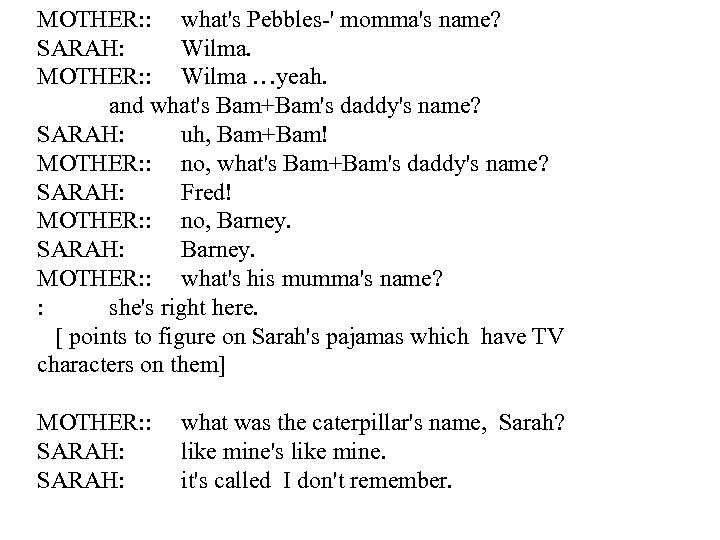 MOTHER: : what's Pebbles-' momma's name? SARAH: Wilma. MOTHER: : Wilma …yeah. and what's Bam+Bam's daddy's name? SARAH: uh, Bam+Bam! MOTHER: : no, what's Bam+Bam's daddy's name? SARAH: Fred! MOTHER: : no, Barney. SARAH: Barney. MOTHER: : what's his mumma's name? : she's right here. [ points to figure on Sarah's pajamas which have TV characters on them] MOTHER: : SARAH: what was the caterpillar's name, Sarah? like mine's like mine. it's called I don't remember.
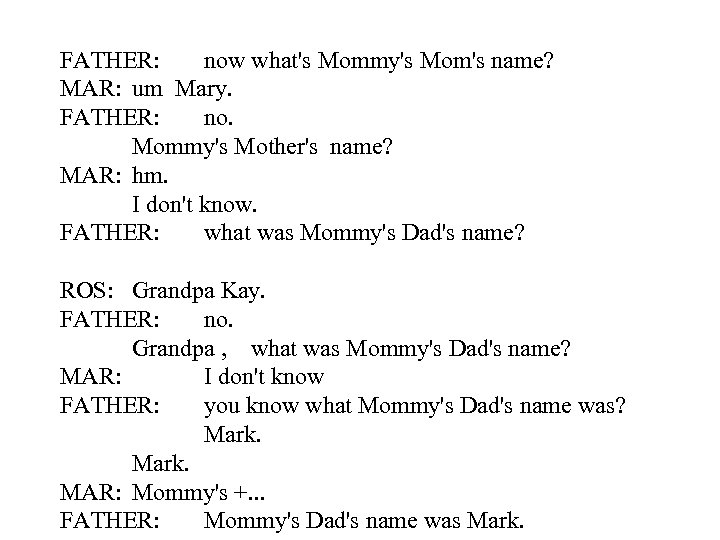 FATHER: now what's Mommy's Mom's name? MAR: um Mary. FATHER: no. Mommy's Mother's name? MAR: hm. I don't know. FATHER: what was Mommy's Dad's name? ROS: Grandpa Kay. FATHER: no. Grandpa , what was Mommy's Dad's name? MAR: I don't know FATHER: you know what Mommy's Dad's name was? Mark. MAR: Mommy's +. . . FATHER: Mommy's Dad's name was Mark.

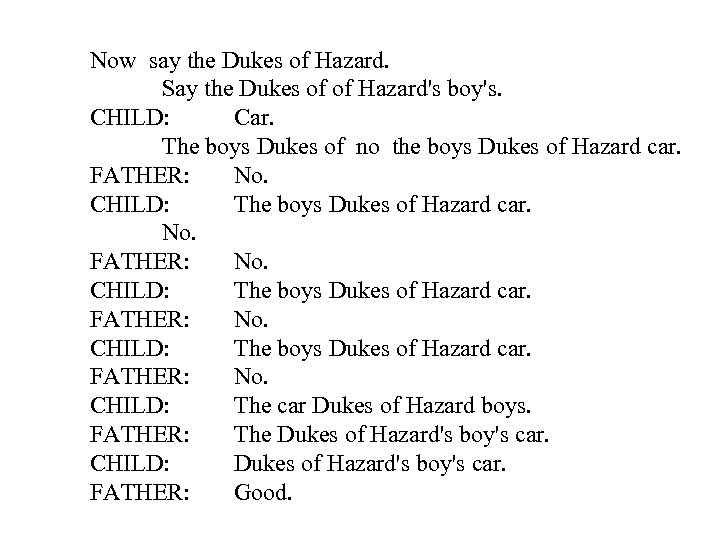 Now say the Dukes of Hazard. Say the Dukes of of Hazard's boy's. CHILD: Car. The boys Dukes of no the boys Dukes of Hazard car. FATHER: No. CHILD: The boys Dukes of Hazard car. No. FATHER: No. CHILD: The boys Dukes of Hazard car. FATHER: No. CHILD: The car Dukes of Hazard boys. FATHER: The Dukes of Hazard's boy's car. CHILD: Dukes of Hazard's boy's car. FATHER: Good.
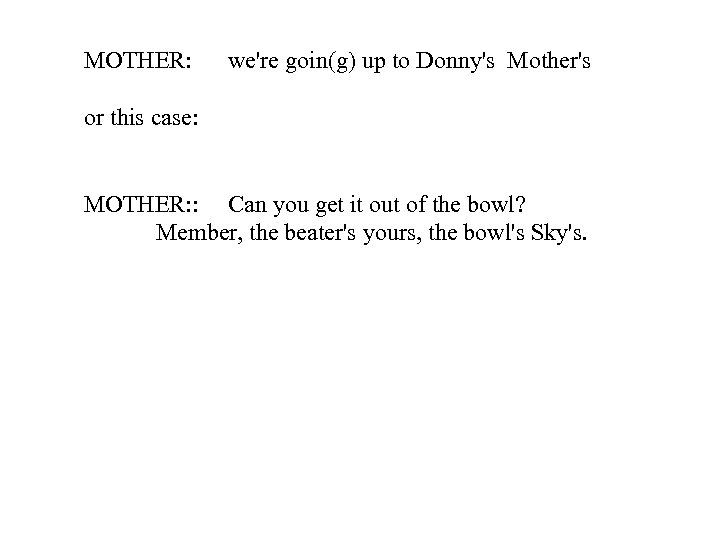 MOTHER: we're goin(g) up to Donny's Mother's or this case: MOTHER: : Can you get it out of the bowl? Member, the beater's yours, the bowl's Sky's.
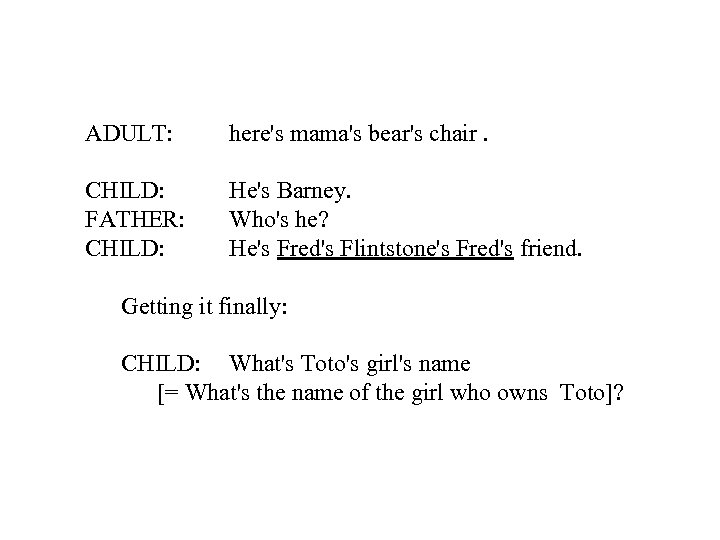 ADULT: here's mama's bear's chair. CHILD: FATHER: CHILD: He's Barney. Who's he? He's Fred's Flintstone's Fred's friend. Getting it finally: CHILD: What's Toto's girl's name [= What's the name of the girl who owns Toto]?
 Determiner => NP ‘s NP => Det N (PP) Suppose we include that PP: The man’s desk The man near you’s desk Contrast: The man near your desk
 NP / Det N / NP ‘s desk / The N / man PP / near you
 What do you think will happen here? Show me the boy in the tree's hat boy hat tree hat boy tree An experiment you could try!
 Proposal: Phrasal Possessives Trigger Recursion Consequences: Phrasal Possessives are Rare Grammar is acquired from crucial Examples not frequency
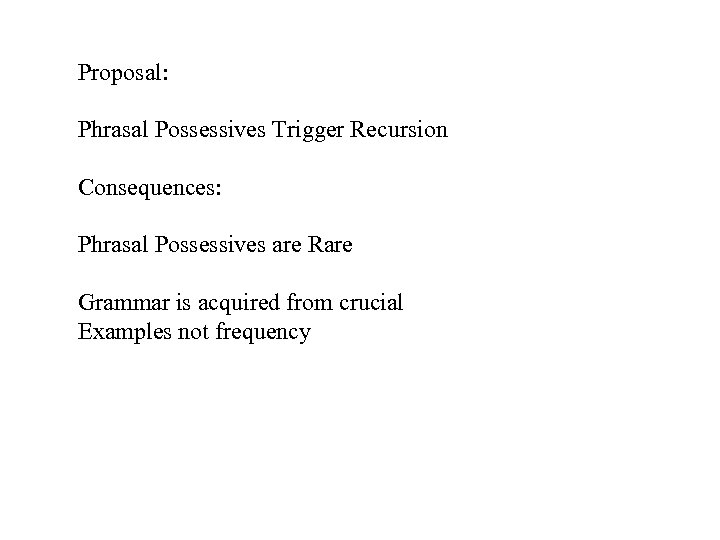
 Conclusions: recursion is an innate mental Propery 2. It is represented differently in various Parts of mind 3. The child must learn where it applies In grammar in general and in his own Language 4. The trigger for recursion may be Rare and unusual